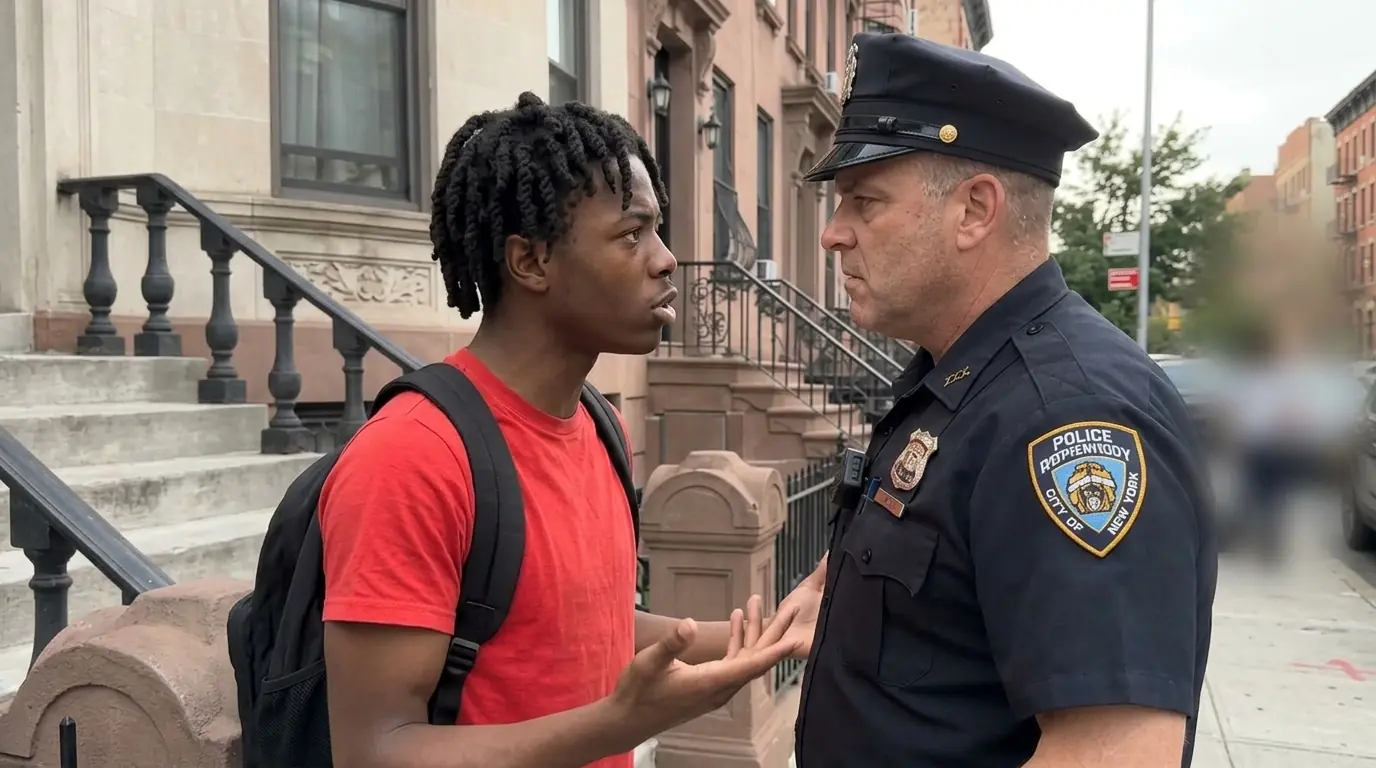
“Sir, I live here.”
Sixteen-year-old Jordan Ellis tried to keep his voice steady while Officer Victor Hale gripped the front of his red T-shirt and pressed him harder against the iron railing of the Brooklyn brownstone behind him. Jordan’s black backpack was wedged painfully between his shoulder blades and the stone wall, while the short twists at the top of his head shook every time Hale pushed him forward. “Stop lying to me,” the officer snapped. “Kids like you come through neighborhoods like this every day looking for something to steal.”
Jordan looked past Hale toward the front door of 226 Carlton Terrace, the house where he had lived since second grade. His basketball shoes were drying beside the basement steps, his mother’s yellow flowers filled the upstairs window box, and the mailbox still carried the faded Yankees decal he had stuck there when he was eleven. His bicycle was chained to the same iron fence Hale was using to pin him in place. None of those details seemed to interest the officer.
“I told you this is my house,” Jordan said. “My keys are in my pocket, and my mother works for your department.” Hale laughed without loosening his grip. “Perfect, then maybe she can explain why I found her son casing brownstones.”
A grocery delivery driver had stopped across the street with two paper bags still sitting on the hood of his van. A woman walking a small white terrier stood near the corner watching with growing alarm, while another pedestrian slowed and pulled out a phone. Jordan could feel the officer’s knuckles pushing into his chest through the thin cotton shirt. Fear had been there from the first shouted command, but anger was beginning to rise beneath it.
The afternoon had started with nothing more serious than a forgotten algebra folder. Jordan had returned from summer tutoring shortly before four, dropped his backpack on the kitchen chair, and realized the folder containing his homework was still in his locker at Franklin Academy. He walked three blocks back toward the school before remembering the summer office closed early on Fridays. On the way home, he stopped at a deli for a bottle of blue sports drink and put one earbud in while heading back toward Carlton Terrace.
Three houses away, seventy-year-old Margaret Collins had been watering flowers on her front steps. She had recently joined a neighborhood safety group after several packages disappeared from porches and believed vigilance meant noticing everyone who looked unfamiliar. She watched Jordan pause beside one brownstone, glance toward another, and adjust his backpack while checking a message on his phone. She did not recognize him, even though she had seen him on the block dozens of times.
Margaret called the police non-emergency line. She reported “a teenage boy looking at houses” and said he seemed to be checking whether residents were home. When the dispatcher asked whether he had entered a yard, touched a door, taken property, or damaged anything, Margaret admitted he had not. Her description was only a Black teenage male, red shirt, dark backpack.
Officer Victor Hale was less than five minutes away. He had served nineteen years with the department, spent most of that time in patrol, and possessed the kind of reputation officers described differently depending on how much they trusted you. Some called him decisive and old-school, while others privately said he treated suspicion like proof and questions like challenges. He was already turning onto Carlton Terrace before dispatch finished repeating the caller’s limited description.
Hale saw Jordan walking toward 226 and accelerated toward the curb. He stopped the patrol car hard enough that the front wheel brushed the gutter, opened the door, and shouted before Jordan even understood the officer was speaking to him. “Hey, red shirt, stop right there.” Jordan removed his earbud and looked over his shoulder.
“Me?” Jordan asked. Hale slammed the cruiser door. “Hands where I can see them.”
Jordan raised both hands chest-high. “What happened?” Hale approached quickly, looking first at Jordan’s backpack and then at the brownstone steps behind him. “Where are you coming from?”
“The deli.” Hale pointed down the block. “Which one?”
“Martin’s Market on Bergen.” Hale looked toward the front door. “And where are you going?”
Jordan pointed. “Home.” Hale frowned.
“That house?” Jordan nodded. “Yeah.”
“You live there?” Jordan gave him a confused look. “Since I was seven.”
Hale studied the renovated brownstone, the polished front door, the carefully maintained flower boxes, and then looked back at Jordan. Something shifted in his face. “Don’t lie to me.”
Jordan’s eyebrows lifted. “I’m not lying.” Hale moved closer.
“We have a burglary complaint.” Jordan looked down the block. “I didn’t burglarize anything.”
He reached slowly toward his phone. “I can call my mom.” Hale slapped the phone from his hand before Jordan could unlock it.
The device bounced off the pavement and landed beside the bottom step. “Did I tell you to reach into your pocket?” Hale shouted. Jordan froze.
“I told you what I was doing.” Hale grabbed one strap of the backpack. “Turn around.”
“Why?” Jordan asked. Hale’s expression hardened. “Because I said so.”
Jordan took a single step backward toward his own doorway. It was not an attempt to flee; it was the instinctive movement of a teenager trying to create space between himself and an angry adult. Hale interpreted it as resistance. Within seconds, he had grabbed Jordan’s shirt and pressed him against the railing.
“I live here,” Jordan repeated. “My house key is in my right pocket.” Hale ignored him.
“Look at the mailbox,” Jordan said. Hale tightened his grip.
“My last name is on mail inside.” No response.
“Press the doorbell.” Hale did not.
The body camera clipped to Hale’s chest recorded every offer. It recorded Jordan repeatedly describing ways the officer could verify his claim without ever releasing control of the scene. It also recorded Hale rejecting every method before demanding identification. That sequence would later become one of the most important parts of the investigation.
“I’m sixteen,” Jordan said. “I don’t carry a driver’s license.” Hale asked for a school identification card.
“In my backpack.” Hale pulled the bag from Jordan’s shoulders and unzipped it.
Instead of searching carefully, he turned it upside down. A geometry textbook, calculator, pencils, notebook, charger, granola wrapper, water bottle, and Franklin Academy student card scattered across the sidewalk. One pencil rolled beneath the patrol cruiser.
Jordan stared at his things. “You didn’t have to dump everything.” Hale picked up the student card.
The photograph matched Jordan. His full name appeared below it: Jordan Michael Ellis.
“Doesn’t prove you live here,” Hale said. Jordan looked toward him in disbelief.
“My key does.” Hale shrugged. “Keys get stolen.”
“Then ring the bell.” Hale ignored the suggestion again.
The doorbell camera at 226 Carlton Terrace was connected directly to Jordan’s mother’s phone. If Hale had pressed it, Captain-level command would not have been necessary and no confrontation would have followed. Jordan’s mother, Lieutenant Alicia Ellis, was sitting in an office less than three miles away reviewing field-training evaluations when the notification would have appeared. One press could have ended everything.
A second cruiser arrived before that happened. Officer Daniel Ortiz, thirty years old and six years into his career, parked behind Hale and approached the sidewalk cautiously. His eyes moved from Jordan pinned against the railing to the school supplies scattered across the pavement. Then he looked at Hale.
“What do we have?” Ortiz asked. Hale said, “Possible burglary suspect, keeps lying about living here.” Jordan immediately said, “I’m not lying.”
Hale pushed him harder. “Be quiet.” Ortiz glanced toward the building number.
“Did we confirm the residence?” Hale looked annoyed. “I’m handling the stop.”
Ortiz crouched and picked up the student ID. “Jordan Ellis?” Jordan nodded.
Something in the surname caught him. “Ellis?” Jordan looked toward him.
“My mom is Lieutenant Alicia Ellis.” Ortiz’s expression changed.
Hale noticed. “What?” Ortiz stood slowly.
“You mean Lieutenant Ellis from the Seventy-Ninth?” Jordan nodded. “Professional standards and field training.”
Hale laughed. “Sure she is.” Ortiz did not.
Alicia Ellis was not famous outside police circles, but inside several Brooklyn precincts her reputation was well known. She had spent twenty-three years with the department, including twelve years in patrol, before moving into supervision and eventually professional standards. Officers respected her because she defended them fiercely when the evidence supported their actions and was equally willing to discipline them when it did not.
Ortiz looked at Hale. “Vic, we should verify this.” Hale’s face hardened.
“You nervous because the kid knows a name?” Ortiz shook his head. “I’m saying we should verify an address before we put cuffs on somebody for standing outside it.”
Jordan looked at Ortiz with sudden hope. Hale looked at him with open irritation.
“You supervising my stop now?” Hale asked. Ortiz answered carefully. “I’m trying to stop this from becoming something it doesn’t need to become.”
That sentence landed badly. Hale pulled Jordan away from the railing and twisted his left arm behind his back. Jordan panicked.
“Wait, what am I under arrest for?” Hale reached for his cuffs. “Obstruction.”
“What did I obstruct?” Jordan shouted. Hale forced the wrist higher.
“Stop moving.” Jordan’s voice cracked. “I’m not moving.”
The first cuff closed. Ortiz stepped forward. “Hale, hold on.”
Hale ignored him and secured the second cuff. Jordan stood on his own front sidewalk with both wrists restrained behind him, textbooks and pencils scattered around his shoes. The delivery driver across the street continued recording.
Then a woman’s voice cut through the scene. “He lives there.” Everyone turned.
Grace Monroe stood beside the neighboring stoop with her terrier’s leash wrapped around one wrist. She had lived next door for twelve years and had known Jordan since he still carried a superhero lunchbox to elementary school. “That is Alicia’s son,” she said.
Hale pointed toward her. “Ma’am, stay back.” Grace laughed once in disbelief.
“You’re handcuffing a child at his own front door.” Hale told her to leave the police investigation alone.
Grace remained where she was. “Press the doorbell.” Hale looked away.