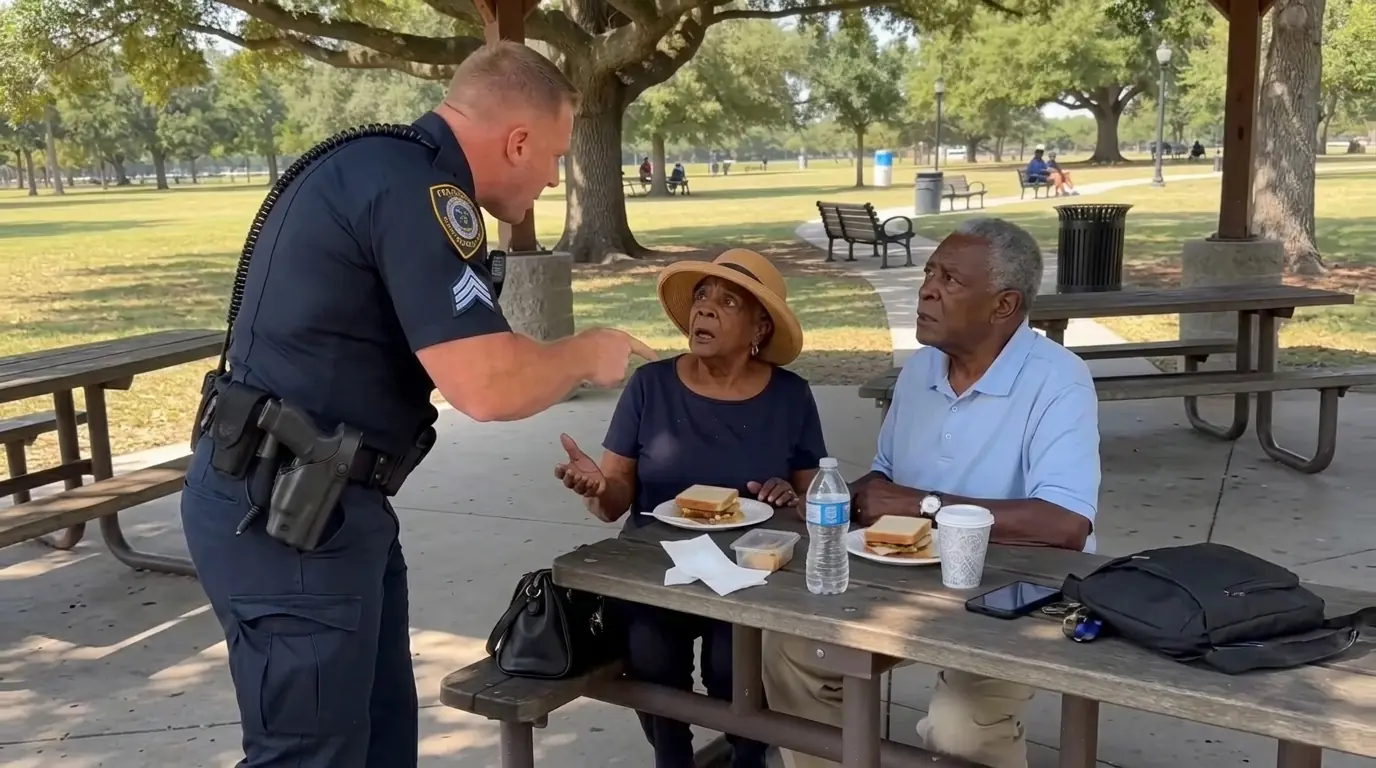
Officer Dylan Mercer had spent seven years patrolling the polished streets of Kingsley Heights, Maryland, long enough to believe his instincts deserved more respect than questions. At thirty-three, he had built a reputation for aggressive stops, high activity numbers, and the kind of confidence supervisors often praised when they did not want to examine where that confidence was aimed. On a bright Sunday afternoon in early October, Mercer carried those instincts into Lakewood Commons, where a Black couple sat beneath a willow tree celebrating thirty-four years of marriage. By sunset, one decision he made beside that pond would end his law-enforcement career and force an entire city to reopen complaints it had ignored for years.
The couple was Judge Nadine Holloway, fifty-six, and her husband, Dr. Terrence Holloway, fifty-nine. Nadine had served nearly eighteen years as a United States magistrate judge after building her career as a federal litigator, while Terrence was chief of vascular surgery at a major Baltimore hospital. They had raised two sons, survived years of impossible schedules, buried parents, paid college tuition, and learned that a long marriage stayed strong mostly through ordinary decisions made when nobody was applauding. Their anniversary tradition had become deliberately simple: no gala, no expensive restaurant, just food from their favorite deli and a few quiet hours somewhere outdoors.
Lakewood Commons looked almost designed for that kind of afternoon. Wide oak branches stretched above winding paths, flower beds were trimmed with irritating precision, and a long pond reflected stone houses rising beyond the park’s northern edge. Kingsley Heights residents liked calling the park their neighborhood jewel, though every legal document describing the property used a simpler word: public. The city maintained it, city taxes funded it, and anyone could enter from sunrise until ten at night.
Nadine wore a pale blue linen dress and a straw hat Terrence had teased her about buying in Charleston. He wore gray trousers and a dark green polo, along with the old watch Nadine gave him on their tenth anniversary. They spread a navy blanket near the pond, unpacked smoked-turkey sandwiches, melon, crackers, and two green glass bottles of sparkling water. For nearly half an hour, the most serious argument between them involved whether Terrence was actually going to retire at sixty or simply change the date again.
“You’ve been retiring for seven years,” Nadine said. Terrence lifted his bottle toward her. “I’m refining the plan.”
“You’re avoiding the plan.”
“I prefer refining.” Nadine laughed. “Thirty-four years and you still think changing the verb wins the argument.”
Three homes beyond the northern fence, Cynthia Weller noticed them from the upstairs balcony of her stone Colonial. Cynthia was fifty-three, owned a boutique interior-design company, and had served for six years as president of the Kingsley Residential Preservation Association. She had a reputation for calling city offices about almost anything that disturbed the picture of Kingsley Heights she carried inside her head: unfamiliar vehicles, teenagers near the fountain, dogs without visible tags, delivery drivers who parked too long, and people sitting in the park after sunset. Most dispatchers recognized her address before she finished giving her name.
Cynthia watched Nadine and Terrence longer than she would later admit. She did not know them, had never spoken to them, and had no reason to believe they were connected to any home in the neighborhood. Still, she decided the green bottles were probably alcohol, then decided they had been sitting near the houses suspiciously long, and finally decided someone should check who they were. Suspicion became certainty because no one was present to interrupt the story she was telling herself.
At 1:09 p.m., Cynthia called the police non-emergency number. “There are two people near the north pond who don’t look like they belong here,” she said. “They’ve been sitting there watching the houses, and I think they may be drinking.”
The dispatcher asked whether either person had threatened anyone. Cynthia said no. She was asked whether they had crossed onto private property, and again the answer was no.
“Are they bothering anybody?” the dispatcher asked.
“They’re making residents uncomfortable.”
“Which residents?”
There was a pause. “People here.”
The dispatcher logged the complaint as a low-priority suspicious-person check. No crime was reported, no threat was identified, and no caller claimed to have spoken directly with the couple. Officer Dylan Mercer was less than a mile away when the assignment appeared on his mobile computer. He read two suspicious persons, possible alcohol, Lakewood Commons and turned his cruiser toward the park.
Mercer had handled calls like that many times. He also had a personnel file that would later become central to everything that followed. Sixteen formal complaints had been filed against him since he joined the department, including allegations of unnecessary detention, racial profiling, rude behavior, excessive handcuffing, and turning minor encounters into confrontations. Thirteen complainants were Black or Latino.
One complaint came from a Black commercial realtor Mercer detained outside a luxury condominium because the officer decided his keys and business cards were not enough proof that he belonged there. Another came from a Latino physician driving a new Range Rover whom Mercer questioned for twenty minutes after claiming the temporary plate looked “off.” A third involved a Black graduate student Mercer searched outside a coffee shop because the student became “defensive” when asked why he was carrying two laptops. None of those cases resulted in serious discipline.
Supervisors repeatedly described Mercer as proactive. His union representative challenged every sustained allegation. Internal reviews often concluded that the officer’s decisions fell within a broad zone of discretion. Mercer absorbed only one lesson from those outcomes: if somebody complained about how he treated them, the department would probably believe him first.
He entered Lakewood Commons at 1:27. Instead of parking in the paved lot, he drove partly across the grass near a maintenance access path and got out. Less than twenty yards away, four white college students were laughing near a gazebo with beer cans sitting openly on the bench beside them.
Alcohol was prohibited without an event permit. Mercer looked directly at the students. One raised a can while laughing at something on his phone.
Mercer continued walking. His eyes moved toward the pond. Nadine and Terrence sat beneath the willow, separated from the students by perhaps thirty yards.
Terrence saw the officer first. Decades in operating rooms had taught him to recognize when somebody entered a space already carrying tension. “Nadine,” he said quietly.
She followed his eyes. Mercer was coming directly toward them with one hand resting near his duty belt. Irritation touched her face before concern did.
“Maybe somebody thinks the sparkling water is contraband.”
Terrence did not smile. “He’s not looking at the bottles.”
Mercer stopped at the edge of the blanket. “Both of you, stand up.”
Nadine slowly lowered her sandwich. “Good afternoon, Officer. Is something wrong?”
“We received complaints about people loitering and drinking in the park.”
Terrence picked up one bottle. The label was fully visible. “Sparkling mineral water.”
Mercer barely glanced at it. “I need identification from both of you.”
Nadine looked up. “Are we being detained?”
“I asked for ID.”
“And I asked whether we’re detained.” Her tone was controlled, almost conversational. “If this is a consensual encounter, I would like to understand why you need identification.”
Mercer’s expression tightened. “There was a suspicious-person complaint.”
“What suspicious conduct was reported?” Nadine asked.
He stepped closer. “You don’t need to interrogate me about procedure.”
“I’m not interrogating you.” She gestured toward the park. “I’m asking what law you believe we may have violated.”
Mercer glanced toward the bottles. “Possible alcohol.”
Terrence held his bottle higher. “It says sparkling water on the label.”
Behind Mercer, one of the college students took a long drink from a beer can. Nadine looked past the officer. “Are you checking everybody in the park for alcohol?”
Mercer turned his head briefly toward the gazebo. “They’re not who I’m dealing with.”
Terrence’s face changed. “That seems pretty clear.”
Mercer pointed toward him. “Watch your attitude.”
Nadine placed one hand lightly against Terrence’s wrist before he could answer. “Officer, this is a public park. We are sitting on a blanket eating lunch.”
She continued calmly. “Sitting here is not unlawful. Drinking sparkling water is not unlawful. Declining to provide identification during a consensual encounter is not unlawful.”
Mercer’s face reddened. “Don’t lecture me about the law.”
Nadine raised one eyebrow. “Then don’t ask me to surrender rights without explaining why.”
“That’s enough.” His voice sharpened. “You people always want to turn a simple conversation into a courtroom.”
Terrence looked at him. “You people?”
Mercer pointed again. “Sit down.”
“I am sitting.”
“You know exactly what I mean.”
Nadine felt something inside her settle. It was no longer merely irritation. She had spent decades listening closely to language people assumed was casual.
She knew what happened when authority began describing questions as defiance. The record was already shifting. If Mercer called them “uncooperative,” whoever read the report later might imagine something much louder than two people sitting beside sandwiches.
Mercer touched his shoulder microphone. “Dispatch, show me with two uncooperative subjects at Lakewood Commons. Start another unit.”
Nadine looked directly at him. “We have not refused any lawful command.”
Mercer stared down at her. “You’re refusing identification.”
“You have not provided a lawful reason requiring it.”
“You want to go to jail over being difficult?”
Terrence’s head turned sharply. “There’s no reason to threaten her.”
Mercer stepped toward him. “You want to join her?”
“Join her in what?”
Nadine put her hand against Terrence’s arm again. “Terry.”
He looked down at her. She gave a small shake of her head.
There were principles worth fighting for. There were also moments when continuing an argument with an armed person who had already decided questions were resistance could turn principle into physical danger. Nadine knew the difference better than most. She decided to end the encounter by giving Mercer information he would have no rational reason to ignore.
“My credentials are inside that tote bag.” She kept both hands visible. “I’m going to reach inside with my right hand.”
Mercer’s hand moved immediately toward his Taser. “Slow.”
“That is why I’m describing the movement.”
Nadine reached into the leather tote and removed a black credential wallet. She opened it slowly and held it at chest level.
The gold federal seal caught sunlight. Beneath it sat her identification.
NADINE ELAINE HOLLOWAY — UNITED STATES MAGISTRATE JUDGE — DISTRICT OF MARYLAND.
For one second, Mercer stared. Nadine watched recognition reach his face. Then pride pushed it away.
“I am a United States magistrate judge,” she said. “You can verify this through the courthouse or the U.S. Marshals Service.”
Mercer looked from the seal to her face. “That supposed to impress me?”
“No.”
“Anybody can buy fake federal badges online.”
Terrence stood completely. “Read the credential.”
Mercer spun toward him. “Sit down.”
“Look at the hologram.” Terrence’s voice rose. “Call the federal courthouse. Call the marshals. You have a radio.”
Mercer’s hand moved to his Taser. “Last warning.”
Nadine stared at him. “Officer Mercer, impersonating a federal judge would itself be a serious criminal offense. If you genuinely believe this credential is fake, verifying it should be the first thing you do.”
Mercer gave a short laugh. “Listen to yourself.”
His eyes moved over her dress, hat, and blanket. “You think expensive clothes and some fake credential make you untouchable?”
Nadine’s face changed. “No.”
She paused. “I think facts should make facts relevant.”
A college student near the gazebo raised his phone. Another started recording. A jogger slowed along the path.
Mercer saw them. Instead of calming him, the witnesses made retreat seem more humiliating. Nadine could see it happen.
“Officer Mercer,” she said quietly, “you have an opportunity right now to verify my identity and walk away from this without making it worse.”
Mercer reached down and snapped the credential wallet closed with his own hand. He shoved it toward her chest. “Stand up.”
Nadine remained seated. “For what offense?”
“Disorderly conduct.”
“Describe the conduct.”
“Failure to obey.”
She looked around the park. “An order needs a lawful basis.”
Mercer reached toward her arm. Terrence stepped forward one pace. “Do not touch my wife.”
Mercer drew his Taser immediately. A red targeting dot appeared against Terrence’s shirt.
“Take one more step.”
Terrence froze. His hands rose.
“I stopped.”
Nadine’s voice cut through the moment. “Terrence, do not move.”
He looked toward her. “Nadine—”
“Do not move.” Her eyes stayed on him. “Do not give him anything else to invent.”
Mercer holstered the Taser. Then he grabbed Nadine above the elbow and pulled her from the blanket.
Her straw hat dropped into the grass. Pain shot through her shoulder.
“I am not resisting,” she said immediately. “You are hurting my arm.”
“Stop resisting.”
“I’m standing still.”
He forced both wrists behind her back. The handcuffs closed too tightly.
Nadine inhaled sharply. “Those cuffs are too tight.”
“You’ll be fine.”
One of the students yelled from the gazebo. “She isn’t resisting!”
Mercer ignored him. He pushed Nadine toward the cruiser.
Terrence looked as though he could barely keep himself where she told him to stand. “She is a federal judge.”
Mercer glanced over his shoulder. “Sure she is.”
Another student said loudly, “Man, you need to make one phone call before you ruin your life.”
Mercer’s jaw clenched. He kept walking.
Nadine raised her voice toward the phones. “For the record, I complied with the officer’s instructions. I displayed valid federal judicial credentials and asked that they be verified.”