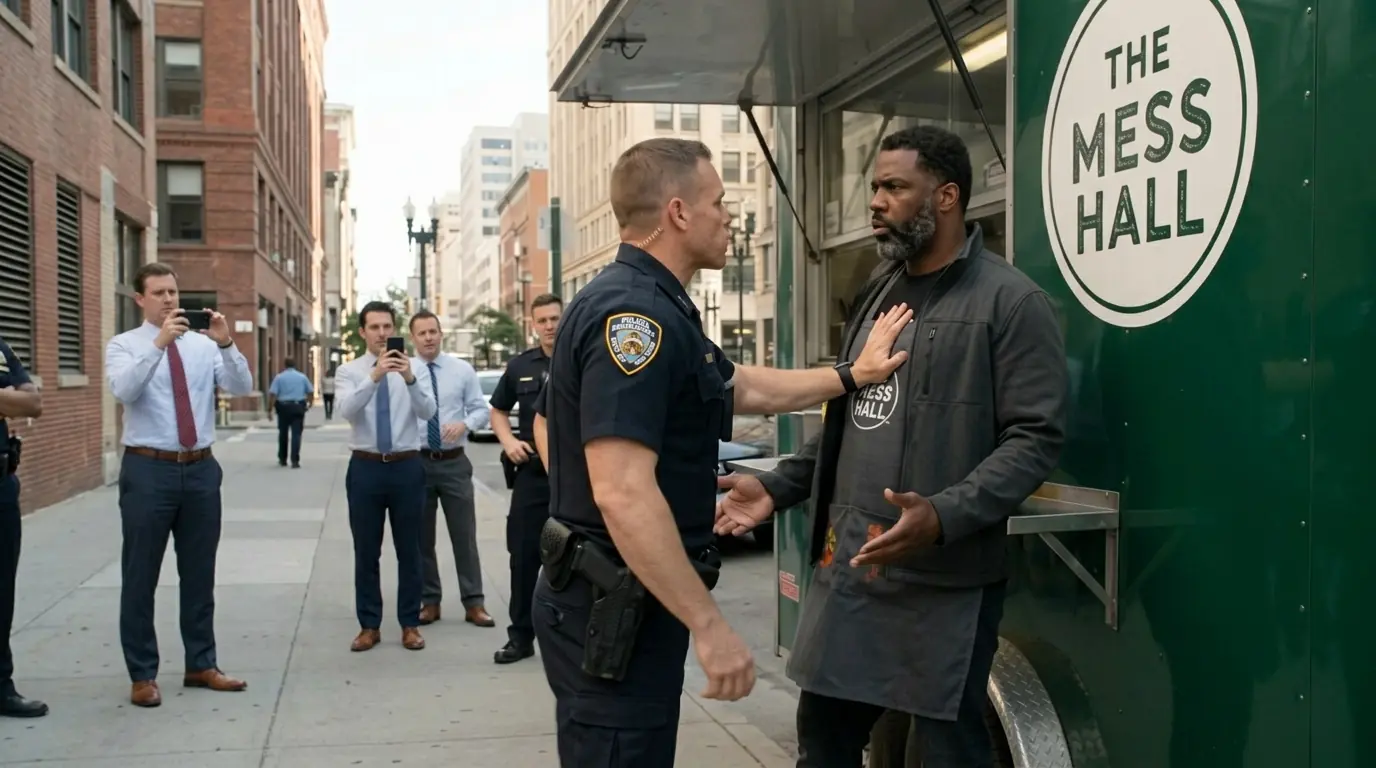
The first thing Officer Trevor Pike did was slap his palm against the stainless-steel counter hard enough to rattle the coffee cups inside the truck. The second thing he did was look up at the words painted across the side—Second Watch Kitchen: Veteran Owned—and laugh under his breath. Then he kicked the front tire twice and looked straight at the Black man standing behind the service window. “You actually own this thing?”
Malcolm Harris kept both hands where Pike could see them. “Yes, officer.”
“Bought it yourself?”
“Yes.”
Pike leaned closer. “With what money?”
Malcolm did not answer immediately.
The question had nothing to do with parking.
Nothing to do with food permits.
Nothing to do with health regulations.
He understood that before Pike said another word.
“Officer, my permit is posted right beside you.”
Pike looked at the laminated document and then back at Malcolm.
“I didn’t ask about your permit.”
He pointed at the truck.
“I asked how somebody like you ends up owning something like this.”
The morning crowd went quiet.
One customer slowly raised her phone.
Then another.
Malcolm took a breath.
“Sir, I’m running a legal business.”
Pike smiled.
“We’ll see.”
Forty minutes earlier, Denver had been just beginning to wake.
The October sky over downtown was pale orange, the kind of Colorado morning that made the air feel colder than the temperature suggested. Malcolm Harris unlocked Second Watch Kitchen at 6:34 a.m. and climbed inside with the same routine he had followed nearly every weekday for two years. Coffee first, grill second, music third.
He was forty-three years old, tall, broad-shouldered, with deep-brown skin and a close gray starting to show in his beard. Eighteen years in the Army had left him with a habit of doing things in the same order even when nobody was watching. He checked propane, refrigeration temperature, fire suppression, generator fuel, and food storage before touching the first egg. Only then did he turn on the small radio mounted above the prep counter.
Stevie Wonder came through the speaker.
Malcolm smiled.
His wife, Renee, had loved Stevie Wonder.
Her photograph still hung above the register.
She had been gone for three years.
Cancer.
Eleven months from diagnosis to funeral.
Some mornings that still felt impossible.
Second Watch Kitchen had been her idea long before it had been his.
Renee had spent years telling Malcolm that retirement from the military did not mean he had to spend the rest of his life taking jobs that left him empty. She cooked when she was happy, when she was worried, when relatives visited, when neighbors were sick, and whenever somebody told her they had not eaten. Her breakfast burritos had become legendary inside their church long before anyone suggested selling them.
Then she got sick.
Plans went into a notebook.
Truck designs.
Menu ideas.
Possible names.
Cost estimates.
Locations.
She died before they bought anything.
For nearly a year, Malcolm could not open the notebook.
Then one morning he did.
Six months later, Second Watch Kitchen served its first burrito.
Every recipe came from Renee.
Every free meal he gave away carried some part of her.
That morning started like hundreds before it.
At 6:53, attorney Claire Dawson walked up in running shoes and a long gray coat.
“Please tell me you have coffee.”
“I was thinking about quitting coffee permanently.”
Claire stared.
Malcolm held up a cup.
She exhaled.
“Cruel man.”
Claire was thirty-eight and worked criminal defense six blocks away. She ordered the same breakfast every weekday—egg-and-pepper burrito, extra salsa, black coffee—and had reached the level of regular customer where Malcolm began making it when he saw her coming. She tapped her card against the reader.
“Veterans center meeting Saturday?”
“I’ll be there.”
“Still pushing winter motel vouchers?”
“Trying.”
Claire took the cup.
“You ever sleep?”
“Government trained me not to.”
“That explains several national problems.”
Malcolm laughed.
Next came Luis Ortega, a construction foreman buying six breakfast sandwiches for his crew.
Then Mrs. Pham.
She was seventy-four, Vietnamese American, tiny, always wore a blue raincoat regardless of weather, and insisted on paying exact cash for a vegetarian burrito every Tuesday and Thursday.
That morning Malcolm waved away her money.
“No.”
Mrs. Pham glared.
“You take.”
“Not today.”
“Why?”
“Because I said so.”
“You sound like bad husband.”
Malcolm laughed.
“My wife would agree.”
Mrs. Pham’s face softened.
She knew about Renee.
Everybody who came regularly did.
Malcolm handed her the foil-wrapped burrito.
“You remind me of her when you argue.”
Mrs. Pham pointed at him.
“Your wife smart.”
“Yes, ma’am.”
She walked away smiling.
A few minutes later, a homeless veteran named Calvin Price appeared beside the truck.
Calvin had served during the Gulf War.
He gave nobody his age.
Malcolm guessed early sixties.
He slept wherever the weather allowed, carried everything important in an old backpack, and still stood straighter whenever another veteran approached.
“Morning, Colonel.”
Malcolm shook his head.
“Don’t start.”
Calvin grinned.
“You hate it.”
“That’s why you use it.”
“Correct.”
“You eating?”
Calvin shrugged.
“That wasn’t the question.”
“No.”
Malcolm handed him coffee and a sausage-and-egg sandwich.
Calvin accepted both.
“Sam Watkins died last night.”
Malcolm’s hand stopped.
“Where?”
“Near Colfax.”
“Cold?”
“Looks like.”
Malcolm closed his eyes briefly.
Sam was another veteran.
Vietnam-era.
Bad knees.
Worse lungs.
Too proud to stay long in shelters.
“I’ll call the outreach office.”
Calvin nodded.
“We need blankets before the weather turns.”
“I know.”
Calvin looked toward the photograph of Renee.
“She’d be proud of you.”
Malcolm busied himself wiping the counter.
“Eat your sandwich.”
Calvin smiled.
That was easier.
By 7:15, Second Watch Kitchen had a line.
The smell of bacon, peppers, onions, toasted tortillas, and strong coffee drifted along the block. Office workers checked phones while waiting. Construction crews leaned against barriers. A nurse in blue scrubs danced badly when the radio switched to Al Green.
Malcolm looked around and felt something close to peace.
Then he saw the patrol car.
It rolled toward the curb with emergency lights flashing but no siren.
Malcolm’s stomach tightened immediately.
Not because he had done anything wrong.
That was not how the body worked.
Officer Trevor Pike stepped out first.
Thirty-nine.
White.
Thick build.
Buzz cut.
Heavy jaw.
He adjusted his vest and rested his right hand near his holster.
Not touching the gun.
Close enough that everyone noticed.
His partner emerged from the passenger side.
Officer Evan Mercer looked younger.
Maybe twenty-nine.
Thin.
Three or four years into the job at most.
His expression told Malcolm something before Pike spoke.
Mercer was already uncomfortable.
Pike walked directly toward the truck.
He passed the green curb sign marking the location as a licensed mobile-vendor zone.
He passed the permit.
Passed the health certificate.
Passed the veteran-business placard.
Then stopped beneath the service window.
Malcolm kept his voice neutral.
“Morning, officer.”
Pike looked inside.
Then around the truck.
Then back at Malcolm.
“This yours?”
“Yes.”
Pike’s eyes narrowed.
“You sure?”
Malcolm paused.
“Yes, sir.”
“Name?”
“Malcolm Harris.”
“That your real name?”
Several customers looked at one another.
Malcolm heard Claire stop drinking her coffee.
“Yes, officer.”
“License.”
Malcolm took out his wallet slowly.
“Registration.”
He handed that over.
“Business permit.”
Malcolm pointed.
“In the window.”
“Take it down.”
“It’s laminated to the display.”
Pike stared.
“You telling me no?”
“No, sir.”
Malcolm carefully removed the document from the holder.
Pike took everything.
Insurance.
Vendor license.
Vehicle registration.
Food-service certificate.
Driver’s license.
He barely looked at any of it.
Claire stepped slightly closer.
“Officer, is there some problem?”
Pike turned.
“Who are you?”
“A customer.”
“Then be a customer.”
Claire lifted her coffee.
“I’m also an attorney.”
Pike smiled.
“Congratulations.”
She did not smile back.
“Mr. Harris has been operating here legally for years.”
“I didn’t ask for legal advice.”
“I’m not charging you.”
Several people laughed softly.
Pike’s face changed.
“Step back.”
Claire’s phone was already in her hand.
“Why?”
“Because I said so.”
“That’s not a legal reason.”
“You want an obstruction citation?”
Claire took three slow steps backward.
“Now I definitely want to stay.”
Pike ignored her.
He held Malcolm’s permit up to the sunlight.
“Looks copied.”
“It came directly from the city.”
“Anybody can print a seal.”
“Officer, there’s a number on the bottom.”
Pike’s eyes moved toward him.
“You telling me how to investigate?”
“No, sir.”
“Sounds like it.”
Malcolm’s jaw tightened.
He heard Renee in his memory.
Choose the hill, baby. Not every hill deserves blood.
He looked at Pike.
“I’m only telling you everything is current.”
Pike raised his radio.
“Dispatch, run Malcolm Harris.”
He read out the driver’s license.
“Also verify mobile-vending permit.”
The dispatcher responded.
“Stand by.”
The line of customers had stopped moving.
Nobody left.
That mattered.
Phones remained raised.
Malcolm saw at least fifteen.
Evan Mercer noticed too.
He leaned toward Pike.
“Trevor, maybe we should just—”
Pike held up one hand.
The radio crackled.
“Unit 28, Malcolm Harris clear.”
Another pause.
“Valid Colorado license.”
“Vehicle registration current.”
“No warrants.”
“Vendor permit active through May.”
“Health-service certification current.”
Pike stared at Malcolm.
The facts had answered the question.
Pike did not like the answer.
“Run it again.”
The dispatcher hesitated.
“Unit 28?”
“I said run it again.”
“Copy.”
Malcolm said nothing.
A minute later, the answer came back identical.
Pike lowered the radio.
He still did not return the documents.
“Something’s off.”
Malcolm looked at him.
“About what?”
Pike glanced toward the truck.
“This area has problems.”
“With what?”
“Illegal sales.”
“My permit is valid.”
“Health issues.”
“My inspection is posted.”
“Possible stolen property.”
Malcolm looked around.
“What stolen property?”
Pike stepped closer.
“You ask a lot of questions.”
“You’re standing at my business.”