“I am the law here.”
Officer Travis Cole said it loudly enough for everyone near the visitor entrance to hear.
Drivers waiting in the checkpoint lane turned their heads.
Two security employees standing beside a portable inspection table stopped talking.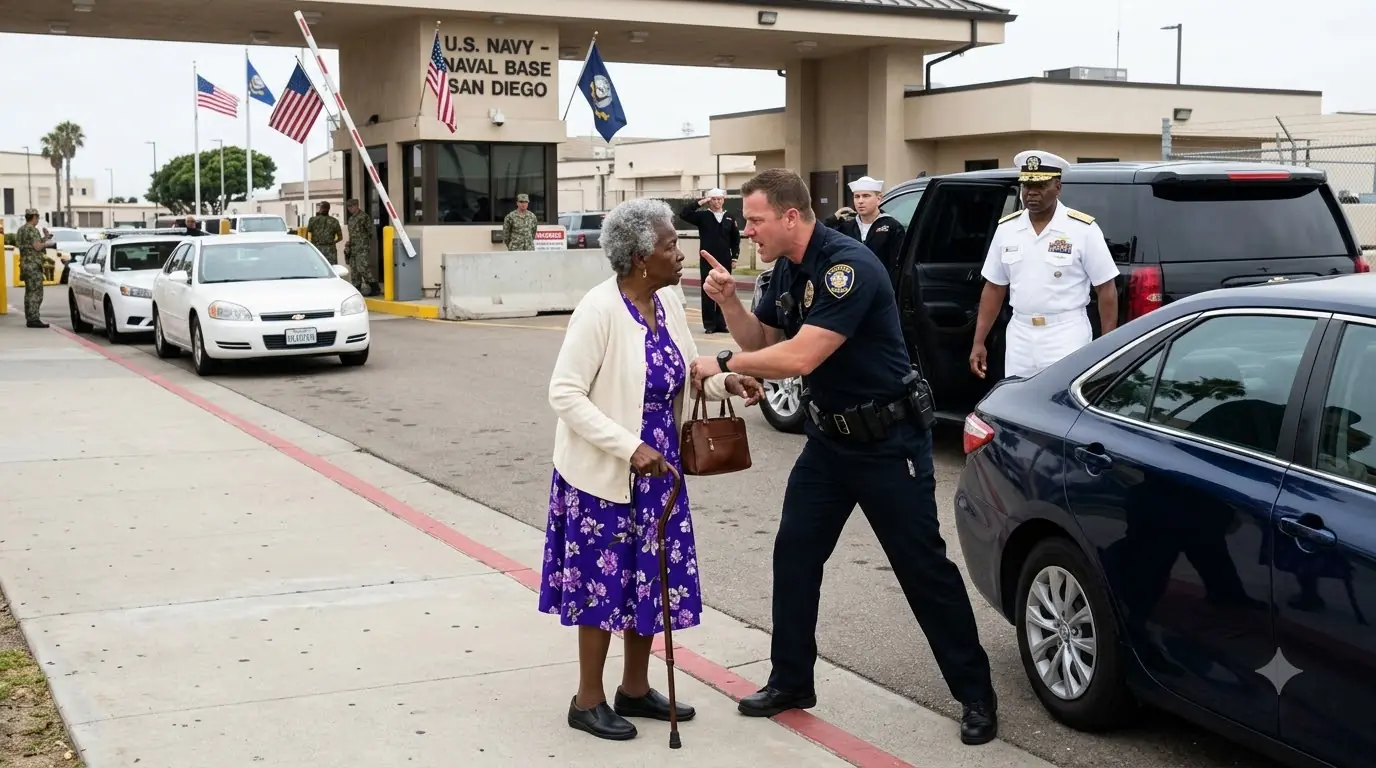
A woman carrying a conference badge paused halfway through the glass doors.
And seventy-four-year-old Eleanor Hayes stood perfectly still beside the curb, one hand gripping her wooden cane while Travis’s fingers remained wrapped around her other forearm.
The morning had begun beautifully.
San Diego sunlight reflected off the harbor beyond the waterfront complex. Flags moved in a light ocean breeze. Black SUVs, city vehicles, emergency-response trucks, and press vans filled the reserved parking area beyond the main gate.
Inside the large federal facility, several hundred invited guests were preparing for the annual National Coastal Resilience Summit, a high-profile public event bringing together emergency managers, engineers, first responders, scientists, mayors, transportation officials, and community leaders from across the West Coast.
Eleanor had been invited personally.
She had the letter in her handbag.
She had identification.
She had a guest credential waiting inside.
And she had arrived exactly where the instructions told her to arrive.
None of that seemed to matter to Travis.
“Take your hand off me,” Eleanor said.
Her voice was controlled.
Not frightened.
Not loud.
Travis leaned closer.
“You were told to step away from the gate.”
“I was told this was the guest entrance.”
“It is.”
“Then we agree.”
“For authorized guests.”
“I am one.”
Travis laughed once.
Not because anything was funny.
Eleanor recognized that kind of laugh.
She had heard variations of it for more than seventy years.
The laugh of someone who had already decided what the answer was and considered further explanation an inconvenience.
She wore a royal-purple floral dress beneath a cream cardigan, low black shoes, small pearl earrings, and a narrow gold watch that had belonged to her mother.
Her short silver-gray curls had been shaped that morning at a neighborhood salon.
She had taken more care with her appearance than she wanted Marcus to know.
Her son had called the previous evening.
“Mom, you don't need to dress up.”
Eleanor had answered:
“I raised you. I know exactly how much cameras make people lie.”
Marcus had laughed.
Now Eleanor looked at Travis’s hand around her forearm.
“Release me.”
“You need to stop resisting.”
Her eyebrows lifted.
“I am standing still.”
“You pulled your arm.”
“Because you grabbed it.”
“Ma’am, lower your voice.”
Eleanor stared.
“My voice is lower than yours.”
That irritated him.
She could see it.
Travis Cole was thirty-nine years old and had worked facility security for nearly nine years. He was broad through the shoulders, athletic, with short brown hair and a square jaw that hardened whenever he believed someone was questioning him.
His dark patrol uniform fit perfectly.
His body camera was active.
His radio sat high on his shoulder.
A silver badge reflected the sun.
Eleanor noticed all of it.
She also noticed the younger officer standing fifteen feet away near the vehicle lane.
The man looked uncomfortable.
He had been watching for almost a minute.
His name tag read M. BARNES.
Eleanor looked toward him.
“Officer Barnes.”
Barnes straightened.
“Yes, ma’am?”
“Would you please tell this gentleman that I have been trying to retrieve my invitation from my handbag?”
Travis immediately said:
“Do not involve my officer.”
Eleanor looked back at him.
“Your officer?”
“You know what I mean.”
“I know exactly what you said.”
Travis tightened his grip slightly.
“Enough.”
Pain moved through Eleanor’s wrist.
She did not show it.
Her arthritis had been bad that morning.
She had almost brought the silver cane Marcus purchased for her birthday, then chose the old wooden one instead because she trusted it more.
Travis pointed toward the public sidewalk.
“You need to leave the secure perimeter.”
Eleanor’s mouth tightened.
“No.”
His eyes narrowed.
“No?”
“I have spent the last seven minutes telling you that I am expected inside.”
“And I have spent seven minutes telling you that your name is not on my printed entry sheet.”
“That sheet may be incomplete.”
“It isn't.”
“How would you know?”
“Because this is my checkpoint.”
Eleanor looked toward the temporary folding table.
A stack of papers.
Plastic visitor badges.
Two radios.
A water bottle.
Very impressive kingdom.
She asked:
“Have you called the guest coordinator?”
Travis stared.
“I don't need you telling me how to do my job.”
“I asked whether you called her.”
“I said enough.”
Eleanor sighed.
Then the cuff of her cardigan shifted, exposing the red pressure mark forming beneath his fingers.
She looked down at it.
Then back up.
“Officer Cole, I am asking you one final time to release my arm.”
Travis leaned closer.
“Listen carefully.”
He pointed toward the road.
“I am the law here.”
Eleanor’s expression changed.
Not fear.
Almost pity.
Behind Travis, a black SUV turned through the secondary access lane.
Neither of them noticed.
The vehicle carried federal plates and a small windshield credential identifying it as executive transport.
It slowed approximately thirty yards away.
Officer Barnes noticed.
He straightened.
Another security employee beside the building did the same.
The SUV stopped.
Rear door opened.
Marcus Hayes stepped out.
He was fifty-six years old, tall, broad-shouldered, with close-cropped black hair beginning to gray at the temples and the deliberate posture of someone accustomed to entering rooms where people were already waiting for him.
He wore a charcoal suit, white shirt, and dark-blue tie.
No flashy pin.
No entourage beyond his driver and a senior aide stepping from the other side.
Marcus had spent twenty-seven years in federal emergency management and infrastructure security. He was currently regional director of the National Coastal Emergency Coordination Office, overseeing disaster-response planning across several western states.
The ceremony happening inside was partly his.
He was scheduled to give the opening address in twenty-three minutes.
He took three steps from the SUV.
Then stopped.
His mother was standing beside the checkpoint.
A police officer had one hand around her arm.
Marcus’s entire expression changed.
“Mom?”
Eleanor looked past Travis.
Relief crossed her face so briefly most people missed it.
“Marcus.”
Travis froze.
The hand around Eleanor’s forearm remained there for another second.
Marcus’s gaze dropped to it.
“Take your hand off her.”
Travis released immediately.
Eleanor rubbed her arm.
Marcus walked quickly toward them.
Officer Barnes moved aside.
Marcus’s aide, Dana Brooks, followed several paces behind with a leather portfolio.
Travis glanced between Marcus and Eleanor.
Then recognition arrived.
He had seen Marcus’s photograph in the morning briefing.
Opening speaker.
Regional director.
Senior federal official.
Travis straightened.
“Director Hayes.”
Marcus ignored the greeting.
He stopped beside Eleanor.
“Are you hurt?”
“I am irritated.”
“That wasn't my question.”
“My arm hurts.”
Marcus looked at the red mark.
Then at Travis.
“What happened?”
Travis began:
“Sir, this individual attempted to enter a restricted—”
Marcus cut him off.
“This individual is Eleanor Hayes.”
Travis swallowed.
“Yes, sir.”
“My mother.”
Silence.
Several people at the checkpoint heard.
Eleanor closed her eyes briefly.
Of course.
The moment she wanted least.
Now everybody would believe the problem mattered because of who her son was.
Travis’s face lost color.
“Sir, I had no idea.”
Eleanor looked at him.
There it was.
The sentence.
The wrong sentence.
Marcus heard it too.
His expression hardened.
“No idea about what?”
Travis hesitated.
“Her relationship to you.”
Marcus stared.
Eleanor spoke quietly.
“That should not matter.”
Travis turned toward her.
“Ma’am, I apologize if—”
“No.”
She raised one hand.
“You do not apologize because you discovered my son’s job.”
Travis swallowed again.
“I meant—”
“I know what you meant.”
Marcus looked at Eleanor.
She was angry.
Actually angry.
That worried him more than if she had shouted.
His mother did not raise her voice when she was most upset.
She became precise.
Marcus asked:
“Do you have your invitation?”
Eleanor tapped the handbag hanging from her shoulder.
“I have been attempting to retrieve it since this gentleman told me I was lying about being invited.”
Travis protested:
“I never called her a liar.”
Eleanor looked at him.
“You said, ‘Everyone claims they know somebody when they want through the gate.’”
Barnes looked at the ground.
Travis glanced toward him.
Then toward his body camera.
Marcus noticed.
“Your camera is recording?”
“Yes.”
“Good.”
Travis shifted.
“Director, may I explain?”
Marcus nodded once.
“Please.”
Travis took a breath.
“She approached the secure visitor lane without visible credentials.”
“Normal,” Marcus said.