Important Corrections and Verification Notes
This compilation is based on the supplied body-camera and narration transcript, but several names, dates, locations, and legal outcomes in that transcript require correction or qualification before the stories can be presented as factual documentary accounts.
The first case involved Lorain, Ohio police officer John Kovach Jr. The officer's daughter was Katlyn Kovach, not “Caitlin,” and the young man she was dating was 18-year-old Makai Coleman, not “McKay Coleman.” The incident occurred on April 16, 2018. Published reporting based on Lorain Police Department internal-investigation material states that Kovach initiated an unjustified traffic stop involving Coleman, detained him, threatened to invent charges, placed his adult daughter in his cruiser, and failed to respond to another police call while dealing with the personal matter. He was fired from the Lorain Police Department on May 11, 2018.
The second case occurred in Hardwick, Vermont, on June 14, 2022. The father was 52-year-old Wayne Tallman, his wife was Amy Tallman, and their 24-year-old son was Brandon Tallman. Vermont State Police troopers had come to arrest Brandon on burglary and assault allegations when his parents interfered. Wayne used an excavator in a way that threatened the troopers. He later pleaded guilty to three felony counts and received a sentence that included 90 days to serve, with the balance suspended and probation conditions.
The third case occurred in Howell Township, New Jersey, on December 28, 2022. The driver was 21-year-old Teresa Lee. Her father, John Lee, worked for the Monmouth County Sheriff's Office. Teresa was investigated after a white sedan struck a traffic signal and left the scene. A later Alcotest reading was reported as 0.172 percent.
The transcript's framing that her father “arrested his own daughter” is misleading: Howell Township officers conducted the investigation and made the arrest. John Lee arrived as her father, was told not to interfere, and did not take over the case.
The fourth case in the supplied transcript describes a March 24, 2023 domestic call in which an adult daughter summoned police during an argument with her parents, was later detained after officers observed suspected drug paraphernalia, and had a friend in the house who was reportedly wanted on warrants. The transcript does not provide enough reliable identifying information to independently verify the people involved or the final disposition. For that reason, this section preserves only what the body-camera account itself supports and does not assign names, criminal histories, or court outcomes that cannot be verified.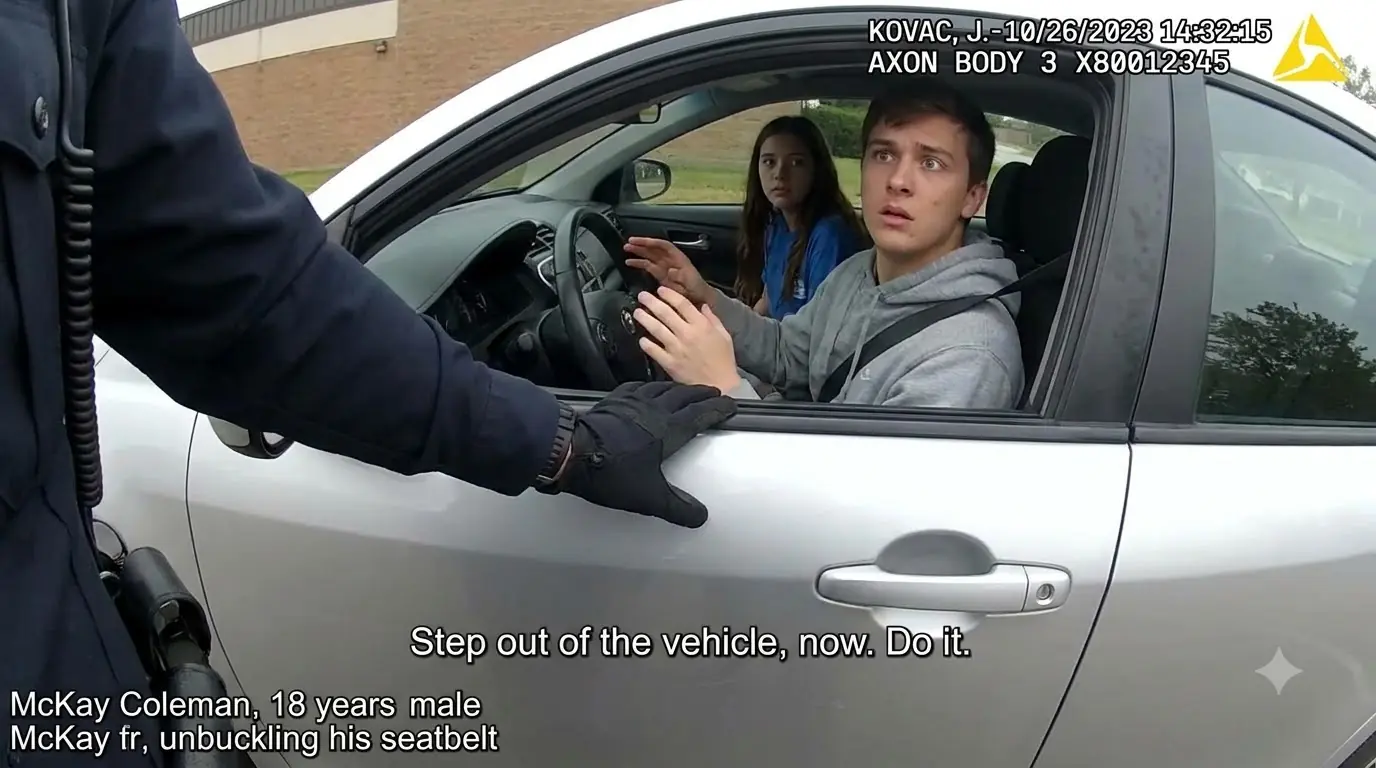
The fifth case occurred in San Juan County, Utah, on November 25, 2022. Kenneth Adams, the son of County Commissioner Bruce Adams, was arrested during a traffic stop after deputies found an active warrant connected to an earlier burglary case. Bruce Adams later confronted a deputy and demanded that his son be released. The warrant was subsequently withdrawn after the underlying paperwork issue was resolved, Kenneth's $150 bail was returned, and Bruce Adams publicly apologized for his behavior. No criminal charges were filed against the commissioner over the confrontation.
CASE ONE: THE OFFICER WHO TURNED A FAMILY DISPUTE INTO A TRAFFIC STOP
On April 16, 2018, Lorain police officer John Kovach Jr. was not responding to a robbery, an assault, or a dangerous driver when he activated his emergency lights behind a silver Pontiac. The driver was 18-year-old Makai Coleman, the young man dating Kovach's 18-year-old daughter, Katlyn. Kovach disapproved of the relationship, and by the time the Pontiac appeared in front of him, his search for his daughter had already become intensely personal.
Kovach had been trying to locate Katlyn after family conflict over the relationship. He believed her laptop could help reveal where she was, and he had gone looking in an area where he thought she might be. When Coleman's car drove by, Kovach stopped it even though the later internal investigation concluded that he did not have a legitimate law-enforcement reason for doing so.
The tone was confrontational almost immediately. Coleman asked why he was being told to get out. Kovach responded that he was going to jail. When Coleman again asked why, the officer made a remark to the effect that they would figure out the charges as they went. That exchange later became one of the most damaging moments in the footage because it suggested the officer was using detention first and searching for legal justification afterward.
Kovach questioned Coleman about weapons and drugs and ordered the other occupants out of the Pontiac. Another young woman was in the vehicle, but Katlyn initially remained out of sight. The stop happened near a home Kovach also associated with his daughter's location, so he began questioning an adult woman there about whether Katlyn had been inside.
The conversation with the homeowner became another extension of the family dispute. Kovach asked why his daughter's computer appeared to be at the residence and warned the woman that lying could lead to arrest. At one point she indicated she would allow him to check the house. The exchange deteriorated when Kovach began discussing a seatbelt citation involving the woman's daughter, and she accused him of making the entire encounter personal because he was looking for Katlyn.
The woman threatened to call 911. The remarkable element was that the person she feared was misusing police authority was himself a uniformed police officer standing in front of her. Her objection captured the central problem later identified by the department: Kovach had mixed his parental anger with powers that were supposed to be exercised only for legitimate law-enforcement purposes.
Then Katlyn appeared. She had been inside Coleman's car during the encounter. Kovach ordered his daughter into his police cruiser. Katlyn protested that she was 18 and had done nothing illegal. Coleman also objected, telling the officer that she had done nothing.
Kovach claimed he intended to take Katlyn for a hospital evaluation because of concerns that she might hurt herself. Whatever his personal fears as a father, the later investigation focused on whether he had lawful grounds for the traffic stop, the detention of Coleman, his treatment of the other civilians, and his use of police resources while acting on a private family matter.
There was another problem. While Kovach was occupied with his daughter, her boyfriend, and the people around them, he was still listed as an available officer. Reporting on the internal investigation stated that he failed to respond to a separate police call during the same period. His personal search had effectively displaced the public duties for which he was on shift.
Lorain police reviewed the footage and the circumstances of the stop. Investigators concluded that Kovach had violated department standards and procedures. The traffic stop lacked a valid basis, his threats and detentions were improper, and his handling of the situation demonstrated precisely why officers are expected to separate personal conflicts from official authority.
Kovach, who had been with the department for decades, was fired on May 11, 2018. The case became widely circulated not because a father objected to his daughter's boyfriend, but because the father happened to possess the legal authority, uniform, cruiser, and restraints of a police officer and used them while emotionally involved in the dispute.
The footage illustrates a basic conflict-of-interest principle. A police officer can have the same fears, anger, and family disagreements as anyone else, but official power changes the stakes. Once that authority is used to settle a private dispute, even an ordinary family argument can become a civil-rights and professional-conduct problem.
CASE TWO: THE FATHER WHO BROUGHT AN EXCAVATOR INTO AN ARREST
Four years later, another family confrontation with police unfolded in a completely different way in Hardwick, Vermont. On June 14, 2022, Vermont State Police troopers Skylar Velasquez and Gabe Schrauf went to a property on Scott Road to arrest 24-year-old Brandon Tallman in connection with burglary and assault allegations.
The assignment should have been straightforward. The troopers had a person to take into custody and expected to complete the arrest. Instead, members of Brandon's family intervened.
Brandon resisted as the troopers tried to detain him. His mother, Amy Tallman, also became involved and attempted to interfere with the officers. While the troopers were physically occupied with Brandon and Amy, Brandon's father, 52-year-old Wayne Tallman, moved toward a nearby excavator.
Wayne climbed into the machine and started operating it while the officers were still on the ground near his family. Cruiser-camera video showed the excavator arm and bucket moving toward the troopers. What had begun as the arrest of one person had suddenly become a situation in which a piece of heavy equipment was being used to threaten law-enforcement officers at close range.
One trooper drew his firearm as the bucket moved. The officers had to divide their attention between maintaining control of the people they were arresting and watching a machine powerful enough to cause catastrophic harm. Vermont State Police later emphasized how unusual the encounter was. There was no standard academy scenario for arresting someone while an angry parent maneuvered an excavator over the scene.
The troopers managed to avoid being struck. Wayne was ultimately removed from the excavator and arrested. Amy was also cited in connection with interfering with the arrest, while Brandon remained the subject of the original burglary and assault case.
Early reports listed multiple serious charges against Wayne, including aggravated assault on protected officials, impeding officers, reckless endangerment, and resisting arrest. The legal outcome later became more specific. In September 2022, Wayne Tallman pleaded guilty to three felony charges: one count of impeding a public official and two counts of aggravated assault with a deadly weapon, with the excavator treated as the weapon in those counts.
The plea agreement called for a two-to-four-year sentence, with all but 90 days suspended. Because Wayne had already spent time in custody, he received credit for time served and was able to leave jail around the time the plea was accepted. He was placed on probation and given additional conditions, including restrictions on operating an excavator without approved supervision.
The troopers objected to the relatively short period of incarceration. They described the lasting effect of an encounter in which they had been forced to dodge the bucket of a heavy machine while trying to complete an arrest. The judge nevertheless accepted the negotiated resolution, noting the felony convictions and the probation conditions attached to the sentence.
The Vermont incident is sometimes reduced online to an almost unbelievable clip: a father tries to stop police with an excavator. But the legal record shows why the scene was treated seriously. It was not simply an angry gesture by a protective parent. The machine was operated close enough to the troopers for aggravated-assault charges to result, and Wayne ultimately admitted criminal responsibility through his guilty pleas.
Unlike the Kovach case, the parent in Vermont was not a police officer misusing official power. Yet the underlying problem was similar. A family member decided that his personal desire to control what happened to his child justified interfering with a lawful process. In this case, the interference transformed an arrest into a dangerous confrontation and created three felony convictions for the father himself.
CASE THREE: THE OFFICER'S DAUGHTER WHO COULD NOT TALK HER WAY OUT OF A DUI INVESTIGATION
On the night of December 28, 2022, Howell Township police in New Jersey were called to a hit-and-run crash on Lanes Mill Road near the side entrance to Lowe's. A white vehicle had struck a traffic signal, and part of the vehicle's bumper had been left behind. The driver had continued away from the scene.
Officers documented the damaged signal and the broken vehicle part, then began looking for a white sedan that matched the witness description. A short time later, an officer located a white car at a nearby Wawa on Kent Road. The driver was 21-year-old Teresa Lee.
Teresa told officers she had been at Applebee's. She admitted consuming alcohol but initially denied striking the traffic signal. She said some of the damage to her car came from an earlier collision with a deer in Pennsylvania. The explanation appeared possible at first because her father later confirmed that a deer collision really had occurred, but the newly damaged area and the bumper piece recovered from the road created a separate problem.
During the conversation, Teresa repeatedly mentioned her father, John Lee, who worked for the Monmouth County Sheriff's Office. In many body-camera videos, mentioning a relative in law enforcement can sound like an attempt to gain special treatment, whether or not that is what the person intends. Here, officers allowed her to contact him.
John Lee arrived at the scene and was briefed on what investigators had found. He confirmed the earlier deer collision but also acknowledged that the damage officers were examining was not fully explained by that previous event. Rather than taking control, he was specifically advised not to interfere with the investigation.
This is where popular retellings often distort what happened. John Lee did not conduct the DUI investigation and did not formally arrest his own daughter. Howell Township officers remained responsible for the case. His role was that of a father who happened to be a law-enforcement officer and who arrived after other officers had already developed evidence.
As investigators continued questioning Teresa, her account shifted. She acknowledged facts connecting her to the collision and also discussed texting while driving. Officers then moved from the crash investigation to a formal assessment of whether she was impaired.
Teresa performed field sobriety exercises. Officers observed indicators they believed were consistent with impairment and concluded that she was not safe to operate the vehicle. When she realized she was being arrested, she became upset and called for her father.
John did not try to stop the arrest. The footage instead shows him telling her to cooperate and get into the police vehicle. That moment made the video spread widely online: the daughter of a law-enforcement officer was facing the same process another driver would face, and her father's presence did not end the investigation.
At Howell Township police headquarters, Teresa agreed to provide breath samples. Published accounts of the footage report an Alcotest result of 0.172 percent, more than twice New Jersey's 0.08 percent threshold for adult drivers. She was issued summonses that included driving under the influence, reckless driving, failure to report an accident, and leaving the scene of an accident.
The supplied transcript says Teresa was still awaiting a penalty at the time that version was produced. Publicly accessible reporting reviewed for this account clearly establishes the arrest, the Alcotest result, and the summonses, but it does not provide a sufficiently reliable later court disposition to state here as a confirmed final outcome. The documentary therefore stops at what can be supported rather than inventing a sentence or conviction.
The more meaningful part of the case is the contrast with the first story. Officer Kovach allowed a family conflict to override professional boundaries. John Lee, by contrast, was told to stay out of his daughter's investigation and did so. Whatever disappointment or embarrassment he may have felt, the officers handling the case were allowed to make their own decision.
CASE FOUR: THE DAUGHTER WHO CALLED POLICE ON HER PARENTS
The fourth incident in the supplied compilation begins on March 24, 2023, when officers were called to a residence after an adult daughter reported a confrontation with her father. Unlike the other cases in this compilation, the available transcript does not provide reliable names, a police department, or a location that can be independently matched to authoritative records. The account therefore has to be treated as a reconstruction from the body-camera dialogue rather than a fully verified case history.
When officers arrived, the woman who had called them met them at the house. She said she had been arguing with her father and claimed that he had threatened to punch her. She also spoke more broadly about longstanding family grievances and childhood experiences, making clear that the police call had grown out of a much deeper conflict than a single sentence exchanged that day.
The responding officer tried to narrow the discussion to facts that could be investigated. He repeatedly asked when the alleged threat happened and what exactly had been said or done. When the woman began directing comments toward her parents instead of answering him, the officer reminded her that if she wanted a police investigation, she needed to explain the alleged offense to police.
Another officer separated the father from the daughter and asked for his account. According to the transcript, he said his daughter had been yelling throughout the day and blaming him and his wife for problems in her life. The parents portrayed the argument as part of a longer pattern of family conflict rather than an unprovoked threat.
The focus of the call changed when officers noticed what they described as a pipe commonly associated with marijuana in or near the daughter's belongings. She challenged the officer's authority to look at the item and objected when he attempted to detain her. The officer responded that the object was in plain view.
The encounter then became physical. Officers ordered her to turn around and put her hands behind her back. She did not comply immediately, and a struggle followed. The transcript says she kicked an officer during the confrontation and that police subsequently located additional suspected intoxicants or controlled substances in her belongings.
At that point, the person who had called police seeking action against her father had herself become the focus of the investigation. Officers restrained her, read her rights, and moved her toward a patrol vehicle.
But the house still contained another surprise. While speaking with the parents, an officer heard movement from a bathroom. The parents identified a woman named Christine as a friend of their daughter. The officer asked why she had remained hidden in the bathroom throughout the police response and whether she had outstanding warrants.
Officers ordered Christine to come out. The supplied transcript states that a warrant check showed she was wanted and that she was taken into custody as well. Because the transcript provides no full legal name, agency, case number, or verifiable charging record, this account should not go beyond that statement.
The parents told police their daughter had been struggling for a long time and was in therapy related to earlier trauma. That background may help explain why the family argument was so emotionally charged, but it does not prove or disprove the original allegation against the father. The transcript says the parents were not charged during the incident, while the daughter faced drug-related and resisting allegations.
It would be tempting to frame the story as a simple case of a 911 call “backfiring.” That language is catchy but legally imprecise. Calling police does not give a caller immunity if officers independently observe evidence of another offense, just as finding evidence against the caller does not automatically prove the caller's original complaint was false. What can be said is that the investigation changed direction after officers arrived and observed circumstances unrelated to the alleged threat.
Without complete records, there is no responsible basis to declare the parents completely right, the daughter completely wrong, or any arrest allegation a conviction. The footage documents a volatile family dispute that expanded into a separate drug and resistance investigation. Anything beyond that would require records not contained in the supplied source.
CASE FIVE: THE COUNTY COMMISSIONER WHO DEMANDED HIS SON BE RELEASED
The final case took place the day after Thanksgiving, November 25, 2022, in San Juan County, Utah. A sheriff's deputy stopped Kenneth Adams after observing traffic violations involving a stop sign and signaling. What initially looked like a minor traffic encounter changed when the deputy ran Kenneth's information and found an active warrant.
The warrant was connected to an earlier case involving burglary, theft, criminal mischief, burglary of vehicles, and trespass allegations. Kenneth insisted that the matter had already been handled in court. From his perspective, the warrant should not have existed. From the deputy's perspective, however, the system showed an active judicial warrant that he was required to honor.
The deputy told Kenneth he was going to jail. Kenneth continued arguing that the case was old and that he had already appeared in court. The officer explained that he could not simply ignore the warrant because the person being arrested believed it was mistaken.
Kenneth was transported away, while arrangements were made for someone to retrieve his vehicle. That person was his father, Bruce Adams, who at the time served as a San Juan County Commissioner.
Bruce arrived angry and demanded an explanation. He wanted to know why Kenneth had been taken to jail and who could release him. Deputy Wyatt Holyoak tried to explain that the warrant was active and that once the arrest had occurred, the deputies at the roadside did not have authority to simply undo it.
Bruce insisted the warrant was false. He told the deputy he wanted Kenneth turned loose. When Holyoak answered that he could not release someone who had already been arrested on a court warrant, the conversation became increasingly heated.
The body-camera footage captured Bruce using profanity and threatening legal action against the county sheriff over what he believed was a wrongful arrest. In his later report, Holyoak wrote that it appeared the commissioner was trying to use his influence to pressure or intimidate him into disclosing information or changing what had happened.
The distinction between perception and proven misconduct matters. Bruce Adams was a county commissioner, and the deputy interpreted his behavior through that lens. Bruce later denied that he had been acting in his official capacity, saying he had reacted emotionally as a father. No criminal charges were filed against him for the confrontation.
The underlying warrant also turned out to involve a genuine administrative problem. Kenneth had previously entered a plea in abeyance related to the older case. Reporting after the body-camera video became public stated that documents connected to the completion of that matter had not been properly reflected in the warrant status. Kenneth was released after posting $150 bail, the warrant was withdrawn, and the court later returned the bail money.
That later correction did not mean the roadside deputies had fabricated the warrant. At the time of the stop, the system showed it as active. The officers were operating on the information legally available to them. The later withdrawal showed that Kenneth had a legitimate reason to believe something was wrong, but it did not give his father authority to order deputies to release him at the roadside.
Bruce Adams later publicly apologized. He described his conduct as embarrassing and said he had been emotional. He also said he contacted the sheriff after the incident. The San Juan County Sheriff's Office reviewed the encounter and concluded that its deputies had acted appropriately.
The case is more complicated than a simple story of corruption. There was an actual problem with the warrant, but there was also a public official angrily demanding immediate action from deputies who did not have the power to resolve that problem on the spot. The proper remedy was through the court system, which is ultimately where the warrant issue was corrected.
WHAT THESE FIVE CASES HAVE IN COMMON
The five incidents are different in almost every obvious way. One involved a police officer searching for his adult daughter. One involved a father operating heavy equipment while troopers arrested his son. One involved the daughter of a sheriff's officer facing a DUI investigation. One began with an adult daughter calling police on her own parents. The last involved an elected county official confronting deputies after his son's arrest.
Yet each case shows what happens when family loyalty collides with law-enforcement authority. The emotional instinct is understandable: parents want to protect their children, children may turn to police when family conflicts feel unbearable, and relatives with law-enforcement experience may feel an especially strong urge to intervene. The legal system, however, depends on boundaries that do not disappear simply because the person involved is family.
John Kovach crossed those boundaries by using police authority during a private dispute and lost his career. Wayne Tallman tried to interfere physically with his son's arrest and left court with felony convictions. John Lee's daughter was arrested by other officers while he remained outside the investigation. The unnamed March 2023 caller discovered that inviting police into a family dispute could expose conduct officers observed after they arrived. Bruce Adams learned that even a county commissioner could not command deputies to erase an arrest based on an active warrant.
The raw footage in these cases is compelling because it captures people at moments when professional roles and family emotions are impossible to separate cleanly. But the footage also requires careful interpretation. A narrator can call something an unlawful arrest, a kidnapping, corruption, or a justified use of authority in a single sentence. The actual legal record is usually more precise.
That is why names, dates, charges, pleas, and later outcomes matter. The first impression from a body camera may explain why a clip goes viral. The later investigation explains what the incident actually became.
Conclusion
Police encounters involving family members create an unusual test of judgment. The ordinary emotional rules of family life tell people to protect the person they love. The rules of public authority require officers and officials to step away when their personal interest threatens impartial decision-making.
In Lorain, John Kovach did not step away, and the internal investigation cost him his job. In Vermont, Wayne Tallman escalated his son's arrest into a dangerous confrontation and ultimately pleaded guilty to felonies. In New Jersey, John Lee allowed other officers to investigate and arrest his daughter rather than trying to use his position to shield her. In the March 2023 domestic call, the available footage shows how quickly the identity of the complainant and the subject of an investigation can change when officers encounter new evidence. In Utah, Bruce Adams's anger could not override an active warrant, even though the warrant itself was later withdrawn.
None of these cases can be understood accurately from the most dramatic thirty seconds alone. The traffic stop, the excavator, the crying daughter, the hidden friend, and the angry commissioner were only the visible moments. Internal investigations, court records, guilty pleas, warrant corrections, and later reporting supplied the context that the viral clips could not.
The common lesson is not that family loyalty is wrong. It is that public power becomes dangerous when family loyalty is allowed to decide how that power is used. The most responsible officials in these stories were the ones who recognized that distinction. The most serious consequences followed when someone did not.