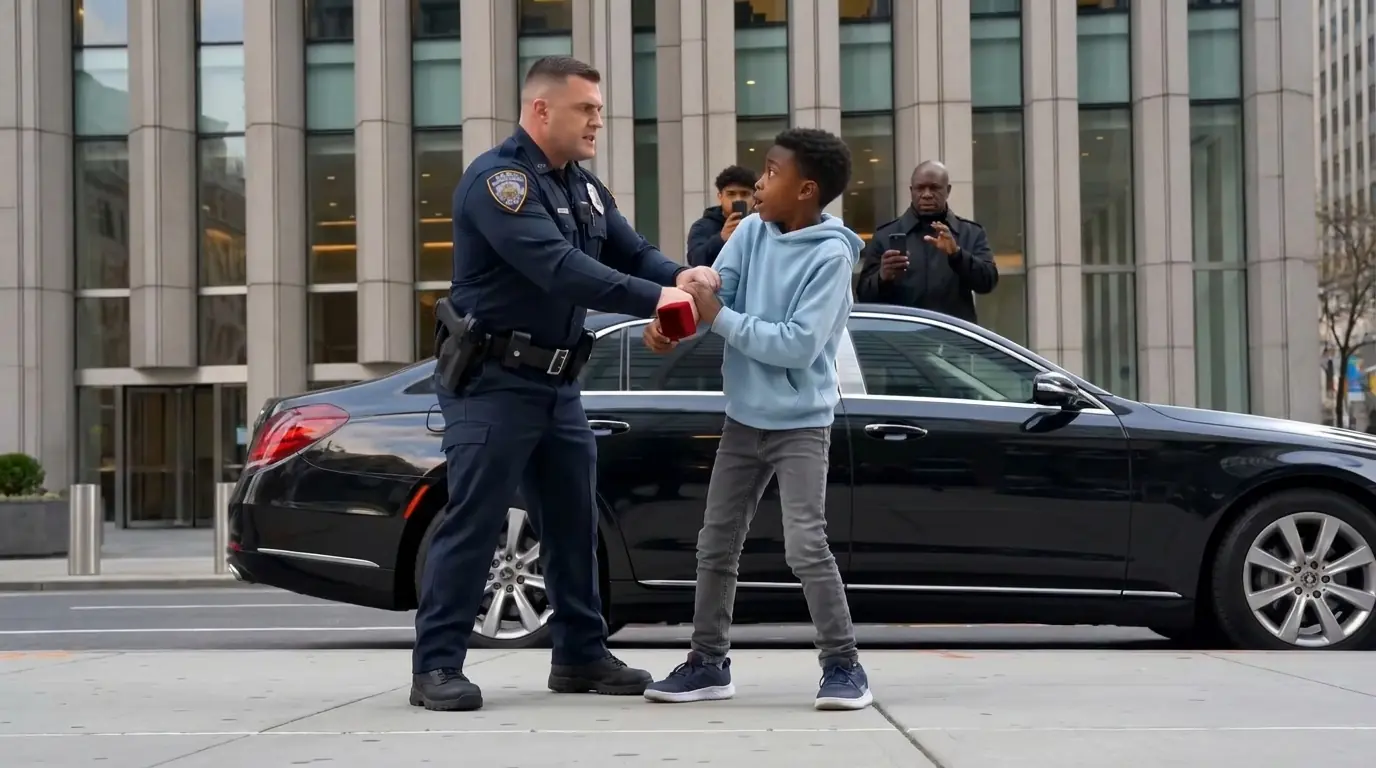
At 4:18 on a Tuesday afternoon, Malik Carter was standing on a downtown sidewalk holding a red-cased phone when a patrol officer grabbed his wrist. Malik was seventeen, Black, thin, and dressed in a pale-blue hoodie, gray pants, and dark sneakers, the kind of clothes that would have disappeared into any American high-school hallway. Behind him, office workers were leaving a marble government building while black sedans crawled through late-afternoon traffic. Malik had been standing there for less than six minutes.
Officer Travis Boone asked him again where he had gotten the phone. Malik stared at him, confused, and said the same thing he had already said twice: it was his phone. Boone stepped closer, pulled Malik’s arm toward him, and told him to stop “getting smart.” Several people near the building entrance turned to watch.
Malik tried to pull his wrist free. Boone’s other arm came up fast, and the next few seconds happened so quickly that witnesses later disagreed about whether the first contact was an open-handed strike or a violent shove. What nobody disputed was the result: Malik lost his balance, his red phone bounced across the concrete, and he dropped hard onto one knee before catching himself with both hands. Boone stood over him and ordered him to stay down.
Phones appeared everywhere.
A woman in a navy blazer began recording from ten feet away. A delivery driver stopped beside his van and did the same, while two courthouse clerks stared from the steps. Boone reached toward his duty belt and pulled out a pair of handcuffs. Malik remained on the ground, looking up at him with an expression that had moved past anger into disbelief.
Then the rear door of a black sedan opened behind them.
An older man stepped onto the sidewalk wearing a black judicial robe over a white shirt and dark tie. Judge William Harrington, sixty-three years old and one of the most respected federal judges in the district, looked first at the police officer, then at the teenager on his knees. His face changed immediately. He walked toward them and said three words that made Boone stop moving.
“That’s my son.”
The video that later spread across the country usually ended there.
It was a perfect internet moment: the officer standing over a Black teenager, handcuffs visible, the judge approaching from a black car, and the sudden realization that the young man Boone had treated like a criminal belonged to someone the officer considered powerful. Millions of viewers would celebrate the twist as if Malik’s connection to a judge were the thing that made the treatment unacceptable. Malik would eventually come to hate that interpretation almost as much as he hated the video itself.
Because the problem was not that Officer Boone had chosen the wrong Black teenager.
The problem was that he believed there could have been a right one.
Malik had moved to Arlington, Virginia, with his mother when he was eleven. Denise Carter had spent most of Malik’s childhood raising him alone while working first as a public-school counselor and later as a district student-services coordinator. Malik’s biological father lived in North Carolina and remained involved, calling regularly and taking Malik during parts of the summer, but distance meant most ordinary parenting fell to Denise. Their household had always been small, busy, and close.
William Harrington entered their lives when Malik was twelve. He met Denise at a legal-aid fundraiser where she was speaking about school discipline and the number of teenagers pushed out of classrooms for minor behavior problems. William had been a federal magistrate judge at the time and asked her nearly twenty minutes of questions after the panel ended. Denise initially assumed he was disagreeing with her.
He was not.
He asked her to dinner.
Malik did not like him at first.
William was white, formal without intending to be, and had the irritating habit of thinking silently before answering simple questions. Malik was used to adults filling empty space with words, so William’s pauses felt like judgment. The first time William asked Malik what he wanted to do after high school, Malik answered, “Survive high school,” just to see how the man reacted.
William nodded.
“Reasonable first objective.”
Malik laughed despite himself.
They became close slowly. William never demanded that Malik call him Dad and never behaved as though marrying Denise gave him automatic authority over a boy who already had a father. He simply showed up.
He drove Malik to early basketball practices when Denise had meetings. He helped him build a disastrous seventh-grade model bridge that collapsed before the teacher could test it. When Malik became interested in photography, William gave him an old camera rather than buying an expensive new one, telling him he should learn what he actually liked before spending money.
Two years later, William and Denise married.
Malik kept the Carter surname.
Nobody considered changing it.
By seventeen, he referred to William as his stepfather when explaining the relationship to strangers and usually just called him Will at home. Their bond was obvious to anyone who knew them, even though nothing about Malik’s name or appearance announced that he belonged to the Harrington household. That fact would become painfully important.
William was confirmed as a federal district judge the following year.
Malik attended the ceremony wearing a suit he hated and a tie William tied for him twice because the first knot sat crooked. Photographs from that day showed Denise smiling, William raising his hand for the oath, and Malik standing behind them trying not to look proud. He failed.
Still, William’s position remained surprisingly unimportant inside their home.
He took out the trash.
Forgot to buy milk.
Left legal pads on the dining table.
Denise regularly reminded him that federal judges were apparently not exempt from loading dishwashers.
Malik treated the courthouse like any other workplace where a parent spent too many hours.
That was why he had been there that Tuesday.
His photography class had ended early, and William had promised they would drive together to see a used car Malik had been saving toward for nearly a year. The seller lived forty minutes away. William texted at 3:51 saying his final hearing should finish around four.
Malik took the Metro downtown.
At 4:07, he reached the courthouse.
Security rules meant visitors could not simply wander into the judges’ private entrance, so William’s judicial assistant told Malik to wait near the east side of the building. A court security officer who recognized him let him know William was running a few minutes late. Malik stepped outside, put in one earbud, and checked the car listing again.
The red-cased phone in his hand had a cracked corner.
It belonged to him.
He had bought it refurbished the previous summer after dropping his old phone in a swimming pool.
Nobody inside Malik’s family considered any of those details significant.
Officer Travis Boone did.
Boone had been with the Metropolitan Patrol Division for eleven years. He was physically imposing, confident, and known among colleagues as an officer who preferred controlling situations early rather than waiting for them to become complicated. Supervisors had praised his command presence several times.
Other parts of his record were less flattering.
Three civilian complaints during the previous four years alleged that Boone had stopped young Black men without adequate explanation. One complaint involved two college students waiting beside a parked vehicle. Another came from a nineteen-year-old delivery worker Boone questioned outside a luxury condominium after assuming he did not belong there.
None resulted in formal discipline.
In each case, Boone explained that he had been responding to behavior rather than race.
The department accepted the explanation.
That Tuesday, Boone had been dispatched to a nearby electronics store after a report of shoplifting. The store manager described the suspected thief as a young Black male wearing a dark jacket and carrying boxed headphones. Security footage later established that the suspect was approximately twenty-five, heavyset, wearing a black baseball cap and red coat.
Malik matched only two things.
He was Black.
And young.
Boone never saw the store footage before approaching him.
Instead, he drove past the courthouse and noticed Malik standing near a black sedan, looking down at a phone. Boone parked and walked over. According to his later statement, he believed Malik “appeared nervous” after noticing the uniform.
Malik remembered it differently.
He noticed a police officer walking directly toward him.
So he took out his earbud.
“Hey,” Boone said.
Malik looked up.
“What’s up?”
Boone glanced at the phone.
“You been over at the electronics store?”
“No.”
“You sure?”
Malik frowned.
“Yeah.”
Boone looked him over.
“Where’d you get the phone?”
Malik stared.
“What?”
“The phone.”
“I bought it.”
“Where?”
“Online.”
Boone held out one hand.
“Let me see it.”
Malik instinctively pulled the phone closer.
“Why?”
That question changed Boone’s tone.
“Because I asked.”
Malik looked toward the courthouse entrance.
He knew enough about police encounters to understand that arguing rarely improved them. Denise had given him some version of that lecture since he was thirteen: keep your hands visible, stay calm, do not make sudden movements, remember the officer’s name, and ask whether you are free to leave. Malik hated those conversations because none of his white friends seemed to receive them.
He kept his voice level.
“Am I being detained?”
Boone’s expression hardened.
“Why are you worried about being detained?”
“I’m asking.”
“You got somewhere to be?”
“Yes.”
“Where?”
Malik pointed toward the courthouse.
“I’m waiting for somebody.”
“Who?”
“My stepdad.”
Boone looked toward the federal building.
“He work in there?”
“Yes.”
“What does he do?”
Malik hesitated.
The question felt invasive.
“That matters?”
Boone smiled slightly.
“There it is.”
“What?”
“The attitude.”
Malik looked genuinely confused.
“I’m answering you.”
“No.”
“You’re giving me a hard time.”
“I’m just asking why you stopped me.”
A woman passing behind them slowed.
Boone noticed.
He stepped closer to Malik.
“You fit the description of somebody involved in a theft.”
Malik looked down at his pale-blue hoodie.
“What description?”
Boone ignored the question.
“Hand me the phone.”
“No.”
Boone stared.
Malik immediately clarified.
“I mean, I can show you the receipt if you tell me why you think it’s stolen.”
“You don’t set the terms.”
Malik swallowed.
He could feel his heartbeat rising.
“Can I call my mom?”
Boone laughed once.
Not loudly.
Enough.
“You’re seventeen and need your mother because somebody asked you a question?”
Malik would remember that laugh longer than the shove.
It contained something familiar.
Not open hatred.
Something smaller and more ordinary.
Contempt.
The assumption that Malik’s fear was funny because Boone had already decided it was unnecessary.
Malik looked toward the courthouse again.
The woman in the navy blazer had stopped walking.
Boone followed his eyes.
“You looking for a way out?”
“I told you.”
“My stepdad’s inside.”
“What, he a janitor?”
Malik stared at him.
Boone later denied saying that.
Two videos captured it.
Malik’s expression changed.
“He works there.”
“That’s what you said.”
“Can I go?”
“I’m not done with you.”
Malik took a slow breath.
“Then tell me what I’m being detained for.”
Boone reached toward the phone.
Malik moved it back.