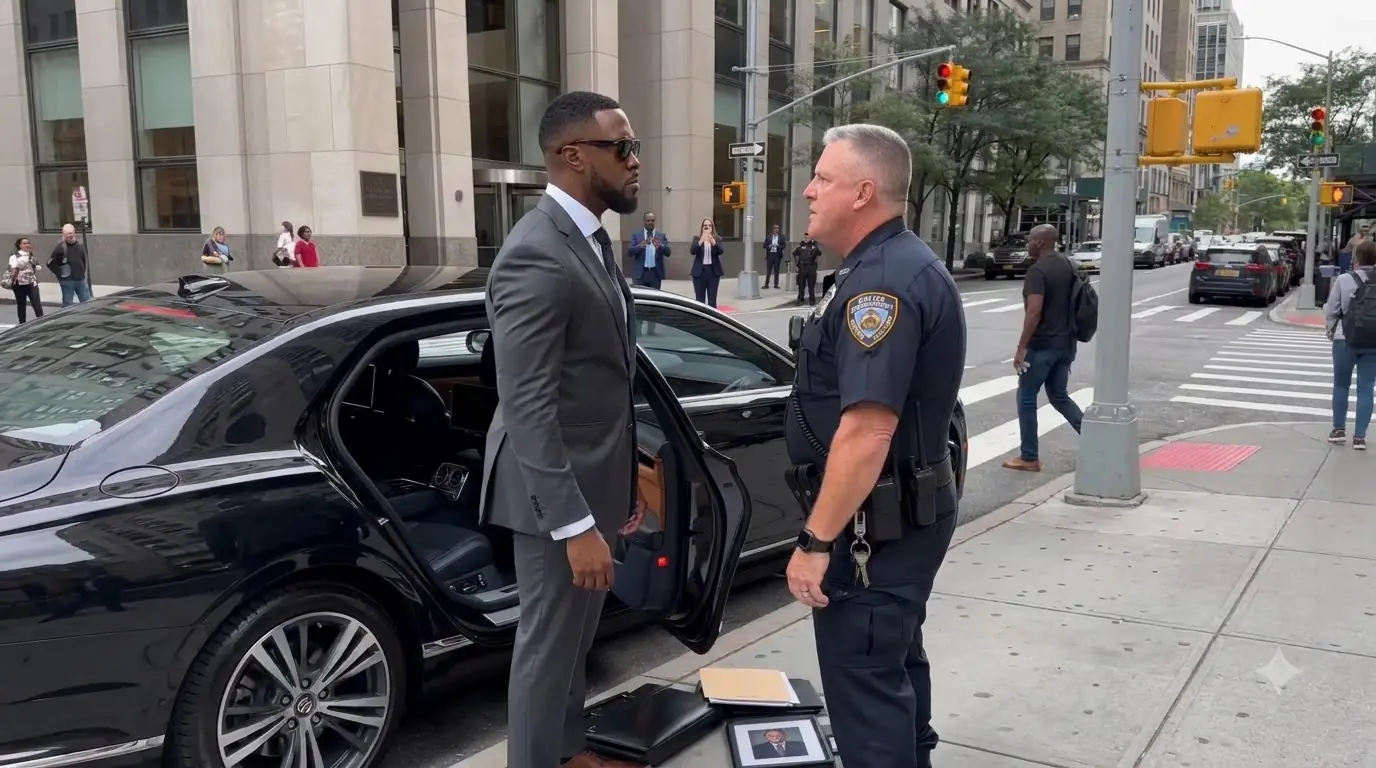
Officer Brent Lawson had spent twenty-one years wearing the same badge and slowly confusing authority with ownership. In Harbor City’s downtown business district, people knew the sound of his cruiser before they knew the number painted on the rear bumper. Restaurant workers stepped aside when he walked in, delivery drivers kept their hands visible, and young men on Jefferson Avenue lowered their voices whenever Lawson stopped nearby. He had learned that if you acted certain enough, most people eventually stopped asking whether you were right.
That confidence followed him onto Franklin Street just after eight on a bright Wednesday morning. Lawson stood beside a dark blue Audi sedan with his left hand resting on his duty belt and his right hand still hanging loosely at his side after striking the man standing in front of him. The slap had cracked through the morning traffic loudly enough to make a cyclist skid sideways near the intersection. A woman carrying two coffees stopped dead on the sidewalk.
The man Lawson had hit wore a tailored navy suit, a pale blue shirt, and a dark tie. One lens of his sunglasses had shattered when they hit the pavement, and a thin line of blood ran from the corner of his mouth. A red print had already begun spreading across the deep-brown skin of his left cheek. He did not raise his hands.
Lawson smiled.
“That’s what happens when somebody gets too comfortable.”
The crowd around them went quiet.
No one asked what he meant.
The man in the suit slowly removed a folded white handkerchief from his breast pocket and touched it to his lip. Then he looked at the metal plate on Lawson’s chest.
“Officer Brent Lawson,” he said evenly. “Badge 4472.”
Lawson’s smile widened.
He had heard that kind of voice before.
Calm.
Educated.
Careful.
The sort of voice some Black professionals used when they believed perfect grammar and expensive clothes could protect them from a man who had already decided who was in charge.
Lawson enjoyed breaking that illusion.
What he did not know was that the man bleeding on the sidewalk was Dr. Julian Cross.
And Dr. Julian Cross was supposed to walk into Harbor City Police Headquarters as the department’s new chief in eleven minutes.
Thirty-five minutes earlier, Julian had stood in front of the mirror in suite 1408 of the Weston Grand Hotel adjusting his cuff links. He was fifty, six-foot-two, lean rather than bulky, with dark-brown skin, silver beginning at both temples, and the calm expression of a man who had spent most of his adult life absorbing other people’s anger without letting it determine his own. A leather credential case rested beside his briefcase. Inside it was a brand-new gold shield engraved with four words he had not yet gotten used to reading.
CHIEF OF POLICE — HARBOR CITY.
Julian had worn a uniform for twenty-six years.
He began as a patrol officer in Baltimore.
Then detective.
Sergeant.
Captain.
Deputy chief.
He earned a master’s degree in criminal justice while working nights and later completed a doctorate in organizational leadership because he became convinced that bad policing was rarely just the product of bad individuals.
Bad systems trained people too.
Bad systems promoted them.
Bad systems excused them.
And eventually, bad systems learned to call predictable failures surprising.
Harbor City had hired Julian because the department had reached that point.
The mayor could no longer explain away the lawsuits.
The city attorney could no longer bury settlements inside routine budget reports.
Body-camera footage kept going missing.
Citizen complaints kept naming the same officers.
Black and Latino neighborhoods had stopped believing anything would change.
Business leaders were embarrassed.
Federal investigators were circling.
The department did not need a public-relations chief.
It needed surgery.
Julian had spent the previous evening reading personnel summaries in his hotel room.
One name appeared repeatedly.
Brent Lawson.
Eighteen citizen complaints in fourteen months.
Thirty-nine reported use-of-force incidents over four years.
Five civil settlements.
Three minors injured during pedestrian stops.
Two cases where body-camera footage was unavailable due to “equipment malfunction.”
Supervisors described Lawson as “firm,” “street experienced,” and “traditional.”
Julian had seen those words before.
Traditional sometimes meant effective.
Sometimes it meant everyone had stopped asking questions because the person had been doing the wrong thing for too long.
Julian closed Lawson’s file shortly after midnight.
At 7:55 the next morning, he slipped the credential case inside his suit jacket.
His official driver had called in sick before dawn.
Julian declined a replacement.
He wanted to drive himself.
One quiet trip through the city before the introductions.
One ordinary twenty-minute stretch before cameras, speeches, union meetings, command staff, politics, and the uncomfortable faces of officers who had already decided an outsider meant disrespect.
The hotel valet brought around the Audi.
Julian drove north toward headquarters.
Soft jazz played through the speakers.
At the same time, Brent Lawson sat in Unit 12 outside the Corner Cup Café on Franklin Street.
His body camera was off.
Again.
He called it battery conservation.
His supervisors had used that language too.
Lawson watched pedestrians through the windshield and drank burnt coffee from a paper cup.
He knew this part of Harbor City well.
He knew which store owners would complain.
He knew which ones had already learned complaints did nothing.
He knew which teenagers talked back.
He knew which homeless men moved when ordered.
He knew which delivery workers became nervous when asked for paperwork.
Most of all, he knew that nobody in command had seriously challenged him in years.
Dispatch crackled.
“Unit 12, reminder, command detail downtown until ten hundred hours. New chief arriving this morning.”
Lawson rolled his eyes.
“Copy.”
New chief.
Another reformer.
Probably another man who had spent more time writing policies than chasing people down alleys.
Lawson had outlasted three chiefs, four deputy chiefs, countless internal-affairs memos, two civilian-review boards, and one mayor who publicly promised a new era of accountability before losing reelection.
He knew how institutions worked.
Outrage became meetings.
Meetings became reports.
Reports became training.
Then everyone got tired.
Lawson sipped his coffee.
A dark blue Audi moved around a pothole and briefly touched the center lane marker.
Two seconds.
No danger.
No traffic.
No reason for anyone to care.
Lawson smiled.
He put down the cup.
Lights came on.
Julian saw the cruiser behind him and glanced at the dashboard clock.
8:37.
He exhaled slowly.
Then pulled over in front of a row of small businesses near Franklin and Sixth.
That location was deliberate.
Public sidewalk.
Traffic.
Security cameras.
Witnesses.
Experience had taught Julian that being legally correct and being physically safe were related but not identical concepts.
He placed both hands on the steering wheel.
The cruiser door opened.
Across the sidewalk, Maria Delgado looked up from unlocking the metal gate outside her family’s print shop.
Her stomach tightened immediately.
Lawson.
She knew the officer.
So did her nineteen-year-old nephew, Adrian.
Nine months earlier, Lawson had slammed Adrian against that same brick building because he “matched a description.”
Adrian had been seventeen at the time.
The supposed suspect had been in his late twenties.
Maria filed a complaint.
She submitted witness names.
Photographs.
A hospital bill.
The department sent a letter six weeks later saying there was insufficient evidence to establish misconduct.
Adrian still crossed the street whenever he saw a police cruiser.
Maria pulled out her phone.
Across Franklin Street, filmmaker Connor Reed was recording a morning video for his neighborhood channel. He usually filmed food carts, street musicians, local construction, weather, or whatever strange thing happened downtown before office workers took over the sidewalks. He had a modest following and was speaking into his camera about a new bookstore when he noticed Lawson approach the Audi. Connor turned his lens.
“Lawson again,” he muttered. “Let’s see what this is.”
The officer reached Julian’s window.
“License.”
Julian kept his hands visible.
“Good morning, Officer. May I ask why you stopped me?”
“License and registration.”
“I’m happy to provide both.”
“Then do it.”
“My wallet is in my left inside jacket pocket.”
Lawson leaned closer.
“Get it.”
Julian slowly reached.
He handed over the license.
Lawson looked at it briefly.
“Julian Cross.”
“Yes.”
“Registration.”
“Glove compartment.”
Lawson stared at the interior of the car.
Leather seats.
Clean dashboard.
Expensive watch on Julian’s wrist.
Then back at his face.
“What do you do?”
Julian looked at him.
“Is that related to the stop?”
Lawson’s expression changed.
“Step out.”
Julian paused.
“For what purpose?”
“I said step out of the vehicle.”
Julian understood what was happening.
Not completely yet.
Enough.
He opened the door carefully.
“I am stepping out now.”
The words were intentional.
So were his movements.
Lawson heard the narration.
He did not like it.
Julian stood beside the Audi.
One hand visible at chest level.
The other relaxed at his side.
“What was the traffic violation?”
Lawson folded his arms.
“You crossed the lane marker.”
“I moved around a pothole.”
“Hands on the car.”
Julian did not move immediately.
“Am I being detained?”
“Hands on the car.”
“Officer, I am asking whether I am detained.”
Lawson stepped closer.
“You always talk this much?”
Maria’s phone was recording.
Connor’s livestream now had more than eight hundred viewers.
Several office workers slowed nearby.
A white-haired bookstore owner named Edith Malone stepped into her doorway and watched.
She had run Malone Books for forty years.
She had watched Lawson stop people for two decades.
Young Black men.
Latino delivery drivers.
Asian college students.
Homeless people.
Men in work boots.
Men in suits.
Lawson had a way of making every encounter feel like the person had already failed a test they did not know they were taking.
Edith had called the department twice.
Nobody returned either call.
Julian placed both hands on the hood.
Lawson patted him down.
Roughly.
“You have any weapons?”
“No.”
“Drugs?”
“No.”
“Contraband?”
“No.”
“You seem nervous.”
Julian almost turned his head.
“I am not nervous.”
“You’re talking a lot.”
“I am creating a clear record of the encounter.”
Lawson’s hand stopped at Julian’s shoulder.
“A record?”
“Yes.”
The word irritated him.
Lawson opened the driver’s door.
Julian straightened slightly.
“I do not consent to a search of my vehicle.”
“Didn’t ask.”
“You do not have probable cause.”
Lawson leaned into the car.
Julian remained calm.
“I am stating clearly that you do not have my consent.”
People began gathering.
Maria moved closer to the sidewalk.
Connor narrated quietly into his camera.
“Driver has been calm the entire time. Officer is searching the vehicle. I have not heard any request for consent.”
Lawson pulled the leather briefcase from the passenger seat.
He placed it on the hood.
Then opened it.
Julian turned slightly.
“That contains confidential employment documents.”
“Then you should have thought about that before acting suspicious.”
Julian’s expression changed.
“What exactly have I done that you consider suspicious?”
Lawson removed several folders.
Transition briefing.
Community safety analysis.
Command staffing.
Outside review proposal.
A framed photograph of Julian’s father slipped onto the pavement.
Lawson glanced at the paperwork.
“Whole lot of papers.”
Julian watched his father’s photograph land face down.
“Those are not yours to search.”
Lawson looked at him.
“You telling me how to do my job?”
“I’m telling you that I do not consent.”
Maria spoke from several feet away.
“Officer, you can’t just throw his things on the sidewalk.”
Lawson snapped toward her.
“Stay out of it.”
“I’m standing outside my own business.”
“You can stand farther away.”
Edith stepped forward.
“What did he even do?”
Lawson’s face tightened.
“Police business.”
Connor called across the sidewalk.
“You stopped him for touching a lane line.”