The morning came in gray and quiet. The kind of cold that settles into stone benches and empty coffee cups left overnight. Frost clung to the edges of the fountain in the middle of the park, and the last of the autumn leaves drifted down in slow spirals, gold and rust-colored, scattering across the gravel paths. Joggers passed with their breath fogging in front of them, barely glancing at the woman who sat on the third bench from the fountain, wrapped in a coat two sizes too large. She held a worn leather notebook against her knees. Its cover cracked from years of handling, and a thin silver necklace hung from her neck, tucked beneath the collar of her coat.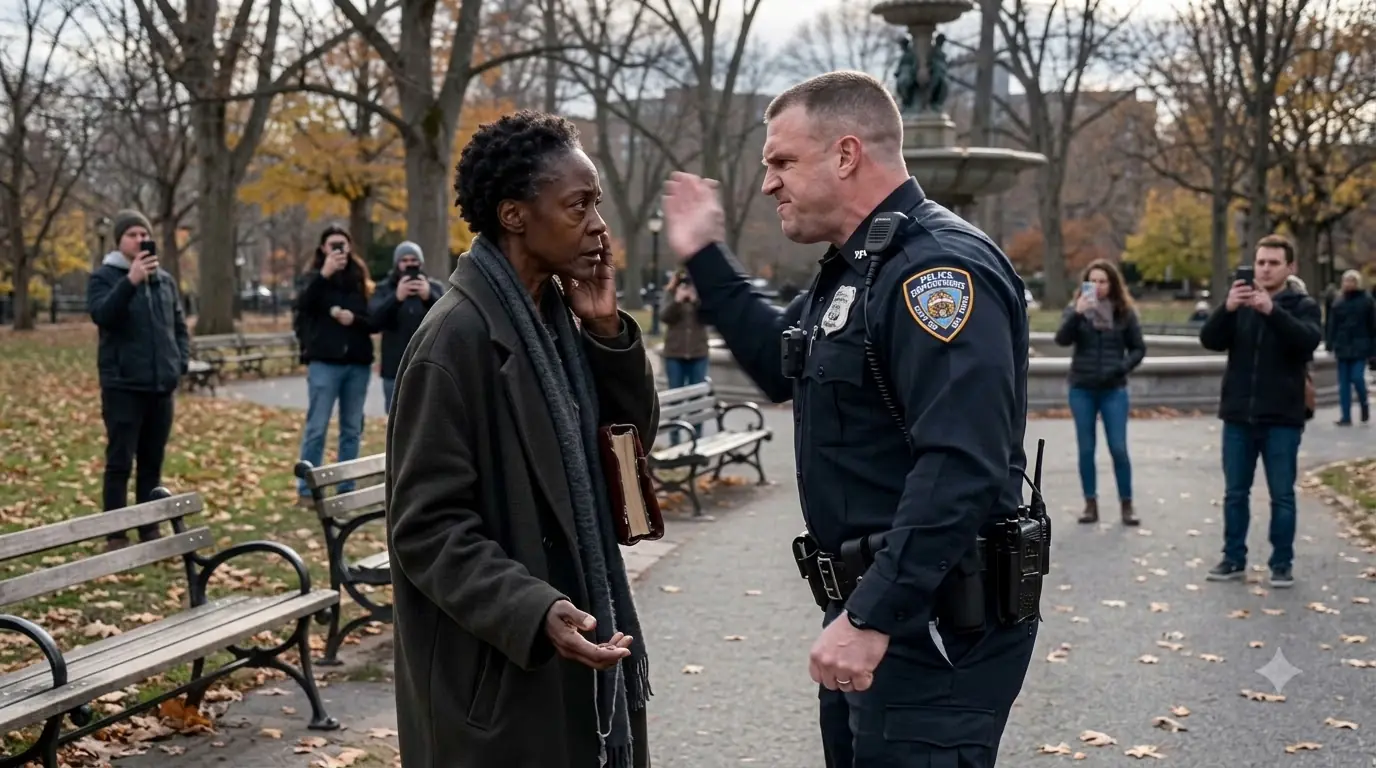
Nobody in that park knew her name. Nobody could have guessed that within the hour, armored vehicles would tear through the quiet streets surrounding that very fountain. Sirens silent but lights flashing, converging on a scene that would end one man's career and reveal a secret three years in the making. For now she was simply the woman on the bench, and the city moved past her the way it moved past all things it had already decided not to see. Her name was Zariah Monroe, 34 years old, though the lines under her eyes and the way she moved with careful deliberation made her seem both younger and far older at once.
She wrote in that notebook every single day, filling its pages with small, tight handwriting that curled across the lines like something rehearsed a thousand times before. Some of the regulars who passed through the park assumed she was troubled, that the constant writing was a symptom of something broken in her mind, and they gave her the same wide berth people give to anything they do not understand. What none of them knew was that she was not rambling at all. She was recording methodically, the way a scientist records data, the small transactions of kindness and cruelty that passed through that park every single day. She wrote about the man who fed the pigeons before dawn. She wrote about the teenager who mocked an elderly man for shuffling too slowly across the crosswalk. Each entry was dated, precise, and utterly without judgment, as though she were building an archive that only she understood the purpose of.
Leonard Price ran the coffee cart near the north entrance, a business he had built with his own hands over 22 years, and he was the closest thing Zariah had to a friend in that park. Every morning around 7, he would bring her a paper cup of black coffee, no charge, and set it gently on the bench beside her without a word, because he had learned early on that she did not like to be approached directly. He noticed things about her that others missed, the way she spoke when she did speak, careful and precise, using words that did not belong to someone who had supposedly spent her life on the street. He noticed how she never begged, never asked for money, and how she always stood and gave a small bow of the head when someone showed her kindness, as though gratitude were a discipline she practiced rather than a feeling she merely had.
A city groundskeeper once offered her a spare coat during an unexpected cold snap in October, and she accepted it graciously, folding the old one beneath her arm rather than discarding it, as though even discarded things deserved some measure of care. There were other unhoused men and women who moved through that same stretch of park, sleeping in the covered pavilion near the old bandstand when the nights grew too cold. And among them, Zariah held a strange kind of respect that nobody had ever explained. When arguments broke out over blankets or space, it was often Zariah who quieted things with nothing more than a look and a few soft words. An older man named Curtis, who had lived on those benches for nearly a decade, once told Leonard that Zariah reminded him of someone important, though he could never say who, and he laughed it off as an old man's foolish memory. Nobody pressed him further, and the thought passed like so many others in that park, unexamined and forgotten.
The truth sat quietly inside Zariah's notebook. Inside the silver necklace she never removed, inside the calm she carried like armor. And that morning, as the frost began to melt off the fountain's edge, a police cruiser turned slowly onto the access road that ran along the park's northern boundary, its engine humming low against the cold, carrying with it a man who was about to make the worst mistake of his career. Officer Travis Boon had been patrolling that district for 11 years, and in that time he had developed a worldview so rigid it had calcified into something resembling certainty. He believed with the kind of conviction that never bothered to question itself that anyone living without a permanent address was one bad moment away from causing real trouble. He had built his entire career on that belief, stopping people for the crime of existing somewhere visible, and more often than not, his superiors had looked the other way because his numbers looked good on paper.
That morning, dispatch had relayed a vague complaint phoned in by someone who claimed a woman near the fountain was harassing customers at a nearby kiosk. Though the details were thin, and the caller had already hung up by the time officers were assigned, Travis took the call anyway, eager as always to be the one who restored order, and he pulled his cruiser up along the curb with the practiced swagger of a man who had never once doubted his own righteousness. Beside him sat Officer Melissa Crane, 38 years old, quieter by nature, who had ridden with Travis for the better part of a year, and had learned to read the tension in his jaw before he ever opened his mouth. She did not share his certainty, not entirely, but she had also not yet found the courage to say so out loud. They stepped out of the cruiser and walked toward the fountain, Travis leading with the kind of exaggerated stride meant to announce his authority before he ever spoke a word.
Zariah looked up from her notebook, calm and unhurried, closing it slowly and folding her hands over the cover. Travis stopped a few feet away and pointed toward the path leading out of the park. Leave this area, he said, his voice pitched loud enough for the nearby joggers to hear. Loud enough to be a performance rather than a request. Zariah tilted her head slightly, studying him the way someone studies a puzzle rather than a threat, and she asked quite simply what law she had broken. The question landed wrong in Travis's ears, because in his mind, questions from people like her were not questions at all. They were defiance, dressed up as curiosity. His jaw tightened, and something in his shoulders squared itself for confrontation, the way it always did when he sensed his authority being tested.
A cyclist slowed his bicycle to a stop near the fountain path, one foot still on the pedal, watching the exchange with the particular curiosity of someone who sensed a story unfolding before it had fully arrived. Two women walking a small terrier paused as well, exchanging glances, their conversation trailing off mid-sentence as Travis's voice climbed another register above what the moment seemed to actually require. Melissa shifted her weight, glancing between her partner and the woman on the bench, sensing the temperature of the moment rising faster than the situation seemed to warrant. A few pedestrians slowed their pace, phones still in pockets, but attention sharpening, the way a crowd gathers around tension even before it understands what it is witnessing. Leonard from behind his coffee cart 30 feet away straightened up and watched with a growing knot in his stomach because he had never once seen Zariah cause a single moment of trouble in all the months he had known her.
Travis raised his voice again, demanding she stand and move along immediately, his hand drifting toward his belt in a gesture that was less about safety and more about theater. Zariah rose slowly from the bench, not out of obedience, but out of the same careful deliberation that governed everything she did, her notebook tucked under one arm. The wind picked up just then, sudden and sharp, tugging a thin scarf from around her neck and sending it tumbling across the gravel path toward the fountain's edge. And in that single unremarkable moment, everything was about to go terribly wrong. Zariah bent down without a word to retrieve the scarf, a motion so plain and human that under any other circumstance it would have gone entirely unnoticed. But Travis, already primed for confrontation, already convinced in his own mind that this woman intended to resist him, saw the movement as something else entirely. He saw defiance. He saw a threat dressed in the shape of a simple gesture. And before Melissa could even open her mouth to intervene, his hand shot out and struck Zariah hard across the face.
The sound of it cracked through the cold morning air like something breaking, sharp and final. And for one suspended second, the entire park seemed to stop breathing. Her silver necklace snapped loose from its clasp and fell to the gravel with a small metallic clink that somehow seemed louder than the slap itself. She did not cry out. She did not stumble. She simply stood there for a moment, one hand raised slowly to her cheek, and the stillness of her reaction was somehow more devastating than if she had screamed. Leonard was the first to break the silence, shouting from behind his cart, telling Travis in no uncertain terms that he had gone too far, that the woman had done nothing wrong. Melissa stepped forward quickly, placing a hand on her partner's arm, her voice low but urgent, telling him to stand down, that this had crossed a line neither of them could walk back from.
But Travis, flushed now with the strange mixture of adrenaline and humiliation that comes from being watched in a moment of overreach, refused to back away. He reached for his handcuffs instead, insisting loudly that the woman had resisted a lawful order and needed to be restrained immediately, his voice cracking slightly under the weight of his own justification. Around them, a small crowd had gathered, phones now raised, faces caught somewhere between horror and disbelief at what they had just witnessed in broad daylight. Zariah knelt slowly and picked up her fallen necklace from the gravel, cradling it in her palm as though it were something far more precious than silver. She looked up at Travis then, her expression unreadable, her cheek already reddening from the blow, and she spoke only a single sentence, quiet but unmistakably clear. You have just made a very serious mistake, she said. And there was nothing in her tone that resembled a threat, only a kind of quiet, terrible certainty.
Travis scoffed, waving off her words as the desperate bluff of someone trying to talk her way out of consequences, and he reached for the cuffs at his belt regardless. Melissa's stomach twisted because something about the woman's calm did not match the panic she would have expected from someone genuinely afraid, and she found herself hesitating, unsure for the first time that morning whose side the truth actually belonged to. The crowd murmured louder now, someone shouting for the officers to stop. Another voice insisting that this had all been caught on a phone camera from across the path. Travis, sweating despite the cold, seemed not to hear any of it, fixed entirely on restoring the authority he felt slipping away from him by the second. And nobody in that park, not Leonard, not Melissa, not even Travis himself, understood yet just how quickly that authority was about to collapse entirely.
Melissa finally stepped fully between her partner and the woman, her hand raised, telling him firmly that she was taking over the situation from this point forward. She turned to Zariah, softening her voice, asking if she needed medical attention for her cheek, and searching her face for any sign of the aggression Travis had claimed to see. There was none. No slurred words, no smell of alcohol, no erratic movement, nothing in her posture or her eyes that matched the description phoned in by the anonymous caller who had started this entire chain of events. Melissa had seen enough intoxicated and volatile individuals in her career to know the difference immediately. And what she saw instead was a woman standing with more composure than most people manage during a routine traffic stop.
A woman standing near the fountain, a stranger to Leonard and to the park itself, spoke up unprompted, saying she had watched the same woman calm an anxious child on a bench weeks earlier when the boy's mother had briefly lost sight of him near the carousel. Another onlooker, an older gentleman with a folded newspaper under his arm, admitted quietly that he had exchanged polite morning greetings with Zariah for the better part of a year, and had never once seen her raise her voice at anyone. Leonard came out from behind his cart, despite the risk of leaving it unattended. Walking straight up to the officers and insisting loudly enough for the gathering crowd to hear that Zariah had spent months helping people in that exact park. He told them how she had guided lost tourists to their hotels, how she had once talked down an argument between two elderly men over a parking dispute near the entrance, how she had helped an anxious mother locate her missing toddler stroller during a busy afternoon the previous summer. Passersby who had paused to watch began nodding along, a few even adding their own small memories of the quiet woman on the bench who never asked for anything but somehow always seemed to give something.
Travis, cornered now by the mounting testimony, insisted stubbornly that appearances meant nothing, that people like her were unpredictable, no matter how calm they seemed in any given moment. He reached again for his cuffs, determined to salvage some version of the authority he had walked in with, and Melissa opened her mouth to stop him outright. But before either officer could take another step, the radio clipped to Travis's shoulder crackled sharply to life. An urgent transmission cutting through the tension. Dispatch relaying words that made every officer within earshot go suddenly and completely silent. The transmission came through in clipped, controlled tones, the kind used only when something far above the paygrade of a district patrol officer was unfolding. All units in the vicinity of the park were to hold position immediately and await further instruction, the voice said, because a federal security detail was inbound and would be arriving within minutes.
Travis frowned, confused, glancing toward Melissa as though she might explain what federal business could possibly involve a homeless woman and a routine disturbance call. Neither of them had time to speculate further because the sound reached them before the vehicles even came into view. A low mechanical rumble growing steadily louder along the access road. A jogger who had stopped near the treeline described it later as the sound of something arriving with purpose, an engine note too disciplined and too heavy to belong to any ordinary emergency response. Then the SUVs appeared, three of them, black and armored, moving with a precision that suggested rehearsal rather than chaos, sweeping around the fountain in a formation that closed off every exit from that section of the park. Pedestrians who had gathered to watch the earlier confrontation now backed away instinctively, some pulling out phones again, others simply staring in stunned silence as doors opened before the vehicles had even fully stopped.
Men in dark suits stepped out first, moving with the disciplined efficiency of trained security personnel, forming a loose perimeter around the fountain without a single wasted motion. Local officers who had begun arriving as backup froze at the sight, uncertain whether to assist, retreat, or simply stand at attention because nothing in their training had prepared them for this particular collision of worlds. Then from the middle vehicle, an older man stepped out, tall and