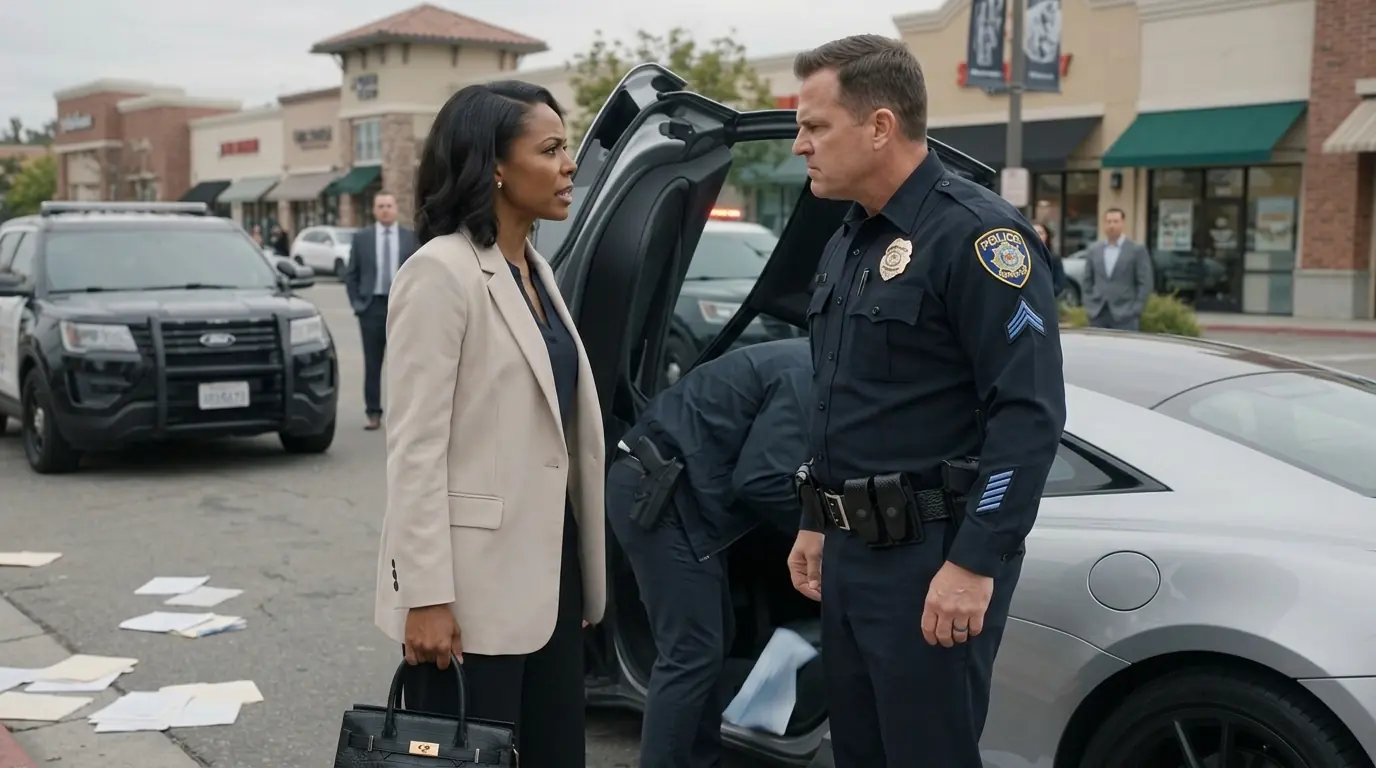
Officer Travis Boone came up behind the silver Lamborghini with his lights already flashing hard enough to paint the storefront windows blue and red. The car had been stopped less than thirty seconds when Boone strode toward the driver’s window, glanced once at the woman behind the wheel, and then looked past her toward the center console as if her face were irrelevant. “License, registration, insurance,” he said. “Now.”
The driver, Dr. Simone Carter, handed him all three documents without argument. Boone barely looked at them before tossing the cards onto the passenger seat. His attention stayed fixed on the narrow seams around the Lamborghini’s center display.
“Shut the engine off.” He pointed toward the shoulder. “Step out.”
Simone kept both hands on the steering wheel. “What is the reason for the stop, Officer Boone?”
“The rear plate looked obstructed.”
She glanced toward the side mirror. The plate was clean. No mud, no cover, no glare.
“Your dispatch call said unreadable plate.” Her voice remained level. “Yet you have not walked behind the vehicle.”
Boone leaned down toward the open window. “You enjoy telling police how traffic stops work?”
“No.” Simone met his eyes. “I notice sequence.”
His expression tightened. “Out of the car.”
Simone removed her seat belt slowly. “I will comply with the order to exit.”
She opened the door. “I do not consent to any search of the vehicle.”
Boone pointed toward a yellow maintenance stripe painted along the edge of the shoulder. “Stand there.”
Simone walked to the stripe. Her charcoal coat moved lightly in the March wind. She kept her hands visible and left her phone inside the car.
Boone immediately leaned into the cabin. He ignored the glove compartment, the door pockets, the luggage space behind the seats, and the front storage compartment.
Instead, he pressed both thumbs against the trim beneath the center screen. He tried one edge. Then another.
Simone watched for nearly ten seconds. “You seem to know exactly where you want to look.”
Boone glanced over his shoulder. “You were told to stay quiet.”
“You stopped me over a license plate.” She nodded toward the untouched rear of the car. “Now you are trying to open an interior panel.”
He returned to the console. “Possible electronic interference equipment.”
“When did that become the reason for the stop?”
Boone pressed his shoulder microphone. “Dispatch, subject is argumentative, evasive, and showing indicators consistent with concealment of an unauthorized electronic device.”
Simone looked toward the dashboard camera in Boone’s cruiser. “For the record, I have answered every question you asked.”
Boone released the microphone. “You think talking to a camera makes you safe?”
“No.” Simone folded her hands in front of her. “It makes the order harder to rewrite.”
Traffic moved steadily along East Marlow Boulevard, one of the busiest roads through Cedar Hollow, Georgia. A delivery van slowed, then continued. An elderly couple near a pharmacy watched for a moment before getting into their pickup truck.
Simone understood the hesitation. Most people did not know when intervention helped. By the time a stranger decided whether to approach, the official version could already be replacing what actually happened.
Boone pushed harder against the lower console. Plastic flexed but did not release.
Simone tilted her head slightly. “You brought no trim tools.”
He straightened. “What?”
“You expected it to open by hand.”
Boone walked toward her. “Tell me what you do for a living.”
“My occupation has nothing to do with the condition of my rear plate.”
“It might explain how you bought a Lamborghini.”
Simone looked toward the registration sitting on the passenger seat. “That document establishes legal ownership.”
Boone’s jaw tightened. “You are making this much harder than necessary.”
“No, Officer Boone.” Her voice did not change. “I am standing exactly where you told me.”
She nodded toward the car. “You are the one changing the reason for the stop.”
His shoulder radio crackled. “Unit fourteen, confirm basis for electronic inspection.”
Boone answered immediately. “Behavioral indicators and visible evidence of interior modification.”
Simone looked at the intact panel. “Nothing was visible until you opened the door.”
He ignored her.
Boone returned to the Lamborghini and pressed along the seam again. This time his frustration showed. He was not exploring the cabin.
He was trying known points in a particular order.
Simone watched his right hand disappear beneath the lower display. “Who told you where it was?”
Boone froze.
For the first time since approaching the Lamborghini, he looked at Simone as though she had become part of the scene. “Be careful what you accuse an officer of.”
“I asked a question.”
“You were told to stand there quietly.”
“You announced an illegal device before seeing one.” Simone nodded toward the console. “Then you skipped every other compartment.”
Boone stared at her.
She continued. “Either you are unusually lucky, or someone gave you instructions.”
His hand moved toward the baton clipped to his belt. He did not draw it.
“Stay behind that line.”
Simone stayed exactly where she was.
Boone pressed the radio again. “Lieutenant Graves, I need you at East Marlow. Possible restricted electronics in a high-value vehicle.”
A man answered almost immediately. “Have you opened the lower console?”
Boone’s expression changed for less than a second.
Simone noticed.
“No, Lieutenant.” Boone looked directly at her. “Panel is secured.”
“Do not remove it until Sloan arrives.”
The radio went silent.
Simone looked toward the Lamborghini. Then at Boone.
“Your lieutenant already knows which panel you are trying to remove.”
Boone stepped toward her again. “One more comment and I put you in cuffs.”
“For what?”
He stopped.
Simone smiled faintly. “Exactly.”
Nine minutes later, a dark city SUV pulled in behind Boone’s cruiser. Lieutenant Preston Graves stepped out wearing a perfectly pressed uniform and the controlled expression of a man who spent years training himself never to look rushed. He did not inspect the Lamborghini’s license plate.
He walked straight to the open driver’s door. “Did you get the panel off?”
Boone shook his head. “Wouldn’t release.”
Graves leaned inside. His eyes went immediately toward the same spot.
Simone watched from the yellow line. “Lieutenant, your officer says this began as an unreadable-plate stop.”
Graves turned. “We are beyond the initial violation.”
“No.” Simone’s tone stayed calm. “Everything after the stop depends on whether the stop had a lawful basis.”
Graves studied her. “The vehicle generated a municipal integrity alert.”
“When?”
“That information is internal.”
“If it existed before Officer Boone activated his lights, the timestamp helps you.” Simone paused. “If it was created afterward, it does not.”
Boone started toward her. Graves raised one hand without looking at him.
“Ms. Carter, you will have a chance to challenge procedure through the appropriate process.”
“I am challenging the sequence while three cameras are recording it.”
Graves walked back toward his municipal SUV. He opened a mounted laptop inside the passenger door and entered several commands.
Thirty seconds later, Simone’s Lamborghini display lit up. Her phone remained inside the cup holder, but notifications appeared on the screen.
REGISTRATION STATUS UNDER REVIEW.
A second notice followed.
INSURANCE VERIFICATION PENDING.
Then a third.
MUNICIPAL ASSET INTEGRITY HOLD.
Graves returned. “The vehicle is now under administrative hold.”
Simone looked at him. “You entered that after Officer Boone began the search.”
“The final classification controls.”
“The final classification does not change the order of events.”
For the first time, Graves’s expression showed something close to irritation. “Stand where you were told.”
A county sheriff’s unit arrived before Simone could answer. Deputy Claire Hollis, fifty-one, stepped out carrying a small leather notebook.
Graves greeted her. “Deputy Hollis, we need an independent county witness for a technical seizure.”
Claire looked first at Simone. Then at the open Lamborghini.
“Ms. Carter, are you being detained?”
Boone answered. “She’s being held pending inspection.”
Claire did not look at him. “I asked her.”
Simone replied, “I was told I could not leave.”
“Were you arrested?”
“No.”
“Did you consent to the search?”
“No.” Simone spoke clearly. “I explicitly refused.”
Claire wrote each answer down. Graves watched.
“The vehicle may contain an illegal electronic device tied to financial fraud.”
Boone added, “She displayed concealment behavior.”
Claire turned toward him. “Who first identified the device?”
Boone pointed toward the center console. “Her behavior gave me probable cause to inspect the electronics.”
Graves said, “The city alert identified the risk.”
Claire looked between them. “Which came first?”
Neither answered directly.
A dark sedan pulled into the roadside turnout. Detective Elliot Sloan got out carrying a hard-shell black equipment case.
He never introduced himself to Simone. He placed the case on the Lamborghini’s roof and opened it.
Inside were trim wedges, anti-static bags, several cables, a diagnostic reader, and specialized connector heads. Simone focused on one cable.
“That connector is fitted for this Lamborghini’s internal control bus.”
Sloan paused. “It’s a standard automotive diagnostic lead.”
“No.” Simone shook her head. “Universal diagnostic heads do not use that locking geometry.”
Boone looked at Sloan. Graves’s voice sharpened.
“Ms. Carter, you are not directing the examination.”
“I’m not.” Simone nodded toward the equipment case. “I’m observing that Detective Sloan arrived with the right connector before he examined the car.”
Claire wrote that down too.
She looked at Sloan. “Who told you what tools to bring?”
“I got a request for technical assistance.”
“From whom?”
Sloan glanced toward Graves.
Graves answered. “The request came through the department.”
Claire closed her notebook halfway. “That was not my question.”
Nobody responded.
Sloan removed the case from the roof and leaned into the Lamborghini. He went directly toward the panel Boone had been working on.
Simone looked toward Claire. “They are not searching.”
Claire waited.
“They are following directions.”
Claire stepped closer to the open door. “I want each piece identified before removal.”
Graves objected. “This is a technical inspection, not an inventory.”
Claire looked at him. “It becomes an inventory when city personnel start removing parts from private property.”
Sloan slid a narrow trim tool beneath the lower panel. The piece released with a small click.
He placed it on the passenger seat. Then he disconnected two factory leads and removed a second fitted plate.
Behind the plate sat a black graphite-colored module no larger than a poker chip.
Boone exhaled.
Graves said quietly, “Bag it before it activates.”
Claire looked toward him. “Before it does what?”
Graves did not answer.
Sloan lifted the module with gloved fingers. Instead of placing it directly into an approved evidence sleeve, he connected it to the handheld reader from his case.
A tiny green light flashed. The reader screen displayed one sentence.
ACCESS VERIFIED.
Sloan disconnected it so quickly the cable struck the side of the case.
Simone remained behind the yellow stripe. “Which one of you wants his name first on the access log?”
No one answered.
Graves looked at Claire. “Do not put that in your report. She is speculating to disrupt the examination.”
Claire continued writing. “I record statements.”