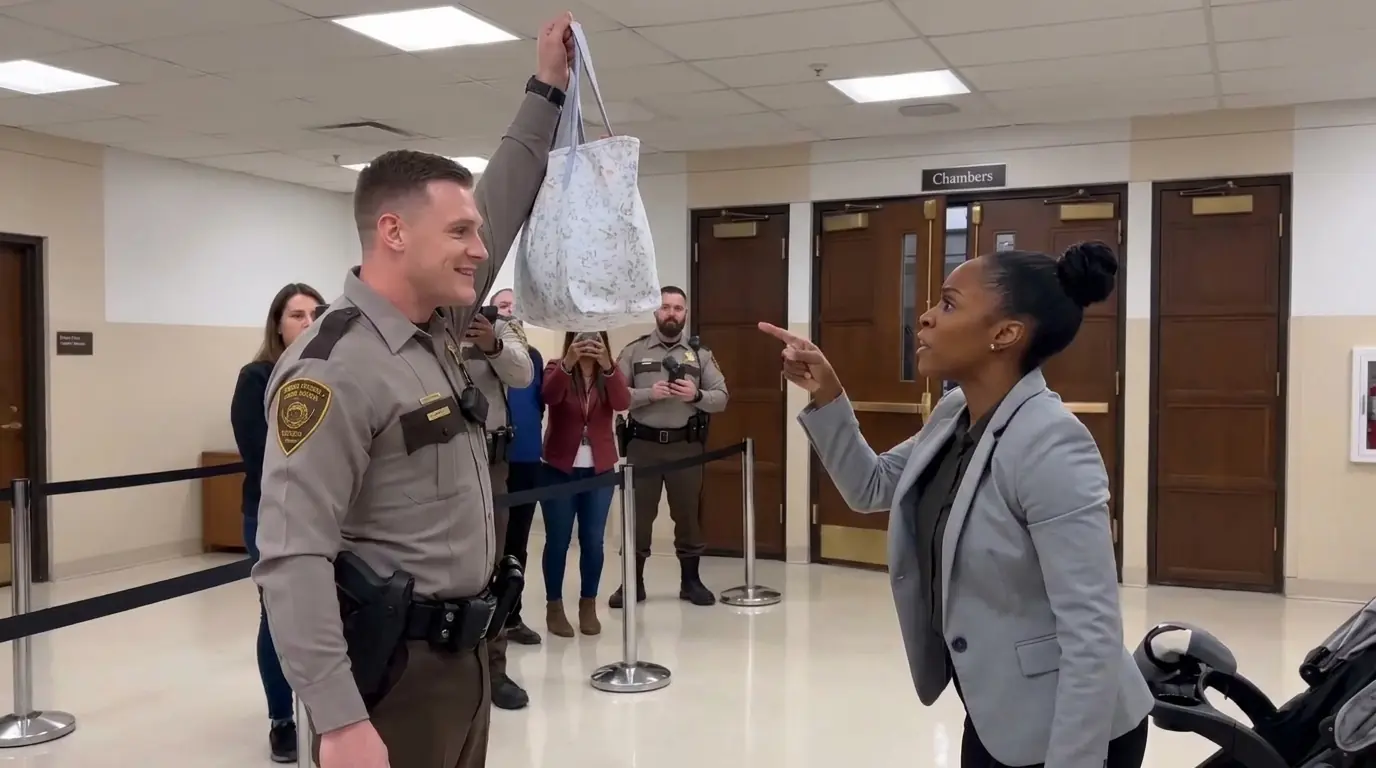
The first thing I heard after my son started screaming was the sound of his formula bottle rolling across the marble floor. It spun beneath a wooden bench while diapers, wipes, receipts, and two sealed containers of baby food spilled from my torn diaper bag around my knees. Court Security Deputy Evan Rusk still had one hand around my wrist and the other wrapped through the shoulder strap of the bag when the heavy chamber doors behind him opened. Then a man in a black federal robe stepped into the hallway and asked, very quietly, “Deputy, why is my niece on the floor?”
My name is Tessa Morgan, and I was thirty-two when this happened. My son, Noah, was seven months old, and that morning I was supposed to appear at nine o’clock for the most important custody hearing of my life. For nearly two years, I had been trying to convince a court that my former fiancé, Caleb Price, was not simply difficult, angry, or bitter about the breakup but increasingly dangerous. I believed the worst thing Caleb could do that morning was lie about me in front of a judge, and I was wrong.
The courthouse complex sat in downtown Baltimore, where an old federal annex and a neighboring state court building were connected by a secured interior corridor. Because part of the family courthouse was under renovation, several domestic-relations hearings had temporarily been moved into courtrooms inside the annex, which meant parents, federal employees, lawyers, witnesses, and judges all passed through overlapping security areas. My attorney had warned me that the building could be confusing, so I arrived forty-five minutes early carrying a blue court folder, the diaper bag, and the stroller. I had no idea that arriving early was the only reason Caleb’s plan ultimately failed.
Caleb and I had been together for almost five years. He owned a small commercial-remodeling company, made good money, dressed well, knew how to be charming when people were watching, and had a gift for explaining his anger as though someone else had forced him into it. The relationship did not become frightening all at once. It became frightening in pieces small enough that I kept explaining each one separately.
There was the night he punched a pantry door because I refused to cancel dinner with my sister, the morning he threw my phone into the backyard because he believed I had ignored one of his messages, and the argument during my pregnancy when he stood in front of my car and refused to let me leave the driveway. He always apologized afterward, and every apology came with a reason that made the incident sound less like a choice and more like weather. Stress at work, exhaustion, money, fear about becoming a father, my tone, his childhood, anything that allowed the explanation to stand where responsibility should have been. I stayed longer than I should have because people rarely leave relationships according to the clean timelines imagined by outsiders.
I finally left when Noah was six weeks old. Caleb had been angry because my mother stayed overnight to help after the baby developed reflux, and during the argument he grabbed the side of Noah’s bassinet hard enough to rock it several inches across the bedroom floor. He did not touch the baby, and for weeks he repeated that distinction as if it were the important one. What mattered to me was that I looked at my newborn son and realized I had started measuring safety by how close violence came instead of whether it belonged in the room at all.
I moved into my sister Danielle’s apartment and filed for temporary custody. The family court initially gave Caleb short supervised visits because there had been no criminal conviction and because several of the worst incidents had happened without witnesses. Over the following year, however, he violated communication restrictions, appeared twice outside my workplace, sent messages from alternate numbers after being blocked, and once followed my car for nearly four miles after a custody exchange. None of those incidents alone ended his parental rights, but together they created the record my attorney needed for a longer-term custody order.
The hearing scheduled that morning was supposed to address permanent custody, future visitation conditions, and an extension of the protective order. My attorney, Rachel Sloan, had spent weeks organizing text messages, police incident numbers, daycare records, medical notes, and photographs of damage from my old apartment. The thick blue folder contained copies of the most important evidence because Rachel believed mothers carrying babies through courthouse hallways should not need to rely entirely on electronic files. That folder was the first thing Deputy Rusk tried to take from me.
I entered through the east security checkpoint at 8:09. An officer there checked my identification and noticed the red banner attached to my courthouse entry paperwork identifying me as a protected domestic-violence litigant. Because Caleb was already inside the complex with his attorney, the standing order directed security to route me through a separate second-floor corridor so we would not cross paths before the hearing. The officer called ahead, confirmed my name, and told me exactly which elevator to use.
Everything was normal until I reached the second floor. Noah had fallen asleep beneath the stroller canopy, and I was pushing him toward Courtroom 2B when Rusk came out from beside a security desk and blocked the hallway. He was forty-five, broad across the shoulders, and wore the expression of a man who had already decided he was correcting somebody. Before introducing himself, he said, “You can’t take that bag through here.”
I stopped and pointed toward the screening sticker attached to the strap. “It was checked downstairs.” Rusk said second-floor security had different rules and told me to place the diaper bag on the desk. I explained that I was on the protected-entry route and had been specifically directed to keep moving toward 2B.
That seemed to annoy him. “Everybody thinks their paperwork makes them special,” he said, reaching toward the bag. I stepped back and told him the documents were court exhibits, not something he could simply pull apart in the hallway. Instead of checking the protected-entry notice, he looked at me and said, “Sweetheart, you can cooperate now or make a scene and miss your hearing.”
My entire body went cold. Caleb used the word sweetheart only when he was angry. More importantly, a text he had sent me the previous night ended with almost the exact same threat: Keep pushing this and you’re going to make a scene tomorrow, sweetheart. Don’t be surprised when you miss your hearing.
At the time, I had assumed it was intimidation. Caleb sent threats wrapped in ambiguity because he had learned that phrases like you’ll regret it sounded different on paper than something specific enough for police. I printed the message anyway and placed it inside the blue folder. Hearing Rusk repeat the same language should have made me understand immediately, but fear does not always organize evidence as quickly as hindsight does.
I said, “Who told you my name?” Rusk did not answer. Instead, he reached for the diaper bag again and told me to stop being difficult.
I placed one hand over the strap. “Call the downstairs checkpoint if you think there’s a problem.” Rusk said he did not need permission from another officer to search property in his corridor. I reminded him that the bag had already been screened, and he answered, “Then you shouldn’t have anything to hide.”
That was when I noticed something else. He had never asked to inspect the stroller itself, even though the stroller was larger than the diaper bag and contained compartments beneath Noah’s seat. If this were really about security, the choice made little sense. His attention stayed fixed on the bag containing my custody records.
I tried to move around him. Rusk stepped sideways and caught the stroller handle with one hand. Noah shifted beneath the canopy.
“Do not touch the stroller,” I said. Rusk answered, “Then stop trying to push past me.”
“I’m trying to reach my courtroom.”
“You’re going nowhere until I clear you.”
I took my phone from my jacket pocket. Rusk immediately grabbed my wrist.
The pain surprised me more than the contact. He twisted my arm downward and told me not to reach for anything without permission. My phone hit the marble.
Noah woke.
His first cry was confused rather than frightened. Then Rusk shoved the stroller sideways with his knee to create space between us, and the front wheel struck the wall. Noah screamed.
Every instinct in me changed. I stopped thinking about court rules, custody strategy, or whether I sounded cooperative. “Get away from my baby,” I said.
Rusk reached for the diaper bag again. The strap caught beneath my arm, and when he pulled, I lost my balance. I went down on one knee beside the stroller.
The zipper tore.
Formula rolled across the floor.
Diapers scattered.
The blue folder fell open.
Rusk looked directly at the visible court caption containing my name and Caleb’s.
He had every opportunity to stop.
Instead, he said, “You should’ve listened when you were warned.”
That sentence mattered even more than sweetheart.
I looked up at him. “Warned by who?”
His expression changed for half a second.
Then the chamber doors opened.
Judge Malcolm Avery stepped into the corridor with two law clerks behind him. He was sixty-one, silver-haired, tall, and had served on the federal bench for thirteen years. He was also my mother’s older brother.
I had not called him about the hearing. Uncle Malcolm had deliberately stayed away from my custody litigation because he was a federal judge, because the case belonged in state family court, and because he believed family connections should never create the appearance of judicial influence. I knew his chambers happened to be in the same complex during renovations, but I had not even told him what time my hearing started.
Seeing him there felt impossible.
His eyes moved from Rusk’s hand around my wrist to the torn diaper bag, the scattered paperwork, the stroller pressed against the wall, and finally Noah’s red face. He did not ask what I had done. He asked the deputy why I was on the floor.
Rusk released me immediately. His posture changed so quickly that even in shock I noticed it.
“Judge Avery, she refused screening,” he said. “She became combative when I attempted to secure the bag.”
Uncle Malcolm looked at me. “Are you hurt?”
“My wrist.”
“And Noah?”
“I don’t know.”
That answer moved him faster than anything else.
He called to one of his clerks to contact courthouse medical staff. Then he looked toward Rusk and said, “Step away from her and do not touch anything else.”
Rusk tried again. “Your Honor, I was following security procedure.”
Uncle Malcolm pointed toward the protected-entry paperwork lying open on the floor. “Did you read that?”
Rusk did not answer.
A deputy marshal named Simone Keller appeared from the chambers behind him. Malcolm asked her to secure the immediate hallway, preserve camera footage, and notify the court security supervisor.
He did not order Rusk arrested. He did not take his badge. He did not threaten his career.
Later, people online would complain that he should have done all three.
I am grateful he did not.
The moment Uncle Malcolm realized I was involved, he understood that any investigation needed independent control. He could stop an immediate threat, preserve evidence, and report what he witnessed. He could not become prosecutor, disciplinary officer, and protective uncle simply because he wore a robe.
That restraint saved the credibility of everything that came afterward.
Medical staff checked Noah first. He was frightened but uninjured, and the stroller had absorbed most of the impact against the wall. My wrist was already swelling.
Rusk remained twenty feet away under another officer’s supervision. He kept looking toward the open blue folder.
That frightened me more than the bruise.
I picked up the text Caleb had sent the night before. My hands were shaking.
Uncle Malcolm saw it.
“What is that?”
I gave him the page.
He read the sentence containing sweetheart and miss your hearing.
Then I told him exactly what Rusk had said.
For several seconds, Malcolm became completely still.
He looked toward Deputy Keller. “Was Rusk assigned to this corridor?”
She checked her radio.
“No.”
That was the first objective break in the story.
Rusk’s assigned post was at the loading entrance on the ground floor.
Keller asked dispatch when he left.
The answer came back: 8:05.
Four minutes before I reached the second floor.
Rusk claimed another officer asked him to assist upstairs.
No such request appeared on the radio log.
Then Keller asked how he knew I was approaching.
Nobody had an answer yet.
My hearing was twenty-five minutes away.
Rachel Sloan called while medical staff wrapped my wrist.
I answered.
“Where are you?”
“Second floor.”
“You’re supposed to be outside 2B.”
“I know.”
“Tessa, Caleb’s attorney is already saying you’re late.”
I looked at the clock.
8:36.
“I’m not late.”
“Not yet.”
I told her what happened.
Rachel went silent.
Then she said, “Do not move unless security escorts you.”
“I need to get upstairs.”
“I know.”
“He wants me to miss it.”
“Who?”
“Caleb.”
That was the first time I said it aloud.
Rachel did not dismiss the theory.
She also did not accept it as fact.
“Then we prove what we can and separate it from what we suspect.”
That sentence became the standard for the next year of my life.
Uncle Malcolm contacted the administrative judge overseeing the temporary court arrangement, not the judge assigned to my custody case directly. The administrative office notified Family Court Judge Elaine Porter that a protected litigant had been delayed by a security incident inside the building. My hearing was held rather than defaulted.
Judge Porter placed the delay on the record.
That was all.
No favors.
No secret phone call fixing my case.
Just a record stating why I was not yet inside the courtroom.
At 8:48, Deputy Keller received the first camera review. The second-floor hallway footage was intact.
It showed Rusk arriving several minutes before me.
He stood near the elevator and checked his phone repeatedly.
When I appeared, he moved toward me immediately.
The video showed no security alarm.
No report from another officer.
No unusual behavior from me.
Then came the grab.
The stroller strike.
The bag tearing.
The footage had no useful audio from that distance, but visually it destroyed the claim that I suddenly became physically aggressive.
Rusk’s face changed when he learned the cameras worked.