Words are like the wind. Actions are what will. The old Apache woman collapsed beside the trail, barely alive. Every instinct told the cowboy to keep riding because helping her could cost him everything, but he couldn’t leave her there to die. He carried her home, treated her wounds, and asked for nothing in return.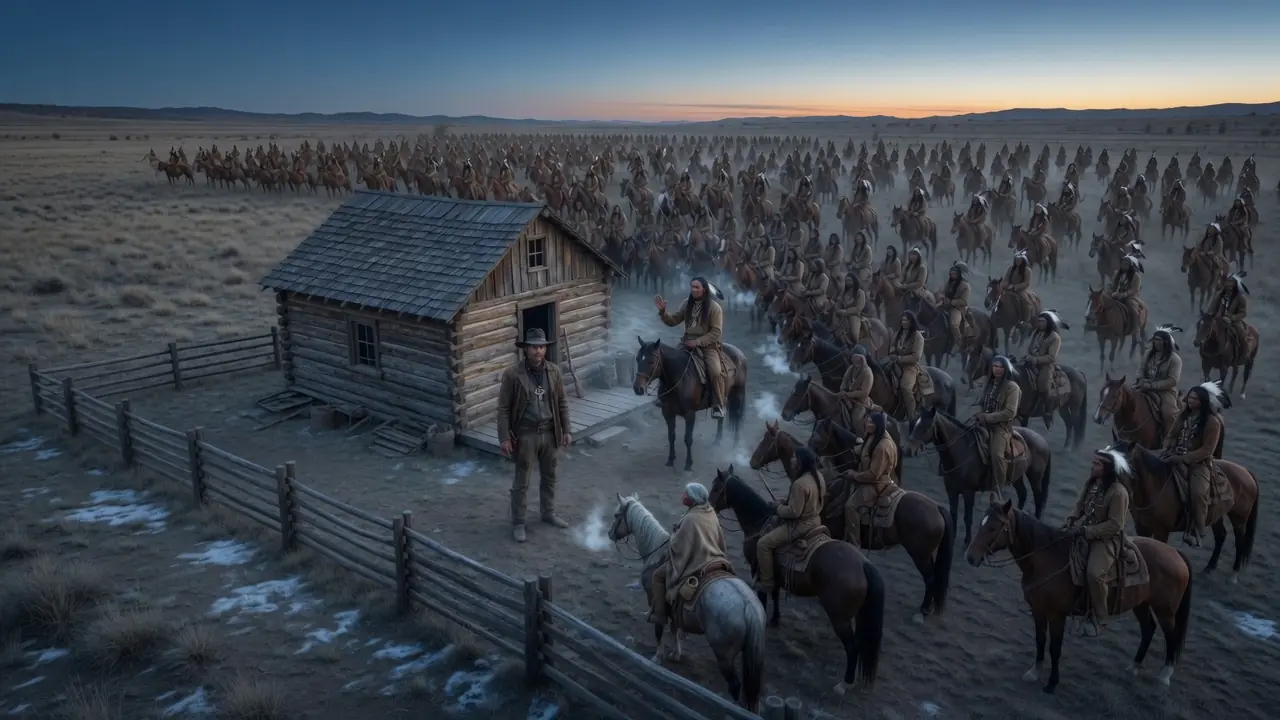
For three days, the ranch stayed silent until dawn. The thunder of dozens of horses shattered the morning. The cowboy stepped outside and froze. Forty Apache warriors had surrounded his ranch. Their faces revealed nothing. Their weapons were ready. And the man who had shown one act of kindness had no idea whether he was about to be honored or buried.
The cowboy had spent most of his life working the same stretch of land on the edge of the frontier. His small ranch sat alone where open grasslands met rocky hills, only a few miles from Apache territory. People in nearby settlements knew him as an honest, hardworking man who never looked for trouble and always kept his word. He had no wife, no children, and no family left to share the quiet evenings. His horses, cattle, and faithful ranch dog were his only companions, and he had long accepted the peaceful loneliness of ranch life.
Every morning before sunrise, he repaired fences, checked the cattle, gathered firewood, and rode the property to make sure everything was in order. The work was demanding, but it gave him purpose. By evening, he usually returned home tired, cooked a simple meal, and watched the sun disappear behind the distant mountains. It was a predictable life, one he appreciated because it offered peace in a land that often knew very little of it.
That peace, however, was becoming harder to hold on to. Relations between local settlers and nearby Apache groups had grown increasingly tense. Stories of stolen livestock, burned camps, and violent encounters spread from ranch to ranch, though no one seemed to know which stories were true and which had grown larger with every telling. Fear had replaced trust. Settlers warned each other never to approach an Apache, while many Apaches believed every settler was an enemy. The invisible line separating both worlds seemed to grow wider every day.
One evening, while riding home before sunset along a little-used trail, the cowboy noticed what looked like a bundle of blankets lying beside the path. As he guided his horse closer, he realized it was an elderly Apache woman. She was barely conscious. Her clothes were torn, her face covered with dust, and her lips were dry from severe dehydration. Several bruises marked her arms, and it was obvious she had been traveling alone for far too long. She looked only moments away from death.
Carefully, he lifted the frail woman onto his horse and slowly guided the animal back toward the ranch. Once home, he cleaned her wounds, gave her cool water, prepared warm food, and laid blankets over her inside the cabin. She spoke only a few words of broken English, but her grateful smile and gentle nods said more than language ever could. As darkness settled over the lonely ranch, the cowboy sat quietly outside staring toward the distant hills. He knew helping her might change everything. The only question left was who she truly was and whether someone was already searching for her.
The elderly Apache woman remained at the ranch for several days while her strength slowly returned. At first, she was too weak to stand without assistance. So the cowboy made sure she had fresh water, warm meals, and a comfortable place to rest. Each morning before tending to his cattle, he checked her injuries and replaced the clean bandages around her arms and feet. Though they shared very few words, they gradually developed an understanding built on patience and simple acts of kindness.
The woman watched him work from the cabin porch whenever she felt strong enough to sit outside. She noticed how carefully he treated his horses, how he never wasted food, and how he respected the land that provided his living. She also saw the loneliness hidden beneath his quiet nature. Inside the cabin were faded photographs of his late parents, an old family Bible, and a few treasured keepsakes that suggested everyone he had once loved was gone. Without asking questions, she understood that he carried his own burdens in silence.
As the days passed, they communicated through gestures, smiles, and the few English words she knew. Sometimes she pointed toward the mountains while telling short stories in her own language. Although the cowboy could not understand the words, he listened respectfully believing every person deserved to be heard. In return, he shared simple stories about ranch life, often making her smile even if she understood only part of what he said.
When she finally became strong enough to leave, the cowboy saddled his horse to escort her part of the way back toward the hills. Before climbing onto the horse, the woman reached beneath her blanket and removed a small handcrafted necklace made from leather and carved stone. The symbol hanging from it was unlike anything the cowboy had ever seen. She gently placed it into his hand and closed his fingers around it. Looking directly into his eyes, she spoke slowly in broken English. Keep always. One day save you.
The cowboy smiled politely, unsure what she meant. To him, it seemed like nothing more than a heartfelt gift from someone whose life he had helped save. He thanked her, slipped the necklace into his pocket, and watched as she disappeared into the distant hills without looking back.
It did not take long for word of his actions to spread. A neighboring rancher had seen the woman leaving, and soon everyone in the nearby settlement was talking about it. Some called the cowboy foolish. Others accused him of risking every family in the valley by helping someone they considered an enemy. They warned that Apache warriors might soon arrive seeking revenge or believing he had interfered in matters that did not concern him.
Several friends urged him to leave the ranch until the rumors died down. They insisted that staying would only invite trouble, but the cowboy refused. He had not helped the woman for praise or reward, and he would not abandon the home he had spent years building simply because others feared the consequences of compassion.
A few evenings later, as the sun dipped below the horizon, the cowboy glanced toward a distant ridge and noticed several riders silhouetted against the fading light. They remained perfectly still, watching the ranch without making a sound. After a long moment, they turned their horses and disappeared into the darkness, leaving the cowboy with the uneasy feeling that something far bigger was about to unfold.
Several days passed without incident, and the cowboy began to believe the rumors had been nothing more than frightened speculation. He returned to his usual routine, repairing fences, feeding the horses, and preparing for the coming winter. Although he remained alert, life on the ranch slowly settled back into its familiar rhythm.
Then, before sunrise one cold morning, he was awakened by an unfamiliar sound. At first, it was distant and faint, like rolling thunder across the plains. As the noise grew louder, he realized it was not thunder at all. It was the steady rhythm of dozens of horses moving together. The ground itself seemed to tremble beneath their hooves.
The cowboy climbed out of bed, quietly reached for his rifle, and stepped toward the cabin window. Pulling back the curtain, he felt his heart stop. Mounted riders surrounded the ranch from every direction. There were not five or ten of them, but nearly forty Apache warriors. Their horses stood silently in a wide circle around the property, leaving no clear path for escape. Every warrior carried weapons, and none of them spoke a single word. The silence was far more terrifying than shouting would have been.
For a long moment, the cowboy simply stared. He remembered every warning the settlers had given him. Perhaps this was the price for helping the old woman. Perhaps they believed he had kidnapped her, or perhaps they had come to avenge some past wrong committed by another settler. Whatever the reason, he understood that one man stood no chance against forty warriors. He took a slow breath and accepted what might be his final morning.
Instead of hiding inside the cabin or attempting to flee, he placed the rifle by the door. He knew that firing even a single shot would almost certainly turn the ranch into a battlefield. If death was coming, he would meet it with dignity rather than panic. The cowboy stepped onto the front porch, his hands clearly visible. The cold morning air was still, and even the birds seemed silent. Every pair of eyes remained fixed on him as if waiting for his next move.
Then one rider separated from the group. An older warrior wearing a feathered headdress and carrying himself with quiet authority slowly guided his horse toward the cabin. The others remained exactly where they were, disciplined and motionless. It was immediately clear that this man was their leader. The cowboy stood his ground, refusing to show fear even though his pulse raced inside his chest.
As the leader approached, his sharp eyes studied every detail of the ranch before finally resting on the cowboy himself. Without thinking, the cowboy reached into his coat pocket. His fingers touched the small necklace the elderly woman had given him days earlier. Remembering her strange words, he slowly removed it and placed it around his neck. The Apache leader noticed the carved symbol instantly. His expression changed. He raised one hand high into the air. At once, every warrior lowered his weapon. The tension that had filled the ranch only moments before seemed to disappear, leaving the cowboy completely confused. He had expected an attack, yet the warriors now looked at him with something entirely different.
The leader brought his horse to a stop only a few feet away and spoke calmly in clear English. “Tell me,” he said, his eyes fixed on the necklace, “where did you get the mark of my mother?” The cowboy realized this unexpected morning was not the end of his story. It was only the beginning.
The cowboy looked at the Apache leader for a long moment before answering. Slowly, he explained everything that had happened. He described finding an elderly woman lying beside the trail, too weak to move and barely able to breathe. He told how he had carried her back to the ranch, cleaned her wounds, given her food and water, and allowed her to rest until she recovered. Finally, he spoke about the small necklace she had placed in his hand before leaving, along with her mysterious promise that one day it might save his life.
The Apache leader listened without interrupting. When the story was finished, he climbed down from his horse and stood silently for several seconds. Then, to the cowboy’s complete surprise, the leader placed a hand over his heart and bowed his head. “The woman you saved,” he said, “is my mother.” The words left the cowboy speechless.
The leader explained that his mother was one of the tribe’s most respected elders. She was known for her wisdom, her courage, and the guidance she had given generations of Apache families. Several days earlier, she had disappeared while traveling through the hills. Search parties had looked everywhere, but they found only faint tracks before losing her trail among the rocks. Many in the tribe had feared she had died alone in the wilderness.
When she finally returned home, weak but alive, she told them about the cowboy who had rescued her without asking for anything in return. At first, some warriors found the story difficult to believe. Years of conflict had taught them to expect fear or hatred from settlers, not compassion. Yet she insisted that every word was true. To remove all doubt, she told them she had left behind her personal necklace, a symbol recognized throughout the tribe and carried only by members of her family.
The leader explained that scouts had followed her trail back to the ranch, not to seek revenge, but to discover whether the man she described truly existed. They had surrounded the ranch that morning because they needed certainty before trusting someone from the other side of the frontier. The cowboy finally understood why the warriors had remained silent. They had not come looking for a fight. They had come looking for the truth.
The elderly woman slowly rode forward from the back of the group. She smiled warmly as she looked at the cowboy, and he immediately recognized the quiet kindness in her eyes. She spoke to her son in Apache, and the leader nodded with deep respect. Turning back toward his warriors, he raised his voice so everyone could hear. “This man saved the life of our mother when he had every reason to walk away. He chose honor over fear. From this day forward, he is a friend.”
One by one, the warriors lowered their heads in respect. Several stepped forward carrying gifts they had brought with them. They offered two strong horses, beautifully woven blankets, handcrafted tools, dried food, and supplies that would help the cowboy through the coming winter. He accepted them with humility, overwhelmed by a gratitude he had never expected.
As the sun climbed above the horizon, the atmosphere that had begun with fear transformed into one of respect and understanding. Men who had expected to become enemies now stood together in peaceful conversation. Before preparing to leave, the Apache leader invited the cowboy to visit their village whenever he wished. The cowboy looked around at the faces surrounding him and realized that a single act of compassion had accomplished something years of suspicion never could. It had opened the door to trust.
The cowboy accepted the Apache leader’s invitation a few weeks later. Although he felt uncertain at first, he believed that trust could only grow if both sides were willing to take the first step. When he arrived at the village, he was welcomed not as an outsider, but as an honored guest. The elderly woman greeted him with a warm smile, and the leader introduced him to families who had heard the story of the stranger who had saved one of their own without expecting anything in return.
As the months passed, the friendship between the cowboy and the Apache community became stronger. He visited the village several times each year, and members of the tribe often stopped by his ranch during their travels. They shared meals, exchanged stories, and learned from one another. The cowboy taught a few young warriors better ways to care for horses and repair ranch equipment, while Apache hunters showed him hidden springs, safe mountain trails, and survival skills that only people raised on the land could know.
News of the growing friendship spread throughout the region. At first, many settlers refused to believe it. Some thought it was only a temporary peace that would soon come to an end. Others questioned whether the cowboy had made the right decision by trusting people they had feared for so long. But as time passed, they could no longer ignore what was happening. Trade slowly began between nearby ranches and the Apache community. Horses, leather goods, blankets, tools, and food were exchanged fairly instead of being taken by force. Families who had once lived in constant fear started seeing familiar faces instead of enemies. While disagreements still happened from time to time, they were settled through conversation rather than violence.
The elderly Apache woman continued visiting the ranch whenever her health allowed. She often sat with the cowboy on the front porch as the sun disappeared behind the hills. Although they still spoke different languages, they had long since learned that friendship did not always require words. A smile, a shared meal, or simple silence was often enough.
The Apache leader never forgot the promise he had made on that unforgettable morning. He reminded every new generation that the cowboy’s ranch would always be considered a place of friendship and respect. Likewise, the cowboy never forgot the lesson the old woman had taught him. Whenever travelers asked why he had risked everything for a complete stranger, his answer never changed. A person in need is still a person.
Years passed and the story of the forty Apache warriors surrounding the lonely ranch became one of the most talked about legends in the region. Whenever people first heard the tale, they expected a bloody battle between a single cowboy and an army of warriors. Instead, they were surprised to learn that the greatest victory came without a single shot being fired.
The cowboy never considered himself a hero. He believed he had simply done what any decent person should have done. Yet those who knew the full story understood that true courage is not always measured by strength or skill with a weapon. Sometimes it is measured by the willingness to show compassion when fear tells you to turn away.
Long after both the cowboy and the elderly woman were gone, people continued telling their story around campfires and family tables. It reminded every generation that kindness has the power to cross even the deepest divisions. One act of compassion saved one life that evening beside a lonely trail, but its kindness reached far beyond that single moment, proving that a single good decision can change countless lives forever.