Nobody looked twice when I walked onto the first tee at Crown Hollow that morning, and that suited me fine.
The course sat behind iron gates, stone walls, and rows of magnolia trees trimmed so carefully they looked almost artificial. Southern heat already shimmered above the fairway, turning the grass into a bright green sheet under the late-morning sun. I had come wearing a faded navy polo, plain khaki pants, scuffed golf shoes, and the kind of old leather glove no wealthy man would bother repairing twice.
After nine months of investigations, classified briefings, funerals, and sleepless flights between bases, I wanted eighteen holes without a uniform, without a motorcade, and without anyone calling me “sir” unless they meant it casually.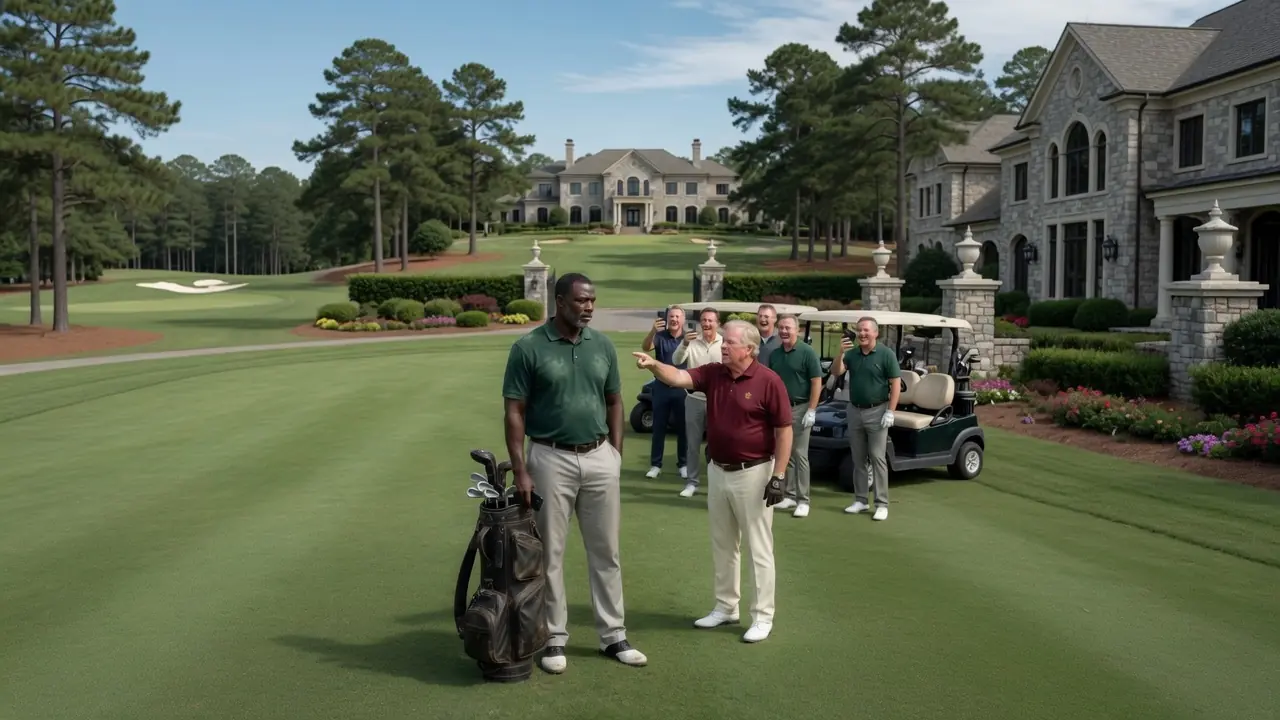
The only thing tying me to the world I had tried to escape was a secure phone in my pocket. It rested there like a sleeping animal, silent but ready to wake the second the country needed something from me. For one morning, I had decided to let the sun hit my face and let the quiet hold.
Then Everett Shaw came rolling toward the tee box.
I heard him before I saw him. The loud laugh, the bright clink of ice in crystal glasses, the expensive engines humming behind customized golf carts that looked more like small luxury cars than course vehicles. Shaw had built a fortune selling armored vehicles, combat systems, and emergency equipment to the government, and he liked to remind everyone that soldiers trusted his company with their lives.
His commercials showed flags snapping in the wind, young troops hugging families, and heroic music swelling behind slow-motion footage of steel and fire.
But men like me had seen the invoices behind the speeches.
Everett Shaw loved the military the way a butcher loved cattle. He respected its size, feared its power, and measured its value by how much money could be carved from it. He came up the cart path in white slacks, a pale blue shirt, and a gold watch thick enough to look like a handcuff made for rich men.
Three executives rode behind him, laughing before anything funny happened.
They saw me standing near the tee marker with my old bag propped beside me, and all four of them slowed down. Shaw’s eyes moved over my Black skin, my cheap-looking clothes, and the plain canvas towel hanging from my clubs. I watched him decide who I was before he bothered learning anything real.
That is a dangerous habit in ordinary men.
In powerful men, it can ruin lives.
“Hey,” Shaw called, pointing with two fingers like he was summoning staff. “What are you doing out here?”
I looked at him for a moment. “Playing golf.”
His friends laughed.
Not because the answer was funny, but because men like that laugh when the richest man in the group gives them permission. Shaw stepped out of the cart and tilted his head at my bag. “Caddies don’t play Crown Hollow’s executive course.”
“I’m not a caddie,” I said.
He smiled the way a man smiles when he believes correction is disrespect. “Then you’re lost.”
The starter, who had checked me in fifteen minutes earlier, stood near the clubhouse pretending to read something on a clipboard. A pair of older golfers beside the practice green lowered their voices and looked away. People always notice injustice more clearly than they admit, but noticing is easier than interfering.
I placed my driver against the grass and took one slow breath.
“You should be careful,” I said, “about confusing silence with permission.”
Shaw blinked once, then laughed louder. “Listen to this. The help has a speech prepared.”
One of his companions, a round-faced man in red pants, smirked into his drink. Another lifted his phone just enough to record, maybe because the morning had suddenly become entertainment. Shaw turned his body so the nearby golfers could hear him better.
“This is a private course,” he announced. “Not a public park. Not a charity field. Not somewhere people wander in because they saw grass and got curious.”
“I have a tee time,” I said.
“Of course you do.”
His voice dripped with mockery. He looked toward two course security men standing by the cart path and snapped his fingers. “Get him out of here before he steals a club or bothers a member who actually belongs.”
The two guards hesitated.
That hesitation mattered.
They were not soldiers, but they understood enough to see something was wrong. I had shown proper credentials at the gate. My name had appeared on the guest list. My access had been approved through a channel higher than any club manager in that building.
Still, Everett Shaw owned half the town and bullied the other half into pretending otherwise.
The guards began walking toward me.
I did not raise my voice. I did not threaten him. I did not reach for a club or step toward anyone.
I only slipped my hand into my pocket, removed the secure phone, and pressed my thumb against the dark screen.
The device woke under my fingerprint.
“Final phase is live.”
A single tone answered.
Then I put the phone away.
Shaw looked pleased, assuming my silence meant fear. He folded his arms, enjoying the little theater he had created. “You people always make it harder than it needs to be,” he said.
The words changed the air.
Not because they surprised me. I had grown up hearing different versions of them in towns, offices, airports, base clubs, and marble halls where powerful men learned to polish their prejudice until it sounded like policy. What made this moment different was not his insult.
It was the fact that this time, the entire trap had finally closed around him.
At first, the rumble sounded like thunder beyond the trees.
Then the earth under the tee box began to tremble.
The golfers turned toward the entrance road. The two guards stopped walking. Shaw’s smile weakened as the sound grew deeper, heavier, and too mechanical to belong to weather.
Birds burst from the magnolias.
Somewhere near the clubhouse, a woman screamed.
The iron gates at the front of Crown Hollow crashed inward as the reinforced bumper of an armored tactical vehicle drove through them like they were made of garden fencing. Two more followed, then a line of matte-black Humvees, their tires tearing across the perfect landscape and throwing clumps of expensive turf behind them. Security carts scattered away from the path as armed teams in helmets and body armor fanned out along the fairway.
Shaw stepped forward instinctively, angry before he was afraid.
“What is this?” he shouted. “Who authorized this?”
Nobody answered him.
The lead vehicle stopped beside the first tee. Doors opened at the same time. Soldiers emerged with smooth, disciplined movements, weapons low, eyes scanning the course, hands steady.
A woman in field uniform crossed the grass toward me.
She was lean, sharp-eyed, and composed under the heat. Her name was Colonel Mira Lang, though Everett Shaw would not know that until it was far too late for introductions to help him. She stopped in front of me, brought her heels together, and raised her hand in a perfect salute.
Every soldier behind her did the same.
The sound of boots striking ground moved across the course like a verdict.
Shaw stared at them, then at me, then at the old golf bag by my feet.
For the first time that morning, he had no words.
I returned the salute and looked into his fading face.
The man he had mistaken for a caddie was General Isaiah Cole, commander of the Joint Military Readiness Authority, and the morning round at Crown Hollow had never been about golf.
Chapter 2
Colonel Lang lowered her salute and turned toward Everett Shaw.
“Mr. Shaw,” she said, “do not move from that position.”
Two soldiers stepped between him and his cart. Another team secured the clubhouse doors. A third moved toward the maintenance road behind the eighteenth green, where private vehicles often left unnoticed when powerful men suddenly remembered urgent appointments.
Shaw lifted both hands in theatrical outrage. “This is private property.”
“So were the lives your company endangered,” I said.
His eyes snapped back to me.
He tried to rebuild his confidence piece by piece, the way rich men do when the room tilts against them. He straightened his collar, adjusted the heavy watch on his wrist, and glanced at the soldiers as if he expected them to remember who supplied their armor. “General, whatever you think you are doing, I assure you my attorneys will bury this circus before lunch.”
“This is not a circus,” Colonel Lang said.
She held up a sealed operation order. “This is a federal military procurement integrity action under judicial authorization.”
One of Shaw’s companions took three steps backward. Another lowered his drink. The man in red pants stopped recording with his own phone, which only made one of the federal agents near the cart ask him politely to keep the device available as evidence.
Shaw’s face tightened. “Procurement integrity? I run one of the most patriotic defense companies in this country.”
“Patriotism looks different when you invoice it by the pound,” I said.
He glared at me. “You have no idea what my equipment has done for your people.”
My people.
There it was again, dressed in a different uniform.
Colonel Lang opened a tablet and turned the screen toward him. On it were photographs of fractured armor panels, failed blast-test data, doctored reports, and field images no decent man would want shown on a sunny golf course. A destroyed transport vehicle appeared next, the passenger side split open like a can peeled by fire.
Shaw looked once and then looked away.
I did not.
I had looked at that image every night for eight months.
“That vehicle carried six soldiers,” I said. “Your internal tests showed the armor would fail under the exact conditions listed in the contract. You sold it anyway.”
Shaw’s throat moved. “Those results were preliminary.”
“They were final before your lab buried them.”
His companions moved farther away from him now. The same men who had laughed when he called me a caddie suddenly studied the grass as though they had never met him. Cowardice has a remarkable instinct for distance.
Colonel Lang swiped again.
A photograph of a young Black officer appeared on the screen. He stood in desert light beside the same type of vehicle, smiling with one hand resting on the open door. His eyes were bright, his shoulders squared, his expression full of the confidence young men carry before the world teaches them how fragile bodies are.
“My son,” I said. “Captain Darius Cole.”
The course became so quiet that I could hear the flag snapping faintly on the first green.
Shaw looked at me differently then.
Not with sorrow. Not with shame. With calculation.
He was measuring grief, searching for a weak seam where he could push. “General,” he said carefully, “I am sorry for your loss, but if this is personal—”
“It became personal at the funeral,” I said. “It became official when the evidence survived.”
His expression shifted.
Only slightly.
But I saw it.
The first real fear of the morning crossed his face when he realized my rage had not brought me there. Rage moves too quickly. Rage misses details. What brought me to Crown Hollow was paperwork, missing test files, altered maintenance logs, and one encrypted trail leading beneath the clubhouse he had used as a private kingdom.
“Crown Hollow is not only where you play golf,” I said. “It is where your company hides the files it cannot show Congress.”
Shaw opened his mouth, but no sound came out.
Colonel Lang turned toward her team. “Execute the warrant.”
The soldiers moved.
Federal agents emerged from vehicles beyond the broken gate, carrying evidence cases and sealed search documents. The club manager tried to block them at the front steps until a marshal read the warrant aloud and explained that obstruction would convert his loyalty into a federal charge.
The manager stepped aside quickly.
Members watched from carts, patios, and behind clubhouse windows. These were men who liked to boast about supporting the troops at charity dinners. Now the troops were walking past them with evidence bags, and none of them seemed eager to clap.
Shaw leaned closer to me and lowered his voice. “You don’t know how high this goes.”
“I know enough,” I said.
“No,” he whispered. “You know what someone allowed you to find.”
That sentence stayed with me longer than I wanted it to.
Chapter 3
Beneath the clubhouse, investigators found the hidden server room exactly where the informant said it would be.
Officially, the basement held wine storage, climate-control equipment, and private lockers for elite members. Unofficially, a steel panel behind a row of imported bourbon opened into a narrow secure chamber cooled by industrial fans. Inside were black server racks, hard drives, encrypted safes, and three machines designed to wipe data faster than any normal search team could preserve it.
But we had not brought a normal search team.
Colonel Lang’s cyber unit cut power to the purge system and cloned the drives on site. Federal agents photographed every connection, every cable, every handwritten label. The deeper they dug, the clearer the pattern became.
Iron Harbor Defense, Shaw’s company, had not made a simple mistake.
It had built a business model out of failure.
Test plates cracked under controlled blasts. Reports were rewritten. Evaluators were bribed. Procurement officers received consulting payments through shell companies with patriotic names and empty offices. Vehicles shipped to active units with the same defects Shaw’s engineers had flagged in private.
One folder held casualty reports linked to those failures.
Thirty-one names appeared before my son’s.
Darius had been number thirty-two.
I stood in the basement doorway while technicians worked around me. It took discipline not to touch anything. My hands wanted to tear drives from racks, wanted to drag Shaw down there and force his face toward every name.
But evidence demands patience.
Dead men deserve better than anger handled carelessly.
Colonel Lang came up beside me. “General, you need to see this.”
She handed me a tablet showing a chain of internal messages. Someone had warned Shaw’s company before inspections. Not once. Not twice. For years.
Routes had changed before auditors arrived. Failed plates had been replaced with clean demonstration models. Damaged vehicles had vanished from storage yards. Witnesses had been reassigned, promoted, or threatened into silence.
Only someone inside my own command could have known enough to protect Shaw this long.
I looked at the access list.
Five people knew the timing of the Crown Hollow operation.
I was one of them.
Colonel Lang was another.
The other three were men I had trusted with my career, my command, and in one case, my blood.
A warning stirred low in my chest.
Then every soldier’s headset crackled at once.
My own voice came through the channel.
“Detain General Cole. Operation compromised. Secure him immediately.”
The basement froze.
Colonel Lang looked at me. Her hand moved toward her radio but stopped halfway. Above us, through the open stairwell, I heard boots shifting and weapons adjusting.
A young captain near the server rack swallowed hard. “Ma’am, that order came through command authentication.”
“I gave no such order,” I said.
Colonel Lang’s eyes did not leave mine. “I know.”
Another voice came through the radio, still mine, perfectly shaped and perfectly false. “Repeat. Detain General Cole.”
I placed my secure phone slowly on a metal table and raised both hands.
No sudden moves. No pride. No performance.
A general who resists his own soldiers gives traitors exactly the picture they need.
“Verify before action,” Colonel Lang ordered.
Some of the soldiers hesitated. Others lowered their weapons toward the floor near my feet, trained to obey the chain of command even when their instincts fought it. The tension in the room became physical, pressing against everyone’s ribs.
Upstairs, Everett Shaw began laughing.
Not loudly. Not wildly.
Just enough for me to hear.
He had known this was coming.
Colonel Lang’s cyber officer opened my phone and connected it to a forensic reader. His fingers moved fast across the screen. “The command did not originate from the military network,” he said. “It came through a spoofed authentication mirror.”
“From where?” Lang asked.
He looked up slowly. “The clubhouse server.”
Shaw’s trap had used the course gate system. When I entered Crown Hollow, the membership scanner had pulled more than access credentials from my device. It had copied biometric fragments, voice samples, and a temporary encryption signature from a near-field exploit built into the entry system.
But that was not enough to generate a command-level order.
The cyber officer’s face tightened. “There was a second authorization.”
“Whose?” I asked.
He hesitated.
That hesitation told me before the answer did.
“General Nathaniel Cole,” he said quietly.
My younger brother.
My deputy commander.
The man who had stood beside me at Darius’s funeral, one hand on my shoulder while my son’s casket disappeared beneath the flag.
The man who had urged me to keep investigating when grief made breathing feel like work.
I walked upstairs without speaking.
The fairway looked unreal under the bright heat. Soldiers held positions around the course. Federal agents moved in and out of the clubhouse with cases of evidence. Shaw stood near the first tee, too pleased with himself for an innocent man.
Then the helicopter appeared over the tree line.
It descended behind the eighteenth green, rotor wash bending the flags and flattening the grass. The side door opened, and General Nathaniel Cole stepped out in full dress uniform as though he had arrived for a ceremony instead of a betrayal.
He looked like my father in the face and like me in the shoulders.
For a second, I hated that.
Nathaniel walked across the fairway with cameras pointed at him from every direction. He embraced me in front of everyone, firm and brotherly, his cheek near my ear.
“Let Shaw walk,” he whispered, “or Darius dies guilty.”
Chapter 4
The worst threats are not the loud ones.
They are the ones that know exactly where your heart is buried.
Nathaniel stepped back and faced the cameras with a sorrowful expression he must have practiced on the flight over. “This operation is unauthorized,” he announced. “General Cole has allowed personal grief to compromise his judgment. Mr. Shaw is cooperating with lawful defense review procedures, and any suggestion otherwise is premature.”
Shaw lowered his eyes in false humility.
It was impressive, in a disgusting way, how quickly a man accused of killing soldiers could learn the posture of a victim.
Reporters had gathered outside the broken gates by then. Some had drones in the sky. Some club members were still recording from balconies and behind tinted glass. In less than thirty minutes, the story had shifted from powerful contractor exposed to grieving general accused of abusing military force.
That was always Shaw’s real gift.
He did not only sell defective armor.
He sold narratives strong enough to protect it.
Nathaniel turned to Colonel Lang. “Stand down your team and release control of the clubhouse.”
Lang did not move.
“That is an order,” he said.
“With respect, sir,” she replied, “this operation was initiated under judicial warrant and active evidence preservation authority.”
Nathaniel’s face hardened. “Are you refusing a lawful order?”
“I am requesting verification due to a compromised command channel.”
He looked at me then, his eyes flat and cold. “You always did inspire disloyalty in the name of principle.”
I felt something old split open between us.
We had grown up in the same narrow house, slept in bunk beds, polished boots beside the same front door before basic training took us in different directions. Nathaniel had always hated coming second. Second son, second athlete, second officer in the family story.
But I had never imagined he would sell the lives of soldiers to finally stand first.
“What did you do to Darius?” I asked.
His jaw tightened.
Shaw answered before he could. “Your son crossed lines he did not understand.”
Nathaniel shot him a warning glance.
Too late.
A young woman stepped from the edge of the crowd near the clubhouse patio. She wore a white service shirt, black vest, and the kind of tired expression carried by people who work luxury spaces while being treated like furniture inside them. In her hand was a phone.
“My name is Talia Mercer,” she said, voice shaking but clear. “My father died in the same convoy as Captain Cole.”
Everyone turned.
Shaw’s face changed.
Not fear exactly. Recognition.
Talia kept walking until she stood near Colonel Lang. “Mr. Shaw’s people paid my mother to sign a silence agreement after the funeral. They said if we spoke publicly, my father’s benefits could be delayed for years.”
Nathaniel’s expression remained controlled. “Miss Mercer, this is not the time.”
“It is exactly the time,” she said.
She raised her phone. “I was working the members’ dining room before sunrise. General Nathaniel Cole met Mr. Shaw behind the south veranda. I recorded them because I knew his voice from my father’s memorial service.”
Colonel Lang took the phone and connected it to her tablet.
The video played across the screen, and the speakers carried Nathaniel’s voice over the fairway.
“The raid will fail once the cloned order triggers. Marcus will look unstable. Shaw stays protected. Darius remains the scapegoat, same as planned.”
Then Shaw’s voice answered, lazy and confident.
“And the original archive?”
Nathaniel replied, “Gone by air before they know what they missed.”
The entire course seemed to inhale at once.
Nathaniel moved for the phone.
I stepped between him and Talia.
He stopped inches from me, his face finally losing the mask. “You have no idea what Darius was about to expose.”
“I know he died because of it.”
“He was going to destroy programs above both of us.”
“He was going to tell the truth.”
Nathaniel’s eyes flashed. “Truth does not keep nations alive.”
“No,” I said. “Men like you use that sentence when profit needs a uniform.”
Colonel Lang’s voice cut through the moment. “Military police, detain General Nathaniel Cole. Federal agents, detain Everett Shaw.”
Shaw ran.
For all his money, influence, and public speeches about courage, he ran like a frightened animal the second the circle closed. He sprinted toward the helicopter beyond the eighteenth green, one hand gripping a black case chained to his wrist. Two agents chased him, but the pilot had already begun lifting the aircraft.
Rotor wash blasted across the fairway.
The helicopter rose with Shaw inside.
Nathaniel, held between two military police officers, laughed through clenched teeth. “You lose. That case has the primary archive. Without it, all you have is copies, accusations, and a dead son officially blamed for everything.”
I looked toward the armored vehicle that had crashed through the gate.
It sat beside the first tee, dented at the front bumper, engine idling low.
Darius had once loved machines more than people. Even as a boy, he could take apart a radio, rebuild an engine, and explain what a broken thing wanted before adults understood it was broken. Before his final deployment, he had worked on prototype guidance systems for convoy vehicles.
I turned to Colonel Lang.
“Track the case.”
She gave the smallest nod.
A soldier opened the rear compartment of the armored vehicle. Inside was a compact drone command station already alive with maps, signal readings, and a blinking aerial marker moving away from Crown Hollow.
Shaw had carried the evidence into the sky.
He had also carried a transmitter Darius had built eight years earlier.
Chapter 5
The drone did not attack the helicopter.
Darius would have hated that kind of waste.
Instead, it followed high above and behind, quiet as a thought. Its sensors copied every outbound signal from the black case, mapped the helicopter’s flight path, and streamed the data to federal aircraft already moving into position. Shaw believed distance created safety because that had always been his experience.
Men like him confuse escape with altitude.
Thirty-seven miles from Crown Hollow, federal air units forced the helicopter down at an abandoned weapons testing strip surrounded by pine woods and cracked concrete. Shaw stepped out shouting about lawyers, jurisdiction, political persecution, and emergency board meetings. Agents ignored every word and cut the case from his wrist.
Inside were original armor reports, payment ledgers, private communications, and a military archive stamped with classification labels that made even seasoned investigators go quiet.
But the most important file was not a spreadsheet.
It was a video.
They brought it back to Crown Hollow under armed escort. By then, Nathaniel had stopped laughing. He knew what was coming before I did, and watching fear settle into his face gave me no satisfaction at all.
Colonel Lang asked whether I wanted to view the file privately.
I said no.
Some truths deserve witnesses.
The video opened with my son sitting inside a maintenance bay, the camera angled slightly low, as though he had balanced it on a toolbox. Darius wore a dusty undershirt, his uniform jacket folded beside him. His face looked thinner than I remembered, older than he had any right to look at thirty-one.
“Dad,” he said, and the word hit me harder than any explosion ever could.
I kept my hands at my sides.
“If you are seeing this,” Darius continued, “then I either failed to come home, or I came home to people powerful enough to bury me.”
Behind me, I heard Talia start crying.
Darius looked down at something off-screen, gathered himself, and continued. “Iron Harbor armor is failing. Shaw knows. Procurement knows. Uncle Nathaniel knows. They are moving money into a private weapons platform built from the savings they create by shipping bad protection to active units.”
Nathaniel closed his eyes.
Darius’s voice cracked only once. “I confronted him. He told me I was young, emotional, and not built for the realities of command. Then he ordered me to surrender my files. I didn’t.”
The video cut briefly, then returned.
“I hid a duplicate archive in the guidance system of Prototype 9C. If they destroy the convoy, they will think the evidence burned with us. But 9C is not deploying under its real plate. I swapped the identification before transfer. Dad, you taught me that systems lie when men lie, but metal remembers what hands did to it.”
The camera flickered.
Darius leaned closer. “Do not chase vengeance. Follow the evidence. If you do that, they cannot make you into what they are.”
The screen went black.
For a moment, nobody moved.
The armored vehicle beside the first tee was Prototype 9C.
The same machine Darius had modified before his final deployment.
The same vehicle Nathaniel believed had been destroyed.
For eight years, it had sat in a military warehouse under a scrap classification while my son’s truth slept inside its frame. When the audit began, Colonel Lang’s team had quietly recovered it, restored it, and brought it to Crown Hollow as the lead vehicle in the convoy.
Shaw had watched his own gates fall beneath the bumper of the evidence he thought was dead.
That was Darius’s final strategy.
Not revenge.
Precision.
Nathaniel looked at me then. Whatever brotherhood had survived in memory died in his eyes. “You think this makes him clean?” he asked. “He copied classified files.”
“He exposed murder.”
“He endangered operations.”
“You endangered soldiers.”
His face twisted. “I protected the future.”
“No,” I said. “You protected your place in it.”
Military police took him away before I could hate him any more than I already did.
Chapter 6
The trials lasted nearly a year.
Everett Shaw hired six law firms, three public relations teams, and a crisis consultant famous for helping powerful men apologize without admitting anything. None of them could unbreak the armor plates. None could erase the video of him laughing on a golf course moments before soldiers saluted the man he had insulted.
Most importantly, none could silence the families.
They came to court carrying photographs, folded flags, worn uniforms, and the kind of grief that does not perform for cameras because it has already survived worse rooms than a courtroom. Talia Mercer testified about her father, Staff Sergeant Lionel Mercer, who had joked in his last message home that his transport looked ugly but safe. A mechanic testified that he had flagged the defective plates and was transferred to a remote depot three days later.
A former Shaw executive admitted the company had two sets of test results.
One for engineers.
One for the government.
Nathaniel’s trial was quieter and colder. Military prosecutors laid out the betrayal without decoration. He had warned Shaw about inspections. He had authorized evidence destruction. He had framed Darius as reckless after death because dead men cannot object when cowards write reports.
The courtroom watched him age in real time.
Everett Shaw was convicted of defense fraud, bribery, conspiracy, obstruction, and negligent actions contributing to the deaths of thirty-two service members. His companies were seized. His contracts were canceled. His personal assets, including Crown Hollow, were placed under judgment control to compensate families and fund long-term care for wounded soldiers.
Nathaniel Cole was convicted of treason, conspiracy, murder-related offenses, and obstruction of military justice.
He received life without parole.
When the sentence was read, he did not look at me.
I was grateful.
There are some faces a man should not have to carry twice.
Crown Hollow went to auction under federal supervision, and for a brief moment veterans’ groups planned to purchase it as a recovery center. Then property lawyers uncovered a deed older than the clubhouse, older than the gates, older than the name Crown Hollow itself.
The land had once belonged to the Mercer family.
Talia’s family.
Black farmers had owned the rolling acres before county officials and local bankers forced them out in the 1950s through threats, false tax claims, and legal pressure no poor family could fight. The course where Shaw had called me a trespasser had been built on land stolen from the father’s line of the young woman serving drinks inside his clubhouse.
Justice has a strange sense of timing.
The court restored ownership rights to the Mercer heirs as part of a larger settlement. Talia did not turn the place back into an exclusive course. She removed the gates first.
That was the first thing she did.
The iron gates that had once kept people out were cut apart and melted down. Part of the metal became a memorial plaque near the first tee. The rest became benches placed along walking paths for wounded veterans learning how to move again without hurry.
Crown Hollow became the Darius Cole and Lionel Mercer Veterans Recovery Grounds.
The clubhouse became a treatment center. The private dining room became a family counseling wing. The basement where Shaw hid the servers became an evidence museum teaching young officers, auditors, and procurement students what corruption looks like before it becomes a coffin.
The first tee remained open.
Not for billionaires.
For children, military families, veterans, and anyone who needed proof that land could be reclaimed from arrogance.
One year after the raid, I returned to the course wearing the same faded polo.
The grass had healed where the armored vehicles tore through it, but Talia kept one track preserved near the entrance. She said people needed to see where the truth entered. I did not argue.
The restored Prototype 9C stood beyond the first tee under a simple steel canopy. Its bumper still carried dents from the morning it broke through Shaw’s gate. Beside it were thirty-two names etched into dark stone, each one lit by the afternoon sun.
Darius Cole was near the center.
Not above the others.
With them.
Talia met me beside the memorial holding a small drive in her palm. “The restoration team found one more file,” she said. “It was buried deeper than the first archive. I thought you should hear it here.”
I took it from her, but my hand closed slowly.
Some messages from the dead feel like gifts.
Others feel like doors you are afraid to open.
We played it through the memorial speaker, and my son’s voice returned to the fairway.
“Dad,” Darius said, softer than before, “I know you hate golf, but you pretend not to because it helps you think.”
I laughed once before I could stop myself.
The sound broke something loose in my chest.
“If this reaches you,” he continued, “then the ugly vehicle made it home. Good. I always liked ugly things that did their job.”
Talia smiled through tears.
Darius took a breath on the recording. “I am not leaving this because I think I am brave. I am scared. I know Uncle Nathaniel is involved, and I know telling you will hurt you. But you always said a man cannot choose the truth only when it spares him.”
I looked at the stone under his name.
“So follow it,” he said. “Not because I died. Follow it because others are still alive.”
The recording ended.
For a long while, I stood there with the Southern sun on my shoulders and the old golf glove hanging from my hand. Around us, children laughed near the practice green. A young veteran worked through physical therapy beside a railing made from the old gates. Families walked freely across land that had once measured worth by membership fees and skin color disguised as rules.
I finally understood something Darius had known before me.
The armored convoy did not come to Crown Hollow because a powerful general had been insulted.
It came because a dead son, a silenced daughter, and thirty-one other stolen lives had left enough truth behind to break through iron.
Everett Shaw had mistaken me for a caddie because my clothes looked ordinary and my skin told him the story he wanted to believe. Nathaniel had mistaken loyalty for weakness because grief had made me quiet. Both men had confused silence with surrender.
But silence is not always surrender.
Sometimes silence is a man waiting for the evidence to arrive.
I picked up my driver and walked to the tee marker. Talia stood beside me, watching the fairway stretch open under the sun.
“You going to play this time?” she asked.
I looked toward Darius’s name, then down the green.
“One hole,” I said.
My swing was stiff, ugly, and late.
The ball still flew.
Not far, not perfect, but straight enough to make Talia laugh and Darius, wherever truth keeps the brave, shake his head with that old amused patience he used whenever I tried to fix a machine without asking for help.
For the first time in a year, the sound did not feel like loss.
It felt like home.