The first time Lady Augusta Harcourt noticed the young woman in the white mask, she assumed someone had admitted the wrong guest.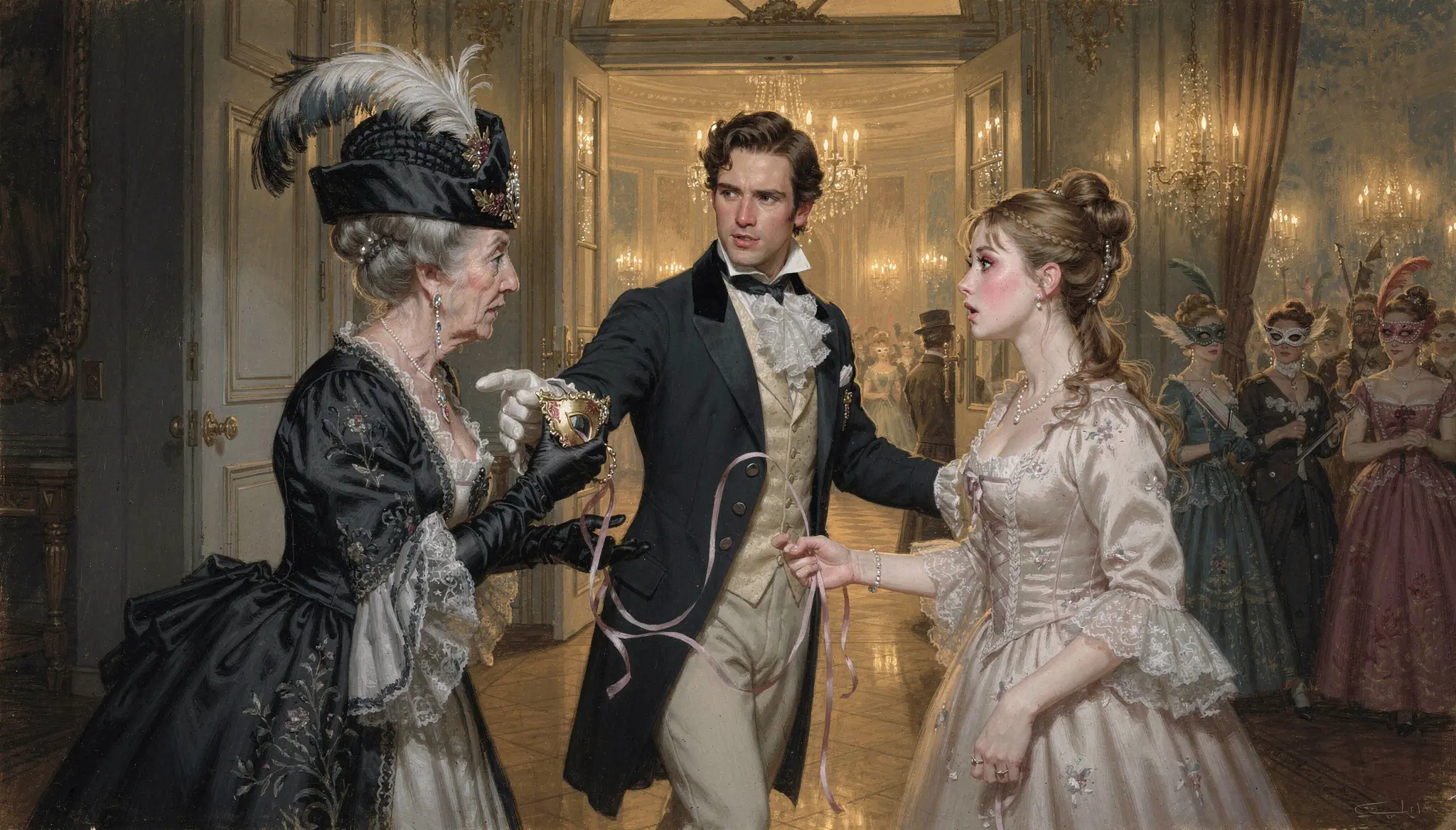
The second time, she saw her son bow.
By the third, Julian Harcourt was holding the young woman’s hand beneath the chandeliers of Harcourt House as though the remaining three hundred people in the ballroom had become scenery.
That was when Augusta crossed the floor.
It was February of 1817, and London was enjoying one of those winters in which society behaved as though war, debt, death, and common sense had all been postponed until spring. The Prince Regent’s name appeared in every newspaper, returning officers filled drawing rooms, and families who had complained bitterly about taxes in January spent February ordering silk from France as though Napoleon himself had personally apologized.
Harcourt House on Grosvenor Square blazed with candlelight.
Crystal chandeliers hung above a ballroom large enough for two full sets of dancers. Evergreen garlands still remained from Christmas because Augusta thought they softened the marble. Musicians occupied the gallery above the western doors, and masked guests moved beneath them in satin, velvet, feathers, gilt leather, and enough jewels to relieve several respectable families of poverty.
Augusta wore wine-colored silk with structured sleeves and a gold half mask embroidered with metallic thread.
She had chosen the mask because it looked dignified.
Her daughter Amelia said it looked terrifying.
Augusta considered that an advantage.
The young woman wore blue.
Not fashionable sapphire.
Not peacock.
Not one of the darker shades designed to make a woman appear expensive by candlelight.
A simple pale blue gown with a square neckline, narrow sleeves, and almost no trimming except white embroidery at the cuffs.
Her mask was white.
Plain.
Her brown hair had been gathered neatly rather than elaborately.
Nothing about her dress was scandalous.
That annoyed Augusta more.
Someone attempting to force her way above her station ought at least to possess the decency to look ambitious.
This girl looked calm.
She stood beside a pillar near the edge of the ballroom while couples passed.
Augusta had noticed her earlier because she recognized the shape of the face beneath the mask.
Not immediately.
Memory required several glances.
Then the young woman turned toward the orchestra.
Augusta knew.
Clara Bellamy.
Miss Bellamy.
Daughter of the late Edward Bellamy.
Niece of Mrs. Lydia Ashcombe.
Occasional companion to Lady Fenwick.
Poor enough to be useful.
Well-born enough to make usefulness awkward.
And, most importantly, a young woman Augusta had explicitly told the household secretary was not to receive an invitation.
Yet there she stood.
Inside Harcourt House.
At Julian’s masquerade.
Watching Augusta’s son approach.
Julian wore black.
Of course.
At twenty-seven, the newly inherited Viscount Harcourt had developed a tiresome habit of choosing simplicity whenever his mother arranged grandeur around him.
Black evening coat.
Black silk waistcoat.
White cravat.
Black mask.
No jeweled pin.
No decorative sword.
Augusta had once told him he dressed like a magistrate attending his own execution.
Julian had replied that magistrates generally wore better wigs.
Now he crossed the ballroom toward Clara Bellamy and bowed.
Not the shallow bow one gave a woman whose name one had forgotten.
A full, deliberate acknowledgment.
Clara curtsied.
They spoke.
Augusta could not hear.
She did not need to.
She watched Julian extend one hand.
Clara hesitated.
Then placed hers in it.
They joined the next set.
Augusta felt the room change before anyone else did.
Not because guests recognized Clara.
Most did not.
Masks were the point.
But people recognized Julian.
The unmarried Viscount Harcourt had inherited one of the oldest names in Sussex nine months earlier and had spent those same nine months refusing every obvious marriage opportunity offered to him.
That made any woman in his hand interesting.
Augusta watched heads turn.
Lady Cecily Moore whispered to her sister.
Sir Frederick Lowe smiled.
Mrs. Calder raised her eyebrows above a silver mask.
Wonderful.
By morning half of Mayfair would know Julian had danced twice with a mystery woman in blue.
By noon someone would know her name.
By dinner, the story would have acquired a pregnancy.
Augusta moved.
She reached the dancers just as the set ended.
Julian was saying something to Clara that made the young woman smile.
Not flirtatiously.
Worse.
Comfortably.
“Julian.”
Her son turned.
The black mask did not hide his expression.
“Mother.”
Augusta looked at Clara.
The girl curtsied.
“Lady Harcourt.”
The voice confirmed it.
Augusta felt anger sharpen into certainty.
“Miss Bellamy.”
Clara’s face changed behind the white mask.
Julian stepped slightly closer.
Augusta noticed.
“Perhaps,” Augusta said, “you would explain how you came to be here.”
Clara looked toward Julian.
Augusta hated that immediately.
“Do not look at him.”
Julian’s jaw tightened.
“Mother.”
“I asked Miss Bellamy.”
Clara folded her hands.
“I was invited.”
“No.”
The answer came too quickly.
Several nearby guests turned.