The letter sitting on the Duke’s mahogany desk that morning was the 17th of its kind. “Everything proceeds admirably, Your Grace. The tenants are content. The harvests are plentiful. The estates run as smoothly as a fine pocket watch.”
Edward Ashford, the fifth Duke of Ashford, set it down beside the others and stared at the ceiling of his study. Seventeen letters, 17 versions of the same comfortable lie. He had never once stepped off his own estate without a carriage, a footman, and at least one steward walking two paces behind him with a leather-bound ledger.
Every village he had ever visited had been scrubbed clean before his arrival. Every tenant who had ever spoken to him had been coached first on what to say. He was, by every official account, a man who ruled well. He was also, he suspected, a man who knew absolutely nothing.
He called for his valet, Thomas, at seven that morning. When Thomas arrived, immaculate as always in his pressed livery, the Duke was already pulling a worn wool coat from the back of his wardrobe. It was a coat he had not touched in 11 years, left behind by a groundskeeper who had quit without collecting his belongings.
Thomas said nothing for a long moment. “Your Grace,” he finally managed, eyeing the coat the way a physician might eye a patient who had announced plans to walk to Scotland. “Are you quite well?” “Perfectly,” said the Duke, shrugging it on.
The wool scratched at his collar. The sleeves were slightly too long. It smelled faintly of pipe tobacco and rain. He found he did not mind any of it.
“I am going to walk to Willowford.” “Walk?” Thomas repeated. “On foot. Alone. Without announcement.” The Duke pulled a flat cap from the shelf and set it over his dark hair.
He caught his reflection in the mirror and was satisfied. The coat was shapeless, the cap unflattering, and the patched trousers he had borrowed from the laundry room completed the effect. He looked like exactly what he intended to look like, a man who had seen better years and could not quite remember when.
“You will tell no one where I have gone. If anyone asks, say I am unwell and resting.” Thomas opened his mouth. “You are not to follow me,” the Duke added. Thomas closed his mouth.
By eight o’clock, Edward Ashford walked out of the servants’ entrance of his own estate, carrying a walking stick, a small canvas satchel containing nothing but a handkerchief, three shillings, and absolutely no idea what he would find. The road to Willowford was six miles of rutted chalk track that wound through elm trees and autumn fields stripped bare after the harvest. Edward had ridden this road on horseback dozens of times, barely noticing it. On foot, it revealed itself differently.
Every dip in the path that collected mud, every stretch of broken fence where the wind cut clean through, every gray mile that stretched longer than the last when your boots were not fitted for walking. By noon, his shoulders ached. By three o’clock, a blister had formed on his left heel, and he had eaten nothing since morning. He had not thought to pack food, which struck him around the fourth mile as a rather aristocratic oversight.
Willowford appeared as dusk was settling. A cluster of stone cottages and timber-framed buildings gathered around a narrow high street, the church spire just visible above the rooftops. Smoke rose from chimneys. The smell of something being cooked drifted through the cold evening air, and Edward’s stomach made its feelings known without restraint.
He approached the first cottage with the plain intention of asking for a crust of bread. He was a duke, yes, but he had three shillings in his pocket and was prepared to pay. The woman who answered did not look at him long before her eyes told him everything. They went to his coat first, then his boots, then past his shoulder, as though checking whether anyone more worth speaking to might be standing behind him.
She said she had nothing to spare and shut the door before he finished his sentence. At the second cottage, a man with his sleeves rolled despite the cold laughed once through his nose and told him to try the parish and not waste honest people’s time. The bakehouse was already locked. The public house looked at him through the window before he even knocked.
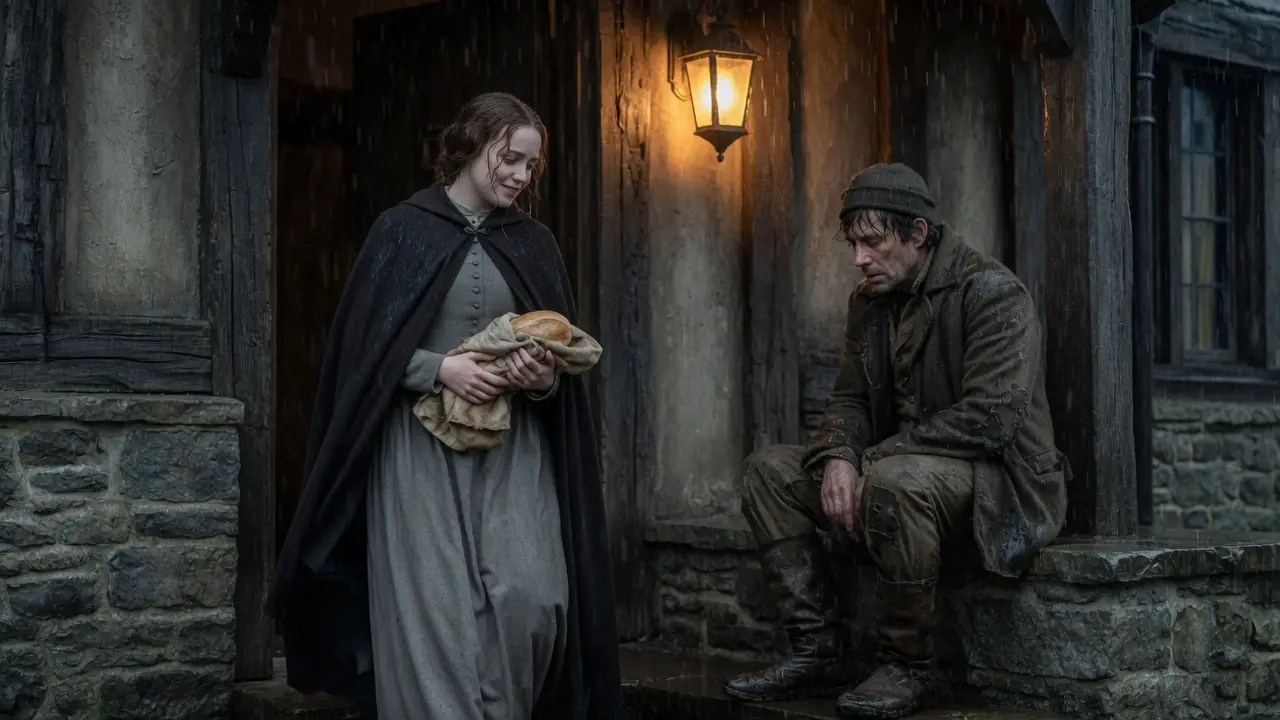
He saw the landlord’s eyes, the small shake of the head, the deliberate turning away. By the time full dark arrived and rain began spotting the cobbles, Edward had been turned away from seven doors. He sat down on the step beneath the narrow porch of a building that turned out to be the servants’ quarters attached to Willowford Manor, a modest country house at the village’s edge. The rain thickened.
This was in every measurable way an inconvenience rather than a crisis. But sitting in the wet dark, invisible, turned away, and cold to the bone, something shifted in his chest. Something that 17 letters from comfortable stewards had never once disturbed. He heard her before he saw her.
Footsteps quick and light came around the side of the building. Then a figure in a plain gray dress and a dark wool cloak stopped short when she almost walked directly into him. She was young, perhaps 20, perhaps a little more, with the kind of face that looked as though it had never quite decided whether to be tired or cheerful and had settled improbably on both. She carried a cloth-covered parcel under one arm.
She looked at him, sitting there in the wet dark, rain dripping from the brim of his cap, and her expression did something he had not expected from a single person in Willowford that evening. It softened. “You look half frozen,” she said. It was not dramatic.
It was simply a fact she had observed and seen fit to mention. “I have been warmer,” he admitted. She studied him for a moment, then unwrapped the parcel. Inside was a small loaf of bread, dense and dark, the kind baked for people who ate to survive rather than for pleasure.
She broke it cleanly in half. Then she unstopped the small bottle at her belt and held both out to him without ceremony, without waiting for thanks, without looking as though she expected any. “It is all I have tonight,” she said simply. “But it is warm, and you are not.”
Edward Ashford, the fifth Duke of Ashford, who had dined on roasted pheasant and dressed turtle soup and French claret, and had never once in 41 years eaten bread on a wet doorstep in the rain, took the half loaf from a housemaid’s hand. He found he could not speak for a moment. “Thank you,” he said at last. He meant it with a weight he had never attached to those two words before.
She nodded once, wished him a dry night, and disappeared inside. He sat in the rain and ate the bread slowly. Somewhere between the first bite and the last, something in Edward Ashford’s understanding of his own world cracked quietly open.
Edward did not leave Willowford the next morning. He told himself it was the blister on his heel. That was partially true. But the fuller truth was that he woke before dawn on a hay bale in the stable behind the servants’ quarters, where a sleepy young groom had silently permitted him to sleep without asking questions.
Through the gap in the stable door, he watched a light come on in the manor kitchen before any other window in the village had stirred. He already knew whose hands had lit that lamp. He pulled his coat tighter and watched. Clara, he had learned her name from the groom, who spoke of her the way younger siblings speak of someone they would not dare disappoint, emerged from the kitchen door at ten minutes to five.
She carried a wooden bucket and a long-handled brush. The morning was bitter. Frost had settled overnight on the cobblestones, and her breath rose in small clouds as she crossed the yard to the main house entrance and disappeared inside. Edward waited.
The groom slept on. A cart horse shifted in the neighboring stall. The village remained dark and quiet. Forty minutes later, Clara reappeared, collected a second bucket, and went back in.
An hour after that, a cartload of linen came out, piled into a wooden tub, and Clara was at the pump in the yard. Her sleeves were pushed to her elbows despite the cold. She worked the handle in long, steady strokes, filling the tub before the wash could begin. She did not sing.
She did not complain. She simply worked with the methodical quiet of someone who had long since stopped expecting the morning to be anything other than what it was. Edward shifted his position against the stable wall and watched with the particular discomfort of a man discovering something about the world that should not have required a disguise to find. Around midmorning, he managed to slip around to the kitchen window without attracting attention.
Through the watery glass, he could see the interior clearly enough. Clara was now assisting an elderly cook who moved slowly between the range and the preparation table, her joints clearly giving her trouble on the cold morning. What struck Edward was not that Clara helped her. It was how she helped.
Without being asked, without drawing attention to it, Clara took the heavier pots before the old woman reached for them. She guided her to the stool near the fire for 10 minutes under the pretense of asking her opinion on the seasoning of something that clearly needed no second opinion at all. Two younger kitchen girls worked nearby. When one of them knocked a tray of prepared pastry onto the floor, the sound brought the housekeeper’s footsteps toward the kitchen instantly, sharp and purposeful.
Edward watched Clara step smoothly in front of the mess, hands clasped, calmly informing the housekeeper that she herself had set the tray too close to the edge and that it had been her error entirely. The younger girl stood behind her, white-faced and silent. The housekeeper’s mouth thinned. She said something Edward could not hear through the glass.
But Clara’s posture absorbed it without flinching. After the housekeeper left, she turned back to the kitchen and simply said something that made both younger girls exhale and return to work. Edward stepped away from the window. He spent the remainder of the morning drifting quietly around the village, listening more than speaking.
In a place this small, people talked. A stranger sitting on a wall, eating the last of his breadcrumbs, was not interesting enough to guard against. By midday, he had pieced together a reasonable portrait of Clara’s life without asking a single direct question. She had been at Willowford Manor three years.
She earned £7 annually, a wage Edward privately noted was low, even by the ungenerous standards he now suspected were common on estates he had never personally inspected. Out of those £7, she sent a portion home each month to her mother, a widow in a parish some 12 miles east. He heard this not as a compliment, but as a passing remark from a woman at the well, who mentioned it the way you mention a fact so established it has stopped being interesting. What nobody mentioned, because nobody seemed to know, was how Clara managed on what remained after that monthly postal order.
It was only the groom later that afternoon who let it slip without meaning to. He said that Clara sometimes told the cook she had already eaten when the kitchen girls were given their midday meal. The cook, who was not as unaware as she appeared, always left something covered on the shelf near the door for when Clara thought no one was looking. Edward absorbed this in silence.
He left Willowford an hour before dusk, walking back the same chalk road he had come by. The blister on his heel had worsened, and he barely noticed it. He thought about the 17 letters waiting on his desk. He thought about the word content, which every one of his stewards had used at least once, and how comfortably that word covered everything it did not bother to look at.
He thought about a young woman who earned next to nothing, sent half of that nothing home to a widowed mother, accepted blame for other people’s accidents, and still, at the end of a 17-hour day, had broken her only loaf of bread in half for a stranger. He walked the full six miles without stopping.
The letter arrived on a Tuesday. It came by private courier rather than the regular post, which was the first thing that unsettled people. The courier wore the Ashford livery, deep burgundy with a silver crest on the breast pocket. He arrived on a well-fed horse at half past nine in the morning, when the village was awake enough to notice.
He asked for the housekeeper at Willowford Manor by name, handed over a sealed envelope, and left without accepting so much as a cup of tea. The housekeeper, Mrs. Briggs, held the envelope for a long moment before opening it. The wax seal alone, the Ashford crest pressed clean and deep into dark red wax, was enough to bring the underbutler out of his pantry and two of the kitchen girls to the corridor doorway. They stood at the precise angle that allowed them to appear to be doing something else.
Mrs. Briggs read the letter once. Then she read it again. Then she set it on the hall table and looked at it as though it might contradict itself if she gave it enough time. It was a formal summons written in the clipped, courteous language of the Duke’s household.
Miss Clara Ashby, currently in service at Willowford Manor, was requested to present herself at Ashford Hall at her earliest convenience. A carriage would be provided. The letter was signed by the Duke’s steward and bore the secondary impression of the ducal seal at the bottom. Mrs. Briggs folded the letter, put it in her apron pocket, and went to find Clara.
She found her in the linen room counting sheets. “You are summoned to Ashford Hall,” Mrs. Briggs said in the tone of someone delivering a medical verdict they did not fully understand. Clara looked up from the linen. “I beg your pardon?”
Mrs. Briggs handed her the letter. Clara read it slowly. Her expression did not leap to conclusions the way the housekeeper’s had. She simply read it, reached the end, and read it once more.
Then she folded it carefully and said she did not know why the Duke’s household would want to see her. This was precisely the wrong thing to say, because it sounded to Mrs. Briggs exactly like what someone would say if they knew very well and preferred not to discuss it. Within two hours, the letter’s existence had passed through every room in the manor. By afternoon, it had reached the village.
By evening, it had grown considerably in the telling. The version circulating among the kitchen staff held that Clara had been seen speaking privately with a nobleman on the road and had said something she oughtn’t. The version that reached the village inn suggested she had somehow come into possession of something belonging to the Duke’s estate, and the summons was the formal beginning of an inquiry. The most elaborate version, which appeared to have originated with the underbutler and gained considerable momentum, was that Clara had been corresponding secretly with someone at Ashford Hall, and the whole business was about to become deeply embarrassing for everyone at Willowford Manor.
Nobody suggested she had done something right. It did not seem to occur to anyone. The manor’s master, Mr. Holt, called Clara into his study the following morning. He was a compact, careful man who wore his respectability like a waistcoat that had been fitted too tight.
It never quite allowed him to breathe comfortably in any situation that fell outside his expectations. He sat behind his desk with the letter in front of him and looked at Clara the way he looked at household accounts that refused to balance. “I will ask you plainly,” he said. “Have you had any communication with anyone at Ashford Hall or connected to the Duke’s household?”
“No, sir,” Clara said. “Have you been approached by anyone, any traveler, any stranger who may have represented themselves as connected to the Duke’s interests?” Clara was quiet for a moment. “There was a traveler, sir, last week.”
“He was sitting in the rain outside the servants’ entrance. I gave him some bread.” Mr. Holt stared at her. “Bread?”
“Half a loaf, sir. He looked very cold.” The silence that followed was the particular kind that forms when a simple explanation fails completely to satisfy the person receiving it. Mr. Holt picked up his pen, set it down again, and told Clara she was to say nothing further about the matter to anyone in the household.
He said she was to conduct herself with appropriate discretion until this business was resolved. He added that whatever she may or may not have done, it had better not reflect poorly on Willowford Manor. Clara said, “Yes, sir,” thanked him, and returned to the linen room. That evening, sitting in the small room she shared with one of the kitchen girls, she took out the letter and read it a third time by the light of a single tallow candle.
The summons told her nothing beyond the basic instruction. It offered no explanation, no indication of what awaited her at Ashford Hall, no note of reassurance. She was frightened, though she would not have said so aloud. She folded the letter, tucked it beneath her spare apron in the drawer, and blew out the candle.
In the dark, she tried to think of a single thing she had done that would interest a duke. She could only think of one. Surely, she told herself, that could not possibly be it.
The carriage arrived at Willowford Manor on a gray Thursday morning. It was not the kind of carriage Clara had ever been inside. She had ridden in the manor’s old trap twice, both times to collect supplies from the market town, sitting in the open air beside the coachman with her basket on her knees. This was something entirely different.
It was a closed traveling carriage with lacquered black panels, brass fittings on the door, and two matched bay horses that stood with the patient, well-fed stillness of animals that had never been asked to hurry unnecessarily. The Duke’s steward, a tall, measured man named Mr. Graves, stepped down and introduced himself with a courtesy that Clara found more unsettling than rudeness would have been. He told her the journey to Ashford Hall would take approximately two hours. He said she was welcome to the traveling blanket inside and that there was no cause for any anxiety.
This last remark had the opposite of its intended effect. She climbed in. Mr. Graves took the seat across from her, produced a small ledger from his coat pocket, and spent the journey making notes in it without explanation. Clara watched the Wiltshire countryside move past the window, kept her hands folded in her lap, and said very little.
She had put on her best dress, which was not very much, a dark wool with a white collar she had pressed carefully the night before. She was aware, as the carriage turned through increasingly well-kept countryside and the roads smoothed beneath the wheels, that her best dress was going to look like what it was the moment she arrived. There was nothing to be done about that. Ashford Hall appeared first as a break in the tree line, then as a roofline, then all at once as the carriage turned through the iron gates and the full facade came into view.
Clara had seen illustrations of great houses in almanacs. She had dusted portraits of such places in the Willowford Manor hallway. None of that prepared her for the reality of it. The sheer accumulated weight of the place, the Georgian stonework stretching wide across the hillside, the 12 steps rising to the entrance portico, the windows that caught the pale morning light and threw it back with an indifference that felt almost deliberate.
Liveried footmen appeared at the carriage door before it had fully stopped. One offered his hand to help her down. She took it because refusing seemed more complicated than accepting, and stepped onto gravel that was raked so evenly it seemed a shame to walk on it. Mr. Graves led her inside.
The entrance hall alone was larger than the entire ground floor of Willowford Manor. A marble staircase rose ahead of her and split at the landing into two separate wings. Portraits lined the walls, generations of Ashfords in oils, their painted eyes following the room with the settled authority of people who had never once doubted their right to be exactly where they were. The floors were polished to a depth that made Clara instinctively careful about where she put her feet.
She was shown to a drawing room on the first floor and asked to wait. The drawing room was warm, at least, with a fire burning in a white marble fireplace. She sat in a chair near the door rather than the more comfortable settee closer to the fire, which felt like the right choice without her being entirely sure why. A clock on the mantelpiece measured out 12 minutes.
She counted them. Then the door opened, and the Duke of Ashford walked in. He was taller than she remembered, though she realized immediately she had not truly looked at him that evening in the rain. She had seen a cold, wet man on a step, and that had been sufficient information.
Now he was in a dark morning coat, his posture straight, his expression composed. There was nothing about him that suggested the worn wool coat or the flat cap or the muddy boots, except his eyes. She recognized those. They were the same eyes that had looked up at her from the doorstep with an exhaustion that had nothing to do with walking.
He stopped a few feet from her. Clara stood immediately and dropped into the best curtsy she could manage, her mind scrambling to reassemble everything she thought she knew about why she was here and finding that it was all collapsing at once. “Please sit down, Miss Ashby,” he said quietly. She sat.
He took the chair across from her, not behind a desk, not elevated in any way, simply across from her. For a moment, he said nothing. “I believe you may have thought about the bread,” he said at last. She stared at him.
“The traveler,” he continued, “sitting in the rain outside the servants’ entrance last Tuesday evening.” The clock on the mantelpiece continued its counting. “That was you,” Clara said. It came out barely above a whisper.
“It was.” She looked at his face and understood, with a certainty that required no further explanation, that she was not in trouble. She was here because of a half loaf of bread broken in the dark on a wet evening, given to a stranger she had not looked at closely enough. She did not know whether to laugh or weep, so she did neither.
“I treated you like a poor traveler,” she said finally, and her voice carried the particular horror of someone replaying a scene they cannot edit. The Duke smiled then, properly, for what felt to Clara like the first time since she had entered the room. “Yes,” he said. “You did.”
“It was the kindest thing anyone has done for me in years.” The news moved through the county the way all uncomfortable news does, quietly at first, then everywhere at once. It began with the household staff at Ashford Hall, who were professionals in every sense except the human one, which meant they were excellent at their duties and constitutionally incapable of not discussing what those duties allowed them to observe. By the end of the week in which Clara visited, the basic facts had reached three neighboring estates.
By the following week, the drawing rooms of Wiltshire had the full story, or rather several competing versions of it. None of those versions were entirely accurate, and all of them agreed on the central outrage. The Duke of Ashford had summoned a housemaid and thanked her. The reactions divided neatly along the lines of people’s existing opinions of themselves.
Those who had spent their lives being quietly kind found the story unremarkable and rather pleasant. These people were unfortunately not the ones who wrote letters or spoke at length at dinner tables. The ones who did were considerably less pleased. Lady Fenwick of Storton Park held what she described as an informal supper, but was in practice a tribunal.
Seated around her dining table were four families of sufficient standing to consider themselves arbiters of county behavior. The consensus reached over three courses was that the Duke had made a serious error of judgment. Servants, Lady Fenwick observed, with the authority of someone who had never carried anything heavier than a fan, were best rewarded through stable employment and the occasional Christmas box. Public recognition of this nature confused the natural order and gave ideas to people who were better served without them.
This view was not universal, but it was loud, and in county society, volume frequently substituted for correctness. At Ashford Hall itself, the discomfort arrived wearing a more familiar face. Lord Gerald Ashford, the Duke’s cousin, a man of 38 who had devoted considerable energy over the years to reminding people of his proximity to the dukedom, appeared at the hall unannounced on a Wednesday morning, which was itself a statement. He was the kind of man whose handsomeness had curdled slightly with age and disappointment, leaving features that might once have been called distinguished now looking merely rigid.
He rode well, dressed impeccably, and had never, in Edward’s memory, said anything that did not eventually circle back to what he felt he deserved. He found the Duke in the estate office reviewing tenant ledgers, which was another thing Gerald found vaguely offensive about his cousin. The man did his own reading. “I’ll speak plainly,” Gerald said, settling into the chair across the desk with the ease of someone who considered all chairs essentially his.
“I’d be surprised if you spoke any other way,” Edward replied without looking up from the ledger. Gerald straightened. “This business with the maid is being talked about from here to Bath. You understand that?”
“I imagine it is.” “It makes you look foolish, Edward. A duke wandering the roads in a laborer’s coat and then rewarding a servant girl for handing him bread. It sounds like something from a penny magazine.”
“People are laughing.” Edward set the ledger down. He looked at his cousin with the patient attention of a man who has decided not to waste energy on irritation. “Which people?”
“People who matter.” “That is a remarkably small category, Gerald, when you examine it carefully.” Gerald’s jaw tightened almost imperceptibly. “She has manipulated you.”
“I don’t know how a girl in service manages it, but women in her position understand that a moment of apparent generosity.” “She didn’t know who I was.” “So you say.” The room held the silence for a moment.
Outside, the sound of the stableyard carried faintly through the window. A horse, a voice, the ordinary business of the estate continuing without any awareness of the conversation happening above it. “I say it,” Edward continued, “because it is what happened. She gave half her supper to a stranger sitting in the rain and went inside without asking his name.”
“That is the complete account.” Gerald studied him. Then he leaned forward slightly, and his voice dropped to the register he used when he wanted to sound like he was sharing concern rather than applying pressure. “Whatever happened that evening, the optics of this are damaging.”
“The household staff are uncertain how to regard her. The county families are unsettled. Send her back to Willowford with a reference and a suitable sum. Everyone will forget it within a fortnight.”
Edward picked the ledger back up. “Is there anything else?” Gerald left an hour later. He rode away from Ashford Hall with the stiff-backed posture of a man who has not received what he came for and intends to find another route to it.
Edward sat alone in the estate office after he left and thought about the word Gerald had used: manipulated. He turned it over in his mind, the way you turn over a stone to examine what is living beneath it. He thought about Clara rising before dawn in a cold manor. He thought about the kitchen girl and the dropped tray and the blame absorbed without hesitation.
He thought about the covered plate left on the shelf by an elderly cook who pretended not to notice things. He thought about a woman who had spent three years being useful to everyone around her and receiving, in return, £7 annually and suspicion the moment anyone powerful took notice of her. Then he opened the ledger again and began making notes of a different kind entirely.
Edward had learned something useful from his walk to Willowford. The world looked entirely different when nobody knew who you were. He did not go back himself this time. That would have been careless.
What he needed now was not impressions, but facts, the kind that could be written down, witnessed, and, if necessary, acted upon in a court of law. He had two people he trusted for this kind of work. Not investigators in any official sense, simply servants of long standing who were intelligent, unremarkable in appearance, and understood that their duke occasionally required information that his stewards were either too comfortable or too compromised to provide. He sent them separately and gave them different covers.
The first, a man named Howell, went as a farrier looking for seasonal work, which gave him legitimate reason to linger around stable yards and outbuildings where men talked without guarding themselves. The second, a woman named Mrs. Potts, who had been the Duke’s housekeeper at his smaller property in Dorset for 15 years, went as a potential domestic seeking a character reference from someone in the Willowford village. That gave her reason to knock on doors and sit in kitchens and let conversations find their own direction. They returned within 10 days.
Edward read their reports at his desk on a cold November evening, with the fire burning low behind him. By the time he finished the last page, he had stopped adding coal without noticing. The picture that emerged was not shocking in the way that dramatic things are shocking. It was shocking in the way that slow, ordinary cruelty is shocking when you finally see it clearly.
Not one large wound, but dozens of small ones, each trivial enough to dismiss on its own and devastating in accumulation. Mr. Holt, the manor’s master, ran his household on a principle of marginal deprivation. Wages were set at the lowest rate the local market would bear, then reduced further through a system of fines so routine they had ceased to feel like punishment and had become simply a feature of employment. A broken dish, sixpence.
A late delivery, threepence. Candles burned past 10:00 without permission, twopence. The fines were recorded in a household book that Howell had seen briefly through the open door of Holt’s study, the pages dense with small deductions that added up across a full staff of nine to a sum that went somewhere that was not the servants’ wages. The food arrangements were worse.
Willowford Manor hosted seasonal dinners for the local gentry throughout autumn and winter, occasions at which Holt spent generously on provisions. What remained afterward, and there was always substantial remainder, was locked in the larder under Holt’s personal key rather than distributed to the kitchen staff or the village. Howell had spoken to a man who collected the manor’s waste, who told him that twice in the past year he had removed from the larder food that had spoiled entirely behind the locked door. Meanwhile, Mrs. Potts had sat in a cottage at the village edge, drinking tea with an elderly woman who mentioned, without particular emotion, that the manor’s servants sometimes looked thin by February.
Edward set that page down and picked up the next. Clara’s name appeared several times, though never as the subject of any single incident. She appeared in the margins of other people’s accounts, quietly and consistently. She had covered for a young footman who arrived late three mornings in a row because his mother was ill, and he was the one who made her morning fire before walking to work.
She had used her own small savings to replace a piece of silver that went missing, almost certainly stolen by a visitor rather than any servant, because the alternative was that Holt would have dismissed the girl responsible for polishing it. She had done this without telling anyone. Mrs. Potts had only discovered it because the silversmith in the village remembered the transaction and described the young woman who paid for it. Edward sat back.
He sent for his carriage the following morning and made the 12-mile journey east to the parish where Clara’s mother lived. He went without livery in a plain dark coat, though this time he did not pretend to be anything other than a man on private business. Clara’s mother lived in a small laborer’s cottage at the end of a lane that turned to mud in wet weather. She was a woman of perhaps 50 who moved carefully around her small kitchen with the deliberateness of someone whose body had logged a great many years of hard use.
She did not know who Edward was. He introduced himself simply as someone connected to her daughter’s current employment and asked if he might ask a few questions. She gave him tea in a cup that had a chip in the rim and answered everything he asked with the direct simplicity of a person who had nothing to hide, because there was nothing to hide. She had not seen Clara in four months.
Clara’s monthly postal orders were the reason the rent was paid. She had told her mother the money was easy to manage, that she ate well, that the work was not too hard. Edward drank his tea and thanked her and walked back to his carriage in the thin winter light. He sat inside it for a moment before telling the coachman to drive on.
Clara had been quietly holding up three people, herself, her mother, and whatever unlucky soul happened to need protecting that week, on £7 a year and a covered plate left on a shelf by a sympathetic cook. Not one word of it had appeared in a single steward’s letter.
The invitations went out three weeks in advance, as they always did. The annual harvest banquet at Ashford Hall was one of the fixed points of the county calendar, the kind of event that people arranged other things around rather than the reverse. It was held in the great hall, which could seat 80 comfortably and had done so every autumn for four generations of Ashfords. The guest list followed its own unwritten rules.
Landowners, clergy, magistrates, the more prosperous tenant farmers, and a selection of village representatives chosen to give the occasion a democratic appearance without meaningfully disturbing the seating arrangements. This year, one additional name appeared on the list: Miss Clara Ashby. Not below the salt, not in the servants’ gallery, not standing at the wall in a white apron ready to pour wine. Her name appeared between a local magistrate and the wife of a neighboring landowner in the section of the seating plan reserved for invited guests.
Mr. Graves, the steward, had delivered the finalized seating arrangement to the Duke for approval without comment, which was how Edward knew his steward was a man of genuine quality. The rest of the household absorbed the information with varying degrees of success. The senior footman managed professional neutrality. The housekeeper at Ashford Hall, who was a more composed woman than Mrs. Briggs at Willowford, said nothing at all, which Edward recognized as a form of loyalty he appreciated.
Word reached the county’s drawing rooms within a fortnight, because it always did. Lady Fenwick sent a note expressing a previous engagement that had not previously existed. Two other families suddenly recalled conflicts with the date. Gerald Ashford sent nothing, which meant he was coming and intended to observe rather than withdraw, which Edward found considerably more interesting than a polite refusal.
On the evening itself, Ashford Hall was lit from ground floor to roofline, candles in every window and lanterns along the drive. It looked, as it always did on harvest night, like something from another century, which, Edward reflected, was more accurate than it was comfortable. Clara arrived in the same carriage that had collected her the first time, accompanied by Mrs. Potts, whom Edward had quietly arranged as an escort. She wore a dark green dress that Edward suspected was borrowed or recently altered, fitted carefully and simply with none of the ornamentation that the county’s women would be wearing tonight.
She looked, he thought when he received her at the door, like someone who had decided that if she could not match the room, she would simply stand straight inside it, which was more elegant than most of the room would manage. He gave her his arm into the hall. The effect on the assembled guests was precisely what a portrait painter might have composed if commissioned to depict the concept of discomfort. Conversations paused, eyes moved, and then moved away.
Gerald, standing near the fireplace with a glass of claret, watched with an expression of careful neutrality that Edward knew concealed several things at once. The dinner proceeded. Clara sat where she had been placed and spoke when spoken to, which in the first half hour was not often, because her immediate neighbors found reasons to address the people on their other sides. Edward noticed this and said nothing.
He had not arranged this evening to be comfortable. He had arranged it to be honest. After the final course, when the wine had been poured and the candles had burned an inch shorter, the room reached the warm, loosened state that follows a long dinner. Then Edward rose.
The room settled into silence with the trained attention of people who understood that the Duke’s standing meant something was about to be said. He did not use notes. He spoke the way he had thought about it for several weeks, plainly and without ceremony. He told them he had left this hall on foot alone, in a laborer’s coat, on a morning in October.
He told them he had walked to Willowford and arrived hungry, wet, and invisible. He told them about seven doors. He described sitting on a step in the rain with the particular patience of someone who has no other option, which was a patience, he said, that he had never previously been required to develop. Then he paused.
“One person in Willowford gave me food that evening,” he said. “One person out of a village of several hundred looked at a stranger sitting in the rain and did not calculate whether it was worth her trouble.” He looked at Clara. She was watching him with an expression he could not entirely read, somewhere between mortification and a stillness that ran deeper than the room around her.
“She gave me half of the only food she had for that evening,” he continued. “And she did it without asking my name, without expecting thanks, and without any reason other than that I was cold and she was not.” The hall was very quiet. “I have sat at this table every harvest for 15 years,” Edward said.
“And I would like to ask everyone present a simple question.” He let the silence hold for a moment. “How many of us would have done the same?” Nobody answered.
Several people found reasons to look at their wine glasses. A magistrate near the end of the table examined his cuffs. Lady Fenwick, who had apparently recovered from her previous engagement, studied the candelabra with sudden fascination. From the far end of the room, where the tenant farmers and village representatives sat, someone began to applaud slowly and quietly.
The sound spread down that end of the table. It did not spread to the other end. It did not need to. The silence from that direction said everything that needed saying.
The morning after the harvest banquet, Edward sat at his desk before breakfast and wrote four letters. The first was to his head steward, instructing him to begin a full review of wage records across all Ashford properties. Not summaries, not the condensed versions that landed on the Duke’s desk each quarter looking tidy and reassuring, but the raw ledgers, every entry, every deduction going back three years. The second was to his solicitor in London asking for a legal opinion on the enforceability of the fine systems that several of his tenant landlords were operating against their domestic staff.
These tenant landlords were men who leased properties from the Ashford estate and ran their own households within them. The third letter was to Mr. Holt at Willowford Manor, informing him that his lease arrangement with the Ashford estate was under review and that a formal inspection of household accounts would take place within the month. Edward worded this with the careful neutrality of a man who has learned that warning someone they are being watched often tells you more about their character than the inspection itself. The fourth letter was the shortest.
It was to Clara, asking whether she would be willing to meet with him at Ashford Hall at her convenience to discuss a matter he believed she would find worth her consideration. He posted all four before he ate. The inspections began the following week. What they found was not in every case as stark as Willowford Manor, but the pattern was consistent enough to be instructive.
Wages on the lower end of households averaged significantly below what a person could live on without supplementing through other means. Food waste was endemic, not malicious in every case, simply the result of nobody ever having been asked to think about it. Elderly servants who had given decades of service were routinely let go without pension or provision when their health made them less useful. They were left to rely on parish relief or family who frequently could not adequately support them.
None of this was illegal. That was perhaps the most sobering thing about it. Edward began with what he could control directly. The Ashford Hall household wages were reviewed and adjusted.
A pension arrangement was formalized for any servant who had been in continuous Ashford employment for more than 15 years. The kitchen at Ashford Hall was given a standing instruction. Surplus food from any household meal or formal occasion was to be packed and sent to the village distribution point by nine o’clock the following morning without exception. Three overseers across the wider estate were dismissed after their inspections produced records that went beyond carelessness into something Edward’s solicitor confirmed was actionable.
The neighboring gentry observed all of this with the attentive disapproval of people watching someone rearrange furniture they considered perfectly well placed. Lord Carrington of the adjacent estate wrote a letter suggesting, with elaborate politeness, that the Duke’s reforms risked creating expectations among the servant class that could not be universally met and might therefore produce more discontent than they resolved. Edward wrote back thanking him for his perspective and continued. It was Gerald who appeared again, this time without the pretense of concern.
He came on a gray December morning and said, standing in the entrance hall without removing his gloves, that he had heard Clara Ashby was being considered for a position of formal responsibility within the Ashford households. “Considered,” said Edward. “She has accepted.” Gerald’s gloves came off then, slowly, the way his composure occasionally did.
“You are appointing a housemaid.” “I am appointing a woman who has demonstrated better judgment, more integrity, and more practical intelligence than anyone currently in that role,” Edward said. “Her previous occupation is a description of her circumstances, not her capacity.” Gerald left without further comment, which was how Edward knew he had genuinely unsettled him.
Clara herself had been uncertain when the offer was made. She had sat across from Edward in the same drawing room where he had first revealed himself to her, and she had listened to the full description of the role. Supervisor of servant welfare across the Ashford households, responsible for conducting regular visits, hearing grievances, reviewing conditions, and reporting directly to the Duke. When he finished, she had said nothing for a long moment.
“I have never managed anyone,” she said finally. “You have been managing everyone around you for three years without a title or a wage that reflected it,” Edward replied. “The difference now is that you will have both.” She started in January.
The first months were the hardest. Senior staff who had operated without oversight for years received her visits with the specific coldness reserved for authority that has arrived in an unexpected form. She did not respond to this with force or with the temptation, which must have existed, to use her position to settle the imbalance. She came back.
She asked questions. She remembered what people told her and returned to check whether anything had changed. By spring, something had shifted. A head cook at one of the smaller properties, who had initially refused to speak to her during inspections, sent a note to Edward saying that the new arrangements for surplus food distribution had reduced waste significantly, and she wished someone had suggested it years ago.
She did not mention Clara by name, which Edward recognized as the particular compliment of someone who will not quite admit they have changed their mind. Two neighboring estates quietly and without announcement began adjusting their wage structures. Nobody credited the harvest banquet. Nobody mentioned a housemaid or a half loaf of bread.
They did not need to. The thing had simply begun. The bread fund was Edward’s idea, but he did not announce it the way he announced other things. There was no formal letter, no seal, no courier in Ashford livery arriving on a well-fed horse to make the village aware that something significant was occurring.
He simply instructed Mr. Graves to arrange it quietly. A store of bread and dry provisions would be kept in a designated space in each village across the Ashford estates, maintained weekly, available to any traveler, widow, or family facing hardship, without question, without means testing, without the particular humiliation of having to explain yourself to someone holding a ledger. The instruction regarding shame was the one Edward felt most strongly about. He wrote it himself in plain language and sent it to every village steward.
The provisions are given freely. No record of recipients is to be kept. No questions are to be asked. He had seen enough ledgers by now to know that the act of recording someone’s need had a way of making the help feel like a transaction.
Transactions, in his experience, had a way of making people feel less than they were. The fund was established in February. By March, it was operating in 11 villages. By April, nobody was discussing it as a novelty anymore, which meant it had become ordinary, which was exactly what Edward had intended.
He visited Willowford on a Thursday morning in late October, almost exactly a year after he had first walked its high street in a worn wool coat with three shillings in his pocket. He came this time in his carriage without disguise, and the village knew who he was. That meant the baker straightened, the women at the well stepped back, and the general atmosphere acquired the particular self-consciousness of a place aware it is being observed by someone who matters. He had asked Clara to accompany him.
She sat across from him in the carriage in a good wool coat, her own, purchased with her new wage, and watched the familiar rooftops appear through the window with an expression that was harder to read than it once was. She had grown into the role over the past months in the way that certain people grow into things, not by changing, but by having enough space finally to be what they already were. The carriage stopped near the church. They walked from there.
The distribution point for the bread fund in Willowford was a dry stone alcove built into the wall of the parish church, covered with a simple wooden door that latched but did not lock. Edward had specified no lock. Clara had been the one to suggest the alcove rather than a separate building, on the grounds that attaching it to the church gave it a permanence and a dignity that a temporary structure would not carry. He had agreed immediately.
They arrived to find three people already there. A woman with a child collected a loaf. An elderly man in a threadbare coat moved slowly away with bread wrapped in cloth under his arm. A young girl of perhaps 12 waited quietly at the side.
None of them looked up when the carriage stopped. The woman collected her loaf, resettled the child, and walked away down the lane without speaking to anyone. Edward watched this and said nothing for a while. “She didn’t look around to see if anyone was watching,” he said eventually.
“No,” said Clara. “That is the point, isn’t it?” He looked at her. “When help comes without conditions,” she continued, “people can take it and simply go on with their day.”
“It is the conditions that make it heavy.” Edward considered this. Around them, the village proceeded with its ordinary Thursday business. A cart moved on the high street, smoke rose from the bakehouse chimney, and two dogs conducted negotiations near the butcher’s step.
The church alcove was quiet again, the young girl gone, the wooden door latched. “I owe you an apology,” Edward said. Clara looked at him with the mild surprise of someone not expecting that particular sentence. “I spent 15 years governing land and people I had never genuinely looked at,” he said.
“Every steward told me what I wanted to hear, and I accepted it because accepting it was comfortable. Whatever good has come from the past year, it began with the fact that you showed me something I had arranged my life very carefully not to see.” Clara was quiet for a moment. “I gave you half a loaf of bread,” she said.
“It wasn’t a lesson. You were just cold.” “I know,” he said. “That is what made it one.”
They stood outside the church in the thin autumn light, the bare elm trees along the lane moving slightly in the wind coming off the fields. Somewhere behind the bakehouse, a woman was calling a child home for the midday meal, her voice clear and domestic and completely indifferent to anything that had happened over the past 12 months. Edward thought about the morning he had walked out of his own servants’ entrance in a groundskeeper’s coat with three shillings and the comfortable assumption that he understood his world. He thought about seven doors and the eighth one, and the young woman who had not calculated anything, who had simply looked at what was in front of her and responded to it.
He thought about how the simplest things were so often the ones that cost a person the most to learn. “Shall we walk back?” Clara said. “Yes,” said Edward. They walked back through the village together, the Duke and the maid, and nobody who saw them pass would have known from looking which one had taught the other everything worth knowing.