"Owen, what in the hell is that?"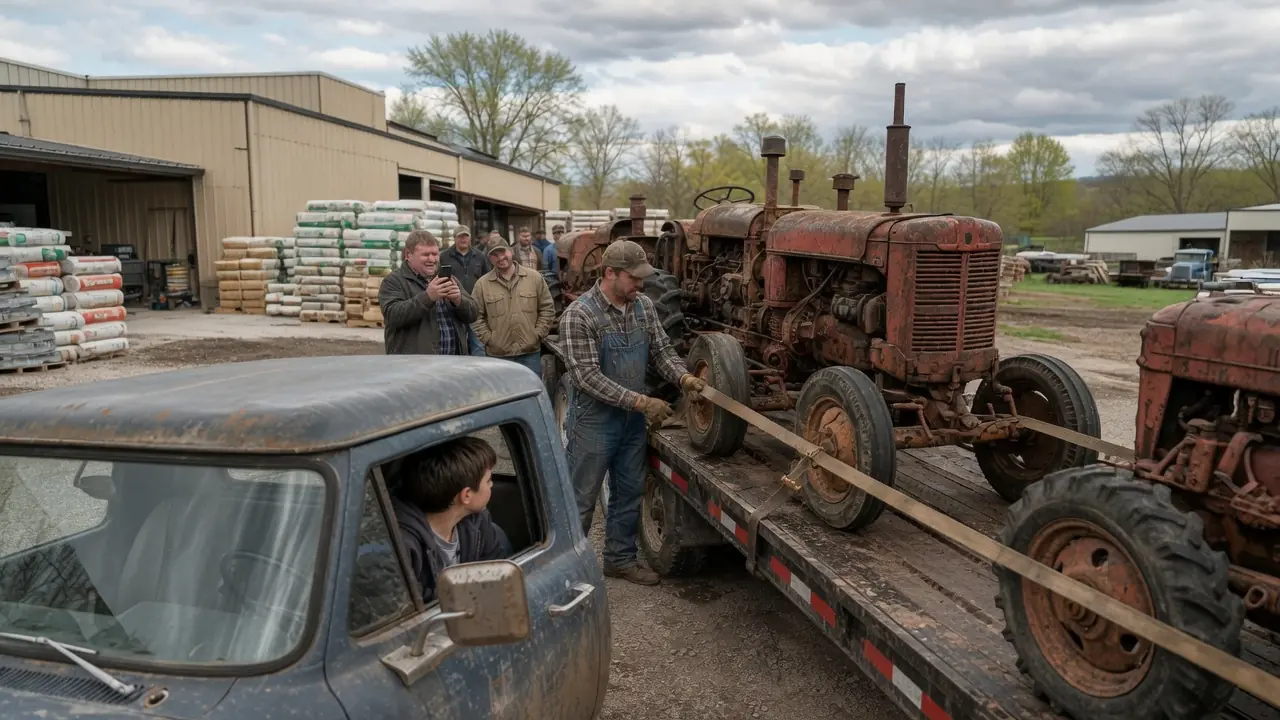
Owen Callister backed the flatbed trailer into the gravel lot behind Hector’s Feed and Supply on a Tuesday morning in early April. It took roughly four minutes for the first person to pull out a phone. He didn’t notice right away. He was focused on the angle of the trailer, the way the rear left tire kept drifting toward the drainage ditch at the lot’s edge, and the sound his son was making from the cab of the truck—a low, tuneless hum that Eli did whenever he was nervous about something but didn’t want to say so out loud.
"Hold on, bud," Owen said, more to himself than to the boy.
He climbed down from the cab, walked around to check the clearance, and that’s when he heard Randy Pollston’s voice cut across the lot like something thrown. Owen straightened up. Randy was standing outside the feed store’s side entrance with a coffee cup in one hand and his phone already raised in the other. Beside him, two men Owen recognized—Dale Ferris and someone from the county assessor’s office whose name he could never remember—were craning their necks to see around the trailer’s edge.
On the flatbed sat three of the five tractors Owen had purchased over the past six weeks. They were not pretty. The word that came to most people’s minds when they saw them was either *condemned* or *crime scene*. One had no hood at all. Another had a cracked front axle held in temporary alignment by what appeared to be a section of industrial chain and two bolts that didn’t match. The third was missing its entire hydraulics assembly, the exposed fittings oxidized a deep, flaking orange.
"Those are your tractors?" Randy said, grinning. It was not the kind of grin that meant anything friendly.
"Two more coming on Thursday," Owen said. He walked to the rear of the trailer and began working the first tie-down strap loose.
"Two more," Randy turned slightly toward Dale. "Two more."
Dale shook his head slowly, the way you do when you’re watching someone make a mistake they can’t take back.
Owen focused on the strap. The buckle was stiff from the cold morning air and his fingers weren’t cooperating the way he wanted them to, but he kept at it, jaw set, not looking up.
"Owen," Randy’s voice had shifted, getting something almost like concern in it, though not quite. "Those things, man... I don’t even know if they can be called tractors anymore. What are you planning to do with them?"
"Fix them."
"Fix them. That’s what I said."
"And then what? Where are you even—" Randy stopped. Something had clicked in his head, and the way his expression changed, the grin widening into something disbelieving, told Owen that Randy had just connected the purchase of these machines to the other thing, the thing people had been talking about since February. "Wait, this is for the Delua place? You’re actually going through with that?"
Owen freed the first strap and moved to the second.
"Owen, that land hasn’t produced a successful crop in... I don’t even know how long. My grandfather talked about that property like it was a cautionary tale. Three families tried to work it and every single one of them walked away broke. One of them, Harland Delra himself, walked away with nothing but the shirt on his back and a drinking problem."
"I know the history."
"Do you? Because it sounds like maybe you don’t, or you wouldn’t be—"
Owen looked up then, directly at the man, and kept his voice level. "I’m going to need to get these off the trailer. You mind stepping back a little?"
Randy stepped back, but he didn’t put his phone down. The video—nineteen seconds of Owen maneuvering that first broken tractor down the ramp while Randy narrated in a hushed, almost reverent tone of disbelief—would be shared 340 times by the end of the week. Someone added a caption that read: *This man spent $11,000 on five pieces of scrap metal and a patch of cursed dirt. Please pray for him.*
The comments were not kind.
Eli saw them that night. Owen found him in bed with the tablet, scrolling through responses with the same quiet, carefully controlled expression that the boy had learned—Owen suspected—from watching him. When Owen sat on the edge of the mattress and gently took the tablet away, Eli didn’t resist.
"People say dumb stuff," Owen said. "They don’t know what we’re doing."
Eli was quiet for a moment. He was seven years old, small for his age, with his mother’s dark eyes and a way of looking at you sometimes that made you feel like he was measuring the distance between what you said and what you actually meant.
"Do you know what we’re doing?" Eli asked.
It was such a direct question that Owen almost laughed. "Yeah," he said. "I do."
He meant it. But he also understood why a reasonable person might find that hard to believe right now.
Owen had come to Ashcroft County the way most people come to places they weren’t born in—through a combination of loss and necessity that makes choosing feel like an illusion. He’d grown up in western Nebraska, the son of a mechanic who supplemented his income with small-scale row-cropping on rented acreage. Owen had learned equipment the way other kids learn their multiplication tables—not from books, but from repetition, from hours beneath chassis and inside engine compartments, from the particular vocabulary of a machine telling you what it needs if you know how to listen for it.
He’d married Maya Reyes when he was twenty-six and she was twenty-five. They’d moved to Ashcroft County because Maya had family there, an aunt who was getting old and needed help, and Owen had found work at a machinery repair shop on Route 9 that paid well enough and let him stay close to the kind of work he knew. The county suited him, mostly—rolling terrain that flattened out toward the east into the wide, low-lying bottomland that the older farmers called the flats. Good soil beneath all that struggling farmland, he’d always thought, though most of the operations out here ran conventional methods on tired earth and wondered why their yields kept shrinking.
Maya had died three days after Eli’s fourth birthday, a cardiac event. That’s how the doctor had put it, and Owen had found himself fixating on that word for months afterward. *Event.* Like something that happened at a venue, like something you could RSVP to. She’d been thirty-one years old with no prior history of anything. And then she wasn’t there anymore. Owen had sat in the hospital parking garage for two hours before he could make himself drive back to the house where his son was waiting.
He didn't talk about it much. He didn’t have the language for it that other people seemed to have—the ability to turn grief into something that could be spoken in sentences. What he did instead was work and take care of Eli, and over the following two years, slowly, methodically form a plan that he told almost no one about, because the plan was the kind of thing that sounds insane out loud before you can show what you mean.
The Delua property was 340 acres of bottomland sitting eleven miles outside the county seat. It had traded hands four times in forty years, and Randy Pollston’s description of its history wasn’t inaccurate. Three separate farming operations had tried and failed there, the last of them going under in the early 2000s and leaving the land fallow, the buildings deteriorating, the whole parcel sitting in a kind of agricultural limbo that drove down its price to a level that should have seemed suspicious.
Owen had spent eight months researching it before he made an offer. Not the surface-level research of someone looking at yield records and water tables, but deep work. Soil composition analysis from samples he’d taken without permission and sent to a university extension lab two states away. Topographical surveys he’d run himself on weekends when he could get a sitter for Eli. Conversations he’d had with an agricultural engineer he’d found through an online forum who specialized in regenerative systems and talked to Owen for free because, as the engineer said later, he’d never met someone who asked such precise questions about so many interconnected problems at once.
The land had failed before because it had been farmed wrong. That was Owen’s conclusion, and he’d arrived at it methodically, documented it, stress-tested it against every counterargument he could construct, and come back to it every time. The soil structure was degraded from decades of conventional tilling. The drainage was catastrophically mismanaged. The existing irrigation infrastructure, what remained of it, was laid out in a pattern that actively worked against the natural water movement of the terrain. Fix those things, and you’d have some of the most productive bottomland in the state.
Fixing those things, however, required equipment. And equipment, for a man making a machinery shop wage while raising a seven-year-old alone, meant making very specific choices. The five tractors he’d purchased weren’t bought for what they were; they were bought for what they contained—specific engine blocks, hydraulic systems, and transmission components that he’d identified across months of cross-referencing parts catalogs, scrapyard listings, and auction records. What looked to Randy Pollston and the internet like a delusional man buying garbage was actually a man assembling the components of three functional machines from the wreckage of five, at a fraction of what a single working tractor would have cost him. He hadn’t explained this because explaining it would have required giving away the specifics of a plan he wasn't ready to have criticized yet, and because, honestly, he’d grown tired of explaining himself.
The shop was a converted barn on the Delua property—his property now, technically, once the financing had cleared and the county recorder had filed the deed. Owen had sat in his truck at the end of the lane for ten minutes looking at the place, trying to make the number feel real. Forty-three thousand dollars for 340 acres of land most people considered worthless. Every dollar of it was borrowed against equipment loans and a small business line of credit that Owen had barely qualified for, and that the loan officer at Merchants and Farmers Bank had approved with an expression suggesting she expected to be processing a default within eighteen months.
He’d moved the tractor components into the barn through February and into March, sorting them with Eli’s help on the weekends, labeling everything with a system that made sense to Owen and looked to outsiders like chaos. Eli had become, in that unself-conscious way of children who are included in adult projects early, genuinely useful. The boy could hand you the right wrench based on a description, keep components sorted, hold a flashlight exactly where you needed it, and crucially, tell you honestly when he was too cold and needed to go inside, which Owen had made a point of never penalizing him for.
"What does this one do?" Eli asked one Saturday evening in late March, crouching beside a disassembled hydraulic pump with a flashlight in both hands, the beam pointed at the component like he was performing a medical exam.
"Controls the lift arms, lets the tractor raise and lower whatever’s attached to the back. A plow, a seeder, a cultivator. And this one’s broken. The seals are shot, fluid leaks out, but the housing and the pump mechanism are good." Owen reached past him to indicate the section he meant. "I can source new seals for about $60. A replacement pump would run me $800."
Eli considered this with the solemnity of a financial adviser. "So, we’re saving $740 roughly across how many parts?"
Owen looked at him. "What do you mean?"
"Like, if we’re saving that much on this one part, and there are a lot of parts, is there a number for how much we’re saving total?"
Owen was quiet for a moment because he had never done that particular calculation aloud for Eli, and the question was sharper than he’d expected. "Compared to buying three new tractors of equivalent capability," Owen said, "about $62,000."
Eli’s eyes widened slightly. He looked back at the pump with something that might have been new respect. "That’s a lot," he said.
"That’s the plan," Owen said.
The first person from outside to see the actual work was a woman Owen didn’t recognize. It was a Thursday morning in late April, the kind of morning that couldn’t decide between winter and spring and had settled on a gray, intermittent drizzle as a compromise. Owen was in the north field running a percolation test, a simple but time-consuming process of measuring how fast water moved through the soil at different depths, when he heard tires on the gravel lane. He looked up to see a muddy white pickup he didn't recognize pulling to a stop near the barn.
The woman who got out was around thirty, maybe slightly younger, wearing canvas work pants and a Carhartt jacket that was well broken in rather than new. She had dark hair pulled back under a plain cap and carried a clipboard with papers attached. She moved across the wet ground with the practiced ease of someone who was used to farm sites, not picking her way carefully through the mud, just walking the way you do when you’ve spent time on working land. Owen jogged back toward the barn, not hurrying exactly, but not taking his time either.
"Morning," she said when he got close enough. "I’m Vera Sanderson, County Assessment Office. I’m scheduled to do an updated survey of this parcel. The purchase triggered a reassessment." She offered her hand, her grip firm and brief.
Owen shook it. "Owen Callister. I bought the place."
"I know. Mind if I walk the acreage?"
"Go ahead." He studied her for a moment. "You’ll want to stay on the high ground on the east side. The drainage channel's been cleared, but the bank's still unstable in a few spots. I can show you."
"I can manage," she said. "But thank you."
She moved off toward the east fields, and Owen watched her for a moment—the way she walked the terrain, pausing occasionally to make notes, crouching once near the edge of the cleared drainage channel to look at something more closely before turning back to his percolation test. He didn’t think much about it until she came back two hours later. She had covered the entire property, all 340 acres, in two hours in an intermittent drizzle.
Owen did the rough math while she was washing her boots at the outdoor spigot near the barn and concluded she had moved at a pace that suggested either exceptional fitness or a level of familiarity with agricultural terrain that went well beyond county assessment work.
"You’ve cleared the main drainage channel yourself?" she asked, straightening up and making a note on her clipboard.
"With help. I hired two guys from town for the heavy equipment work. I did the engineering and oversight."
"That’s a significant project. The original drainage layout was..." She paused, choosing the word carefully, "...counterproductive."
"That’s generous. It was actively working against the topography. The previous operators were irrigating against the natural slope and losing half their water to evaporation and runoff before it got where it needed to go."
She looked at him steadily. "You’ve done soil work, too."
"Got cores from thirty-one locations across the property. Sent them out for analysis."
"Where?"
"University Extension Lab, and a private outfit in Colorado that specializes in regenerative soil systems."
Something shifted in her expression. Not dramatically—she was controlled, this woman—but something. "What were your findings?"
Owen looked at her for a moment. This was not the standard line of questioning for a property reassessment. "The soil's got significant compaction in the top eighteen inches from forty years of conventional tillage," he said. "Below that, it’s actually good. Decent organic matter, reasonable mineral profile. The compaction is the main problem. It’s preventing water infiltration and root penetration. Standard fix is deep tillage, but that’s expensive and only buys you a couple of seasons. I’m looking at a different approach."
"What approach?"
He hesitated. Not because he didn’t trust her exactly, but because weariness had become his default. "Cover-cropping and biological remediation," he said, giving her the summary version. "Combined with precision irrigation and a modified tillage system that disrupts the compaction layer without inverting the soil profile. Takes longer to see results than the conventional approach, but it builds something that actually lasts instead of just borrowing productivity from the future."
She wrote something on her clipboard—or pretended to. Owen couldn’t see the page. "That’s an ambitious plan for a solo operation," she said.
"I have help," he nodded toward the barn. "My son."
For the first time, something broke through her controlled expression. It wasn’t a laugh exactly, more like the recognition of something unexpected. "How old?"
"Seven."
"That’s young for this kind of work."
"He mostly hands me tools and keeps inventory. He’s good at inventory."
She nodded slowly, looking around the property. The drizzle had finally made up its mind and stopped, and the late morning light was coming through the cloud cover in long, flat panels that turned the wet grass into something almost luminous.
"Good luck, Mr. Callister," she said.
She walked to her truck, and Owen watched her go. It occurred to him that she had not at any point written down any of the property details that would normally be the subject of a county assessment visit. He thought about that on and off for the rest of the day without arriving anywhere. And then Eli got home from school and needed dinner and help with a math worksheet, and Owen let it go.
Owen was doing something about both. He was doing something about both at roughly 5:30 every morning before Eli woke up, and again from 7:00 to 9:00 most evenings after Eli was asleep, and through full days on weekends while his sister-in-law, Darra—Maya’s younger sister who lived twenty minutes away and was one of perhaps three people in the world Owen allowed himself to really trust—watched his son.
Darra was thirty years old, working as a dental hygienist, unmarried, with a direct manner that reminded Owen of Maya in some ways and was distinctly her own in others. She had made clear after Maya’s death that she intended to remain a constant in Eli’s life, regardless of what Owen thought about it. Owen had accepted this, not just because it was clearly the right thing for Eli, but because Darra was, in the moments when the isolation got heavy, one of the few people he could sit in a room with without having to perform.
"You look bad," she told him one Saturday afternoon, appearing in the barn doorway with a paper bag from the diner in town. "Like, considerably bad."
"Thanks for that."
"I’m serious. Are you sleeping enough? What does that mean?"
"It means enough." He wiped his hands on a shop rag and looked at the bag. "What’s in that?"
"Food. Real food, not whatever you’ve been surviving on out here." She set it on the workbench and looked around the barn.
The progress was visible now if you knew what you were looking at. Two of the three composite tractors were nearly complete. A workbench along the far wall was covered in organized component bins. A whiteboard was covered in Owen’s small, precise handwriting—diagrams, calculations, sequencing schedules.
"How’s it actually going?"
"Slower than I wanted on the tillage equipment, faster than I expected on the irrigation layout. In English: I’ll be ready to plant the cover crop by July. That’s..." He thought about how to explain it. "...about three weeks later than ideal, but still inside the window."
Darra was looking at the whiteboard. "Is that a crop rotation schedule?"
"Four years out."
She turned to him. "You have a four-year plan."
"I have an eight-year plan. That’s the first four."
She was quiet for a moment. "Does anyone in this county know what they’re looking at when they look at you?"
"Probably not. Because from the outside, it looks like..."
"I know how it looks from the outside, Owen. I know." She looked at him for another moment, then opened the paper bag and started setting out containers. "Eli’s asleep in the truck," she said. "He conked out on the way over. Don’t tell him I let him skip lunch. He’ll think it means he doesn’t have to eat dinner."
"I won't."
They ate at the workbench, sitting on overturned buckets, and for a while neither of them said anything, and it was the most comfortable Owen had felt in about three weeks.
He saw the woman from the county assessor’s office twice more that spring. Once at the hardware store in town, where she was buying structural screws and didn’t seem to notice him. Once on the road that ran along the eastern boundary of his property, where her white pickup was parked on the shoulder and she was standing outside it looking across the fields. Owen slowed as he passed, but she didn’t turn around, so he kept driving.
He hadn’t been able to find a Vera Sanderson in any of the county records he could access. The assessment office, when he’d mentioned the survey visit to the woman at the front desk while picking up a form for something unrelated, had looked mildly puzzled and said that field assessments for recent purchases usually took four to six months to schedule, and she wasn’t aware of any having been sent to his parcel yet. Owen had thought about this and then decided he had too many other things to think about.
Summer arrived. The cover crop went in the second week of July. Owen had chosen a mix—winter rye, crimson clover, and tillage radishes—that he’d had validated by the agricultural engineer he’d been corresponding with, a man named Carl Hesler, who operated out of Iowa and had become, over eight months of email exchanges and occasional calls, something close to a collaborator.
"The radishes are going to do the heavy work for you," Hesler had said on their last call. "They’ll penetrate the compaction layer in a way that minimal till passes just can’t replicate. You’re going to lose some of them to early frost if you’re in a county where that’s a factor."
"It’s a factor."
"That’s fine. The penetration happens before the frost kills them. The decomposition over winter is actually part of the benefit. Creates channels, adds organic matter at depth. You’ll see the difference in your spring infiltration numbers."
"How different?"
A pause on the line. "If your soil analysis is right and you’ve applied the seeding rate we discussed, you might see a thirty percent improvement in water infiltration in year one. Which..." another pause, and Owen could hear Hesler working through something, "...honestly, is aggressive, but the baseline you’re starting from is so degraded that the improvement space is real."
Owen had seeded alone, running one of the rebuilt tractors, which on its first full operational test performed with a smoothness and reliability that had made him stand next to it for a full minute after shutting it down, just breathing across the prepared fields in careful, overlapping passes that he tracked against a grid he’d laid out with stakes and string the weekend before.
Eli, who had been at school for the first day of that week and had arrived home to find Owen just finishing, walked out to the edge of the seeded ground and stood there looking at it. "Is it done?" he asked.
"First step is done."
"What does it look like when it starts working?"
"Green," Owen said. "It starts looking green."
Eli nodded with the air of someone filing information for future reference. "I want to see that," he said.
The first online comment that shifted came from someone Owen didn’t know in late August. By that point, the cover crop was up. Not dramatically, not cinematically, but visibly—the field showing the early color that Owen had promised his son. He’d been tagged in a local Facebook group post by someone asking about the Delua property, whether anything was actually happening out there. Owen hadn’t posted anything himself; he didn’t have accounts on most platforms, and the ones he had, he used purely for part sourcing and agricultural forums. But someone had apparently driven past the property and taken a photo of the fields.
The picture, greenish and a little blurry, taken from a car window, had circulated through the county’s various agricultural social circles with a question mark appended. Most of the responses were skeptical. Randy Pollston made a comment about how green fields didn't mean much in August. *Wait until you see if there’s anything worth harvesting in year three.* Several people agreed with this assessment, but one comment from an account Owen didn’t recognize and couldn’t place caught his eye. The name attached to it was a simple *V. Ashcroft*, with no profile photo. It read: *He’s not growing a crop. He’s growing a system. Those two things require completely different timelines, and most people who’ve never built the second kind can’t tell them apart.*
Owen stared at that comment for a while. It was so precisely accurate to what he was actually doing that it caught him slightly off balance. Not wrong, not even close to wrong—just unexpectedly specific. He clicked on the profile; it was private and offered nothing. He put his phone down and went back to work.
But the second year was where the isolation started to get to him in a way he hadn’t fully anticipated. Progress was happening—real, measurable progress—the kind he could track in his soil infiltration logs, his cover crop biomass weights, and the water retention numbers he’d been recording across the property in a spreadsheet that now ran to nearly four hundred rows. But visible progress, the kind that other people could register, was still months away at minimum, and the distance between what Owen knew and what the rest of the world saw had begun to develop a particular weight.
He didn’t have close friends in the county, really. He’d never cultivated them, not out of antisocial instinct, but out of the simple fact that he’d always been someone who operated better in focused work than in social contexts. Maya had been his primary social world in the way that’s both beautiful and dangerous about long marriages. She’d been the one who made them part of things, who remembered birthdays, accepted invitations, and knew which neighbors were going through what. Without her, he drifted inward. And the project had given that inwardness a purpose that felt like sufficiency most of the time.
Most of the time.
There was a night in February of the second year when he was alone in the barn at 10:30 p.m., trying to work through a problem with the precision irrigation controller. The thing had developed an intermittent fault he couldn’t isolate, when fatigue hit him with a kind of physical weight that made him sit down on the floor of the barn with his back against the workbench and stay there for a while.
He wasn’t crying. He almost wished he was, because that at least would have been a release of something. He was just tired in a way that sleep didn't fix—the deep tiredness of someone who had been holding too much together alone for too long. He thought about Maya. He thought about what she would have said, which was impossible to know exactly, but which he could approximate after nine years of marriage with enough accuracy to be useful. She would have said, *"You’re doing fine. You’re just inside the part that feels like drowning before it turns into swimming."* She would have said it while doing something else, not making a production of the comfort. She’d been good at that.
He sat on the floor for maybe twenty minutes. Then he got up, found the fault in the controller—a loose ground connection he’d overlooked three times—fixed it, and drove home.
He told Darra about the floor moment three days later because she asked him directly how he was doing, and he’d decided somewhere in those twenty minutes on the barn floor that lying to people who asked him that sincerely was a waste of everyone’s time.
"That sounds like grief," she said. "Not project doubt, just grief."
"Maybe."
"Not maybe. That’s what it sounds like." She looked at him across the kitchen table. "Are you okay?"
"I’m okay."
"That’s not actually an answer."
"I know." He looked at his coffee. "I’m in it. I’m doing the thing. I just had a night where the price of it felt heavier than usual."
Darra was quiet for a moment. "Eli’s fine, for what it’s worth," she said. "He told me last week that when he grows up, he wants to understand how things work. Not what they do—how they work. That’s not nothing, Owen. That’s from watching you."
Owen didn’t say anything, but something in his chest shifted slightly.
"He also told me that you’re saving $62,000 in equipment costs," Darra added. "He was very specific about the number."
Owen almost smiled. "He remembers that?"
"He remembers everything you tell him. That’s not nothing either."
The third year was when it started to turn. The spring soil tests came back with infiltration numbers that Carl Hesler, reading them over the phone, described as honestly pretty remarkable for a three-year remediation timeline. The subsoil compaction layer had broken down significantly in the zones where the tillage radishes had concentrated. Water was moving through the profile the way it was supposed to—not pooling at the surface, not running off toward the drainage channel, but soaking in and distributing.
Owen planted his first cash crop that spring—soybeans, in a precision spacing and depth that he’d calculated based on three years of site-specific data no one else had. He planted them with his own rebuilt equipment, running an eighteen-hour day that left him with a back that would take two weeks to fully stop complaining and a field that looked, in the late afternoon light as he made his final pass, like something that had always been meant to be there.
Eli was there for the end of it, sitting on the tailgate of Owen’s truck at the edge of the field with his homework abandoned beside him. "Is this the part where it works?" he asked.
"We’ll know in about 120 days," Owen said.
"But you think it works?"
"I think it works."
Eli thought about this. "How confident?"
Owen leaned against the truck beside him. "Eighty percent."
"That’s pretty good for this kind of thing."
"Yeah, it’s pretty good."
They sat there for a while as the light went orange and then began to fade, the newly planted field stretching out in even, impossibly neat rows. It held, Owen hoped—Owen believed—the beginning of something that most of the people in this county would not understand until they could see it with their own eyes, which was fine. He had never needed them to understand it early. He’d only ever needed enough time to build the proof.
Somewhere on the road along the eastern boundary, a white pickup slowed as it passed the entrance lane, then continued on. Owen didn’t see it; he was watching the light change over his fields.
The soybeans came in at a yield that made Carl Hesler go quiet on the phone for a long moment before he said anything. "Run that number by me again," he said.
Owen read it off his harvest log. "Fifty-two bushels per acre, averaged across the planted acreage on land that had produced nothing commercially viable in over a decade."
"That’s..." Hesler paused again. "Owen, the county average for comparable bottomland in a normal year is around forty-two, forty-three. On land that’s been conventionally farmed and isn’t recovering from forty years of degradation."
"I know what the county average is."
"You beat it by twenty percent. In year one of cash crop production on land everyone wrote off."
"The soil work was three years of setup. It’s not year one, really. It’s year four."
"I understand that. I’m just saying... the people who told you that land was cursed are going to have a hard time explaining this number."
Owen closed his harvest log. Through the barn window, he could see Eli out in the yard, bouncing a tennis ball off the side of the house in a rhythm that meant he was thinking about something and hadn’t decided yet whether to say it out loud. "They’ll find a way," Owen said. He wasn’t being bitter about it; he was just being accurate.
Randy Pollston’s explanation, when the yield numbers circulated through the county’s agricultural network—and they did circulate because a few of the grain elevator operators talked and a few of their contacts talked, which is how information moves in farming counties whether anyone intends it to or not—was that Owen had gotten lucky with the weather. Good rainfall distribution this year, good temperature patterns. Anyone with decent soil prep would have seen strong numbers. *Wait until next year,* Randy said, *when conditions normalize.*
Owen heard the rumor second- or third-hand and didn’t respond to it publicly. He was already into his cover crop rotation for the following season, running a different mix this time based on what the soil data had told him about where the remaining deficiencies were concentrated. He had adjusted his nitrogen management, adjusted his seeding depths, and adjusted the timing of his irrigation cycles based on three years of site-specific weather data he’d been logging himself. He wasn’t farming the county; he was farming this specific piece of ground in a way that was informed by everything this specific piece of ground had told him. That distinction was everything. And it was also almost impossible to explain to someone who hadn’t spent four years learning to listen to four hundred acres the way Owen had.
Eli understood it in the way children understand things that are demonstrated rather than explained. He’d been part of the soil testing, part of the data logging, part of the evening conversations at the kitchen table where Owen walked through what the numbers meant and what they were going to do about them. At eight years old, Eli could tell you the nitrogen content of four different zones on the property and explain why the number mattered. He couldn’t have told you why that was unusual for a child his age, because he had no reference point for unusual.
"Marcus at school says his dad says our farm is a fluke," Eli reported one evening, without particular distress, just informationally.
"What do you think?" Owen asked.
Eli considered it seriously, the way he considered most things. "I think Marcus’s dad hasn't seen the soil logs."
Owen looked at his son for a moment. "No," he said. "He probably hasn't."
"Should we show people?"
"Not yet."
Eli accepted this with a nod that said he trusted the timing, even if he didn’t fully understand it. Owen found that trust—casual, undemonstrative, but absolutely there—harder to carry sometimes than the skepticism from outside. It had weight to it. Real weight.
The second cash crop season was harder than the first in ways Owen had partly anticipated and partly hadn’t. A dry stretch in June compressed what should have been a three-week irrigation window into something he had to manage almost daily, running calculations against his soil moisture sensors and adjusting the system in real time. His setup—precise but not automated, dependent on manual oversight—demanded constant attention.
He lost eight days of work at the repair shop managing it. His boss, a patient man named Gerald Trask, who had given Owen more flexibility than the job strictly required, called him into the office after the third consecutive partial day.
"I’m not firing you," Trask said immediately, which told Owen that the thought had at least crossed his mind. "But I need to understand what’s happening."
"I have a crop stress situation. It’ll be passed in another ten days, maybe two weeks."
Trask leaned back in his chair and looked at him. He was sixty-one, a heavy-set man with the kind of face that had settled into permanent, mild skepticism, which Owen had come to understand was not unfriendliness, but simply his default. "The Delua place... my place, your place." A pause. "Owen, I’ve been watching what you’re doing out there from a distance, the way everyone in this county has been, and I want to ask you something directly. Do you have a timeline on when the farm can replace this job?"
Owen hadn’t expected the question. He’d been expecting a conversation about scheduling, about coverage, about whether he could give Trask more notice before taking time off. "Honestly? Yeah. Two more seasons, maybe three, if the market does something unexpected. The yield numbers are there; I need the volume to catch up."
Trask studied him. "You’re that confident."
"I’m not confident about the market. I’m confident about the land."
Trask nodded slowly, picking up a pen and setting it back down. "Two weeks," he said. "Manage whatever you need to manage, but I need you back full days after that."
"I’ll be there."
Owen was there in twelve days because the rainfall came back earlier than forecast and broke the stress period before his projection. He’d been sleeping four hours a night for most of those twelve days, running between the property, the shop, and the house, eating whatever was fastest and not always remembering whether he’d eaten at all. By the time the pressure lifted, he had a particular hollowed-out feeling that wasn’t quite exhaustion and wasn’t quite relief.
Darra noticed immediately. "You’ve lost weight," she said, appearing at his door on a Saturday with Eli in tow. The boy had apparently requested an aunt visit and texted her from Owen’s phone with some assistance from autocorrect that had produced a message Darra described as very dramatic.
"Eli texted you?"
"He’s resourceful." She looked Owen up and down. "Go sit down. I’m cooking something. You don't have to eat, just go sit down, Owen."
He sat down. He was more tired than he’d admitted to himself, apparently, because the act of being told to sit by someone who was handling the situation made something in him release that he hadn’t realized he’d been clenching. Eli appeared in the kitchen doorway and assessed him with the same expression he used for soil cores.
"You look like you need electrolytes," the boy said.
"Where did you learn that word?"
"School."
"In what context?"
"Science. We did a unit on dehydration."
Darra pointed at Eli without turning from the stove. "Get him water. The big glass."
Eli got the big glass. He filled it from the tap, set it in front of Owen with the gravity of someone performing a medical intervention, and sat across from him at the table. "Dad?" he said.
"Yeah."
"Are we okay?"
Owen looked at his son—eight years old, and asking "Are we okay?" the way an adult would because he’d been paying attention long enough to understand that there were periods when the answer wasn’t guaranteed.
"We’re okay," Owen said. "This was a hard stretch. It's passed the crop. The crop's fine—better than fine, actually. The stress period may have improved the root development."
Eli processed this. "So, the hard thing made it better."
"Sometimes it works that way."
Eli nodded slowly, like he was filing that somewhere.
Darra set a bowl of soup in front of Owen that smelled like the thing Maya used to make on the first cold weekend of fall—chicken, vegetables, something with bay leaves. Owen had to look away from the bowl for a second before he could eat it.
"She taught me," Darra said quietly, sitting down across from him after clearing her throat. "After she got sick the first time. She said I needed to know how to make it."
Owen nodded. He didn’t trust his voice quite enough to use it.
"Eat," Darra said. He ate.
The woman called Vera Sanderson had not appeared in two months. Owen had more or less stopped watching for her the way you stop watching for something once enough time passes without it arriving. He had too many other things requiring his attention, and the mystery of who she actually was had gradually receded behind more immediate questions: irrigation timing, soil amendment schedules, and the question of whether he could afford to expand his planted acreage the following season without overextending his equipment capacity.
She came back in September. He was running a field audit, walking the rows, recording plant health observations, and collecting samples from six predetermined sampling stations when he heard the truck on the lane. He looked up—the white pickup, same mud pattern on the wheel wells. She was better at her cover story this time; she had what appeared to be actual survey equipment in the truck bed, but she didn’t go to the fields. She came directly to where he was working.
"Mr. Callister."
"Miss Sanderson," Owen said. "Or should I be using a different name?"
She stopped walking. It was brief—just a half-second pause in her stride—but it was there. "Why would you use a different name?" she said.
"Because I checked with the county assessment office. They don’t have a scheduled survey on my property." He looked at her. "And they don’t have a Vera Sanderson on staff."
She held his gaze for a moment. The controlled expression was in place, but there was something behind it now. Not embarrassment exactly, but something that suggested she was recalibrating. "You’re observant," she said.
"I pay attention to things," he kept his voice neutral. "What do you actually want?"
She looked out across the field. The soybeans from the second cash crop season were eight weeks from harvest, standing in even rows that spoke—to anyone who knew what they were looking at—to a quality of soil health that shouldn’t have been achievable on this land.
"I wanted to see if what I thought I was seeing was real," she said.
"And what did you think you were seeing?"
"Someone doing something genuinely new," a pause, "or genuinely recovered, which is actually harder than new in my experience."
Owen studied her. "Who are you?"
She turned back to him. Something had shifted. Not a dramatic shift, but the quality of the restraint had changed. She’d made a decision. "My name is Vivien Ashcroft," she said. "I run an agricultural investment group. We operate in fourteen states."
Owen was quiet for a moment. "Ashcroft," he said, "like the county."
"My family founded it 140 years ago. The name stuck around longer than the money did for a while." Something in her expression suggested that was an understatement. "It came back. What kind of investment group?"
"We acquire and develop agricultural land. We back farming operations that we believe are scalable. We’ve taken eleven farms from distressed conditions to commercial viability in the past seven years."
"And you were looking at this property."
"I’d been watching it since before you bought it," she said it matter-of-factly, not as a confession. "The parcel had been on our assessment list for two years. When you made the purchase—the price you paid, the fact that you paid it at all given what most of the market thought of the land—I came out to understand what you were planning. So, the assessment visit was real in the sense that I genuinely needed to see the property. The credentials were not."
She didn’t apologize for this, which Owen found, to his own surprise, more honest than an apology would have been.
"Why didn’t you just introduce yourself?"
"Because I wanted to see what you were actually doing, not what you’d show me if you knew who I was." She looked at him steadily. "People perform for investors. They show you what they think you want to see. I wanted to see what you were doing when you thought you were alone."
Owen looked back at his field, eight weeks from a harvest that his own models projected at fifty-four to fifty-seven bushels per acre. Better than last year, better than anyone who didn’t understand what the soil remediation had built would have any reason to expect.
"You’re not doing what I thought you were doing," she said.
"What did you think I was doing?"
"Trying to grow crops," she said. "You’re building an agricultural system from the ground up on a property everyone else had given up on, with rebuilt equipment and three years of soil remediation that most commercial operations wouldn’t have the patience or the knowledge to execute. And you’re doing it while working a full-time job and raising a child alone." She paused. "I’ve been in this industry for eight years. I’ve assessed hundreds of operations. I have not seen this."
Owen said nothing. He was processing the information, running it against what he knew, what he was uncertain about, and where it could go wrong. "What do you want?" he said again.
"Right now? Nothing. I’m not here to make you an offer. I’m not here to acquire your land or bring you into a partnership," she said it directly, without softening it, which told him it was true. "I came because I needed to understand if what I was seeing was what I thought it was. And... I’ve been leaving things, some information, a few introductions that I thought might be useful to you. Anonymously."
Owen looked at her sharply. "What things?"
"The contact for the irrigation equipment supplier in Tulsa. The one with the precision sensor package you couldn’t find locally."
Owen stared at her. He’d found that contact through what he’d assumed was a lucky search result click. He didn’t fully remember. It had saved him approximately four weeks of component sourcing and reduced his irrigation sensor cost by thirty percent.
"The university extension researcher who published the paper on biological compaction remediation," she continued. "The one you emailed and who responded the same day despite not knowing you."
Owen thought back. Dr. Elsa Marsh, University of Missouri, who had responded to his cold email with an enthusiasm that had seemed slightly surprising at the time. "You told her to respond to me?" he said.
"I told her that an independent farmer in the Midwest was doing applied work on a timeline and scale she’d want to know about. Everything she did after that was her own choice." A beat. "I’ve sent a few things your way. Small things. Nothing that changed what you were building—that’s all yours. Just things that removed some unnecessary friction."
Owen was quiet. He was not sure what he felt about this—not angry exactly, but something adjacent to it. A feeling about the fact that help had been administered without his knowledge or consent. He was someone who didn’t take help easily under any circumstances, and the covert nature of it scraped against something. "Why covert?" he said.
She seemed to have expected this question. "Because you’re someone who would have refused it if I’d offered it directly, and you would have been wrong to refuse it, but you would have done it anyway because that’s how you’re built." She said it without criticism, just a plain statement. "I’ve been watching you for two years. I think I have a reasonable read."
"You’ve been watching me for two years, and you didn’t think it was worth introducing yourself?"
"I introduced myself today."
"After I caught you."
The corner of her mouth moved, not quite a smile. "Yes," she said. "After you caught me."
Owen looked at her for a long moment. She met his gaze without shifting, which he noted; a lot of people couldn't do that. "I need to finish this audit," he said. "But I want to talk more about the anonymous assistance, what it was, and what the intent behind it was."
"Whenever you’re ready," she said. "I’m not going anywhere."
She walked back toward her truck and Owen watched her go, then turned back to his field, his clipboard, and the work that still needed doing. But his mind was running on two tracks now—the familiar one, the data, the decisions, and the next ten things on the schedule; and another one, newer, processing the shape of what had just been said and what hadn’t been said. He considered what it meant that someone with that kind of reach had been quietly paying attention from a distance for two years.
He thought about the comment on the Facebook post. *He’s not growing a crop. He’s growing a system.* The private account with the initial and the last name: *V. Ashcroft.* She’d known exactly what he was doing from the first time she’d walked this land.
That evening at dinner, Eli was quieter than usual, which with Eli generally meant he was working up to something. "Who was that woman today?" he said around his third bite.
"Someone from an investment company."
"What kind?"
"Agricultural. She invests in farms."
Eli processed this. "She wants to invest in ours?"
"I don't know yet."
"Do you want her to?"
Owen thought about it honestly. "I don't know that yet either."
Eli nodded slowly. He pushed a piece of carrot around his plate in a small circle. "Is she good or bad?"
"I don't think it’s that simple."
"Is she smart?"
Owen thought about the way she’d spoken about what he was doing—the precision of it, the fact that she’d identified from external observation alone the distinction between cash crop farming and system-building that almost no one else in his acquaintance had grasped. "Yeah," he said. "She’s smart."
"Smarter than you?"
"Different smart." He looked at his son. "Why?"
Eli shrugged, but it was a considered shrug. "Because if she’s smart and she’s been watching us for two years," he said, "she probably knows something worth knowing."
Owen looked at his eight-year-old and had the particular feeling he got sometimes of being instructed by someone who didn’t know they were doing it. "Yeah," he said. "Probably."
The third cash crop harvest came in at fifty-six bushels per acre. Randy Pollston had moved past the weather luck explanation by this point and was telling people that Owen must have had outside financial backing from the beginning. There was no other way to explain the equipment, the soil work, and the level of technical sophistication in the operation. He wasn’t entirely wrong in the end, though the timing was different from what he assumed, and the nature of the backing was different from anything Randy's mental model could easily accommodate. Owen had spent three years building entirely on his own before Vivien Ashcroft had involved herself, even anonymously, in his trajectory. The foundation was his—every calculation, every rebuilt component, every soil sample, every sleepless night running moisture data. That was his. What she’d given him was some friction removed. Not the engine, just a little less resistance in the path.
He drove out to the property on the Sunday after harvest, alone while Eli was at Darra’s. He walked the harvested fields in the early afternoon light, the stalks cut low, the ground showing the particular quality of productive farmland. It was not just soil, but something more alive than that, with a darkness and a texture that told you the work had gone in. He stood at the center of the south field for a while. The county stretched flat around him to the east and rolled gently toward the treeline to the west. The air smelled like harvested grain and cooling soil.
He had proven beyond what anyone in this county had thought was provable that the land was viable. He had three years of data, three harvests, and yield numbers that put him in a tier most established operations in the county hadn't reached. He had a farm that was beginning—just beginning—to generate income that could stand on its own. He also had a woman with significant resources who had been watching him build it from a distance, who had offered no explanation for what she wanted beyond the one she’d given him: that she’d needed to understand if what she was seeing was real.
He wasn’t naive enough to think that was the complete story. Nobody builds an investment group operating in fourteen states by quietly watching things for two years without want. There was something she was building toward. He didn’t know what it was yet, but she’d been honest with him when he’d cornered her, she’d been right about what she’d seen, and she’d left him alone to do the work. Those three things, Owen had come to believe, told you more about a person than almost anything they said directly.
He drove home as the light was going golden, thinking about the next season’s planting schedule, about what it meant to build something so carefully that even the people who doubted you start running out of explanations, and about a conversation he needed to finish with a woman who had given herself a false name but had described his work more accurately than anyone else ever had.
The conversation he’d promised himself happened three weeks after harvest in the cab of Owen’s truck, parked at the edge of the south field, because Owen had suggested his kitchen and Vivien had said she’d rather be outside, and he’d accepted that without asking why. She brought coffee in a thermos. He didn’t comment on this.
"You said you weren't here to make an offer," he said, when you came in September.
"I wasn't then. And now..." She looked out at the harvested field.
The ground was in its post-harvest state—stripped, quiet, with the cover crop mix Owen had seeded immediately after cutting already showing the first faint green in the low morning light. It looked to someone who knew what they were seeing like a field being carefully tended between seasons rather than abandoned. That distinction mattered more than most people understood.
"I want to fund a four-year expansion," she said. "Additional acreage if you can acquire it adjacent to your current parcel. Upgraded precision agriculture infrastructure—sensors, automated irrigation management, data integration. And I want to bring in two people from my technical team to document what you’re doing."
"Document it for what?"
"For replication." She turned to look at him. "What you’ve built here is a system. Like I said, systems can be taught. If we can document the methodology thoroughly enough, we can apply it to other distressed parcels. There are a lot of them nationwide. There are hundreds of thousands of acres sitting in roughly the same condition your land was in when you bought it."
Owen thought about this. "You want to scale it."
"I want to understand whether it can scale. There’s a difference."
He appreciated the distinction. It was the kind of thing that separated people who actually understood agricultural systems from people who understood investment portfolios and thought those were the same thing.
"The two people you want to bring in," he said. "Who are they?"
"A soil scientist from our research division, and an agricultural engineer who specializes in precision systems implementation." A pause. "Neither of them will tell you what to do. They’ll watch, ask questions, record. The methodology stays yours."
"And in exchange?"
"A minority equity stake in the operation. Nothing that changes your control."
"How minority?"
"Fifteen percent."
Owen was quiet for a moment. Outside, a red-tailed hawk was working a lazy circle over the far end of the field, riding something invisible. He watched it without really seeing it. "Why fifteen?"
"Because it’s enough to make the relationship real without changing the power structure. You run this operation. That doesn’t change." She said it flatly, the way you state something that’s already been decided. "I’m not interested in managing your farm, Owen. I’m interested in what you know how to do."
It was the first time she’d used his first name. He noticed it.
"I need to think about it," he said. "And I need to understand what documentation means in practice. My methods aren’t trade secrets in some formal sense, but they’re also not something I’m ready to hand over wholesale to a company I’ve known about for six weeks."
"That’s reasonable. And I want to meet the two people before I agree to having them on my property."
"I’ll arrange it."
He nodded. She poured coffee from the thermos into the cap and offered it to him. He took it, and they sat there in the truck cab while the hawk finished its circle and dropped out of sight beyond the treeline.
"Can I ask you something?" Owen said.
"Yes."
"Why did you watch for two years before saying anything? You’d seen enough to know what I was doing well before September."
She was quiet for a moment, not hesitating, more like choosing the precise version of the true thing. "I’ve made investments in operations where the person had real skill and the situation still collapsed," she said. "Not because the farming was wrong, but because the person wasn't built for what scaling requires—the attention it brings, the external relationships, the..." she paused, "...the way success changes things that were working fine when they were quiet."
"And you needed to know if I was built for it."
"I needed to know what you were built for. Those aren't the same question."
Owen looked at her. "What’s the difference?"
"Some people are built to build things, not necessarily to run them once they’re built. Some people are built for crisis and struggle better than stability. I’ve seen both fail in ways that cost a lot of people a lot." She field-tested his gaze. "I needed to understand which one you were."
"What did you decide?"
She didn’t answer immediately. She looked back out at the field. "I... I decided you were someone who builds things because you can see them before they exist," she said. "And that you’re careful enough that you don’t get attached to the vision over the reality. When the data tells you something, you adjust. You don’t argue with it." A beat. "That’s rarer than it sounds."
Owen drank the coffee. It was good—better than what he made himself, which wasn’t saying much because he’d been making coffee for the function of it rather than the experience for a long time now.
"I’ll give you an answer by the end of the month," he said.
She took the cap back when he was done, screwed it onto the thermos, and opened the passenger door.
"One more thing," Owen said before she could get out. She paused. "The anonymous assistance—I want it to stop either way. If we work together, it’s direct. If we don’t, it stops."
She looked at him for a moment. "Agreed," she said.
She got out of the truck and he watched her drive away, and then he sat there for another ten minutes looking at his fields and thinking about what it meant to let something in that you’d been building alone for four years.
He called Carl Hesler that evening. "I need a reality check," he said.
Hesler listened to the situation without interrupting, which was one of the things Owen valued about him. The man could hold information patiently, turn it over, and respond to the actual content rather than the first thing that occurred to him.
"Ashcroft Agricultural Partners," Hesler said when Owen finished. "You know them?"
"I know of them."
"They’re legitimate. They’re well-regarded in the industry. Not flashy, not the kind of operation that shows up in magazine profiles. They do real work." A pause. "The woman, Vivien Ashcroft... she built that company from basically nothing. Started it at twenty-two with capital from the family land sale. Grew it methodically. She’s considered one of the sharper minds in agricultural investment, which is not a field famous for sharp minds."
"She watched my operation for two years before approaching me."
"That’s consistent with how she’s described. She’s not someone who moves fast." Another pause. "Owen, how do you feel about it? Actually, let me rephrase: you’re asking me to validate a decision you’ve already mostly made." Hesler said, and Owen could hear the slight amusement in it. "I can tell from the way you laid it out—you’ve already decided the terms are acceptable and the risk is manageable. You want someone to tell you you’re not missing something obvious."
Owen said nothing.
"You’re not missing something obvious," Hesler said. "A fifteen percent minority stake for infrastructure funding and documentation support on a farm that’s about to need capital to scale is a reasonable deal. Assuming the documentation terms protect your methodology appropriately. Get that in writing, Owen. Explicitly. Not just 'the methodology stays yours' verbally. Written terms about how the documentation can and can’t be used, who owns what, and what happens to the intellectual property if the partnership ends."
"Yeah."
"And meet the two people she wants to send before you sign anything."
"I already told her that."
"Good." A pause. "Owen?"
"Yeah."
"This is the part where it gets harder, not easier. I want you to know that going in. Having capital and outside attention on an operation that’s been a solo project... it changes things. Not necessarily bad, but it changes them."
"I know."
"Okay. Just wanted to say it."
"I know, Carl. Thanks."
He sat with Eli that night at the kitchen table after dinner—not to explain the Vivien situation. Eli was nine now, capable of following more than people expected of nine-year-olds, but this wasn't a conversation for tonight. It was just to be in the room. Eli was doing homework, a worksheet about fractions that he moved through quickly and then set aside in favor of a library book about soil biology that he’d checked out, apparently of his own initiative, because he’d seen the title in Owen’s reading pile and asked if it was any good.
"Is it any good?" Owen asked.
"Some parts are slow," Eli said without looking up. "But the part about mycorrhizal networks is really interesting."
Owen looked at his son. This was the thing he couldn't explain to people. Not the farm, not the financial math, but this—Eli at the kitchen table reading about mycorrhizal networks because he thought it was interesting. The life they had built inside the hard years, the specific texture of it.
"Yeah," Owen said. "That part's good."
He signed the preliminary agreement with Vivien Ashcroft in December, after three weeks of back-and-forth on the documentation terms with a lawyer Darra had recommended—her brother-in-law, a contracts attorney who normally handled commercial real estate but was smart enough and careful enough to protect what mattered. The final language around intellectual property was tighter than Vivien’s initial draft, and she’d accepted the revisions without resistance, which told Owen something.
The two team members arrived in January. The soil scientist was a woman named Priya, mid-thirties, with a background in applied microbiology and the quality of attention of someone who has spent years looking at things other people overlook. The agricultural engineer was a man named Tomas, older, deliberate, who showed up with notebooks rather than a laptop and asked questions that suggested he’d done significant pre-reading on what Owen had built.
Owen’s first evaluation of both of them was: *they’re not here to perform.* That was the thing he’d been most worried about—people who would show up and make a theater of engagement while actually just collecting data to take elsewhere. What he got instead were two people who seemed genuinely interested in the work for its own sake.
"This irrigation layout," Tomas said on his second day, walking the field grid with Owen. "The zone distribution is non-standard. It follows the topography rather than the property lines."
Owen said, "The original layout followed the property lines. That’s why it was losing half its application to runoff."
Tomas made a note. "You mapped the microtopography yourself?"
"Stakes and a transit level over about three weekends."
Tomas looked up from his notebook. "Three weekends."
"The equipment for precision topographic mapping was outside my budget."
Tomas nodded slowly, made another note, and continued walking. He didn’t editorialize. Owen appreciated that.
Priya spent her first week almost entirely in the fields, pulling cores from locations she chose based on a grid pattern she’d developed from Owen’s existing sampling records. She worked quietly and thoroughly, and on Friday of that first week, she came to find Owen in the barn, where he was doing maintenance on the primary tractor.
"Your organic matter levels at depth," she said without preamble.
Owen rolled out from under the chassis. "What about them?"
"You’re at 4.2% in the B horizon on the south field. That’s..." She paused. "...that’s not typical for a four-year remediation. That’s more consistent with eight to ten years of managed regenerative practice."
"The radish rotation in year one penetrated deeper than the standard seeding depth," Owen said. "I went heavier on the seed rate than the protocol calls for."
"How much heavier?"
"About forty percent above the recommended rate."
She looked at him. "Why?"
"Because the compaction layer was at twenty-two inches in most of the south field. The standard rate is designed for an eighteen-inch layer. I needed the roots to get below twenty-two to do useful work."
"And you calculated this yourself?"
"I had some help from an agricultural engineer I’ve been working with remotely, Carl Hesler."
"I know Hesler's work," Priya said it with the mild surprise of encountering an unexpected name in an unexpected place. "He’s well-regarded."
"He’s been a good collaborator."
She nodded, made a note, and went back to her cores. Owen went back under the chassis.
What he didn’t fully anticipate was how the presence of Priya and Tomas on the property—two people from outside with credentials and affiliation—changed how the county saw things. Within a month of their arrival, the story had traveled: Owen Callister had outside researchers on his operation. An investment company was involved. There was documentation happening, which implied someone with money thought there was something worth documenting.
The dynamic shifted in ways Owen noticed but hadn’t quite braced for. Gerald Trask, who had managed Owen’s reduced schedule with quiet patience for years, called him into the office in February and told him with genuine warmth that if Owen needed to reduce his hours further or leave the shop entirely, he understood and there would be no hard feelings.
"I’m not leaving yet," Owen said.
"I know. But when you do, the offer stands. Come back if you need work. No questions. You’re one of the best mechanics I’ve ever had. The farm stuff doesn't change that." It was a generous thing to say, and Owen felt the weight of it.
Randy Pollston’s tone in the county changed, too, though not into something Owen had any use for. The mockery dried up and was replaced with something more uncomfortable—a species of possessive local pride, as if the county had always believed in what Owen was doing. Randy mentioned Owen’s name in conversations with the studied casualness of someone establishing association with the thing before it gets too big to claim proximity to.
Owen stayed out of it. He had a fourth season planting to manage—expanded acreage now that Vivien’s capital had allowed him to acquire an adjacent parcel of sixty acres—and an operation that was growing in ways that required more of him, not less. The thing nobody from the outside seemed to understand was that success at scale creates new problems at the same rate it solves old ones. The expanded acreage required more detailed soil management planning. The upgraded irrigation infrastructure was more capable than what he’d built himself, but also more complex to calibrate to his specific site conditions. The documentation process with Priya and Tomas, while genuinely collaborative, added a layer of communication and coordination that took time Owen was already short on.
He was not sleeping enough. He knew this because Eli told him, in the direct manner that the boy had always had.
"You fell asleep at the table last night," Eli said one morning.
Owen looked up from his coffee. "For how long?"
"Like twenty minutes. I finished my homework and you were still asleep, so I just went to bed."
"Why didn’t you wake me?"
Eli gave him the look that meant he found the question slightly baffling. "Because you needed to sleep."
Owen rubbed his face. "I’ll do better."
"I know." Eli poured cereal into his bowl with the competence of a child who had learned to manage mornings somewhat independently. "Priya said you’ve been getting to the field at 5:30."
"You’re talking to Priya?"
"She’s there in the mornings. She asks me things sometimes."
"What kind of things?"
"About the farm. About what it was like at the beginning." Eli looked at him. "I told her about the first tractor. How we fixed the hydraulic pump for $60."
Owen was quiet for a moment. "What did she say?"
"She wrote it down." Eli ate a spoonful of cereal. "She said the part about the $60 was important. I don’t know why."
Owen thought about it. "Because it tells you something about the approach," he said. "The whole system was built on finding solutions that don’t require unlimited resources. That matters if you want to replicate it somewhere with limited resources."
Eli considered this while chewing. "So me telling her that was useful?"
"Yeah. That was useful."
Eli nodded, satisfied. He had, since approximately age six, preferred being useful to being praised for things he hadn't done. Owen had never figured out where that came from exactly, but he tried not to mess with it.
The fourth harvest in the fall of that year was the one that changed the scale of attention. Sixty-three bushels per acre on the original parcel, fifty-eight on the new acreage—which was in only its first cash crop season after Owen had run an accelerated version of his remediation process, abbreviated by about six months from his original timeline. Tomas had initially questioned it, but Owen had defended the choice by demonstrating that the soil data on the adjacent parcel showed a different compaction profile that made the shorter timeline viable. The data had been right.
Those numbers, published in the grain elevator’s quarterly newsletter in a brief note that was not intended as a feature, were picked up by an agricultural trade publication that ran a short article about Owen’s operation. The article was accurate but incomplete; it got the yield numbers right and described the regenerative approach in general terms, but it couldn’t capture the specificity of what Owen had built—the density of site-specific data and years-long adaptive management that the numbers rested on. It made the results look more like a trick than a methodology. Still, it went wider than the county. It went considerably wider.
Vivien called him the evening it published. "You’ve seen it?" she said.
"Just now."
"Your phone’s going to start ringing. Probably tomorrow, maybe tonight."
"From who?"
"Agricultural companies initially, then probably food companies after that. People who want contract relationships, supply agreements, investment discussions." A pause. "It’s going to feel like a lot all at once."
"Has this happened with your other operations?"
"Not at this speed. Your numbers are..." she seemed to consider, "...most of the operations we’ve worked with showed meaningful improvement over time. Your numbers are in a different category. The yield on the original parcel is something that established commercial operations with standard resources and good conditions achieve. You’re achieving it on reclaimed land with rebuilt equipment in four cash crop seasons."
"Five years of prep," Owen said. "Four seasons."
"I know. And the trade publication doesn't know how to communicate five years of prep. They just see the numbers." Owen was quiet for a moment. Through the window of his kitchen, he could see the barn lights. He’d left them on after an evening of maintenance work, throwing yellow light out across the gravel. "What do I do?" he said.
It wasn’t the kind of question he usually asked, but Vivien had been in this industry considerably longer than he had, and he’d learned that the relevant skill set shifted at a certain scale.
"You talk to people when you want to," she said. "You decline when you don’t. You don’t make any decisions based on momentum. Just because someone’s offering doesn’t mean you have to respond immediately. And you come to me before you sign anything."
"I was going to say that."
"I know you were." A brief pause that might have had a smile in it. "One other thing."
"What?"
"There’s an agriculture summit in April. International. Chicago. I’ve been invited to present on regenerative land recovery at scale, which is something I can now actually speak to in a way I couldn't eight months ago." Another pause. "I’d like you to be there."
Owen thought about that. He thought about what April looked like on his planting schedule, about Eli’s school calendar, and about the fact that he had been on exactly one airplane in the past seven years and had not enjoyed the experience. "I’ll think about it," he said.
"That’s all I’m asking."
He sat at the kitchen table after the call for a while. The house was quiet. Eli was already in bed. The barn lights eventually timed out, leaving the yard dark except for the security light at the lane entrance. He thought about the five tractors. He thought about Randy Pollston’s phone camera on that Tuesday morning in April, four and a half years ago—the grin that wasn’t friendly, the comments that had called him unstable and delusional and a cautionary tale waiting to happen. He wasn’t angry about it. He’d spent a long time not being angry about it, and that wasn't a performance. It was just that anger had never been the useful thing. The useful thing was the work, and he’d done the work. And the work had told the truth about itself in the only language that actually counted: sixty-three bushels per acre on land that three previous farming operations had walked away from, in four cash crop seasons.
He went to check the barn locks the way he always did before bed. He looked at the five tractors parked in a row along the far wall. Three of them were fully operational and had been for years. The other two, the ones he’d cannibalized for parts, sat at the end of the row, stripped down to their frames, waiting for a future he hadn't decided on yet. He’d been asked once or twice why he kept them; they had no mechanical value anymore, they weren't historical artifacts, they were just old, gutted frames. He looked at them for a moment in the quiet of the barn. He didn’t have an answer he could explain to the people who asked. He just knew he wasn't ready to move them.
He turned out the barn light and went inside.
Three weeks later, a director of procurement from one of the country’s three largest food processing companies called Owen’s cell phone and left a voicemail that was twelve minutes long, laying out the terms of a supply agreement that, if signed, would have committed Owen’s entire output for three years at a per-bushel rate that was twenty-two percent above current market. The voicemail ended with the phrase, "Call us at your earliest convenience," delivered in the tone of someone who was not accustomed to waiting.
Owen listened to it twice. Then he called Vivien and read her the key terms. She was quiet for a moment.
"Don't call them back today."
"I wasn't planning to."
"And don't call them back tomorrow either."
"Vivien, I’m serious."
"Let them sit for a week. Then we’ll talk strategy."
"I know how to negotiate," Owen said.
"I know you do. I’m also saying that the position you’re in right now is stronger than you might realize, because they called you and not the other way around. And every day you don’t call back is a day they get more interested in why you’re not calling back."
Owen thought about this. It was, he had to admit, a different set of skills from building soil health in winter rye. "Fine," he said. "A week."
"Good. And I want to be in every conversation, not briefed after."
"In it," Owen said. "I want to hear what they say."
"I wouldn't have it any other way," she said.
The week passed. The procurement director called again on day five; Owen let it go to voicemail. On day eight, Owen called back, and the rate they landed on after four days of back-and-forth was thirty-one percent above market—nine points better than the initial offer—with terms that gave Owen production flexibility he’d insisted on, and that Vivien had helped him articulate in language the lawyers on the other side would take seriously.
When it was done, Owen sat in his truck in the parking lot of the lawyer’s office where they’d signed and felt something he couldn't quite name. Not elation, not relief—something more like the sensation of a long-held weight finally resting on a surface that could bear it.
He called Darra. "It’s signed," he said.
A pause, then, "Owen..." He could hear her collecting herself. "Maya would have... she would have thought it was crazy, and then she would have cried, and then she would have made you explain every single part of it."
Owen looked at the parking lot. A woman was pushing a stroller past, a kid maybe a year old bundled in a puffy coat. "I know," he said. "Is Eli with you?"
"He’s at school. Go get him early. Just go get him and take him somewhere and tell him."
Owen looked at the building he’d just walked out of. "Yeah," he said. "I’m going to do that."
He pulled out of the lot, drove to Eli’s school, and signed him out at the front office. Eli came down the hall with his backpack, looking puzzled and slightly worried, the way kids do when a parent shows up unexpectedly.
"What happened?" Eli said.
"Nothing bad. I’ll tell you in the truck."
They sat in the cab in the school parking lot, and Owen told him about the supply agreement, the terms, and what it meant for the farm’s financial position. He tried to keep it clear and not to oversell it, because overselling things to Eli had never worked and wasn't something he was interested in starting. Eli listened with his backpack on his lap, following carefully.
"So, we don’t have to worry about the loan anymore," he said when Owen finished.
"Not the way we have been."
"No." Eli nodded slowly. He looked out the windshield at the school building where his classroom was visible on the second floor, the windows at an angle that meant you could see the ceiling but not inside. "I want to go see the farm," he said.
"We can do that."
"Not to celebrate or anything. I just want to see it."
Owen looked at his son. "Yeah," he said. "Me, too."
They drove out to the property in the early afternoon, and they walked the fields together in the October light, the harvested ground quiet around them. Neither of them said much, because there wasn't much that needed saying that the fields didn't already say better.
The agriculture summit in Chicago was held in the second week of April in a convention center on the lakefront that Owen thought was the largest interior space he had ever stood in, which was saying something for a man who spent most of his time in open fields. He had driven rather than flown, which Vivien had accepted without comment when he’d mentioned it. Fourteen hours each way with one overnight stop. Eli was in the passenger seat for the first four hours on the outbound leg before Darra took over at a midpoint handoff they’d arranged so Eli could get back for school. The drive had been Owen’s idea, partly for practical reasons and partly because he’d needed the transition time—the mental space between the farm and whatever this was going to be.
He’d stood outside the convention center for a few minutes before going in, looking at the lake. It was gray and choppy in the April wind, which was colder here than back home. The building behind him was already full of people. He’d passed groups of them in the lobby—people with lanyards and rolling luggage, and the particular energy of professionals who had come somewhere to be seen being there. He was not good at that kind of thing. He knew this about himself without embarrassment.
Vivien had texted: *We’re in room 14B. Take the escalator past registration. Turn left.*
He found her in a side room off the main exhibition floor, standing at a table with two people from her company Owen recognized from previous meetings. She was dressed differently than he’d seen before—not the Carhartt jacket and muddy boots of her field visits, but something that looked considered without trying to announce itself. She looked like someone who’d spent enough time in both sets of clothes that neither was a costume.
"You drove?" she said when he got close enough.
"I drove."
"How was it?"
"Long."
She almost smiled. "Come meet some people."
The next hour was the kind of sustained social engagement that Owen endured rather than enjoyed—handshakes, names he immediately began losing, and conversations that started in the middle because everyone assumed context he didn't have. Vivien navigated it naturally, positioning him in conversations with a light precision that he only half noticed at first and then started watching with something like professional respect. She knew what these people needed to hear, she knew when to step back and let Owen talk, and she knew when to redirect.
He was better at the technical conversations than the general ones. When a researcher from an international food systems institute started asking specific questions about his soil remediation timeline, Owen found himself more at ease because that was ground he could stand on. When a senior vice president from an agricultural conglomerate tried to talk to him about the "exciting opportunity that operations like yours represent for the sector," Owen gave answers that were polite and completely non-committal.
Afterward, in a quieter moment when they were walking between sessions, Vivien said, "The VP from Consolidated Grain... he’s going to try to approach you again."
"I know."
"What are you thinking?"
"I’m thinking I’m not interested in being acquired by Consolidated Grain."
She glanced at him. "Good. I wasn't sure you'd see it clearly in person. They’re very good at the in-person version."
"I’ve been talked at by Randy Pollston for four years," Owen said. "I can recognize a performance."
This time she did smile. It changed her face more than he expected.
The main session that afternoon was in a large hall that seated several hundred people. Owen had been told when the agenda was first explained to him that Vivien was presenting. He hadn't fully understood until he was sitting in the third row that she was the keynote presenter, introduced by the summit’s organizing chair in terms that sketched a career that Owen, knowing fragments of it now, understood more completely.
She’d started Ashcroft Agricultural Partners at twenty-two with capital from the sale of family land. The family that had given the county its name had reduced by Vivien’s generation to a single parcel, which she’d sold with the clear-eyed practicality of someone who understood that the asset was worth more as capital than as sentiment. She’d grown the company through her mid-twenties while most people her age were still trying to figure out where they wanted to work. The eleven distressed farms her company had recovered were spread across six states. And the methodology Priya and Tomas had been documenting on Owen’s property was, according to the introduction, the most significant refinement of her company’s approach in three years of operation.
Owen sat in the third row and listened to all of this and thought, *She never mentioned any of it. Not once in eighteen months of working together.*
The presentation itself was technically precise and moved quickly through the material in a way that assumed an audience capable of following the specifics, which was, in Owen’s experience, a sign of genuine respect for the room. She covered the theory of regenerative soil recovery, the data from Priya’s documentation work, and the yield progression of Owen’s operation across four cash crop seasons without naming him, presenting the numbers in aggregate as a case study labeled only by state and soil type.
Then she stopped.
"I want to be transparent about something," she said in a register that was slightly different from the presentation tone—less formal, more direct. "The operation I’ve been describing was not something I built. The methodology, the timeline, the specific technical innovations in drainage management and biological compaction remediation... those belong to the farmer who built them. I’m describing what I found when I went looking, and I want to name it clearly. This was not an investment thesis that produced a farm. This was a farm that was already becoming something that I had the good sense to get adjacent to."
A few people in the room turned to look at Owen, which told him they knew who she was talking about. He kept his expression neutral.
"I’d like to introduce the person who actually built it," Vivien said. "Owen Callister. Owen, come up here."
He had not been told this was going to happen. He sat very still for about two seconds. Then he stood up, because there was no version of staying seated that was better than standing up, and walked to the front of the room. Vivien stepped to the side of the podium.
He stood there in front of several hundred people from the global agricultural industry and thought, for a brief and absurd moment, about Randy Pollston’s phone camera on that Tuesday morning in April, five years ago.
"Talk about the hydraulic pump," Vivien said quietly from beside him.
"What?"
"The one from part one. $60 versus $800. Tell them."
He looked at her. She looked back at him with an expression that said, *You know how to do this. You just don’t know that you know yet.*
He turned to the room. He talked for eleven minutes. He didn’t have notes, so he just said the true things in the order they had actually happened: the five tractors, the soil cores, the three years before the first cash crop, the cover crop mix and why he’d chosen it, the drainage layout and why the previous one had failed, the specific calculations behind his irrigation zone distribution. He talked about the hydraulic pump. He talked about Eli handing him tools under work lights at ten o'clock at night.
When he stopped, the room was quiet for a moment longer than he expected. Then it wasn’t quiet anymore.
The response in the room was something Owen processed in pieces rather than as a whole, because his mind was still partly on the farm and partly on the fact that he was hungry and hadn’t eaten since seven that morning. He answered questions from the audience for twenty minutes, more at ease now that it was back to the technical material. And when it was over and people began coming up to the front, Vivien was beside him again, managing the traffic with the same light precision she’d used in the side room earlier.
There was a conversation with a journalist from an agricultural trade publication. There was a long exchange with a food systems researcher who had specific questions about the mycorrhizal network documentation that Priya had included in the case study materials. There was a business card pressed into his hand by a man who said only, "When you’re ready to talk scale, call me," and walked away before Owen could respond.
And there was, near the end of the evening, Randy Pollston. Not physically—Randy was two hundred miles away in Ashcroft County and had no reason to be at an agricultural summit in Chicago—but his voice was there in Owen’s memory, narrating nineteen seconds of video on a gray Tuesday morning. *What in the hell is that?* The grin that wasn’t friendly. The phone already up.
Owen stood in the emptying hall after most people had gone to the dinner reception and thought about that briefly, and then let it go. Vivien appeared beside him.
"You need to eat something," she said.
"I know."
"There’s a place two blocks from the hotel. Not the reception. The reception is for people who want to be seen talking to each other. I’m thinking somewhere with actual food."
"Yeah," Owen said. "Okay."
They ate at a diner-style place that had booths and a menu that didn’t require interpreting, and coffee that arrived without being asked for. Owen ate a real meal for the first time since the drive started and felt the specific relief of simple food after a complicated day.
"You didn’t tell me about the introduction," he said.
"I know."
"You should have told me."
"Yes." She didn’t apologize for it, in the way she never apologized for things directly, but always acknowledged them squarely. "If I told you in advance, you would have prepared something."
"I would have."
"And it would have been worse." She held her coffee cup in both hands. "What you said up there worked because you weren’t performing it. You were just describing what happened."
Owen looked at her. "That’s not a sufficient explanation for not telling me."
"No," she agreed. "It’s not. I made a call. I think it was the right call, but I should have given you the choice."
He looked at her for a moment. This was, he had come to understand over eighteen months, as close to an apology as Vivien Ashcroft got. She acknowledged the gap between what she’d done and what she should have done, stated it plainly, and didn’t dress it up. It was honest in a way that served the relationship better than a performance would have.
"Don't do it again," he said.
"I won't."
They ate for a while without talking. Outside the window, Chicago moved past in its evening version—headlights, people on the sidewalk, the particular energy of a large city after dark that Owen always found slightly vertiginous.
"The man who gave me his card," Owen said. "Who was he?"
"Gerald Morrow. He runs a land recovery fund. Different from what I do, more focused on the acquisition side. He’s been trying to develop a scalable methodology for distressed farmland recovery for about four years."
"And he thinks my methodology is what he’s been looking for."
"He thinks it might be part of it." She set down her coffee. "He’s going to make you an offer. It’ll be substantial."
"What kind of offer?"
"Licensing. He’ll want to license the documentation of your system—what Priya and Tomas put together—and apply it across his portfolio. A pause. The offer will be real. The number will be genuinely significant. But..."
"But what?" Owen asked.
She looked at him. "No 'but'. It’ll be a real offer and you should consider it seriously. A beat. I’m telling you in advance this time."
He almost smiled. "Noted."
"There’s one complexity," she said. "If you license the methodology broadly, it stops being a differentiator for your specific operation. Other farms will be applying versions of what you built. Some of them will do it well, some badly, but the market positioning of your farm as a unique system becomes harder to maintain."
"I never planned to maintain it as a secret," Owen said. "The whole point was that it works. If it works somewhere else, that’s not a problem. That’s the point."
Vivien looked at him. Something in her expression shifted—not dramatically, but a quality of attention that was different from the professional assessment he’d become familiar with. "Most people with something that valuable would protect it," she said.
"Most people are building toward a different thing than I am."
"What are you building toward?"
Owen thought about it honestly. "I wanted to prove the land worked. I wanted my son to grow up watching something built from nothing—not from leverage or inheritance or somebody else’s luck. And I wanted to understand whether this approach to soil recovery was real or just applicable to one specific set of conditions." He paused. "I think I know the answers now. The land works. The approach is real. And Eli has watched every step of it. So, what comes next? I don’t know yet. That’s the first time in five years I’ve been able to say that honestly."
She was quiet for a moment. "Can I ask you something?" she said.
"Yes."
"When I first came to your property—the fake assessment visit—when you figured out who I was and what I’d been doing, you weren’t angry. I mean, you were a little angry, but you didn’t walk away."
"No."
"Why?"
Owen looked at the window. "Because you were right about what you saw," he said. "And being right about what you see when everyone else is wrong about it... that’s not something I could afford to dismiss."
She held his gaze for a moment. "I wasn't just right about the farm," she said. He looked at her. "I was watching you," she said. "Not just the operation. You." She said it without self-consciousness, just the same directness she brought to everything. "I have been for two years."
Owen was quiet. This was not a conversation he’d anticipated, and he was not, by his own assessment, someone equipped to handle surprises of this particular kind gracefully. "Vivien," he said.
"I’m not asking you for anything," she said. "I’m telling you something true because I’ve found that telling you true things is more useful than managing what you know." A pause. "We have a business relationship that works. I’m not interested in compromising that. But... I thought you should know. That’s all." She looked down at her coffee.
Owen sat with that for a while. The diner moved around them—a couple in the next booth, a server refilling water, the sound of the kitchen through the swing door. "I don’t know what to do with that," he said finally. It was as honest as he could be.
"You don't have to do anything with it," she said. "I just didn’t want to keep not saying it."
He nodded slowly. He understood the value of saying the true thing, even when the true thing doesn't lead anywhere immediate; he’d built his whole operation on versions of that principle. "The business relationship is solid," he said. "That’s real, and I’m not putting it at risk."
"I know."
"Everything else... I need time."
"I know that, too." She picked up her coffee again. "The licensing conversation with Morrow—do you want to handle it yourself or do you want me in the room?"
Just like that, the register shifted back. Not falsely, not as a retreat, but as the natural respiration of two people who had learned to work together and were choosing to keep doing that.
"Both," Owen said. "I want you in the room. I want to hear what he says directly, and I want you there for the parts I might miss."
"Good," she said. "That’s the right call."
They split the check. She reached for it, but he put his hand on his half, and she accepted the split without making a production of it. They walked back to the hotel in the April cold, the lake wind finding them between buildings.
He called Eli from his room before bed. The boy answered on the second ring, which meant he’d been waiting. "How was it?" Eli said.
"Different than I expected."
"Good different or bad different?"
Owen sat on the edge of the bed. "Mostly good. I had to speak in front of a lot of people."
"How many?"
"Several hundred."
Silence on the line. "Were you scared?"
"A little."
"What did you talk about? The farm? The tractors?"
"How we fixed the hydraulic pump."
"You told them about the $60?"
"Yeah."
Another silence, but a different kind—the kind Eli had when he was satisfied about something and was letting it settle. "Was Vivien there?"
"She was the one who asked me to come up."
"Did she warn you?" Owen looked at the ceiling. "No."
"Huh." Eli processed this. "Was she right not to?"
"Yeah," Owen said after a moment. "Probably."
"Okay." The boy shifted on his end of the line. "Dad?"
"Yeah."
"Come home soon."
"Two days, maybe three."
"Okay." Another pause, and in it, Owen could hear the small, uncomplicated fact of his son waiting for him. "The south field’s cover crop is showing more on the east side than the west. I checked this morning."
Owen blinked. "You checked the field?"
"Darra drove me out after school. I thought you’d want to know."
"That’s... yeah. The east side gets earlier sun this time of year. It’s fine." He paused. "Thanks for checking."
"I knew you’d want to know," Eli said again, simple and factual.
Owen stayed on the phone for another few minutes talking about nothing in particular, and when he hung up, he sat in the quiet of the hotel room for a while before he got ready for bed.
The Gerald Morrow conversation happened the following morning in a smaller meeting room off the main exhibition floor, with Vivien present as agreed. Morrow was a tall man in his fifties with the precise, unhurried manner of someone who had learned that patience was a form of leverage. He laid out the licensing proposal methodically and without pressure, which Owen recognized as a technique but appreciated nonetheless.
The number was, as Vivien had said, substantial. Owen listened to all of it, asked six questions that covered the specifics of how the methodology would be implemented and what protections existed against misapplication, and then said he needed thirty days to consider it. Morrow accepted this without visible reaction.
In the hallway afterward, Vivien said, "The six questions... three of them were things I would have asked, and three of them were things I wouldn't have thought to ask." A pause. "The ones about misapplication specifically—the concern that the methodology gets applied incorrectly on sites that aren't compatible and then fails, which damages the credibility of the approach."
"That’s the real risk," Owen said. "Not the licensing terms. Whether someone takes what Priya documented and applies it somewhere with a different soil profile and a different compaction pattern and then tells people the system doesn't work."
"I know. I’m just saying... you saw it and I didn't." She looked at him as they walked. "It’s possible," she said with the equanimity of someone who’d made peace with the limits of their own vision, "that I’ve been on the investment side of this long enough that I don't always see the field side clearly anymore." She said it without drama. "That’s one of the reasons the partnership works."
Owen thought about that as they walked back toward the main hall where the morning sessions were beginning. The summit noise was picking up around them—voices, footsteps on the polished floor, the tiny audio from a presentation already underway somewhere.
"I’m going to take the licensing deal," he said.
"I thought you would. With modifications."
"There need to be site compatibility assessments before the methodology is applied to any parcel, done by someone with Priya’s level of training, not a general agricultural consultant. That’ll slow down Morrow’s rollout timeline. I know he’ll push back on it."
"Then we’ll negotiate," Owen said. "But that’s not a point I’m moving off."
She looked at him as they walked. "Okay," she said. "Then we don’t move off it."
The drive home took him through flat country that gradually gave way to the gentler rolling terrain he recognized as his part of the state. He stopped for the overnight again at the same motel as the outbound trip—a place with a diner attached that had decent pie—ate at the counter, and drove the last five hours the following morning.
He turned onto his property lane on a Thursday afternoon, with the light going gold and long across the fields. The cover crop was visible from the lane entrance, greener than when he’d left, the east side of the south field slightly ahead of the west, just as Eli had reported.
He sat in the truck for a moment at the end of the lane. The five tractors were visible through the open barn door, catching the late light—the two gutted frames at the end of the row, the three operational machines lined up beside them. He thought about what Vivien had said in the diner. *I was watching you, not just the operation. You.* He hadn’t known what to do with it when she’d said it, and he still didn't, not exactly, but there was something in it he’d been carrying for two days. Not uncomfortable exactly, just present.
He got out of the truck. The air smelled like the specific combination of turned soil and early spring grass that he’d come to associate with the farm in this season—the smell that told you things were alive and working the way they should be. Darra’s car was in the yard. She and Eli appeared at the farmhouse door as he walked up—Eli first, the boy coming down the porch steps at a pace that was not quite running but was clearly trying not to run.
"You’re back," Eli said.
"I’m back."
"How was Chicago?"
"Cold. Big."
Eli fell into step beside him as he walked toward the house. "Did the licensing thing work out?"
Owen glanced down at him. "I haven’t agreed to it yet, but..."
"But you’re going to."
"Probably."
"Good." Eli said it with finality, as though he’d been tracking the variables and had arrived at this conclusion independently. "It should go to other farms. The system should go somewhere else, too."
Owen stopped walking. Eli walked two more steps and then stopped as well, looking back. "What?" Eli said.
"Nothing." Owen looked at his son. "When did you figure that out?"
Eli shrugged. "It works here. Why wouldn't it work somewhere else? That seems like the whole point."
Owen looked at him for a moment—fifteen now, serious, standing in the last of the afternoon light with the field stretched out behind him. "Yeah," Owen said. "That’s the whole point."
Darra was in the doorway with her arms folded and an expression that said she’d been watching this exchange and had opinions about it. "There’s food," she said, "and you both look like you need it."
They went inside, the door closed, and the farm settled around them into its evening quiet—the kind of quiet that only comes to a place that’s been worked hard and is resting temporarily before the next thing begins.
The licensing agreement with Gerald Morrow’s fund took four months to finalize, not thirty days, because Owen had held firm on the site compatibility requirement, and Morrow had pushed back in three successive rounds of negotiation before accepting it. The final terms included a mandatory soil assessment protocol written by Priya, reviewed by Carl Hesler, and submitted to both parties for approval before any implementation began on any parcel, and a clause that Owen had insisted on personally, over Vivien’s mild skepticism, that allowed him to withdraw the license on any specific site if the assessment was falsified or ignored.
"Nobody’s going to falsify a soil assessment," Vivien had said in the third negotiation call.
"Someone will, eventually," Owen said. "People cut corners when they’re behind on a timeline. I’ve watched it happen in every other industry I’ve been adjacent to. I want the language in there."
Morrow had agreed to the clause. Owen suspected he’d agreed because he thought it would never be invoked, which was fine. The point wasn't to invoke it; the point was for it to exist.
The licensing deal, when it was announced in the trade press, produced a round of attention that was different in character from the summit coverage. The summit had reached an industry audience; the licensing story reached a broader one—agricultural news outlets, a couple of general interest business publications, and one national newspaper piece that Owen read in its entirety and found accurate in its facts and somewhat baffling in its framing, which described him as an "agricultural innovator" in a way that made him feel like he was reading about someone else.
He was still at that point working three days a week at Trask’s shop. He’d reduced his hours gradually over the preceding year, and Gerald Trask had managed the staffing transition with the equanimity of a man who’d seen employees move on before and bore Owen no ill will for it. Owen kept going, partly because the shop income still mattered at the margins, and partly because he found, to his own mild surprise, that he needed it—the four walls and the familiar work and the conversations with Trask about engines and customers and the small news of the county.
The farm had grown into something that required more of him every month, but it had also become, in its growth, less purely his in the way it had been in the early years. The presence of Priya and Tomas and Vivien’s organizational infrastructure, the supply agreement, and now the licensing framework had made it something larger and more complex, and some days less legible to him than it had been when it was just him and Eli and five broken tractors and a whiteboard covered in his own handwriting. That was not a complaint, but it was a real thing, and he noticed it.
Darra noticed that he noticed it. "You’re somewhere else," she said one evening when she’d come over for dinner and found Owen looking at a progress report from Tomas on his laptop with an expression she described later as "like you’re reading the minutes of a meeting you didn't attend."
"I did attend," Owen said.
"That’s not what I mean." She sat down across from him. "Is it too big?"
He thought about the question honestly, the way she deserved. "It’s bigger than I planned for," he said. "That’s not the same thing."
"Are you sure?"
"The farm itself... the land, the soil system, the actual agricultural operation... that still makes sense to me. I can read that. It’s the everything else—the business side, the documentation framework, the..." He情 gestured vaguely at the laptop, "...progress reports."
Darra looked at him. "Do you trust Vivien?"
Owen was quiet for a moment. "To do the business correctly? Yes."
"That’s not what I asked."
He looked at his sister-in-law. She had a quality—which she’d had since he’d known her and which he suspected she’d had her whole life—of asking the question underneath the question without making it a production.
"I trust her," he said.
"Okay." Darra nodded. "Then use that. You built the system. Let her manage the things that aren't your system." A pause. "That’s not losing control. That’s knowing what you’re actually good at."
It was the kind of thing that sounds simple and isn't, but Owen turned it over in the weeks that followed and found that it held. He had a conversation with Vivien that was more direct than most of their previous ones, laying out what he needed to be in the middle of and what he was willing to delegate. She listened without defending herself and then reorganized the reporting structure so that Tomas’s documentation updates went to her team rather than to Owen directly, and Owen got a monthly summary of the things that actually required his input. It was a small adjustment. It made a significant difference.
The farm, in its fifth full season of cash crop production, delivered numbers that Owen had projected conservatively and that landed above his conservative projection in a way that felt less like luck and more like the compound effect of every previous year’s soil work finally expressing itself fully: sixty-seven bushels per acre on the original parcel, sixty-one on the adjacent acreage, now in its second cash crop season. The supply agreement terms negotiated at thirty-one percent above market were looking better as commodity prices shifted in the direction his models had suggested they might.
He was not rich; he wanted to be precise about that in his own mind because there was a version of the story that was already circulating in Ashcroft County that had him as something he wasn't. The farm was financially viable and growing. The licensing revenue was real and meaningful. He had paid off the original land loans, the equipment financing, and the business line of credit, and he had done it ahead of schedule. He had savings for the first time in his adult life in an amount that meant Eli’s education was not something he had to worry about in the way he’d been worrying about it since Maya died. That was what it actually was—not a fortune, a firm foundation, the thing he’d set out to build, built in the way he’d planned to build it, which almost no one had believed was possible. The gap between the story people were telling about him and the reality he was living in was smaller than it used to be, but it was still there, and he’d made his peace with the fact that it probably always would be.
The day Randy Pollston came to the farm was a Thursday in late summer, two weeks before the fifth harvest. Owen was in the north field running his pre-harvest inspection when he saw the truck. Not a white pickup this time—just Randy’s truck, blue, which Owen knew because most people in the county knew what most other people drove. It pulled slowly down the lane. He finished the row he was on and walked back to the barnyard.
Randy got out of the truck. He looked the same, mostly—heavier, maybe, in the way of men who’d been comfortable for a long time—with a different quality to his expression than the one from the feed store parking lot. The grin was gone. What was there instead was something more complicated.
"Owen," he said.
"Randy." Owen kept his voice even. Not cold, but not warm either. Neutral was what he had available, and neutral would have to do.
"I was wondering if I could walk the operation, if you had time," Randy said it carefully, in the way of someone who’d rehearsed and was trying not to let the rehearsal show. "I’ve been hearing things and... I’d like to see it myself."
Owen looked at him for a moment. "I’ve got about an hour before I need to be somewhere," Owen said. "You can come with me on the inspection."
They walked the north field together, Owen doing his work while Randy followed. For a while, neither of them said anything that wasn't practical. Owen pointed out the soil color in a test strip, explained what the difference between the center zone and the field edge told him about the drainage adjustment he’d made in year three. Randy listened, which was something.
"The cover crop," Randy said at one point, looking at the seeded strips between the rows.
"Winter rye and crimson clover. The radishes were in year one and year two, primarily. They did the deep work. Now the legumes are maintaining the nitrogen."
"You figured all this out yourself?" It wasn't a question, exactly.
"I had help from people who knew more than me in their specific areas," Owen said. "But the application was mine. The site-specific decisions."
Randy nodded. He was quiet for a while as they walked. Then: "I said things. When you started. The video... that was me."
"I know it was you."
"I thought you’d lost it. After Maya. I thought..." he stopped, "...I thought you were a man making bad decisions because he’d had a hard couple of years. I didn't think it was malicious. I just thought I was right."
Owen kept walking. The field stretched around them—green, ordered, and full of the accumulated work of five years—and he could feel the truth of it under his feet in a way that he didn't need Randy Pollston or anyone else to confirm. "I know what you thought," Owen said.
"I was wrong."
"Yes."
Randy seemed to have expected more than that—some version of absolution or confrontation, or at least a fuller response. What he got was the single word, and then Owen moving on to the next test strip. After a moment, Randy followed.
They finished the inspection in something that wasn't quite a comfortable silence, but wasn't hostile either. At the barnyard, Randy stopped beside the five tractors visible through the open doors. "Those the original machines?" he said.
"Three of them. The other two I cannibalized for parts." Owen stopped beside him. "These three are what I built the three operational tractors from. The other two frames have been sitting there since year one."
Randy looked at them for a while—the gutted frames, the operational machines lined up beside them. Whatever he was thinking about, he kept it to himself. "I’ve been telling people you had backing from the beginning," Randy said finally. "That’s the story I’ve been telling. That there was money behind this that nobody saw. I know that’s not true."
"No, it’s not."
Randy looked at him. "I’m sorry, Owen. For the video, and for... for the rest of it."
Owen looked at the tractors. He thought about the barn floor two years into the project, sitting with his back against the workbench at 10:30 at night, too tired to stand up. He thought about Eli handing him wrenches in the cold. He thought about four hours of sleep for twelve days during the drought, and Gerald Trask’s patient face across a desk. He thought about Maya, briefly; he usually did when he was in the barn.
"Okay," he said.
Randy blinked. "That’s it?"
"What did you want me to say?"
"I don't know. Something more than 'okay', I guess."
Owen looked at him. "You thought what you thought. You were wrong about the farm. I don't think you’re a bad person for not being able to see it before it was visible. I think you were a regular person who looked at something that didn't look like what it was going to become and made a reasonable call." He paused. "The video was unkind, but the underlying assumption—that what I was doing looked like failure—was fair based on what you could see."
Randy stared at him. "So... okay?"
"So, okay," Owen said.
Randy left twenty minutes later, and Owen stood in the barnyard watching his truck move down the lane toward the county road. He felt nothing dramatic—just the particular quiet of a thing that had been pending for five years and was now done.
Eli came home from school to find his father sitting on the porch steps with a cup of coffee going cold beside him.
"Randy Pollston was here," Owen said.
Eli dropped his backpack. "What did he want?"
"To apologize."
Eli sat down on the step below him. "Did he?"
"He did."
"Was it a good apology?"
Owen thought about it. "It was a real one. That’s about as good as they get."
Eli considered this. "Did you forgive him?"
"I told him, 'Okay.'"
"Is that the same thing?"
Owen looked at his son—thirteen now, still small for his age, still with Maya’s dark eyes, still carrying the quality of attention that had made him hand Owen tools at exactly the right moment since he was four years old. He asked questions differently than he used to; the questions were sharper, more interested in the gap between the word and the thing the word was supposed to mean.
"I think forgiveness is something you do for yourself," Owen said, "not for the other person. And I think I did it about four years ago, because staying angry at Randy was a thing I couldn't afford." He paused. "The apology was for him. I didn’t need it to finish what I needed to finish."
Eli was quiet for a moment, working through that. "That’s kind of sad," he said.
"Maybe. Or maybe it means the thing I built didn't depend on proving him wrong. It just got built and it was what it was, regardless of what Randy thought about it."
Eli picked up a pebble from the step and turned it over in his fingers. "Mom would have wanted to hear him say it, though," he said. "She would have wanted the apology."
Owen looked at his son. The statement had come out of nowhere and landed in the exact right place, the way Eli’s statements sometimes did—precise, a little startling, and true in a way that had no defense against it. "Yeah," Owen said. "She would have."
They sat there for a while in the late afternoon, the farm quiet around them and the coffee going cold, and the fields doing what they’d been built to do quietly, in the way that real systems do their work when no one’s watching.
The Ashcroft County Regenerative Agriculture Foundation was Vivien’s idea initially, but Owen had reshaped it into something that differed from her original concept in ways that he thought mattered. Her version had been structured primarily as a technical resource—a repository for the documented methodology, training programs, that kind of thing. His version added a component he’d felt the absence of for six years: direct financial support for farming families in the transition period.
The transition period was the thing nobody talked about honestly—the gap between when you changed your practices and when the results appeared in your yield numbers was two to four years, minimum, depending on your starting conditions. Two to four years during which you were farming differently, getting different results than you were used to, bearing costs you couldn't yet offset with improved revenue. Most families couldn't carry that gap. That’s why the conventional wisdom didn't change—not because farmers didn't know better approaches existed, but because the bridge between here and there was a real, physical thing that cost real money to cross.
Owen’s addition to Vivien’s structure was a bridge fund, modest by the standard of what the licensing revenue and the supply agreement were generating, targeted specifically at single-operator and small family farms in demonstrably distressed conditions. Not grants—Owen had thought hard about that and landed on structured, no-interest loans with repayment tied to yield improvement. He'd seen enough to know that the design of help matters as much as the help itself, and that structures which preserve the farmer’s ownership of their own outcome tended to produce better results than structures that created dependence.
He’d presented the idea to Vivien over coffee at the farm—at the workbench in the barn where he still did most of his thinking, sitting on the same overturned buckets he’d used since the beginning because he’d never gotten around to buying actual stools and had stopped noticing the absence. Vivien had listened to all of it. She’d asked four questions, two of which identified gaps Owen hadn't fully closed yet, and two of which confirmed that the structure he’d proposed was sound.
Then she’d said, "The no-interest loan structure is going to be harder to capitalize than a grant program. The math on repayment is complicated when the collateral is future yield. I know I can make it work, but you need to let me restructure the financial mechanism. The intent stays yours; the vehicle needs to be mine."
He’d looked at her across the workbench. Eighteen months earlier, that sentence would have required more negotiation. He would have needed to understand it better before he could trust it. By this point, he understood enough about how Vivien operated to know that when she said "the intent stays yours," she meant it in a way that she would defend in practice, not just in conversation.
"Okay," he said.
She pulled a notebook from her bag—not a laptop. She’d switched to notebooks somewhere in the past year, which Owen had noticed and not commented on. "Walk me through the target family profile again," she said.
They worked for three hours. When they were done, the structure was better than what Owen had started with, and the parts that were better were better because of the specific ways Vivien’s expertise had filled in what his lacked. He’d been thinking about the farming side; she’d been thinking about the financial architecture. Together, it was more complete than either version alone. This was, Owen had come to understand, what a real partnership was. Not the word 'partnership', which people used for all kinds of arrangements, but the actual thing—two people with different capabilities working on the same problem in a way that each made the other more effective. He’d been suspicious of it for a long time, because he’d been alone long enough that the aloneness had started to feel like integrity rather than circumstance. It had taken him longer than it should have to see the difference.
The foundation launched in the spring of the following year, coinciding with the sixth planting season on Owen’s property and the second year of the licensing program’s implementation across Morrow’s portfolio. The site compatibility requirement had held. Priya had personally conducted or supervised seven of the initial fourteen assessments, which had revealed that four of the fourteen proposed sites were not suitable for the methodology without significant preliminary drainage work that Morrow’s timeline couldn't accommodate. Morrow had been annoyed, but the four sites had been deferred. Owen had been correct about why the clause needed to exist.
The first family to receive a bridge fund loan was named Garrettson—a woman named Susan Garrettson, fifty-one, who farmed 180 acres in southern Iowa that had been in her family for three generations and was in year three of a productivity decline that her conventional approach couldn't arrest. Priya had done the assessment and found conditions similar to what Owen’s land had looked like before remediation: degraded topsoil, drainage issues, and compaction at depth. The loan amount was modest enough that Owen could have written the check personally, which he’d considered and decided against, because the structure mattered and the structure required the loan to come from the fund.
Susan Garrettson drove to Ashcroft County two months after the loan closed, unannounced. She appeared at the farm on a Saturday morning when Owen was in the barn doing maintenance. He heard a car on the lane he didn't recognize and came out to find a woman standing in the barnyard, looking at the five tractors through the open door.
"Mr. Callister?" she said.
"Yeah."
"I’m Susan Garrettson. I..." She stopped. She was a compact woman with weathered hands and the particular kind of eyes that people get from years of looking at horizons, assessing what’s coming. "I just wanted to see it," she said. "The place. I’ve read everything—the documentation, the case study, the yield progression. I wanted to see where it started."
Owen looked at her. He thought about the white pickup in his lane two years into his own project—the woman he’d thought was a county assessor walking his fields with a clipboard. The strange recursion of it: someone who’d needed to see the thing in person to believe what the numbers were telling them.
"Come in," he said. "I’ll... I’ll show you around."
He spent two hours walking the property with Susan Garrettson—the same inspection route he’d walked with Randy Pollston, though the conversation was entirely different. She asked good questions—specific, practical, the questions of someone who was working a problem and needed information, not the questions of someone looking for confirmation of what they’d already decided. She told him about her land without dressing it up, describing the degradation honestly and without self-pity, and he found himself respecting that in the way he respected directness in general—as a limited and undervalued resource.
"The transition years," she said at one point, standing at the edge of the south field. "My neighbor thinks I’m losing my mind. He said I’m throwing good money after bad."
"What does your neighbor farm?"
"Corn. Conventional. He’s been doing it forty years and he knows how to do it. And he’s not wrong that it works. It’s just... not working the way it used to. And he thinks the answer is inputs. And I think he’s wrong about that. But I can’t prove it to him in any way he’ll accept."
"No," Owen said, clearing his throat. "You can’t prove it to him. You can only do it."
She looked at him. "Is that enough? Just doing it?"
"It was for me," Owen said. "Eventually."
"Eventually," she repeated. Not dismissively, more like she was testing the weight of the word.
"The validation came later," Owen said. "A lot later, in some ways. By then, I wasn't doing the work for the validation anymore. I was doing it because I knew it was right. That’s the shift. When you stop needing the people who think you’re wrong to admit you’re right—not because you’ve stopped caring what they think, but because you’ve gotten more interested in the work than in the argument about the work."
Susan Garrettson was quiet for a moment. The field stretched around them, the sixth-season crop standing in rows that Owen could read the way other people read text—full of information, full of the history of everything that had gone into the ground before it.
"My kids think I should sell," she said. "The land. Just take what it’s worth and be done with it."
"What do you think?"
She looked at the horizon. "I think my grandmother planted her first crop on that land at twenty-three years old. I think I’d like to plant my last one on it, too." She paused. "However old I am when that happens."
Owen nodded. He didn’t say anything else about it, because there wasn't anything else to say.
She left in the early afternoon, and Owen watched her drive away and felt something settle in him that was difficult to name. Not pride, exactly—more like the recognition of a circle, the long arc of a thing that had started with him standing in the barn at 10:30 p.m. unable to get up off the floor and had arrived here, at a point where the thing he’d built was reaching back and doing for someone else what he’d needed someone to do for him.
Nobody had done it for him; that was the truth of his own story. The anonymous help from Vivien had eased friction, but nobody had funded his transition. Nobody had bridged his gap. He’d carried it himself, which was something he was neither proud nor ashamed of. It was just what had been available. The fact that something different was now available for Susan Garrettson, and however many people came after her, was not a correction of his own experience; it was a choice about what to do with it.
The evening of the day Susan Garrettson visited, Owen sat on the porch steps—the same steps where he’d sat with Eli after Randy Pollston’s apology—and Vivien sat beside him, because she’d driven out to go over the quarterly foundation numbers and had stayed later than either of them planned, the way that had become increasingly common in the past several months. She sat close enough that their shoulders nearly touched. Not touching, but nearly.
He’d thought about what she’d said in the Chicago diner more times than he’d admitted to himself or to her—the things she’d told him, how she wasn't asking for anything, the way she’d said, *"I just didn’t want to keep not saying it"* in a voice that was simply true, with no leverage in it, no expectation. He’d been slow. He knew he’d been slow; he was slow about most things that weren't soil science or equipment mechanics. He’d made his peace with that generally, but the slowness here had cost something he was only recently willing to look at directly.
"The Garrettson visit," Vivien said. "How was it?"
"Good," Owen said. "She’s going to be fine."
"You think so?"
"She’s asking the right questions. She knows her land. She just needed someone to bridge the gap and someone to tell her that the not-knowing period is real, but it ends." He paused. "That’s the part nobody tells you. That the period when you’re doing the right thing and it doesn’t look like the right thing... that period has an end."
Vivien was quiet for a moment. The evening light was doing what it did in this part of the season—that particular gold that landed horizontally and made everything it touched look considered.
"Owen," she said.
"Yeah."
"I’ve been patient," she said. "I’m good at patient, but I’m less good at not knowing, and I’d rather..." she stopped, which was unusual for her, the stopping, "...I’d rather know than wonder."
He looked at her. She was looking at the field, not at him, which told him this was costing her something, despite the even tone. "I know," he said.
She turned to look at him.
"I’ve been figuring out how to be a person who lets people in," he said. "Since Maya. It’s taken me a long time, and I’m still not particularly good at it. That’s not an excuse; it’s just the true description."
"I know it is," she said.
"I don't want you to be in my life the way the farm has been in my life," he said. "I don't want to be managing something carefully, keeping it at the right distance. I’m tired of that." He held her gaze. "I don't know what this looks like in practice. I’ve been out of practice for a long time."
"So have I," she said. "In different ways."
"You’ve been watching me for two years. Then you told me how you felt, and then you waited two more years for me to catch up." He said it plainly. "That’s... I know that’s a lot."
"It was fine," she said.
"Was it?"
She held his gaze. "It was hard, sometimes. But you were worth being patient about." A pause. "Don't make me say that again."
He almost laughed. Almost. "Okay."
"Okay," she said.
They sat there as the light changed and the field went from gold to a deeper, quieter color. And after a while, Owen moved the fractional distance between nearly touching and actually touching, his shoulder settling against hers, and she didn’t move away. And that was how it started. Not dramatically, not in the way that stories usually tell it, but in the plain and solid way of two people who’d been working toward the same ground for a long time and had finally arrived there.
Eli found out the way Eli found out most things—through observation before anyone told him directly. He came home one evening three weeks later to find Vivien at the kitchen table with Owen, the quarterly reports between them and coffee on both sides, and he looked at the two of them for approximately four seconds before going to the refrigerator without comment.
Over dinner, he said, "You two dating now?"
Owen set down his fork. "We’re... yes," Vivien said.
Eli looked at her and then at his father. "Okay," he said, and resumed eating.
Owen looked at his son. "What?"
Eli considered. "I knew it was going to happen."
"Since when?"
"Since Chicago. You called me and said she was smart." Eli shrugged. "You don't say that about people."
Owen sat with that for a moment, aware that his fifteen-year-old had read the situation ahead of him by approximately two years and had apparently been waiting patiently.
"He’s right, you know," Vivien said.
"I know," Owen said.
The five tractors remained at the entrance to the barn—all five of them, including the two gutted frames, for reasons Owen had stopped trying to explain and had started to understand. He’d been asked about them again by a journalist doing a feature piece on the farm—a longer piece for a national publication—and this time he tried to answer honestly instead of deflecting.
"They’re not inspirational," he’d said. "I don’t look at them and feel inspired. I look at them and I remember what it cost."
The journalist had written that down. "What did it cost?" she’d asked.
Owen had thought about it for a long time before answering. "Sleep," he said. "Most of the years when Eli was young. The version of myself that might have been more present for people who needed more of me than I had available. The easy version of whatever my life could have been." He paused. "I don’t know if that’s a cost or just a description of what it takes. I’m still not sure how to tell the difference."
The journalist had published the piece, and the line about the cost had been quoted and shared more than anything else in it, which told Owen something about what people were actually looking for when they read stories like his. They weren’t looking for the yield numbers; they were looking for the true version of the price—the one that doesn't get written on the inspirational poster, the one that lives in the specific texture of the years before the numbers arrived.
The foundation’s second year saw twenty-three families enter the bridge loan program across eleven states. Not all of them would make it through the transition; Owen knew this, and he’d said it plainly at the foundation’s first annual meeting to a board that had included Priya, Carl Hesler, and two farmers who’d been through the program already.
"Some of these operations are too far gone, or the family doesn't have the capacity for the transition period, or the site conditions turn out to be different from what the assessment indicated," he’d said. "That’s going to happen. The goal isn't a perfect record. The goal is to change the odds."
The odds were real, but the first cohort’s outcomes were better than any comparable support program in the dataset Vivien had compiled. Not perfect—better.
In the seventh year of Owen’s ownership of the Delua property, on a Saturday in late June, he was in the south field doing a soil test when Eli came out to find him. Eli was fifteen now, taller than Owen had expected him to be, with the same dark eyes and a new quality of stillness that came, Owen thought, from years of watching things patiently and waiting to understand before speaking.
"Someone’s here," Eli said.
"Who?"
"A woman and her son. They drove in from Nebraska. She says she read the article."
Owen straightened up from his core sampler. "The national piece?"
"I think so. The son is like eight. He’s asking about the tractors."
Owen walked back to the barnyard and found a woman in her forties with a boy beside her. The boy crouched in front of the two gutted tractor frames with the expression of someone encountering a thing they’ve imagined and are now checking the reality against the imagining.
The woman introduced herself as Petra Callahan, farming three generations of land in central Nebraska that was in year two of its trouble. She’d driven six hours.
Owen talked with her for two hours—the same inspection walk, the same honest conversation about the transition period and what it cost and what it built. And when she left, she had Priya’s contact information, the foundation’s application materials, and something Owen couldn't name in her expression that had replaced whatever had been there when she arrived.
The boy, whose name was Declan, had spent most of the conversation examining the tractors. On his way to the car, he stopped and looked up at Owen. "Those ones that don't work," he said, pointing at the two gutted frames. "Why do you keep them?"
Owen looked at the frames. He’d been asked this question before and had given different versions of the answer. He thought about which version was truest. "So I don't forget what I started with," he said. "And so the people who come here see that I didn’t start with something impressive. I started with something broken." He paused. "The broken thing is part of the story. If you take it away, the story doesn't make sense anymore."
Declan thought about this with the gravity of an eight-year-old engaging a real idea. "My mom’s farm is broken," the boy said.
"I know."
"Is she going to fix it?"
Owen looked at the woman standing at the car door, watching her son. He thought about what honesty looked like here and whether hope and reality were compatible. "She has a real chance," he said. "She’s going to have to work very hard."
Declan nodded. He seemed to accept this as a satisfactory answer—not the easiest one, but the real one. "Okay," he said, and walked to the car.
Owen stood in the barnyard after they drove away, the summer afternoon warm around him, the fields stretching to the treeline in every direction. Eli appeared beside him in his easy, unhurried way—his mother’s way, Owen had thought more than once—and they stood together looking at the property.
There was a thing Owen had been trying to put into words for a while, something about what the past seven years had actually been about—the lesson underneath the numbers, the methodology, the supply agreements, and the foundation. He’d come close to it a few times and then lost it. He came close again now.
The land hadn’t been cursed; the land had been misunderstood. Forty years of operations had approached it as if it were a thing to be used rather than a system to be understood, and had been surprised every time it failed to produce on those terms. Owen had approached it differently—not with some special wisdom, but with enough curiosity and enough patience to listen to what it was actually telling him rather than what he wanted it to say.
That was, he thought, the thing underneath the thing—not the soil science, not the regenerative methodology, not the rebuilt tractors or the precision irrigation or the licensing framework. All of that was true and real and had taken everything he had to build. But underneath it was something simpler: the willingness to look at something everyone had given up on and ask a different question than the ones that had failed. Not *why won't this work*, but *what would it take to understand this well enough to know what might?*
The answer had taken seven years. It had cost what it had cost, and it had built what it had built—not just the farm, not just the foundation, not just the methodology and the licensing program and the twenty-three families in year two of their own transitions. It had built Eli in a way, though Eli had always been his own person, and Owen knew better than to take too much credit there. It had built the man Owen was now, who was harder and softer than the one who’d backed that flatbed into the lot behind Hector’s Feed and Supply on a Tuesday morning seven years ago, and who was still, on the worst days, aware of the floor of that barn at 10:30 at night.
He kept that awareness; he held on to it deliberately. There was a version of success that made you forget the floor, and he’d seen it in people and found it diminishing rather than protective. The floor was information. The floor was the truest data point he had about what the work required, what he was capable of, and what it felt like before the numbers arrived.
"Dad," Eli said.
"Yeah."
"Vivien’s coming for dinner."
"I know."
"She said to tell you she’s bringing real food again."
Owen almost smiled. "What does that mean?"
"I think it means she looked in our fridge when she was here Tuesday."
Owen looked at his son, who was looking at the fields with the same patient, reading attention that he’d had at seven years old handing tools to his father in the cold, that he’d had at nine telling a soil scientist about a $60 repair, and that he’d had at thirteen correctly identifying a situation two years before his father did.
"She’s not wrong about the fridge," Owen said.
"I know," Eli said. "I didn’t say anything because I didn’t want to deal with it."
Owen laughed—a real one, full and unguarded in the afternoon light. Eli glanced at him with mild satisfaction, the way he did when a thing landed the way he’d intended.
They walked back toward the house together, the fields on both sides of them, the five tractors in the barn behind them, the seventh season already underway in the soil where the cover crop was working through its nitrogen cycle in the quiet, accountable way that living systems do their work. It wasn't for the audience, not for the story people would later tell about it, but because the conditions were right and the system had been built to last.
That was the harvest Owen had been farming toward all along—not the one you could weigh at the elevator, but the one that keeps growing after you stop measuring it. It lived on in the land, in the people who come to see what's possible, and in the children who watch their parents refuse to give up, carrying that refusal forward as their own most durable inheritance. The afternoon light stretched across the fields, long and golden, and the farm did what it had always done—quiet, alive, and exactly what it had been built to become.