The number came across the asphalt with almost no emotion.
“Eighty-four.”
Daniel Hayes did not need to shout.
He stood beside Claire Miller with his hands folded behind his back, his face unreadable beneath the brim of a faded training cap, while humid July air shimmered above the enormous blacktop behind the Georgia Wilderness Response Academy.
Claire lowered herself again.
Her chest stopped inches above the pavement.
Then she pushed upward.
Her elbows locked.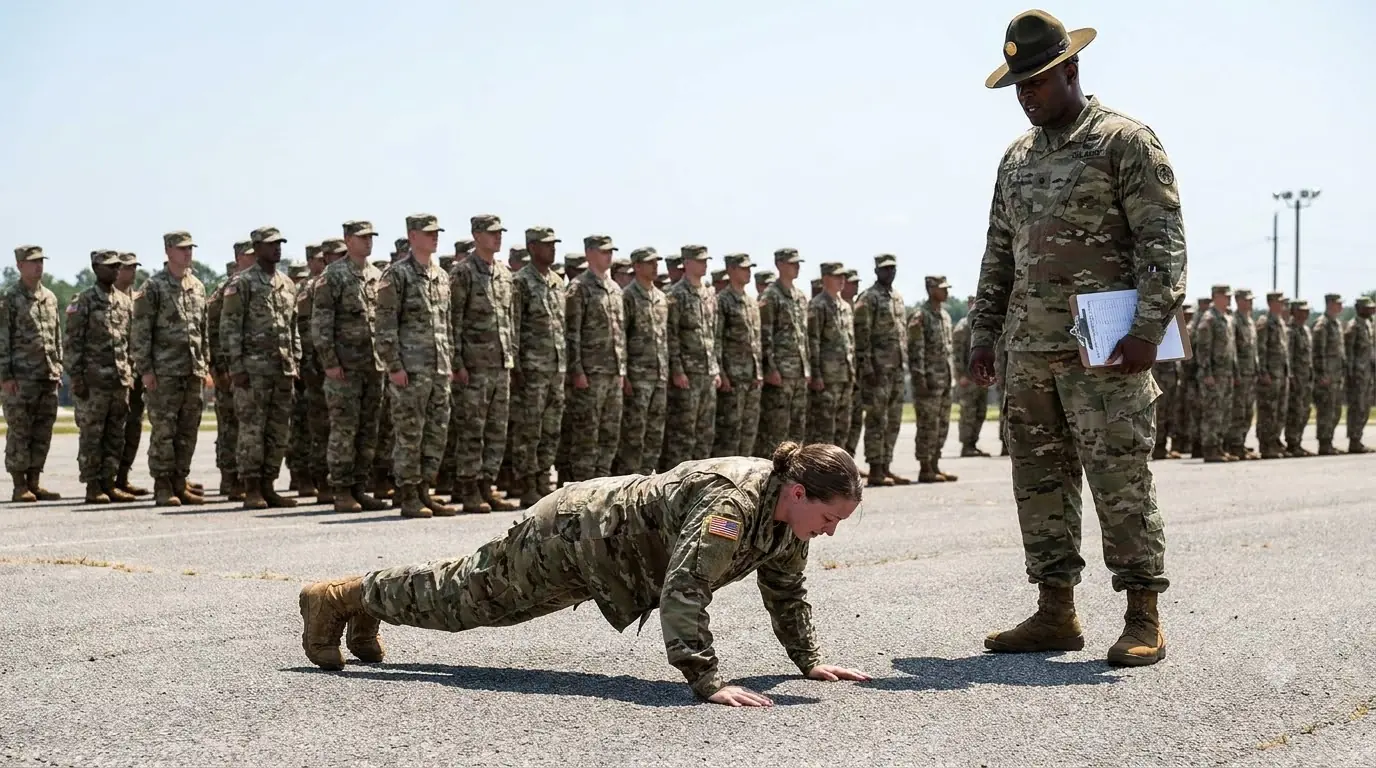
Barely.
“Eighty-five.”
The asphalt had been baking beneath the Georgia sun since morning, and the heat rising from it pressed against Claire’s face every time she descended. Small pieces of limestone grit had already embedded themselves into the skin of her palms, and every repetition ground them deeper.
She tried not to think about that.
She tried not to think about anything.
Down.
Up.
Breathe.
Down.
Up.
Breathe.
Ninety-two trainees stood behind her in four perfectly straight rows.
All men.
All exhausted.
All silent.
They had completed the same twelve-mile weighted endurance march less than twenty minutes earlier, carrying emergency packs through wooded trails, mud, steep inclines, and open stretches where the afternoon sun seemed to drain strength directly from their bodies.
Claire had completed it too.
She had finished thirty-seventh.
Not last.
Not first.
Thirty-seventh.
It should have meant nothing.
To her, it meant everything.
For nine weeks, Claire had felt as though every result she produced entered a different accounting system than everyone else’s.
If one of the men finished twentieth, he finished twentieth.
If Claire finished twentieth, people noticed.
If a man struggled carrying equipment, he was tired.
If Claire struggled, someone wondered whether she belonged.
No one said it directly anymore.
They had learned better.
But Claire could still feel the question.
It followed her through every obstacle course, every classroom evaluation, every overnight navigation exercise, and every timed rescue simulation.
Can she really keep up?
She hated the question.
Mostly because she had asked herself the same thing.
Hayes stepped closer.
“Eighty-six.”
Claire lowered herself.
Pushed.
Her arms shook.
The academy had no ranks, no formal chain of command beyond instructors and trainees, and no promise of glory waiting at graduation.
People came because they wanted certification for wilderness rescue teams, disaster-response organizations, industrial emergency crews, backcountry medical units, and volunteer search groups.
Some were firefighters.
Some were paramedics.
Some worked for private emergency organizations.
Others wanted credentials for careers in outdoor rescue.
Claire had come for one reason.
Her younger sister.
Four years earlier, nineteen-year-old Emily Miller disappeared during a solo hiking trip in northern Montana.
Search teams found her forty-one hours later.
Alive.
Hypothermic.
Dehydrated.
Injured.
The people who reached Emily first were civilian wilderness responders who had spent the night crossing unstable terrain while a storm moved through the mountains.
Claire met them afterward.
They looked ordinary.
Tired.
Dirty.
Quiet.
No speeches.
No performance.
One woman named Sara had simply told Claire:
“We found her because people kept looking.”
That sentence stayed.
Claire had been studying accounting at the time.
Six months later, she changed direction completely.
Emergency medicine courses.
Navigation.
Rope systems.
Wilderness first aid.
Search coordination.
Then the Georgia academy.
The training program was considered one of the most demanding civilian rescue certifications in the region.
Nine weeks.
Ninety-three trainees at the start.
Claire was the only woman.
That fact had shaped the program from the first hour whether anyone admitted it or not.
Hayes had noticed immediately.
Everyone had.
He was forty-five, lean rather than bulky, with close-cropped gray hair and a voice so controlled that trainees became nervous when he got quieter.
He taught equipment discipline, field leadership, and endurance management.
He believed mistakes multiplied under pressure.
A loose buckle could mean lost equipment.
A missing medical pouch could mean delayed treatment.
A forgotten carabiner could ruin a rope system.
His philosophy was simple:
Small habits mattered before emergencies made them large.
Claire understood that.
She even respected it.
What she did not understand was why Hayes seemed determined to turn every mistake she made into a public referendum on whether she belonged.
That afternoon, the march ended at 2:38.
Every trainee stood in final formation while instructors checked equipment.
Claire’s shirt was soaked through.
Salt had dried along the collar.
Her legs trembled beneath her.
A blister on her right heel had opened three miles earlier.
She said nothing.
Hayes moved down the line.
Pack strap.
Water container.
Radio.
Emergency blanket.
Medical pouch.
Gloves.
He stopped in front of Claire.
His eyes dropped.
Her stomach tightened.
One small buckle on the side of her pack hung open.
Half an inch of nylon strap protruded.
Claire saw it.
So did Hayes.
He touched the buckle with one finger.
“Miller.”
“Yes, Instructor.”
“Unsecured.”
“Yes.”
“How long?”
“I don’t know.”
“Wrong answer.”
Claire swallowed.
“Possibly the final mile.”
Hayes nodded.
“Equipment attached?”
“Yes.”
“Lost anything?”
“No.”
“Could you have?”
“Yes.”
Hayes looked at her.
“Drop.”
Claire lowered the pack.
Then herself.
Hands on the asphalt.
Feet back.
She expected twenty.
Maybe fifty.
Hayes said:
“Three hundred.”
For the first time, Claire thought she had misheard.
Behind her, someone inhaled sharply.
Hayes looked down.
“Problem?”
“No.”
“Then begin.”
Claire began.
At first, anger made everything easy.
One.
Two.
Three.
Her movements were sharp.
Controlled.
Fast.
She imagined every push-up as an argument she did not need to verbalize.
Ten.
Twenty.
Thirty.
The men behind her remained standing.
Nobody spoke.
At fifty, the first layer of anger disappeared.
Pain replaced it.
At seventy, her pace slowed.
At eighty, her shoulders began burning.
At eighty-four, the world reduced itself to asphalt and Hayes’s shoes.
“Eighty-seven.”
Claire pushed.
Her triceps trembled.
“Eighty-eight.”
Down.
Up.
“Eighty-nine.”
Her breathing came harder.
Hayes remained near her head.
She could see his shoes each time she lowered herself.
He was waiting.
That irritated her more than the number.
Not counting.
Waiting.
For failure.
At least that was what she believed.
“Ninety.”
Claire locked out.
Her entire upper body shook.
Hayes said:
“Keep your elbows controlled.”
“Yes, Instructor.”
“Again.”
She lowered.
The formation behind her had become unnaturally quiet.
Normally after a march everyone breathed loudly.
Shifted weight.
Cleared throats.
Now ninety-two men seemed to have collectively decided that even breathing might distract her.
Claire did not know what they were thinking.
She assumed pity.
She hated pity.
“Ninety-five.”
Her palms hurt.
“Ninety-six.”
Shoulders.
“Ninety-seven.”
Lower back.
“Ninety-eight.”
Chest.
“Ninety-nine.”
Hayes paused.
Claire waited at the top.
Her arms shook.
“One hundred.”
Something strange happened.
For half a second, Claire felt proud.
Then she remembered there were two hundred remaining.
The pride disappeared.
She lowered again.
At one hundred and one, her left palm slipped.
Only an inch.
But the sudden movement sent a jolt through her shoulder.
Claire caught herself before her chest touched the pavement.
Behind her, a boot scraped.
Hayes looked toward the sound.
“Hold formation.”
Silence.
Claire reset her hand.
She could feel moisture under her palm.
Sweat.
Maybe a small scrape.
She did not look.
“One hundred and two.”
She pushed.
The next ten repetitions felt slower than the first hundred.
At one hundred and fifteen, Claire began breaking the number into smaller pieces.
Five.
Then five.
Then five.
Never think about three hundred.
Think about the next one.
At one hundred and twenty-seven, a memory appeared.
Her father in his garage.
Claire at eleven.
Trying to loosen a rusted bolt on an old pickup.
“It’s stuck.”
“Then change your angle.”
“I can’t.”
“You mean you haven’t yet.”
Claire hated that answer as a child.
She understood it now.
Her father, Thomas Miller, had repaired trucks for thirty-two years.
His hands looked permanently stained with grease no matter how often he washed them.
He was not philosophical.
He did not give speeches.
But one sentence had followed Claire through adulthood.
The only thing you truly own is your decision about the next minute.