Have you ever been looked at like you're taking up space you don't deserve? A mother just wanted to buy her son a birthday dessert. Instead, a greedy waitress humiliated her in front of a crowded room, entirely unaware that the quiet man at table five owned the building.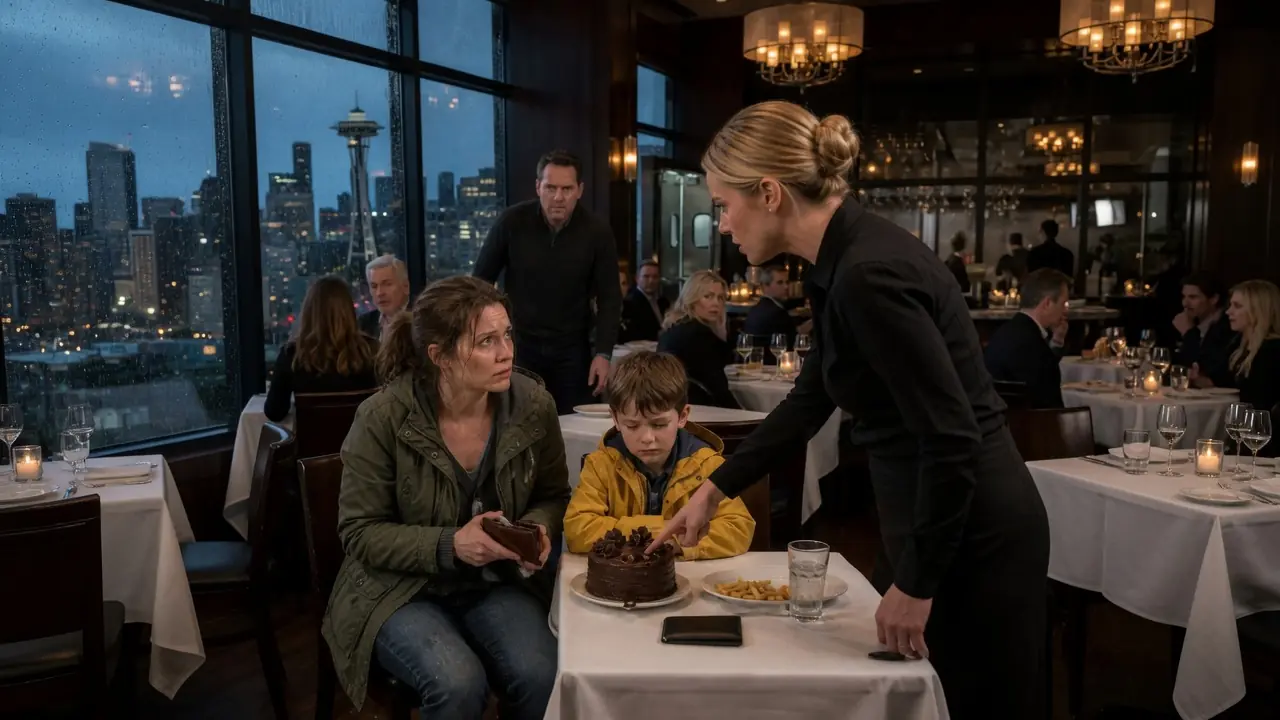
The rain in Seattle didn't wash things clean; it just made everything heavy. Sarah stood under the dripping maroon awning of the Oak Haven, her knuckles white around the handle of a cheap umbrella. Beside her, little Leo was vibrating with the kind of pure, unadulterated excitement only a seven-year-old can muster on their birthday. His yellow raincoat was too short at the sleeves, and her boots were leaking through the left sole.
"Is this it, Mom?" Leo asked, his breath fogging the heavy glass of the restaurant's front window.
Inside, golden light spilled over white tablecloths, crystal wine glasses, and people who didn't have to check their bank accounts before ordering a second drink.
"This is it, buddy," Sarah said. Her voice was steady, but her stomach was a tight, cold knot.
She hadn't been to the Oak Haven in three years. Back then, it was a neighborhood bistro—burgers, decent pasta, and friendly faces. She used to save up her tips from the dry cleaners to bring Leo here for pancakes on Sunday mornings. But the neighborhood had changed. Tech money moved in, tearing down the brick walk-ups and replacing them with slate gray condos. The Oak Haven had clearly adapted to survive; the neon beer signs in the window were gone, replaced by a tasteful, unreadable cursive logo.
Sarah squeezed her purse against her side. Inside, a worn leather wallet held exactly thirty-four dollars in cash. It was supposed to be a groceries week, but it was his birthday, and she had promised him the famous, massive chocolate lava cake. A promise was a promise.
She pushed the heavy oak door open. The warm air hit them instantly, carrying the rich, expensive scent of truffled butter, roasted garlic, and seared steak. The dull roar of conversation shifted as the hostess came into view.
Tiffany stood behind the podium, her name tag made of polished brass and her smile sharp enough to cut glass. Her eyes did a quick, ruthless inventory of the pair. She clocked the damp, fraying hem of Sarah's jeans and noticed the scuffed toes of Leo's hand-me-down sneakers. The professional warmth vanished from her face, replaced by the tight, practiced mask of someone forced to deal with an inconvenience.
"Do you have a reservation?" Tiffany asked, completely ignoring Leo.
"No," Sarah said, keeping her chin up. "Just the two of us. We were hoping to just get some dessert."
Tiffany sighed. It was a microscopic exhalation, but in the quiet foyer, it was deafening. She tapped a lacquered fingernail against the screen of her tablet. "We're moving into our dinner rush. Tables are reserved for full-service dining."
"It's my birthday," Leo chirped, looking up at the tall woman with wide, hopeful eyes.
Tiffany offered a smile that didn't reach her eyes. "Happy birthday. Let me see what I can do."
She grabbed two oversized menus and marched them through the dining room. Sarah held Leo's hand tightly, feeling the eyes of the other patrons sliding over them. They were led past the plush corner booths, past the warm fireplace, all the way to the back. Tiffany stopped at a small, wobbly two-top table jammed right next to the swinging kitchen doors. The draft from the hallway was cold, and the clatter of dishware was constant.
"Here you go," Tiffany said, dropping the menus flat on the table. "Your server will be right with you."
She didn't mention that she was taking this section herself tonight solely because she wanted to keep an eye on turnover. Tiffany hated campers. She lived on tips, and people who ordered cheap didn't tip well.
Sarah sat down and opened the menu. The knot in her stomach tightened into a vice. The prices had changed; they hadn't just increased, they had skyrocketed. The burgers were gone. In their place were Wagyu sliders for twenty-eight dollars. The pasta was now hand-rolled gnocchi for thirty-five dollars. Panic, cold and sharp, flooded Sarah's veins. She mentally calculated the thirty-four dollars in her purse. Turning quickly to the dessert section, she found the dark chocolate lava cake listed for eighteen dollars.
Relief washed over her. It was expensive, ridiculously so, but she could afford it. That left sixteen dollars—enough for a decent tip and maybe a side of fries to share.
Tiffany returned before they could even take off their coats, standing with her weight shifted to one hip, her pen hovering over a notepad. "Can I get you started with some sparkling water? Or perhaps half a dozen oysters?"
"Just tap water, please," Sarah said softly. "And we're actually ready to order."
Tiffany's eyebrows twitched upward. "Already? Great."
"We'll take the chocolate lava cake," Sarah said, forcing a warm smile for Leo's sake. "And a side of the truffle fries, please. To share."
Tiffany stopped writing and stared at Sarah. "That's it?"
"Yes, thank you."
"Ma'am, the fries are a side dish. We usually require an entree order to sit in the main dining room." Tiffany's voice was dripping with polite condescension, loud enough that a businessman at an adjacent table glanced over.
Sarah felt the heat rushing to her cheeks. She hated this feeling—the absolute, crushing vulnerability of being poor in a room full of money. "We just came for his birthday. The hostess sat us here knowing we only wanted dessert."
"I am the hostess," Tiffany snapped her notepad shut. "And I assumed you'd at least order a proper meal. I'll put the order in. Tap water, fries, cake." She spun on her heel and pushed through the kitchen doors, leaving a gust of cold air in her wake.
Leo looked up from the napkin he was smoothing out. "Is the lady mad at us, Mom?"
"No, baby," Sarah lied, reaching across the small table to grab his hand. "She's just busy. It's a busy place." She took a slow, deep breath, trying to push down the humiliation. She wasn't going to let this ruin his night. She wouldn't let him see the math running frantically behind her eyes—the desperate, exhausting calculation of survival. She poured him a glass of ice water from the carafe on the table and smiled.
David Hayes hated fancy restaurants. He hated the performative bowing, the microscopic portions, and the way the waiters announced the origin of a carrot like they had birthed it themselves. Most of all, he hated the sycophants. David sat alone in the spacious, curved leather booth at table five, nursing a glass of bourbon he didn't really want. He wore a plain charcoal sweater and dark jeans. Nothing about him screamed wealth; there were no flashy watches on his wrist and no designer logos on his chest. He looked like a tired architect who had just gotten off a long shift.
In reality, he was the CEO of Apex Holdings, a private equity firm that had just finalized the acquisition of the hospitality group that owned the Oak Haven. He was here doing a silent audit. He did this with all his new acquisitions. Spreadsheets and quarterly reports could only tell you if a business was making money; sitting in a corner booth told you how it was making money and, more importantly, if the soul of the place was rotting out.
From table five, David had a clear view of the entire floor. For the last forty minutes, he had watched the manager, a slick-haired guy named Richard, schmooze with the tables ordering expensive wine while ignoring the staff visibly struggling with a backup at the expediter station. It was sloppy management, but what really caught David's attention was the waitress, Tiffany.
David had an eye for mechanics. He watched how people moved and how they operated when they thought no one important was looking. He had watched Tiffany seat the mother and the little boy by the kitchen doors, and he had seen the sneer on her face when she took their order. He watched her rigid spine and her aggressive pen tapping. He didn't know what the mother had ordered, but he knew the look on the woman's face when the waitress walked away. It was a look David remembered from his own childhood—the look his mother used to get at the grocery store checkout when she had to quietly tell the cashier to put the milk back. It was the quiet, dignified panic of poverty.
David took a slow sip of his bourbon, the ice clinking against the glass, keeping his eyes on the two-top by the kitchen.
Ten minutes passed. The restaurant grew louder. A party of six walked through the front door, loud, dripping in designer labels, and laughing boisterously. David watched Richard, the manager, practically trip over his own feet rushing to greet them.
"Gentlemen, welcome," Richard's voice carried over the din. "We are completely full, but give me just a moment to arrange something for you."
David watched Richard scan the room. The manager's eyes landed on the back corner. He caught Tiffany's eye and gave a sharp, subtle nod toward the mother and the boy. It was a silent command: Clear them out.
Tiffany's eyes lit up. A party of six drinking heavily meant a massive tip. She didn't hesitate. She grabbed a tray with a small plate of fries and a single slice of chocolate cake, marching over to the two-top. Instead of serving it properly, she unceremoniously slid the plates onto the table, causing the small ramekin of ketchup to clatter loudly.
"Here you go," Tiffany said. She didn't offer plates to share, and she didn't bring silverware. She reached into her apron, pulled out a black leather billfold, and dropped it right next to the cake. "And here is your check."
Sarah flinched at the sound of the leather hitting the wood, looking up in confusion. "We haven't even eaten yet."
"I know," Tiffany said, leaning in slightly, her voice dropping into a harsh, urgent register. "But I need to cash you out now. We have a time limit on our tables, and to be perfectly honest, we have a fifty-dollar per table minimum during peak hours. You aren't meeting it."
David, sitting just two tables away, heard the whole thing and frowned. There was no time limit; he had read the operational manual for the restaurant group that morning. There was certainly no fifty-dollar minimum. Tiffany was lying to flip the table.
Sarah's face went pale. She looked from the check to Tiffany, then down at Leo, who was staring at the cake with wide, excited eyes, entirely oblivious to the tension above his head.
"A minimum?" Sarah whispered. "You didn't say anything about a minimum when we sat down."
"It's standard policy," Tiffany lied smoothly. "Look, I'm trying to be nice here, but I have paying customers waiting at the front—people who are actually ordering dinner. I need this table in ten minutes. You can box that up if you need to."
"Box it up?" Sarah's voice cracked. The dignity she had been holding onto by a thread was starting to fray. "It's a hot lava cake. He can't eat it in a box. It's his birthday."
"Ma'am, I am not going to argue with you," Tiffany said, her voice rising just enough to draw the attention of the surrounding tables. She wanted to embarrass Sarah into compliance; it was a classic bully tactic. "You're taking up space for a five-dollar side of fries and a dessert. You need to pay the bill and leave."
The room seemed to go quiet, the clatter of silverware fading into the background. Sarah felt the heat of a dozen stares burning into her skin. Looking down at her hands, she found them shaking. She reached for her purse, her throat tight with unshed tears, wanting nothing more than to get Leo out of here before the humiliation bled onto him.
"Okay," Sarah choked out, unzipping her wallet. "I'll pay. We'll eat fast."
"No," Tiffany said coldly. "I need the table now. I'll get you a box."
At table five, David Hayes slowly placed his linen napkin on the table. The anger in his chest was cold and sharp. He had built his empire on efficiency, yes, but he had built it on respect, too. Watching a woman weaponize her small fraction of power to crush a mother trying to give her son a birthday treat disgusted him on a molecular level.
He stood up. The legs of his heavy oak chair scraped loudly against the hardwood floor, cutting straight through the tension in the room. Tiffany glanced over, irritated by the interruption, and saw a man in a plain sweater walking toward her.
"Excuse me," David said. His voice wasn't loud, but it carried an undeniable weight—the voice of a man who was used to an entire boardroom shutting up when he spoke. He stopped right next to Sarah's table, looking down at Tiffany. "Is there a problem here?"
Tiffany plastered on her fake customer service smile. "No problem at all, sir. I'm just helping this table box up their food so we can accommodate waiting guests. If you need a refill, I'll be right with you."
"I don't need a refill," David said softly.
He looked at Sarah. She was frozen, her hands still clutching the cheap leather of her wallet. He looked at the little boy who was holding a fork, staring at the melting chocolate cake he wasn't allowed to eat. Then David turned his eyes back to Tiffany, the coldness in his stare making the waitress take a half-step back.
"I heard you mention a fifty-dollar minimum," David said, his tone conversational but laced with steel. "That's fascinating. I've eaten here a few times and I've never heard of that policy."
Tiffany's smile faltered just for a second. "It's a new policy, sir. Management implemented it for the dinner rush."
"Management?" David repeated. He looked across the dining room, locking eyes with Richard, who was still lingering near the wealthy party of six, watching the confrontation unfold with mild annoyance.
"Yes, sir," Tiffany said, her tone growing sharper and defensive. "Now, if you don't mind, I need to finish closing out this tab."
"Actually, I do mind," David said. He reached down, picked up the black leather billfold from Sarah's table, and slid it into his own pocket.
Tiffany gasped. "Excuse me, you can't take that! Get the manager!"
"I don't need the manager for this," Tiffany snapped, dropping the polite act entirely as she turned to Sarah with pure venom. "Lady, tell your friend to back off or I'm calling security for the both of you."
"I don't know him," Sarah whispered, terrified.
David didn't break eye contact with the waitress. "I won't ask twice. Go get Richard."
Tiffany froze. She hadn't used the manager's name aloud; how did this random guy in a plain sweater know it? A sliver of doubt finally pierced through her arrogance. She glared at David, then turned and marched furiously across the floor toward the host stand.
David looked down at Sarah, his expression softening instantly. The cold executive vanished, replaced by a grounded, deeply human warmth. "Eat the cake," he told the little boy.
Leo looked up at his mother for permission. Sarah was staring at David, her heart pounding against her ribs.
"Who are you?" she asked, her voice trembling.
"Just a guy who hates bad service," David said, taking a step back to give them space. "Please, let him eat his birthday cake. I'll handle this."
Across the room, Richard, the manager, was storming over, his face flushed with the righteous anger of a man who thought he controlled the room. He was flanked by Tiffany, who was pointing a manicured finger directly at David's chest. David stood his ground, waiting. The audit was officially over; it was time for the restructuring.
Richard crossed the dining room with the heavy, purposeful strides of a bouncer rather than a manager. His suit was expensive, but it fit poorly around the shoulders, and he carried a clipboard tucked under one arm—a universal prop for manufactured authority. Tiffany trailed half a step behind him, her chin tipped up with a look of supreme, vindicated triumph.
Sarah shrank back against the vinyl of the booth, pulling Leo's chair a few inches closer to her own. Her instinct was to flee; poverty taught you to run when the people in charge started looking at you like a problem. But David Hayes stood between her and the aisle, an immovable object wrapped in a charcoal sweater.
"Sir," Richard said. He didn't introduce himself, and he didn't ask what the issue was, going straight for the kill. "I'm going to have to ask you to return the checkbook to my server, return to your table, and mind your own business. Otherwise, I'll have you escorted out."
David didn't flinch, and he didn't even shift his weight. "Your server was attempting to enforce a fifty-dollar table minimum on a woman and her child—a policy that does not exist."
Richard's eyes flicked to Tiffany, then back to David. The manager knew it was a lie, but David could see the calculation happening behind his eyes. Richard had a party of six waiting at the front holding black cards and a thirst for expensive vodka. He needed this table empty. Truth didn't matter; turnover did.
"We reserve the right to refuse service to anyone, sir," Richard said, his voice slick and low, meant to intimidate without causing a scene. "During peak hours, management implements dynamic seating guidelines to ensure all our patrons have a premium experience. Now, the billfold. Hand it over."
"Dynamic seating guidelines?" David repeated, a humorless smile touching the corners of his mouth. "That is an incredibly creative way to say you're kicking a family out onto the street so you can chase a larger tip. That is none of your concern."
"This is a private establishment," Richard snapped, his patience evaporating as he took a step closer to David, invading his personal space. "Give me the book. Now."
"It actually is my concern," David said quietly.
He reached into his pocket, but he didn't pull out the billfold. Instead, he pulled out a slim, matte-black wallet, slid a single heavy metal card from the slot, and held it up. It wasn't a credit card; it was a corporate ID badge. The logo at the top was a sharp cursive script—the exact same logo stamped on the front window of the Oak Haven. But beneath it were clear words printed in stark white text: Apex Holdings.
"My name is David Hayes," he said. He didn't raise his voice; he didn't have to. The silence spreading outward from their little triangle by the kitchen doors was absolute. "I finalized the purchase of the hospitality group that owns this restaurant four days ago."
Richard froze. His breathing stopped. The aggressive, forward lean of his posture suddenly looked incredibly awkward, like a man caught off balance on the edge of a cliff.
"You—" Richard choked, the slick, polished veneer of the authoritative manager melting away instantly. Underneath was just a terrified man realizing he had made a catastrophic error. "You're the CEO?"
"I am," David said. He finally reached into his other pocket, retrieved the black leather billfold, and placed it flat against Richard's chest, forcing the manager to scramble to catch it before it hit the floor. "And I have been sitting at table five for the last hour watching you operate my restaurant."
Tiffany looked completely lost, staring at the metal card in David's hand. Her brain struggled to connect the dots between the unassuming man in the simple sweater and the billionaire owner her regional director had been frantically emailing them about all week.
"Mr. Hayes," Richard stammered, a thin sheen of sweat breaking out across his forehead. "Sir, I had no idea. We're just trying to... we have to maintain a certain standard for our clientele."
"Your standard?" David asked, the ice in his voice absolute. "Your standard is watching your kitchen staff drown in tickets while you hover around tables that order expensive wine. Your standard is allowing your servers to invent fake policies to intimidate mothers and children into leaving. You think you're protecting the brand, Richard. You're actually just destroying its soul."
"Sir, please," Richard begged, lowering his voice to a desperate whisper. "The party at the front, they spend thousands here."
"I don't care," David cut him off. "I don't care if they spend a million. You don't treat people like garbage to make a dollar. Not in my building." David turned his attention to Tiffany, who took a physical step backward, her previous arrogance entirely gone, her hands shaking. "You wanted this table," David said to her. "You lied to a customer, humiliated her in front of a crowded room, and tried to ruin a child's birthday because you wanted to flip a seat. That isn't hospitality; that's greed."
"I was just following orders," Tiffany blurted out, throwing Richard under the bus with zero hesitation. "He told me to clear them out."
"And you enjoyed doing it," David replied flatly. "You're both done."
Richard opened his mouth to argue, but the look in David's eyes stopped the words in his throat. It was a look of total, unyielding finality.
"Pack up your office, Richard," David said. "Leave the keys on the bar. Tiffany, punch out. Corporate will mail your final checks on Monday."
"You can't do this," Tiffany said, her voice shrill. "You can't just fire us on the spot."
"I just did," David said. "Now, walk away before I have security escort you out for trespassing."
Richard swallowed hard, looked at the floor defeated, then turned and walked numbly toward the back office. Tiffany stood there for two more seconds, her face burning red, before she spun on her heel and pushed violently through the swinging kitchen doors.
The dining room stayed completely quiet—the specific, suffocating quiet that follows a car crash. At the front of the house, the loud party of six suddenly found their manicures and empty martini glasses absolutely fascinating.
David exhaled, the ice-cold executive dropping away, leaving behind a tired man in a plain sweater. He turned back to the wobbly two-top by the kitchen doors.
Sarah was shaking, the adrenaline rapidly draining out of her blood, leaving behind the cold, heavy exhaustion of survival. Leo, entirely immune to the corporate slaughter that had just occurred above his head, was finally eating his cake, dark chocolate smeared across his nose.
David pulled out a chair from the adjacent table. Instead of standing over them, he sat down, forcing himself to eye level. "I am sorry," David said, his voice rough. "You shouldn't have had to sit through that."
Sarah stared at her pale hands. "I did the math. I had thirty-four dollars. The cake was eighteen. I just wanted him to have the cake."
David knew that math. It was the arithmetic of poverty—calculating the exact tax on a carton of milk before walking to the register. It was a language you never forgot, no matter how many commas they eventually added to your bank account.
"You did the math right," David said softly. He looked at the boy. "Happy birthday, Leo. Is it good?"
Leo nodded vigorously, his eyes wide. "The lady was mean, but the cake is super awesome."
David smiled a sad, genuine smile. "Yeah, she was." He caught the eye of an older waiter lingering nervously near the service station and gestured him over. "Thomas, right?" David asked.
"Yes, Mr. Hayes?" Thomas wiped his hands frantically on his apron.
"Thomas, scrap the dynamic seating garbage and get these two the steak frites. Two orders. Throw in the truffle mac and cheese for the kid. Put it all on my personal tab."
Sarah flinched, the instinct to refuse charity a deeply ingrained reflex. "Please, no. You don't have to do that."
David looked at her. There was no pity in his eyes; pity was a luxury for people who had never gone hungry. There was only recognition.
"I want to," David said. "People like Richard think a paycheck makes them a god. They forget that the only real use for money is making the world a little less ugly for someone else." He dug into his pocket and slid a plain, matte business card across the table—just a name and a direct number. "If you ever need a decent job, call that. My assistant will answer."
David stood up, pushing his chair in, not waiting for her to cry or thank him. He didn't want a display of gratitude. "Take your time tonight. The steak is actually decent."
David walked back to table five, sat down, picked up his bourbon, and watched the Seattle rain beat against the glass. It was still a cold world out there, but right here by the kitchen doors, it was just a little warmer.
True wealth isn't measured by what you have; it's measured by how you treat people who can do absolutely nothing for you.