People think the streets harden you until you feel nothing. They are wrong. The streets just teach you when to look away. But when a 60-year-old biker queen went down in a twisted heap of chrome and blood, a forgotten homeless kid chose to look. And 800 outlaws noticed.
Rain in Seattle does not fall. It hangs. It suspends itself in the air like a cold, wet sheet, soaking into everything. It seeped through the nylon of Riley's sleeping bag. It chilled the concrete under the I-5 overpass and settled deep into her bones.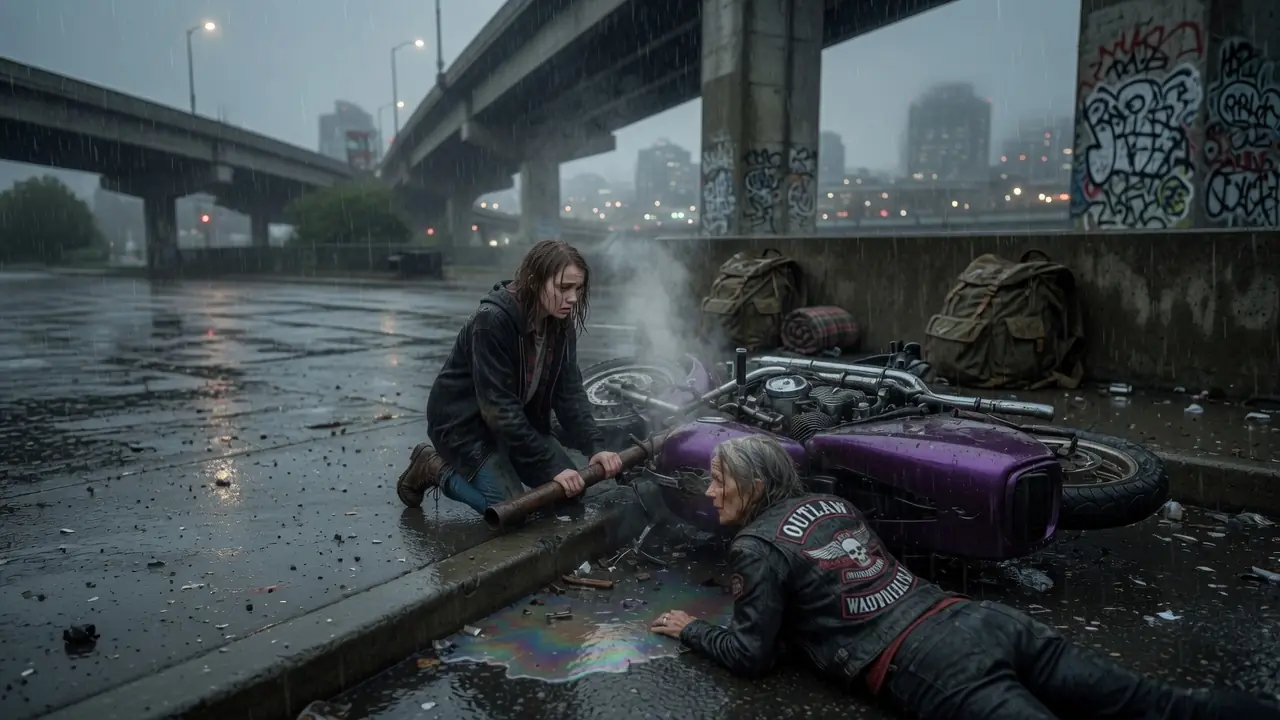
Seventeen years old, and Riley was a ghost. Society had looked right through her for three years, ever since the foster system spat her out and the group homes became more dangerous than the alleys. She knew the rules of the concrete: keep your head down, do not hold eye contact, and when trouble happens, become a shadow. It was 2:00 a.m. on a Tuesday, and the city was a slick black mirror.
The roar started as a low vibration in her jaw. It grew into a guttural, ground-shaking thunder, a heavy V-twin engine tearing down the wet tarmac, pushing 80 on a road meant for 40. Riley did not bother opening her eyes. Bikers ran this stretch all the time.
Then came the screech. It was not a clean sound. It was the violent, chaotic shriek of rubber failing to grip wet asphalt, followed instantly by a percussive, world-ending crunch. Metal tore into concrete, and sparks cascaded like fireworks against the dark structural pillars of the bridge.
The heavy machine tumbled violently, shedding parts before slamming into the guardrail with a sickening thud. Silence slammed back down. Just the hiss of rain on a hot engine block. Riley lay still in her damp sleeping bag.
"Do not move," her instinct screamed. Whoever that was, the cops were coming. Paramedics. Questions. They would run her name, see she had nothing, and cage her again.
But the silence was wrong. It was not empty. Under the hiss of the rain, someone was choking. Riley crawled out of her bag, and the cold hit her instantly, biting through her thin layers of flannel.
She crept toward the concrete pylon, peering around the edge. The bike was a massive custom build, heavy American iron painted a deep bruised purple, now scraped raw to the steel. It lay on its side, a dying beast leaking gasoline into a murky puddle. Trapped beneath its 900-pound bulk was a woman.
Riley hesitated. She knew the jacket. It was heavy black leather. The rockers on the back, though half obscured by the crushed fender, bore the red and white lettering that commanded absolute, unquestioning fear on the streets: Hells Angels.
This was not just a biker. She was an old lady, but the patch she wore on her chest, a specialized diamond, marked her as someone of immense reverence, a matriarch, a queen in a kingdom built on exhaust, loyalty, and violence. And she was bleeding to death. A jagged piece of the primary cover had shattered, driving a thick shard of aluminum deep into the woman's upper thigh.
This woman had maybe three minutes before her heart pumped the last of her life onto the wet pavement. "Walk away," the street whispered. Riley stepped out from the pillar. She ran.
Her worn boots splashed through the gas-slicked puddle. The smell of high-octane fuel and fresh, hot blood hit the back of her throat. She dropped to her knees beside the woman. The biker queen's eyes flickered open.
They were storm gray, surrounded by deep lines carved by decades of wind and sun. Even pinned and dying, there was no panic in them. Just a cold, hard assessment. "Gas," the woman rasped, blood bubbling at the corner of her mouth. "Going to catch. Get back, kid."
"Shut up," Riley grunted. She grabbed the handlebars. The metal was scalding. She planted her boots, braced her incredibly thin frame, and pulled.
Nothing. The bike did not budge. It was like trying to lift a bank vault. "Leave it," the woman coughed, her head lolling.
The pool of blood around her leg was widening, mixing with the rain and staining Riley's jeans. Riley looked around frantically. A few yards away lay a broken piece of scaffolding, a heavy steel pipe left behind by city workers. She scrambled for it, her fingers slipping on the wet metal.
She dragged it over, shoved one end under the bike's frame, and used the shattered curb as a fulcrum. She threw her entire body weight onto the pipe. The laws of physics kicked in. The massive engine block groaned, and the bike lifted two inches, then four.
"Pull your leg out!" Riley screamed, her muscles burning, her vision going white at the edges. The woman gritted her teeth, a guttural snarl tearing from her throat, and dragged her mangled leg free from the wreckage. Riley let go of the pipe. The bike slammed back down, cracking the pavement.
Riley fell to her knees beside the leg. The aluminum shard had torn clean out, leaving a gaping wound. The femoral artery was hit. She did not think.
Riley ripped the top layer of her flannel shirt, tearing it violently at the seam. She grabbed a smaller chunk of debris, a snapped foot peg, and wrapped the soaked fabric high around the woman's thigh. She tied a crude knot, slotted the foot peg through, and began to twist. One turn. Two.
The woman screamed, a raw, ragged sound that echoed off the concrete. "I know, I know, I know," Riley chanted, twisting the peg a third time. The pulsing flow of blood slowed. Another half twist, and it stopped.
Riley held the peg tight against the leg, tying it off with the remaining tail of the shirt. Her hands were slick with dark, sticky red. She sat back on her heels, gasping for air. The woman stared up at her.
Her face was chalk white, the rain plastering gray hair to her forehead. She reached out with a heavy, silver-ringed hand and grabbed Riley's wrist. The grip was weak, but the intent was iron. "Roxanne," the woman breathed.
"Riley," the kid whispered back. In the distance, the wail of sirens finally cut through the night. First responders. Police.
Riley's survival instinct snapped back into place. Cops. Questions. The bloody shirt. The gang affiliations. They would put her in holding and send her back to the youth authority.
She pulled her wrist from Roxanne's grip. "Do not run," Roxanne said, her eyes dropping shut. "Do not." Riley did not listen.
She grabbed her sleeping bag, shoved it into her battered canvas backpack, and melted into the shadows of the overpass, just as the flashing red and blue lights painted the concrete.
Four days. Four days of jumping at every loud engine. Four days of keeping her head buried under the hood of her oversized jacket. Riley relocated to the industrial district, a wasteland of rusted shipyards and abandoned warehouses.
It was farther from the soup kitchens, farther from the relative safety of the lit streets, but she did not care. The city was vibrating. Word on the street travels faster than the news. The homeless network is a sprawling, invisible organism that sees everything.
And what the organism saw right now was terrifying. The club was out. Not just a few guys running errands. The heavy hitters, the nomads, men with scarred faces and patches that denoted things decent society preferred not to know about.
They were tearing the downtown grid apart, moving through alleys, questioning corner hustlers, and shaking down junkies. Riley sat on an overturned milk crate behind a defunct cannery, chewing on a stale bagel she had dug out of a bakery dumpster. Her hands were still stained. The blood had dried deep into her cuticles.
No amount of harsh gas station soap had gotten it entirely out. They think I hurt her, Riley thought, her stomach twisting into a cold knot. They think I caused the crash. Or they think I robbed her while she was down.
It made sense. Why else would the Hells Angels mobilize a citywide manhunt for a street kid? Retribution. It was the only language the streets understood.
She pulled her knees to her chest. She had saved a life, and it was going to cost her her own. The rain started again, a slow, miserable drizzle. Riley pulled her hood tighter.
She needed to move. Maybe hop a freight train heading south. Get out of the state entirely. The crunch of gravel stopped her dead.
She did not look up immediately. She listened. Boots. Heavy. Deliberate. Not the frantic scuffle of a meth head, and not the squeaking rubber soles of a beat cop.
A shadow fell over her, blocking out the dim yellow light of the street lamp at the end of the alley. Riley slowly raised her head. He was a mountain of a man. A thick, gray-shot beard covered the lower half of his face.
His arms were corded with muscle wrapped in faded ink. Over his black hoodie, he wore the leather cut. The winged death head stared right at her. Riley's heart hammered against her ribs like a trapped bird.
She calculated the distance to the fence. Ten feet. He was huge, but she was small and fast. If she could just...
"Do not," the man said. His voice was a deep, gravelly rumble. It was not a threat. It was a statement of fact.
He stepped sideways, blocking the path to the fence without breaking a sweat. Riley froze, her muscles locking up. "I did not take anything," she blurted out. The words tumbled over each other, laced with raw panic.
"I did not touch her stuff. I just got the bike off her. That is all. I swear to God." The giant did not move.
He reached into his pocket. Riley flinched, throwing her arms up, expecting a knife, a gun, or a sap. He pulled out a black burner phone. He hit a single button and held it to his ear.
"Yeah," the man said into the phone. His eyes never left Riley. "Warehouse district, behind the old cannery. Yeah, got her." He hung up and slid the phone back into his pocket.
"Who are you?" Riley demanded, trying to force a toughness into her voice that she absolutely did not feel. Her voice cracked. "Name's Wade," he said. He crossed his arms.
"You just sit tight, kid." "I am not sitting anywhere. You cannot just keep me here." Wade let out a short, quiet exhale.
"Kid, if I wanted to hurt you, you would be hurt. Just sit." The sheer gravity of his calm scared her more than rage would have. She sank back onto the milk crate. Five minutes passed in excruciating silence.
The drizzle turned into a steady downpour. Wade stood there, an immovable wall, rain beating off his leather. Then came the sound. It was a deep, synchronized thunder.
It echoed off the corrugated steel of the warehouses, shaking the puddles on the ground. It was not one bike. It was a dozen. Headlights cut through the darkness of the alley.
They rolled in slowly, a procession of massive, gleaming machines, their exhausts popping and growling in the enclosed space. They parked in a semicircle, boxing Riley in completely. The engines cut off one by one, leaving a ringing silence in their wake. Men dismounted.
Big men. Dangerous men. They did not speak. They just stood by their machines, the red and white patches on their backs forming a solid wall of intimidation.
From the center of the pack, a man stepped forward. He was older, maybe late 60s. His face was a road map of scars and deep creases. He wore the president patch over his left breast.
He walked with a heavy limp, favoring a silver-tipped cane, but his presence commanded the alley like a king stepping into a throne room. This was Cole. He stopped five feet from Riley. He looked at her.
Really looked at her. He took in the bruised, exhausted face, the terrified eyes, the clothes that were three sizes too big and soaked through. He looked at her hands, still faintly stained with dried blood. Riley stopped breathing.
This was it. Cole reached into his jacket, slowly and deliberately. He did not pull a weapon. He pulled out a folded, blood-stained piece of ripped flannel.
Riley recognized it instantly. It was the makeshift tourniquet. "Surgeon at Harborview said if this was not tied exactly the way it was, exactly when it was, my wife would have bled out on the pavement," Cole said. His voice was remarkably quiet, but it carried the weight of an anvil.
Riley swallowed hard. "She... she alive?" "She is," Cole said, nodding slowly. "Lost a lot of blood. Bones shattered. But she is alive. Breathing on her own. Complaining about the hospital food, which means she is going to be fine."
Riley felt her knees weaken. The adrenaline that had kept her going for four days suddenly vanished, leaving her hollow. She slumped forward slightly, putting her face in her hands, letting out a jagged, shaky breath. "You ran," Cole said, stepping closer.
"I had to," Riley mumbled through her fingers. "Cops do not look at kids like me and see a hero. They see a suspect. I could not risk the cage."
Cole stood silent for a long moment. When Riley finally looked up, the hard, terrifying mask on the president's face had cracked just a fraction. There was a profound, heavy sorrow in his eyes, masking a fierce gratitude. "Roxanne told me what you did."
"Told me you lifted 900 pounds of dead iron off her leg to get her free." Cole looked back at Wade, then back to Riley. "We have been tearing this city apart looking for you." "Why?" Riley asked, her voice small.
"You found me. You know I did not steal anything. So what now?" Cole planted his cane in the wet gravel. He leaned his weight onto it and looked down at the shivering, discarded child in front of him.
"What now?" Cole repeated softly. He looked around the alley at the squalor, the cold, and the utter abandonment of the scene. The president of the most feared motorcycle club in the region turned his head and spat on the ground, a gesture of absolute disgust directed not at Riley, but at the city that had left her there.
He looked back at her, his eyes locking onto hers. "Now," Cole said, his voice ringing with absolute, unyielding authority, "you pack your stuff. You are done sleeping in the rain."
The clubhouse was not a home. It was a fortress. Squatting on the edge of the industrial flats, the building was surrounded by chain-link fencing and topped with razor wire. Security cameras swept the perimeter.
Heavy iron gates rolled back as Cole's convoy arrived, the rumble of the engines swallowing the sound of the rain. Riley sat in the passenger seat of Wade's battered pickup truck, her hands gripping the door handle. Her instincts screamed at her to bolt. You did not just walk into a 1% compound.
People who went behind these walls usually had a reason, and they usually did not leave until the club said they could. Wade killed the engine. He did not look at her. "Doors unlocked, kid."
"You can run back to the bridge, or you can come inside and eat something that did not come out of a dumpster." He got out and slammed the door. Riley watched him walk toward the heavy steel entrance. She looked back at the open gate.
The street was dark, wet, and empty. She opened the door and followed him inside. The interior hit her senses like a physical blow. It smelled of stale beer, heavy tobacco smoke, gun oil, and burnt coffee.
The walls were lined with framed photographs of men long dead, their faces stern and uncompromising. A massive wooden bar dominated one side of the room, scarred and stained from decades of abuse. It was intimidating. It was rough, but above all else, it was warm.
A few members sat at a corner table playing cards. They looked up as she walked in behind Cole and Wade. Eyes hard, assessing. No one smiled.
No one offered a gentle greeting. But Cole gave a short, sharp nod, and the men went back to their game. The message was clear. She belonged to the president's protection now.
"Kitchen is in the back," Cole said, shrugging off his wet leather cut and tossing it over a bar stool. "Jensen is on cook duty. Tell him you want a steak. Tell him I said to cook it blue, or I will break his jaw."
For the next three weeks, Riley existed in a state of suspended animation. She slept on a heavy leather sofa in a back room, wrapped in a clean wool blanket. She ate three meals a day. She stayed out of the way.
She expected them to put her to work, to demand something in return. That was how the streets worked. But the men in the club largely ignored her, treating her with a gruff, distant respect. They stepped around her and left plates of food out.
When a younger prospect tried to ask her where she came from, Wade materialized from the shadows, put a massive hand on the prospect's shoulder, and steered him away without a word. They were giving her time to thaw. The turning point came on a Thursday. Cole walked into the back room holding a set of truck keys.
"Get up," he ordered. "We are going to Harborview." The hospital smelled of bleach and sickness. Riley hated it.
It reminded her of the group homes, of fluorescent lights and locked doors. She walked a step behind Cole, keeping her head down until they reached the intensive care wing. Roxanne was sitting up in bed. She looked smaller without her heavy leather, her gray hair tied back in a loose braid.
A massive metal frame held her shattered leg together with pins and wires. When she saw Riley, a faint smile cracked her weathered face. "Look at you," Roxanne rasped. Her voice was stronger now, the gravel back in her throat.
"Got some color in your cheeks. You do not look like a drowned rat anymore." Riley shoved her hands deep into her pockets. "You look like you lost a fight with a freight train."
Cole let out a low chuckle. Roxanne grinned, revealing a chipped front tooth. "Come here, kid," Roxanne said, patting the mattress. Riley hesitated, then stepped forward.
Roxanne reached out and grabbed her hand. The grip was no longer weak. It was tight and warm. "I owe you my life," Roxanne said.
No preamble, no flowery nonsense, just the heavy, undeniable truth. "In our world, a blood debt is absolute. You bled for me. You held the line when you had every reason to run."
"I just... I just did not want you to die alone on the concrete," Riley whispered, staring at the floor. "Well, I did not," Roxanne replied. "And neither will you. Not ever again."
The system is a machine. It runs on paperwork, mandates, and cold, unfeeling bureaucracy. Two months later, the machine finally caught up with Riley. She had been spotted by a former case worker outside a grocery store.
The police were called. Her name was run. She was still a minor, a ward of the state, a runaway from a broken system that demanded her return. The knock on the clubhouse gate came from two city detectives and a social worker armed with a court order.
Cole met them at the fence. He did not raise his voice. He did not threaten them. He simply looked the lead detective in the eye and said, "She is not going back to the cages. We will see you in court."
The state did not care about blood debts. They set an emancipation and custody hearing for the following Friday at the county courthouse. The goal was simple: declare Riley a delinquent, strip her of any autonomy, and throw her back into a locked juvenile facility until she turned 18. The night before the hearing, the clubhouse was dead silent.
Riley sat at the bar, staring at a glass of water. Her hands were shaking. "They are going to lock me up, Cole," she said, her voice cracking. "They look at me and they see a piece of trash."
"They look at you and they see criminals. The judge is not going to let me stay." Cole was polishing a piece of chrome with a rag. He did not stop moving. "The system only has power when you stand alone," Cole said quietly. "Tomorrow, you are not standing alone."
Friday morning, 8:00 a.m. The sky over Seattle was overcast, a pale, flat gray. The downtown courthouse was a towering monument of concrete and glass, a place where lives were processed and ruined on a daily basis. Riley walked up the wide concrete steps, flanked by Cole and Roxanne.
Roxanne was in a wheelchair pushed by Wade. They all wore their cuts. The red and white patches stood out like a bloody thumb against the bleak backdrop of suits and briefcases. As they reached the top of the steps, a low vibration began in the concrete beneath their feet.
The social worker waiting near the metal detectors looked around in confusion. The vibration grew. It was not an earthquake. It was a mechanized, guttural roar that seemed to tear the very air apart.
Riley turned around and looked down the avenue. They came from the south. A tidal wave of chrome, steel, and black leather. It was not just the Seattle chapter.
Nomads from California, charters from Oregon, Idaho, and Nevada came with them. The call had gone out across the wire: a kid saved the queen, and the state was trying to take the kid. Ride. They rode.
Eight hundred heavy V-twin engines poured into downtown Seattle, completely blocking off four city blocks. The police presence on the street froze, overwhelmed by the sheer, terrifying mass of the convoy. There was no violence. There were no broken windows.
There was only the deafening, earth-shattering statement of presence. They parked in perfect staggered formation, filling the streets, the sidewalks, and the plazas. Eight hundred men and women killed their engines in unison. The silence that followed was heavier than the roar.
The bikers dismounted. They did not shout. They did not chant. They simply walked toward the courthouse and stopped at the base of the steps, forming a massive, silent wall of leather and patches.
They folded their arms and looked up. Eight hundred pairs of eyes locked onto the glass doors of the courthouse. Inside the courtroom, the atmosphere was suffocating. The judge, a stern man with a reputation for putting runaways in lockup, looked over the case file.
He looked at Riley. Then he looked at the windows. Outside, the street was a sea of outlaws. "Your Honor," the state's attorney began, clearing his throat nervously.
"The minor is a chronic runaway. The individuals she is currently residing with are... well, they are known associates of a recognized criminal organization. This is an unfit environment." Cole stood up.
He did not wait for permission to speak. He leaned heavily on his cane, his scarred face set in stone. "Your Honor," Cole rumbled, his voice filling the quiet room, "this girl saved my wife's life. She dragged a 900-pound motorcycle off her leg and tied a tourniquet with her own shirt while the rest of the city drove by."
He pointed a thick, calloused finger at the state's attorney. "You call it an unfit environment, but your environment left her sleeping in the rain under Interstate 5. Your system left her to starve. We put a roof over her head."
"We put food in her stomach. And we put 800 men outside this building today to promise you that she will never be hungry, cold, or abandoned again." Cole sat back down. The judge looked at the paperwork.
He looked at the frail, tough, terrified girl sitting between a giant with a neck tattoo and a woman in a wheelchair. He looked out the window one last time at the silent army waiting for his decision. He closed the file. "Petition for state custody is denied," the judge said, his voice flat.
"Emancipation granted. Custody transferred to the sponsors." He slammed the gavel. Riley did not cry. The streets had trained that out of her.
But as she walked out of the courthouse doors and stood at the top of the steps, the wall of 800 bikers raised their fists in absolute silence. She was not a ghost anymore. She had a name. And she had a family.