The boy had been standing outside the hotel for almost an hour before anyone truly saw him.
Most people looked at him only long enough to decide he did not belong there.
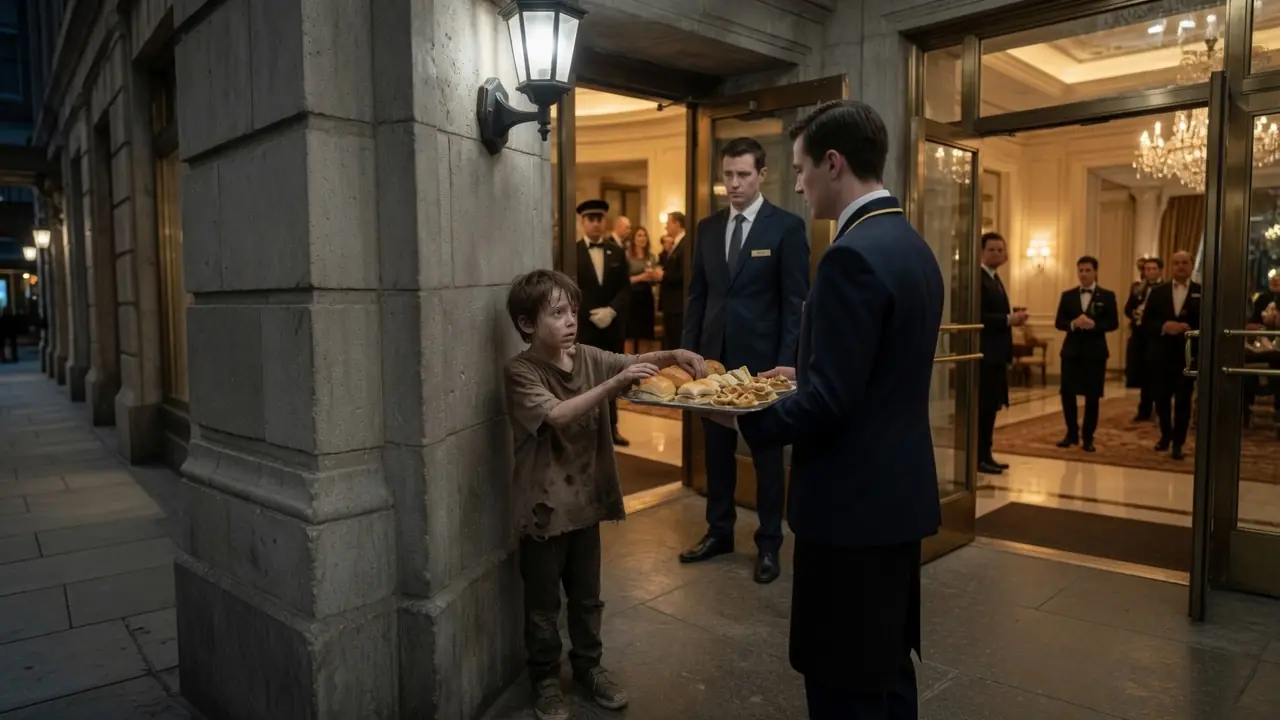
He was eight years old, though hunger made him look smaller. His coat was too thin for the November wind, one sleeve torn near the wrist, the zipper missing three teeth. His shoes were not a pair. One was black, one was brown, both too large, both tied with knots that looked older than he was.
He stood near the flower arch at the entrance of the Winslow Grand Hotel, holding a paper cup in both hands.
Inside the hotel, a wedding reception glittered beneath crystal chandeliers.
Outside, the boy whispered, “Please, ma’am. Just a little food.”
A woman in a silver shawl tightened her grip on her purse and walked past him without looking down.
A man in a tuxedo frowned as if the child were an inconvenience placed there by poor management.
A group of young women in pastel dresses stepped around him carefully, lifting their hems away from the wet sidewalk.
The boy did not chase anyone.
He did not grab.
He only stood there, shivering, holding out the cup.
His name was Eli.
At least, that was the name he had been given by the woman he called Mama Lena.
She had died three months earlier in a rented room behind a closed laundromat in Newark, coughing so hard at the end that Eli had been afraid her whole body might break. Before she died, she gave him a photograph sealed in a plastic sandwich bag.
“Keep this,” she had whispered.
The photograph showed a young woman in a hospital bed holding a newborn baby.
The woman was pale, exhausted, and beautiful in a quiet way. Her dark hair was damp at her temples. Her smile was weak but full of wonder. A small diamond necklace rested against her collarbone, and in the corner of the hospital blanket, someone had embroidered the initials A.M.
Eli had looked at the photo many times.
“Who is she?” he had asked.
Mama Lena had cried when he asked that.
For most of his life, she had said his real mother was gone.
But at the end, when the sickness made lies too heavy to carry, Lena told him the truth in pieces.
“She didn’t leave you,” Lena said. “They told me she forgot you. They told me there was no choice. But I think they lied. I think they lied about everything.”
Eli had not understood.
“How do I find her?”
Lena pressed the photo into his hand.
“She was rich. Or her family was. Her name was Audrey. Audrey Marlowe.”
Then Lena had gripped his wrist with a strength that scared him.
“If you ever see that woman, you show her this. Do you hear me? You show her the photo and tell her Lena tried to keep you safe.”
After Lena died, Eli spent two weeks in a shelter and then ran when a man there tried to take the photograph.
Since then, the photo had lived inside his sock, folded flat in the plastic bag.
It was the only thing he owned that mattered.
The Winslow Grand Hotel was not a place Eli would have approached on an ordinary day. The front doors were too polished. The doormen were too clean. The people entering looked like they belonged to a world where children did not sleep under loading docks or learn which dumpsters behind bakeries held edible bread.
But that afternoon, he smelled food.
Roasted chicken.
Warm rolls.
Butter.
Vanilla cake.
The smell slipped through the revolving doors every time wedding guests entered.
Eli followed it the way starving children follow mercy.
He stood near the entrance until one of the hotel employees noticed him.
The employee was a tall man in a black suit with a gold name tag that read Brent. He had a clean haircut, sharp eyes, and the tense politeness of someone trained to remove problems without looking cruel.
“Hey,” Brent said. “You can’t stand here.”
Eli stepped back immediately.
“I’m sorry.”
“This is a private event.”
“I’m not going in.”
“You’re asking guests for money.”
Eli looked down at the paper cup.
“I’m hungry.”
Brent glanced toward the entrance, where another group of wedding guests had begun looking at them.
His face tightened.
“You need to leave.”
“Could I just have some bread?” Eli asked. “From the kitchen maybe? I won’t bother anybody.”
Brent’s expression hardened.
“This is not a shelter.”
The words landed on the boy with more force than shouting would have.
Eli nodded quickly.
“Okay. I’m sorry.”
He began to move away, but a woman in a navy dress paused near him and opened her small evening bag.
Brent saw the motion.
Before she could drop anything into Eli’s cup, he reached out and pushed the boy’s hand away.
The cup flew from Eli’s fingers.
Coins scattered across the wet pavement.
One nickel spun in a small circle before falling flat.
Eli stumbled backward and hit the edge of a stone planter.
The woman gasped.
“Was that necessary?”
Brent straightened his jacket.
“Ma’am, please go inside. We’ll handle it.”
Eli crouched quickly to gather the coins.
His cheeks burned.
He did not cry.
He had learned that crying made some adults kinder and others meaner. Outside expensive buildings, it usually did the second.
Brent stepped closer.
“I said leave.”
Eli grabbed the last coin and stood.
“I will.”
But before he could turn, someone behind them said, “Why is that child being pushed?”
The voice was soft.
That made everyone turn faster.
The woman standing at the hotel entrance looked as though she had stepped out of the golden light inside.
She wore a deep gold dress that caught the afternoon sun even though the sky was gray. A cream wool coat rested over her shoulders. Her dark hair was swept into an elegant knot, and diamonds glimmered at her ears with the quiet confidence of real wealth.
She was not young, not old.
Thirty-six, perhaps.
Beautiful, but in a way sadness had sharpened instead of ruined.
Her name was Audrey Marlowe Whitaker.
To the guests inside, she was the bride’s older sister.
To the hotel, she was one of the women paying for the wedding.
Brent’s posture changed immediately.
“Mrs. Whitaker,” he said. “I apologize. This child was bothering guests.”
Audrey looked at Eli’s paper cup on the ground.
Then at the coins in his dirty hand.
Then at Brent.
“He asked for food?”
Brent hesitated.
“He was panhandling.”
“That is not what I asked.”
The woman in the navy dress stepped forward.
“He asked for bread. That’s all.”
Brent’s jaw tightened.
Audrey turned toward Eli.
The boy dropped his eyes.
“I’m sorry,” he whispered. “I didn’t know it was private.”
Audrey’s expression shifted.
Something about his voice had touched a place she kept locked.
“What’s your name?”
Eli hesitated.
“Eli.”
“How old are you, Eli?”
“Eight.”
The number moved through Audrey like a blade.
Eight.
Her son would have been eight.
The son she had been told to forget.
The baby she had held for thirteen minutes before nurses took him for testing and never brought him back.
Audrey looked away for a moment because the old grief rose too fast.
Behind her, through the glass doors, the wedding music continued. A string quartet played something light and romantic. People laughed near the champagne table. Her younger sister Marissa was inside wearing white lace and smiling beneath chandeliers.
Life had continued for everyone.
That had always been the cruelest part.
Audrey looked back at the boy.
“Have you eaten today?”
Eli shook his head.
“Yesterday?”
He looked embarrassed.
“A little.”
Audrey’s face tightened.
She turned to Brent.
“Bring food.”
“Mrs. Whitaker, hotel policy—”
“Bring food,” she repeated.
Brent swallowed.
“Yes, ma’am.”
He disappeared through the doors.
Audrey crouched carefully, lowering herself despite the gold dress and the damp pavement.
Eli stepped back.
She noticed.
“I won’t touch you,” she said gently.
Children who lived outside learned the difference between kindness and the kind of kindness that grabbed.
Eli studied her.
“You don’t have to help me.”
“No,” she said. “I don’t. But I want to.”
He looked toward the entrance.
“Will he call police?”
“Not if he enjoys his job.”
The woman in the navy dress gave a small surprised laugh.
Eli did not.
He looked at Audrey’s face as if trying to place it.
Audrey noticed that too.
“Do I know you?” she asked.
Eli’s hand went immediately to his coat pocket, then stopped.
“No.”
But something in his face changed.
Fear.
Memory.
Instruction.
Audrey spoke softer.
“Eli?”
He looked down.
“My mama told me not to show strangers.”
“Show strangers what?”
He did not answer.
Brent returned with a white takeout container, a bottle of water, and a roll wrapped in a napkin. He held them stiffly, as if feeding a hungry child were an insult to hotel standards.
Audrey took the food from him.
“You can go inside now, Brent.”
He glanced at the guests watching.
“Mrs. Whitaker, perhaps security should—”
“My family is spending enough money in this hotel tonight to buy your discretion,” Audrey said quietly. “Use it.”
Brent went pale.
Then he left.
Audrey opened the container.
Chicken.
Mashed potatoes.
Green beans.
Two dinner rolls.
Eli stared at the food with the fierce stillness of a child trying not to appear desperate.
“It’s yours,” Audrey said.
He looked up.
“All of it?”
“All of it.”
He took the fork and began eating too fast.
Audrey wanted to tell him to slow down, but she stopped herself. Hunger had its own manners. She simply opened the water bottle and placed it beside him.
The woman in the navy dress went inside, murmuring something about telling the bride’s father.
Soon the entrance quieted again.
Audrey sat on the stone bench near Eli while he ate.
The hem of her gold dress brushed the wet pavement. She did not seem to care.
“What was your mother’s name?” she asked after a while.
Eli stopped chewing.
His fingers tightened around the fork.
“Why?”
“Because you said your mama told you not to show strangers something.”
He swallowed.
“She died.”
Audrey’s face softened.
“I’m sorry.”
Eli looked at the food.
“She was sick a long time.”
“Was she your birth mother?”
He stared at her.
That was not a question children expected from rich women outside hotels.
“No,” he said at last. “But she was my mama.”
Audrey nodded.
“Those can both be true.”
His eyes lifted.
For the first time, trust moved near him.
Not close.
Just near.
Then the hotel doors opened behind Audrey.
A man stepped out, tall, silver-haired, wearing a tuxedo and a face full of irritation.
“Audrey,” he said. “Marissa is asking where you are. The photographer needs the family.”
Audrey did not move.
“Not now, Robert.”
Robert Whitaker was her husband.
A real estate developer with perfect teeth, political friends, and a long history of disliking emotional scenes unless he controlled them. He looked at Eli and immediately understood only the parts of the situation that offended him.
“What is this?”
“A hungry child.”
“At the entrance of your sister’s wedding?”
“Yes.”
Robert’s jaw tightened.
“Could hotel staff not handle it?”
“They tried.”
He glanced at Eli with impatience.
“Then let them. Your mother is looking for you.”
At the mention of her mother, Audrey’s face changed.
Not fear exactly.
Hardness.
“Tell her I’ll be in shortly.”
Robert lowered his voice.
“Audrey, don’t do this today.”
“Do what?”
“Disappear into one of your causes.”
Eli stopped eating.
He knew when adults were fighting around him.
Audrey stood slowly.
“This is not a cause.”
Robert leaned closer.
“Your sister is getting married. For once, can this family have a happy day without you dragging the past into it?”
Audrey’s eyes flashed.
The past.
He meant the baby.
He meant the years of search.
The private investigators.
The hospital lawsuits.
The missing nurse.
The police reports that grew cold.
The birthday candles Audrey lit alone every year.
The nursery she had kept locked until Robert finally ordered it cleared while she was away at a charity board retreat.
Audrey looked at him with a coldness Eli could feel even without understanding it.
“A hungry child is standing outside a hotel where we are throwing away more food than he has seen in a week,” she said. “If that ruins your happy day, Robert, perhaps your happiness is poorly made.”
Robert’s face reddened.
Before he could answer, Eli reached into his coat.
“I should go.”
Audrey turned immediately.
“No, sweetheart, finish eating.”
But Eli had already pulled something from inside his sock.
A small plastic sandwich bag.
Inside it was a folded photograph.
He held it in both hands, careful and trembling.
“My mama said if I ever saw the woman in this picture, I should show her.”
Audrey’s breath stopped.
Robert’s expression changed before she even opened the bag.
He recognized fear faster than she recognized hope.
Audrey took the photograph.
At first, she only saw the creases.
The worn edges.
The faint water stain near the corner.
Then she saw herself.
Twenty-eight years old.
In a hospital bed.
Holding her newborn son.
The world tilted.
The wedding music continued behind the glass doors, soft and cruel.
Audrey’s fingers tightened around the photo.
Her voice came out barely above a whisper.
“Where did you get this?”
Eli looked frightened.
“My mother gave it to me.”
“Your mother?”
“Before she died.”
Audrey stared at him.
“What was her name?”
Eli swallowed hard.
“Lena.”
Audrey stopped breathing.
Lena.
The name cracked open eight years of sealed pain.
Lena Morales.
A young nurse from St. Catherine’s Medical Center.
Twenty-four years old.
Kind voice.
Soft brown eyes.
The nurse who had taken Audrey’s baby down the hall for a routine oxygen check and never returned.
The hospital said Lena left her shift early.
The police said she disappeared.
Audrey’s mother said Audrey had to accept tragedy.
Robert said grief was ruining their marriage before it even truly began.
But Audrey had never believed the story.
A baby did not vanish by accident.
A nurse did not disappear the same hour without being connected.
And now a hungry eight-year-old boy stood before her with Lena’s name and Audrey’s photograph.
Robert reached for her arm.
“Audrey.”
She pulled away violently.
“Don’t touch me.”
His face hardened.
“Be careful.”
That word.
Careful.
He had used it for years.
Careful, Audrey, you sound unstable.
Careful, Audrey, people will think you’re obsessed.
Careful, Audrey, your sister deserves peace.
Careful, Audrey, your mother has suffered enough.
Careful had become the family word for silence.
Audrey looked at Eli.
The boy stared back, confused by the tears forming in her eyes.
“My mother gave it to me,” he said quietly. “Before she died.”
Audrey could barely speak.
“What else did she tell you?”
“That if I saw the woman, I should say Lena tried to keep me safe.”
Audrey made a sound like something breaking.
Behind her, the hotel doors opened again.
Brent stepped out with another staff member.
“Ma’am,” Brent said nervously, looking between Audrey, Robert, and Eli, “should I call security?”
Audrey turned to him with tears running down her face.
“No.”
Then she knelt on the cold ground in front of Eli, her gold dress touching the dirt.
The boy backed away, scared.
“I didn’t steal anything,” he whispered. “I promise.”
Audrey shook her head.
“No, sweetheart. You didn’t steal from me.”
She looked at his face properly now.
His eyes.
Her eyes.
The shape of his mouth.
The tiny scar near his left eyebrow.
Her baby had been born with that mark, a small crescent cut from the emergency forceps delivery. She had kissed it once in the delivery room and joked that he had arrived already carrying a moon.
Her voice broke completely.
“You were stolen from me.”
Eli’s lips trembled.
“What?”
Audrey reached for him slowly, carefully, not wanting to frighten him.
“I looked for you for eight years.”
The boy stared at the photo.
Then at her face.
For the first time, he saw it too.
The same eyes.
The same mouth.
The same pain.
His voice came out small.
“Are you the woman my mom told me to find?”
Audrey pulled him gently into her arms and cried into his dirty hair.
“Yes,” she whispered. “I’m your mother.”
For a few seconds, nobody moved.
Then Robert spoke.
“This is insane.”
Audrey held Eli tighter.
He stood stiff in her arms at first, as if being held too gently was another kind of danger. Then slowly, carefully, his hands rose and gripped the back of her coat.
Robert stepped closer.
“Audrey, you cannot just claim a street child because he has a photograph.”
She lifted her head.
“A photograph no one should have.”
“Photos can be stolen.”
“Lena’s name cannot be coincidence.”
“You are emotional.”
Audrey looked at him.
Something in her face made him stop.
“I am awake.”
The words were quiet.
They frightened him more than shouting would have.
Guests had begun gathering near the entrance now. Marissa, the bride, appeared at the doorway in white lace, her veil pinned crookedly from dancing. Audrey’s mother, Evelyn Marlowe, stood behind her in champagne silk, one hand pressed to her pearls.
Evelyn saw the photograph in Audrey’s hand.
Then she saw Eli.
Her face changed.
Not shock.
Recognition.
Audrey saw it.
The world narrowed.
“Mother,” she said.
Evelyn gripped the doorframe.
Robert turned sharply.
“Evelyn, go inside.”
Audrey rose slowly, keeping one hand on Eli’s shoulder.
“No,” she said. “She stays.”
Marissa looked from her sister to the boy.
“Audrey, what’s happening?”
Audrey held up the photograph.
“This child had my hospital photo. Lena gave it to him.”
Marissa covered her mouth.
Evelyn whispered, “Oh God.”
Audrey heard the confession before the words came.
The old woman’s knees softened.
Robert moved toward her.
“Evelyn.”
Audrey’s voice cut through the cold.
“What did you know?”
Evelyn’s eyes filled.
“Audrey, not here.”
“Here.”
The wedding guests had gone silent.
Traffic hissed along the street.
A camera flash went off from somewhere behind the glass doors, then stopped.
Evelyn looked at Eli.
The boy moved closer to Audrey’s side.
“I thought he was dead,” Evelyn whispered.
Audrey went still.
“What?”
“I thought—” Evelyn pressed a shaking hand to her mouth. “They told me he would not survive. They told me you were too weak to hear it. They told me it was kinder.”
Audrey stared at her.
“Who told you?”
Evelyn looked at Robert.
Robert’s face went blank.
Too blank.
Audrey turned slowly.
The man she had married two years after losing her child stood in the doorway of the hotel, dressed in a tuxedo, surrounded by flowers, wealth, and the family he had helped manage into silence.
“You knew,” Audrey said.
Robert’s jaw tightened.
“Do not make a public scene.”
“You knew.”
“Audrey—”
“My son was alive, and you knew.”
Eli looked up at her.
His face had gone pale.
Robert lowered his voice.
“You were broken after the hospital. Your father was dying. Your mother was collapsing. The family could not survive another scandal.”
Audrey stared at him as if she were seeing him for the first time.
“Scandal?”
Robert glanced at the guests.
“An heir stolen from a private maternity wing. A nurse involved. Security failures. Lawsuits. Press. Your father’s company was already under investigation. It would have destroyed everything.”
Marissa whispered, “Robert, what are you saying?”
He did not look at her.
Evelyn began crying now.
“I thought the baby had died. I swear to you, Audrey. I swear I thought—”
Audrey pointed at Robert.
“Did you tell her that?”
Robert’s silence answered.
Eli stepped back slightly.
Audrey held his shoulder gently.
Robert’s polished mask began to crack.
“You have no idea what was happening then,” he said. “Your father’s partners were circling. Investors were panicking. Your grief was becoming uncontrollable. Lena threatened to go to the police.”
Audrey’s voice turned deadly calm.
“What did Lena know?”
Robert looked toward Brent and the other hotel staff.
“This conversation ends now.”
“No,” Audrey said. “It began eight years too late.”
Marissa stepped forward.
“What did Lena know?”
Robert’s face hardened.
“She knew the child had been moved.”
The word moved struck Audrey like a physical blow.
“Moved where?”
Robert exhaled.
“To a private placement.”
Evelyn made a sound of horror.
“You told me he died.”
“I told you what needed to be believed.”
Audrey’s hand tightened around the photograph.
Eli was trembling now.
He understood only pieces, but children understand danger even when adults speak in polished language.
Audrey knelt again.
“Eli, look at me.”
He did.
“None of this is your fault.”
His lips trembled.
“Was Lena bad?”
Audrey’s heart twisted.
“No.”
Robert laughed bitterly.
“You don’t know that.”
Audrey stood.
“I know she kept him alive.”
The words silenced him.
Whatever else Lena Morales had done, she had fed the boy. Hidden him. Given him the photograph. Sent him back toward the truth when she could no longer protect him.
Robert stepped backward.
Audrey saw it.
He was measuring exits.
That snapped something into action inside her.
“Brent,” she said.
The hotel employee froze.
“Yes, Mrs. Whitaker?”
“Call the police.”
Robert’s head whipped toward him.
“Do not.”
Audrey looked at Brent.
“Call them now. Tell them I have found my missing child outside this hotel, and my husband has just admitted knowledge of his disappearance.”
Brent’s mouth opened.
Then closed.
Then he pulled out his phone.
Robert lunged toward him, but two men from the wedding party stepped in front of him. One was Marissa’s new husband, still wearing his boutonniere. The other was Audrey’s cousin David.
“Don’t,” David said.
Robert looked around at the faces watching him.
The room had shifted.
Power depends on people agreeing not to see.
Now everyone was seeing.
Evelyn sank onto a bench near the entrance, sobbing into her hands.
Marissa stood in the doorway with tears running down her face, her wedding forgotten.
Audrey removed her cream coat and wrapped it around Eli’s shoulders.
He looked up at her.
“Are they going to take me away?”
The question nearly broke her.
“No.”
“They always take kids somewhere.”
“Not today.”
“What if they say I’m not yours?”
Audrey placed the photograph between them.
“Then we will prove it.”
“How?”
“Doctors can test blood. DNA.”
He frowned.
“Will it hurt?”
“No. Just a swab in your cheek.”
He considered that.
“Lena said you would have my eyes.”
Audrey smiled through tears.
“She was right.”
Eli touched the tiny scar near his eyebrow.
“She said this mattered too.”
Audrey brushed his hair back gently.
“I kissed that scar when you were born.”
His face changed.
Not joy.
Not yet.
Something more fragile.
A child who had carried a story suddenly finding the person who had lived the other half.
Police arrived within twelve minutes.
So did an ambulance, because Audrey demanded Eli be checked for exposure and malnutrition. Robert tried once to speak privately with the first officer. Audrey loudly informed the officer that Robert Whitaker was not to be treated as a helpful spouse but as a person of interest.
That phrase changed the entire posture of the scene.
Robert stopped smiling.
Eli would not let go of Audrey’s hand.
She rode with him to the hospital, still wearing the gold dress, still holding the photograph. Marissa came too, her wedding gown gathered awkwardly in the ambulance, refusing to leave her sister alone.
Evelyn followed in another car with David.
Robert did not come.
By then, detectives had separated him.
At St. Catherine’s Medical Center, the same hospital where Audrey had given birth eight years earlier, a nurse took Eli’s vitals and gave him warm blankets. A doctor examined his hands, his ribs, his weight, the healed scar near his eyebrow.
Audrey watched every movement.
She had once trusted hospital walls.
She would not do that blindly again.
A detective named Karen Holt arrived with a case file that had not been opened in years. She was in her fifties, tired-eyed and direct, with a voice that did not waste sympathy but did not withhold it either.
“Mrs. Whitaker,” she said, “we are reopening the disappearance of your son.”
Audrey looked at Eli.
“He has a name.”
The detective nodded.
“What name was he given?”
“Eli.”
“What was his birth name?”
Audrey’s lips trembled.
“Alexander Marlowe.”
Eli looked at her.
“Alexander?”
“That was what I named you.”
“Do I have to be Alexander?”
Audrey turned to him immediately.
“No. You can be Eli. You can be Alexander. You can be both. You don’t have to decide tonight.”
He nodded slowly, relieved.
The DNA swab was quick.
Eli made a face and said it tasted like paper.
Audrey laughed.
It came out broken, but it was still a laugh.
The results would take time, but Detective Holt did not need DNA to begin. The photograph, Lena’s name, Robert’s public statements, and hospital records were already enough to restart the case.
Within hours, old sealed doors began opening.
Lena Morales had not kidnapped the baby alone.
That much became clear quickly.
She had been a junior nurse on the maternity floor, frightened, underpaid, and newly responsible for a younger brother with medical debts. Someone had offered her money to move the infant from the nursery to a private exit.
But according to a letter found later in Lena’s belongings, she panicked when she realized the baby was not going to an adoptive family.
He was going to disappear.
Lena took the baby and ran.
For eight years, she hid him under different names, moving from city to city, working cash jobs, nursing home shifts, motel cleaning, anything that kept food in front of him.
She was not innocent.
But she had become protective.
That contradiction would trouble Audrey for years.
Lena had helped steal her son.
Lena had also kept him alive.
Robert’s role emerged more slowly and more brutally.
He had been close to Audrey’s father then, not yet her husband, but already a trusted advisor to the Marlowe family business. The company was drowning in scandal after an investor fraud inquiry. The abduction of the Marlowe heir from a private hospital wing would have brought press, lawsuits, and federal attention at the worst possible time.
Robert had not ordered the baby stolen at first.
That detail came later.
The original plan had belonged to a desperate relative who thought a newborn heir complicated inheritance negotiations after Audrey’s father became ill. But once Robert learned the baby was alive, he made the decision that defined him.
Hide the truth.
Let Audrey grieve a death that had not happened.
Protect the family name.
Then marry the wounded woman two years later and call it devotion.
When Audrey learned that, she did not scream.
She was sitting beside Eli’s hospital bed while he slept with a turkey sandwich half-eaten on a tray. Detective Holt stood near the window. Marissa sat in the corner, pale and silent.
Audrey listened to the facts.
Then she took off her wedding ring.
She placed it on the hospital tray beside the sandwich Eli had not finished.
“That belongs with the rest of the things that made me sick,” she said.
Marissa began crying.
Audrey did not.
Not then.
There would be time for collapse later.
For now, her son was sleeping.
The DNA results came back forty-six hours after Eli was found.
Audrey Marlowe Whitaker was his biological mother.
The hospital administrator cried when Detective Holt told him.
Audrey did not care.
Press gathered outside the hospital by the third day. The story had already escaped. Guests from the wedding had talked. Someone had taken a photo of Audrey in the gold dress kneeling before the boy outside the hotel.
The headline wrote itself.
Missing Marlowe Heir Found Begging Outside Family Wedding.
Audrey hated every word of it.
Heir.
Begging.
Found.
As if Eli were a misplaced object returned to its shelf.
She refused all interviews.
Instead, she filed for emergency custody, divorce, and a protective order against Robert Whitaker before sunset.
Evelyn tried to see her twice.
Audrey refused the first time.
The second time, she allowed it only because Eli was asleep.
Her mother entered the hospital room looking ten years older than she had outside the hotel. Her champagne silk dress was gone. She wore a plain gray sweater and no jewelry. Without pearls, Evelyn Marlowe looked less like a family matriarch and more like a frightened old woman.
Audrey stood near the window.
“You believed him.”
Evelyn wept silently.
“I believed what I could survive.”
The answer was terrible because Audrey understood it.
That did not make it forgivable.
“You let me bury a child without a body.”
“I thought there was no body because they were protecting you from seeing him.”
Audrey turned away.
“I listened to you tell me to stop looking.”
“I know.”
“You called my grief obsession.”
“I know.”
“You told me Robert was patient with me.”
Evelyn’s face collapsed.
“I didn’t know he was the one keeping the lie alive.”
Audrey looked at her mother for a long time.
“I cannot forgive you today.”
Evelyn nodded.
“I know.”
“I may not forgive you tomorrow either.”
“I know.”
Audrey looked toward Eli.
“But if he wants to know his grandmother someday, you will tell him the truth. Not the family version. Not the soft version. The truth.”
Evelyn pressed a hand to her mouth.
“Yes.”
Eli woke later that evening.
He saw Audrey sitting in the chair beside him and watched her for a while before speaking.
“Did the test say?”
Audrey leaned forward.
“Yes.”
He swallowed.
“And?”
Her eyes filled.
“You’re my son.”
Eli looked at the ceiling.
He did not smile.
That surprised her until she remembered he had lost a mother three months ago.
Joy and grief were not opposites.
Sometimes they arrived holding hands.
“What happens to Mama Lena now?” he asked.
Audrey took a careful breath.
“She died, sweetheart.”
“I know. I mean… is she bad now?”
Audrey looked at the folded photograph on the bedside table.
“She did something wrong. Something very wrong.”
Eli’s eyes filled.
Audrey continued gently.
“But she also loved you. She protected you. She told you how to find me.”
He wiped his nose with the blanket.
“So can I miss her?”
Audrey moved slowly, giving him time to pull away.
He did not.
She sat on the edge of the bed.
“Yes. You can miss her.”
“Will that hurt your feelings?”
Audrey’s heart broke again, but differently this time.
“No.”
He looked at her.
“You sure?”
“I’m sure. Love is not a chair, Eli. You don’t have to push one person out so another can sit down.”
He thought about that.
Then he leaned against her side.
It was the first time he had done it without fear.
Audrey wrapped one arm around him and stared at the hospital wall while tears slipped silently down her face.
Three weeks later, Eli moved into Audrey’s townhouse in Manhattan.
It was not simple.
Stories like that only become simple when strangers tell them too quickly.
The house was beautiful, but beauty did not make it home. Eli did not know how to sleep in a room where the door closed quietly and no one coughed in the next bed. He hid food under pillows. He woke screaming if Audrey left the room before he fell asleep.
The first time a housekeeper took his dirty coat to wash it, he panicked so badly that Audrey had to sit on the laundry room floor with him until the coat came out of the dryer.
“It’s still yours,” she promised.
He touched the sleeve.
“It came back.”
“Yes.”
He nodded as if that fact mattered more than anything else in the world.
Audrey learned not to replace everything at once.
She wanted to buy him warm clothes, books, toys, shoes that fit, a bed shaped like a race car, a childhood large enough to cover the years she missed. But Eli became overwhelmed by too much choice.
At the toy store, he picked one small stuffed fox and asked three times if it cost too much.
Audrey bought only the fox.
Then, in the car, she cried quietly while he slept with it under his chin.
A month after he came home, Eli asked to visit Lena’s grave.
Audrey had dreaded the question.
Still, she took him.
Lena Morales was buried in a small cemetery in Newark, beneath a temporary marker paid for by the clinic where she had worked part-time. The grass was patchy. The air smelled of rain and exhaust from the nearby road.
Eli placed a drawing beside the marker.
It showed three people.
A woman with dark hair in a gold dress.
A boy with mismatched shoes.
Another woman in a nurse uniform, smiling from a cloud.
Audrey stood beside him, holding flowers.
For a long time, she said nothing.
Then she knelt and placed the flowers on the grave.
“I don’t know how to forgive you,” she whispered. “But thank you for keeping him alive.”
Eli took her hand.
That was enough for that day.
Robert Whitaker’s trial became national news.
Audrey testified for three hours.
She wore a black suit, no jewelry except the diamond necklace she had been wearing in the hospital photo. Eli did not attend. Audrey refused to let the courtroom turn him into evidence while he was still learning how to be a child.
Robert’s lawyers tried to paint him as a man trapped by old family decisions.
Audrey’s attorney showed emails, bank transfers, sealed hospital communications, and the testimony of an elderly former security guard who had finally come forward after seeing the wedding video.
The guard had been the anonymous source who sent the case back into motion.
He had kept copies of hallway footage from the hospital for years, ashamed and afraid. When he saw Eli outside the hotel, he recognized Lena’s face from old memories and realized the boy’s age matched the missing child.
He was the one who sent the first message to Detective Holt.
He was the one who said, “You were not the first.”
Because there had been another attempted infant placement two years before Audrey’s son vanished. That child had been recovered quietly. The family had been paid into silence. The system had learned it could survive.
Until Eli stood hungry outside the wrong hotel.
Robert was convicted on charges tied to conspiracy, obstruction, evidence tampering, and child concealment. Others fell with him: a former hospital administrator, a private security contractor, and the relative who had first arranged the removal.
Evelyn testified too.
She admitted her cowardice publicly.
Audrey watched from the front row.
It did not heal everything.
But truth spoken aloud has a weight silence cannot bury again.
A year after the wedding that never finished properly, Audrey and Eli returned to the Winslow Grand Hotel.
Not for a celebration.
For a meeting.
Audrey had purchased a controlling interest in the hotel group after Robert’s assets were frozen. The first policy she changed was simple.
No child asking for food at any property entrance would be pushed away.
Every hotel would keep emergency meal cards at the front desk. Every staff member would be trained to call child services with care, not contempt. Security could protect guests without treating hungry children like stains on the sidewalk.
Brent, the employee who had knocked Eli’s cup away, no longer worked there.
Malcolm, the kitchen supervisor who had quietly sent extra food out after learning what happened, had been promoted.
Audrey did not do it for publicity.
She did it because the first hand Eli reached toward her had been holding a paper cup.
On that return visit, Eli stood outside the entrance for a long time.
He wore warm boots, a navy coat, and a red scarf Audrey had wrapped twice around his neck. His hair had been trimmed, though one piece still refused to lie flat near his scar.
Audrey stood beside him.
“Do you want to go in?” she asked.
He looked at the place where he had dropped the cup.
“They were mean here.”
“Yes.”
“But you were here too.”
“Yes.”
He thought about that.
“Can both be true?”
Audrey smiled softly.
“You ask very hard questions.”
“You told me both can be true about Lena.”
“I did.”
He looked up at the hotel.
“Then yes. Both can be true.”
They went inside.
The lobby smelled of flowers, polished wood, and expensive coffee. Guests moved around them without knowing they were walking through the place where a boy had entered his own life again.
Near the entrance, Audrey had placed a small bronze plaque.
Not large.
Not dramatic.
Most guests passed without reading it.
Eli read it every time.
No child is invisible.
That was all it said.
On Eli’s ninth birthday, Audrey gave him a new copy of the hospital photograph, restored and framed. The old one, creased and worn from years inside a sock, remained in his bedside drawer because he refused to let it go.
“This one is too clean,” he said.
Audrey laughed.
“The old one has traveled farther.”
He nodded seriously.
“It knows me better.”
She sat beside him on the bed.
“May I tell you something?”
“Okay.”
“When you were born, I named you Alexander because it means defender.”
He made a face.
“That sounds like homework.”
“It does a little.”
“Why Eli?”
“I don’t know. Lena chose it.”
He looked down at the photograph.
“Do you hate that?”
Audrey thought before answering.
“No.”
“Why not?”
“Because it is the name that kept you alive until I found you.”
He touched the frame.
“Can I be Eli Alexander?”
Audrey’s eyes filled.
“Yes.”
“Eli Alexander Marlowe?”
Her breath caught.
“If you want.”
He leaned against her shoulder.
“I want.”
That night, after he fell asleep, Audrey stood in the hallway outside his room and let herself cry at last.
Not the sharp tears from the hotel entrance.
Not the controlled tears from court.
These were quieter.
Fuller.
The tears of a mother who had spent eight years grieving a stolen child and now had to learn him one day at a time.
She grieved the first steps she missed.
The first words.
The fevers.
The school drawings.
The birthdays.
She grieved Lena too, though she had no easy place to put that grief.
She grieved the version of herself who had been told to forget and nearly believed she was broken for refusing.
Then she opened Eli’s door a little and saw him sleeping with the stuffed fox under one arm and the old photograph under his pillow.
He was there.
That was the miracle.
Not neat.
Not painless.
But real.
Years later, people would tell the story as if fate had arranged it beautifully.
A boy begging outside a wedding.
A rich woman in a gold dress.
A photograph.
A scar.
A mother found.
Audrey always corrected them when they made it sound too sweet.
“My son should not have had to beg outside a hotel to be seen,” she would say. “The miracle is not that I found him there. The tragedy is that so many people walked past him first.”
Then she would add, if the listener was willing to hear the harder part, “And the truth is this: love does not erase what happened. It gives you someone to hold while you face it.”
Eli grew taller.
The mismatched shoes disappeared, though Audrey kept them in a box because he asked her to. He learned to sleep without hiding food, then learned to ask for more without shame. He struggled in school at first, not because he was not bright, but because survival had taken up the space where spelling and multiplication should have been.
Audrey hired tutors who knew how to be patient.
She fired one who called him “resilient” too often.
“I’m not a rubber band,” Eli said afterward.
Audrey smiled.
“No, you are not.”
At twelve, he asked for Lena’s last name as his middle name too.
Audrey said yes.
At fifteen, he read every court transcript from the case and did not speak much for a week.
At sixteen, he told Audrey he wanted to become a lawyer.
“Because of Robert?” she asked.
He shook his head.
“Because of kids outside buildings.”
Audrey looked at him for a long time.
Then nodded.
“That is a better reason.”
On the tenth anniversary of the day they found each other, Audrey and Eli returned again to the Winslow Grand.
He was eighteen by then, tall, serious, and gentle in a way that reminded Audrey of the hungry boy with the paper cup.
They stood outside the entrance beneath the same stone arch.
The hotel had changed. New paint. New staff. New flowers. But the pavement near the planter looked the same in the evening light.
Eli placed one hand over the scar near his eyebrow.
“Do you ever wish it happened somewhere else?” he asked.
Audrey looked at the doors.
“Yes.”
“Where?”
“In a police station. In a hospital. In a warm room where you had already eaten.”
He smiled sadly.
“That would’ve been better.”
“Yes.”
“But would you have known me?”
Audrey turned to him.
“I would know you anywhere.”
He believed her now.
That had taken years.
He reached into his coat and pulled out the old photograph, still in the plastic bag, carefully preserved though the creases would never vanish.
“Lena said to find you,” he said.
Audrey’s eyes softened.
“She gave you back to me.”
“She also took me.”
“Yes.”
He looked at the photo.
“Both can be true.”
Audrey nodded.
“Both can be true.”
Inside the hotel, music began playing for another wedding. Soft strings. Gentle laughter. Glasses clinking.
This time, the sound did not feel cruel.
It felt distant.
Like another life happening nearby.
Eli slipped the photograph back into his coat.
“Ready?” Audrey asked.
He looked at the entrance, then at the sidewalk, then at his mother.
“Yes.”
They walked inside together.
No one stopped them.
No one asked whether he belonged.
No one pushed his hand away.
And if anyone had looked closely at the woman beside him, they would have seen that she still watched every doorway like a mother who once lost everything in a hallway.
But they would also have seen her hand resting lightly on her son’s arm.
Not gripping.
Not afraid he would vanish if she blinked.
Just there.
A promise made visible.
The child she had been told to forget had grown into a young man who remembered everything.
And together, they had learned that remembering did not have to be a prison.
Sometimes remembering was a map.
A photograph in a plastic bag.
A name whispered before death.
A scar near an eyebrow.
A hungry boy outside a hotel.
A woman in a gold dress kneeling on the cold ground.
And one sentence strong enough to tear down eight years of lies.
“You were stolen from me.”
After that, nothing could be buried completely again.