The snow fell thick and heavy that Christmas night in Hillsboro, turning the upscale neighborhood into something that looked like a postcard if postcards could capture the kind of cold that makes your bones ache. Mara Vance sat alone on a park bench, her body curled tight against the freezing wind. At 28, she should have been at some holiday party laughing with friends, sipping expensive wine. Instead, she was here watching her breath turn to white clouds in the darkness, feeling the cold seep through her cashmere coat, the only thing standing between her and hypothermia.
The Louis Vuitton suitcase beside her seemed almost ridiculous now. Just that morning, it had been a symbol of the life she’d known. Now it was just a container holding everything she owned in the world, which wasn’t much anymore. Her teeth chattered as she pulled the coat tighter. The temperature had dropped to somewhere around 5 degrees, and the wind cut through the park like a knife.
She could see the mansions surrounding the park, their windows glowing warm and golden. Laughter drifted out from one of them, muffled by the snow, but still audible. A family together, safe. Mara looked down at her hands. They were shaking, but not just from the cold. Three hours ago, she’d had a home, a family, a life that made sense, even if it wasn’t perfect.
Now, she had a suitcase and a coat sitting in a public park at 11 at night because she literally had nowhere else to go. She thought about calling someone, but her phone had died an hour ago. Besides, who would she call? Her friends from law school had all moved away. Her college roommate had gotten married and moved to California. And her family—God, her family.
Mara felt tears prick at her eyes, but she blinked them back hard. Crying wouldn’t help. Crying wouldn’t change the fact that her own father had thrown her suitcase down the marble steps like it was garbage. That her mother had turned away, adjusting her pearls, too concerned with appearances to care that her daughter was about to freeze to death.
A sound cut through her thoughts—footsteps slow and uneven, crunching through the snow. Mara’s head snapped up. Through the swirling white curtain of snowfall, a figure emerged. An old woman moved like every step might be her last. The woman was white, maybe 70, with wild gray hair plastered to her head by the wet snow.
But what stopped Mara’s heart was what the woman wasn’t wearing. No coat, no shoes, just a thin tattered dress that looked like it had been pulled from a dumpster and bare feet that were turning blue against the white snow. “Oh my god,” Mara whispered. The old woman stumbled, caught herself, and kept moving forward.
She was maybe 20 feet away now, and Mara could see her lips. They were actually blue. The woman’s whole body was shaking so violently that Mara could see it from where she sat. The woman’s eyes found Mara’s, and there was something desperate in them. “Excuse me?” The woman’s voice came out as barely more than a rasp, her words broken by the chattering of her teeth.
“Young lady, do you know? Is there anywhere? Anywhere I can get warm? I’m so cold. I’m so so cold.” Mara stood up fast, her own problems forgotten for a moment. This woman was dying. She had to be. Nobody could survive in this weather dressed like that.
“Ma’am, you need to—” Mara started, but the woman’s legs gave out. Mara lunged forward, catching the old woman before she hit the ground. The woman’s skin was like ice against Mara’s hands. And up close, Mara could see that her lips weren’t just blue, they were gray. Her fingernails were the color of old bruises.
“Ma’am, listen to me,” Mara said, trying to hold the woman steady. “We need to get you help. There’s a fire station about six blocks from here. Can you walk?” The old woman shook her head weakly. “Can’t. Can’t feel my feet.”
Mara’s mind raced. Six blocks might as well be six miles for this woman. She wouldn’t make it. Hell, Mara wasn’t sure she’d make it herself. The wind was picking up and the temperature felt like it was dropping by the minute. She looked down at her coat.
The cashmere coat her mother had given her three years ago for her birthday. Back when things were different. Back when her mother had actually smiled at her and said, “Happy birthday, sweetheart.” It was warm, expensive, and right now it was the only thing keeping Mara from freezing.
The old woman’s eyes were starting to close. “No, no, stay with me,” Mara said, shaking her gently. “Don’t close your eyes.” But even as she said it, Mara knew. She knew what she had to do. And the knowledge sat in her stomach like a stone.
If she gave this woman her coat, she’d be down to just a thin sweater. She’d be in real danger herself. She had no phone, no money for a cab, no way to get warm. She could die out here. The thought was so clear and simple that it almost made her laugh.
Here she was already at rock bottom, and the universe was asking her to dig deeper. Mara looked at the woman’s gray lips, then at the warm houses surrounding them, their windows like eyes watching, but not helping. She thought about her father’s cold voice. “Get out of here. Don’t come back until you can stand on your own two feet.”
She thought about her sister smirking as security dragged Mara’s clothes across the snow. She thought about Darius, the man she’d loved for four years, kissing Vivika like Mara had never existed. And then Mara did something that surprised even herself.
Her hands moved to the buttons of her coat. One by one, she undid them, her fingers clumsy with cold. The woman’s eyes flickered open, confused. “What are you—?” the woman tried to say. “Shh,” Mara said softly. “It’s okay.”
She slipped the coat off her shoulders and the cold hit her like a physical blow. Jesus, it was so much worse than she’d thought. The wind went right through her thin sweater and she could feel goosebumps exploding across her entire body. But she didn’t stop.
She wrapped the coat around the old woman’s shoulders, pulling it tight, making sure it covered as much of her as possible. “There,” Mara said, and her voice was already shaking from the cold. “That’s better.”
The woman stared up at her with wide eyes. “But you—you’ll freeze.” “I’ll be fine,” Mara lied. She was already not fine. Her hands were shaking so badly she could barely hold them still. “Just—just stay warm. Okay.”
The old woman pulled the coat tighter around herself, and Mara could see some color starting to return to her face. Good. That was good. Mara knelt down in the snow. God, it was so cold. And took the woman’s hands in hers.
They felt like ice sculptures, hard and frozen. Mara began to rub them gently, breathing warm air onto them, trying to get blood flowing back into those blue fingers. “You’re going to be okay,” Mara said, though her own teeth were starting to chatter. “You hear me? You’re going to be okay.”
The old woman’s eyes fixed on Mara’s face, and there was something strange in her expression, something sharp and assessing that seemed at odds with her frail appearance. She studied Mara for a long moment. And when she spoke again, her voice was still weak, but somehow clearer.
“Why?” the woman whispered. “Why would you do this?” Mara didn’t have a good answer. She just shook her head and kept rubbing the woman’s hands. “Because you needed it,” she said simply. “Because nobody should have to freeze alone.”
The woman’s eyes glistened with what might have been tears. “Kindness like yours,” she said softly, “is rarer than a flawless diamond, child.” Mara almost laughed at that. Kindness. She didn’t feel kind. She felt stupid and scared and so cold that her bones hurt.
But she kept rubbing the woman’s hands, kept breathing warm air onto those frozen fingers. “Can you stand?” Mara asked after a minute. “We really need to get you somewhere warm.” The woman nodded slowly. With Mara’s help, she got to her feet, swaying but upright.
She pulled the cashmere coat tighter around herself and looked at Mara one more time. “Thank you,” she said, and then before Mara could respond, “What’s your name, child?” “Mara. Mara Vance.” The old woman nodded as if committing it to memory. “Mara,” she repeated. “That’s a beautiful name.”
And then she turned and shuffled away into the snow, moving slowly but steadily, the coat wrapped around her like a cocoon. Mara watched her go until she disappeared into the white curtain of falling snow. Then she was alone again, sitting back down on the frozen bench in just her thin sweater and jeans.
The cold was immediate and vicious. Within seconds, Mara was shaking harder than she ever had in her life. Her skin felt like it was burning and freezing at the same time. Her fingers were going numb. She wrapped her arms around herself and tried to think.
The fire station. She needed to get to the fire station, but when she tried to stand, her legs felt weak and the world spun a little. “Okay. Okay, don’t panic.” She’d rest for just a minute, catch her breath, then she’d go.
Mara sat there on the bench, shivering so hard her vision blurred, watching the snow fall, and wondering if maybe she’d just made the last mistake of her life. But weirdly, through all the cold and fear, she felt something else, too. Something quiet but unmistakable. Peace.
For the first time since her father had thrown her out, since Darius had betrayed her, since her whole world had collapsed like a house of cards, Mara felt like she’d done something right, something that mattered. She’d given away everything she had left, literally everything, to a stranger.
And somehow that felt more valuable than all the money her family had ever had. The irony wasn’t lost on her. Her father had called her worthless, said she couldn’t stand on her own two feet, said she had no value. But sitting there in the freezing cold, wearing nothing but a sweater, having just given her coat to a dying woman, Mara had never felt more valuable in her entire life.
She didn’t know it yet, but 20 feet away, hidden behind a snow-covered tree, one of the SUVs was already watching, already recording, already reporting back. The test was over. And Mara Vance had passed with flying colors.
One hour earlier, 10 p.m., the Vance mansion stood like a monument to wealth in the heart of Hillsboro, its white marble steps gleaming under the decorative lights that lined the driveway. Three stories of Mediterranean architecture, 12 bedrooms, and enough square footage to house a small village. Tonight, those steps felt like the coldest thing Mara had ever touched.
She stood at the bottom looking up at the mahogany door, the same door she’d walked through a thousand times as a child, a teenager, a young woman trying to make her family proud. The door opened. Langston Vance stepped out first. Fifty-five years old, wearing an Armani vest that probably cost more than most people’s monthly rent. His Rolex President catching the light.
He looked down at Mara with an expression that might have been carved from stone. Behind him came Oilia, Mara’s mother. She wore an Oscar de la Renta cocktail dress and a string of Mikimoto pearls that had been a wedding gift. Her face was perfectly made up, not a hair out of place.
They looked like they were posing for a magazine spread. Beautiful, successful, untouchable. “Dad,” Mara said, her voice cracking. “Please, can we just talk about—” Langston bent down, grabbed the handle of Mara’s suitcase, and hurled it down the steps.
Mara stared at the mess, her mouth open, unable to process what had just happened. “Dad, what are you—?” “You have your things,” Langston said, his voice flat. “Now leave.”
Behind her parents, another figure appeared in the doorway. Vivika, 25 years old, dressed head to toe in Chanel, her nails painted blood red. The six-karat engagement ring on her finger caught the light like a small sun. Vivika leaned against the doorframe, arms crossed, and smiled. It wasn’t a nice smile.
“Have fun out there, sis,” she said sweetly. “I can’t wait to see how you survive on your own. Should be entertaining.” She paused, then added with mock concern, “Oh, and don’t worry about your old room. I’m turning it into a walk-in closet. I’ve been needing the space.”
Mara’s hands clenched into fists. “Vivika, you—” “Save it,” Langston interrupted. He took a step down, and Mara instinctively stepped back. “You want to talk? Fine. Let’s talk about how you got yourself fired again. That’s three jobs in two years, Mara. Three.”
“It wasn’t my fault,” Mara said desperately. “The senior partner, he had it out for me from day one. He gave me impossible deadlines and—” “Excuses,” Oilia’s voice was soft but cutting. She still hadn’t looked directly at Mara. “That’s all you ever have, excuses.”
“Mom, please,” Mara heard the desperation in her own voice and hated it. “I just need a few days to figure things out. I’ll find another job. I’ll—” “No,” Langston’s voice could have frozen water. “You’re done using this family as a safety net. You’re 28 years old, Mara. Look at your sister. Same age and she’s engaged to Darius Wellington. She’s building connections. She’s actually doing something with her life.”
The mention of Darius hit Mara like a physical blow. “That’s not fair,” she whispered. “Darius and I were together for four years. Four years. And then he—he upgraded.” “Vivika cut in, examining her nails. “Can you blame him? You were stagnant, Mara. A low-level legal assistant going nowhere. Darius needs someone who can match his ambition.”
She looked up, her smile sharp. “He needs someone like me.” Mara felt something break inside her chest. “You’re my sister,” she said, and her voice cracked on the last word. “How could you do that to me?”
Vivika shrugged. “Business, sis. Nothing personal. In this world, you either win or you lose. I choose winning.” “That’s enough,” Langston held up a hand. “Mara, I’m going to say this once. This family does not support dead weight. You have shown repeatedly that you cannot succeed. You cannot provide value. Therefore, you cannot stay here.”
“But the trust fund,” Mara said desperately. “Grandpa and Grandma left me $38 million. I don’t get access until I’m 30, but surely we can—” Langston pulled a folder from inside his vest. “I’m the trustee until you turn 30, which means I have discretionary power over the funds.”
He opened the folder showing Mara a document covered in legal text. “As of this morning, I transferred the entire trust to Vivika.” The world stopped. Mara stared at the document, but the words blurred together. “What?”
“You heard me. Vivika has proven herself worthy. You haven’t. The decision is final.” “That’s my money,” Mara’s voice rose, panic clawing at her throat. “Grandpa left it to me. You can’t just—” “I can and I did,” Langston closed the folder. “Consider it a lesson. In this family, love is earned through results. You’ve produced nothing but failures.”
Mara looked at her mother, desperate. “Mom, say something. Please tell him this is crazy.” Oilia finally met her eyes. For a second, just a second, Mara thought she saw something flicker in her mother’s expression. Doubt, maybe, regret. Then it was gone.
“You made your bed, Mara,” Oilia said quietly. She reached up to adjust her pearl necklace, a nervous habit. “You can’t expect us to keep saving you from yourself.” “Saving me?” Mara’s voice was rising now, edged with hysteria. “You’re throwing me out in the middle of winter with nowhere to go. How is that saving me?”
“It’s teaching you responsibility,” Langston said coldly. “Something you should have learned years ago. Now you have exactly 20 minutes to collect your things and leave. After that, security will escort you out.”
Mara looked from her father to her mother to her sister—three people she’d known her entire life. Three people who were looking at her like she was a stranger, like she was nothing. “Please,” she whispered. “I’m your daughter.”
“And Vivika is our daughter, too,” Oilia said. “But Vivika knows how to win. You need to learn.” Behind them, another figure appeared. Darius Wellington stepped into the light, putting his arm around Vivika’s waist. Thirty years old, devastatingly handsome in a Tom Ford suit.
He looked at Mara with something that might have been pity. “Mara,” he said, his voice smooth. “You need to understand. I waited for you. Four years I waited for you to become someone I could be proud to stand next to, but you stayed small. You stayed safe. And I need someone who thinks bigger.”
“I loved you,” Mara said, and the words came out broken. Darius sighed. “I know, but love isn’t enough. Not in this world.” He pulled Vivika closer. “Your sister understands that. She has ambition, drive. She’s going places.”
Vivika reached up and kissed Darius’s cheek, her eyes never leaving Mara’s face. The message was clear. I won. You lost. Mara felt something inside her go numb. It was almost a relief, that numbness. Better than the pain.
“Twenty minutes,” Langston repeated. He checked his Rolex. “Starting now.” Mara climbed the steps like a sleepwalker, moving past her family, past people who were supposed to love her, and into the house.
The marble foyer was decorated for Christmas. A 20-foot tree stood in the corner covered in ornaments that cost more than most people’s cars. Garland wrapped around the banister. Everything perfect, everything beautiful, everything meaningless.
She went upstairs to her room, not running, just walking steadily like she was in a dream. Her room looked the same as always. The bed she’d slept in since she was 10. The desk where she’d studied for the bar exam. Photos on the wall from college, from law school, from family vacations that felt like they’d happened to someone else.
Mara pulled out the suitcase from her closet and started throwing in clothes. She didn’t fold them, didn’t organize, just grabbed handfuls of fabric and stuffed them in. Sweaters, jeans, a few dresses. Her hands were shaking so badly she could barely grip anything.
On her nightstand, there was a photo of the whole family from five years ago. Everyone smiling, everyone together. Mara picked it up, looked at it for a long moment, then set it back down. She didn’t take it with her.
Eighteen minutes later, she dragged the suitcase back down the stairs. The foyer was full now. Not just her immediate family, but guests, friends of her parents, business associates, all of them standing in clusters, champagne glasses in hand, watching her descend like she was part of the evening’s entertainment.
Nobody said anything. They just watched. Mara walked through the crowd, her suitcase bumping against the marble floor. Someone whispered something. Someone else laughed quietly. Mara kept her eyes forward and kept walking.
At the door, Langston was waiting. “Get out of here,” he said, his voice carrying through the silent foyer. “Don’t come back until you can stand on your own two feet. This family doesn’t feed parasites.”
The words echoed. Mara looked back one last time. Her mother was examining her phone. Her sister was whispering something to Darius, who chuckled. The guests were already losing interest, turning back to their conversations. Nobody was going to stop this. Nobody was going to help her.
Mara walked out. The door slammed behind her with a sound like a gunshot. Then came the electronic beep of the lock engaging. Then silence.
Mara stood on the steps, her breath coming out in white clouds, looking at the door that had just closed on her entire life. She thought about ringing the bell, thought about banging on the door, thought about screaming. Instead, she knelt in the snow and started gathering her scattered clothes, shoving them back into the suitcase with numb fingers.
A blouse here, a pair of jeans there. Everything was already wet and cold. When she was done, she stood up, grabbed the suitcase handle, and started walking. She didn’t look back.
Behind her, through the windows, she could see the party continuing. Light and laughter and warmth, everything she just lost. Mara walked until she couldn’t see the house anymore. Then she kept walking.
Earlier that day, 6 p.m., the day had started badly and gotten worse. Mara had driven her aging BMW 3 Series, a hand-me-down that was seven years old, not new like Vivika’s car, home from Morrison and Associates, her hands shaking on the steering wheel.
Getting fired had been humiliating enough. Having security escort her out while her colleagues watched had been soul-crushing. All she’d wanted was to go home, curl up in her room, and maybe cry for a few hours, let herself feel bad. Then tomorrow she’d start over, send out resumes, network, do what she always did when things fell apart.
Instead, she’d pulled into the driveway to find it full of cars. Expensive cars. A Bentley, two Mercedes, a Tesla, the kind of cars that belonged to her parents’ friends, the ones who owned companies and sat on boards and made decisions that affected thousands of people’s lives over cocktails.
Mara had sat in her car for a full minute trying to understand. It wasn’t anyone’s birthday. It wasn’t an anniversary. What was then? She’d seen the banner through the living room window. “Congratulations, Vivika and Darius.”
Her stomach had dropped through the floor of the car. No. No, there was no way. Vivika and Darius, that wasn’t— They wouldn’t. But even as she’d thought it, Mara had known it was true.
The secret glances she’d caught between them at Thanksgiving. The way Darius had been too busy to see her for the past month. The way Vivika had been smiling lately like she’d won some private victory.
Mara had gotten out of the car and walked to the front door on legs that felt like they might give out any second. Inside the house was transformed. The formal living room had been set up for a party. Fifty people at least, all dressed like they were attending a gala. Champagne flowed from a fountain. A jazz band played in the corner. Tables overflowed with lobster, caviar, prime rib.
And in the center of it all, like a queen holding court, stood Vivika. She wore a white Chanel dress that probably cost $20,000. Her hair was perfect. Her makeup was perfect, and on her left hand, catching every light in the room, was a diamond engagement ring so large it looked almost obscene.
Darius stood next to her, his arm around her waist, looking at her like she’d hung the moon. Mara had frozen in the doorway, her work bag slipping from her shoulder to the floor.
Vivika had seen her first. Her sister’s face had lit up with something that wasn’t quite joy and wasn’t quite cruelty. Maybe both. “Mara!” Vivika had called out loud enough to make people turn. “You’re home! Come see! Come see!”
Vivika had rushed over practically bouncing and grabbed Mara’s hand before she could react. She’d pulled Mara into the center of the room into the crowd of people who’d all stopped talking to stare. “Everyone, this is my sister Mara,” Vivika had announced.
Then she’d thrust her left hand up, making the diamond catch the light. “Look! Darius proposed this afternoon. We’re getting married!” The room had erupted in applause and congratulations. People Mara barely knew had rushed forward to hug Vivika, to shake Darius’s hand, to coo over the ring.
Mara had stood there feeling like she’d been punched in the stomach, trying to remember how to breathe. Darius had looked at her then, really looked at her, and in his eyes she’d seen nothing. No guilt, no regret, no acknowledgement that they’d spent four years together, that he’d said he loved her, that he’d promised her things. Nothing.
“Mara,” he’d said, his voice calm and polite like they were strangers at a networking event. “Congratulations are in order, I suppose. Your sister and I are very happy.” “You—” Mara’s voice had come out as a croak. She’d cleared her throat and tried again. “You were my boyfriend. We were together for four years.”
“Were,” Darius had emphasized past tense. “We broke up two months ago, Mara. You know that. You said you needed space. You said you were busy with work. I was letting you down easy.” Darius had sighed like Mara was being difficult. “I didn’t want to hurt you, but clearly I should have been more direct. We weren’t working, Mara. We haven’t been working for a long time.”
“So you started dating my sister?” Mara’s voice had risen. People were definitely staring now. “My sister?” Darius. Vivika had stepped between them, her smile still in place, but her eyes hard. “Don’t make a scene, Mara. This is my engagement party.”
“Your engagement party. You’re marrying my ex-boyfriend.” “Your ex,” Vivika had corrected. “You said it yourself. He’s not yours anymore.” She’d leaned in closer, lowering her voice so only Mara could hear. “And honestly, he was never really yours. You were a placeholder, someone to pass the time with until he found someone better.”
The words had hit like bullets. “I can’t believe you’re doing this,” Mara had whispered. “Believe it,” Vivika had straightened up, her public smile back in place. “This is how the world works, Mara. The strong take what they want. The weak make excuses.”
That’s when Langston had appeared, putting a hand on Mara’s shoulder. Not gently. Firmly, like he was restraining her. “Let’s talk in my office,” he’d said. “It wasn’t a request.”
Mara had let him guide her out of the living room, through the foyer, and into his study. Oilia had followed them, closing the door behind her. The study was all dark wood and leather chairs. Behind Langston’s desk hung his degrees, his awards, his photos with important people, a shrine to success.
“I got fired,” Mara had blurted out. Because what did it matter anymore? The day was already destroyed. “Morrison and Associates let me go this afternoon.” She’d expected concern. Maybe sympathy, at least acknowledgement.
Instead, Langston had sighed heavily and sat down behind his desk again. “It wasn’t my fault.” “It’s never your fault,” Oilia had interrupted, still standing by the door. She’d been examining her nails, not looking at Mara. “Every time you fail, it’s your boss’s fault or your co-worker’s fault or the universe’s fault. Never yours.”
“That’s not true,” Mara had protested. “The senior partner had unrealistic expectations. He gave me three major cases with 48-hour turnarounds and—” “Successful lawyers handle it,” Langston had said flatly. “Successful lawyers find a way. You found an excuse.”
Mara had felt tears pricking at her eyes. “I tried. I swear I tried.” “Trying isn’t enough,” Langston had opened a drawer and pulled out a folder. “Sit down, Mara.”
She’d sat, dread pooling in her stomach. “Your grandmother and grandfather,” Langston had begun, “left you a trust fund of $38 million. You know this. You were supposed to get access when you turn 30, two years from now.”
“Yes,” Mara had said cautiously. “I’m the trustee, which means I have full discretionary control until then,” he’d opened the folder. “These are transfer documents. As of this morning, I signed over the entire trust to Vivika.”
The room had spun. “What?” “The money is Vivika’s now,” Langston had looked at her without emotion. “You’ve had multiple opportunities to prove you deserve it. You’ve failed every time. Vivika, on the other hand, has built connections, made smart choices, secured a profitable marriage. She’s earned it.”
“That’s my money,” Mara had stood up, her chair scraping back. “Grandpa left it to me. You can’t just—” “I can and I have,” Langston had closed the folder. “The decision is final.”
Mara had turned to her mother, desperate. “Mom, you can’t let him do this. That money was supposed to be mine. It was supposed to help me.” “Help you what?” Oilia had finally looked at her. “Help you coast. Help you avoid having to actually succeed at something.”
“Mara, we’ve given you every advantage. The best schools, the best connections, and what have you done with it? Nothing.” “I’ve been trying to build a career.” “You’ve been failing to build a career,” Oilia had corrected. “There’s a difference. And frankly, I’m tired of making excuses for you to our friends.”
“Do you know what it’s like to have people ask me how you’re doing and have to lie? To pretend you’re thriving when really you’re just existing.” The words had cut deeper than Mara thought possible. “You’re my mother,” she’d whispered.
“And you’re my daughter, which is why this hurts me, too,” Oilia had adjusted her pearl necklace, that nervous habit. “But sometimes the best thing you can do for someone is let them hit bottom. Maybe then you’ll find the motivation to actually climb.”
“This is insane,” Mara had said. “You’re both insane. You can’t just steal my inheritance and throw me out.” “We’re not throwing you out,” Langston had said. Then he’d paused. “Yet. But I am giving you a choice. You have 20 minutes to pack whatever you can fit in a suitcase and leave voluntarily. If you refuse, I’ll have security remove you. Either way, you’re leaving tonight.”
“Where am I supposed to go?” “That’s not our problem anymore,” Langston had stood up, signaling the conversation was over. “You’re 28 years old, Mara. Figure it out. That’s what adults do.”
Mara had looked between her parents, these people who were supposed to love her unconditionally, and realized she didn’t recognize them. Or maybe she’d never really known them at all. “You’ll regret this,” she’d said. But even as she said it, she knew it wasn’t true.
They wouldn’t regret it. They’d go back to their party, toast to Vivika’s engagement, and forget Mara existed. “Twenty minutes,” Langston had repeated. “Starting now.”
Mara had walked out of the study and climbed the stairs to her room, her legs moving on autopilot. Behind her, she could hear the party continuing. Laughter, music, the clink of champagne glasses.
In her room, she’d sat on her bed for five full minutes, just staring at the wall, trying to process what had just happened. Her family had betrayed her. All of them. Not just Vivika and Darius. Her parents, too. The people who were supposed to protect her had decided she wasn’t worth protecting.
And the worst part—some small, horrible part of Mara had wondered if they were right. If maybe she really was worthless, if maybe she really had failed at everything she’d ever tried.
But she hadn’t had time to spiral. The clock was ticking. Mara had stood up, pulled out her suitcase, and started packing.
The Sunset Motel looked like something out of a horror movie. Peeling paint, flickering neon sign, the kind of place where you paid by the hour and didn’t ask questions. Mara sat on a bed that felt like it was made of concrete, staring at the stained carpet.
The room reeked of old cigarette smoke and something else she couldn’t identify and didn’t want to. The wallpaper was peeling. The bathroom faucet dripped with a steady, maddening rhythm. She’d counted her money three times. $47. That was it. That was everything she had in the world.
The room cost $20 a night, which meant she could stay here for two more nights, maybe three if she didn’t eat. After that—Mara didn’t let herself think about after that.
Her phone was dead. She’d let it die, actually, because she didn’t want to risk turning it on and seeing messages. Didn’t want to see if anyone had texted, didn’t want to confirm that nobody had.
She lay back on the bed, still wearing her clothes because the sheets looked questionable, and stared at the water-stained ceiling. Tomorrow she’d figure out a plan. Tomorrow she’d start looking for shelters, for resources, for something. Tonight she just needed to survive.
A phone rang, jarring her out of her thoughts. Not her phone. The phone. The ancient landline on the nightstand that she hadn’t even noticed. Mara stared at it as it rang. Once, twice, three times.
Who the hell would be calling a motel room? Nobody knew she was here. Hell, she’d barely known she was here until she’d stumbled in an hour ago, half frozen and desperate.
On the fifth ring, Mara reached over and picked it up. “Hello?” There was a pause, then a woman’s voice, warm and cultured. “Miss Mara Vance?”
Mara sat up straight. “Who is this? How did you—” “Please come outside to the parking lot,” the woman said. “Someone wants to speak with you.” “I’m not going anywhere until you tell me who you are.”
But the line was already dead. Mara held the phone for a moment, her heart pounding. This was crazy. This was how people got murdered. You don’t just go outside because a mysterious voice on the phone tells you to.
But something in that voice had been not threatening. The opposite, actually. It had been almost kind. And what did Mara have to lose? Her life was already over. If this was some elaborate scheme to rob her—good luck, she had $47 and a suitcase full of wet clothes.
Mara stood up, grabbed her thin sweater—all she had left after giving away her coat—and walked outside.
The parking lot was mostly empty. A few beat-up cars, a rusted pickup truck, nothing unusual. Then Mara saw them. 19 black SUVs. They were arranged in a semicircle around the motel parking lot. Their headlights off, but their presence unmistakable. Mercedes-Maybach GLS 600s, every single one. The kind of vehicle that cost more than most people’s houses.
People had stopped on the sidewalk to stare. A couple across the street was taking pictures. Mara stood there frozen as the door of the center vehicle opened. A woman stepped out.
Not the old woman from the park. Or rather, yes, it was her. Mara recognized the face, but she looked nothing like the dying vagrant from an hour ago. This woman wore a camel-colored Loro Piana coat that probably cost $50,000. Her silver hair was pulled back in an elegant bun, Hermès scarf, Louboutin heels.
Behind her, six bodyguards in black suits arranged themselves in a protective formation. But it was her eyes that stopped Mara’s heart. Sharp, assessing, intelligent—the eyes of someone who’d built empires and destroyed enemies.
The woman walked forward, and Mara noticed she moved without any of the frailty from before. No shuffling, no weakness. Each step was confident and measured.
“Hello again, Mara,” the woman said. Mara’s mouth opened, but no sound came out. The woman smiled slightly. “I believe I owe you a coat and an explanation.” She gestured to one of her assistants who stepped forward holding Mara’s cashmere coat in a garment bag. “Though I suspect the explanation is more important right now.”
“Who are you?” Mara finally managed to whisper. “My name is Emma Harrington.” The woman extended a hand. The name hit Mara like a physical blow. “The Emma Harrington. I’m sorry, I know that’s rather dramatic, but yes—the one who owns half the real estate in Boston, the one who runs Harrington Foundation. That Emma Harrington.”
Mara took a step back. “I don’t understand. You were dying. You were freezing. I gave you my coat because—” “Because you’re kind,” Emma interrupted gently. “Because even when you had nothing, you gave away everything. That’s exactly what I needed to see.”
“This was a test,” Mara’s voice rose. “You pretended to be homeless to test me.” “I’ve been pretending to be homeless every Christmas for 25 years,” Emma said calmly. “Would you like to know why?”
Mara didn’t answer. Couldn’t answer. Her brain had stopped processing information somewhere around “25 years.”
Emma gestured to the motel. “Perhaps we could speak somewhere more comfortable. I have a car.” “I’m not getting in your car,” Mara said automatically.
“Fair enough,” Emma nodded to one of her assistants who immediately produced two folding chairs. “Then we’ll talk here.” The assistant set up the chairs in the motel parking lot.
It should have been absurd. A billionaire and a homeless woman sitting on folding chairs outside a roach motel. But somehow Emma made it seem natural. Mara sat because her legs were shaking too badly to stand.
“Twenty-five years ago,” Emma began, “I lost my daughter. Caroline. She was your age. 28. Beautiful, brilliant, kind to a fault.” Emma’s voice wavered slightly on the last word. “She died in a car accident while volunteering in Dorchester. She’d been helping renovate a community center. The brakes failed on her car. She hit a tree.”
Emma paused, collecting herself. “After she died, I realized something. All my money, all my success, all my power—none of it mattered. The only thing that mattered was the good she’d done, the people she’d helped, the kindness she’d shown.”
Mara listened, her anger starting to ebb into something else. Curiosity. Sadness.
“I decided to find someone like her,” Emma continued. “Someone who had her heart, her spirit. So every Christmas, I disguise myself and go looking. I’ve approached 247 people over 25 years—politicians, business leaders, charity workers, people who claim to be good, who claim to care about others—and every single one of them failed.”
Emma’s voice was flat. “They’d offer money, offer to call someone, offer directions to a shelter. But not one—not one—gave me something they needed themselves. Not when they were comfortable and safe and had alternatives.”
Emma leaned forward in her chair. “But you did. You were just as desperate as I was pretending to be. You’d been thrown out of your home. You had nowhere to go. That coat was the only thing keeping you alive. And you gave it to a stranger. A white stranger, no less. And I know the history of that. The weight of that.”
Mara blinked. She hadn’t even thought about the racial dynamic in the moment. She’d just seen someone who needed help.
“That’s exactly my point,” Emma said as if reading her mind. “You didn’t see black or white. You didn’t see rich or poor. You saw a human being in pain and you helped. That’s what Caroline would have done.”
“I still don’t understand what you want from me,” Mara said quietly. “I want to give you a choice.” Emma stood up and Mara automatically stood too. “I’m 70 years old. I have $4 billion and no one to leave it to. The Harrington Foundation needs a leader. Someone who understands that wealth is a responsibility, not a privilege. Someone who will use resources to help people, not accumulate more.”
Mara’s head was spinning. “You’re offering me—” “Nothing,” Emma interrupted. “Not yet. I’m offering you a chance to prove you deserve it.”
Emma pulled a black card from her pocket and held it out. “This is the address of my office. Come there tomorrow morning at 8. I’ll give you six months. I’ll teach you everything I know about business, about leadership, about managing wealth responsibly. You’ll work harder than you’ve ever worked in your life. And at the end of those six months, if you’ve proven yourself, the foundation is yours.”
“And if I fail?” “Then you leave with nothing. No safety net, no second chances.” Emma’s eyes were hard. “I need to know you’re not just kind, Mara. I need to know you’re strong. Kindness without strength is just sentiment. It doesn’t change anything.”
Mara looked down at the card. Heavy stock, embossed lettering. An address in downtown Boston that probably had a view of the harbor.
“Why me?” she whispered. “You don’t know anything about me.” “I know everything about you,” Emma’s voice softened. “I’ve had investigators watching you for five years, Mara. Ever since you graduated law school and took that underpaid public defender job instead of the corporate offer. I know about every pro bono case you’ve taken, every weekend you’ve spent volunteering, every dollar you’ve given to people who needed it more than you.”
Emma stepped closer. “I know your family abandoned you tonight. I know your sister stole your boyfriend and your inheritance. I know you have $47 to your name and nowhere to sleep tomorrow night.” She paused. “And I know that despite all of that, you gave away your coat to a stranger. That’s who you are, Mara. That’s your character.”
Tears were running down Mara’s face now, but she didn’t wipe them away. “The question is,” Emma said gently, “are you willing to fight for a better life? Not just for yourself, but for everyone like you. Everyone who’s been thrown away by people who should have loved them.”
Mara looked at the card in her hand. Then at Emma, then at the 19 SUVs and the motel and the life she’d lost. She thought about her father’s voice. “This family doesn’t feed parasites.” She thought about Vivika’s smile. “The strong take what they want.” She thought about the old woman’s words. “Kindness like yours is rarer than a flawless diamond.”
“I’ll be there at 8,” Mara said. Emma smiled. A real smile this time, warm and proud. “Good. One of my drivers will take you somewhere warm tonight, somewhere safe. Tomorrow your real life begins.”
She turned to leave, then paused. “Oh, and Mara—your family is going to regret what they did. Not because you’ll punish them, but because they threw away something priceless, and by the time they realize it, it’ll be too late.”
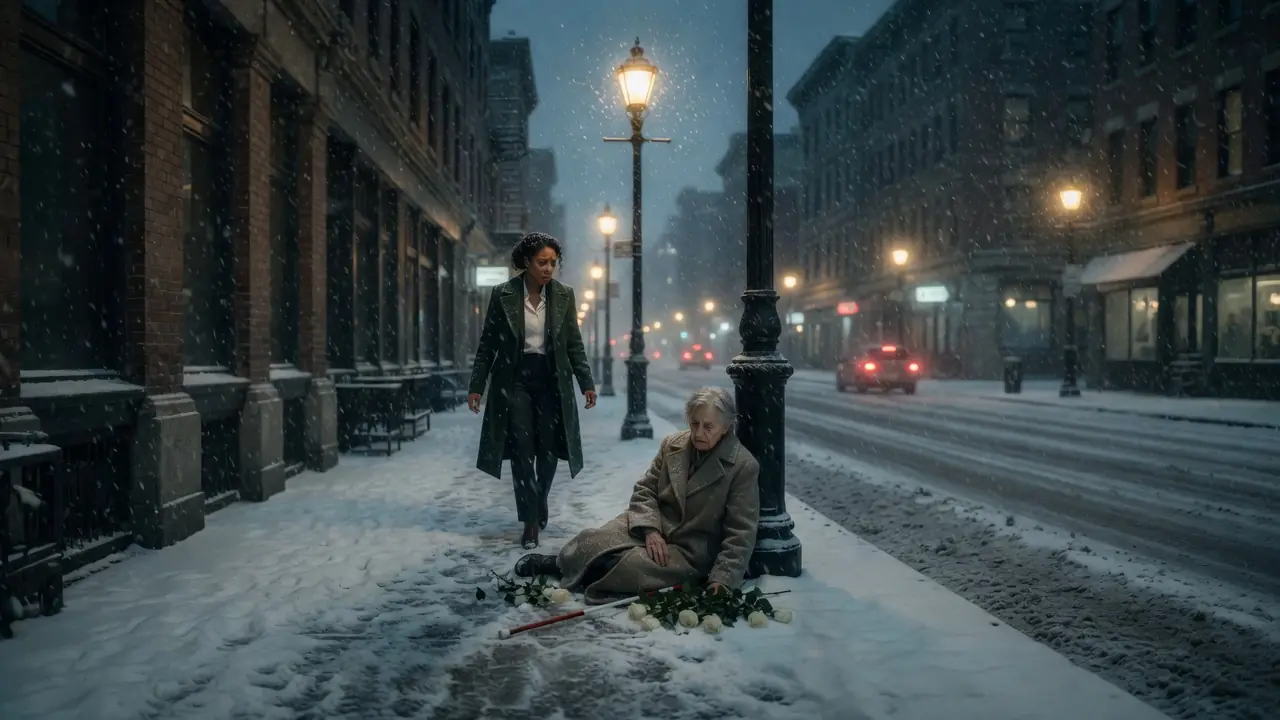
Emma walked back to her SUV, and Mara stood in the parking lot of the Sunset Motel, holding a business card and wondering if she’d just hallucinated the entire conversation. But the 19 SUVs were real, and the card was real. And the hope—that fragile, terrifying hope—was real, too.
For the first time in 24 hours, Mara felt like maybe, just maybe, she was going to survive.
Six months. That’s what Emma had given her. Six months to prove she deserved a $4 billion foundation. Six months to transform from a homeless woman with no prospects into someone capable of changing the world.
Mara stood in Emma’s office at exactly 8:00 a.m. wearing clothes that one of Emma’s assistants had bought for her the night before. Simple but professional. A far cry from the designer labels she’d grown up with, but they fit well and they were clean.
Emma sat behind a desk that faced floor-to-ceiling windows overlooking Boston Harbor. The office was elegant but not ostentatious. Everything had a purpose.
“Sit,” Emma said. Mara sat.
“Let me be clear about something,” Emma began. “This is not a fairy tale. I’m not your fairy godmother and you’re not Cinderella. I’m not going to wave a wand and give you a perfect life. What I’m offering is an opportunity to earn something real.”
“I understand,” Mara said. “Do you?” Emma leaned forward. “Because a lot of people say they understand and then they expect handouts. They expect special treatment. They expect me to make things easy.”
“I don’t expect anything to be easy.” “Good. Because here’s how this works. For the next six months, you’re going to live in a small room in my house. Not a guest suite—a staff room. You’re going to wake up at 5 every morning and train with my personal trainer. You’re going to take online classes from MIT professors in business management. You’re going to work on real foundation projects with real consequences.”
Emma pulled out a leather-bound notebook. “At the end of every day, we’ll have dinner together and I’m going to ask you questions. Hard questions about what you learned, what you did, how you handled challenges. If you can’t answer them, if you give me excuses instead of results, you’re done.”
“And at the end of six months—” “At the end of six months, if you’ve proven yourself, I sign over controlling interest in the Harrington Foundation to you. Four billion in assets, 200 employees, 50 ongoing projects. It all becomes your responsibility.”
Mara’s hands were shaking. She gripped the arms of the chair to steady them. “And if I fail?” “Then you walk away with nothing. No money, no references, nothing.” Emma’s eyes were hard. “Because if you can’t handle this, you don’t deserve to manage resources that affect thousands of people’s lives. Kindness isn’t enough, Mara. You need competence.”
“When do I start?” Emma smiled. “You already have. Welcome to your new life.”
The first month nearly broke her. Mara woke at 5 a.m. every morning to the sound of an alarm that felt like a drill sergeant screaming in her ear. By 5:15, she was in the home gym with Marcus, Emma’s trainer, a former Marine who showed no mercy.
“Ten more,” Marcus would shout as Mara’s arms trembled with exhaustion. “You think poverty waits for you to be ready. You think the people you’ll help care if you’re tired. Move.”
She’d run until her lungs burned, do push-ups until her arms gave out, planks until her core screamed. Marcus pushed her past every limit she thought she had, then found new limits to push past.
By 7:30, she was showered and sitting at a desk for online lectures—economics, finance, organizational management. Her professors were the real deal, actual MIT faculty who’d been recruited by Emma and who expected graduate-level work.
Professor Chen, who taught financial analysis, had zero patience for weakness. “Ms. Vance, you’ve miscalculated the ROI on this housing project by 12%,” he’d say, his voice crackling through the video call. “Do you know what happens when you miscalculate by 12% in real life? People lose homes. Lives are ruined. Try again.”
And Mara would try again and again and again until she got it right.
Afternoons were spent working on actual foundation projects, not training exercises. Real work with real stakes.
Three weeks in, Emma assigned her to fix a crisis. “The Morrison Street Development Project,” Emma said one morning at breakfast. “We’re building 50 affordable housing units. The contractor just pulled out. We’ve lost $5 million in deposits. The families are expecting to move in by Christmas. They’re about to be homeless. You have two weeks to fix it.”
Mara stared at her. “Two weeks? But I’ve only been here three weeks. I don’t—” “You don’t what? Don’t know how.” Emma set down her coffee cup with a sharp clink. “Then learn fast. Because those 50 families don’t care about your learning curve. They care about having a home.”
Mara had worked 18-hour days on that project. She’d called 43 contractors, learned to read construction bids, negotiated, begged, threatened, compromised. On day 13, she’d sat in Emma’s office exhausted and said, “I found a solution.”
Emma had leaned back. “Tell me.” “Instead of one large contractor, I’ve assembled a coalition of six smaller local firms. They’ll each handle different aspects of the build. It’ll take an extra month, but we’ll actually save $2 million and the quality will be better because we’re using specialists.”
Emma had studied her for a long moment. “And what happens if one of those six firms fails?” “Then I fire them and find another. I’ve built in redundancies. Every firm has a backup.” “What if two fail?” “Then I’m on site personally managing the work myself.”
Emma had smiled then, just a small one. “Good. You’re learning.”
But it wasn’t all victories. Week seven, Mara crashed hard. She’d been working on a pitch for new investors, trying to raise $20 million for a mental health initiative. She’d stayed up for 48 hours straight preparing. The presentation was perfect. The data was solid.
The investors said no.
Mara had walked out of that meeting feeling like someone had scooped out her insides. All that work, all that hope—for nothing.
She’d gone back to her small room, sat on the narrow bed, and pulled out her phone. Against her better judgment, she’d opened Instagram.
Vivika’s latest post showed her and Darius in the Maldives. Crystal blue water, white sand, champagne. The caption read, “Living my best life. #blessed #engagementbliss.” 3,000 likes. Hundreds of comments about how perfect they were together.
Mara had felt something crack inside her chest.
At 11:00 p.m., she’d knocked on Emma’s door. Emma had answered in a silk robe, reading glasses perched on her nose. “Mara? What’s wrong?”
“I can’t do this,” Mara had said, and her voice had broken. “I’m sorry. I thought I could, but I can’t. The investors said no, and I just—I saw my sister’s Instagram, and she’s so happy, and my family just threw me away like garbage, and I don’t know if I’m strong enough to—”
“Stop,” Emma had said firmly. She’d pulled Mara into the room and sat her down. “Listen to me. Your sister is not happy. She’s performing happiness for an audience. There’s a difference.”
“She looks pretty happy.” “She’s 25 years old with a six-karat ring and no substance underneath it. Give her five years. Watch what happens when the looks fade and the money runs out and she realizes she’s built her entire life on nothing but other people’s validation.”
Emma had sat beside her. “You want to know what real happiness looks like? It’s you three weeks ago figuring out how to save 50 families from homelessness. It’s the look on your face when you solved a problem everyone else said was impossible. That’s happiness, Mara—working hard and knowing your work matters.”
“But I failed today,” Mara had whispered. “The investors failed. You got 20 people in a room to listen to a 28-year-old woman with no track record pitch them on a mental health initiative. That’s not failure. That’s a miracle. The fact that they said no this time just means you try again. Different approach, different pitch, different investors.”
Emma had taken Mara’s hands. “Your family taught you that love is conditional, that it has to be earned through success. But real love, real strength comes from failing and getting back up again and again as many times as it takes.”
Mara had cried then, really cried for the first time since that night in the park. And Emma had let her.
The next morning, Mara had gotten up at 5 a.m. and started again.
Month four brought a different kind of challenge. Emma sent Mara to Roxbury, the poorest neighborhood in Boston. “There’s a community center there,” Emma said. “I want you to spend two weeks on the ground. Talk to people, understand their needs. Come back with a proposal.”
The community center was a dump—peeling paint, broken windows, a roof that leaked when it rained. But the people inside were incredible.
That’s where Mara met Sophia Martinez. Sophia was 32, a single mom with two kids working three part-time jobs just to keep a roof over their heads. She came to the community center every day to use the computers, applying for better jobs, trying to get her nursing license reinstated.
“I used to be an ER nurse,” Sophia told Mara one afternoon. They were sitting in the center’s cramped office sharing coffee from a machine that barely worked. “Made good money, had benefits, but then my husband left and I couldn’t afford childcare. Had to quit. Once you leave nursing for more than a year, you have to retake all the certifications. Can’t afford that either.”
Her daughter Lily was eight years old. She sat in the corner doing homework, coughing every few minutes. A wet, harsh cough that made Mara wince.
“She has asthma,” Sophia said quietly. “Our apartment is full of mold. Makes it worse. But it’s all I can afford.”
Mara looked at Lily, this little girl trying so hard to concentrate on her math homework while struggling to breathe, and felt something inside her shift. This wasn’t abstract anymore. This wasn’t numbers on a spreadsheet or theoretical problems to solve. This was real.
“What if I could help?” Mara heard herself say. Sophia laughed bitterly. “No offense, but I’ve heard that before. Everyone wants to help. Nobody actually does.”
“I’m serious.” “So were they.” Sophia started gathering her things. “Thanks for the coffee.”
Mara grabbed her arm gently. “Wait—what if I could get your apartment fixed? Get rid of the mold. Get Lily on the right medications.” “In exchange for what?” Sophia’s eyes were hard. “Nothing’s free.”
“In exchange for you trusting me. That’s it.” Sophia had studied her for a long moment. “You’re serious.” “Dead serious.”
Two days later, Mara was at Sophia’s apartment with a crew of contractors. She paid for it herself, used the small stipend Emma had been giving her, got the mold removed, fixed the windows, installed a proper ventilation system. Cost her $3,000 she couldn’t afford.
But when Lily stopped coughing, when Sophia cried and hugged her, Mara knew she’d made the right choice.
“Why?” Sophia asked through her tears. “Why would you do this for us?” “Because someone did it for me,” Mara said simply. “And because Lily deserves to breathe.”
Sophia became her first real friend in this new life. She’d call Mara at night when she was struggling with coursework. “Girl, explain this economics thing to me again,” she’d say. And Mara would, because teaching Sophia helped her understand it better herself.
When Mara created a scholarship program to help people like Sophia get their certifications, Sophia was the first applicant. Three months later, Sophia passed her nursing exams and got a job at Boston General. Good pay, benefits, a stable future for her kids.
“I wouldn’t be here without you,” Sophia told Mara at her graduation ceremony. “You did the work,” Mara said. “I just opened a door.” “That’s what angels do,” Sophia replied. “They open doors.”
Month five brought the hardest test yet. Emma called Mara into her office with a grim expression. “We have a problem. The Second Home Project, the one you’ve been leading, is in trouble.”
Mara’s heart dropped. “What kind of trouble?” “The main contractor just pulled out. They’re citing financial concerns, but I suspect they were bribed by a competitor who wants the land. We’re looking at losing everything. $200 million, two years of work, and housing for 500 families.”
“When did this happen?” “An hour ago. You have 10 days to salvage it or we shut it down.”
Mara had worked around the clock, barely slept, barely ate. She had been so focused on solving the crisis that she didn’t notice what was really happening until Emma sat her down on day nine.
“The contractor wasn’t bribed,” Emma said quietly. “I paid them to pull out.” Mara stared at her. “What?”
“This was a test. I needed to know if you could handle a real crisis. If you could function under extreme pressure.” “You sabotaged your own project to test me.” “Yes.”
Mara stood up furious. “Do you have any idea what I’ve been through this week? The stress? The sleepless nights?” “Yes. Because that’s reality. In the real world, projects fail, contractors bail, things go wrong, and you have to handle it without falling apart.”
Emma’s voice was sharp. “I needed to know you could do that.” “By lying to me. By sabotaging me.” “By preparing you,” Emma stood too. “You’re angry. Good. Channel that anger into solving the problem because the test isn’t over until you fix it.”
Mara had wanted to quit right then. Had wanted to walk out and never come back. But she didn’t.
Instead, she’d gone back to her desk, channeled her fury into focus, and created a solution so innovative that Emma had actually looked impressed.
“You found a way to cut costs by 30% while improving quality,” Emma said, reviewing Mara’s proposal. “How?” “By thinking differently,” Mara said coldly. “Since apparently traditional methods don’t work when your mentor is sabotaging you.”
Emma had actually laughed at that. “Good. You’re learning to be ruthless when necessary. That’s important.” “Is that what you want for me? To be ruthless?” “I want you to be strategic. Ruthless when dealing with people who try to stop you. Compassionate with people who need your help. Smart enough to know the difference.”
By the end of month six, Mara had changed. Not just physically—though she was stronger, healthier, more confident—but internally. She’d learned that kindness and strength weren’t opposites. They were partners. She’d learned that failure wasn’t fatal. It was educational. She’d learned that her family had been wrong. She wasn’t worthless. She was capable of extraordinary things.
On the last day of month six, Emma called her into the office one final time. “You passed,” Emma said simply.
Mara let out a breath she didn’t know she’d been holding. “As of today, you are the new CEO of Harrington Foundation. Four billion in assets, full control. Congratulations.”
Mara should have felt triumphant. Instead, she felt terrified. “What if I screw up?” she whispered. “Then you’ll fix it. That’s what leaders do.” Emma smiled. “Besides, I’ll still be around. Not as your boss—as your adviser, your friend.”
Emma opened a drawer and pulled out a small box. Inside was a key. “What’s this?” “The key to Caroline’s office. It’s yours now.” Emma’s eyes were wet. “She would have liked you, Mara. You remind me so much of her.”
Mara took the key with shaking hands. “I won’t let you down.” “I know you won’t. Now go. Your first board meeting is tomorrow. Time to show them what you’re made of.”
Mara walked out of Emma’s office as the CEO of a $4 billion foundation. Six months ago, she’d been homeless and hopeless. Now, she had the power to change the world, and she was just getting started.
Four months into her tenure as CEO, Mara had settled into the role. She’d earned the respect of the board, launched three major initiatives, and was in the middle of overseeing the completion of the Second Home Project.
Her office was on the 40th floor. Floor-to-ceiling windows overlooking Boston, a custom walnut desk, leather chairs—everything tasteful and professional.
She was reviewing construction reports when her assistant’s voice came through the intercom. “Miss Vance, there are two people in the lobby. They say they’re family. They don’t have an appointment.”
Mara’s pen stopped moving. She knew somehow. She just knew. “Send them up,” she said quietly.
Five minutes later, her office door opened and Vivika walked in, followed by Darius. Mara almost didn’t recognize her sister. The designer clothes were gone, replaced by something from Target. The perfect hair was limp and unwashed. Dark circles under her eyes.
Darius looked worse. His suit was cheap and ill-fitting. He’d lost weight, but not in a healthy way. He looked gaunt, desperate.
“Mara!” Vivika rushed forward, her voice bright and fake. “Oh my god, look at you! CEO! I always knew you’d do something amazing.”
Mara didn’t stand, didn’t smile, just looked at them with cool, assessing eyes. “What do you want?” she said.
Vivika’s smile faltered. “Can a sister just visit? I’ve missed you.” “You have 60 seconds to tell me why you’re here. After that, security escorts you out.”
The mask dropped. Vivika’s face crumpled and suddenly she looked young and scared. “We need help,” she said, her voice breaking. “The family—we’ve lost everything. The house is gone. The cars are gone. We’re living in a two-bedroom apartment in Dorchester, and we can barely afford rent.”
“And you want money?” Mara said flatly. “Just $2 million?” Darius jumped in. “Just to get back on our feet. We’ll pay you back. We swear. We just need $2 million.”
Mara stood up and walked to her desk. She pressed a button and a large screen descended from the ceiling. “Let me show you something.”
The screen lit up with a PowerPoint presentation. Slide one: “Where did $38 million go?”
Vivika’s face went white.
“This,” Mara said, clicking through slides, “is what you did with my inheritance in 10 months.” The slides showed everything—bank statements, credit card bills, social media screenshots.
$8 million on cryptocurrency scams. $12 million on luxury cars, most of which had been repossessed. $6 million on designer clothes and jewelry. $5 million on parties and international vacations. $4 million on gambling. $3 million on fake investment opportunities and lifestyle coaches.
“$38 million,” Mara said, her voice cold. “Gone in less than a year. And now you want $2 million more.”
“That’s private information!” Vivika shrieked. “How did you—” “It’s not private when you posted all over social media. ‘Self-made millionaire living the dream.’ You couldn’t help but brag about it.”
Mara advanced on them. “You didn’t earn that money. You stole it. And then you pissed it away like it meant nothing.”
Darius tried a different approach. “Mara, please think about all the good times we had. Four years together. That has to mean something.” “You’re right,” Mara said. “It means I know exactly what kind of person you are. A leech who attaches himself to whoever has the most money.”
She pulled out her phone, pulled up Vivika’s Instagram, and turned it toward them. “This was six months ago. ‘Best day ever with my perfect fiancé.’” She scrolled down. “This was three months ago. ‘So blessed to have this life.’” Another scroll. “This was last month. You posted 57 times about your amazing relationship and your perfect life.”
Mara looked up. “But the truth is you’ve been broke for months. The posts were all lies trying to maintain an image you couldn’t afford anymore.”
Vivika was crying now, mascara running down her face. “Please, Mara, I’m sorry. I was a terrible sister. I know that. But we’re desperate. We have nothing left.”
“Good,” Mara said simply. “Good.”
Darius’s voice rose. “What kind of monster are you? We’re family!” “No, we’re not. Family doesn’t steal from each other. Family doesn’t betray each other. You’re just people I used to know.”
Vivika pulled out her phone with shaking hands. “Fine. Fine. If you won’t help us, everyone needs to know what kind of person you really are.” She opened Facebook Live.
“Hi everyone,” Vivika said, her voice trembling, tears streaming. “I’m here with my sister Mara Vance. She’s the CEO of a billion-dollar foundation, but she won’t help her own family. We’re about to be homeless, and she doesn’t care.”
She expected sympathy. An outpouring of support. Instead, the comments started appearing immediately, but they weren’t what Vivika expected.
“Wait, isn’t this the girl who posted about buying a Lamborghini last year?” “I remember her. She was flexing about her self-made millions, girl. You spent all that money and now you’re begging. That’s embarrassing.”
“So you blew through millions and now want a handout. That’s not how life works.” “Your sister has no obligation to fix your mistakes.”
Vivika stared at her phone in horror as the comments kept coming, each one more brutal than the last. She’d expected sympathy. Instead, the internet was dragging her.
“Turn it off,” Mara said quietly, but Vivika couldn’t. She was frozen, watching her public humiliation unfold in real time.
Mara took the phone from her hands and ended the stream. “You tried to weaponize social media against me,” Mara said. “But you forgot the internet has a long memory. They remember your posts. They remember your bragging. And they have zero sympathy for people who squander opportunities.”
She walked back to her desk and pressed the intercom. “Security, please come to my office.”
“Mara, no!” Vivika grabbed her arm. “Please, we’ll do anything.” Mara looked down at her sister’s hand on her arm, then back at her face.
“You want to know the real tragedy here? I would have helped you if you’d come here humble. If you’d admitted your mistakes and asked for guidance, not money. If you’d shown even a shred of genuine remorse, not this performance.”
She pulled her arm free. “But instead you came in here entitled, demanding, acting like I owed you something, just like always.”
Two security guards appeared at the door.
“This is your last chance,” Darius said desperately. “If you don’t help us, I’ll go to the press. I’ll tell them you’re heartless, that you abandoned your family.”
Mara opened a folder on her desk and pulled out several documents. “These are recordings of this entire conversation. They clearly show you attempting to extort money from me. And these,” she pulled out more papers, “are emails you sent to three different tabloids last week trying to sell false stories about me.”
She handed copies to security. “If either of you contacts me again or attempts to spread false information, I’ll file charges. Extortion, defamation—whatever my lawyers can make stick.”
She looked at them one final time. “The Harrington Foundation helps people who’ve been knocked down by circumstances beyond their control. It doesn’t enable people who knock themselves down through their own greed and stupidity. You had $38 million and an opportunity to build something real. You chose to waste it. That’s on you.”
“Please,” Vivika whispered one more time. “Get out,” Mara said. “And don’t come back.”
Security escorted them out. Vivika was crying. Darius was swearing. Their voices faded as they were taken to the elevator.
Mara stood at her window, looking out over the city, and felt nothing but emptiness. She’d won. She’d stood up to them, defended herself. So why did she feel so hollow?
One month later, the news about Vivika and Darius had spread through their social circles like wildfire. The live stream had gone viral—not in the way Vivika had hoped. Someone had edited together a compilation of Vivika’s old posts about being self-made and living her best life contrasted with her breakdown in Mara’s office. It had 3 million views.
The comments were brutal. “This is what happens when you confuse money with character.” “She really thought crying on live stream would make people sympathize.” “We have Google. Her sister dodged a bullet when this family threw her out.”
Vivika deleted all her social media accounts, but it was too late. The damage was done.
Mara learned all this from Emma, who kept tabs on the situation. She also learned what had happened to the rest of the family. Langston’s business had collapsed. The risky investments he’d made, egged on by Darius, had all failed. He’d been forced to declare bankruptcy. The mansion was gone, sold at auction. He was living in a rental apartment, working as a consultant for a fraction of his former income.
Oilia had been quietly dropped from every charity board and social club she’d been part of. In their world, bankruptcy was contagious. Nobody wanted to be associated with failure.
And Darius had been disbarred. Turned out he’d been skimming from client accounts to fund his lifestyle. Someone had finally reported him.
“They’re paying for what they did,” Emma said one evening over dinner. “The question is, what are you going to do about it?”
“Nothing,” Mara said. “They made their choices.” “Are you sure?” Emma looked at her carefully. “Because doing nothing is also a choice. And I’m not sure it’s the right one.”
“You want me to help them?” Mara couldn’t keep the bitterness out of her voice. “After everything?” “I want you to think about what kind of leader you want to be. What kind of person?” Emma set down her fork. “Revenge is easy. Anyone can leave their enemies to suffer. But what separates great leaders from average ones is the ability to show mercy even when it’s hard.”
“They don’t deserve mercy.” “Maybe not. But you deserve peace.” Emma reached across the table and took Mara’s hand. “Carrying anger is exhausting. Trust me, I know. I spent years being angry after Caroline died. It didn’t bring her back. It just made me miserable.”
Mara pulled her hand away. “So would I just forgive them? Pretend it never happened?” “No. You hold them accountable while still offering a path forward. That’s what tough love is.”
The knock on Mara’s office door came two weeks later. She knew who it was before her assistant announced them.
Langston, Oilia, and Vivika stood in her doorway. They looked broken—not just financially, but spiritually. Langston’s shoulders were slumped. Oilia’s perfectly maintained facade had cracked. Vivika couldn’t even make eye contact.
“May we come in?” Langston’s voice was quiet. Mara nodded.
They shuffled in like prisoners approaching a sentencing. Mara gestured to the chairs across from her desk. They sat. Nobody spoke for a long moment.
Finally, Langston said, “We came to apologize.” Mara waited.
“What we did to you was unforgivable,” he continued, and his voice broke on the last word. “We threw you away when you needed us most. We chose money over family. We were—” He couldn’t finish.
“Monsters,” Vivika whispered. “We were monsters.” Oilia was crying silently, tears running down her face, but she didn’t make a sound.
Mara looked at them—these people who’d raised her, loved her, then destroyed her—and felt something twist in her chest. Not forgiveness. Not yet. But maybe understanding.
“Why did you do it?” she asked quietly. “Why was it so easy to throw me away?”
Langston shook his head. “I don’t know. I told myself it was tough love, that you needed to learn self-reliance. But the truth is, I was scared.” “Scared of what?”
“Scared that if you failed, it would reflect on me. On all of us. On the Vance name.” He laughed bitterly. “Like the name matters now.”
“And you?” Mara looked at her mother. Oilia wiped her eyes. “I thought love was conditional, that it had to be earned through success. My parents raised me that way. I raised you that way. And I was wrong. So terribly wrong.”
Vivika finally looked up. “I was jealous. You were always the smart one, the good one. And I thought if I took everything from you—your boyfriend, your money, your place in the family—I’d finally be enough. But all I did was prove I was nothing without those things.”
They sat in silence.
Then Mara opened her desk drawer and pulled out three envelopes. “I can’t give you money,” she said. Their faces fell. “But I can give you this.”
She slid the envelopes across the desk.
Langston opened his first. Inside was a business card. “Financial counseling,” he read, “and a referral to a bankruptcy attorney who will work pro bono. They’ll help you restructure your debt and create a plan to rebuild. But you have to do the work.”
Oilia opened hers. “Therapy. A full year prepaid. You need to deal with whatever made you think love was transactional, because until you do, you’ll never be whole.”
Vivika’s envelope contained information about vocational training programs. “Job training. You’re 25 years old. You have skills. You just never developed them because you didn’t have to. These are programs for everything from accounting to marketing to coding. Pick one. Complete it. Build a real career.”
She leaned forward. “Here’s the deal. I’ll support you through this process. I’ll pay for the counseling, the therapy, the training. But you don’t get a dime of cash. You don’t get shortcuts. You do the work or you get nothing. And if we complete everything,” Langston asked, “then we’ll talk. Not about money—about us. About whether we can rebuild some kind of relationship.”
“Why?” Vivika whispered. “Why would you help us after what we did?”
Mara thought about Emma, about Sophia, about the hundreds of people the foundation had helped. “Because someone helped me when I needed it,” she said simply. “And because everyone deserves a second chance. But you only get one. Screw this up and I’m done forever.”
She stood up. “There’s one more condition. You check in with me every week. You show me your progress. You prove you’re taking this seriously. The second you stop trying, this offer disappears.”
Langston stood too. For a moment, Mara thought he might try to hug her. Instead, he held out his hand. “Thank you, Mara. I don’t deserve this, but I promise—I’ll earn it.”
They shook.
One by one, her family left. At the door, Vivika turned back. “I don’t expect you to forgive me,” she said, “but I am sorry for everything.”
Mara nodded. “I know.”
After they left, Mara sat at her desk for a long time staring at the door. Emma appeared in the doorway.
“I’m proud of you.” “I’m not sure I did the right thing.” “There’s no right thing. Just the thing you can live with.” Emma came in and sat down. “You didn’t give them money. You gave them tools. That’s leadership.”
“What if they waste this chance, too?” “Then they do. And you’ll know you tried. But I don’t think they will.” Emma smiled. “Sometimes people need to lose everything to understand what really matters.”
“Is that what happened to me?” “Yes. And look who you became.”
Six months later, spring had arrived in Boston. The Second Home Project—the affordable housing development that had consumed so much of Mara’s energy—was finally complete. 200 apartments, bright, clean, safe. Rent capped at $400 per month for families making under $40,000 a year. A community center, a playground, a medical clinic.
It was everything Mara had dreamed of and more.
The grand opening was scheduled for a Saturday morning. 500 people showed up. Families who’d been waiting for affordable housing, local politicians, press, donors—and in the front row, sitting together, were Emma, Sophia, and Sophia’s two kids.
Mara stood at the podium looking out over the crowd and felt something shift in her chest.
“Four years ago,” she began, “I sat on a park bench on Christmas night with nowhere to go. I’d lost my family, my home, my future. I thought my life was over.”
She paused, finding Emma’s eyes. “But a stranger saw something in me that I couldn’t see in myself. She saw kindness, strength, potential—and she gave me a chance to become who I was meant to be.”
Mara’s voice grew stronger. “This building isn’t just about housing. It’s about second chances. It’s about recognizing that people’s value isn’t measured by their bank account or their job title or their success. It’s measured by their character, their heart, their willingness to keep fighting even when the world tells them to give up.”
In the back of the crowd, Mara spotted them. Langston, Oilia, Vivika. They stood apart from everyone else, wearing simple clothes. Langston had completed his financial counseling. Oilia was still in therapy but had started volunteering at a senior center. Vivika had finished a marketing certification program and landed an entry-level job at a startup.
They’d done the work.
Mara hadn’t invited them, but she hadn’t told them not to come either.
“Someone told me once that family isn’t about blood,” Mara continued. “It’s about who chooses to stand beside you when you’re falling, who catches you, who lifts you up.”
She looked at Emma, at Sophia, at the families in the crowd who’d supported the project. “Real family is the people who see you at your worst and love you anyway. Who challenge you to be better. Who refuse to let you settle for less than you deserve.”
Her eyes found her biological family in the back. “And sometimes—sometimes family is also about forgiveness. About recognizing that people can change, that mistakes don’t have to be permanent, that love can be rebuilt if both sides are willing to do the work.”
Oilia put her hand over her mouth, crying.
“I’m not going to stand here and say everything is perfect. It’s not. Some relationships take years to heal. Some never fully heal. But what I’ve learned is that holding on to anger only hurts yourself. Forgiveness isn’t about excusing what someone did. It’s about freeing yourself from carrying it.”
Mara stepped away from the microphone and cut the ribbon across the door.
The crowd erupted in applause. People flooded into the building, exploring their new homes. Children ran through the community center. Parents cried with relief.
Sophia found Mara in the crowd and pulled her into a fierce hug. “You did it. You actually did it.” “We did it,” Mara corrected. “You were the inspiration, remember?”
Lily ran up and grabbed Mara’s hand. “Aunt Mara, can I show you my new room? We have a balcony!” “Of course, sweetie.”
As Lily pulled her toward the building, Mara glanced back at her family. They were still standing there, watching.
Langston raised his hand in a small wave, tentative, hopeful.
Mara paused, then nodded back. Not a wave. Not a smile. Just acknowledgement.
It was a start.
Emma appeared at her side as they walked into the building. “You handled that well.” “I didn’t know they’d come.” “I did. I told them about the opening.” Emma smiled at Mara’s surprised look. “They’ve been working hard, following every rule you set. I thought they’d earned the right to see what you’ve built.”
“Did they?” “That’s for you to decide. But from where I’m standing, they’re not the same people who threw you out. People can change, Mara. You’re living proof.”
Inside the community center, a little boy—eight years old with bright eyes and a shy smile—approached Mara holding a bouquet of wildflowers.
“Are you Miss Vance?” he asked. “I am.” “What’s your name?” “James. I live here now with my grandparents. They said you made this place so we could have a home.”
He held out the flowers. “These are for you. I picked them this morning.”
Mara knelt down and took the flowers, her eyes filling with tears. “These are beautiful, James. Thank you.”
“Thank you for giving us a home,” he said. “Seriously? Grandma says you’re an angel.”
“I’m not an angel. I’m just someone who had help when I needed it. And now I’m trying to help others.”
James hugged her suddenly, his small arms tight around her neck. “You’re the best,” he whispered.
Mara closed her eyes and held him. This child who represented everything she was fighting for. Second chances. Safe homes. Hope.
When she opened her eyes, she saw her family through the glass doors. They were still there, watching this moment, seeing who she’d become. Langston was crying. Oilia had her hand on his shoulder. Vivika looked proud, maybe even inspired.
Mara stood up, still holding James’s hand.
Emma leaned close. “Are you going to invite them in?”
Mara looked at the door. That glass door separating her old life from her new one, separating pain from healing, past from future.
She walked to the door and pushed it open.
Then she looked at her family and did something she never thought she’d do.
She gestured them inside.
Langston’s face crumpled with relief. Oilia rushed forward. Even Vivika moved through, more slowly.
They stood together in the community center—not as the family they’d been, but maybe as the family they could become.
“This doesn’t fix everything,” Mara said quietly. “I know,” Langston replied. “But it’s a start.”
“You hurt me, all of you. So badly that some days I still feel it.” “I know,” Oilia whispered. “And we’ll spend the rest of our lives trying to make it right.”
Vivika stepped forward. “Can I—can I hug you?”
Mara hesitated, then nodded.
Vivika’s hug was careful, tentative. Not the casual embrace of before, but something more meaningful. “I see who you are now,” Vivika said. “And I’m sorry I never saw it before.”
Emma watched from across the room, Sophia beside her, both women smiling.
“She’s something special,” Sophia said. “Yes,” Emma agreed. “She reminds me of my daughter. Same heart. Same strength.”
“What happens now?” “Now,” Emma looked at Mara, surrounded by her family and the children who just moved into safe homes and the community that had come together to celebrate second chances, “now she changes the world, one person at a time.”
As the sun set over Boston, Mara stood in the doorway of the Second Home community center. James still holding her hand, her family tentatively reconnecting inside, and Emma’s words echoing in her mind.
“Family is who chooses to stand beside you when you’re falling.”
She looked at the building behind her, full of people laughing, children playing, families finally safe—and then at the city beyond, full of more people who needed help.
The door behind her was open.
The door ahead was open, too.
And Mara Vance—who’d once had nothing—now had everything that mattered.
Purpose. Love. Hope.
And a whole world of doors still waiting to be opened.