"You will serve this lady first," said a young woman's voice quite clearly across the counter of a linen draper's shop in Winbury, "because she was standing here before you came in, and because she is seventy-one years old."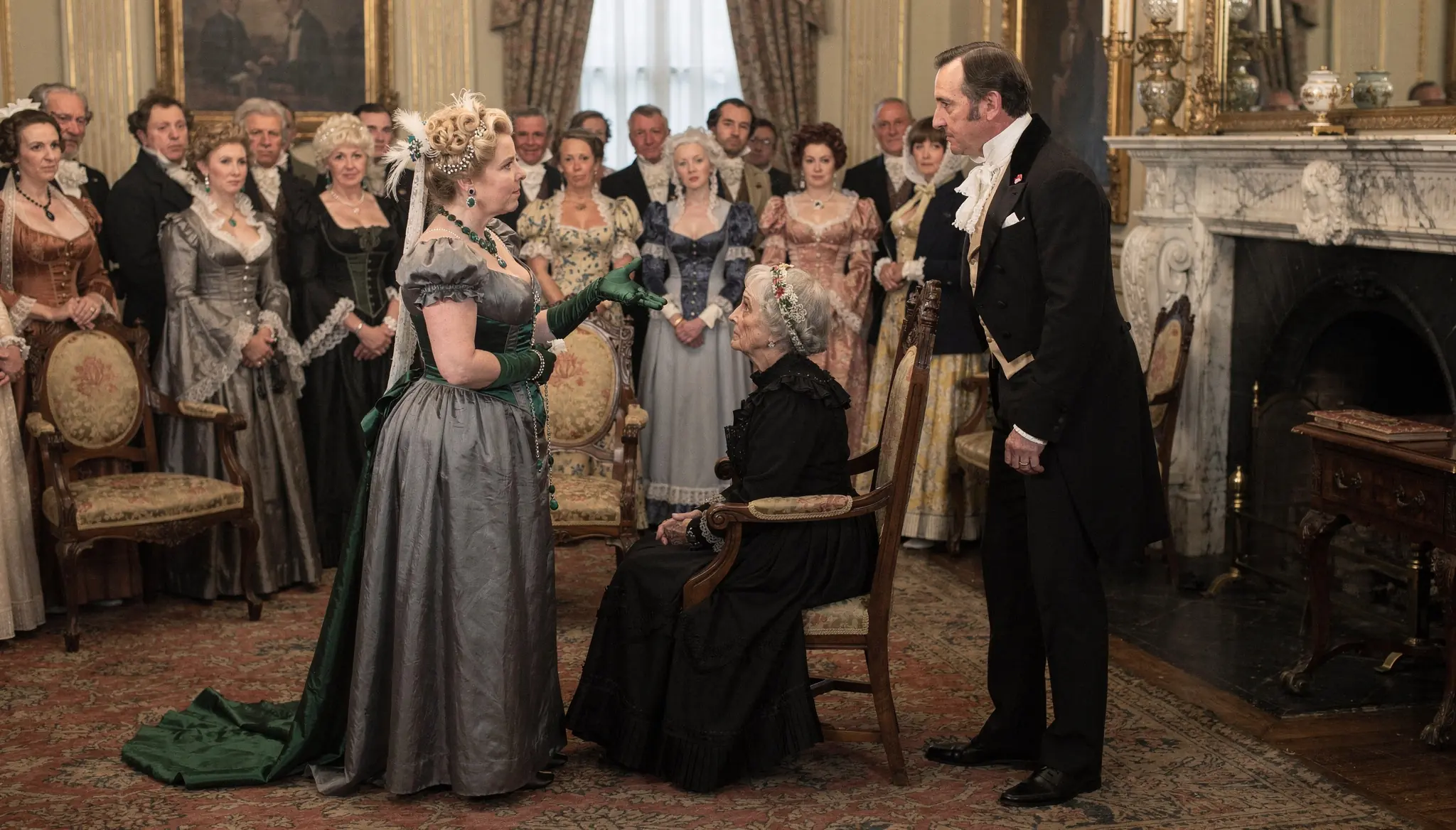
The Duke of Dunmore, who had come in out of the rain three seconds earlier and had not yet been noticed by anybody, stopped with his hand still on the door. The lady of seventy-one was his mother. She was sitting on a stool by the counter in the black bombazine she had worn since his father died, with an old-fashioned bonnet and a purse she had carried for twenty years, counting out silver very slowly because her hands were bad in wet weather. She had gone out alone, as she always did, in the plainest thing she owned, because she said it was the only way left to her of finding out what the world was actually like.
Standing over her in bottle green and a great many feathers was Lady Sowerby.
"I do not require to be lectured by a shop girl," Lady Sowerby said. "Vell, have that person moved. My carriage cannot wait upon some old creature off the parish who is counting pennies out of a rag."
Redmond did not move. He would not afterward be able to explain the whole of why. Part of it was that he had learned at fourteen that when his mother wanted a thing handled, she handled it, and that she had once ordered a bishop out of her drawing room without raising her voice. Part of it was that she had seen him. Her eyes had come up over Lady Sowerby's elbow and found him at the door, and she had moved her head perhaps half an inch, which, in the language of that family, meant, "Stand still and hold your tongue."
And part of it, he admitted later, was that he wanted very much to know how the girl behind the counter would answer.
She was small and neat and about four-and-twenty, in the gray stuff gown the shop put its assistants into, with her sleeves pinned back and her hair pulled off her face without any vanity in it whatever. She had gone white. She was quite plainly terrified. And she came round the end of the counter anyway.
She set her own stool straight and took the old lady's parcel and tied the string herself, neatly twice round.
"Ma'am, the ribbon is threepence and the tape is a penny farthing, and there is no hurry at all. Take your time with the coins. I have all day."
The shop was entirely silent. Rain went along the window.
"Vell," said Lady Sowerby, "I have dealt with this house for nineteen years. Either that creature is out of your employment before I leave the premises, or I take my custom to Bradon's, and I shall tell everyone I know precisely why."
Mr. Vell was not a wicked man. He was a man with a lease and four hundred pounds of stock and a rich woman in front of him, and Redmond watched him do the arithmetic in about two seconds and arrive where such arithmetic always arrives.
"Miss Redfern," he said, and could not look at her. "Fetch your things."
She did not argue. That was the part Redmond found he could not get out of his mind afterward. She did not argue or weep or appeal to anybody. She untied her apron and folded it and set it on the counter with the shop's own pins laid on top of it.
"Thank you for my place, sir," she said. "And I am sorry to have cost you."
Then she turned to the old woman in black and said, "Mind the step outside, ma'am. It runs wet," and went out through the back.
Lady Sowerby had her muslin measured with the air of a woman restoring order to the world. Redmond let her go by him in the doorway. She did not know him. They had met twice, but he had a way of not being looked at when he did not wish it, and she was too full of her own victory to look anywhere.
Then he crossed the shop and gave his mother his arm.
"You might have spoken," said the Dowager Duchess of Dunmore on the wet pavement.
"You told me not to."
"I did." She was pulling on her gloves of worn black leather, and he saw with interest that her hands were not quite steady. "Redmond, in forty-eight years no one has ever done that for me. Not once. Duchesses are defended constantly by people who know they are duchesses. That is not the same article."
"No," he said. "It is not."
His mother stood in the rain and looked down Winbury High Street, where a small gray figure was going away fast with a bundle under her arm and no umbrella.
"Find out who she is," she said. "I want her at my birthday."
Her name was Constance Redfern. She had an aunt with a bad chest in two rooms over a cooper's yard, eleven shillings a week between them, and, as of that Thursday, no situation and no character from her last employer.
The Dowager Duchess wrote to her the same evening in her own hand and told her the plain truth in the first sentence: that the old creature off the parish was the Dowager Duchess of Dunmore, that she required a companion to read to her in the evenings because her eyes had gone, and that the wages were forty pounds a year, while the aunt might have the cottage at the gate.
Constance came to Fernlow on the Monday and, Redmond was told, went scarlet to the ears at the sight of the hall. Then she said that she would take the place on condition it was a real one, and that if Her Ladyship was doing it out of pity, she would rather walk back to Winbury now than find it out in six months. His mother said afterward that it was the best hour's conversation she had had in a decade.
He began to call at the Dower House on Thursdays. He told himself it was filial. It was not entirely filial by the third week, and by the sixth he had stopped telling himself anything at all.
She read aloud beautifully without performing. She had a laugh she plainly considered unbecoming and tried to stop, which made it worse and much better. She argued with his mother about the poor rate and did not give way when the Duke of Dunmore came down on the other side. When he pointed out, mildly, that he had sat in the Lords upon the question, she said, "Yes, Your Grace, and I have queued at the vestry, and I dare say between us we have the whole of it."
He sent her a shawl in November. It came back within the day with three lines saying that she was very much obliged, that she had a shawl, and that a woman in her situation who accepted presents from a gentleman in his had thrown away the only thing she owned outright.
He read that standing at the window at Dunmore and understood that he was in serious trouble, and found that he did not mind in the least.
The letter reached his mother in January. It was from Lady Sowerby, who had a daughter to place and had heard, as everybody had heard, that the Duke was at the Dower House every week. It was written in the tone of a duty painfully discharged.
Her Ladyship felt bound to warn the Dowager Duchess that the young person she had taken up was dismissed from Vell's in Winbury for dishonesty. There had been, she claimed, a question of missing lace. Her Ladyship had herself been in the shop upon the occasion and would say no more.
His mother put the letter into Redmond's hand at breakfast and watched him read it. He was angrier than he had been in years, and quieter with it.
"It is a lie invented after the fact."
"Of course it is. She must account somehow for having a girl turned off, and 'she gave up her stool to an old woman' does not answer." The Dowager Duchess buttered her toast. "It is being said in three parishes, Redmond. She offered me her resignation this morning."
"She what?"
"She said that a woman with a doubt on her name should not sit in my drawing room while my birthday guests are eating my supper, and that she would go to her aunt and take in plain sewing." She looked up. "I refused. She is a great deal more stubborn than I am, so you had better do something clever, and do it in front of witnesses, or I shall lose her."
The birthday assembly at Dunmore was held on the fourth of February, and the whole county came. Lady Sowerby came in bottle green with her daughter beside her in white. Constance stood by the Dowager's chair in a plain gray silk with the fit of her aunt's mending, and she did not once look at the door.
It happened, as such things do, at the worst possible moment, between the music and the supper, when the room was full and quiet enough to hear a fan close.
"Duchess, forgive me." Lady Sowerby's voice carried as it was meant to. "I must speak in your own house out of pure regard for you. That young woman by your chair was put out of a shop in Winbury for theft. I was present. I saw it done."
Sixty people turned round.
Redmond stepped away from the mantel.
"You were present," he said. "So was I."
He had never in his life used his full voice in a drawing room, and it stopped the movement of the room the way a hand stops a clock.
"Mr. Vell of Winbury is here this evening," he went on. "I invited him, and he was good enough to come. Mr. Vell, tell the room what Miss Redfern was dismissed for."
The draper came forward, twisting his hat, scarlet to the collar, and did the bravest thing of his small, careful life.
"For giving up her stool, Your Grace," he said. "And for asking to serve an old lady in black before Her Ladyship. There was never a farthing missing from my shop in the fourteen months she was in it, and I have said so to any who asked, and I am ashamed I did not say it louder."
The silence that followed had a particular quality that Redmond intended to remember for a long time.
"And the old lady in black," he said, "was my mother."
The Dowager Duchess of Dunmore rose from her chair, which took her a moment because her knees were bad and she declined all assistance on principle.
"I was counting my pennies out of a rag," she said pleasantly. "Lady Sowerby was so obliging as to remark upon it. This child," and she put her hand on Constance's arm, "did not know me from Eve and cost herself her bread for me. She did it while she was frightened, which is the only kind of courage that counts for anything. She has been my eyes since November. She will be at my side while I have one."
She looked round the room once.
"Now, supper."
Lady Sowerby left before the covers were off. Her carriage was a long time coming, and nobody assisted her to it.
Constance was on the terrace in the cold with her arms folded, which was where Redmond found her.
"I have made you a spectacle," he said.
"You have given me back my name." Her voice was not steady. "Which is a different thing, and I shall be grateful for it as long as I live. I would rather not be thanked for anything else, because there is not anything else."
"There is a great deal else."
She turned round then and looked at him, and her chin came up in the way it had come up across a draper's counter in the rain.
"Your Grace, I earn forty pounds a year and my aunt lives in your gatehouse. Whatever you are about to say, please consider what it will cost me to hear it."
"I have considered it since October," said Redmond. "That is why I have not said it before."
He came a step nearer and no more, and he did not touch her, though he wanted to more than he had ever wanted anything.
"You did not know she was a duchess," he said. "That is the whole of my case. There is not another woman in that room tonight who would have crossed a counter for a poor old woman in wet bombazine. I have spent my life among people who are unfailingly kind to me because of what I am, and I did not know until the fourth of February that I had never once been shown a kindness in my life. I saw you shown to be honest tonight. I have known you were good since the day it cost you everything."
He drew breath.
"Marry me. Not out of gratitude, and not tomorrow. Tell me to wait a year, and I will wait a year."
Constance Redfern put her hand over her mouth. Then she put it out to him instead, and he took it. Neither of them said anything at all for a moment while the light from the long windows lay in gold bars across the frost.
"You will be talked of," she said at last, shakily.
"I have an excellent mother. She will out-talk them."
They were married at Dunmore in the summer. The aunt with the bad chest was carried to the church in the Duke's own carriage and lived nine more years in the gatehouse.
Mr. Vell of Winbury supplied the linen and would take nothing for it, and had to be argued into a fair price by the new duchess, who knew the wholesale figure to a halfpenny.
And on Thursdays, for as long as the old lady lived, the Dowager Duchess of Dunmore still went into Winbury alone in her worst black bonnet to find out what the world was like. She said she had done rather well out of it once already.