The old woman had been sitting alone in Booth Six for two hours when the waitress noticed the birthday candle in her purse.
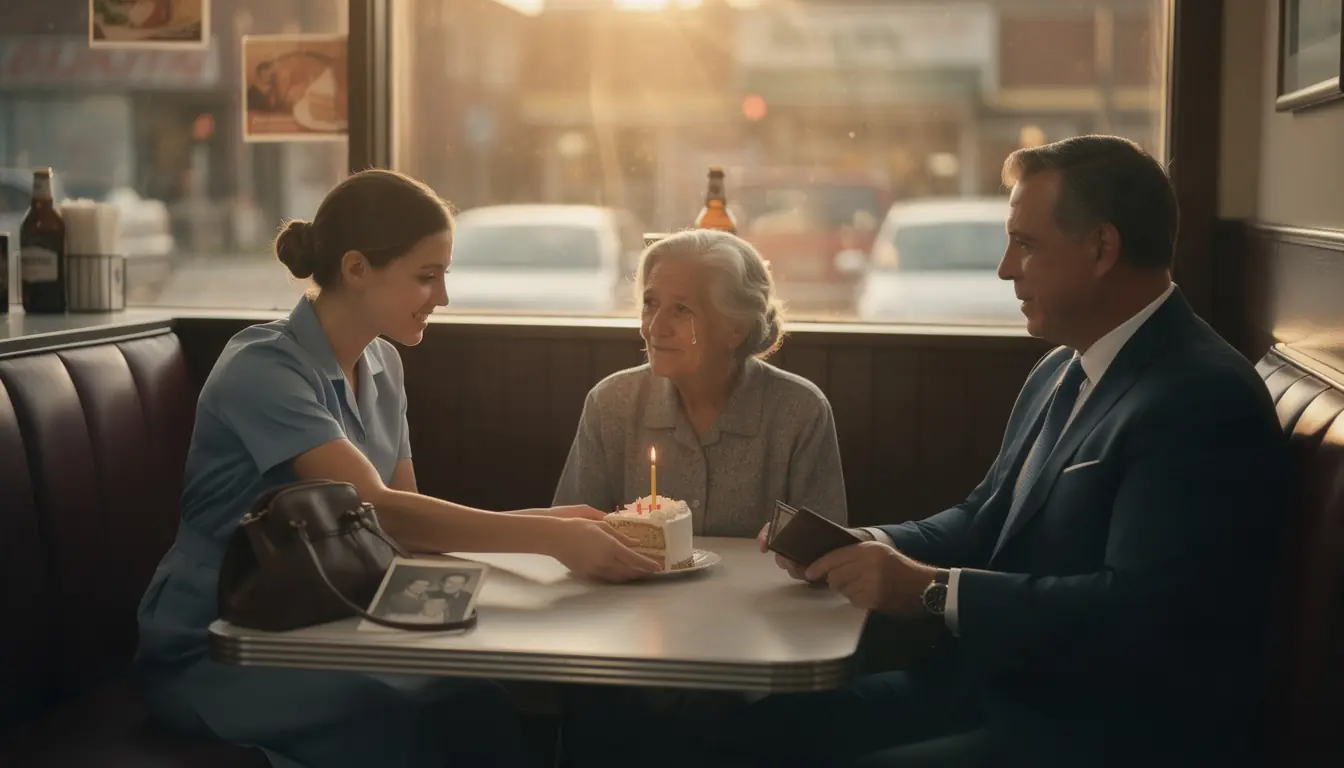
It was a tiny pink candle, bent in the middle, wrapped in a paper napkin beside an unopened greeting card. The woman was nearly eighty, with silver hair arranged carefully beneath a navy hat and a lavender cardigan buttoned all the way to her throat. She had ordered a cup of tea and one slice of lemon pie, but she had barely touched either. Every time the bell over the diner's front door rang, she looked up with sudden hope. Every time it was someone else, she lowered her eyes to the empty seat across from her.
At six fifteen, the waitress came over with a fresh pot of hot water. "Would you like another cup, ma'am?"
The woman looked at her name tag. "You're Grace, aren't you?"
"Grace Jackson. Yes, ma'am."
"Such a pretty name." The woman folded her napkin again, although it was already perfectly folded. "How late do you stay open?"
"Ten o'clock, unless the weather drives everybody home early. Why? Are you waiting for somebody?"
The woman hesitated. "My son. He said he might come. I suppose he is busy. He's always busy." She smiled apologetically. "I know he loves me. He sends beautiful flowers. But I had hoped we could sit together for a little while today."
Grace glanced at the little candle. "Is today your birthday?"
"My eightieth." The woman looked embarrassed to say it. "I bought the candle at the pharmacy on the way here. Silly, isn't it? A woman my age buying herself a birthday candle."
"No, ma'am," Grace said. "Not silly at all."
She looked toward the kitchen, where the diner owner was arguing with a temperamental freezer. Then she looked back at the untouched pie and the empty place setting, the napkin folded as though its owner expected company any moment.
"Would you let us celebrate with you?" Grace asked.
The woman blinked. "Oh, honey, you don't have to do that. You're working."
"I know. But there's no rule that says we can't wish a customer happy birthday while we're working. What name should we put on the cake?"
"Eleanor," she whispered. "Eleanor Whitcomb."
Grace had never heard the name before. She could not know that Eleanor's only son owned a freight and warehousing empire worth more than a billion dollars. She could not know that he had spent the afternoon in a glass conference room deciding whether to purchase the very block where the diner stood. And she certainly could not know that the man now sitting behind a newspaper in the shadowed booth near the back window was that son.
His name was Jonathan Whitcomb. He had entered the diner twelve minutes earlier, wearing an ordinary dark coat and no tie. He had come to inspect a property his company's real estate division wanted to acquire, not to have dinner. From the far side of a wooden partition he could see his mother's profile, the little candle beside her handbag, and Grace Jackson kneeling briefly to wipe tea from the table.