The red delivery van came so close to Lily Bennett’s walker that the little gold comet sticker on the front bar lifted at the corner.
For one frozen second, she thought the van was going to hit her.
It did not.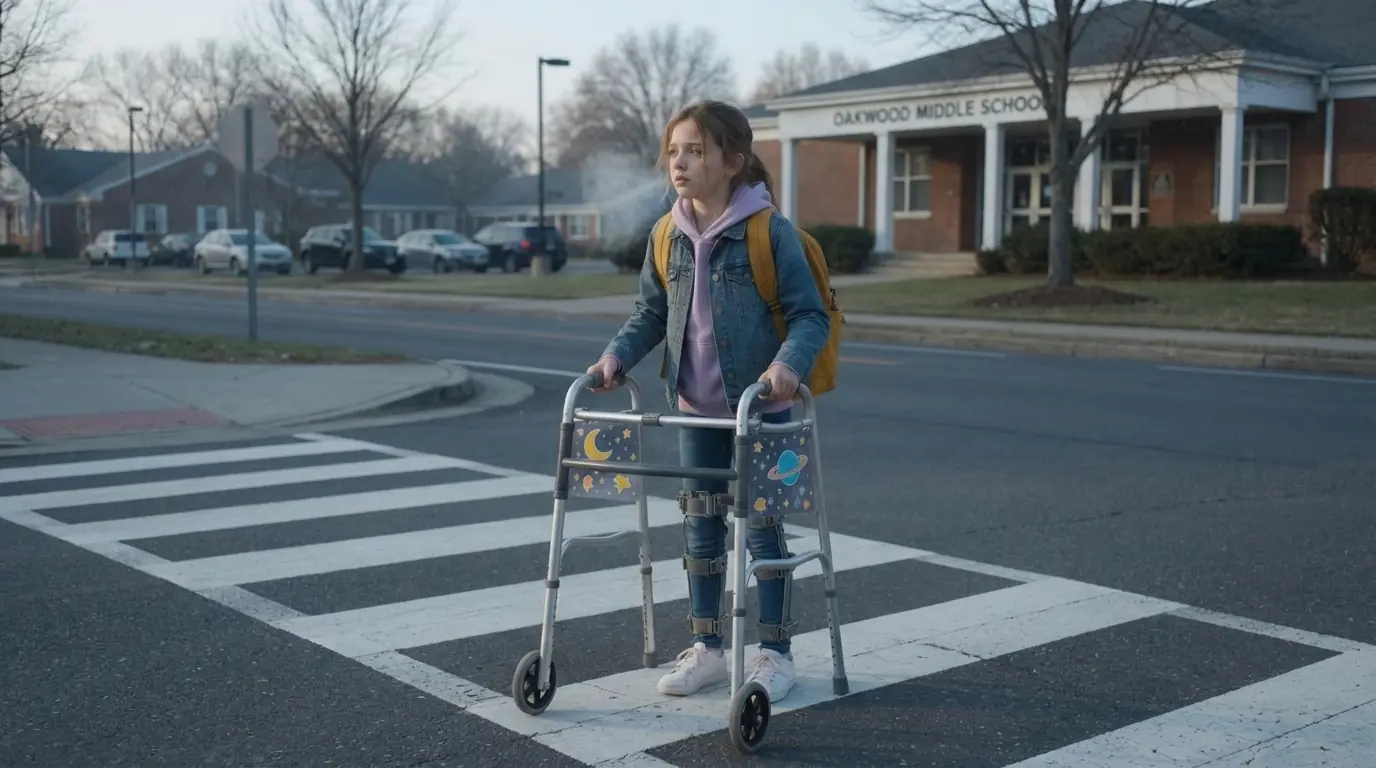
It rushed past the school crosswalk with its tires humming over the white paint, close enough that Lily felt the warm gust of air push against her face. The driver never looked back. He never slowed down. He never saw the nine-year-old girl standing at the edge of the street with both hands locked around a silver walker and two braces holding her legs straight beneath her jeans.
Lily’s fingers tightened until they hurt.
Across the road, Maple Grove Elementary was already waking up for the day. Kids hopped out of minivans with backpacks bouncing, lunch boxes swinging, and jackets half-zipped. Parents leaned across seats to kiss cheeks. Teachers stood on the front steps with coffee cups in hand, waving students toward the doors before the morning bell.
But Lily stayed at the curb.
Alone.
She wore a pale blue sweater under a denim jacket, jeans carefully pulled over the braces on both legs, white sneakers with purple laces, and a yellow backpack her mother had decorated with tiny embroidered stars. Her walker had stickers too. Comets, moons, planets, and little paper rockets her mother had sealed with clear tape so they would not peel off in the rain.
Her mother used to say, “The sky is big enough for slow stars too, Lily.”
That morning, Lily did not feel like a star.
She felt like something left behind.
The crossing signal turned white.
Then the countdown started.
Seventeen.
Sixteen.
Fifteen.
For most children, that was more than enough time.
For Lily, every number felt like a warning.
She looked toward the corner where Mr. Denny usually stood. He was the school crossing guard, an old man with a soft belly, a bright orange vest, and a red stop sign he held like a shield. He always waited for Lily. He always stepped out first and told the cars, “Nobody moves till my girl gets across.”
But that morning, the corner was empty.
No orange vest.
No whistle.
No red sign.
No Mr. Denny smiling like he could stop the whole world if Lily needed him to.
The number blinked down.
Twelve.
Eleven.
Ten.
Lily swallowed.
“Okay,” she whispered to herself. “You can do it.”
She pushed the walker forward.
Step.
Click.
Tap.
The metal braces made their familiar sound.
Step.
Click.
Tap.
A black SUV rolled too far into the crosswalk.
Lily froze.
Somewhere behind it, a horn blared, sharp and angry. It probably was not meant for her, but her body did not know the difference. Her shoulders jumped. Her eyes burned. She could already imagine walking into class late again, feeling every head turn.
Kids were not always cruel.
Sometimes they were curious.
Sometimes they whispered.
Sometimes they looked away too fast because a teacher had taught them that staring was rude.
Lily hated that almost more than staring.
The countdown hit seven.
She pulled the walker back to the curb.
Her breath came out shaky.
She wanted her mother.
Then she remembered again.
Her mother was not coming.
Not this morning.
Not after school.
Not ever.
Across the parking lot, beside a small breakfast diner called Rosie’s Corner, a line of motorcycles sat angled toward the curb. They were black, silver, and deep blue, shining under the early sunlight. Beside them stood a group of bikers in leather vests, denim jackets, boots, gloves, and faded bandanas.
They looked rough.
The kind of men people noticed and pretended not to notice.
Broad shoulders.
Gray beards.
Tattooed arms.
Faces shaped by weather, road miles, and the kind of lives that did not come easily.
A few parents glanced toward them and quickly looked away.
One mother pulled her little boy closer when they passed.
Lily saw that.
But she had also seen a clean white SUV almost trap her in the crosswalk, so appearances did not mean as much to her as they did to other people.
She turned her face toward the bikers.
“Excuse me…”
Her voice was swallowed by traffic.
She tried again, louder this time.
“Excuse me, sir. Can someone help me cross?”
The bikers went still.
The tallest one turned first.
His name was Wade Callahan, though the men in his riding club called him Bear because he was built like one and had the quiet, heavy patience of something that did not move unless it meant to. He had a thick beard, dark eyes, a leather vest worn soft at the edges, and silver threaded through his hair at the temples.
At first, he looked like every parent’s warning about strangers.
Then he saw Lily.
The change in his face was instant.
The hard look dropped away. His shoulders eased. His eyes moved from her walker to her braces, then to the crosswalk, then to the cars cutting through the school zone like children were obstacles instead of lives.
Something in him went cold.
He stepped away from the motorcycles.
“Hold up,” he told the others.
But the others were already moving.
Wade crossed the diner parking lot quickly, then slowed when he reached Lily. He did not tower over her. He dropped to one knee on the sidewalk, lowering himself until they were almost eye level.
“Hey, kiddo,” he said. “You trying to get across?”
Lily nodded.
“I can’t make it before the numbers run out.”
Wade looked at the signal.
Five.
Four.
Three.
Then he looked at the traffic.
His jaw tightened.
“You don’t need to beat a clock,” he said. “Traffic can wait.”
Lily blinked at him.
Nobody had ever made that sound simple before.
Wade stood and turned.
“Moose.”
A huge biker with a shaved head and a gray mustache stepped into the road like a barn door had grown boots. He raised one hand, and a sedan stopped so hard its front end dipped. The driver started to throw both hands up, then saw Lily’s walker and suddenly found something very interesting to look at on his dashboard.
“Patch,” Wade called.
Another biker moved into the opposite lane.
“Reno, cover behind her.”
A third biker walked behind Lily, giving her space but staying close enough to block any impatient driver from squeezing through.
The road stopped.
Not slowed.
Stopped.
Engines idled.
Brakes squeaked.
A woman in a silver minivan rolled down her window like she was ready to complain, then saw the line of bikers standing in the street and changed her mind.
Wade walked beside Lily.
“Whenever you’re ready.”
Lily looked at the road.
Then at him.
“You won’t rush me?”
“No, ma’am.”
She pushed the walker forward.
Step.
Click.
Tap.
The walker touched the white paint.
Step.
Click.
Tap.
The bikers moved with her like a shield. Wade stayed beside her with one hand hovering near the walker but not touching it. He seemed to understand without being told that helping did not always mean grabbing. Sometimes helping meant being ready without taking over.
Halfway across, Lily’s right brace caught on a raised strip of paint.
Her body tipped.
Wade caught the side of the walker before she fell.
“Easy,” he said. “I’ve got it.”
Lily’s cheeks flushed.
“I’m sorry.”
Wade’s expression changed.
“Don’t apologize for needing help.”
The words landed somewhere inside her.
A place that had been hurting all morning.
By the time they reached the school curb, the second bell had already rung. Most children were inside. The front doors were beginning to swing shut. Lily looked up at the bikers with wet eyes.
“Thank you.”
Moose gave a small salute.
Reno coughed and turned his head like the morning air had suddenly become dusty.
Wade smiled at her, but the smile did not last.
He looked around.
No parent came running.
No teacher had reached her yet.
No crossing guard hurried down the sidewalk.
No one seemed to understand that a child with braces and a walker had just been left alone at one of the busiest school crossings in town.
Wade crouched again.
“Lily,” he said carefully, reading the name tag clipped to her backpack, “where’s your mom?”
Lily’s hands tightened around the walker.
The whole morning seemed to pull back from her.
“She couldn’t come.”
“She at work?”
Lily shook her head.
Wade’s voice softened.
“Sick?”
Lily looked down at the comet sticker lifting from the walker frame.
“She died yesterday.”
For a moment, even the idling cars seemed quieter.
Moose lowered his head.
Reno whispered something under his breath.
Wade did not move.
Lily continued in a small, steady voice that sounded too old for her face.
“My neighbor was supposed to walk with me, but she was crying and couldn’t stop. I didn’t want to miss school.”
Wade swallowed.
“Sweetheart, school can wait for a thing like that.”
Lily shook her head hard.
“Not today.”
“Why not today?”
She looked toward the school doors.
“They’re having the assembly for my mom.”
Before Wade could ask another question, the school doors burst open.
A woman in a red cardigan rushed out first, followed by the principal, two teachers, and a group of children peeking from behind the glass. The woman’s face was pale and frantic.
“Lily!”
Lily flinched, then tried to stand straighter.
“I’m sorry, Mrs. Palmer.”
The woman dropped to her knees and wrapped Lily in her arms carefully, mindful of the walker and braces.
“Oh, baby. We were looking everywhere. Mrs. Cline called and said you left the house before she could find her keys.”
“I had to come,” Lily whispered.
The principal, Mr. Abrams, stopped in front of Wade and looked past him at the bikers still holding traffic.
“You helped her across?”
Wade nodded.
“She asked.”
Mr. Abrams looked at Lily.
Then back at Wade.
“Thank you.”
The words were simple, but his voice was not.
Wade heard something heavy in it.
He looked toward the front steps. Teachers stood there with tissues in their hands. Children pressed against the lobby windows. Nobody looked confused about Lily being late. They had not been waiting for the bell.
They had been waiting for her.
“What assembly?” Wade asked.
Mrs. Palmer looked at Lily first, as if asking permission.
Lily nodded.
The teacher wiped her eyes.
“Lily’s mother, Grace Bennett, was our school nurse for eleven years. She passed last night after a long illness. The students planned a remembrance this morning.”
Wade went still.
The name reached him before the meaning did.
“Grace Bennett?”
Mrs. Palmer nodded.
“Before she was Bennett,” Wade said, his voice rough. “What was her name?”
Lily looked up at him.
“Callahan.”
The bikers behind him froze.
Moose looked at Wade.
Reno took a step closer.
Wade’s hand went slowly to the chain around his wrist. Beneath the leather cuff, he pulled free a small, old charm. It was shaped like a silver comet, dented along one side, cheap and worn but carefully kept.
Lily stared at it.
“My mom had one like that.”
Wade could barely speak.
“She gave me this.”
“When?”
He looked at the charm.
“Twenty-nine years ago.”
Mr. Abrams stepped closer.
“Mr. Callahan, did you know Grace?”
Wade kept his eyes on Lily.
“I had a little sister named Grace.”
The entire sidewalk seemed to hold its breath.
“Our mother died when we were kids,” Wade said. “Our father fell apart after that. We went into foster care. They split us up before I was eighteen.”
His voice hardened for a moment, not with anger at Lily, but at a world that had once been careless with two children.
“I looked for her for years. Found a Grace Callahan once, but she’d already married and changed names. I wrote letters. They came back. After a while, I thought maybe she didn’t want me to find her.”
Lily’s mouth opened.
“She kept letters.”
Wade blinked.
“What?”
“My mom had a green box under her bed,” Lily said. “She said they were from someone she missed but didn’t know how to talk to.”
Wade looked like the pavement had shifted beneath him.
“She got them?”
Lily nodded.
“She read them sometimes when she thought I was asleep.”
His face broke a little.
Not fully.
Not yet.
But something cracked.
Lily unzipped her backpack with trembling fingers and pulled out a folded sheet inside a clear plastic sleeve.
“I brought this for the assembly,” she said. “Mom wrote it before she went to the hospital.”
Mrs. Palmer touched her shoulder.
“Lily, you don’t have to do this right now.”
Lily looked at her.
“Yes, I do.”
She held the letter out to Wade.
His hands, huge and scarred, shook as he took it.
Across the top, written in careful blue ink, were the words:
For my brother Wade, if he ever finds my Lily.
Wade made a sound like a breath being pulled from too deep.
He read silently at first.
Then Lily whispered, “Can you read it out loud?”
So he did.
“My dear Wade,” he began, his voice rough and uneven. “If this letter finds you, then I was not brave enough while I was alive, and I am sorry for that.”
The street remained silent.
“I got some of your letters. Not all, I don’t think, but enough to know you were looking. I wanted to answer. I wanted to tell you I never stopped remembering you. But shame is a strange thing. It makes cowards out of people who still love each other.”
Wade pressed the letter closer.
Moose turned away completely.
Wade continued.
“I thought you would ask why I did not look harder. I thought you would hate me for building a life without you. The truth is, I was afraid to open the door and find out I had already lost you twice.”
Lily’s eyes filled.
“I have a daughter named Lily. She walks with braces, but she has more courage than most people who run. She loves pancakes, comets, purple socks, and pretending she hates attention when she secretly loves being chosen first.”
A soft laugh moved through Lily’s tears.
Wade swallowed hard.
“If I am gone, and if God gives you the mercy of finding her, please know this. You were never unloved. You were never forgotten. And Lily should not have to grow up with no one who knows where her mother came from.”
Wade lowered the letter.
His eyes were wet now.
He did not hide it.
Lily reached into her backpack again and pulled out a small envelope.
On the front, in Grace’s handwriting, were the words:
Give this to the one who stops the street for you.
Wade stared.
“She told me I’d know,” Lily whispered.
He opened it.
Inside was an old photograph.
A teenage boy and a little girl stood at a summer carnival, both wearing cheap silver comet bracelets. The boy was lean, serious, and trying not to smile. The girl beside him had both hands full of cotton candy and was laughing so hard her eyes were almost closed.
On the back, Grace had written:
Lily will know you by your kindness before she knows your name.
That was when Wade Callahan broke.
He sank to one knee on the sidewalk and covered his face with both hands. The enormous biker, the man drivers had obeyed and parents had avoided, wept like a boy who had finally found home only to realize the door had been open the whole time.
Lily moved toward him.
Step.
Click.
Tap.
Step.
Click.
Tap.
Then she put both arms around his neck.
Wade held her so carefully that Mrs. Palmer began crying again.
“I’m sorry,” he whispered into Lily’s shoulder. “I’m so sorry I didn’t find her.”
Lily’s voice shook.
“Mom said you would find me when I needed you most.”
Wade pulled back.
“She said that?”
Lily nodded.
“She said family sometimes takes the long road.”
Wade looked at the crosswalk, the stopped cars, the bikers in the street, the school doors, the letter in his hand, and the comet stickers on Lily’s walker.
He had thought he was helping a child cross a dangerous road.
But Grace had left him a map made out of love, grief, timing, and one little girl brave enough to ask strangers for help.
The assembly moved outside.
Nobody planned it.
Nobody went to the office to make an announcement.
It simply happened because grief had already spilled beyond the walls.
Teachers brought the microphone onto the front steps. Children sat on the curb and along the sidewalk. Parents left their cars where they were and came closer. Even the drivers who had been impatient minutes earlier stayed at the edge of the street, suddenly unwilling to be the kind of people who drove away from this.
Lily sat in the front beside Wade.
Her walker stood next to her, shining with moons, rockets, comets, and taped-over stars.
Mrs. Palmer spoke first.
She talked about Grace Bennett, the school nurse who kept crackers in her desk for children who came hungry. The woman who remembered which students were scared of needles, which ones needed quiet before calling home, and which ones only pretended to have stomachaches because they were lonely.
She had bandaged scraped knees.
She had sat with sick children until parents arrived.
She had kept extra gloves in winter and extra socks for rainy days.
She had made every slow child feel like the hallway was not impatient.
Then Lily stood.
Wade rose beside her, ready to help.
She shook her head.
“I want to do it.”
He stepped back.
Only a little.
She placed both hands on her walker.
Step.
Click.
Tap.
Step.
Click.
Tap.
The whole school watched her move to the microphone.
Her voice was small at first.
“My mom said some people are only scary because we don’t know their story yet.”
The children were silent.
“She said some people look kind and aren’t. And some people look rough but will stop the whole road for you.”
Wade wiped his face with the back of his hand.
Lily looked at him.
“My mom couldn’t walk me to school today,” she said. “But she still helped me get here.”
A long quiet moved through the crowd.
“She left me a letter. She left me a person. She left me someone who remembered the same stars she did.”
Then Lily looked at the street.
“And I think she would want everybody to slow down at the crosswalk.”
A small laugh rose through the tears.
Even Wade laughed.
After the assembly, Wade walked to the middle of the crosswalk. He removed his leather vest and folded it over one arm. Then he faced Mr. Abrams.
“You got a crossing guard coming back?”
Mr. Abrams looked tired.
“Mr. Denny had a stroke last night. We only found out this morning. We’re trying to arrange coverage.”
Wade nodded.
“Until you do, we’ll be here.”
Moose stepped beside him.
“Morning and afternoon.”
Reno nodded.
“Rain too.”
Patch looked down the street.
“Especially in rain. People drive stupid in rain.”
Mr. Abrams looked at the line of bikers and then at Lily.
His voice softened.
“I think Maple Grove would be grateful.”
So the bikers came back the next morning.
And the morning after that.
And the one after that.
At first, parents stared.
Then they waved.
Then they started bringing coffee.
Within a week, the school zone had become the safest block in the county. Cars slowed before the sign. Trucks stopped behind the line. Drivers who had once rushed through the crosswalk now waited while Moose stood with both hands raised and Wade walked beside Lily at her own pace.
Step.
Click.
Tap.
Step.
Click.
Tap.
No one honked anymore.
Not at Maple Grove.
Not when the Iron Road Riders were standing there.
Every morning, Lily ate breakfast with Wade at Rosie’s Corner before school. He ordered black coffee. She ordered blueberry pancakes with too much syrup. The first few times, they sat quietly because grief makes even family feel new and strange.
Then she began asking questions.
“What was my mom like when she was little?”
Wade smiled.
“Bossy.”
Lily looked delighted.
“She told me she was shy.”
“She lied.”
Lily laughed.
Wade told her about Grace chasing fireflies in bare feet, stealing his baseball cap, and crying when he left for work at the auto shop because she thought every goodbye might become permanent. He told her about the comet bracelets they bought at a fair with money he had saved for lunch.
He told her he had never stopped looking.
Lily told him her mother sang badly in the car, burned toast every Saturday, and cried during animal commercials.
Between them, Grace became whole in ways neither of them had managed alone.
One month after the assembly, a lawyer called Wade into his office.
Lily came with him, sitting beside him with her walker folded against the wall.
Grace had left very little money.
Medical bills had taken most of what she had.
There were boxes of photographs, a few savings bonds, a life insurance policy meant for Lily, and one surprise no one expected.
“Your sister purchased Rosie’s Corner two years ago,” the lawyer said.
Wade stared at him.
“The diner?”
“Yes. The previous owner was retiring. Grace bought it quietly through a small business loan and kept the name.”
Lily looked up.
“Mom owned Rosie’s?”
The lawyer nodded.
“She left instructions.”
He opened an envelope.
“If Wade finds Lily,” he read, “tell him I kept the diner open because it sat across from the school and I liked knowing there was always one warm place close by. Tell him Lily likes blueberry pancakes with extra syrup. Tell him not to burn them.”
Wade laughed once, but it broke halfway.
The lawyer continued.
“And tell him this is not charity. It is a place to start.”
Wade pressed the heel of his hand against his eye.
Grace had known him better than he thought.
She knew he would have refused money.
But a place to start was different.
A place could be worked for.
A place could be earned.
Two weeks later, Rosie’s Corner closed for three days.
When it reopened, the sign had changed.
Above the door, painted in blue and gold, were the words:
Comet Crossing Café.
Beneath the name was a picture of a little walker, a comet, and five motorcycles lined up beneath a school-zone sign.
Inside, Wade learned how to make pancakes.
Badly at first.
He burned the first batch so badly Lily declared them “historic.” Moose claimed he liked them crispy. Reno said they could be used to patch asphalt. Mrs. Palmer brought a recipe written in Grace’s handwriting, found in the school nurse’s desk.
After that, the pancakes got better.
Every morning before school, Lily sat at the counter with her yellow backpack beside her. Teachers came for coffee. Parents came after drop-off. Kids came for muffins, hot chocolate, and the strange comfort of seeing large tattooed men argue about syrup brands like the fate of America depended on it.
Wade kept a framed photograph behind the register.
The old carnival picture.
Teenage Wade and little Grace with their comet bracelets.
Beside it, he placed the letter.
Not all of it.
Only one line.
Lily will know you by your kindness before she knows your name.
Years passed.
Lily grew taller.
Her walker changed, then changed again. Her braces needed adjustments. Her steps became stronger some seasons and harder in others. Life did not become easy just because family arrived, because real stories do not work that cleanly.
But she never crossed alone again.
On the first anniversary of Grace’s death, the whole school gathered at the crosswalk. Mr. Denny, the old crossing guard, had recovered enough to stand with a cane. He cried when Lily hugged him.
Wade stood beside them in his leather vest.
The vest had changed too.
On the front, just above his heart, he had sewn a small patch shaped like a gold comet.
Under it were two words.
Grace’s Road.
The principal placed a new sign below the school-zone warning.
It read:
SLOW DOWN. THE WORLD CAN WAIT.
The town kept that sign.
No one ever asked to remove it.
Years later, people still told the story of the morning the bikers stopped traffic for a little girl with a walker.
Some told it like a miracle.
Some told it like proof that you should not judge a man by leather, tattoos, or motorcycle noise.
Some told it as a sad story about a mother who died too soon and a brother who arrived too late.
But Lily told it differently.
She said her mother had walked her to school that day through a letter.
Through a comet charm.
Through a diner across the street.
Through a brother she had loved but feared answering.
Through strangers who became family because one frightened girl found the courage to ask for help.
And every morning, when Wade Callahan stood in the crosswalk with one hand raised to stop traffic and the other ready beside Lily’s walker, he understood something that had taken him nearly thirty years to learn.
Family does not always return through the front door.
Sometimes it waits at the curb.
Sometimes it has a shaking voice and purple shoelaces.
Sometimes it crosses slowly, step by step, while the rest of the world finally learns to wait.