You think wearing that dead man’s ring still protects you, sweetheart? He grabbed her wrist across the table in front of everyone and smiled like cruelty was a language only he spoke fluently. She was seven months pregnant, exhausted, and completely alone. And every person in that diner looked away.
Every person except six. Emily Carter had learned somewhere between the funeral and the eviction notice and the third double shift in a row that survival wasn’t a feeling. It was a decision you made every single morning before your feet even touched the floor. You didn’t feel brave.
You didn’t feel strong. You just decided again that you weren’t going to let today be the day that broke you. And then you laced up your boots, even when your fingers were too swollen and too tired to do it properly. And you walked back out into the world that had already taken nearly everything from you.
She was 28 years old and she moved like someone twice that age. Not because she was weak, because she was carrying weight that most people in Blackwater Ridge, Montana, couldn’t even imagine. seven months of pregnancy pressed against the front of her body like a second heartbeat that never stopped reminding her that she had to keep going. Not for herself anymore.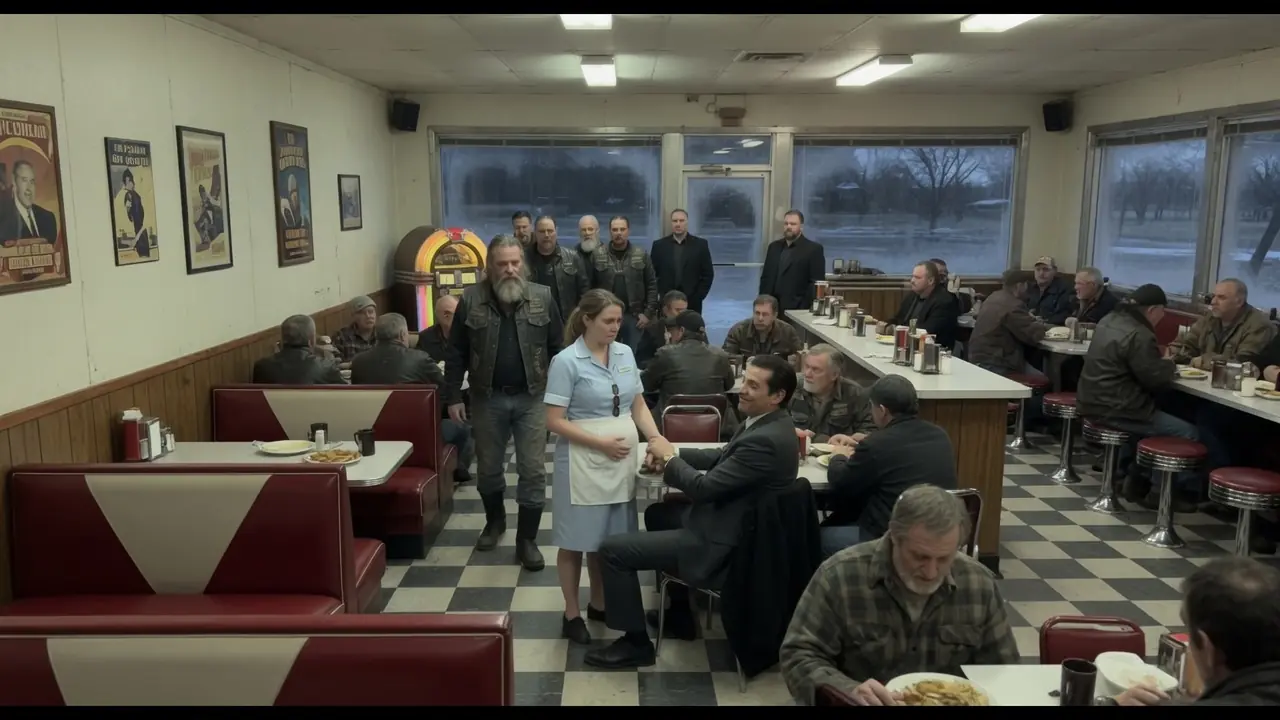
For him, for the boy she already knew she was going to name Tyler after the man who was supposed to be standing right beside her through all of this. Tyler Carter had been dead for 11 months. And in those 11 months, Emily had worked 80-hour weeks at the Crossroads Diner on the edge of Interstate 81, smiled at every trucker and tourist and regular who walked through the door and managed to keep the lights on in the small house she could barely afford at the edge of town. She had done all of that alone with swollen ankles with a wedding ring she no longer wore on her finger because her fingers had grown too swollen.
So she wore it on a chain around her neck pressed against her chest close to the place where grief lived permanently. The diner wasn’t much. Cracked vinyl booths, fluorescent lights that buzzed when the temperature dropped outside a jukebox in the corner that nobody ever used anymore, and a laminated menu that hadn’t been updated since the previous owner ran the place. But it was warm, and it was hers in the way that a place becomes yours when you spend more hours inside it than you spend inside your own home.
Deb, the older waitress who had worked at the crossroads for going on 20 years, always saved Emily the section closest to the kitchen. Not because the tips were better, they weren’t, but because it was closer to a chair when Emily’s back began to scream at her around the four-hour mark of every shift. Deb never said that out loud. She just made it happen quietly the way that women who have watched other women struggle tend to take care of each other without making a production of it.
That Friday evening started the same way most of them did. A few regulars at the counter, a family with kids in the corner booth who ordered chicken strips and asked for extra napkins three different times. two truckers at separate tables who ate in complete silence, the way men who spend most of their lives alone tend to eat. The television above the counter was running a local news broadcast that nobody was watching.
Outside, the temperature had dropped down past freezing, and the parking lot lights made everything look pale and isolated. The way small towns at the edge of winter always looked like the world had contracted, and everybody who was still here had chosen to stay for reasons that had more to do with stubbornness than happiness. Emily refilled the family’s coffee, smiled at the children, told the little girl with the pigtails that she liked her jacket, and then walked back toward the kitchen with her hand pressed to the small of her back. Because the baby had been pushing against her spine since noon, and the pain had settled into something, she had simply stopped fighting.
You need to sit down, Deb said, intercepting her near the coffee station. I need to finish my section, Emily said. The Hendersons haven’t gotten their check yet. The Hendersons can wait 30 seconds while you sit down.
Deb and Emily looked at each other for a moment in the way that women who genuinely care about each other look at each other when one of them is being stubborn with exasperation layered over genuine worry layered over deep unspoken respect. 10 minutes, Emily said, after I get the Hendersons their check. Deb shook her head and went back to the counter. It was not a surrender.
It was an acknowledgement that some arguments with Emily Carter were simply not winnable and the wisest thing you could do was stop fighting them and stay close enough to catch her if she fell. The bell above the door rang at 7:43 in the evening. Emily heard it from the back. The way you hear sounds differently when you’ve worked in a place long enough that your body has learned the rhythms of it before your mind catches up.
The sound of the bell, the rush of cold air, the brief hesitation before the door swung shut again. She didn’t think anything of it. People came in all the time at this hour. Travelers, locals, guys coming off the highway looking for something hot to eat before pushing through to wherever they were going next.
She came back out of the kitchen carrying the Henderson’s check and stopped. Six men had come through the door. big men, men in leather vests that carried road dust, and the kind of insignia that made certain people in certain towns pay very careful attention. The Iron Reapers, Blackwater Ridge people, knew the name mostly from reputation in the occasional newspaper article, a veterans motorcycle club, mostly former military men who had served and come home to something that felt smaller than the lives they’d led overseas.
They weren’t criminals. Emily knew that much, even if other people in town weren’t entirely sure what to make of them. But they were large and they were weathered, and they took up space in a way that made rooms adjust around them. Owen, their president, was a gray- bearded man somewhere in his 60s, who walked with a slight limp that he clearly didn’t think about anymore.
The kind of limp that had stopped being an injury and had simply become part of how he moved through the world. He surveyed the diner with calm eyes, not suspicious eyes, just careful ones. The eyes of someone who has spent enough years in enough situations that the habit of knowing exactly what is happening in every corner of any room he walks into is no longer something he decides to do. It’s just how he sees.
His name, Emily would learn later, was Wade Hunter. But she didn’t know that yet. Right now, she was just watching him quietly assess the diner with that unhurried, unreadable gaze and then nod once to his men, and they moved toward the large corner booth at the back without any of them saying a word. She would find out later that they had been on a memorial ride honoring three brothers they’d lost in the last year.
One of them in an accident on I-90, two of them to health that had failed the way it does when men who spent years in physical extremity finally run out of borrowed time. They were tired. They were quiet in the particular way that comes after grief that hasn’t quite finished settling. Emily delivered the Henderson’s check, took a breath, and walked toward the corner booth.
Evening, she said. Can I start you all with some coffee? The gray-bearded man looked up at her and for just a moment, barely a second, barely enough for her to register it. something moved across his face.
Not pity, not the thing she’d been seeing in people’s faces for the past 11 months. That particular combination of sympathy and discomfort that told her they had heard about Tyler and didn’t know what to do with it. This was something else. Recognition of a kind she couldn’t quite place.
Like he was seeing something in her face that reminded him of something he already knew. Coffee would be outstanding, he said his voice was low and even with the kind of cadence that belongs to people who have spent years in situations where the wrong tone at the wrong moment could turn everything sideways. Whatever’s hot. Everything’s hot, Emily said, We’re good at hot. The man to his left, younger, maybe early 40s, with a thick red beard and kind eyes, smiled at that.
That’s exactly what we needed to hear. Now, she poured their coffee and left them with the menus and went back to the counter, and for a few minutes, the diner settled back into its quiet evening rhythm. The truckers finished their meals. The family with children paid and left.
And the little girl in the pigtails waved at Emily on the way out. And Emily waved back and felt a specific kind of warmth that comes from a moment that is small and genuine and costs nothing. Then the bell rang again and everything changed. She heard the door before she turned around.
Not the bell itself. She heard the silence that followed the bell. the particular quality of stillness that falls over a room when something has entered it that everyone recognizes as dangerous. It wasn’t loud.
It wasn’t dramatic. The conversations didn’t stop all at once. They just softened, thinned, like the air pressure in the room had shifted slightly, and everyone’s body understood it before their minds did. Emily turned. Three black SUVs were in the parking lot.
She hadn’t even heard them pull in. And Victor Salazar was already inside. And she had never spoken to Victor Salazar directly. She had seen him twice before, once at a Chamber of Commerce event that Tyler had dragged her to three years ago when Tyler had pointed him out from across the room and said quietly, Stay away from that man.
without explaining why. And once about six weeks after Tyler died when a car she didn’t recognize drove slowly past her house at 11 o’clock at night and didn’t stop. She hadn’t been able to see the face behind the window clearly, but something in her chest had tightened in a way that she still hadn’t entirely explained to herself. Victor Salazar was in his early 50s, well-dressed in the way that men who want you to know exactly how much their clothes cost are well-dressed.
He had the build of a man who had once been physically imposing and now simply allowed his money and his reputation to do the work that his body used to do. He moved through the diner the way powerful men who have never once in their adult lives been told no tend to move through spaces like the room was arranged specifically for his comfort. And everyone in it was already aware of that fact. His four bodyguards fanned out without being told to.
Two by the door, two moving to positions at either side of the room. They did it smoothly. The way people do things that they have done so many times it no longer requires thought. Victor chose the center table.
Not a booth. The table in the center of the room where he could see everyone and everyone could see him. Emily understood the choice immediately in a wordless instinctive way, the same way she understood it when a customer sat down and immediately made the booth bigger than it needed to be, spreading elbows, spreading belongings, expanding into space as a declaration of priority. He sat down.
He looked at the menu for exactly four seconds. Then he looked up and looked directly at Emily. Then she felt it. That specific quality of being seen by someone who sees you not as a person but as an object.
Not sexual, not exactly. More fundamental than that, the way a man looks at something when he is deciding what it is worth and what he intends to do with it. She walked over. Good evening, she said.
Her voice was steady. She had gotten very good at keeping her voice steady. Can I get you something to drink to start? You’re the only waitress working this section, he said. Yes, sir. Interesting.
He looked at her for a moment longer than was comfortable. What’s your name? Emily. Something flickered in his expression. So fast she almost missed it.
Emily, he repeated, Bring me a coffee, black, and I’ll need a few more minutes. She wrote it down and turned to go. Walk slower, he said. I’m not done looking at the menu.
She stopped, felt the words land against the back of her neck like something physical, heard in the silence that followed that the two truckers at the counter had both gone completely still. She turned back around, kept her face empty of everything she was feeling. Of course, she said. Take your time, and she stood there while he made a performance of studying the menu.
She could feel every person in the diner watching in that collective way that people watch when something uncomfortable is happening in a public space. Not looking directly but not able to look away entirely the way you slow down near an accident even when you don’t want to. He ordered the steak, complained that the menu didn’t specify the cut. When Emily explained that it was a top sirloin, he made a sound that communicated his thoughts about that without requiring words.
She wrote it down. She told him she’d have it out in about 1five minutes. She went back toward the kitchen. Behind her, she heard him say to no one in particular.
They let pregnant women work triple shifts in this town. Remarkable. A low laughter from his bodyguards. The sound of it made her jaw tighten hard enough to ache. Deb was in the kitchen passed through when Emily came back in.
She took one look at Emily’s face and said, Salazar. Emily nodded. Deb’s expression shifted into something careful and controlled. She had lived in Blackwater Ridge for 6three years. She had watched Victor Salazar go from a local businessman with a questionable reputation into something that functioned more like a landlord of the entire county.
She knew the way long-term residents of small towns know these things, which police officers returned his calls within minutes and which city council votes went the way he needed them to go. She knew what happened to the two men who had tried to press charges against his company three years ago. She knew all of it with the quiet, exhausted certainty of someone who has watched power work in a community for long enough to understand that it is rarely sudden. It is always gradual.
It is always patient and it always wins. Keep your head down, Deb said quietly. I always do, Emily said. She came back out with the coffee.
Your husband worked for Harmon Logistics, didn’t he? The words stopped Emily absolutely cold. She didn’t move. She didn’t speak.
She felt the air in her lungs go thin and sharp. Harmon Logistics was the trucking company Tyler had worked for, the company whose warehouse had burned down on a Thursday night in December with Tyler Carter still inside it. I’m sorry, she managed. Harmon Logistics, Victor repeated slowly, turning his coffee cup in a small circle on the table.
The man who died in the fire, Tyler Carter. That was your husband. It was not a question. Yes, Emily said.
He looked at her then, really looked at her with those flat assessor’s eyes. Terrible accident, he said. And something in the way he said the word accident, a fraction of a pause before it, a slight elevation on the first syllable. The way people sometimes say a word when they want you to understand, they know it isn’t the right word made the hair on Emily’s arms rise under her uniform.
Yes, she said again. Because there was nothing else to say. because she was standing alone in the middle of a diner with four armed men stationed around the room and the only help she had was Deb in the kitchen and six bikers in the corner booth who had no reason on earth to involve themselves in her problems. Bring me some water, Victor said.
I assume you can manage that without too much difficulty. She turned and walked to the water station. Her hands were shaking. Not visibly, she pressed one of them flat against the counter and concentrated on controlling it the way she had learned to concentrate on controlling everything because control was the only thing she had left.
She filled the water glass. She breathed through her nose. She turned back around in the corner booth. She noticed that the gray bearded man Wade was watching Victor Salazar with the same quiet, unreadable expression he’d used to survey the diner when he first came in.
His coffee sat in front of him untouched. His men hadn’t opened their menus again. They were listening. All six of them were listening in that particular way that people who have been trained to process threat listen.
Not tense, not reactive, just receiving. She delivered the water. Victor’s food came out eight minutes later. He cut into the steak, chewed once, set his fork down, and looked up at Emily.
It’s cold, he said. I can have it remade. I didn’t ask you to have it remade. I said it’s cold.
He pushed the plate aside. Your husband Tyler, he was well-liked around here. He was, Emily said, a mechanic, wasn’t he? Before he went to work for Harmon. Army mechanic. Yes. Smart man.
Mechanical aptitude is rare. He picked up his coffee again. Too bad about the accident. There was the word again, the pause before it, the elevation on the first syllable.
Emily said nothing. You know what I find interesting? Victor continued in the conversational tone of a man who is entirely aware that every word he is speaking is landing on the person in front of him like something blunt and deliberate. A man works for a company for three years, never causes any problems, gets along with everyone.
And then one night he’s working late alone apparently and there’s a fire and the building is gone and the man is gone and nobody saw anything. He tilted his head slightly. You’d think a man’s wife would want to know more about how something like that happened. The trembling in Emily’s hands moved up into her arms.
She pressed them against her sides. I know how it happened, she said quietly. There was an investigation. Yes, Victor said.
There was? He looked at her for a long, even moment, and the investigation concluded it was an accident. He smiled. And Emily Carter, standing in the middle of the Crossroads Diner at 7:58 on a Friday evening, understood with a certainty that settled into her bones like cold water, that the man sitting in front of her knew exactly how Tyler died, that the word accident was a message, that she had been the target of this conversation from the moment he walked through the door. She placed the check on the table.
Her hand was trembling visibly now. She couldn’t stop it. I’ll get out of your way, she said. She turned to walk back toward the kitchen.
She needed to get to the back. She needed 30 seconds behind the kitchen door where nobody could see her face. Then his hand closed around her wrist hard, without warning, without hesitation. He pulled her back toward the table with a grip that had no interest in what she wanted.
She stumbled, her center of gravity off because of the baby, because of the surprise, because of the raw physical shock of being grabbed and caught herself against the edge of the table with her free hand. I wasn’t finished talking to you, Victor said. The diner went silent, not quieter. Silent. Every conversation, every sound, the television, even the buzz from the fluorescent light seemed to hold its breath.
Emily looked down at his hand around her wrist. She could feel her pulse hammering against his grip. She could feel her baby moving inside her. A slow rolling shift like the baby was adjusting its position in response to the sudden spike of adrenaline flooding her system.
Please let go of me, she said quietly. Victor looked at her with those flat eyes. See, that’s the problem with women in your situation. He said in a tone that was almost conversational, almost reasonable, almost friendly.
You mistake politeness for weakness. My sitting here and having a conversation with you, that was politeness. He tightened his grip slightly. This is something else.
Let go of her wrist. The voice came from her left, low, even, completely without theater. Wade Hunter was standing 6 feet away. He hadn’t rushed.
He hadn’t knocked a chair over. He had simply stood up and crossed the room with a steadiness that was somehow more frightening than anger would have been. His five men were behind him, arranged in a loose half circle, their faces showing expressions that contain nothing readable except complete absolute attention. Victor looked at Wade.
He took in the leather vest, the gray beard, the limp, the age, and she could see him running the calculation, the same calculation powerful men run when they’re surprised by something they didn’t expect. assessing whether this was real or theater. This is a private conversation, Victor said. I can see that, Wade said, He didn’t move closer.
He simply stood there, present and immovable, like something that had always been in this room and always would be. Let go of her wrist. Victor’s grip tightened a reflex, not a decision. Emily made a small involuntary sound.
And Victor Salazar, who had operated in Blackwater Ridge for 15 years without anyone telling him no, in public looked at the gray bearded man standing in front of him and arrived, for the first time in longer than he could remember. At a moment of genuine uncertainty, he released her wrist. Not because he was afraid, because he was calculating, and calculation required a fraction of a second of pause. Emily stepped back.
Her wrist throbbed. Her legs were not entirely steady. Victor looked at Wade with the expression of a man who is storing information. I don’t know who you think you are, he said.
You don’t need to know, Wade said. The lady needs to go do her job. You need to let her. A silence that had temperature that had weight.
Victor’s jaw moved once like he was chewing something. Be very careful, he said softly. I’m always careful, Wade said. That’s how I got to be my age.
Victor looked at Emily at the wrist he’d been holding, at the hand she’d unconsciously moved to cover her stomach. Something moved across his face that wasn’t quite regret and wasn’t quite calculation and wasn’t quite satisfaction. Something in between all of them. The emotional signature of a man who is deciding how to file this moment away for later use.
He picked up his coffee. Bring me a fresh steak, he said to Emily. Medium rare this time and try not to take so long. Um, Emily looked at Wade.
Wade looked at Emily and in that look, brief wordless between two people who had not spoken more than 30 words to each other, something passed that felt impossibly like recognition. She went back to the kitchen and Deb, who had seen all of it through the pass-through window, took both of Emily’s shaking hands in hers and held them still for a moment without saying a single word. Because there are moments where words are not the right thing. Deb had been alive long enough to know exactly when those moments were.
From the corner booth visible through the pass-through window, Emily could see Wade Hunter sitting back down. Could see him pick up his coffee. Could see him wrap both hands around the cup the way a man does when he is settling in for the long wait. His eyes were on Victor Salazar and they did not move. not once.
For the next 40 minutes while Emily forced herself back out onto the floor and refilled coffees and delivered checks and smiled at people who were all very carefully not making eye contact with anyone else. Wade Hunter watched Victor Salazar with the patient unblinking attention of a man who has spent years in situations where the difference between what happens next and what doesn’t happen next comes down entirely to whether you are paying attention. He was paying attention every single second of it. And Victor Salazar, for reasons he would not have been able to entirely articulate, had begun to understand that the fresh steak came out in 11 minutes.
Emily carried it herself because Deb had offered, and Emily had said no, because saying no to Deb’s help was the only form of control she had left in that moment, and she needed it badly. She crossed the floor with the plate balanced on her forearm, her wrist still throbbing where Victor’s fingers had pressed, and she set the plate down in front of him without a word and turned to leave. Did I say you could go? She stopped. Her back was to him.
She closed her eyes for exactly one second, the amount of time she allowed herself, and then she turned around. Is there something else you need? Victor cut into the steak, chewed, considered. This is acceptable, he said as if he were doing her a favor by admitting it. Sit down.
I’m working, sir. I’m not asking, he gestured to the chair across from him. Sit. The diner held its breath again. Emily felt every set of eyes on her back.
She felt Wade Hunter’s gaze from the corner booth like a hand on her shoulder, steady present, not pulling her in any direction. Just there. She did not sit down. I can’t leave my tables, she said. Victor set his fork down with a small, deliberate click against the plate.
You know what I’ve noticed about this town. He leaned back in his chair. Everyone here has a very specific kind of pride. The kind that comes from people who don’t have much else. Stubborn pride.
The kind that makes a pregnant widow stand on her feet for 1two hours because she’s too proud to ask for help. He tilted his head. Your husband had that same pride. You know that?
Emily’s jaw locked. Don’t, she said quietly. Don’t what mention him? Victor spread his hands in a gesture of mock innocence.
I’m paying my respects, Emily. Is that not allowed? You didn’t know my husband. I knew of him.
Victor picked his fork back up. Tyler Carter, Army mechanic, honorable discharge, two tours, came home married. He got a job driving for Harmon Logistics. He cut another piece of steak.
diligent man, very thorough, the kind of man who pays attention to things other people aren’t meant to notice. He looked up at her then and his eyes were completely flat. That kind of thoroughness can be a liability in certain industries. The room was so quiet Emily could hear the grease popping in the kitchen behind the closed door.
I need to get back to my table, she said. Of course you do, Victor waved his hand dismissively. Go ahead. We’ll talk more later. The the will talk more later landed in her chest like a stone dropped into still water, sending rings outward in every direction.
She walked back to the counter. She poured coffee for one of the truckers who hadn’t asked for any and who looked down at his cup and didn’t say a word about it. Deb appeared beside her from nowhere. He’s baiting you, Deb said under her breath.
Don’t give him the satisfaction. I know what he’s doing, Emily said. then stop letting him see that it’s working. Emily looked at her.
He said Tyler was thorough, that it was a liability. Deb’s face went still in a way that was worse than any expression Emily had ever seen on it. Still like a person who had just been handed information they don’t know what to do with. She sat down the coffee pot.
She looked at the floor for a moment. Emily, he knows something. Emily said, He knows what happened. He’s sitting right there eating a steak and telling me he knows what happened to Tyler and there’s nothing I can— Her voice cracked on the last word and she stopped, pressed her lips together, felt the baby shift inside her that slow underwater roll that she had come to understand as her son’s way of reminding her he was there. She breathed.
I’m fine, she said to Deb, to herself, to Tyler maybe somewhere. No, Deb said gently. You’re not, but you’re going to be. Emily straightened her back, which cost her something because her spine had been protesting since noon, and she picked up her order pad, and she walked back out onto the floor.
And at the corner booth, she noticed that two of Wade’s men had shifted position slightly. Subtle, if you weren’t paying attention, you wouldn’t catch it. But one of them had moved from the inner seat to the outer seat, which put him with a clear sight line to the door of the door and to Victor’s table simultaneously. Another had his phone out on the table screen up, not scrolling, just on, just there.
Wade himself was still watching Victor. When Emily passed the corner booth, refilling waters, Wade spoke without looking up at her. You doing all right? he said, quiet, conversational, like he was asking about the weather.
Wonderful, Emily said in the exact same tone. Good, he turned his coffee cup in a small circle. My name’s Wade, by the way, in case that becomes relevant. She looked at him, then really looked, and she saw what she’d only half registered before, that the calm in his face wasn’t indifference.
It was the specific hard one calm of someone who has been in rooms where the tension was this thick and worse, and who has learned that calm is not the absence of feeling. It is the decision to manage feeling because panic doesn’t help anybody. Emily, she said, I know, he said. I heard him say it.
She moved on to the next table. Victor ate his steak slowly. He was in no hurry. He never was, or if he was, he never let it show.
Because urgency suggested weakness, and weakness was not a thing Victor Salazar displayed in public under any circumstances. His bodyguards stayed at their positions. One of them, the one nearest the door, was watching the corner booth with the practiced neutral expression of a man who is doing a threat assessment and finding it inconclusive. In wake of the family with children had left.
Most of the regulars had paid and gone, which Emily suspected was not entirely coincidental. There was something about Victor Salazar’s presence that cleared a room the way a shift in wind clears a campfire smoke. And the people who knew him cleared out first because they’d had more practice recognizing the signal. The two truckers were still at the counter.
Neither of them had ordered anything in 40 minutes, but neither of them had left either. Emily suspected this was not accidental. Truckers are practical people, and practical people don’t leave the freeway diner where something is developing unless they’re in a situation where self-preservation makes departure non-negotiable. These two had clearly decided it wasn’t non-negotiable yet.
Victor called her back to the table. How long have you been working here? he asked. seven months, Emily said. Before that, administrative work for a property management company in Billings.
You came back to Blackwater Ridge after Tyler died. Not a question. This is where I’m from, she said. Right. He studied her.
And you’re raising this baby alone. The word alone hit her with specific precision. She recognized it as intentional. Everything this man said was intentional.
She’d understood that within the first five minutes of talking to him. I have family here, she said. Friends, yes, but no husband. He leaned forward slightly.
No one to take care of business for you the way a husband does. No one to protect your interests. That’s a vulnerable position, Emily, especially for a woman who might accidentally find herself in possession of information that other people would prefer she didn’t have. The sentence landed slowly, the way certain sentences do when they’re constructed precisely enough that your brain has to unpack them in sequence.
rather than all at once in possession of information that other people would prefer she didn’t have. She felt a chill move through her that had nothing to do with the temperature. I don’t know what you mean, she said. I think you do.
Victor smiled pleasantly. Think Tyler was the kind of husband who talked to his wife, who brought things home from work without meaning to. Worries, concerns, things he’d seen. The smile stayed perfectly in place.
Men like that, they can’t help it. They’re carrying something and they need to set it down somewhere. And the somewhere is always the person they trust most. Emily stared at him, buffed because he was right.
Tyler had talked to her. three weeks before he died, he had come home late later than usual and sat down at the kitchen table with his jacket still on and told her that he’d seen something at the warehouse that didn’t add up. truck manifests that didn’t match the cargo crates that arrived sealed and left sealed and were never logged. He hadn’t used the word worried.
Tyler never used the word worried, but she’d seen it in his face in the set of his shoulders in the way he’d reached across the table and held her hand for a long time without saying anything else. She had asked him if he was going to do something about it. He had said he didn’t know yet. three weeks later, he was dead.
She had never told anyone about that conversation, not the police, because the two officers who had interviewed her after the fire had both been wearing expressions that told her the investigation was going to conclude exactly the way the department needed it to conclude. Not Deb, not her mother, nobody. And yet, Victor Salazar was sitting across from her in a roadside diner, describing it with the casual confidence of a man who already knew. Who told you that?
Emily said, and her voice came out very quiet and very controlled, the way voices do when the emotion behind them is so large that the only way to manage it is to compress it into something almost inaudible. Told me what? Victor said. I’m just making conversation, Emily. I’m a businessman.
I talk to people. He picked up his coffee. I want you to understand something. Whatever Tyler may or may not have been concerned about before his accident, that’s over. It’s done.
The investigation is closed and a young woman about to become a mother has enough to worry about without getting tangled up in things that don’t concern her anymore. He held her gaze over the rim of his cup. Do you understand what I’m saying to you? It was a threat.
The most elegant kind of threat. The kind that never uses a threatening word that could be quoted back to anyone and sound perfectly reasonable that leaves the receiver with no evidence of having been threatened and no one to credibly tell about it. The kind of threat that works precisely because it is deniable. And Emily’s hands were very still at her sides.
The kind of still that comes after the shaking when the body runs out of adrenaline and shifts into something colder and more fundamental. I understand exactly what you’re saying, she said. Good. He set the cup down. Then I think we’ve had a very productive evening.
He reached into his jacket. For one terrible second, Emily’s body went rigid. And then he produced a money clip and peeled off several bills and laid them on the table without counting them, which was its own kind of statement. Keep the change, he said.
He stood up. His bodyguards moved a simultaneous shift in posture, a collective rotation toward the door, smooth and practiced and deeply unsettling. And then one of them laughed. It came from the one nearest the register, the youngest of the four, maybe 30 years old, with a jaw that looked like it had been hit many times and had rebuilt itself slightly wrong.
He laughed at something, not at Emily directly, but near her about her in the direction of her, and said something to the bodyguard beside him in a low voice that Emily couldn’t hear, but that came with a gesture toward her stomach that made her take an involuntary step backward. Wade Hunter said from the corner booth clearly and without raising his voice by even a fraction. You think something’s funny? The laughing stopped.
Victor turned, but he looked at Wade with the full attention of a man who has just decided to reclassify something. Up until this point, Emily would understand it later, thinking back Wade had been filed in Victor’s mind as an inconvenience, a large man who’d inserted himself into a private interaction. manageable. Now, Victor looked at him the way a chess player looks at a piece they had underestimated. This doesn’t involve you, Victor said.
It did the moment your boy started pointing at a pregnant woman. Wade hadn’t moved from the booth. His coffee was in front of him. His hands were flat on the table.
His eyes were on Victor with the particular intensity of a man who is not angry, who is past anger, who has already done the emotional work of anger and has arrived at something calmer and therefore considerably more dangerous. So, I’ll ask again, what’s funny, Marlo? The youngest bodyguard turned toward the corner booth fully. His jacket shifted slightly as he turned, and the shift revealed for exactly half a second the shape of what was underneath it.
Every trucker at the counter saw it. Deb watching through the pass-through window saw it. Emily saw it. And she realized with sudden dizzying clarity that the room had just become an entirely different situation than the one she’d been managing.
Wade, she said quietly without meaning to. Just his name. A warning or an appeal or both. He didn’t look at her, but something in his posture shifted.
An acknowledgement, a registration of her voice without breaking his focus on the man in front of him. Victor Wade said first name, no title, no courtesy. Your man showing hardware in a diner full of civilians. That’s a choice.
You might want to think about whether it’s the choice you want to make tonight. The silence lasted four seconds. Emily counted them. Victor looked at his bodyguard.
The bodyguard adjusted his jacket. The shape underneath it disappeared. We’re leaving, Victor said, his voice unchanged, perfectly controlled. He looked at Emily one last time.
The look lasted exactly as long as it needed to to deliver its message. Emily, take care of yourself. He walked toward the door. His men followed.
The bell rang once and they were gone. The diner didn’t exhale immediately the way it had in movies Emily had seen where the danger leaves and everyone relaxes at once. It was slower than that. It was the sound of someone at the counter setting their coffee cup down.
The hiss of the kitchen, Deb pushing through the kitchen door, one of the truckers turning around on his stool for the first time in 20 minutes. The gradual careful return of the room to itself. Emily stood in the center of the floor holding her order pad. She became aware all at once of how much she was shaking.
Not her hands this time, her whole body from the inside out. The delayed physical response to 4five minutes of sustained fear that had been held very tightly in place and was now not required to be held anymore. Her knees felt wrong. Her vision had gone slightly soft at the edges.
She sat down in the nearest chair. Deb was beside her in 3 seconds. Put your head down, Deb said. I’m fine. Oh, and Emily, put your head.
I’m fine, she sat up straighter, pressed one hand to her stomach, felt the baby move that slow, reassuring roll, and breathed in, out. I’m fine, she said a third time, more quietly, mostly to herself. Wade appeared on the other side of the table. He sat down across from her without asking permission, which somehow felt exactly right.
Not presumptuous, just practical. He had a glass of water, and he set it in front of her. Drink that, he said. She drank it.
How long has he been coming in here? Wade said. He’s never come in here before, Emily said. Tonight was the first time. Wade absorbed that.
She could see him processing it, filing it, reorganizing his understanding of what had just happened in this room. He knew your name before he sat down. Wade said it wasn’t a question. He knew my husband’s name.
Emily said he knew where Tyler worked. He knew. She stopped. She looked at the glass of water. He knew things he shouldn’t know or things that shouldn’t have been easy to know. What kind of things?
She looked at him, at this man she had known for less than two hours. At the gray beard and the careful eyes and the leather vest and the limp and all the things she didn’t know about him. And then she looked at the chain around her neck, at the dog tags that rested against her sternum, warm from her skin, and she said, My husband found something at work, something he wasn’t meant to find. He told me about it three weeks before the fire.
She kept her voice level. He saw cargo that wasn’t being logged, trucks moving things that weren’t on any manifest. He thought, she paused. He thought it was contraband.
He didn’t know what kind. He said he was going to figure out what to do about it. Wade was very still. And tonight, Emily said, Victor Salazar sat across from me and told me without saying it directly that Tyler’s death wasn’t an accident.
And then he told me without saying it directly that I should forget everything Tyler ever said about what he found. She looked up and there are no words for what it feels like to sit across from a man and know that he killed your husband and know that he knows you know and know that there is nothing. Her voice broke. She held it.
There is nothing you can do about it. The diner was very quiet. Wade looked at her for a long moment. His jaw was tight.
His eyes had the quality of a man reviewing a calculation. He had just been handed the missing variable for everything. Reorganizing everything, reconfiguring every piece of the last two hours, slotting into a shape he could now see completely. He reached into the front pocket of his vest.
He pulled out a worn photograph folded in half. He set it on the table between them. Emily looked at it. Two men in desert fatigue squinting against a brutal sun.
One of them was clearly younger. Wade, the beard was dark, the limp was absent, but the eyes were the same. The man beside him was the breath left her body in one involuntary expulsion. It was Tyler.
A Tyler she recognized from the photos he’d kept in a shoe box in the closet. Younger, thinner in the face. The particular weathered expression of men who have been somewhere very hot for a very long time and have learned to carry it in the muscle of their jaw. But unmistakably, Tyler, where did you get this? Emily whispered.
Kandahar Wade said 2009. Your husband pulled me out of a burning convoy vehicle while people were shooting at us. He said it the way men who have been in those situations say things about them flatly factually without drama because the drama of it is so large that ornamentation would insult it. He saved my life.
I spent six years trying to find him after I got home. Emily stared at the photograph. I found out 2 months ago. Wade said that Tyler Carter had died in a fire in Montana.
His voice was steady. I’ve been driving toward Blackwater Ridge for six weeks trying to figure out what I was going to say to his family. The shaking in Emily’s body had stopped. Something had replaced it.
Not calm, not quite, but the particular stillness that comes when a shock is large enough to temporarily override everything else. She touched the edge of the photograph with one finger. He never talked about Kandahar, she said. He never talked about any of it.
Men like Tyler don’t, Wade said. They carry it and they move forward and they believe in the life in front of them more than the one behind them. He paused. He was the best kind of soldier, which means he was the best kind of man. Emily’s hand moved to the chain around her neck, to the dog tags.
She felt the raised letters under her fingertips. Carter tags worn smooth from 11 months of being touched exactly this way. He was she said Wade looked at the dog tags at the photograph back at Emily. Tell me everything Tyler told you.
He said all of it from the beginning. Because Wade Hunter had come to Blackwater Ridge to find Tyler Carter’s family and offer them whatever was in his power to give. He had arrived with guilt and gratitude and six years of a debt he had been trying to figure out how to repay. and he had walked into the Crossroads Diner on a Friday evening and watched Victor Salazar threaten the widow of the man who had saved his life.
And the calculation had changed. It was no longer about repaying a debt. It was about something older and simpler and considerably more serious than that. Outside in the parking lot, the black SUVs were gone.
The night had gotten colder. The highway beyond the tree line was quiet. And inside the diner at a table near the counter, Emily Carter wrapped both hands around a glass of water and began to talk. Emily talked for 40 minutes.
She didn’t plan to. She had spent 11 months keeping every piece of what Tyler told her locked inside a part of herself that she accessed only late at night alone when the grief and the fear and the unanswered questions pressed against the inside of her chest hard enough that she had to do something with them or she would break. She had learned to manage it the way you manage a wound that isn’t healing carefully with specific habits without looking at it directly for too long. But Wade Hunter sat across from her with a photograph of her husband on the table between them and eyes that had seen enough of the world that she didn’t have to explain the parts that were hard to explain.
And the words came out, all of them. She told him about the Tuesday evening in November. Tyler coming through the door later than usual, still in his work jacket, sitting down at the kitchen table without taking it off. The way he’d looked at her for a moment before speaking like he was deciding something.
She had been 7 weeks pregnant. They had just told her parents the week before, everything had felt in that particular way of late autumn before bad things happen like it was settling into something good and permanent. He said the crates started arriving about six weeks before that. Emily said he didn’t see them come in.
He worked days. Mostly the loading dock ran nights, but he saw them in the inventory space when he came in for his shift. Sealed. No markings. The kind of sealed that means someone went to some trouble to make sure they stayed sealed. She turned her water glass in a slow circle.
He said what bothered him wasn’t the crates themselves. It was the manifests. He was a mechanic. He wasn’t supposed to be looking at manifests.
But Tyler was Tyler. He paid attention to everything. And the manifest he could see listed the cargo as auto parts, standard shipping weights. But the crates didn’t move like auto parts when the forklifts handled them. Weight distribution.
Wade said, He said you can tell by the way equipment responds. He’d been loading and unloading cargo for three years, and he knew the difference. These crates were heavy in a way that was inconsistent with what was on the paperwork. Did he take photos?
Emily looked at him. That’s what I asked him. What did he say? He said he was being careful, that he didn’t want to do anything that would get him fired before he understood what he was actually dealing with. She paused.
He said he was going to wait one more week and then decide. He never got the week. Wade absorbed this. He was doing the things she’d noticed he did when processing something.
a slight stillness, a internal quality of reorganization, like a man running calculations behind his eyes that his face wasn’t permitted to display. Did he tell anyone else? Wade said. Coworker, anyone at Harmon? There was one man, Marcus Webb.
He drove long hall for Harmon had been there 8 years. Tyler trusted him. Emily’s voice flattened slightly. Marcus left Blackwater Ridge four days after Tyler died.
Moved out of state. I tried calling his number six weeks later and the line was disconnected. Wade looked at her. Marcus saw something too.
Wade said, I think Marcus saw what happened to Tyler and decided that surviving was more important than justice. She said it without judgment. She had spent considerable time deciding whether she blamed Marcus Webb and had arrived at the conclusion that fear is a rational response to genuine threat and that she did not have the right to judge a man for choosing his own life. I think he made the only decision that made sense to him at the time.
And you, Wade said. After Tyler died, did anyone from Harmon contact you from Victor’s people? Anyone? Twice, Emily said.
She said it quietly. The first time was three days after the funeral. A man I’d never seen before came to the house. Said he was from Harmon’s insurance division.
Said he wanted to offer condolences and make sure the company’s obligations to Tyler’s estate were being handled properly. She paused. He asked me very politely whether Tyler had left any personal belongings at the warehouse that I might want returned to me. Fishing Wade said completely. I told him Tyler kept everything personal at home and there was nothing at the warehouse.
He thanked me and left. She set down the glass. The second time was the slow drive past my house at 11 at night. About six weeks after a car I didn’t recognize.
It came down the street, slowed in front of my house for long enough that I got up from the couch and then drove away. Did you get a plate? It was dark. I saw the make model black Escalade.
She looked at Wade. Same as the one in the parking lot tonight. The diner’s kitchen exhaust fan was humming. Outside, a truck passed on the interstate, its headlights sweeping briefly across the windows before the sound faded east.
Deb was at the counter close enough to hear everything, making no pretense of doing anything else. One of Wade’s men, the red-bearded one whose name Emily would learn was Danny, appeared at the edge of the table. He bent down and said something quietly into Wade’s ear. Wade listened, his jaw tightened once.
Then he nodded and Danny moved back to the corner booth. What? Emily said. Two of Victor’s cars are parked on the access road behind the building. Wade said, They haven’t left.
They’re watching the exits. The chill that moved through Emily’s body started at the back of her neck. He’s watching to see who I talk to, she said. He’s watching to see what you do next, Wade said.
You just became relevant to him in a way you weren’t before tonight. He came in here to deliver a message. You didn’t receive it the way he wanted, and then I inserted myself which he didn’t anticipate, and now he’s recalibrating. What does recalibrating mean for a man like Victor Salazar? Emily said.
Wade looked at her directly. He had the quality she had noticed of answering questions straight when most people would soften the answer. Not brutal, not unkind, but honest in the way of someone who believes that people deserve to know exactly what they’re dealing with. It means he’s deciding how significant a problem you are.
Wade said, Tonight he was testing. Tomorrow he decides. The word tomorrow landed in the room. Deb set her hand flat on the counter.
She’s not going home alone tonight, she said. Not to Wade, not to Emily. To the room in general in the tone of a woman making a declaration rather than a suggestion. No, Wade agreed. She’s not. Yeah.
Emily looked between them at Deb, at Wade, at the six men in the corner booth who were all, she realized angled toward the windows with the coordinated instinctive awarenesses of people who have trained themselves never to be surprised by what comes through a door. I don’t need, she started. Emily, Deb said. I was going to say I don’t need either of you to decide things for me, Emily said.
I’m pregnant, not helpless. Deb smiled despite herself. Wade made a sound that might have been a laugh in another context. Fair, he said.
What do you want to do? It was such a simple question. What do you want to do? Four words that treated her like the person in charge of her own situation instead of a problem to be managed.
She felt the shift in her chest that came with being asked rather than told. She thought about it. I want to know what Tyler found. She said, I want to know exactly what was in those crates.
And I want to know if there’s any evidence left that proves Victor Salazar is responsible for what happened to my husband. She looked at Wade. That’s what I want. And then I want to decide what to do with it.
Wade nodded like that was the most reasonable thing he’d heard all evening. All right, he said. Then that’s where we start. He pulled out his phone.
He made two calls in quick succession. Emily could hear only his side brief and specific coordinates and timing information that meant nothing to her, but clearly meant something to whoever was on the other end. When he put the phone down, something in his posture had shifted incrementally. Still calm, but operational in a way it hadn’t been before.
I have two brothers not here tonight who have been working in private investigations since they got out of the service. Wade said one of them has federal contacts. The other one spent 8 years doing logistics oversight work for the army, which means he knows exactly how illegal cargo movement works and exactly what evidence would be needed to prove it. He looked at Emily.
What Tyler saw wasn’t unique. Men like Victor Salazar don’t run one operation. They run systems and systems leave traces. The police here, Emily started, won’t help, Deb said flatly.
Jimmy Roar has been on Victor’s payroll since at least 2019. Half the force follows where Roar goes. Not Federal, Wade said. Federal is a different architecture.
Victor owns this county. He doesn’t own the FBI field office in Helena. He paused. But we’d need something to take to them. something substantial enough that they have to move.
A credible witness with specific information, documentation, physical evidence, at least two of those three. Emily was quiet for a moment. Tyler had a notebook, she said. Both Wade and Deb looked at her.
He kept a notebook in his truck. He was old-fashioned like that. He didn’t trust phones for anything he wanted to keep private. He said phones were just surveillance devices with good cameras.
A ghost of something crossed her face. He kept a small notebook in the glove box of his truck. When he told me about the crates, he said he’d been writing down dates, times, descriptions. Whatever he could observe without making it obvious, he was observing.
Where’s the truck? Wade said. Harmon claimed it after he died. Said it was company property. She looked at her hands.
I didn’t fight it. I wasn’t I was 7 weeks pregnant and I was planning a funeral and I wasn’t thinking clearly enough to fight anything. The truck? Wade said slowly.
Is the truck still at Harmon’s yard? I don’t know. Emily looked up. Maybe. They have a big equipment lot outside of town.
I drove past it once, maybe 2 months after Tyler died, and I thought I saw his truck in the back of the lot. But I didn’t stop. I couldn’t. She paused. I couldn’t look at it. Wade was already looking at Danny.
Danny had heard every word. He nodded once, stood up from the corner booth, and walked toward the door with his phone already at his ear. He’s going to find out if the truck is still there, Wade said. And if it is, we’re going to find out if the notebook is still in it.
If Victor’s people went through that truck, they’d have looked for electronics, a phone, a USB drive, documents. Wade’s voice was measured. A small handwritten notebook in a glove box from a man who was supposed to have died in an accident that was officially ruled accidental. They might not have thought to look or they might not have known it existed.
He looked at her. Did you ever mention it to anyone in the notebook? No, Emily said. Tyler told me about it in passing.
I didn’t even remember it clearly until just now when we Wade nodded slowly. The calculation behind his eyes was moving quickly. Okay, he said. Here’s what happens tonight.
You are not going home alone. Two of my men stay with you, visible outside the house, not intrusive. The others are going to take a drive past Harmon’s lot and see what they can see without touching anything. Nothing gets touched tonight.
We observe only. Understood. Um, he said the last word to the room in general, but it landed on his men like a command, and she saw two of them nod from the corner booth without having to be addressed directly. And Victor’s cars in the alley, Deb said. They’ll move when we move.
Wade said, Let them watch. Watching is all they’re authorized to do tonight, and they know it. Victor’s not going to escalate in front of witnesses with cameras. Tonight was a message.
He sent the message. He’ll wait now to see if it was received. Emily looked at him steadily and was it Wade met her eyes loud and clear, and he said, just not the way he intended and the next two hours moved in a different rhythm than the previous ones. Deb closed the diner early first time she’d done that in 11 years she said pulling the open sign and not apologizing to anyone for it.
The two truckers at the counter, whose names Emily learned were Frank and Roy, and who had both done military service, Army and Marines, respectively, 30 years ago, offered in the understated way that men of that generation offer things to stay until the parking lot cleared. Danny called back from outside in 3five minutes. Wade listened, said three words. Hung up. He looked at Emily.
Tyler’s truck is still in Harmon’s lot, he said. Back corner behind a row of trailers. hasn’t moved in months by the look of it. Emily’s heart did something complicated in her chest.
In the notebook, she said, Danny can’t confirm her from the road. He’d need to get closer. Wade paused. That’s tomorrow’s problem. Tonight, the only problem is getting you home safely.
I can drive myself. Emily, it was Deb again. Just her name. Just the weight of it. Emily exhaled.
Fine, she said, but I’m walking out the front door on my own two feet. Nobody said otherwise, Wade said. Is she stood up? Wade stood up at the same moment.
Not in a way that was protective. Exactly. More in the way that people who have good instincts stand when the person they’re responsible for stands a reflexive alignment that has nothing to do with chivalry and everything to do with training. She noticed it. She found it unexpectedly more comforting than she wanted to admit.
She untied her apron. She folded it the way she did every night. The automatic ritual of the end of a shift. She got her coat from the back.
She came back out into the diner and looked around it. The half-cleared tables, the still buzzing fluorescent lights, the jukebox no one ever played, and felt something she hadn’t expected. She felt angry. Not the thin exhausted anger of the last 11 months.
the anger of someone who is too tired and too alone to do anything with their rage except fold it up and put it somewhere interior where it couldn’t cost her anything. This was different, cleaner. The anger that comes when you have been afraid for a very long time and you finally understand that you have something real to be afraid of. And that understanding paradoxically makes the fear smaller because named things are more manageable than unnamed things.
And Victor Salazar had made the enormous miscalculation of walking into this diner and naming himself. He had come to remind her to be afraid. Instead, he had reminded her that she had a reason to fight. She walked toward the door.
Behind her, she heard the corner booth empty. Out: six men standing simultaneously, leather vests, heavy boots, the specific sound of people who take up physical space and don’t apologize for it. heard Frank and Roy put money on the counter more than they owed and pushed their stools back. Heard Deb say quietly, You call me the second you’re inside.
and knew without turning that Deb was talking to her. She pushed the door open. The cold hit her immediately the real cold past midnight. Montana cold that doesn’t negotiate and doesn’t soften its position for anyone.
She felt it on her face and in her lungs and against the thin material of her uniform under her coat. And she straightened into it rather than shrinking from it the way she’d been shrinking from things for 11 months. She could see at the far end of the parking lot the dark shape of an Escalade on the access road. Just sitting, just watching, the engine running faint exhaust rising in the cold air.
She looked at it directly. She held that look for five seconds longer than was comfortable, longer than was smart. long enough that whoever was behind that windshield understood that she was not looking away, that she was not hurrying, that she was not going to fold herself small to accommodate their surveillance of her. Then she walked to her car.
Wade was one step behind her slightly to the left in the specific position of someone who was covering a flank without making it look like that’s what they’re doing. Danny and two others were already in the parking lot distributed casually but not randomly. their positions describing a loose perimeter that had no accidental gaps in it. Nobody spoke. Nothing dramatic happened.
She got in her car. She started the engine. She sat for a moment with her hands on the wheel and felt the baby move that slow rolling shift and put one hand on her stomach. I know, she said quietly.
To him, to Tyler Wade Carter, who didn’t have a name yet, but who she already knew would grow up to be someone who deserved to know his father’s story. I know we’re going to be okay. She pulled out of the parking lot. In her rearview mirror, she could see headlights Wade’s bikes following at a respectful distance, staying with her through every turn.
Could see behind them the Escalade pulling out too farther back, maintaining its own surveillance. Two processions following the same woman home. One that wanted to protect her. One that wanted to know how frightened she was.
And she kept her eyes on the road ahead and drove at exactly the speed limit, signaling every turn coming to full stops at every sign. Not defiant, not showy, just precise, just controlled. Just the specific discipline of a woman who has decided somewhere between the diner and the access road and the cold and the baby’s movement in 11 months of surviving on pure stubborn will that she was done being the woman everyone ignores. She pulled into her driveway.
The bike stopped at the curb, not on the property respectful of the line, but present. Unmistakably present. The Escalade drove past slowly, kept going, turned at the end of the block, and did not come back. Emily sat in her car for a moment. Then she called Deb.
I’m inside, she said, which was almost true. Close enough. Good, Deb said. Lock everything. I will. And Emily. I know, Emily said. I know. She went inside.
She locked the door behind her. She stood in the kitchen, her and Tyler’s kitchen, still with his coffee mug on the shelf, still with the crack in the tile above the sink that he’d always meant to fix. Still with the photograph on the refrigerator from a camping trip three summers ago, where both of them were laughing at something the camera had arrived a half second too late to record. And she stood in all of that and felt it, all of it at once without managing it or folding it or storing it somewhere interior where it couldn’t cost her anything.
She let herself feel the full weight of what Tyler had known and what it had cost him and what it was going to cost her to do what needed to be done next. She let herself feel the anger and the fear and the grief and underneath all of it deeper and more durable than any of the rest of it. a particular brand of love that doesn’t end when the person does, the love that transforms in the way that things transform. When they survive enormous pressure into something harder and more permanent than it was before, she was not going to let Tyler’s death mean nothing.
She was going to find that notebook and then she was going to burn Victor Salazar’s entire operation to the ground through every legal channel available to her with every piece of evidence Tyler had died collecting. And she was going to do it while seven months pregnant and exhausted and grieving and completely terrified because she was Emily Carter. And that was what Emily Carter did. She survived and then she fought.
Outside in the dark on the street in front of her house, two motorcycles sat with their engines quiet. Two men kept watch without being asked to explain themselves. And somewhere across town in the back lot of Harmon Logistics, a battered pickup truck sat in the cold with a small notebook in its glove box that nobody had thought to look for. Not yet. She didn’t sleep.
She had told herself she would, had gone through the motions of it, changed out of her uniform, drank the glass of warm milk that Deb had been telling her for months, helped with the insomnia, lay down on top of the covers with her hand resting on her stomach. But sleep was not interested in her that night and she was not surprised. Her mind was running in the way it runs when something has shifted fundamentally in your understanding of your own situation. When the shape of a thing you’ve been living with for a long time suddenly reveals itself as different from what you thought it was.
And the new shape is both more frightening and somehow more manageable than the old one. She thought about Tyler. Not the Tyler of the last few weeks of his life. The one she’d been living with in memory.
The worried one. the one sitting at the kitchen table with his jacket still on. She thought about the Tyler from the camping trip photograph on the refrigerator, laughing at something, eyes completely open, completely present, completely unguarded. The Tyler who had looked at her across a fire 6 years ago and said entirely without performance, I think I’m going to marry you.
as a statement of fact rather than a question, and who had then looked mildly surprised by his own honesty. Yes, she thought about the Tyler who had come home from two tours of Afghanistan and chosen deliberately to come back to Blackwater Ridge. Not because there was nothing else available to him. Because he had decided that the life worth living was not the largest or most impressive one, but the most real one, the one with roots and people and responsibility in a woman he loved in a town he knew.
He had made the right choice. She had believed that then and she believed it now. She thought about the notebook. By 3:00 in the morning, she had stopped pretending to try to sleep and was sitting at the kitchen table with a cup of tea, the overhead light low.
Tyler’s old road atlas open in front of her to the page for Montana, a habit she’d developed in the first months of grief, looking at maps he’d used, touching the dogeared pages, reading his handwriting in the margins where he’d noted road conditions and fuel stops. It wasn’t rational. It was just the thing she did. Her phone buzzed at 3:47.
Wade, she answered before the second vibration. You’re supposed to be sleeping, she said. So are you, he said. I saw your kitchen light.
You’re watching my windows. My guys are watching your street. I’m watching their reports. A pause. You doing all right.
I’m thinking, she said. About the notebook. About Tyler, she paused. And yes, the notebook.
Danny and Marcus, my other Marcus, not Webb, drove the perimeter of Harmon’s lot an hour ago, Wade said. The truck is there, tucked behind three trailers in the back northeast corner. Plates had been removed, but the VIN through the window matches Tyler’s registration. He paused again.
The lot has camera coverage on the main entrance in the south fence. The northeast corner is a blind spot. Emily was very still. You’re telling me the notebook might be retrievable, she said.
I’m telling you where the cameras are, Wade said carefully. What that information means to you is your business. She understood the distinction he was making. He was not suggesting anything.
He was sharing information and letting her draw her own conclusions, which was she was coming to understand how Wade Hunter operated. He presented facts. He let people decide. He supported the decision without requiring it to be his.
We can’t break into the lot, she said. Correct. But if someone were already authorized to be there, that would be different. Wade said Emily’s brain turned the problem. Harmon Logistics, who had authorization, who might still have a relationship with the company?
Who might be able to access the lot without triggering the kind of alarm that brings Victor Salazar’s people to a location before you’ve had time to accomplish anything? Roy, she said suddenly, the trucker at the counter tonight. He said he drives for Harmon. A silence from Wade said.
You caught that, he said, and there was something in his voice, not a surprise, exactly more like recognition. The sound of a man recalibrating his assessment of someone upward. I catch these things, Emily said. Tyler used to say, I paid attention to people the way he paid attention to machines.
That I noticed small behaviors the way he noticed sounds an engine makes. He was right. Wade said Roy’s been driving for Harmon for 6 years. His access card would get him through the main gate without triggering a flag.
Security would assume he was picking up an early run. Another pause. I spoke to Roy 40 minutes ago. Of course you did, Emily said. He said yes.
Emily closed the road atlas. She set her hand flat on the cover for a moment on the worn Montana page and then she looked at the clock. 3:52 in the morning. Roy starts his first run at 5:30, which means he needs to be at the gate by 5:15.
That gives us just over an hour to get organized. Wade’s voice was steady and quiet and completely awake. You stay home. Non-negotiable. You’re seven months pregnant, and Victor is watching your movements.
Roy goes in alone, accesses the truck with his override key. All Harmon drivers carry one for equipment. issues, retrieves whatever is in the glove box and comes out. The whole thing takes 12 minutes if the truck is accessible.
Emily wanted to argue the non-negotiable part. She recognized, however, that he was right and that recognizing when someone is right, even when you don’t like it, was one of the forms of intelligence Tyler had always said she possessed in greater abundance than most people. Call me the second Roy is out, she said. You’ll be my first call, Wade said.
Y she didn’t sleep in the 73 minutes that followed. She drank her tea. She sat with the road atlas. She talked to the baby low quiet, a running monologue that was part explanation and part apology and part promise.
The way she had started talking to him in the later months of the pregnancy when the silence in the house became too large to sit inside without filling it with something. Your dad was brave. She told him he wasn’t reckless. He wasn’t the kind of brave that’s really just not thinking clearly.
He was the kind of brave that sees the danger completely and moves toward it anyway because the alternative is worse. She paused. That’s the best kind. It costs the most, but it’s the best kind. Her phone rang at 5:31.
She answered before the screen fully lit up. Roy’s out, Wade said he has the notebook. The sound that came out of Emily was not a word. It was something below language, a compressed, involuntary release of something that had been held under pressure for so long, it had stopped feeling like pressure and had started feeling like her normal internal atmospheric condition.
Is it? She started. I haven’t seen it yet. Roy’s driving to the crossroads to meet me. 20 minutes a beat.
Emily Roy said the glove box was sealed with a strip of duct tape from the outside. Someone taped it shut after the truck came into the lot. The implication landed immediately. They searched it, Emily said.
They searched it, Wade said. But Roy says the tape was on the outside, which means whoever searched it found the compartment empty. Maybe they checked for a phone or documents, but didn’t search it the way you search it when you know what you’re looking for. The notebook was probably under the lining.
Tyler put it there deliberately. Under the lining. Of course, he did. Tyler, who had spent years in army logistics, who understood that people searching for something look in the places objects are meant to be.
Not in the places a careful man hides them from people who know where objects are meant to be. I’ll be at the diner in 1five minutes, Emily said. And she was already moving. Emily, wait. A pause. 1five minutes, he said.
She drove through empty pre-dawn streets, the town dark and still around her frost on the windshields of parked cars. One traffic light cycling through its colors for nobody. She passed the street where Victor’s Escalade had parked the night before. Empty now. She kept driving.
The crossroads was dark from the outside, but Deb’s car was already there, which meant that someone had called Deb, which meant that this community of people who had formed around her situation overnight was already operating with its own internal communication system. She pushed the door open. Roy was at the counter. A large man late 50s with a particular physical bearing of someone who has spent 30 years driving long distances.
A kind of settled solidity comfort in his own size eyes that have watched a lot of highway and have learned to stay calm at speed. He had a small notebook on the counter in front of him. He hadn’t opened it. Wade was beside him.
Danny was near the door. Two others at the windows. Deb was behind the counter with coffee she’d made at 5:00 in the morning without being asked because Deb understood that some situations require coffee the way surgery requires anesthesia. Emily sat down at the counter.
She looked at the notebook and it was small, the kind you get at a drugstore spiral-bound the cover of plain dark blue. Tyler’s handwriting was on the first page visible through the cover, dense and slightly cramped, the way it always was when he was writing something he wanted to get down quickly before he forgot it. She recognized it the way you recognize a voice instantly in your body before your mind. A recognition that bypasses all processing and lands directly in the place where loss lives.
She picked it up. She opened it. The first entry was dated October 14th, six weeks before he died. She read it aloud because Wade and Roy needed to hear it, too.
And because saying Tyler’s words out loud in her own voice felt in a way she couldn’t have explained like the right way to receive them. Tyler’s handwriting said crate count in Bay A is up to 11. Same configuration as the others reinforced corners commercial sealing. Forklift response on the heaviest ones suggests 400 to 600 pounds each.
Auto parts don’t pack like that. Talked to Delgado on the loading dock. He looked at me like I’d asked him something he already regretted knowing. said nothing, avoiding me since.
Emily’s voice was steady. She kept reading. October 21st. Watch the trucks leave tonight from the access road. Three of them heading north on 191.
Not the usual Harmon route. Those go south and east. Wrote down the plate numbers. She turned the page.
The plate numbers were there. Three of them. She watched Wade take a photo of the page with his phone. October 28th. Marcus confirmed he’s seen the same crates, his word weapons.
He said it once and then said he didn’t say it and hasn’t brought it up again. He’s scared. I don’t blame him. I’m scared, too. But someone’s moving guns through this county, and Harmon’s trucks are doing the moving, and I can’t unknow that.
She stopped reading aloud for a moment. The diner was completely silent. Roy’s jaw was tight. He was staring at the counter with the expression of a man hearing something confirmed that he had half suspected and had hoped he was wrong about.
Deb had her arms crossed and her eyes were dry but barely. Danny was by the window, not looking at the street anymore, looking at the notebook in Emily’s hands. Wade said nothing. He waited. She turned to the last entry, November 3rd, 11 days before Tyler died.
Decided tonight can’t sit on this anymore. Told Emily some of it. Not everything. Didn’t want to scare her more than necessary. Going to contact the FBI field office in Helena on Monday.
Found a name special agent Karen Reyes. She handles interstate trafficking cases. Going to put together everything I have. Dates, plates, crate specs, Marcus’s confirmation, and take it to her directly.
Going to tell Marcus tonight, give him the chance to come with me or get clear. Whatever he chooses. After that, it’s out of my hands. I think Victor Salazar is running weapons through Harmon’s routes.
And I think at least two people in this company above the logistics level know about it. I can’t prove that yet. But I can prove the trucks. I can prove the crates.
That should be enough to start. I hope it’s enough. I hope I’m doing the right thing. I think I am.
Emily’s going to have a son. I need this county to be worth raising a son in. She stopped. The silence lasted a long time. Then Emily closed the notebook.
She set it on the counter. She pressed her hand flat on top of it. And she looked straight ahead at the wall behind the counter where Deb had kept the same three photographs for 20 years. The diner’s opening day, a summer festival, a Christmas with all the staff, and she breathed through it.
In, out, all the way in, all the way out. I need to make a phone call, she said. Her voice was even. I need to find Karen Reyes.
Already found her, Wade said. He put his phone on the counter. An FBI field office listing for Helena Montana. Special Agent Karen Reyes, Interstate Trafficking and Organized Crime Division.
She’s been in that office for nine years. She’s made four major trafficking arrests in this region in the last six. He paused. She also filed two formal complaints against local law enforcement interference and active investigations. One of those complaints named Blackwater Ridge PEmily looked at him.
She already knows about Victor. Emily said she knows something is wrong in this county. Wade said she just hasn’t had enough to move on. He looked at the notebook.
Three truck plates running an undocumented route north on 191 written down by a Harmon employee who died 2 weeks after writing them in a notebook hidden from a company that searched his truck after he died. That’s a credible witness trail. That’s a paper chain. He paused. That’s enough to make a phone call.
Emily picked up her phone. Roy said quietly. I can give a statement, too. I’ve seen things at Harmon that I told myself weren’t my business.
I’m done telling myself that. She looked at him, the large, quiet man who hadn’t left the counter the night before. Who had gotten up at 4:30 in the morning on behalf of a woman he barely knew and a dead man he’d never met because he’d been handed a reason and it turned out to be a good enough one. Thank you, she said.
Tyler would have done it, Roy said simply. That’s enough. She called the Helena Field office at 7:15 in the morning. She was transferred three times and put on hold twice and had to explain herself to two different people before she reached a voicemail that said Karen Reyes. Leave a detailed message.
She left one. She said Tyler Carter’s name. She said Victor Salazar’s name. She said she had a notebook with dates, truck plates, and corroborating witness testimony.
and that she needed to speak to someone before the evidence became inaccessible. She left her number. She hung up. She put the phone on the counter and drank the coffee Deb put in front of her.
22 minutes later, her phone rang. But Karen Reyes did not sound like someone who had just arrived at her office. She sounded like someone who had been at her desk for hours and had been handed exactly the call she’d been waiting for. Her voice was direct and professional.
And underneath both of those things, Emily could hear something else. The particular energy of a person who has been working a problem patiently for a long time and has just been given the piece that makes everything else make sense. Mrs. Carter, Karen Reyes said, I want you to listen to me carefully. Are you somewhere safe right now?
Yes, Emily said. Are you alone? Emily looked at Wade, at Danny, at Roy, at Deb, at the Iron Reapers positioned at the windows in the door with the quiet, patient competence of men who have been told to hold a position and intend to hold it. No, she said, I’m not alone at all. That’s good.
A brief pause, the sound of someone pulling up a file or opening a recording program or both. The name Victor Salazar has appeared in two separate federal investigations in the last four years. Both times the local cooperation we needed wasn’t available. Both times the case stalled at the county level. Another pause.
I’ve been waiting for someone inside his operation or close to it to come forward with specific information. Your husband’s notebook, if it contains what you’re describing is exactly what we’ve been missing. Her voice was controlled, but the urgency underneath it was audible. I need you to secure that notebook.
Don’t photograph it. Don’t copy it. Don’t let it out of your possession. I’m sending an agent to Blackwater Ridge this afternoon.
How long? Emily said 4 hours, maybe three. A beat. Mrs. Carter, do not contact local law enforcement for any reason. Not about this. I know.
Emily said, I already knew that. Good, Reyes said it again. And Emily heard in the way the agent said it with the specific inflection of someone who has been around enough compromised local jurisdictions to have calibrated her trust accordingly that Karen Reyes had been doing this work for a very long time and was not surprised by anything Emily had told her. Saddened maybe angered perhaps but not surprised.
They hung up. Emily set the phone down. 3 hours she said to the room 3 hours. Wade repeated. And then from outside, Danny’s voice sharp and immediate.
Wade, black SUV, coming down the access road. Every person in the diner went still for exactly one second. The collective pause of people registering threat. And then the room reorganized itself with the particular efficiency of people who have trained for situations like this or lived through enough of them that the training is redundant.
Wade was at the window in four steps. He looked without getting close to the glass. One vehicle, he said. Two occupants moving slow. He watched.
They’re not stopping. They’re doing a sweep. They saw Roy’s truck. Danny said. Roy’s truck is parked out front.
Roy said from the counter. My truck is always parked out front. I start my run from here most mornings. They know that.
They’ll check the Harmon lot. Wade said. How long before they find the truck was accessed? The gate logs entry times. Roy said they’ll see I badged in at 5:17.
It’s now 7:41. That’s two hours and 20 minutes. If they run the log this morning and someone who knows a lot checks the camera angles, he stopped. They’ll know the notebook is gone within the hour.
The diner absorbed this. Then we have less time than we thought, Wade said. He looked at Emily. The notebook needs to leave this building right now.
Not with you. You’re the first person they’ll move on. Not with me. I’m the second.
He looked at Danny. Danny takes it. Single bike south on the interstate exits at the Clearwater junction, parks at the truck stop, and waits there until Karen Reyes’s agent contacts him. He looked at Emily.
Call Reyes’s back. Give her Danny’s number. Tell her the handoff location. Danny doesn’t know Reyes, Emily said.
He will in 30 seconds. Wade looked at Danny. You good? Danny had already picked his helmet up from the chair beside him.
I’ve driven in worse weather for less important reasons, he said. Emily called Reyes’s back, gave her Dy’s number, gave her the Clearwater Junction truck stop. Reyes said her agent would make contact within 90 minutes and would provide a code word that Emily was to communicate to Danny in advance. Kandahar, Emily said before Reyes could offer a suggestion.
A brief silence on the agent’s end. That works, Reyes said. Danny was out the door with the notebook sealed inside his jacket before Emily had finished the call. She heard the bike start that specific mechanical rumble, deep and purposeful, and then the sound of it pulling out of the lot and heading south and then fading and then gone.
The diner was quieter without it. Wade turned from the window. He looked at Emily with an expression that was still controlled, still that operational calm, but with something underneath it that she recognized now. The same thing she’d seen in it when he looked at Tyler’s photograph the night before.
a sense of weight, of consequence, of being in a moment that is going to matter in ways you can’t fully see yet. Now we wait, he said. I’m not good at waiting, Emily said. Nobody is, Deb said, and poured everyone more coffee because some forms of waiting are more bearable with something warm in your hands.
At 9:47, Wade’s phone rang. He answered, listened for 20 seconds. His face did something Emily had not seen it do before. A brief involuntary tightening followed immediately by the reassertion of control, but she saw it.
She saw the thing that lived underneath the calm when the calm was challenged hard enough. He hung up. Victor Salazar’s people were at Harmon’s lot, he said. They found the truck.
They found the glove box. He looked at Emily. They know the notebook is gone. The air in the room got thinner.
How long until they trace it to Roy? Emily said the gate log shows Roy’s badge. That’s not a trace that’s a fact. He looked at Roy.
Roy was sitting very still on his counter stool. His jaw was set and his eyes were level and he looked in that moment like a man who has just stepped through a door and heard it close behind him. Roy, I heard it, Roy said. He took a long breath. Okay.
He picked up his coffee. Okay. So, what do we do? You don’t go home, Wade said. Not today. Your wife Sandra’s in Billings visiting her sister.
She left yesterday morning. Roy paused. That’s lucky. It is. Wade said he was already on his phone, already making decisions in the seconds between sentences in the way that men who have operated in actual emergencies make decisions quickly, linearly, without the luxury of extended deliberation. You stay here. My guys are with you, Emily.
I’m not leaving, Emily said. Wade, I’m not leaving. She looked at him steadily. Victor Salazar killed my husband and spent 11 months thinking I was too afraid and too alone and too pregnant to do anything about it.
I’m done going home and locking the door. I’m staying here and I’m waiting for Karen Reyes’s agent. And I’m giving a statement that is going to be thorough enough to bury him. And I’m doing it in this diner because this is where I work and this is where Tyler took me on our second date.
and this is where I’m going to be when his son is old enough to ask me what I did. She stopped. The room was very quiet. Wade looked at her for a long moment. Okay, he said just that. Okay.
He turned back to his phone. He started making calls to his contacts to his brothers with the federal experience to men Emily didn’t know and didn’t need to know the distributed network of people who owed Wade Hunter things or who shared his understanding of what it meant to protect someone weaker than yourself from someone more powerful than yourself. The calls were brief and specific and produced resaw she could see taking shape in the movements of his men, repositioning, communicating the quiet choreography of a group of people organizing themselves for a situation that is about to escalate significantly. At 10:15, the first truck drove past the diner with a Harmon Logistics logo on the side.
It didn’t stop, but it slowed. Wade watched it from the window. He’s making a decision, Wade said half to himself. Victor’s making a decision right now about how far he’s willing to go.
How far will he go? Roy said. And Wade turned from the window. He looked at Emily. He looked at Roy.
He looked at the room around him, the diner he’d walked into 20 hours ago, looking for a meal and a place to sit quietly with his grief. Not far enough, he said, because we’re going to end this before he gets the chance. Outside the morning was bright and cold and completely indifferent to the things being decided inside the crossroads diner on the edge of Interstate 81. Cars passed. The highway moved its usual traffic.
Blackwater Ridge went about its Friday morning the way small towns go about Friday mornings with the specific unhurried rhythm of a place that does not expect to be at the center of anything. But something was different. Something had shifted overnight in the way that things shift when a match is finally struck after a very long time in the dark. And whatever was coming next was already in motion.
Karen Reyes’s agent arrived at 11:43 in the morning. His name was Callahan. Late30s unremarkable in the specific way that federal agents cultivate unremarkability as a professional asset. Medium height, plain jacket, a face that didn’t announce itself.
But his eyes were sharp and his handshake was firm. And when he sat down across from Emily at the corner booth and opened his recorder, he looked at her with the particular attention of someone who understands that the person across from them is not a witness. They are the center of everything. Mrs. Carter, he said, I’ve spoken with Agent Reyes on the drive down.
I want you to know that what you’ve brought to us this morning, the notebook, the plates, the timeline, this is significant. This is genuinely significant. He said it without theater, just fact. I also want you to know that I understand what it cost you to get here.
Emily looked at him steadily. Then let’s not waste it, she said. She talked for 90 minutes. She covered everything from the Tuesday evening in November when Tyler came home with his jacket still on to the warehouse fire to the 11 months of silence and survival to Victor Salazar.
walking through the diner door the previous evening and delivering his message with the confidence of a man who had never once been held accountable for anything. She gave Callahan the notebook. She gave him Roy’s statement, which Roy delivered in the same plain unhurried voice he used for everything a man who had made his decision and was not revisiting it. She gave him the plate numbers Tyler had recorded the dates the route north on 191.
Wade sat beside her the entire time, not speaking, not inserting himself, just present in the way he was present at everything solidly, quietly with the specific gravity of someone whose presence itself communicates that the person next to him has backup. When she finished, Callahan closed his recorder. He looked at the notebook in its evidence sleeve. He looked at Emily.
Marcus Webb, he said, Tyler’s coworker. You said he left Blackwater Ridge four days after the fire. His number was disconnected six weeks later. Emily said, We’ve been looking for Marcus Webb for 8 months.
Callahan said he contacted our Kansas City office 14 weeks ago. Said he had information about illegal cargo movement through a Montana logistics company, but was afraid to come forward because a colleague of his had already died. He paused. We couldn’t verify his claims without corroborating evidence. The notebook is the corroboration.
The table went very quiet. Emily stared at him. Marcus is alive, she said. Marcus Webb is alive in protective custody in Kansas City and has provided a 60-page sworn statement naming Victor Salazar as the primary operator of an interstate weapons trafficking network running through Harmon Logistics.
Callahan’s voice was level. What we have been missing for 8 months is the physical documentation that ties the operation to specific shipments on specific dates. Tyler’s notebook does that. He looked at her directly.
Your husband’s instinct to write everything down saved this case. Why? Emily’s hand went to the chain around her neck to the dog tags. She held them without thinking about it.
The automatic gesture of 11 months, the reflex that had become as natural as breathing. He saved the case, she thought. Even after they killed him, he saved the case. She pressed her lips together and held everything that wanted to come out of her face very tightly in place because she was not finished yet, and she needed to stay functional for the part that came next.
What happens now? She said. Now, Callahan said, We move fast. Victor Salazar knows the notebook is gone. He knows Roy took it.
He doesn’t know where it is or who has it, but he’s going to start making calculations about damage control within the next few hours. We need to be ahead of those calculations. He stood up. He picked up the evidence sleeve.
I need to make some calls. I need you to stay here with your people and not contact anyone outside this room. Can you do that? Yes, Emily said.
Callahan walked to the far end of the diner phone already at his ear. Roy exhaled slowly from the counter stool. Deb refilled his coffee without asking. Wade looked at Emily and said nothing, which was the right thing to say.
Tyler’s notebook, Emily said quietly to no one in particular. He put it under the lining of the glove box because he was afraid it would be found. He died before he could use it. And it sat there for 11 months. She paused.
And then Victor Salazar walked into this diner and reminded me it existed. And Wade looked at her. Something moved in his face, deep and complicated. the expression of a man processing the specific intersection of grief and gratitude and the particular anguish of outcomes that arrived too late for the person who made them possible.
Tyler knew what he was doing. Wade said he trusted the evidence to survive him. He was right. He was always right.
Emily said it was one of his more irritating qualities. When Wade made the sound that was his version of a laugh, she found unexpectedly that she was almost smiling. Callahan came back to the table 12 minutes later. His expression had changed, not dramatically, but enough.
The controlled professional calm was still in place, but underneath it, something had accelerated, and Emily could feel the shift in the room’s energy the moment he sat back down. We have a warrant, he said. Federal signed 40 minutes ago by a judge in Helena. Reyes had it prepared and waiting for the corroborating evidence.
The operation moves this afternoon. He looked at Emily. Victor Salazar will be in federal custody before dark. Roy set his coffee cup down with a sound that was louder than he intended.
Deb put both hands flat on the counter and looked at the ceiling for a moment. Wade said nothing. His jaw was tight and his eyes were very still and he was doing the thing he did when something large was moving through him that he was choosing not to display the compression of emotion into steadiness, the conversion of feeling into presence. Emily said, What about the people in this county who’ve been protecting him, the police, the council members?
The warrant covers communications and financial records. Callahan said, If the money trail goes where we think it goes, the county level exposure is going to be significant. He paused. I want to be honest with you, that process is slower. Local corruption cases take time, but they start today.
Good, Emily said. Just that clean and flat and final. Callahan left the diner at 12:30. His unremarkable car disappeared south on the interstate carrying Tyler’s notebook in an evidence sleeve toward a federal processing center in Helena.
And Emily watched it go from the window and felt a specific enormous weightlessness of a thing you have been carrying for a very long time finally leaving your hands. What happened next happened fast. At 217 in the afternoon, three federal vehicles and two unmarked cars converged on Victor Salazar’s property east of town simultaneously. Callahan had told Emily nothing about the timing in advance standard protocol he’d said to prevent information leaking to anyone in Victor’s network, but the news moved through Blackwater Ridge the way news moves through small towns instantaneously person to person, phone to phone before any official announcement was made.
Deb’s phone rang first. her cousin, who lived two blocks from the county road that ran past Victor’s east gate. There are federal vehicles everywhere, her cousin said. And they’re not leaving.
Then Frank, the other trucker from the night before, who had gone home at midnight, but had apparently not stopped paying attention, texted Wade a single line, It’s happening. Wade showed it to Emily without comment. She nodded. She pressed her hand to her stomach. The baby was moving that slow rolling shift that had become over seven months her most reliable source of comfort and grounding.
She focused on it on the steady fact of his existence on Tyler Wade Carter who was not yet in the world but who was already the reason she had done every hard thing she had done in the last 24 hours. At 3:45 Callahan called Victor Salazar is in federal custody, he said the warrant execution was clean. We’ve secured the property and initiated the evidence inventory. The Harmon Logistics records are being pulled as we speak.
A brief pause. Roy’s cooperation has been noted at the federal level. He’ll have full whistleblower protection. You and your son will have protection for as long as the case requires it.
Emily stood at the counter of the Crossroads Diner and listened to all of this and held the phone with both hands and did not cry. Not yet. Not here. The crying was for later for the private hours when she could let it be as large as it actually was without having to manage it for anyone else’s comfort. Thank you, she said. Tyler Carter did this, Callahan said.
We just finally caught up to him. She hung up. The diner was quiet for a moment. Then she said to the room in a voice that was steady and clear and carried everything she felt without letting any of it break the surface.
He’s in custody. What happened in the crossroads diner in the 30 seconds that followed that sentence was not dramatic. Nobody cheered. Nobody threw anything. Roy nodded once slowly the way a man nods when something he has been hoping for long enough.
That hoping had started to feel like foolishness has finally arrived. Deb turned away toward the kitchen and stayed there for two minutes and came back with her eyes red, but her expression composed. Danny by the window exhaled one long, slow breath and then stood up straighter. The other shifted, readjusted.
The specific physical release of people who have been holding a position for a long time and have just been told they can stand down. Wade looked at Emily. She looked back at him. Come on, she said.
Let me buy you a cup of coffee. The real kind, not the stuff I’ve been serving you all night. He sat down at the counter. Then she went behind at Deb’s domain, Deb’s territory.
But Deb was in the kitchen and Emily had worked this diner for seven months and knew where everything was and she made a proper pot of coffee, ground beans and everything and poured two cups and pushed one across the counter to Wade and held the other in both hands and drank it. It was 3:58 in the afternoon, 20 hours and 1five minutes since Victor Salazar had walked through the diner door. He thought I was alone, Emily said. That’s what he got wrong.
He saw a pregnant widow working a triple shift and he thought alone, vulnerable, manageable. She turned the cup in her hands. He didn’t see you. He didn’t see Roy.
He didn’t see Marcus in Kansas City waiting for someone to corroborate his statement. She paused. He didn’t see Tyler. He thought killing Tyler ended it. He didn’t understand that Tyler’s the kind of man who keeps working even after he’s gone.
Wade looked at his coffee at the counter at the photograph. Tyler’s photograph that was back in his vest pocket where it had lived for years, waiting for him to find a way to use it. I came to Blackwater Ridge because I owed Tyler a debt. Wade said, I thought I was going to find his family and offer them whatever I had.
Money, protection, whatever they needed. He paused. I didn’t expect to find his wife in the middle of fighting the man who killed him. Tyler picked well, Emily said simply. Wade looked at her and smiled.
a real one. The kind that reaches all the way up, the kind you can’t manufacture. He really did, he said. And in the weeks that followed, the story did what stories do when they are true and specific and involve a mafia boss on camera getting walked out of his own mansion in handcuffs while federal agents carried boxes of evidence through his front door.
It spread the local footage security camera footage from a neighbor, a passing driver’s dash cam, someone’s phone from the road went everywhere. National news picked it up by the following morning and with the national attention came the excavation. The waste sunlight after a long darkness reveals what was living in it. Former Harmon employees coming forward.
County officials submitting to federal interviews. Paper trails unspooling across Montana and Wyoming and two other states where Victor’s network had tendrils. Jimmy Roar, the police chief who had been on Victor’s payroll since 2019, resigned on a Tuesday morning without explanation. Two county council members declined to seek re-election.
The local newspaper, which had not run a single investigative piece about Victor Salazar in 15 years, published a three-part series that won a regional award and resulted in a state level review of law enforcement oversight in rural Montana in Montana. None of it was fast, none of it was clean. Corruption doesn’t dissolve when you expose it. It breaks down slowly in pieces like something very old and very dense being dismantled by patient hands.
But it dismantled day by day, case by case. It came apart. The Iron Reapers stayed in Blackwater Ridge. Most not permanently, they had lives and chapters and obligations distributed across the West.
But Wade stayed and two of the others rotated in and out. And the presence of the leather vests at Emily’s doctor appointments and at Deb’s diner and on the street in front of her house became a feature of the town’s landscape. In those weeks, unremarked upon by most understood by everyone. Roy testified in front of a federal grand jury in Helena on a Thursday in January.
He drove himself there in his own truck, arrived 30 minutes early, delivered his statement in the same plain voice he used for everything, and drove home. He called Emily from the road afterward to tell her it went fine. She asked if he was scared. He said yes.
She said, Good. That meant he understood what was at stake. He said Tyler had married a smart woman. She said she knew.
Marcus Webb came back to Montana for the trial. Emily met him in a coffee shop in Helena, a careful, quiet man with the eyes of someone who has been living with what he knows for a long time and has carried it the way Tyler carried things internally constantly without letting it show until the right moment. He had left Blackwater Ridge because he was terrified. He had called the FBI because he was more afraid of what silence costs than of what speaking would.
Emily looked at him across the table and saw a man who was still deciding whether he had done enough. You’re the reason they could move, she told him. Your 60 pages held the case together until Tyler’s notebook arrived. You kept it alive.
Marcus looked at his hands. I should have stayed, he said. You should have been safe, she said. Those aren’t the same thing.
Tyler knew the difference. Marcus looked up at her. She saw something in his face settled the specific settling of something that has been suspended in a difficult place for a very long time and has finally been given permission to land. We on a cold morning in February inside a small hospital room in Billings with Deb on her left and weighed in the hallway because Emily had said she could come in after and she meant it.
Emily Carter gave birth to a healthy baby boy with his father’s dark hair and she was certain immediately and completely his father’s eyes. as she held him for the first time and felt the specific enormous truth of the fact that Tyler had known about him, had written, I need this county to be worth raising a son in Had made his decision partly because of this boy who was not yet a name, not yet a face, not yet a weight in anyone’s arms. Hi, she said to him. Just that, just hi, the way you greet someone you have been waiting for.
She named him Tyler Wade Carter. And when Deb came in and held him, she cried immediately and without apology. And when Wade came in and held him, he was very still for a long moment, looking at the face of the son of the man who had pulled him out of a burning vehicle in a desert on the other side of the world. And he said nothing at all because there was nothing that language was built to carry that was equal to what he was holding.
Outside the hospital, the Iron Reaper stood with their bikes in the winter air. Not for a performance, not for a photograph, because this was the closest thing they knew to a ceremony for a man who deserved one. And they were the people who had arrived in time to give it to him. Victor Salazar was convicted on 11 federal counts 14 months later.
Weapons trafficking, money laundering, conspiracy, obstruction. The sentence was 4three years. He walked into the courtroom in an expensive suit and walked out in handcuffs. And the cameras caught both moments.
And the contrast between them was the kind of image that stays in a community’s memory for a long time. The image of power that believed itself permanent and meeting the consequence that patience and evidence and one dead man’s handwritten notebook had assembled against it. Emily attended every day of the trial. She sat in the third row behind the prosecution with Tyler Wade Carter’s stroller beside her because she had decided without consulting anyone that her son would be in the room where his father’s name was spoken into the record and made permanent even if he was too young to understand it.
Callahan had offered to arrange for her not to attend to shield her from the testimony. She had thanked him and declined. She was not the woman everyone ignored anymore. She had never actually been that woman.
Victor Salazar had simply made the mistake of treating her like one and in doing so had handed her the specific clarifying anger that turned a surviving woman into a fighting one. Tyler Carter had known what he was doing. He had written down dates and plates and observations in a small notebook and hidden it under a glove box lining and trusted that the evidence would outlast the people who wanted it to disappear. He had been right.
He was always right. And on the last day of the trial, when the verdict was read and the courtroom exhaled around her and Deb grabbed her hand and squeezed it hard enough to hurt Emily, Carter looked down at her son in the stroller beside her. Tyler Wade Carter, four months old, looking at the ceiling with a specific unimpressed expression of someone who has not yet learned that the world is supposed to be surprising. And she said very quietly so that only he could hear it, Your dad did this.
All of it. We just finished it for him. Tyler Wade Carter blinked, reached up at nothing in particular, wrapped his small hand around his mother’s finger with the absolute unquestioning grip of someone who has never doubted not once that there is something solid to hold on to. And Emily Carter held on right back.
That was how it ended. Not with a speech, not with a ceremony, not with anything that could be packaged and made to look larger than it was. It ended with a woman and her son and the quiet permanent fact of what they had done together. What she had done, what Tyler had started, what a gray-bearded veteran and a long-haul trucker and a frightened man in Kansas City and a diner owner who made coffee at 5:00 in the morning had made possible by simply refusing one after another to look the other way.
Justice doesn’t announce itself, it accumulates. It is built piece by piece by ordinary people who decide that ordinary silence costs too much. Tyler Carter knew that and now so did everyone