"She doesn't fit the aesthetic. Put the maid's girl behind the curtain." She doesn't fit the aesthetic. Claudia Devereaux said it without lowering her voice. One manicured finger pointed at the 15-year-old standing at the center of the choir.
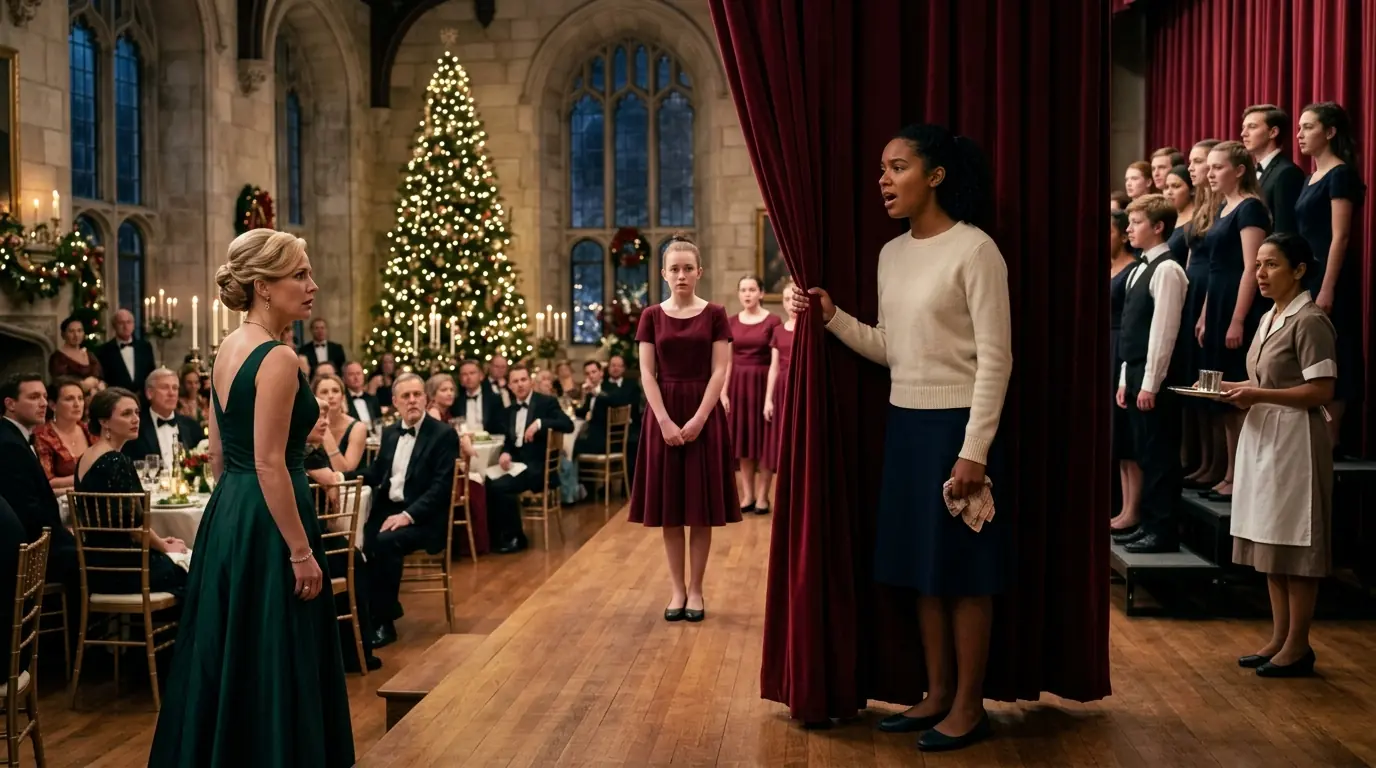
"Put the maid's girl behind the curtain." "Ma'am, she's the best singer we have." The conductor said. That wasn't a question. So, they hid Natalia Vasquez in the dark.
They swapped her for a richer girl. They told her mother to keep her out of sight, and her mother, terrified of losing everything, said yes. They thought they had silenced her. They had no idea what happens when a voice three generations couldn't break finally decides to rise. The Harrington estate sat on a hill above the river like something carved out of an older century, and on the afternoon before the Christmas gala, the low winter sun came through the tall glass doors in long pale bars.
Inside the great hall already smelled of pine and beeswax candles, of cinnamon warming somewhere in the kitchens, and beneath all of it the faint cold mineral scent of the snow pressing against the glass. A fir tree rose nearly to the second floor balcony, strung with ornaments that had been in the family longer than anyone living could remember. Servants moved through the rooms in quiet choreography, getting the house ready for the evening, and in the center of the marble floor, where the afternoon light fell in those long pale bars, the youth choir stood rehearsing one last time before the guests arrived. Natalia Vasquez stood where she had earned the right to stand, at the front, at the center. She was 15, dark-skinned with her grandmother's tight black curls pulled back from a face that went very still when she sang, as though the rest of her had stepped aside to let the sound through.
The conductor lifted her hands, and the children began. And when Natalia's voice came in over the others, it did something the room did not expect. It filled the space. It found the high ceiling and came back down warmer than it left. The other children's voices were pretty.
Hers was true. Her mother had told her once where it came from. Elena Vasquez had been folding laundry in their small apartment across the city, and she had said in the soft mix of English and Spanish she used when her heart was in a thing that Natalia's grandmother used to sing in a church with a tin roof that when it rained you couldn't tell the rain from the singing and that the voice was the only inheritance their family had ever managed to keep. Not money. Not land.
A voice passed down through three generations of women who'd had almost nothing else. Natalia had held that the way other girls held a locket. Elena worked in this house. She had worked here for 11 years, long enough to know which floorboards complained and which stayed silent long enough to be trusted and to be invisible at the same time, which in a house like this were nearly the same thing. The choir rehearsed here because the Harrington Foundation paid for it.
The children came from the row of tired streets where Elena and Natalia lived and once a year the foundation gathered its wealthy friends and let them see for an evening where their generosity went. This year the foundation had gone a step further and invited a few people from the music world to come hear the children, among them a quiet gray-haired man who taught at the conservatory across the city. The very academy whose name the kids in the choir said the way other people said the name of a faraway country. That was the arrangement. That was why a maid's daughter could stand on this marble floor at all.
Elena had pulled every quiet string she had to get Natalia a place in that choir, and watching her daughter at the center of it was the proudest she had let herself feel in years. Near the windows, apart from the children, a girl named Sophie was not having a good rehearsal. She was the daughter of a family that summered in places the Harringtons summered, and she had a thin, careful soprano that did well enough in a group and came apart on its own. The conductor had moved her up for one passage, a small solo line, and twice now Sophie's hands had started to tremble before she even opened her mouth. The second time, her voice simply stopped, the note dying in her throat, and she stood there with her eyes too wide until the moment passed.
The conductor, a patient woman with reading glasses pushed up into gray hair, went to where Claudia Devereaux stood watching from the edge of the room. "I want to be honest with you," the conductor said, keeping her voice low. "Sophie isn't ready to carry a solo, not in front of a crowd. She froze at the autumn recital and walked off the risers. The girl who should be out front is Natalia.
She's the strongest singer I've worked with in years." Claudia did not look at the conductor. She was watching the children, and what she was watching was Natalia. Claudia Devereaux was going to marry Richard Harrington in the spring, and tonight was in a sense her examination. She had not come from this world.
She had spent the last several years learning its passwords, which fork, which name, which silence, and she had learned them well enough that most people no longer asked where she'd come from, but she knew they wondered. She had caught the wondering in the corner of a smile in the half second before a woman said her name. Tonight, every person who mattered to that older world would be in this hall, and the evening had to be flawless because she understood in the particular way that only the recently arrived understand that flawless was the price of being allowed to stay. She turned from the conductor without answering her and walked out onto the floor while the children were still finding their places and the rehearsal stopped because she had stopped it. "It's lovely," she said and her voice was warm, almost kind, which was what made it terrible.
"Truly, but I think we want a particular picture tonight. Something that reads as harmonious." She let the words sit. She moved down the front row the way a woman moves down a rack of dresses and she stopped in front of Natalia. "You have a beautiful instrument," she said to her and she even smiled.