Chapter One: The Girl Behind the Silver Tray
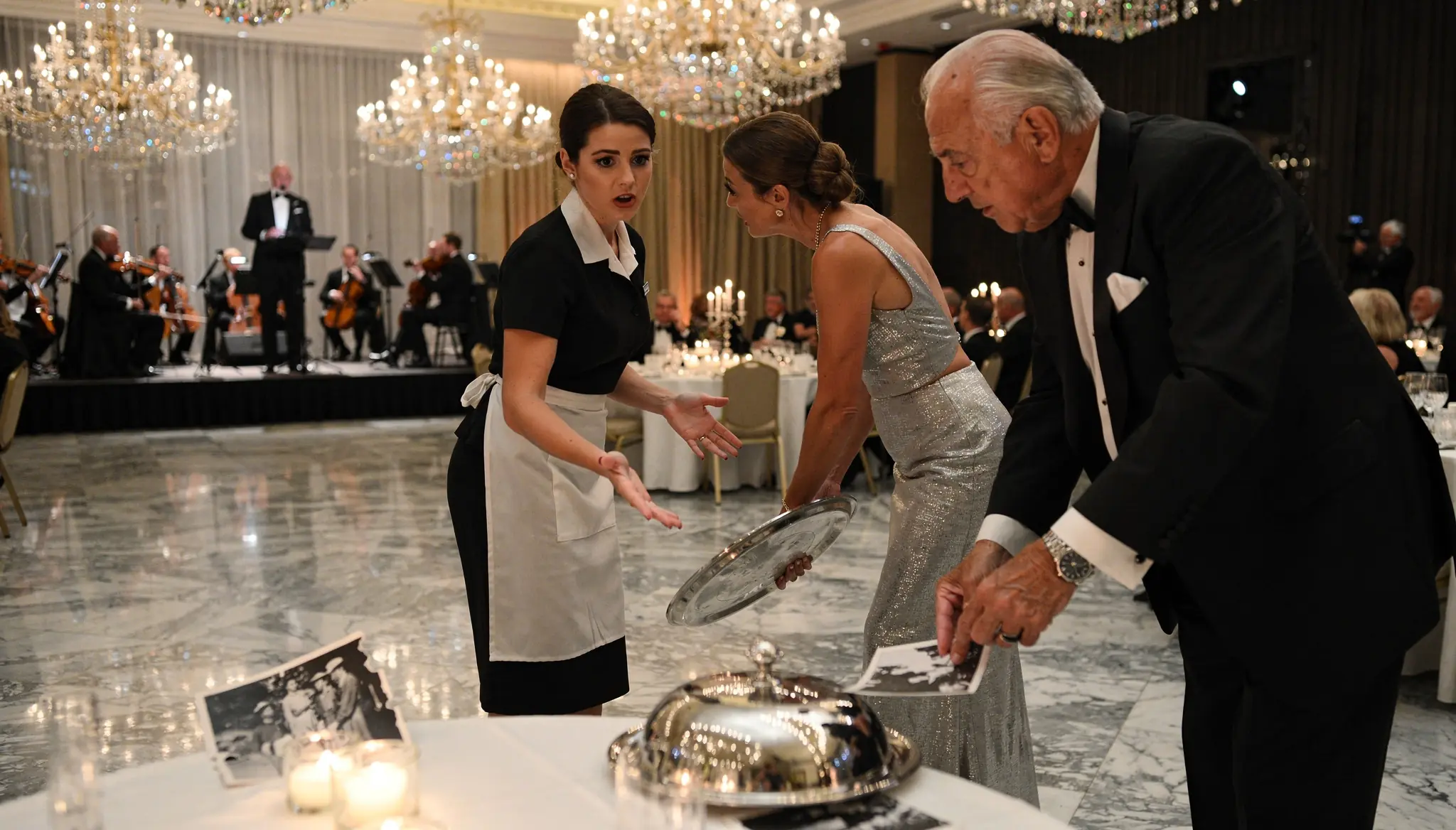
The annual Hawthorne Charity Gala transformed the Grand Beaumont Hotel into a world that seemed almost unreal. Crystal chandeliers cast clean white light across the enormous ballroom, where politicians, actors, financiers, and leaders of international companies gathered beneath painted ceilings and towering marble columns. An orchestra played near the grand staircase while photographers waited behind velvet ropes to capture the arrival of every important guest. For one evening, the ballroom became the center of the city’s wealth, influence, and reputation.
Grace Miller entered through a service corridor carrying a silver tray of champagne flutes. At twenty-two, she had already learned how to move silently through expensive rooms, how to avoid interrupting private conversations, and how to recognize the exact moment a guest wanted something without being asked. Her dark brown hair was pinned beneath a simple black headband, and her white apron had been pressed so carefully that not a single crease appeared out of place. She wore the uniform of the invisible, and invisibility had always made her feel safe.
Grace had worked at the Grand Beaumont for nearly three years. She started in the laundry room, where she folded hundreds of sheets during ten-hour shifts, before a banquet supervisor noticed that she was unusually careful and rarely complained. Within six months, she was promoted to the banquet staff. The work paid slightly better, but it also placed her directly among people whose clothes cost more than she earned in a year.
She never envied them as much as others assumed. Wealth seemed less like happiness to Grace and more like a language she had never been taught. She watched guests smile while insulting each other, shake hands while planning betrayals, and donate enormous sums of money while treating service workers as though they were furniture. Their lives appeared polished from a distance, but Grace had learned that polished surfaces often hid cracks.
The only valuable object Grace owned was not valuable to anyone else. It was a faded photograph, torn almost perfectly through the center, with edges weakened by years of folding and unfolding. She kept it inside a narrow pocket sewn into the lining of her apron. Whenever she felt overwhelmed, she pressed two fingers against the fabric and reminded herself that the photograph was still there.
The image showed part of a luxury yacht, a section of blue water, and the left side of a young woman in a pale summer dress. The woman’s face was mostly missing because the photograph had been torn through her shoulder. Beside her, one tiny hand remained visible, belonging to a child who had been standing in the missing half of the picture. On the back, written in faded ink, were three incomplete words: Always with our.
Grace had spent her entire life wondering how the sentence ended.
Always with our love, perhaps.
Always with our little girl.
Always with our family.
She had invented hundreds of endings, but none of them could tell her why she had been abandoned outside Saint Agnes Children’s Home when she was barely two years old.
According to the orphanage records, a night attendant found her wrapped in a wool blanket beside the rear entrance shortly before dawn. She was dehydrated, feverish, and too young to explain where she had come from. There was no letter, no identification, and no name stitched into her clothing. The torn photograph had been hidden beneath the blanket, protected inside a small wooden box.
The orphanage named her Grace because she survived.
Miller came from the surname of the nurse who carried her inside.
For years, Grace imagined that someone would return for her. Every time a dark car stopped outside the orphanage gate, she wondered whether a mother or father had finally found her. Whenever prospective parents visited, she sat straighter and tried to appear cheerful without seeming desperate. But families usually chose younger babies, children with complete medical histories, or siblings who already knew how to call someone Mom and Dad.
Grace was fostered twice and returned twice.
The first family decided she was too quiet.
The second accused her of hiding food, though she only kept crackers beneath her pillow because hunger frightened her.
By the time she was twelve, she stopped waiting to be chosen.
She learned to depend on herself instead.
At eighteen, Grace left the foster system with a suitcase, a list of shelters, and less than four hundred dollars. She worked mornings in a bakery, evenings in a laundromat, and weekends cleaning apartments. She eventually saved enough for a tiny basement studio with one narrow window facing an alley. The apartment smelled like damp concrete in winter, but the door locked, the rent was hers to pay, and no one could send her away without warning.
The Hawthorne Gala was Grace’s most demanding assignment of the year. Every staff member had undergone two weeks of training because the hotel could not risk embarrassing Charles Hawthorne, founder of the Hawthorne Group and the event’s principal benefactor. The gala raised money for hospitals, orphanages, scholarship programs, and emergency housing. Its guest list included people whose decisions affected thousands of lives.
Charles Hawthorne was expected to arrive at eight thirty.
Grace had never met him, but his portrait appeared in newspapers, business magazines, and the hotel’s preparation materials. He was seventy-eight, silver-haired, and known for rarely attending public events outside his charitable foundation. Some called him ruthless. Others described him as private, disciplined, and haunted by a tragedy no journalist had ever fully explained.
At seven forty-five, the ballroom was already crowded. Grace moved between guests with her tray balanced against one palm. She offered champagne to a senator, sparkling water to an actress, and ginger ale to an elderly judge. No one asked her name.
Near the head table stood Victoria Ashford, one of the evening’s most photographed guests. Victoria wore a fitted silver gown decorated with thousands of tiny crystals, a diamond necklace, and an expression that warned people to compliment her before speaking about anything else. Her husband, Grant Ashford, was the owner of several luxury resorts and a member of the gala’s organizing committee.
Grant had spoken to Grace earlier that evening.
He had not flirted with her.
He had only asked whether the kitchen had prepared a dairy-free meal for one of the donors.
Grace confirmed the request, and Grant thanked her.
Victoria had watched from across the room.
Grace noticed the coldness in Victoria’s eyes but dismissed it. She had been blamed for strangers’ insecurities before. Some wealthy guests believed a young waitress’s politeness was an invitation, while others became offended if she did not smile enough.
Grace focused on her work.
At eight thirty-two, Charles Hawthorne entered the ballroom.
The orchestra shifted into a formal piece as the guests turned toward the entrance. Charles wore a black tuxedo and walked with a polished wooden cane, though his posture remained straight and commanding. His face appeared older than it did in magazine photographs. Deep lines crossed his forehead, and his eyes carried the exhausted alertness of someone who had spent years expecting bad news.
He greeted the gala committee but avoided unnecessary conversation. When a photographer asked him to smile, Charles offered only a restrained expression before moving toward the head table. His assistant followed closely, carrying a leather folder containing the evening’s speech.
Grace was standing near the ballroom doors when Charles passed.
For one strange second, he slowed.
His eyes rested on her face.
Grace lowered her gaze immediately, assuming she had violated some rule.
Charles continued walking, but he looked back once before taking his seat.
Grace did not see the gesture.
Victoria Ashford did.
And the suspicion already growing inside her sharpened into anger.
Chapter Two: A Public Accusation
Victoria had built her entire adult life around being watched. She knew how to enter a room at the exact angle that made photographers turn toward her, how to laugh without disturbing her lipstick, and how to place one hand against her husband’s arm so every image suggested devotion. She measured value through attention, invitations, and proximity to powerful people. Being ignored frightened her more than being disliked.
That evening, Grant Ashford was distracted. He spent most of his time speaking with investors, checking messages, and reviewing last-minute details with the hotel staff. Each time Victoria attempted to draw him into a conversation, he excused himself to address another problem. The behavior would not have troubled her under ordinary circumstances, but she had recently discovered several messages from an unknown woman on his phone.
The messages were innocent business communications, but Victoria had read them while angry. Suspicion transformed every ordinary sentence into evidence. By the time she entered the ballroom, she had convinced herself that Grant was hiding an affair.
Then she saw him speaking with Grace.
The conversation lasted less than a minute.
Grace stood respectfully, listening as Grant explained the dietary request.
Grant smiled when she answered.
Victoria noticed the smile.
She did not notice the donor sitting nearby with a medical alert bracelet, or the kitchen manager waiting for confirmation, or the tablet Grace used to check the meal assignment. She saw only a beautiful young woman receiving her husband’s attention.
Later, Victoria observed Grace glance toward the head table. Grace was checking whether the first course had been served. Victoria decided she was staring at Grant.
When Grace passed behind Grant’s chair, he moved aside to let her through. Victoria interpreted the courtesy as familiarity.
By the time dinner began, Victoria was no longer searching for the truth. She was collecting details that supported the conclusion she had already chosen.
Grace sensed the tension but did not understand its source. She carried soup bowls, removed empty plates, and replaced silverware between courses. Each time she approached the head table, Victoria watched her with increasing hostility. Grant remained unaware, focused on Charles Hawthorne’s speech and the donors seated beside him.
The gala’s opening presentation began shortly after nine. A large screen displayed photographs of children receiving medical care, families moving into permanent homes, and students accepting scholarships. Charles listened without expression, though his fingers tightened around the head of his cane when an image of Saint Agnes Children’s Home appeared.
Grace noticed the institution’s name.
Her steps slowed.
Saint Agnes had changed locations years earlier, but the old red-brick building shown in the photograph was the place where she had grown up. She remembered its narrow dormitories, the squeak of the staircases, and the way winter air entered through the window frames. She also remembered Sister Margaret, the elderly nun who had sat beside her during nightmares and promised that being abandoned did not mean she was unwanted.
Grace looked at the photograph for only a few seconds.
Grant happened to be seated directly beneath the screen.
Victoria followed Grace’s gaze and misunderstood it completely.
The presentation ended, and the orchestra resumed playing. Grace returned to the kitchen, where Chef Martin placed a silver platter in her hands. The covered dish was intended for Charles Hawthorne, who had requested a simple meal because of his health.
“Head table,” Chef Martin said. “Careful. The sauce is hot.”
Grace nodded.
She checked the edge of the cloche, adjusted her grip, and entered the ballroom.
She was halfway across the marble floor when Victoria rose from her chair.
Grant reached for her wrist. “Victoria, what are you doing?”
Victoria pulled away.
The orchestra continued playing until she shouted.
“Stay away from my husband!”
Her voice struck the ballroom like breaking glass.
The musicians stopped.
Conversations died instantly.
Grace froze with the silver platter held against her palms. Every face turned toward her.
Victoria stepped around the table and walked directly toward Grace. Her crystals flashed beneath the chandeliers, and anger transformed her carefully controlled features. She pointed one trembling finger at the young server.
“I have watched you all evening,” she said. “Do not pretend you don’t know what you’re doing.”
Grace’s mouth went dry. “Ma’am, I’m only serving dinner.”
“You keep finding reasons to come near this table.”
“This is my assigned section.”
“Do you think I’m blind?”
Grant stood. “Victoria, stop.”
His intervention made the accusation appear more serious. Several guests leaned toward one another, already whispering. Phones appeared discreetly beneath tables as people began recording.
Grace felt the entire room closing around her.
“I haven’t done anything,” she said quietly.
Victoria moved closer. “I saw the way you looked at him.”
Grace glanced at Grant, then immediately looked away. “Mr. Ashford asked me about a meal request. That was all.”
“You expect everyone to believe that?”
“It’s the truth.”
Victoria laughed without humor. “Girls like you always call it the truth.”
The words carried more than jealousy. They carried contempt for Grace’s uniform, her position, and the assumption that a server could be publicly accused without consequence.
Grace’s fingers tightened beneath the platter. “Please let me deliver the meal.”
Victoria stepped into her path. “You won’t be serving anyone at this table again.”
The banquet supervisor stood near the kitchen doors, pale and uncertain. He wanted to intervene, but Victoria Ashford’s family controlled contracts worth millions to the hotel. One wrong response could cost him his position.
Grant moved from behind the table. “There is nothing between us. I asked her about an allergy.”
Victoria turned toward him. “Of course you would defend her.”
“I am defending an employee you are humiliating.”
Grace’s face burned.
The word humiliating made the reality impossible to ignore. She was standing in the center of the most prestigious ballroom in the city while hundreds of powerful strangers watched her dignity being dismantled.
Victoria faced Grace again.
“Put the tray down.”
“I need to take it to Mr. Hawthorne.”
“I said put it down.”
Grace did not move.
Victoria grabbed the handle of the silver cloche.
“Ma’am, it’s hot.”
Victoria pulled the cover away.
The cloche slipped from her hand, struck the marble floor, and spun loudly across the ballroom. The sudden movement knocked the platter against Grace’s hip. She managed to keep the plate level, but the hidden pocket inside her apron opened.
A small faded photograph floated downward.
Grace saw it fall.
Her heart lurched.
She quickly placed the platter on the nearest table and reached for the picture. Before her fingers touched it, a polished black shoe stepped beside the torn edge.
A hand descended.
Charles Hawthorne picked up the photograph.
Grace stopped breathing.
The elderly man straightened slowly, holding the faded image between his fingers. At first, his expression showed only curiosity. Then his face lost all color.
His cane fell against the table.
The sound was quiet compared with the cloche, but it drew everyone’s attention.
Charles stared at the photograph as though the ballroom had vanished around him. His lips parted, but no words came. His hand began to tremble so violently that his assistant moved closer.
“Mr. Hawthorne?”
Charles did not answer.
He turned the photograph toward the chandelier light, examining the torn edge, the yacht railing, and the partial figure of the young woman.
“Where did you get this?”
His voice was barely audible.
Grace looked from the photograph to his face. “It belongs to me.”
Charles raised his eyes. “Where?”
“It was left with me when I was a child.”
“When?”
“I don’t know the exact date.”
His breath became uneven. “Where were you found?”
Grace felt hundreds of people waiting for her response.
“Outside Saint Agnes Children’s Home.”
A sound escaped Charles that was neither a gasp nor a word.
His assistant reached for his arm, but Charles stepped back.
“What year?”
Grace swallowed. “They estimated I was two years old. It was late September, twenty years ago.”
Charles closed his eyes.
For more than two decades, he had imagined thousands of possibilities. He had followed false sightings across states and countries. He had paid investigators, consulted government agencies, searched hospitals, contacted shelters, and offered rewards large enough to attract criminals and opportunists. Yet he had never allowed himself to imagine this moment because hope had become too dangerous.
When Charles opened his eyes, tears had gathered along his lower lashes.
He reached inside his tuxedo jacket.
The guests watched silently as he removed a worn leather wallet. Its surface was cracked and softened by years of use. Charles opened a hidden compartment and carefully withdrew another torn photograph.
Grace’s knees weakened.
The colors matched.
The yacht railing continued from one piece to the other.
Charles placed the photographs together on the white tablecloth.
The torn edges aligned perfectly.
For the first time in more than twenty years, the picture was complete.
A young couple stood on the deck of a magnificent white yacht. Between them was a little girl with dark brown hair, wide hazel eyes, and a small crescent-shaped birthmark near her left temple. The child held her mother’s hand and smiled directly at the camera.
Grace unconsciously touched the faint birthmark hidden beneath her hair.
Charles looked at the completed photograph.
Then he looked at Grace.
His voice cracked.
“Elena.”
Grace shook her head. “My name is Grace.”
Charles pressed one hand against the table to steady himself. “Elena was the name your parents gave you.”
A murmur spread through the ballroom.
Victoria stood motionless, the anger drained from her face.
Grace stared at the child in the photograph. The little girl’s eyes looked like hers. The shape of her chin, the slight curve of her mouth, and the birthmark were impossible to dismiss.
“That can’t be me,” Grace whispered.
Charles pointed toward the woman in the picture. “That was my daughter-in-law, Isabelle. The man beside her was my son, Jonathan.”
Grace struggled to breathe.
Charles touched the small child’s image.
“And that was their daughter, Elena Hawthorne. My granddaughter.”
Chapter Three: The Name She Lost
The completed photograph seemed to divide Grace’s life into two parts. Before it, she had been a banquet maid named Grace Miller, abandoned without explanation and tolerated at the edge of an important event. After it, she became the possible granddaughter of Charles Hawthorne, a child whose disappearance had remained one of the country’s most painful unsolved mysteries.
The change happened within seconds, but Grace could not understand it.
She looked around the ballroom, searching for something familiar. The chandeliers, musicians, white tablecloths, and silver place settings were unchanged, yet the room no longer felt real. Guests who had ignored her moments earlier now watched her with fascination.
Grace wanted to recover the photograph and run.
Charles seemed to recognize her fear. He did not attempt to embrace her or call her by the lost name again. Instead, he carefully separated the two pieces and offered Grace’s half back to her.
“You should keep this,” he said.
Grace took it with trembling fingers.
“Mr. Hawthorne,” his assistant said softly, “perhaps we should move somewhere private.”
Charles nodded, though his gaze never left Grace. He turned toward the ballroom and spoke with the authority of a man accustomed to immediate obedience.
“The gala will pause for fifteen minutes.”
No one objected.
He looked at the banquet supervisor. “Miss Miller is coming with me. She is not in trouble, and her position will not be affected.”
The supervisor nodded rapidly. “Of course, Mr. Hawthorne.”
Charles then faced Victoria.
He did not raise his voice.
“You will remain here.”
Victoria’s lips parted. “Mr. Hawthorne, I can explain.”
“You have already explained enough.”
Grant looked down, visibly ashamed.
Charles gestured toward a private reception room adjoining the ballroom. Grace followed because she could think of nothing else to do. His assistant, Grant, the banquet supervisor, and the hotel’s general manager came with them.
Victoria attempted to follow.
Charles stopped at the doorway.
“Not you.”
The door closed between them.
Inside the reception room, the noise of the ballroom became a distant murmur. Grace stood near a wall while Charles placed his half of the photograph on a small table. A framed mirror reflected her pale face and frightened eyes.
The hotel manager offered her water.
Grace’s hand shook so badly that she nearly dropped the glass.
Charles remained several feet away. “May I ask you some questions?”
Grace looked at him. “Are you sure the photograph belongs to your family?”
“Yes.”
“Someone could have copied it.”
“That photograph was taken by me aboard the Hawthorne yacht two days before the storm. Only one print existed. Jonathan tore it accidentally while placing it inside a frame, and Isabelle kept one half in a travel bag because Elena liked carrying pictures of the family.”
Grace pressed the torn picture against her palm. “Why would a child carry half a photograph?”
“Elena had a small wooden treasure box. She put anything important inside it.”
Grace’s breathing stopped for a moment.
“What kind of box?”
Charles described a dark wooden box with a brass star fixed to the lid.
Grace gripped the edge of the table.
“That was with me.”
Charles’s eyes filled again. “Do you still have it?”
“It’s in my apartment.”
“Was anything else inside?”
“No. Only the picture.”
Charles lowered himself into a chair. “The rescue teams found parts of the yacht, several life jackets, and Jonathan’s travel case. They never found Isabelle’s bag, Elena’s box, or any confirmed trace of Elena.”
Grace sat across from him. “What happened to my parents?”
The words my parents emerged before she could stop them.
Charles looked down.
“The official investigation concluded that Jonathan and Isabelle died during the evacuation. Their bodies were never recovered.”
Grace stared at the photograph.
She had imagined her unknown parents in many ways. Sometimes they were poor and desperate. Sometimes they were criminals. Sometimes they were young people who regretted giving her away. She had never imagined them standing on a yacht, smiling as though they believed their family would remain together forever.
“What kind of storm was it?”
“A sudden tropical system changed direction. The yacht lost communication and struck debris. A fire started near the engine room, and the captain ordered an evacuation.”
“Who survived?”
“Six crew members and four guests were rescued.”
“Did anyone see the child?”
“Stories conflicted. One crew member remembered Isabelle carrying Elena toward a lifeboat. Another believed Jonathan took her. A steward claimed a wave separated several passengers before the final evacuation.”
Grace’s mind filled with darkness, wind, and water.
She had no memory of the storm.
Her earliest clear memory was sitting beneath a table at Saint Agnes, watching rain slide down a window.
“I don’t remember any of it,” she said.
“You were two.”
“What if I’m not her?”
Charles’s face tightened, but he answered carefully. “Then we will discover the truth.”
“How?”
“A DNA test.”
The room became silent.
Grace knew that a test was reasonable, but the idea frightened her. For twenty years, she had lived without a family. Now a stranger was offering the possibility of one, and a laboratory could remove it again.
Charles seemed to understand.
“You do not have to decide tonight.”
Grace looked toward the closed door. “Everyone already thinks it’s true.”
“That is my fault. I should have protected your privacy.”
“You were shocked.”
“I have had twenty years to imagine finding you. I should have prepared for the possibility that hope could make me careless.”
Grace studied him.
Powerful men rarely apologized to her. Most did not notice when they caused harm.
“What was she like?” Grace asked. “Elena.”
Charles looked toward the photograph. “Curious. Stubborn. She refused to sleep unless someone read the same book three times. She loved strawberries but hated strawberry jam. She was afraid of large dogs and fascinated by birds.”
Grace’s throat tightened.
She loved strawberries.
As a child, she had once climbed onto the roof of Saint Agnes to rescue an injured pigeon.
Those details could mean nothing.
They felt like everything.
Charles reached for his wallet and removed a smaller image. It showed the same little girl sitting on a carpet beside a wooden horse.
Grace leaned closer.
The child had her eyes.
Grant Ashford, who had remained silent near the door, finally spoke. “Charles, the ballroom is full of reporters.”
Charles’s expression hardened. “No statements.”
“The photographs are already online.”
Grace looked up sharply. “What photographs?”
Grant hesitated. “Guests recorded the confrontation.”
The hotel manager checked his phone. His face changed.
A video had already been uploaded. The first clip showed Victoria accusing Grace of pursuing her husband. A second showed Charles joining the two pieces of the photograph.
The story was spreading faster than anyone could control.
Grace rose from the chair. “I need to leave.”
Charles stood. “The main entrance is surrounded.”
“I’ll use the staff exit.”
“Reporters may be there as well.”
“I don’t want them following me home.”
“I can arrange transportation and security.”
Grace shook her head. “I don’t want security. I want my life back.”
Pain crossed Charles’s face, but he did not argue.
His assistant arranged for a hotel vehicle to wait in an underground garage. Before Grace left, Charles wrote a telephone number on a plain card.
“This reaches me directly,” he said. “Not an office. Not an assistant.”
Grace took the card.
“I will not contact you unless you ask me to,” Charles continued. “But whatever the test shows, what happened in that ballroom was not your fault.”
Grace glanced toward the door.
“What will happen to Victoria?”
“That is not a decision you need to make tonight.”
She placed the card beside the photograph inside her pocket.
Charles’s voice softened. “Grace.”
She looked back.
“I am sorry the first time you heard your parents’ names happened this way.”
Grace wanted to say something, but no words came.
She left through the service corridor where she had entered earlier carrying champagne. This time, hotel security walked beside her. Kitchen workers, dishwashers, and servers watched silently as she passed.
Some looked curious.
Others looked frightened.
Chef Martin stepped forward and placed her coat around her shoulders.
“You forgot this,” he said.
Grace knew she had not.
He had brought it so she would not have to return to the staff room.
“Thank you.”
Grace entered the underground garage and climbed into the waiting car. As the vehicle pulled away, she pressed the torn photograph against her chest.
For most of her life, she had believed the picture represented abandonment.
Now it might represent the exact opposite.
Perhaps someone had been searching for her every day she believed no one wanted her.
Chapter Four: The Morning After
Grace did not sleep.
She sat on the floor of her basement apartment with the wooden box beside her. The brass star on its lid had turned green with age, but the hinges still worked. She opened and closed it repeatedly, hoping the movement might unlock a memory.
Nothing returned.
At two in the morning, she searched Charles Hawthorne’s name online.
Thousands of results appeared.
The Hawthorne Group controlled shipping companies, renewable energy projects, construction firms, medical research centers, and a chain of private hospitals. Charles’s wealth was estimated in billions. His foundation had donated hundreds of millions to educational and humanitarian causes.
Grace felt uncomfortable reading the numbers.
Then she searched for Elena Hawthorne.
The first photograph showed a smiling two-year-old girl beneath a headline published twenty years earlier.
HAWTHORNE HEIRESS MISSING AFTER YACHT DISASTER.
Grace clicked the article.
It described a family vacation off the southern coast, a storm that developed faster than forecasts predicted, and a yacht that sent a distress signal before communication failed. Rescue teams found survivors scattered across several miles of ocean. Jonathan and Isabelle Hawthorne were listed among the missing, along with their daughter Elena.
The article included the outfit Elena had been wearing.
A pale yellow dress.
Grace stared at the words.
Saint Agnes records stated that she had been found wearing a pale yellow dress beneath the blanket.
Her hands began to shake.
She found another article published ten years after the accident. Charles Hawthorne had renewed a reward for information about his granddaughter. The report quoted investigators who believed Elena probably died at sea, but Charles refused to close the search.
A video interview showed him standing outside a government building.
“I do not need certainty that she survived,” Charles told the reporter. “I need certainty before I stop looking.”
Grace replayed the sentence three times.
At four in the morning, someone knocked on her door.
Grace froze.
The knocking continued.
“Grace?” a woman called. “It’s Lena.”
Grace relaxed slightly.
Lena Ortiz lived upstairs and worked at the hotel’s front desk. She was Grace’s closest friend and one of the few people who knew about the torn photograph.
Grace opened the door.
Lena stepped inside holding two cups of coffee and her phone. “You’re everywhere.”
“I know.”
“There are reporters outside the hotel. One called the front desk pretending to be your cousin.”
“I don’t have cousins.”
“You might have hundreds of them now.”
Grace did not laugh.
Lena’s expression softened. “Sorry.”
They sat beside the small kitchen counter.
Lena looked at the wooden box. “Is that the one?”
Grace nodded.
“Does it match what he described?”
“Exactly.”
Lena placed her phone face down. “Do you believe him?”
“I believe he believes it.”
“That isn’t what I asked.”
Grace wrapped both hands around the coffee. “I don’t know what to believe.”
Lena hesitated. “The internet has already decided.”
Grace turned on her phone for the first time since leaving the gala. Hundreds of messages appeared. Former classmates, foster parents, hotel employees, and strangers had attempted to contact her.
Some congratulated her.
Some asked for money.
Some claimed they had always known she was special.
A woman Grace barely remembered from high school wrote that she would be happy to manage Grace’s public image.
Grace shut the phone off.
“This is why I stayed invisible.”
Lena leaned closer. “Being visible did not cause Victoria to attack you. She caused it.”
“What if I had kept the photograph at home?”
“Then you would still be wondering.”
Grace looked at the box.
“Maybe wondering was easier.”
At seven, the hotel called.
The general manager informed Grace that she was placed on paid leave for her protection. He repeatedly assured her she had done nothing wrong. His careful tone suggested lawyers were listening.
At seven thirty, a news station broadcast Victoria Ashford’s public statement.
Victoria stood outside her townhouse wearing dark glasses.
“I reacted to a misunderstanding during an emotional evening,” she said. “I deeply regret any embarrassment experienced by the young woman involved.”
She never said Grace’s name.
She never apologized for accusing her.
She never admitted throwing the cloche.
Lena stared at the screen. “That is not an apology.”
Grace turned the television off.
At eight fifteen, Charles called.
Grace considered letting the phone ring, but something made her answer.
“Hello?”
“It is Charles Hawthorne.”
“I know.”
A brief silence followed.
“I promised not to contact you unless you asked,” he said. “I have already broken that promise, and I apologize.”
“Why are you calling?”
“To warn you that several people are attempting to obtain your medical records and childhood files.”
Grace stood. “Who?”
“We do not know yet. Journalists, perhaps. Or individuals hoping to manufacture a claim.”
“How did they learn where I grew up?”
“The video includes your statement about Saint Agnes.”
Grace closed her eyes.
Charles continued. “My legal team can protect the records, but I need your permission.”
“You have lawyers checking on me?”
“I have lawyers preventing strangers from exploiting you. They will not investigate your private history unless you authorize it.”
Grace looked at Lena, who watched with concern.
“What would authorization involve?”
“A written agreement limiting their work to securing your records. You may choose your own lawyer to review it.”
“I don’t have a lawyer.”
“I can provide a list of independent attorneys with no connection to my companies.”
Grace almost laughed at the absurdity. Yesterday she worried about paying her electricity bill. Today she needed an independent attorney to protect her identity from international media.
Charles’s voice softened. “I know this is overwhelming.”
“You don’t know anything about my life.”
“No,” he said. “But I know what it is like to have strangers turn grief into entertainment.”
The answer disarmed her.
Grace sat down.
“What about the DNA test?”
“I have contacted a court-certified laboratory. We can arrange the collection privately, with representatives for both of us present. The results can remain sealed.”
“How long will it take?”
“Several days.”
Several days.
Grace imagined spending them between two identities.
“I want the test,” she said.
Charles exhaled slowly. “Thank you.”
“I’m not doing it for you.”
“I understand.”
“I need to know.”
“So do I.”
The collection took place that afternoon at a private medical office. Grace brought Lena, and Charles arrived with his attorney and physician. He looked tired, as though he had slept no more than she had.
The technician explained every step.
Grace provided a cheek swab.
Charles did the same.
The sealed samples were divided and sent to two laboratories to avoid disputes.
Before leaving, Charles placed a small envelope on the table.
Grace did not touch it. “What is that?”
“Copies of photographs. Nothing legal and no money.”
She opened the envelope.
Inside were images of Jonathan, Isabelle, and Elena. One showed Isabelle holding her daughter beside a rose garden. Another showed Jonathan asleep on a sofa with Elena curled against his chest.
Grace studied the faces.
“Your mother had your eyes,” Charles said.
Grace looked up. “Do not call her my mother yet.”
Charles’s face tightened.
“I’m sorry,” she said, though she was not certain why.
“You do not owe me an apology.”
He moved toward the door.
“Charles.”
It was the first time she used his name.
He turned.
“Did they love her?”
He understood who she meant.
“Yes,” he said. “More than anything.”
Grace lowered her gaze to the photographs.
“Then why was she left outside an orphanage?”
“I don’t know.”
The uncertainty hurt more than any explanation.
Charles gripped the handle of his cane.
“But I intend to find out.”
Chapter Five: The House That Waited
While the laboratories processed the samples, Charles invited Grace to visit the Hawthorne estate. She refused twice before agreeing. Curiosity became stronger than fear, though she told herself she only wanted to see whether anything felt familiar.
The estate stood outside the city behind stone walls and old iron gates. Grace expected something grand, but the scale of the property still shocked her. A long driveway passed gardens, fountains, and rows of oak trees before reaching a mansion built from pale stone.
Grace arrived in a car driven by Lena.
Charles waited at the entrance rather than sending a servant.
He wore a dark sweater and no tie, appearing less powerful and more fragile than he had at the gala. For a moment, neither of them spoke.
“Thank you for coming,” he said.
“I almost didn’t.”
“I assumed that.”
Lena remained nearby until Grace told her she would be fine.
Inside, the house was quiet. The floors shone, the furniture appeared expensive, and paintings covered the walls, but there was little movement. Charles explained that most of the staff worked in separate areas and had been instructed to respect Grace’s privacy.
He led her through a library and into a family gallery.
Photographs covered one wall.
Grace approached slowly.
Jonathan Hawthorne appeared in dozens of images, first as a child, then as a university student, and later as a young father. He had dark hair, thoughtful eyes, and a smile that looked slightly uneven. Isabelle appeared beside him in later photographs, elegant but unguarded, often laughing at something outside the frame.
Grace saw herself in both of them.
Not exactly.
But enough.
Charles stopped before a portrait of Jonathan holding baby Elena.
“My son hated formal photographs,” he said. “Isabelle convinced him to sit for this one.”
Grace studied the baby.
“Did he work for your company?”
“For a time. We disagreed often.”
“About what?”
“Almost everything.”
Grace glanced at him.
Charles smiled faintly. “Jonathan believed I valued the company more than the family. He was not entirely wrong.”
“What did he want?”
“To establish a medical foundation with Isabelle. She was a pediatric surgeon.”
Grace looked toward him. “My mother was a doctor?”
“If the test confirms what we suspect, yes.”
Charles immediately regretted the qualification.
Grace appreciated it.
They moved upstairs.
Charles stopped before a closed white door.
“This room was Elena’s.”
Grace’s body tensed. “You kept it?”
“For too long.”
He opened the door.
The room had not remained untouched, but its original character survived. A painted tree covered one wall, with small wooden birds attached to its branches. Shelves held children’s books, stuffed animals, and toys protected from dust.
Grace entered.
Her steps slowed near the painted tree.
A strange pressure formed behind her eyes.
She reached toward a blue wooden bird.
Before touching it, she knew one wing would be loose.
Her fingers moved beneath the wing.
It shifted.
Grace stepped back.
Charles watched silently.
“I knew that,” she whispered.
“You remembered?”
“I don’t know.”
She touched the bird again.
A fragment surfaced.
Small hands.
A man lifting her toward the wall.
A woman laughing.
The memory vanished before Grace could hold it.
She pressed both palms against her temples.
Charles moved forward but stopped himself from touching her.
“Sit down.”
Grace lowered herself onto a small window seat.
“I thought I remembered nothing.”
“Memory can hide itself.”
“Or I saw a picture of this room online.”
“No photographs of this room have ever been published.”
Grace stared at the painted tree.
Charles opened a cabinet and removed a children’s book about a swallow searching for its nest. The cover was faded from use.
“Elena demanded this every night.”
Grace’s lips moved before she could stop them.
“The bird comes home after the snow.”
Charles went still.
Grace looked at him. “Is that in the book?”
“Yes.”
“I’ve dreamed those words.”
Charles sat in a chair opposite her. Tears gathered in his eyes, but he did not wipe them away.
Grace opened the book.
On the inside cover, someone had written: To our little bird, always with our love.
Her hand flew to her apron pocket, though she was not wearing the uniform.
Always with our.
The unfinished words from the torn photograph were the beginning of the same message.
Grace closed the book.
“I need air.”
Charles led her to the garden.
They walked without speaking until they reached a small fountain. A stone bench stood beneath an oak tree.
Grace sat down.
“What happened between you and Jonathan before the trip?”
Charles studied the ground. “We argued.”
“About the company?”
“About the foundation. Jonathan wanted to leave the Hawthorne Group permanently. I believed he was acting impulsively.”
“Did you try to stop him?”
“Yes.”
“How?”
“I threatened to remove him from the board and reduce his inheritance.”
Grace’s expression hardened.
Charles continued before she could respond. “Those were the last words I spoke to my son in person.”
“What did he say?”
“He said he would rather raise his daughter without the Hawthorne name than teach her that money mattered more than courage.”
The confession settled between them.
“Did you ever apologize?”
“I called the yacht the morning before the storm. Jonathan did not answer. I left a message.”
“What did you say?”
“That I was wrong.”
Grace looked toward the house. “Did he hear it?”
“I don’t know.”
Charles’s hands tightened around his cane. “For twenty years, I have wondered whether he died believing I chose the company over him.”
Grace felt sympathy but resisted it. She had spent her life protecting herself from the pain of other people’s regrets.
“What happens if the test confirms it?”
“You decide.”
“That is not an answer.”
“It is the only answer I have the right to give.”
“What about the company, the house, and the fortune everyone keeps discussing?”
“They are legal matters. You would be Jonathan’s surviving child and therefore his heir. But no one will force you into the company.”
“Would you expect me to live here?”
“No.”
“Change my name?”
“No.”
“Call you Grandfather?”
Charles’s face softened. “Only if the word ever belongs to you.”
Grace looked away quickly.
A staff member approached from the house carrying a telephone. Charles answered and listened without speaking.
His expression changed.
“What is it?” Grace asked.
Charles ended the call.
“One laboratory completed an early comparison.”
Grace rose.
“They require the second laboratory before issuing a final report,” he said. “But the preliminary result indicates a direct biological relationship.”
“How direct?”
Charles’s voice trembled.
“Grandfather and granddaughter.”
Grace stood beneath the oak tree, surrounded by a home she had forgotten and a family history she had never known.
She expected joy.
Instead, grief arrived first.
She thought of every birthday spent wondering why no one came. Every foster home. Every school form where she left the family medical history blank. Every night she unfolded half a photograph and invented people who might have loved her.
“They were searching for me,” she whispered.
Charles nodded.
“All that time?”
“Every day.”
Grace covered her mouth.
The first sob escaped before she could stop it.
Charles took one step closer.
Grace did not move away.
He opened his arms slowly, giving her time to refuse.
Grace hesitated.
Then she crossed the distance.
Charles held her as carefully as though she were still the little girl from the photograph. His body shook with silent tears. Grace pressed her face against his shoulder and mourned parents she had only just discovered, a childhood that should have been hers, and twenty years lost between two halves of the same picture.
Chapter Six: What Happened After the Storm
The second laboratory confirmed the result two days later. Grace Miller was biologically related to Charles Hawthorne with a probability greater than 99.99 percent. Additional comparison with preserved medical records from Jonathan Hawthorne established that Grace was almost certainly Elena Grace Hawthorne, the missing child from the yacht disaster.
Charles did not announce the result immediately.
He asked Grace what she wanted.
For the first time since the gala, someone placed the decision entirely in her hands.
Grace requested one day of privacy.
She spent that day at Saint Agnes.
The original orphanage building had been converted into a community education center, but Sister Margaret still lived nearby in a retirement residence. She was eighty-four and used a wheelchair, though her memory remained clear.
When Grace entered the room, Sister Margaret smiled.
“I wondered when you would come.”
“You saw the news?”
“Everyone saw the news.”
Grace sat beside her. “Why didn’t anyone connect me to Elena Hawthorne?”
Sister Margaret’s expression became troubled. “We tried.”
Grace leaned forward. “What do you mean?”
“The morning you were found, we contacted the police. An officer recorded your clothing and the photograph, but he assumed the picture showed an unrelated family. There was no internet database like there is now, and the Hawthorne disappearance occurred hundreds of miles away.”
“But it was a famous case.”
“The first reports said the child was lost at sea. You were found several weeks later, and no one imagined you had traveled that far.”
“How did I get here?”
Sister Margaret reached toward a drawer and removed a folder.
“I saved copies of the original intake notes.”
Grace opened it.
The night attendant had described finding muddy tire tracks near the rear gate. A witness in a neighboring building reported seeing an old green truck shortly before dawn. Grace’s blanket smelled faintly of fuel and seawater.
“Why wasn’t this investigated?”
“It was. But the license plate was covered, and the witness could not describe the driver.”
Grace turned another page.
A nurse had documented a healing cut on Grace’s forehead, salt irritation on her skin, and bruising around one ankle. The injuries were consistent with prolonged exposure and travel.
Sister Margaret folded her hands. “There is something else.”
Grace looked up.
“You spoke one name repeatedly during the first weeks.”
“What name?”
“Matthew.”
Grace had no memory of anyone named Matthew.
Charles’s investigators found a connection within hours.
Matthew Voss had been a junior engineer aboard the Hawthorne yacht. He survived the initial disaster but disappeared before the official investigation began. His body was discovered three months later after a truck accident several states away.
The truck was green.
Charles reopened every file connected to Voss.
The surviving crew members remembered him as quiet, skilled, and devoted to Isabelle Hawthorne, who had treated his younger sister during a medical emergency. On the night of the storm, Matthew was last seen near the damaged lifeboat containing Isabelle and Elena.
Investigators traveled to the town where Voss had died. They found an elderly mechanic who remembered repairing his truck shortly before the accident. The mechanic recalled a child’s blanket on the passenger seat and a wooden box with a brass star.
Grace listened as Charles’s investigator presented the findings in the estate library.
“Why didn’t he take me to the police?” she asked.
“We may never know,” the investigator said. “But financial records show that Voss withdrew cash after the storm and stayed in remote motels. He may have feared being accused of kidnapping you.”
Charles looked toward the window. “The newspapers had already declared Elena missing. A reward was announced within forty-eight hours.”
“Wouldn’t the reward make him come forward?” Lena asked.
“Not if he believed someone caused the disaster,” the investigator replied.
The room became silent.
“What are you saying?” Grace asked.
The investigator placed another file on the table.
“The original yacht fire was attributed to storm damage. But Matthew Voss contacted a maritime attorney before his death. The attorney’s retired secretary remembers him claiming the engine failure began before the worst part of the storm.”
Charles’s face hardened. “Sabotage?”
“We do not have evidence of that. Only a possibility that Voss believed the yacht had been unsafe before departure.”
Grace looked at the completed photograph lying beside the reports.
“Did he save me?”
“Most likely,” the investigator said. “He may have pulled you from the water or taken you from a damaged lifeboat. The time between the disaster and your arrival at Saint Agnes suggests he traveled with you for nearly three weeks.”
“Why abandon me?”
The investigator hesitated. “His truck accident occurred two days after you were found. He may have known someone was following him, or he may have believed the orphanage was the safest place until he could resolve the situation.”
Charles placed both hands on the table. “Find out who maintained the yacht.”
The investigation expanded.
Records revealed that the Hawthorne yacht underwent emergency electrical repairs one week before the voyage. The maintenance company had falsified several safety certifications. Its owner disappeared after the accident and later died overseas under another name.
The evidence suggested negligence rather than murder. Faulty wiring probably started the engine-room fire, and the storm transformed the mechanical failure into catastrophe. Matthew Voss discovered the problem too late, helped evacuate passengers, and escaped with Elena after losing contact with the others.
A journal recovered from Voss’s late sister provided the final pieces.
Matthew had called her two days after the disaster.
He said he had “the little bird” with him and needed time to understand whom he could trust. He believed Isabelle died while placing Elena into his arms. Jonathan had been injured while helping other passengers.
Matthew planned to return Elena to Charles.
Before he could, he noticed a car following his truck.
The person may have been a journalist, a private investigator, or no threat at all. Exhaustion and trauma made Matthew paranoid. He left Grace at Saint Agnes, intending to contact Charles once he reached safety.
He never made the call.
The truck accident ended his life.
Grace read the journal entry repeatedly.
Matthew had not abandoned her because she was unwanted.
He left her because he believed he was protecting her.
Isabelle had not lost her in carelessness.
She placed her child into the arms of a man she trusted during the final moments of her life.
Jonathan had not disappeared without fighting for his family.
Witnesses confirmed that he remained aboard the yacht helping others reach lifeboats.
Every new truth brought comfort and pain together.
Grace visited Matthew’s grave alone.
It stood in a small cemetery near a rural highway. The headstone was simple and weathered. Someone had placed artificial flowers beside it years earlier.
Grace carried the wooden box.
She knelt and placed a copy of the completed photograph against the stone.
“I don’t remember you,” she said. “But I know what you did.”
Wind moved through the grass.
“You saved me. Then you were afraid, and you made a choice that changed my whole life.”
Her voice trembled.
“I was angry when I learned you left me there. I thought I had been abandoned again.”
She touched the headstone.
“But maybe you were trying to get back.”
Grace left the photograph beneath a clear protective cover. She kept the wooden box.
As she walked away, she realized her story no longer began at an orphanage door.
It began aboard a yacht with two parents who loved her, a stranger who risked his life to save her, and a grandfather who refused to stop searching.
Chapter Seven: The Price of a Name
Charles and Grace released a joint statement one week after the gala. It confirmed the DNA results, thanked the public for respecting Grace’s privacy, and requested that no one contact former foster families or employees of Saint Agnes. The statement referred to her as Grace Miller, also born Elena Grace Hawthorne.
The world ignored the request for privacy.
News vans gathered outside the Grand Beaumont and Hawthorne estate. Photographers followed Grace to the grocery store. Commentators debated her inheritance, education, appearance, employment, and ability to enter high society.
Some praised her humility.
Others accused her of planning the entire discovery.
A popular online host claimed the photograph had been planted.
Grace learned that truth did not end speculation. It merely gave strangers new material.
Charles offered her a guest suite at the estate until the attention decreased. Grace resisted before accepting because reporters had identified her apartment. She refused the largest bedroom and chose a modest room overlooking the garden.
She also refused new clothes.
A stylist arrived one morning carrying designer dresses, shoes, and jewelry. Grace sent everything back unopened.
Charles did not interfere.
“You are not offended?” she asked him.
“Why would I be?”
“Because I’m supposed to represent the family now.”
“You are supposed to represent yourself.”
Grace began spending mornings with attorneys. Jonathan’s estate had remained in trust after Elena was declared legally dead. Because Grace was alive, the trust required restructuring.
The numbers were difficult to understand.
Shares in the Hawthorne Group.
Properties.
Investments.
Art.
Accounts large enough to fund entire hospitals.
Grace closed the financial report.
“I don’t want this.”
The attorney adjusted his glasses. “It legally belongs to you.”
“I didn’t earn it.”
“Inheritance is not based on earning.”
“Then what is it based on?”
“Relationship and the intentions of the deceased.”
Grace looked toward Charles. “What did Jonathan intend?”
Charles answered without hesitation. “To use much of his wealth for medical programs and raise his daughter without allowing money to define her.”
Grace reopened the report.
“Can I continue that?”
“Yes.”
“Without joining the company?”
“Yes.”
The Hawthorne board was less patient.
Several members wanted Grace introduced publicly as the future face of the family. Her story could improve the group’s reputation after years of criticism involving labor practices and environmental disputes. Advisers proposed interviews, magazine covers, and a documentary.
Grace rejected all of them.
One board member, Richard Vale, requested a private meeting.
He was a polished man in his sixties who had worked beside Charles for decades. He spoke gently, but every sentence concealed pressure.
“The Hawthorne name carries responsibilities,” Richard told her. “Public confidence affects thousands of employees.”
“I’m not responsible for your stock price.”
“No, but your actions influence it.”
“My actions?”
“Returning to hotel work, for example, could create an unfortunate image.”
Grace’s expression hardened. “An unfortunate image for whom?”
“For the family.”
“I was serving food, not committing a crime.”
“Of course. But the granddaughter of Charles Hawthorne carrying trays could be interpreted as a criticism of the family.”
“Maybe the family deserves criticism.”
Richard smiled tightly. “You are still adjusting.”
“No. You are still adjusting to the fact that I don’t need your permission.”
Charles entered before Richard could respond.
“Leave,” he said.
Richard stood. “Charles, I was only explaining the realities.”
“You were explaining obedience.”
Richard collected his documents. “The board will require clarity.”
“The board will receive it from me.”
After Richard left, Grace looked at Charles.
“Is everyone around you afraid of you?”
“Not everyone.”
“Should I be?”
“No.”
“Were my parents?”
Charles considered the question. “Sometimes.”
Grace appreciated the honesty.
The greatest conflict came from Victoria Ashford.
Her public reputation collapsed after the gala video spread. Charities removed her from committees, invitations disappeared, and sponsors ended partnerships. Grant Ashford issued a statement confirming that Grace had never behaved inappropriately.
Victoria blamed Grace for the consequences.
Her attorney sent a private letter offering a financial settlement in exchange for Grace publicly describing the confrontation as a misunderstanding.
Grace read the letter twice.
“They want to pay me to protect her,” she said.
Her attorney nodded. “They also request that you agree not to pursue a civil claim.”
“Do I have a claim?”
“Public defamation, emotional distress, and interference with employment are possible arguments.”
Grace looked through the library window.
“What would happen if I sued?”
“The case would attract enormous attention.”
“And if I accept?”
“Victoria would probably release a carefully written statement suggesting both parties resolved a personal disagreement.”
Grace remembered the words Girls like you.
She remembered the silence of the guests and the banquet supervisor’s fear.
“I don’t want her money.”
“Then we decline.”
“I want an apology.”
“Public or private?”
“Public. And not one written entirely by lawyers.”
Victoria resisted.
Her representatives argued that a direct apology might create legal liability. Grace refused every alternative.
Two weeks later, Victoria appeared before reporters outside the Ashford Foundation offices.
She wore a plain navy dress and no sunglasses.
“On the night of the Hawthorne Gala, I publicly accused Grace Miller of conduct that never occurred,” she said. “I treated a young employee as though her position made her unworthy of dignity. My jealousy does not excuse my behavior, and the discovery of Grace’s identity is not what made my actions wrong. They were wrong before anyone knew who she was.”
Grace watched from the estate.
The final sentence mattered.
Victoria continued.
“I apologize to Grace, to the hotel staff, and to every person who has been mistreated because someone believed wealth protected them from consequences.”
The apology did not erase the humiliation.
But it acknowledged the truth.
Grant and Victoria separated several months later. Their marriage had been failing long before the gala, and the confrontation merely exposed the distrust between them. Grace refused interview requests about the separation.
She had become tired of being connected to Victoria.
The accusation was the moment the photograph fell.
It was not the most important part of Grace’s life.
Chapter Eight: Becoming Grace Hawthorne
Grace returned to the Grand Beaumont six weeks after the gala.
The hotel offered her a management position, a public relations role, and a private office. She refused all three.
Instead, she completed one final banquet shift.
She wore the same uniform and placed the torn photograph inside the repaired pocket of her apron. Charles wanted to attend but respected her request to do it alone.
The staff greeted her awkwardly.
Some called her Miss Hawthorne.
Grace corrected them.
“Grace is fine.”
Chef Martin prepared the employee meal himself. Lena decorated Grace’s locker with a paper crown as a joke. The banquet supervisor apologized for failing to intervene during Victoria’s accusation.
“I was afraid of losing my job,” he said.
“I know.”
“That doesn’t excuse it.”
“No.”
He looked down. “I’m sorry.”
Grace accepted the apology but did not comfort him. She had learned that forgiveness did not require pretending a failure had been harmless.
That evening, Grace served a smaller charity dinner in the hotel garden. No one shouted at her. No photographs fell from her apron.
At the end of the shift, she returned her uniform.
“Are you leaving because of the money?” Lena asked.
Grace shook her head. “I’m leaving because I was already planning to apply to school.”
Grace had secretly taken evening courses in social work. She wanted to help children aging out of foster care because she understood how quickly the world expected them to become adults without families, savings, or permanent homes.
Charles supported the decision.
He offered to donate a building to the university.
Grace refused.
“Just help me understand the application,” she said.
He smiled. “That I can do.”
She enrolled under the name Grace Miller Hawthorne.
The choice surprised the public. Some expected her to reclaim Elena completely. Others believed she should reject Hawthorne and remain Miller.
Grace did both.
Miller belonged to the child who survived Saint Agnes, foster homes, and years of uncertainty.
Hawthorne belonged to the child her parents loved and Charles searched for.
Grace belonged to the woman who could carry both histories without allowing either to erase the other.
Her relationship with Charles developed slowly.
At first, they scheduled dinners because unplanned intimacy felt uncomfortable. Charles asked too many questions about her childhood, then apologized when he saw her withdraw. Grace became frustrated when he tried to solve emotional problems with money.
When she mentioned that Saint Agnes needed a new heating system, Charles attempted to purchase the entire building.
Grace stopped him.
“They need heat, not ownership.”
Charles frowned. “Ownership would provide long-term stability.”
“It would also put your name on another building.”
He recognized the criticism.
Together, they funded the repairs anonymously.
Grace also taught Charles ordinary parts of her life. She showed him how to use the washing machines at a public laundromat after he admitted he had never washed his own clothes. He looked offended when a machine rejected his coin, and Grace laughed so hard she had to sit down.
It was the first time Charles heard her laugh without restraint.
He later insisted on learning to cook.
His first attempt at pasta ended with smoke filling the estate kitchen and three staff members pretending not to panic.
Grace took a photograph.
Charles threatened to remove her from the family trust if she showed anyone.
She knew he was joking.
That knowledge felt like a small miracle.
They also argued.
Grace criticized the Hawthorne Group’s treatment of contract workers. Charles defended the company’s policies until she brought pay records from hotel employees and maintenance crews.
“You donate millions to poverty programs,” she said, “while companies carrying your name pay some workers so little that they need those programs.”
Charles studied the records.
No one had spoken to him that directly in years.
He ordered an independent labor review.
The review revealed wage violations among several subcontractors. Charles replaced the contracts and established minimum standards across the group.
Richard Vale warned that the changes would reduce profits.
Charles answered, “Then profits will be reduced.”
Grace did not join the board, but her influence became impossible to ignore.
She created the Little Bird Initiative, named after the story her parents once read to her. The program provided housing, legal assistance, education grants, and mental health services to young adults leaving foster care.
Grace insisted that former foster youth help design every policy.
“We are not rescuing people,” she told the foundation staff. “We are removing barriers that should never have been placed in front of them.”
The first center opened near Saint Agnes.
Sister Margaret attended the ceremony in her wheelchair. Charles stood beside her, holding the completed family photograph.
Grace addressed the audience without prepared notes.
“When I left foster care, people congratulated me for becoming independent,” she said. “What they meant was that I had reached an age when society no longer felt responsible for what happened to me.”
The crowd became silent.
“Independence is not the same as abandonment. Young people deserve choices, support, and somewhere safe to return when life becomes difficult.”
Grace looked toward Charles.
“I learned recently that someone had been searching for me for twenty years. Many young people never discover that. This center exists so no one has to believe they are completely alone.”
The program expanded faster than expected.
Grace rejected proposals to name each building after her. She preferred local names chosen by residents.
Media attention gradually shifted from her inheritance to her work.
She still received cruel comments.
Some people said her compassion was easy because she was wealthy now.
Grace responded only once.
“Wealth does not erase what happened to me,” she said during an interview. “It gives me the responsibility to make sure fewer people experience it.”
Charles watched the interview from his office.
On his desk stood a framed copy of the yacht photograph.
Both halves remained visible because Grace refused to repair the tear.
“The line matters,” she told him. “It shows that something can be broken and still become whole.”
Chapter Nine: The Next Hawthorne Gala
One year after the discovery, the Hawthorne Charity Gala returned to the Grand Beaumont.
The ballroom looked nearly identical.
Crystal chandeliers glowed above marble floors. The orchestra played near the staircase. Politicians, celebrities, and business leaders gathered around tables decorated with white roses.
But Grace entered through the main doors.
She wore a simple deep blue gown and the small silver pendant that had belonged to Isabelle. Charles walked beside her, leaning on his cane. Cameras flashed, but Grace did not stop for every photographer.
Lena waited inside wearing an evening dress Grace had bought as a graduation gift.
“You’re late,” Lena said.
“Charles changed his tie four times.”
“It was an important decision,” Charles replied.
Grace smiled.
She had worried the ballroom would bring back the humiliation. Instead, she remembered Chef Martin’s coat around her shoulders, Charles’s trembling hands, and the moment two torn edges joined.
Victoria Ashford did not attend.
Grant sent a donation but remained overseas.
Richard Vale had retired from the board after opposing Charles’s labor reforms. The Hawthorne Group survived the changes he predicted would destroy it.
The gala’s theme that year was Beyond Survival.
The Little Bird Initiative was the principal beneficiary.
Several young adults from foster care sat at the head tables, not as examples of tragedy but as designers, employees, scholarship recipients, and board advisers.
Grace walked through the ballroom greeting hotel staff by name.
A young server approached carrying champagne. She appeared nervous and nearly tilted the tray when Charles reached for a glass.
“Take your time,” Grace said.
The server steadied the tray. “Thank you, Miss Hawthorne.”
“Grace.”
The young woman smiled.
Before the speeches began, Charles gave Grace a small package.
“What is this?”
“A gift.”
“You already gave the foundation twelve buildings.”
“Eleven.”
“That is not a correction that helps you.”
He laughed.
Grace opened the package.
Inside was a new frame containing the complete yacht photograph. The original torn pieces rested side by side without being glued, protected beneath museum glass. Below them was the full inscription copied from the children’s book.
To our little bird, always with our love.
Grace touched the glass.
“I thought this belonged in the family gallery,” she said.
Charles shook his head. “It belongs wherever you are.”
The orchestra stopped.
The master of ceremonies invited Grace to the stage.
She carried the photograph with her.
The ballroom fell silent, but this silence felt different from the silence surrounding Victoria’s accusation. No one was waiting for Grace to defend herself. They were waiting to hear what she chose to say.
Grace stood behind the podium.
“One year ago, I entered this ballroom through the service door,” she began. “I believed my job was to remain unnoticed.”
She looked toward the servers standing along the walls.
“A uniform can make people forget that the person wearing it has a history, a family, fears, hopes, and dignity. I was treated badly that night, but the behavior became a scandal only after people learned I was connected to wealth.”
Several guests lowered their eyes.
“That troubled me more than the accusation itself.”
Grace lifted the framed photograph.
“I did not become valuable when these two pieces came together. I was valuable when I was found outside Saint Agnes. I was valuable in every foster home. I was valuable while folding hotel sheets, carrying trays, and paying rent in a basement apartment.”
Charles watched from the front table with tears in his eyes.
“Every person serving this room tonight has a life as complicated and important as the lives of the people seated at these tables. Respect that depends on someone’s surname, title, or bank account is not respect. It is calculation.”
The applause began quietly and grew.
Grace waited until it stopped.
“This photograph gave me answers, but it also gave me responsibility. My parents did not survive to build the medical foundation they imagined. Matthew Voss did not survive to explain how he saved me. Charles spent twenty years searching for a child who was growing up only a few hours away.”
She looked at her grandfather.
“We cannot return those years. But we can decide what happens because of them.”
Grace announced that the Little Bird Initiative would open centers in twelve additional cities. The program would also provide emergency funds to prevent young adults from becoming homeless during their first two years after leaving foster care.
The guests rose.
Grace stepped away from the podium.
Charles met her at the bottom of the stage.
“Your father would have been proud,” he said.
Grace swallowed.
“So would my mother?”
“Especially your mother.”
They returned to the head table together.
Later, while the orchestra played, Charles asked Grace to dance.
“I don’t know how,” she said.
“Neither do I.”
“You attended thousands of events like this.”
“I avoided the dancing.”
Grace allowed him to lead her onto the floor.
He moved slowly because of his cane, and she adjusted her steps. Around them, other guests joined.
For one brief moment, Grace closed her eyes.
She imagined Jonathan and Isabelle on the yacht before the storm. She imagined Matthew carrying a frightened child through rain and darkness. She imagined Sister Margaret opening the orphanage door and lifting her from the cold ground.
Her life had been shaped by loss.
It had also been shaped by people who refused to leave her behind.
Chapter Ten: Always With Our Love
Grace completed her degree three years later.
Charles attended the ceremony with Lena, Sister Margaret, Chef Martin, and several young people from the first Little Bird center. He applauded before Grace’s name was fully announced, causing the people around him to laugh.
Grace began working as an advocate rather than taking an executive role in the Hawthorne Group.
She visited shelters, government offices, schools, and courtrooms. She listened to young people who had been moved between homes, separated from siblings, or forced to leave care with no plan.
She did not present herself as someone who understood every experience.
Her inheritance changed her life in ways most of them would never experience.
But she understood the loneliness of having no permanent address to write on a form. She understood saving food because tomorrow felt uncertain. She understood how adults described children as difficult when the children were frightened.
The Little Bird Initiative grew into a national organization.
Its greatest success was not the number of buildings it opened. It was the number of young people who returned years later to become mentors, counselors, lawyers, teachers, and social workers.
Grace hired people who challenged her.
She refused to create another institution where powerful adults decided what vulnerable young people needed without listening to them.
Charles gradually reduced his role in the Hawthorne Group. He remained chairman but delegated daily control to a new leadership team required to follow stricter labor and ethics standards.
He spent more time at the foundation.
Sometimes he arrived unannounced and attempted to help.
Grace usually gave him simple jobs because he disrupted everything when allowed near complicated equipment.
At one center, she found him assembling furniture with the instructions upside down.
“You built the shelf backward,” she said.
“It is an innovative design.”
“It is facing the wall.”
“Privacy is important.”
Grace laughed.
Charles’s health weakened during the fifth year after their reunion.
He began using a wheelchair for longer distances and stopped attending large public events. Grace moved into the estate temporarily, though she kept her apartment near the foundation.
They spent evenings in the library.
Charles told stories about Jonathan’s childhood, Isabelle’s determination, and Elena’s habit of hiding strawberries beneath napkins because she wanted to save them for later.
Grace shared stories from Saint Agnes.
She described Lena helping her pass mathematics, Sister Margaret sneaking extra blankets into the dormitory, and the first apartment she rented.
Charles listened even when the stories hurt him.
“I should have found you sooner,” he said one evening.
Grace closed the book she had been reading. “You didn’t know where I was.”
“I had every resource.”
“And Matthew was trying not to be found. The records were disconnected. The police assumed I was someone else.”
“I still failed.”
Grace moved closer.
“You searched for Elena.”
Charles looked at her.
“But Grace survived without you,” she continued. “You cannot change that. You can know her now.”
Charles’s eyes filled with tears.
“Do you regret becoming Grace?”
“No.”
“Do you regret finding me?”
Grace considered the question.
“Sometimes I regret how it happened. Sometimes I hate that one photograph changed the way people treated me. Sometimes I wish I could have learned everything quietly.”
She placed her hand over his.
“But I don’t regret you.”
Charles lowered his head.
It was the first time Grace called him Grandfather without thinking.
“Grandfather, look at me.”
He raised his eyes.
“You did not cause the storm. You did not leave me at Saint Agnes. You made mistakes with my father, but you tried to apologize before it was too late.”
“I don’t know whether he heard me.”
“Maybe forgiveness isn’t always something the other person gets the chance to give.”
Charles studied her.
“What is it, then?”
“A decision about what we do with the regret.”
He smiled faintly.
“You sound like Isabelle.”
“I’ll take that as a compliment.”
“You should.”
Charles died peacefully the following spring.
Grace sat beside him, reading The Little Bird Comes Home, the book from her childhood room. His breathing slowed near the final page.
“The bird comes home after the snow,” Grace read.
Charles opened his eyes.
“Elena?”
Grace held his hand.
“Grace,” she said gently. “And Elena.”
His fingers tightened around hers.
“My little bird.”
“I’m here.”
Charles looked toward the framed photograph on the table.
“Always with our love,” he whispered.
Then he closed his eyes.
The funeral was private.
Grace rejected proposals for a televised memorial and held the service in the estate garden beneath the oak tree where Charles first told her about the DNA results.
Employees, family friends, foundation workers, hotel staff, and residents from Little Bird centers attended.
Richard Vale came and stood at the back.
Victoria Ashford sent a handwritten letter but did not request to attend.
Grace placed Charles’s half of the photograph inside the coat pocket in which he had carried it for twenty years. She kept her own half.
A copy of the completed image remained in the family gallery.
Charles’s will surprised the business world.
He left the majority of his personal fortune to the Hawthorne Foundation and divided voting authority in the company among independent trustees, employees, and Grace. He specifically stated that Grace was not required to serve as chief executive, chairperson, or public representative.
The estate belonged to her, but she converted much of it into a medical research and training center dedicated to Jonathan and Isabelle.
She kept the library, the garden, and Elena’s childhood room.
Not as a monument to what was lost.
As proof that memory could survive without controlling the future.
Years later, Grace visited the Grand Beaumont for another charity gala.
She arrived early and entered through the service corridor.
The kitchen looked smaller than she remembered. Chef Martin had retired, but his photograph hung near the office. The new banquet manager recognized Grace and nearly dropped a clipboard.
“Ms. Hawthorne, the main entrance is on the other side.”
“I know.”
Grace walked toward the staff room.
A young server stood in front of an open locker, sewing a tear in her apron. She looked no older than Grace had been during the night of the discovery.
“Do you need help?” Grace asked.
The server glanced up. “I’m fine. The pocket keeps opening.”
Grace smiled.
“I had one like that.”
She helped repair the seam.
The server thanked her without realizing who she was.
Grace preferred it that way.
Before entering the ballroom, she placed the torn photograph inside her handbag. She no longer carried it because she feared losing the only clue to her past. She carried it because the line through the center reminded her who she had become.
The gala began beneath the same enormous chandeliers.
Servers moved carefully between tables while guests discussed donations, business, and reputation. Grace watched them and remembered how easy it was for people in expensive clothing to believe they were the center of every story.
Then she saw a guest snap his fingers at a young waiter.
Grace approached.
The guest turned toward her. “Can you find someone in charge?”
“You already have.”
He recognized her and immediately changed his tone.
Grace did not allow the moment to pass.
“You were about to speak to him differently before you knew my name,” she said. “Try again.”
The guest looked embarrassed.
He faced the waiter.
“Excuse me. Could I have some water, please?”
The waiter nodded.
Grace continued through the ballroom.
She had once believed power meant being protected from humiliation.
Charles taught her that real power meant refusing to let humiliation become normal for anyone else.
Near the stage stood the framed photograph of Jonathan, Isabelle, and Elena aboard the yacht. The torn line remained visible beneath the glass.
Guests often described the photograph as a symbol of destiny.
Grace understood why.
A jealous accusation caused it to fall.
An elderly man happened to be close enough to pick it up.
Two fragments carried separately for twenty years met on a white tablecloth beneath crystal chandeliers.
But Grace no longer believed destiny explained everything.
Destiny did not keep Charles searching. Love did.
Destiny did not cause Sister Margaret to preserve the intake records. Care did.
Destiny did not make Matthew Voss carry a child away from a sinking yacht. Courage did.
Destiny did not help Grace survive foster care, work exhausting shifts, attend evening classes, and build a life before anyone knew her surname. She did that herself.
The completed photograph did not transform a maid into someone valuable.
It revealed that she had always been valuable.
Grace stepped onto the stage.
The audience quieted.
She looked toward the servers, young people from the foundation, business leaders, and families whose lives had been changed by the programs built from her parents’ unfinished dream.
“My grandfather carried half a photograph for twenty years,” she began. “He believed the missing half represented the person he had lost.”
Grace lifted her piece of the photograph.
“I carried the other half believing it represented the people who had left me.”
She placed the photograph beside its matching piece.
“We were both wrong.”
The room remained silent.
“The photograph did not represent abandonment. It represented a connection neither distance, time, fear, nor misunderstanding could completely destroy.”
Grace looked at the image of her parents.
“They were with me in the only way they could be. In a faded picture. In a wooden box. In fragments of memory. In the courage of the man who saved me. In the grandfather who refused to stop searching.”
Her voice softened.
“And they were with me in the person I became while I believed I was alone.”
Grace joined the torn edges one final time.
The image became whole.
Not perfect.
The line remained.
But the smiling family could be seen clearly.
Grace no longer wished the tear would disappear.
Without it, the photograph would have been only a picture of a family before tragedy.
With it, the photograph told a larger story.
It told of a child lost at sea and found outside an orphanage.
A servant publicly humiliated in a ballroom.
A grandfather carrying grief inside a leather wallet.
A frightened engineer who chose to save a child.
A young woman who discovered that inheritance was not only money, property, or a famous name.
Inheritance was unfinished work.
It was the love people attempted to give, even when life prevented them from completing the gesture.
It was the responsibility to transform suffering into protection for someone else.
Grace looked across the ballroom.
The applause began slowly.
She saw Lena standing near the front with tears on her cheeks. Sister Margaret’s photograph appeared on the foundation’s memorial wall. Young adults from the Little Bird Initiative stood beside teachers, counselors, and foster families.
Grace smiled.
Years earlier, she walked through the same room hoping no one would notice her.
Now she did not need attention to prove she existed.
She had a name.
Two names.
She had a family built from blood, memory, friendship, loyalty, and choice.
She had answers, though not every answer.
She had grief, though grief no longer controlled her.
She had wealth, though wealth no longer defined the direction of her life.
Most importantly, she had learned that being found was not the beginning of her worth.
She had been worthy in the cold outside Saint Agnes.
She had been worthy when foster families returned her.
She had been worthy in the laundry room, the basement apartment, and the banquet uniform.
She had been worthy when Victoria pointed across the ballroom and reduced her to a false accusation.
She had been worthy before Charles picked up the photograph.
Grace left the stage and walked toward the garden doors.
Outside, the night air was cool. Stars appeared beyond the lights of the city.
She removed the torn photograph and read the faded words on the back.
Always with our.
For most of her life, the unfinished sentence had felt like a question.
Now Grace knew how it ended.
She whispered the final word beneath the stars.
“Love.”
Then she folded the photograph carefully along the old torn edge, placed it close to her heart, and returned to the ballroom not as a servant, not merely as an heiress, and not only as the missing child the world once searched for.
She returned as Grace Miller Hawthorne.
A woman who had finally discovered where she came from.
And who had chosen, with courage and purpose, where she would go next.