The mechanic circled the tractor twice before saying anything.
That was not a good sign.
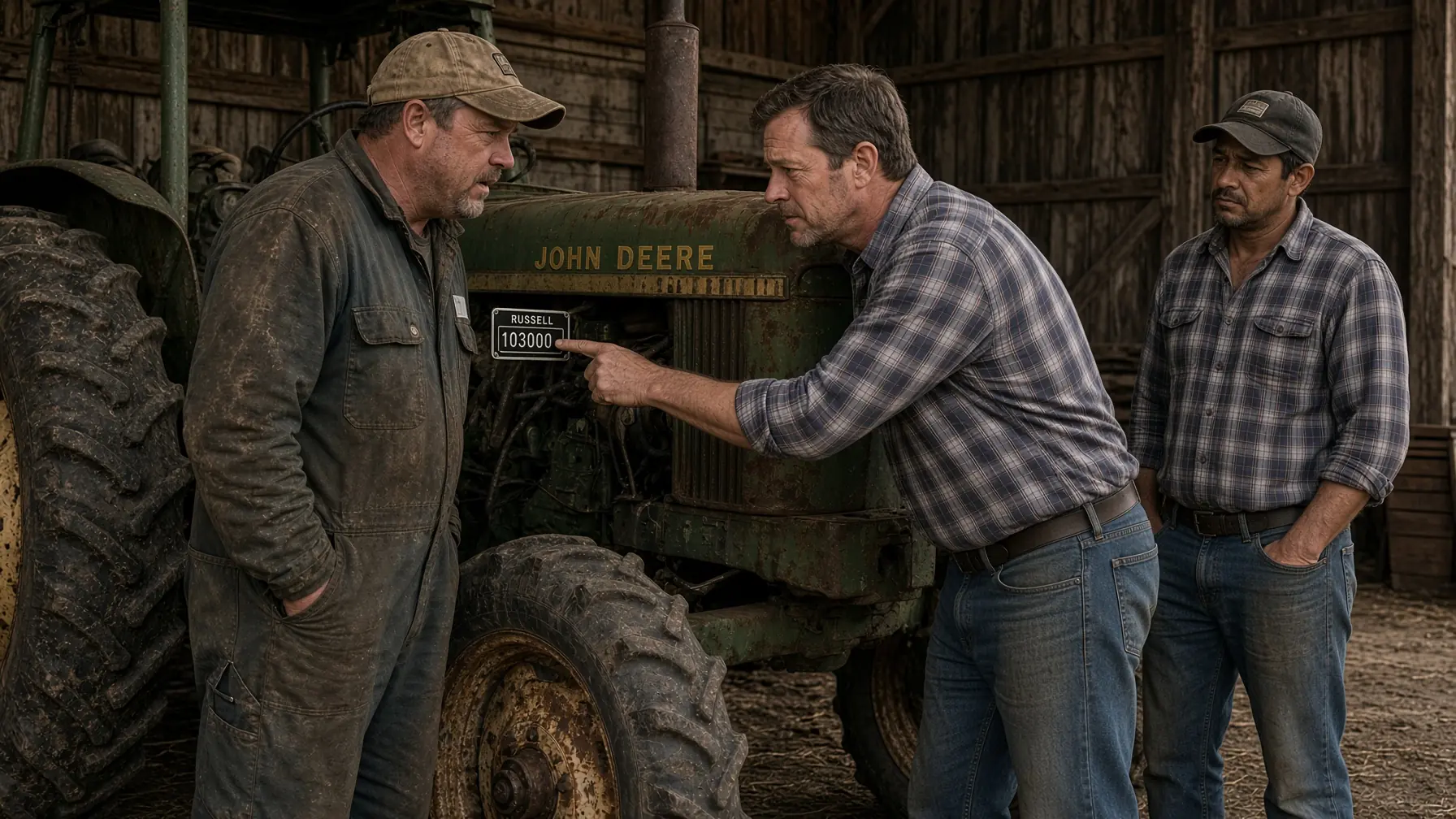
Russell Hayes had spent twenty-three years repairing farm equipment across three counties in southern Indiana. He had revived combines that caught fire during harvest, tractors pulled from flooded fields, engines that sounded as if someone had dumped gravel into the crankcase, and hydraulic systems held together by wire, prayer, and the refusal of farmers to buy anything new.
He was not easily discouraged.
But when Russell stopped beside the rear wheel of the 1978 John Deere and pressed one thumb into a crack running through the tire, his expression said plenty.
The tractor sat in the back corner of a collapsing barn on the Cross property, half hidden beneath a gray sheet of dust.
Pigeon droppings covered the hood.
Rust had eaten through one rear fender.
A section of the exhaust pipe had flaked away near the top.
The seat was split wide enough to expose yellowed foam underneath.
Under the dashboard, mice had built a nest out of insulation, twine, and several pieces of wiring that were supposed to remain attached to the tractor.
Russell opened the hood.
He stared.
Then sighed.
Caleb Turner stood a few feet away watching him.
Caleb had inherited the property only four months earlier after purchasing what remained of the old Cross farm from Walter Cross’s estate.
He had not bought it for the tractor.
In fact, when he first walked through the barn with the real-estate agent, the green shape in the corner barely registered.
Old farm equipment came with old farms.
Sometimes it worked.
Usually it didn’t.
The tractor had been sitting there so long that one of the barn swallows had built a nest above the steering wheel.
Caleb had planned to call a scrap dealer.
Then an eighty-two-year-old neighbor named Frank Delaney stopped by one afternoon.
Frank stood in the barn doorway, stared through the dust, and said:
“Well, I’ll be damned. Walter never got rid of the 4440.”
Caleb looked at the tractor.
“You know it?”
Frank laughed.
“Know it? That thing probably worked more hours than half the men in this county.”
That was the first time Caleb wondered whether it might be worth saving.
Now Russell was giving him the answer.
Probably not.
The mechanic crouched beside the engine.
He pulled the dipstick.
What clung to the metal barely resembled oil.
He rubbed it between two fingers.
“Water contamination.”
He moved lower.
Cracked hoses.
Corroded fittings.
Frozen linkage.
He disconnected the battery cables, though the battery itself had been dead so long it looked archaeological.
Then he put a breaker bar on the crankshaft pulley and leaned into it.
Nothing.
He repositioned.
Tried again.
The engine did not move a fraction of an inch.
Russell stood.
Wiped his hands on a shop rag.
Caleb already knew what was coming.
“How bad?”
Russell looked at the tractor.
“Honestly?”
“That bad?”
“Don’t waste your money on this.”
Caleb folded his arms.
“Why?”
Russell pointed as he talked.
“Engine appears seized. Fuel system’s contaminated. Wiring harness is chewed to pieces. Every belt and hose is suspect. Hydraulic fluid looks like chocolate milk. Tires are done. Brakes are probably frozen. Cooling system’s full of sediment. I don’t even know what the transmission looks like yet.”
He walked toward the rear.
“And you’ve got corrosion here, here, and underneath this mount.”
Caleb followed him.
“Can it be fixed?”
“Anything can be fixed if you’re determined to spend enough money.”
“That’s not what I asked.”
Russell looked at him.
“Could I rebuild it? Probably.”
“How much?”
“I’m not giving you a number until I know what’s inside the engine.”
“Ballpark.”
Russell hesitated.
“If everything is as bad as it looks? You could spend more restoring this than buying a decent working tractor.”
Caleb stared at the faded John Deere emblem on the hood.
Russell lowered his voice.
“This machine had a life. A long one, probably a good one. That doesn’t mean you have to be the guy who funds the funeral.”
Caleb laughed despite himself.
“So scrap it?”
“If it were mine?”
Russell nodded.
“I’d sell what parts are still good and let the rest go.”
That should have been the end of the story.
A sensible diagnosis from an experienced mechanic.
An old tractor nobody needed.
A machine that had already spent twenty years dissolving quietly into a barn floor.
Russell left around noon.
Caleb spent the rest of the day clearing rotten boards from the loft.
Three days later, he found the envelope.
And everything changed.
The tractor had not always looked dead.
In the spring of 1978, Walter Cross drove it home from a John Deere dealership almost sixty miles away.
Back then, the paint was bright enough to shine across a field.
Walter was forty-one years old, raising three children with his wife, Margaret, on just over two hundred acres his father had left him.
Money was tight.
Always.
The farm produced corn, soybeans, hay, and enough cattle to ensure there was never a season when Walter had nothing to worry about.
The tractor was one of the largest purchases he had ever made.
Frank Delaney remembered the day it arrived.
“He washed it twice that first week,” Frank told Caleb.
“A tractor?”
“Walter.”
Frank smiled.
“He acted like he’d bought a Cadillac.”
The old John Deere was not a collector’s piece then.
It was a tool.
And Walter used it.
Hard.
It pulled tillage equipment through clay ground after wet springs.
Moved hay.
Dragged wagons.
Cleared snow.
Ran an auger.
Pulled stranded trucks out of ditches.
Once, during a summer storm, Walter used it to drag a fallen tree away from a neighbor’s driveway while lightning was still flashing over the ridge.
The tractor became so familiar that family photographs from the eighties often caught part of it accidentally.
A green fender behind a birthday picnic.
A tire near the barn during Christmas snow.
Walter leaning against the hood while one of his sons held a newly caught fish.
The machine worked through the farm’s good years.
And the bad ones.
In 1983, drought cut yields nearly in half.
In 1988, heat turned pastures brittle.
In 1993, relentless rain left fields so wet that machinery buried itself to the axles.
Walter still kept the tractor serviced.
Religiously.
He changed oil early.
Greased fittings before they complained.
Replaced parts before failures became disasters.
Frank once teased him about it.
“You know Deere isn’t going to send you a medal for loving that thing.”
Walter replied:
“They don’t have to. I’m the one who needs it running.”
That was Walter.
He did not romanticize maintenance.
He simply understood the cost of neglect.
By the late nineties, newer equipment had begun appearing across surrounding farms.
More horsepower.
Better cabs.
More electronics.
Walter kept the old machine.
It had dents by then.
Paint faded along the hood.
A repair weld showed near one step.
But mechanically, according to Frank, it remained strong.
That was the detail that bothered Caleb after Russell’s inspection.
Frank had remembered seeing the tractor working years later than Caleb expected.
“How late?” Caleb asked him one afternoon.
Frank squinted toward the barn.
“Early 2000s for sure.”
“That doesn’t mean it wasn’t dying.”
“No.”
Frank rubbed his chin.
“But Walter complained about everything. If that engine had been going bad, I’d have heard about it.”
“When did he stop using it?”
Frank went quiet.
“That’s harder.”
“What happened?”
“The farm got smaller.”
Walter’s children left.
His oldest son became an electrician in Indianapolis.
His daughter moved to Kentucky.
His youngest son, Daniel, helped for several more years but eventually took a trucking job.
Walter sold sixty acres.