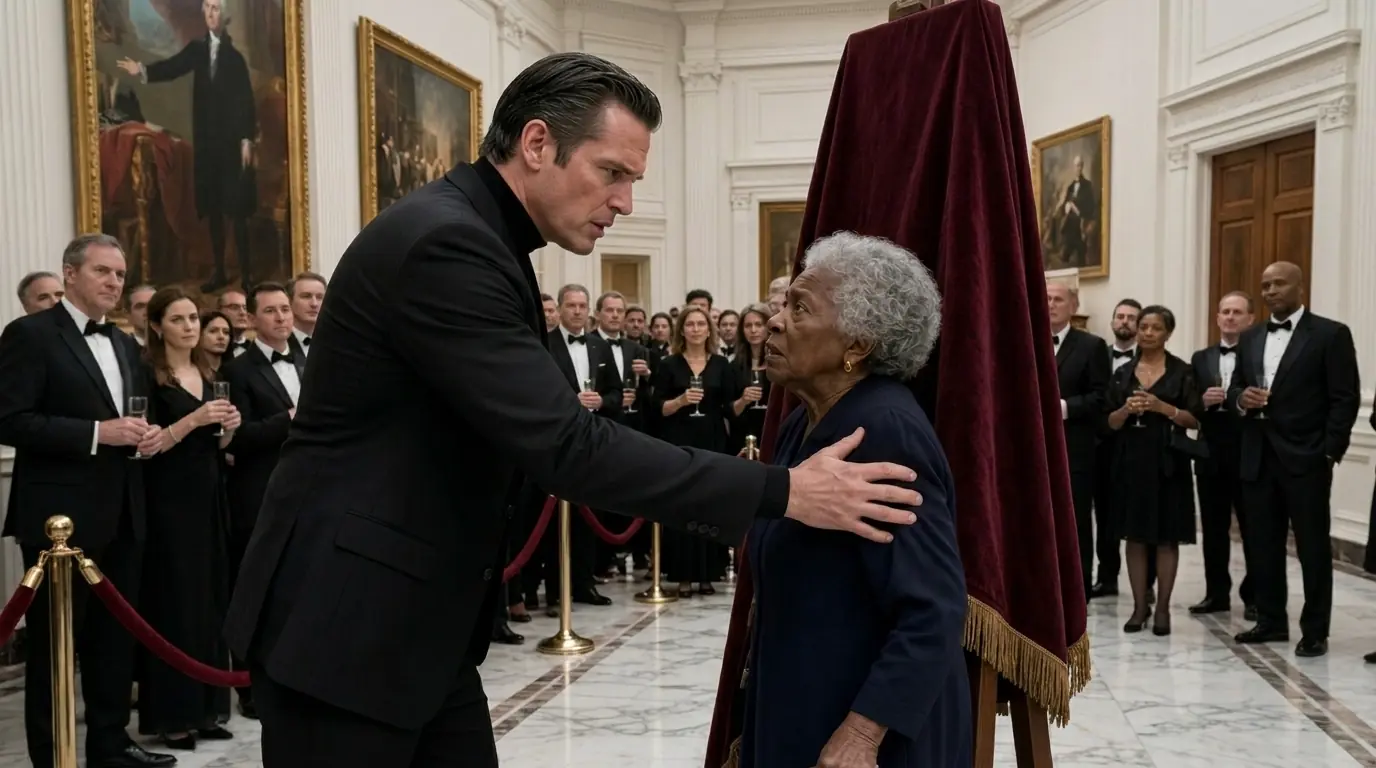
The security guard had one fist twisted into the sleeve of my wool coat when the doors at the far end of the gallery opened. I was seventy-seven years old, leaning hard on a cherrywood cane, standing beside a portrait of my late husband while two hundred people pretended not to notice that I was being removed from a gala I had helped pay for. The guard told me one last time to stop resisting even though both of my feet were planted exactly where they had been for several minutes. Then my son walked into the room with four federal marshals behind him and said, “Take your hand off my mother.”
My name is Evelyn Mercer, and until that evening I had never been escorted anywhere in my life except down a church aisle and into the passenger seat of my husband’s old Cadillac. I had spent forty-three years married to Theodore Mercer, a civil engineer who began with a two-room office above a tire shop and eventually built Mercer Infrastructure into one of Virginia’s largest privately held construction companies. When Theo died three years earlier, I inherited more money than either of us had ever imagined possessing when we were young. I also inherited the uncomfortable responsibility of deciding what parts of his life deserved to continue after he was gone.
The Langston Museum of American Art in Richmond became one of those decisions. Theo loved paintings but hated admitting it because he believed engineers were supposed to care about bridges, concrete, and whether buildings stood up straight. On Saturdays he would disappear into the Langston for hours, then come home pretending he had merely wandered in because the weather was bad. After his death, I donated six million dollars to renovate the museum’s neglected twentieth-century wing in his memory.
The agreement was not complicated. Five million dollars would fund construction, climate control, archival storage, and conservation work, while another million would create a permanent maintenance reserve. The new gallery would carry both our names because Theo had spent his life insisting that anything we built together belonged to both of us. The official dedication plaque was supposed to read The Theodore and Evelyn Mercer Gallery of American Life.
The gala was scheduled for a Friday in October. Museum trustees, donors, local executives, elected officials, artists, university leaders, and several members of Richmond society were invited for cocktails, dinner, and the ribbon cutting. My son Julian told me he might arrive late because he had work in Washington, but he promised he would be there before the unveiling. I told him not to make a federal emergency out of his mother cutting a ribbon.
Julian was fifty-one and worked for a federal financial oversight agency that investigated misuse of regulated charitable funds, grant fraud, and large-scale financial misconduct involving institutions receiving public benefits. He was careful about discussing his work because half the stories were confidential and the other half were too boring to survive dinner. Theo used to joke that Julian had inherited my patience and his suspicion. I told both men that suspicion was simply patience with better paperwork.
I arrived at the museum forty minutes early wearing a burgundy dress, a gray wool coat, and the same black shoes I had worn to Theo’s memorial service. My knees had worsened over the previous year, so I carried the cherrywood cane my husband bought after my first surgery. Inside my worn leather tote were my invitation, copies of the original endowment documents, a small makeup bag, and a folder Julian had asked me not to remove until he arrived. I assumed the folder had something to do with the ribbon ceremony.
A young volunteer checked my printed invitation at the front entrance and welcomed me by name. She directed me toward the new east gallery and said the reception had already begun. I walked slowly through the museum, passing enormous floral arrangements, black-tie guests, waiters carrying champagne, and signs thanking donors whose names appeared in gold lettering. Nobody stopped me until I reached the entrance to the renovated wing.
The man standing there was named Graham Bellamy. He was forty-six, handsome in the polished way people become when they spend their careers raising money from wealthy strangers, and he had served as executive curator of the Langston for almost four years. I had met him twice during construction meetings, though both times Julian had been beside me and Graham had spent most of his attention on people he apparently considered more important. That evening, he looked directly at my face without showing the slightest sign of recognition.
“Private event,” he said before I had spoken. I handed him the invitation and told him I was there for the Mercer gallery dedication. Graham glanced at the card for barely a second before asking where I had obtained it. I told him the museum mailed it to my home.
His eyes moved from my coat to my cane and then toward my tote bag. “There have been counterfeit invitations circulating,” he said, though nobody had mentioned such a problem at the entrance. I told him he was welcome to compare my name with the guest list. Instead, he answered, “We’re trying to keep this area clear for actual benefactors and their guests.”
I thought perhaps I had misheard him. “My name is Evelyn Mercer,” I said, and Graham gave me a tight smile as though I were testing his patience. He replied that the Mercer family’s representatives had already been contacted and that Mrs. Mercer was not expected that evening. I stared at him long enough that his smile faded.
“I am Mrs. Mercer,” I said. Graham exhaled through his nose and answered, “Ma’am, this is exactly the kind of confusion we are trying to avoid tonight.” He suggested I visit the public café downstairs until a relative or caretaker could be located. That was the moment embarrassment entered a conversation that had previously only irritated me.
I told him nobody needed to locate me. He asked whether I had identification, so I began opening my purse. Before I could remove my wallet, Graham changed his mind and said identification would not prove I belonged at a private donor function. The problem was no longer verification because he had already decided what verification was allowed to count.
A security officer named Dale Mercer, no relation to me, approached after Graham raised two fingers toward him. Dale was a large man in his early fifties who seemed uncomfortable from the moment he reached us. Graham told him I had entered the donor reception without valid credentials and might be confused. Dale asked whether I had a ticket, and I showed him the same invitation.
“Looks real to me,” Dale said. Graham replied that his job was not to authenticate invitations and instructed him to escort me to the public lobby. I said I would wait where I was until someone checked the list. Dale hesitated.
That hesitation angered Graham. “She is not on tonight’s registry,” he said more sharply, and I noticed a young event coordinator at a nearby desk suddenly look down at her laptop. I asked whether the registry showed Evelyn Mercer. Graham answered, “No.”
The coordinator looked up again. She was a Black woman around twenty-six named Hannah Price, and I had seen her once during a donor luncheon months earlier. Her expression told me she wanted to say something. Graham turned toward her and said, “Hannah, the west tables still need place cards.”
She stood but did not leave immediately. “Mr. Bellamy, I thought Mrs. Mercer was listed at Table One.” Graham’s face changed, not dramatically, but enough. He told her the seating plan had been revised.
I asked who revised it. Graham ignored me and told Dale to move me out of the gallery before more guests arrived. When Dale touched my elbow, I pulled away and said, “Please don’t put your hands on me.” He immediately released me.
Graham stepped forward. “You’re disrupting a private function now.” I told him the easiest solution remained checking the original guest registry or calling the board chair. He replied that the board chair was entertaining major donors and was not going to be interrupted because an unfamiliar woman claimed an important name.
People had begun watching. Not openly, of course. Wealthy people become surprisingly skilled at studying conflict through reflections in champagne glasses.
An older white couple stood near a bronze sculpture ten feet away. I recognized the husband from photographs as a bank executive who had donated several hundred thousand dollars to the museum. He watched Graham block my path, then leaned toward his wife and whispered something. Neither approached.
I asked Hannah whether she could check the system herself. Graham snapped, “She works for me.” The young woman lowered her eyes. That sentence explained why nobody else working nearby moved.
I could have called Julian. I had my phone. One call would likely have ended the argument, but I did not want my son arriving at his father’s memorial dedication already angry.
So I waited.
Graham became more confident as the crowd stayed silent. He told me there was a service elevator near the catering kitchen that security could use so I would not need to walk back through the donor reception. I asked why I needed a service elevator. He answered, “Because at this point we are trying to preserve your dignity.”
I nearly laughed. “Mine?” I asked. Graham looked past me toward the tables as if reminding me how many people were watching.
Then he said something that stayed with me longer than most of what followed. “People here paid serious money to be in this room.” I looked around at the gallery my money had helped rebuild and answered, “So did I.”
His expression hardened. “Not according to anything I can verify.” I told him he had repeatedly refused to verify it. Graham answered, “I’m not going to debate procedure with you.”
He waved Dale forward again. This time another guard named Kevin Shaw joined him, younger and noticeably more eager to follow instructions. Graham told them to remove me.
Dale said quietly, “Maybe we should check with administration first.” Graham turned on him. “I am administration.”
Kevin reached for my tote. I pulled it closer and told him not to touch it. Graham said the bag might contain items taken from the gallery.
That accusation shocked even Dale. “She hasn’t been inside the exhibit,” he said. Graham replied, “Then there should be no problem checking the bag.”
I told them no. The tote contained private legal documents and personal belongings, and no one had identified any missing property. Graham smiled and said refusing inspection made the situation more suspicious.
Kevin took hold of the strap. I held on.
The leather pulled painfully across my wrist. Dale told Kevin to wait, but Graham said, “Get it from her.”
I planted the cane against the marble floor and refused to release the tote. Kevin stepped closer and caught the sleeve of my coat with his other hand. His grip tightened.
That was when the oak doors behind the gallery entrance opened.
The string quartet stopped mid-song.
Julian walked into the room wearing a gray suit, followed by four federal marshals.
He did not run. He did not shout. He looked first at Kevin’s hand on my coat, then at Graham, then at the black silk covering Theo’s portrait.
“Take your hand off my mother,” he said.
Kevin released me so fast he nearly stumbled. Dale stepped backward on his own. Graham turned toward Julian with the irritated confidence of someone who believed another unauthorized guest had arrived.
“This is a private museum function,” Graham said. “Whoever you are, you cannot enter with armed personnel and interfere with security.” Julian ignored him completely and walked to me.
“Are you hurt, Mom?” he asked. I told him my wrist was sore but nothing seemed broken. He asked whether anyone had searched my bag.
“No.” I looked at Kevin. “Not successfully.”
Julian almost smiled, then stopped himself. “Good.” He asked one marshal to make sure I had somewhere to sit if I wanted it.
“I don’t.” I tapped the cane once against the marble. “I paid for this floor, Julian. I can stand on it.”
That finally drew a few uncomfortable looks from the crowd.
Graham heard it too. “What exactly is going on here?” he demanded. Julian turned toward him for the first time.
“My name is Julian Mercer.” Graham’s eyes changed slightly.
Julian opened a dark credential wallet. “I’m a senior inspector with the Federal Office of Charitable Financial Oversight.” The title was fictional to most people in the room, but the badge was not.
Graham’s posture changed. “Federal oversight of what?” Julian answered, “The Mercer endowment, among other things.”
Whispers moved through the gallery.
Graham recovered quickly. “This is absurd. The museum has done nothing except deal with a security problem involving someone who was not on the guest list.” He pointed toward me without looking directly at my face.
Julian reached inside his jacket and removed a folded copy of the original seating registry. “Evelyn Mercer, Table One, Seat One, principal benefactor and dedication guest.” He held it high enough for Graham to see.
Graham shook his head. “That is outdated.” Julian nodded once.
“Yes. The digital registry changed at 2:37 this morning.” Graham stopped moving.
Julian continued. Federal investigators had already obtained preservation records associated with an audit that began three weeks earlier after discrepancies appeared in grant and endowment reporting. Because the museum received certain public benefits and administered restricted charitable funds, investigators had legal authority to review specified financial systems.
The audit logs showed Graham’s administrator account accessing the gala database overnight. My name was removed. So was the notation identifying me as principal benefactor.
Hannah covered her mouth.
Graham said someone could have used his login. Julian answered, “That possibility is being examined.” He did not accuse him of a crime.
That distinction irritated Graham more than a direct allegation might have. He wanted something clear enough to fight. Julian kept giving him facts.
“The login came from your museum-issued laptop,” Julian said. “The device connected from your home network.” Graham’s face tightened.
He said his laptop could have been remotely accessed. Julian nodded. “Also possible.” Then he added that investigators had already secured the device under proper legal authority that afternoon.
One of the marshals lifted a sealed evidence bag containing a silver laptop. Graham stared at it.
His phone slipped from his hand.
The screen cracked against the marble.
Nobody laughed.
Graham bent as if to retrieve it, then seemed to think better of moving. “I need counsel.” Julian said, “You are free to call counsel.”
Graham looked toward the exit. Two marshals stood nearby.
“You said I’m free,” he snapped. Julian answered, “You are not under arrest at this moment.” He then explained that the gallery contained materials subject to a federal preservation notice and that investigators would document departures and protect records from destruction.
Graham laughed nervously. “You people are turning a donor event into a raid because your mother had an argument with security.” Julian’s expression did not change.
“This investigation began before my mother arrived.” He pointed toward the covered portrait. “Her removal gave us another question.”
I finally understood why Julian had been so vague about arriving late.
He had known something was wrong with the endowment.
He had not known Graham would try to throw me out.
Graham said the museum accounts were clean. Julian asked whether he wanted to discuss a vendor called Northbridge Conservation Partners.
The name hit him visibly.
That was when my own suspicion became certainty.
I had seen Northbridge once.
Three months earlier, it appeared on a quarterly summary showing almost three million dollars billed for climate-control engineering, archival cabinetry, and specialized humidity equipment. The amount seemed high, so I asked our family accountant about it.
He told me museum management had supplied supporting invoices.
Theo taught me never to confuse an invoice with evidence that something existed.
I asked Julian to look.
That request started the audit.
Graham told the room Northbridge was a nationally respected conservation consultant. Julian answered that investigators had found no employees, no physical office, no professional licenses, and no evidence of completed conservation work.
The company was registered in Wyoming through an agent. Its beneficial ownership traced to a trust controlled by Graham’s sister and her husband.
Graham’s face turned gray.
He said the relationship had been disclosed.
Julian asked, “Where?”
No answer came.
Graham claimed the finance department handled vendor due diligence. Julian said investigators were reviewing finance separately.
He did not let Graham assign guilt to someone simply because panic had begun.