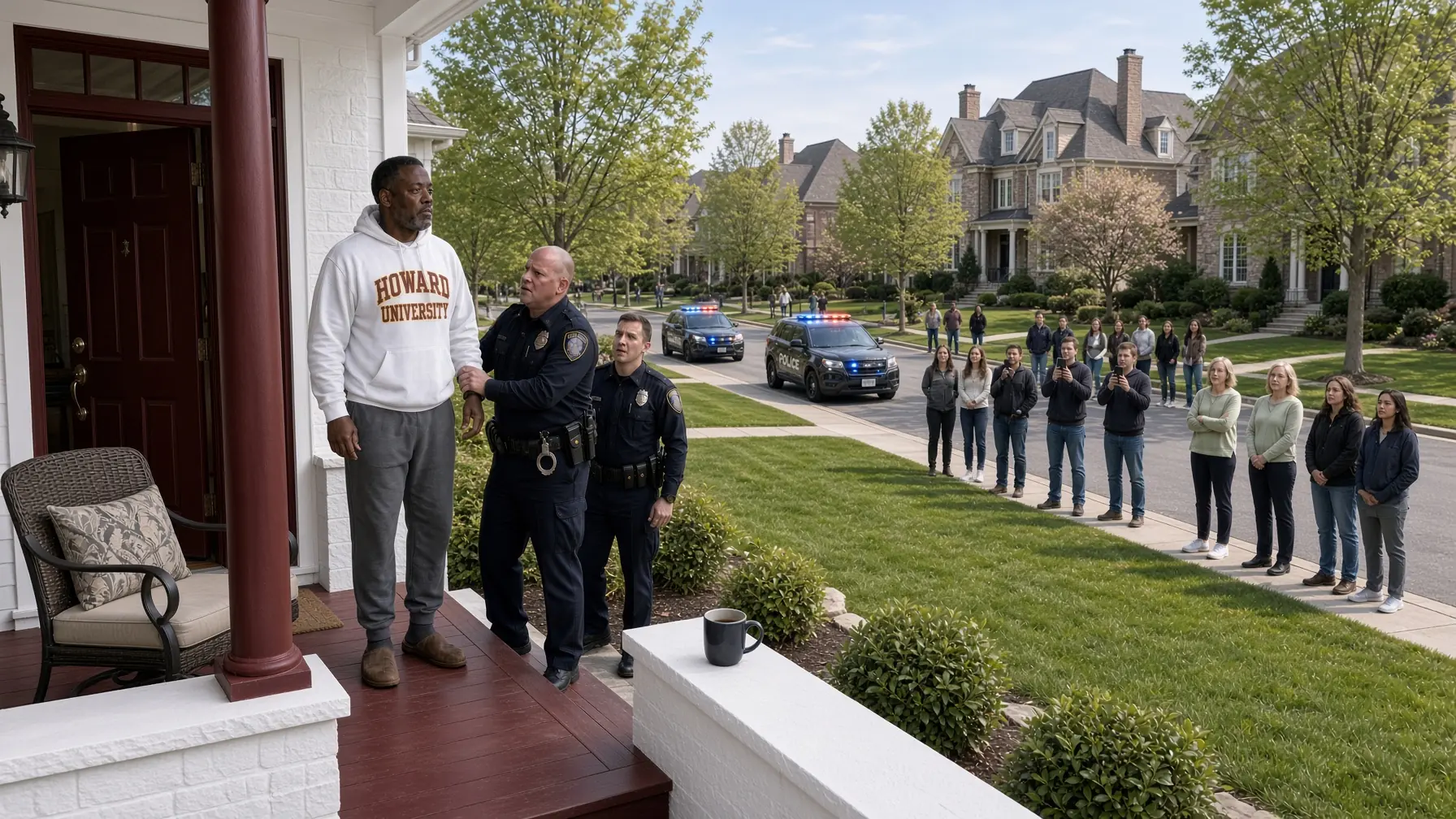
By eight-thirty on Saturday morning, Michael Avery had already decided the best part of his new house was the front porch. It was deep enough for two wooden chairs, faced a quiet row of old maple trees, and caught the first sunlight without exposing him to the full heat that would settle over western North Carolina by noon. He stood there in gray sweatpants, an old Howard University hoodie, thick socks, and worn leather slippers, holding a mug of coffee with both hands while half his belongings remained sealed in boxes behind him. After two years of investigations, press conferences, sealed warrants, witness meetings, and nights spent sleeping on his office couch, ten silent minutes felt almost luxurious.
Michael had moved into 42 Hawthorne Crest twenty-four days earlier. The house sat inside a private development called Westbridge Preserve, where the stone entrance signs were pressure-washed more often than some public buildings and every yard seemed to contain exactly the correct amount of landscaping. He had paid more than he ever imagined spending on a home, not because he wanted to impress anyone but because his doctor had finally told him chronic exhaustion was not a personality trait. His younger sister Camille had translated that advice more bluntly: “Mike, you prosecute people for organized crime all week and then go home to an apartment facing the federal courthouse parking garage. Buy a tree.”
So Michael bought several.
At forty-nine, he had spent more than two decades inside the Department of Justice. He started as an assistant federal prosecutor handling firearms and fraud cases, moved into public corruption, later supervised a multi-state organized-crime unit, and eventually became the United States Attorney for the Western District of North Carolina. Six days before moving into Westbridge, his office had unsealed an indictment against nineteen defendants tied to a labor-trafficking and money-laundering network that moved vulnerable workers through fake staffing companies and industrial warehouses.
The case made national news. Michael stood in front of microphones while reporters called it a historic prosecution, but the word historic mostly made him tired. He knew the case contained frightened witnesses whose names would never appear in headlines and agents who had spent eighteen months eating cold food in rental cars.
By Friday night, Michael wanted nothing to do with federal power. He left his secure phone on the kitchen counter, turned off every television in the house, and told his chief deputy not to call unless someone had been kidnapped or Congress unexpectedly became efficient. Saturday morning was supposed to be coffee, unpacking, and maybe finding the box containing his toaster. Instead, three houses away, a woman named Vivian Mercer was watching him through the narrow opening between plantation shutters.
Vivian was sixty-one and had lived in Westbridge Preserve for sixteen years. She chaired the HOA’s neighborhood standards and safety committee, moderated the residents-only alert page, and had built an entire social identity around knowing which cars belonged on which streets. People described her as vigilant when they liked her, intrusive when they did not, and “extremely committed to the neighborhood” when they wanted to avoid choosing sides. Vivian preferred the first description.
She had reported workers before. A Black roofing contractor measuring a storm-damaged home, a Hispanic landscaping crew that arrived before sunrise, a young delivery driver who parked too long while finding the correct address, and once a home health aide sitting in her car between appointments. None of those calls had resulted in an arrest, but Vivian never interpreted that as evidence that her instincts might be unreliable.
That morning she saw Michael in a hoodie and slippers moving a large planter six inches toward the sunlight. She had read the closing notice announcing that 42 Hawthorne Crest had sold, but the new owner’s name had meant nothing to her. She vaguely remembered seeing a well-dressed Black man with a realtor one afternoon but had mentally filed him as attorney, banker, consultant, guest, or something equally temporary. Now she watched the same man standing comfortably on the porch and decided comfort itself was suspicious.
Vivian called the non-emergency police line at 8:37. She told the dispatcher there was an unknown man on the porch of a recently sold home, possibly trying to enter the property or establish whether anyone was inside. The dispatcher asked whether he had forced a door, broken a window, threatened anyone, or carried tools, and Vivian answered no to each question. Then she added, “He looks like he’s pretending to live there, and that house is worth over a million dollars.”
The dispatcher asked whether she knew the homeowner. Vivian said she knew enough.
Seven minutes later, Michael heard tires turn sharply onto Hawthorne Crest. Two marked patrol vehicles came down the street faster than normal neighborhood traffic, their lights flashing silently across stone walls, polished SUVs, and perfectly trimmed hedges. Michael lowered his coffee and watched both cruisers angle across his driveway.
The first officer out was Sergeant Bradley Shaw, forty-six, thick through the shoulders, with a shaved head and the expression of a man who disliked needing extra information. The second was Officer Aaron Bell, twenty-nine, taller and leaner, whose eyes immediately moved from Michael to the open front door, then to the porch furniture, the moving boxes visible through the foyer, and the coffee in Michael’s hand. Shaw did not seem interested in any of those details.
“Put the cup down and show me your hands,” Shaw called.
Michael looked at the mug. “It’s coffee.”
“I didn’t ask.”
Michael placed one hand against the porch railing while keeping the cup visible in the other. “Good morning. What is the reason for the contact?”
Shaw stopped at the bottom step. “We received a report of a suspicious person possibly attempting to enter this residence.”
Michael glanced behind himself at the open door. “I live here.”
“Then step down and show identification.”
Michael studied him for a second. “My identification is inside the house.”
“Go get it.”
Michael did not move.
Officer Bell looked at Shaw.
Michael asked, “You want me to turn my back on two armed officers, walk into a house you currently believe I may be burglarizing, and reach for something you cannot see?”
Shaw’s jaw tightened. “Don’t make this complicated.”
“It was simple when you arrived.”
That answer irritated Shaw.
He moved up one step. “Sir, we are investigating a possible trespass. If this is your home, show us identification and we’ll be done.”
Michael set the mug on a small table beside the chair. “Before I do anything else, tell me what specific conduct created suspicion of a crime.”
Shaw looked almost surprised by the wording. “The caller reported you.”
“Doing what?”
“Being on property that may not belong to you.”
Michael looked toward the front door again. A pair of shoes sat just inside, along with an open moving box marked OFFICE BOOKS and a framed family photograph leaning against the wall. “The property does belong to me.”
“Prove it.”
“No.”
Officer Bell’s expression changed.
Shaw stepped onto the porch.
Michael stayed still.
The street began to notice.
A retired dentist named Paul Benton stopped halfway to his mailbox. Two women walking a terrier slowed near the corner, and a teenage boy on a bicycle lifted his phone. Across the street, a woman watering flowers turned off the hose and simply watched.
Vivian came outside too.
She stood at the edge of her driveway with both arms folded, wearing a pale green sweater and white sneakers. Her expression carried the cautious satisfaction of a person waiting for authority to confirm what she already believed. Michael noticed her but did not yet know she had made the call.
Shaw said, “Turn around.”
Michael’s voice stayed level. “Am I under arrest?”
“You are being detained while we determine whether you have lawful access to this property.”
“What facts support that detention beyond a caller saying I do not look like the homeowner?”
Shaw stared. “Did I say anything about what you look like?”
“No.”
Michael glanced toward Vivian.
“But somebody apparently did.”
Officer Bell cleared his throat. “Sergeant, maybe we should run the address and owner information first.”
Shaw turned sharply. “I know how to handle a trespass call.”
Bell stopped talking.
Michael looked at him.
“Your first instinct was better.”
Bell looked away.
That sentence embarrassed him, but embarrassment would matter later.
Shaw unclipped his handcuffs.
Michael heard the metal.
So did everyone else.
The teenage boy’s phone rose higher.
“Turn around,” Shaw repeated.
Michael asked, “What crime am I suspected of committing?”
“Obstruction if you keep refusing.”
“Obstruction requires a lawful investigation and conduct that actually interferes with it.”
Shaw’s face reddened. “You a lawyer?”
“Yes.”
“Everybody’s a lawyer when police show up.”
Michael almost smiled. “Unfortunately for both of us, I actually am.”
Shaw stepped closer. “Name.”
“Michael Avery.”
“Date of birth.”
“I am not answering further questions until you identify the reasonable suspicion supporting this detention.”
Shaw lifted the cuffs.
The gesture made Bell move slightly.
“Sergeant.”
“Not now.”
Michael looked toward Bell again. “If you think this is wrong, now is exactly when it matters.”
Bell flushed.
Shaw said, “Hands behind your back.”
Michael picked up the coffee mug.
Not to drink.
He moved it several feet away and set it on the porch ledge.
Shaw interpreted that as preparation.
“There you go.”
Michael turned back. “I’m moving hot liquid away because I don’t want you claiming later that I used it as a weapon.”
The teenager on the bicycle whispered, “Damn.”
Shaw heard him.
That made things worse.
Michael saw it happen in real time: the original problem—whether he lived at 42 Hawthorne Crest—was disappearing. Shaw was no longer solving a call. He was protecting his authority in front of an audience.
Michael had prosecuted enough obstruction cases to recognize that transition.
“Sergeant Shaw,” he said, reading the nameplate, “call your watch commander.”
“I don’t need permission.”
“I didn’t say you did.”
“Then stop telling me how to do my job.”
Michael’s voice lowered. “I am trying to give you a clean exit.”
Shaw laughed once. “From what?”
“From a detention your own records will not support.”
Shaw grabbed Michael’s wrist.
That changed everything.
Michael did not pull away.
He let his arm stay loose while Shaw began turning him.
Officer Bell moved forward. “Sergeant, wait.”
“What?”
“I know that name.”
Shaw stared.
Bell looked at Michael more closely.
“Michael Avery.”
“Yes.”
Bell’s face went pale.
Shaw said, “What about it?”
Bell hesitated. “I think he’s the U.S. Attorney.”
The hand on Michael’s wrist froze.
For half a second, nobody moved.
Then Shaw released him.
Too quickly.
The change in body language was so abrupt that several neighbors murmured.
Michael looked at his wrist.
A red mark had already formed.
Shaw swallowed. “You’re United States Attorney Avery?”
Michael looked directly at him. “I was five seconds ago too.”
Vivian took one step backward.
Bell reached for his radio.
Shaw snapped, “Wait.”
Bell ignored him.
“Dispatch, Unit 14, request watch commander to 42 Hawthorne Crest. Priority response, no emergency traffic.”
The dispatcher answered.
Michael picked up his coffee.
It had already started cooling.
“Tell Commander Watkins who you’re with.”
Bell looked at him.
Then keyed the radio again. “Possible contact involving U.S. Attorney Michael Avery.”
The radio went quiet.
Then the dispatcher’s voice changed. “Copy. Command notified.”
Shaw looked angry now for a different reason.
“You could have told us that from the start.”
Michael raised his eyebrows. “Why?”
“What do you mean why?”
“Would it have changed your conduct?”
Shaw did not answer.
Michael nodded. “That is why.”
Ten minutes later, a dark command SUV turned onto Hawthorne Crest.
Deputy Chief Angela Watkins stepped out.
She was fifty-four, wore reading glasses on a cord around her neck, and had attended a federal task-force meeting with Michael less than a month earlier. The second she saw him standing in slippers beside Shaw, she closed her eyes briefly.
“Sergeant Shaw.”
“Yes, ma’am.”
“Step off the property.”
Shaw tried to explain.
Angela repeated herself.