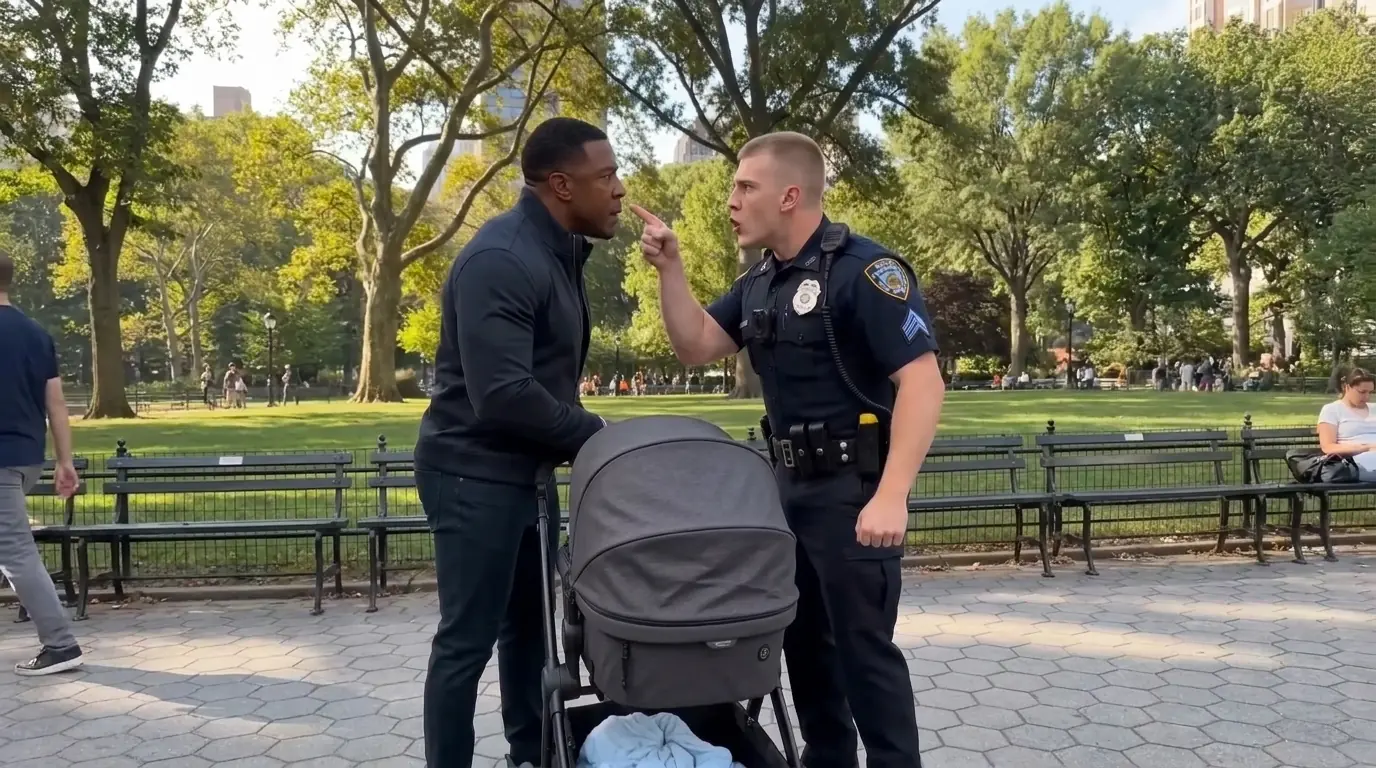
Officer Grant Holloway kicked the brake down on the stroller before Marcus Reed understood the conversation had stopped being about identification. The gray carriage jerked sideways on the paved path, waking Marcus’s eleven-month-old daughter, Ava, who immediately began crying beneath the sunshade. Marcus reached instinctively for the handle, but Holloway caught his wrist and shoved him hard enough that his hip struck the aluminum frame. “Back away from the property,” the officer ordered, as though the stroller containing Marcus’s own child had suddenly become evidence.
It was a warm Tuesday afternoon in Bellmont, a river city where expensive townhouses climbed the hills above Franklin River Park and families from the surrounding neighborhoods filled the walking paths after lunch. Marcus wore jeans, running shoes, a plain black T-shirt, and a lightweight green jacket his wife had been trying to convince him to throw away for three years. Nothing about him suggested government authority, which was exactly the point. Inside the jacket, beneath a zipped pocket, rested the four-star gold shield identifying Marcus Reed as the newly appointed Police Commissioner of Bellmont.
He had been commissioner for seventeen days. Most residents knew his name from the news, but few recognized him without the charcoal suit, tie, podium, and department seal that appeared behind him during the swearing-in ceremony. Holloway apparently had not recognized him at all. That was why the officer felt comfortable planting one hand against Marcus’s chest and saying, “I asked you where you got the stroller.”
Marcus looked at his daughter. Ava’s crying had become sharper, her small hands moving beneath the blanket as she tried to understand why her afternoon ride had suddenly stopped. “I bought it with my wife six months ago,” Marcus said, keeping both hands visible, “and the child inside it is my daughter.” Holloway glanced beneath the sunshade for less than a second and answered, “That’s what you’re saying.”
Marcus had spent twenty-eight years in policing, beginning as a patrol officer in Baltimore before moving through investigations, professional standards, precinct command, deputy chief positions, and eventually executive leadership. He understood suspicious behavior, reasonable suspicion, officer safety, and how quickly ordinary encounters could become dangerous when one person decided every question sounded like defiance. He also understood exactly what had happened before Holloway approached him. For forty-seven minutes Marcus had been sitting on a bench near the south entrance watching the officer work.
The commissioner had not chosen Franklin River Park because the weather was pleasant. His executive office had received thirteen separate complaints during his first two weeks, all describing Black fathers or grandfathers being stopped while walking children through the park or nearby residential blocks. Several complainants said officers demanded receipts for expensive strollers, proof that bicycles belonged to their children, or identification establishing why they were in a neighborhood where public sidewalks required none. Eight complaints mentioned one officer by description, and five included Grant Holloway’s name.
Marcus did not believe thirteen complaints automatically proved misconduct. He had spent enough time reviewing allegations to know that people sometimes remembered events incorrectly, officers sometimes made lawful stops that felt unpleasant, and multiple complaints could repeat the same misunderstanding without establishing intent. What bothered him was the similarity of the descriptions. So instead of holding a press conference or ordering immediate discipline, he came to the park with his daughter and watched.
He arrived shortly after noon and sat on a bench near the playground. Three white mothers passed Holloway while pushing premium strollers, including one model that cost considerably more than Marcus’s. Holloway smiled at two of them and helped the third woman retrieve a dropped toy. He did not ask where their strollers came from.
A white grandfather walked by pulling a red wagon containing two toddlers. Holloway nodded and said, “Beautiful day.” A Black man carrying a little girl on his shoulders entered from the north path, and Holloway watched him for almost a minute before a radio call pulled his attention elsewhere. Marcus noticed the difference but still refused to treat observation as conclusion.
Then Marcus stood and started walking. He pushed Ava slowly toward the river, stopping once to adjust the blanket and again when she threw a stuffed giraffe onto the pavement. Holloway crossed the grass from nearly forty yards away. His path made it obvious he had selected Marcus before any conversation began.
“Hey,” Holloway called. Marcus stopped. “Afternoon, officer.”
Holloway looked at the stroller before looking at Marcus. “You live around here?” Marcus answered, “Not within the immediate neighborhood.” The officer’s eyes narrowed, and he asked what Marcus was doing in the park.
“Walking with my daughter.” Holloway looked past him toward the expensive townhouses lining the river and asked whether Marcus had identification. Marcus said he did, then asked, “Is there a reason you need it?” That simple question changed Holloway’s posture.
“Just asking,” the officer replied. Marcus nodded. “Then I’d prefer to keep walking.”
Holloway moved into the path. “We’ve had thefts around here.” Marcus stopped again and asked whether there was an active report involving someone matching his description.
“Strollers,” Holloway said. “Bags, bicycles, whatever people can grab.” Marcus looked down at Ava’s carriage and then at the diaper bag hanging from the handle. “Was a gray stroller reported stolen today?”
The officer’s jaw tightened. “Why are you getting defensive?” Marcus answered, “I asked whether my property matches anything reported stolen.” Holloway ignored the question and demanded identification again.
Marcus reached slowly toward the inside of his jacket. Holloway’s hand immediately dropped toward his weapon. “Hands where I can see them.”
Marcus stopped. “You asked me for identification.”
“Don’t reach without telling me.”
“I just told you what I was reaching for.”
Holloway stepped closer. “You think this is funny?” Marcus shook his head and said the only person crying was his daughter, which made the officer glance briefly toward the stroller. The child’s distress did not slow him down.
Instead, Holloway asked whether Marcus could prove the baby was his. For several seconds, Marcus simply stared at him. He had heard complainants describe that question in writing and had wondered whether emotional retelling had exaggerated the language. Now he heard it exactly.
“What proof would satisfy you?” Marcus asked. Holloway said, “ID, maybe pictures, something showing you belong with her.” Marcus’s voice stayed controlled when he replied, “Parents do not carry ownership papers for their children.”
Holloway looked irritated. “You know what I mean.” Marcus said, “Actually, I want you to explain exactly what you mean.” The officer moved closer until less than a foot separated them.
“What I mean is people steal expensive stuff in this area.” Marcus nodded toward the stroller. “And what specifically connects me to one of those thefts?” Holloway answered, “You’re here.”
Marcus waited. “That is your answer?”
The officer pointed toward the diaper bag. “Open it.” Marcus refused. Holloway asked why an innocent person would object to showing what was inside.
Marcus had heard that reasoning thousands of times. Sometimes from citizens. Sometimes from inexperienced officers. Sometimes from supervisors who should have known better.
“Because ownership does not disappear because an officer is curious,” Marcus said. Holloway smiled without humor and told him he sounded like someone who had practiced dealing with police. Marcus replied, “I’ve had some experience.”
Had Holloway asked one more neutral question, Marcus might have identified himself. Had he called dispatch, checked recent theft reports, or simply acknowledged that nothing connected Marcus to a crime, the encounter could still have ended quietly. Instead, the officer reached for the stroller handle. “I’m holding this here until I figure out what’s going on.”
Marcus placed one hand over the handle first. “Do not touch my child’s stroller.” Holloway stared at his hand and said, “Take your hand off.”
“No.”
That was the first direct refusal. Marcus understood the risk of it and chose the word carefully because nothing had given Holloway lawful authority to seize the carriage. The officer kicked the wheel brake down.
The stroller stopped abruptly. Ava woke and began screaming. Marcus bent toward her.
Holloway grabbed his wrist. “Back up.”
“Take your hand off me.”
“Stop resisting.”
“I am not resisting.”
Holloway shoved Marcus sideways. His hip struck the stroller, pushing it several inches despite the brake. Ava’s crying turned frantic.
Every parent in the nearby seating area looked up. A woman packing snacks into a diaper bag froze with one hand inside the bag. An older man walking a terrier stopped beneath a maple tree. A Black father sitting near the playground stood slowly while holding his toddler against his chest.
Marcus did not push Holloway back. He did not raise his voice. He planted one hand against the stroller frame to keep it stable and waited until the officer released his wrist.
Then he said, “Your name is Grant Holloway.” The officer glanced toward his nameplate and smirked. “Congratulations, you can read.”
“Badge 3814.”
Holloway’s smile faded slightly. “What about it?” Marcus reached slowly toward his jacket again, announcing every movement before making it. “I’m retrieving identification.”
This time Holloway allowed him. Marcus removed a black leather credential wallet and opened it between them. Sunlight struck the gold shield.
For several seconds, Holloway did not react. His eyes moved across the four stars, the city seal, the engraved title, and finally the name. Then he looked up at Marcus’s face.
The officer took one step backward. “What is that?” His voice had lost most of its volume.
“You know what it is.”
Holloway looked again. Every sworn officer in Bellmont had received an email containing the new commissioner’s official portrait less than three weeks earlier. Marcus had also visited five precincts, although he had not yet reached Holloway’s district.
“You’re Commissioner Reed?” Holloway asked. Marcus closed the wallet. “I was Commissioner Reed before you touched the stroller.”
The officer’s mouth opened. “Sir, I didn’t know.”
Marcus looked at Ava rather than him. “That is not the problem.”
Holloway started explaining that the neighborhood had experienced property theft. Marcus interrupted only long enough to ask one question. “What stolen-property description matched me?”
The officer went quiet.
Marcus repeated it. Holloway finally said there had been several thefts but not necessarily one involving Marcus’s stroller. The commissioner nodded.
“So there was no description.”
“No, sir.”
“No reported gray stroller.”
“Not that I know of.”
“No stolen diaper bag matching this one.”
“No.”
“No call sending you toward me.”
Holloway swallowed. “No, Commissioner.”
Marcus placed the credential wallet back inside his jacket. “Call your supervisor.”
Holloway’s hand moved toward his radio. Then he hesitated. “Commissioner, if I could explain—”
“You’ll have opportunities to explain.”
His voice was still quiet.
“Call your supervisor.”
The officer transmitted the request. He did not mention the commissioner on the radio, only that he needed a sector supervisor at the south river path. Dispatch asked whether additional units were required, and Holloway quickly said no.
Marcus turned away from him. He unlocked the stroller brake and rolled Ava several inches back and forth until her crying softened. Then he crouched beside her, touched her cheek, and quietly told her everything was okay.
It was not entirely true. But fathers have been telling children temporary truths for comfort since the beginning of language. Ava eventually stopped screaming and settled into small exhausted hiccups.
Holloway stood several feet away. He looked at the ground, then toward the nearby witnesses, then toward the blinking red light on his own body camera. Only then did his expression change again.
Marcus noticed. “Your camera has been running?”
“Yes, sir.”
“From the initial contact?”
The officer hesitated.
“Most of it.”
Marcus looked directly at him. “Do not touch the device.”
“I wasn’t going to.”
“Good.”
He pointed toward a glass dome mounted high on a green park light pole. “And the city camera at the intersection covers this path.”
Holloway looked up. Another camera sat near the playground. A third faced the south entrance.
Whatever explanation he had begun forming became smaller.
Three minutes later, a white supervisor SUV entered the gravel service lane. Sergeant Thomas Keegan stepped out wearing sunglasses and the irritated expression of someone expecting a minor complaint to interrupt paperwork. He walked across the grass while adjusting his belt and called, “What have we got?”
Holloway looked toward him but did not answer quickly enough. Keegan turned toward Marcus. “Sir, did my officer tell you why you were stopped?”
Marcus said nothing.
The sergeant moved closer. “I’m asking you a question.”
Then he looked fully at Marcus’s face.
Keegan stopped.
His shoulders went rigid.
“Commissioner?”
Holloway looked down.
Marcus answered, “Good afternoon, Sergeant.”
Every parent within twenty yards heard the title.
Keegan removed his sunglasses. “Sir, I wasn’t aware you were in this district today.”
“That was intentional.”
The sergeant glanced toward Holloway. “What happened?”
Marcus checked Ava once more before answering. Then he described the encounter clinically.
“Officer Holloway approached without identifying any active call or suspect description, demanded identification, questioned whether my stroller and diaper bag were stolen, asked me to prove the child was mine, attempted to seize the stroller, activated the wheel brake, grabbed my wrist, and shoved me into the carriage.”
Keegan slowly turned toward the officer. “Grant?”
Holloway started speaking quickly. “Sergeant, we’ve had a lot of theft complaints around this section, and he was refusing to cooperate.”
Marcus interrupted. “I asked what connected me to a reported offense.”
Keegan looked at Holloway. “Did you have a description?”
“No specific description.”
“A call?”
“No.”
“A BOLO?”
“No.”
“Anything on the radio?”
“No.”
Keegan’s face tightened.
Marcus nodded toward the body camera. “His recording should answer most remaining questions.” Keegan immediately told Holloway not to manipulate the device.
The commissioner then pointed toward the park cameras. “Those should also be preserved.” Keegan agreed.
For the first time, Marcus looked toward the parents watching. A white mother had begun recording after the shove. The older man with the terrier was still standing beneath the tree.
The Black father from the playground remained nearby with his toddler. Marcus recognized him from one of the complaint emails. His name was Darren Hayes.
Darren had written that an officer stopped him three weeks earlier while he pushed his niece in a borrowed stroller. The officer demanded to know where he obtained it and asked whether the child’s mother knew he had the baby. Darren included no officer name because he said he had been too frightened to look closely.
Now he stared at Holloway.
Marcus understood.
“Sergeant Keegan,” the commissioner said, “I need Internal Affairs notified immediately.” Holloway’s head snapped up.
“Commissioner, please.”
Marcus looked at him. “Please what?”
“This was a misunderstanding.”
“A misunderstanding ends when facts correct it.”
Holloway’s breathing became shallower. “Sir, I made a bad call.”
“Yes.”