The first thing that hit the pavement was her wallet. The second was a small silver picture frame, which bounced against the curb and cracked beneath the front tire of a parked car. Then came the keys, a comb, a notebook, a pair of reading glasses, and an envelope of photographs that scattered into a shallow stream of rainwater running beside the road. Jasmine Reed stood motionless on the sidewalk, one hand wrapped around the purple leash of her tiny terrier, while the heavyset police officer in front of her shook her handbag upside down as if he were emptying a trash can.
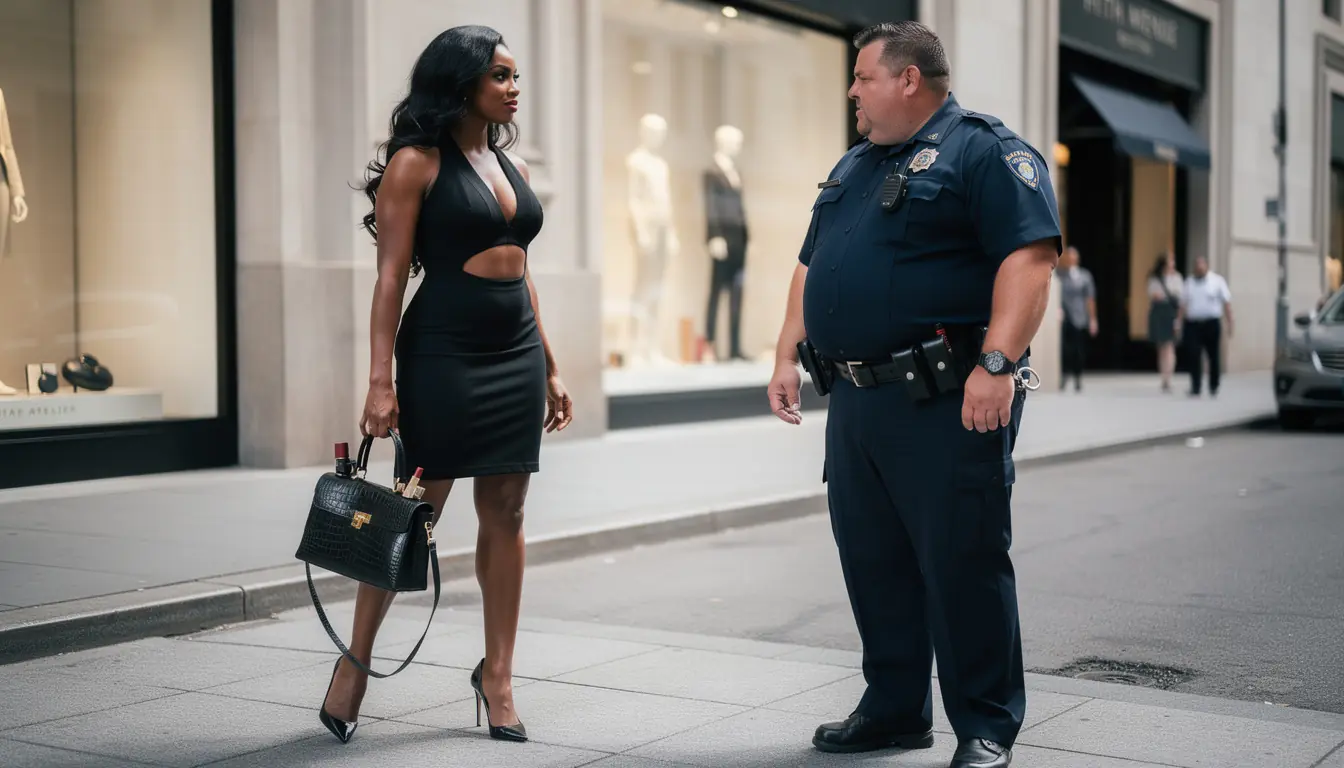
"There," Officer Raymond Harlan announced. "Now we can all see what you've been hiding." He gave the worn leather bag one last violent flick. A packet of tissues fell beside Jasmine's shoes, and a few people near the coffee shop began to stare. Harlan was a broad, heavy man in his late forties, with a flushed face, a thick neck, and a uniform belt pulled tight around his waist. He wore the satisfied expression of someone who believed a badge made every other person in the conversation smaller.
Jasmine looked from her belongings to his face. "You had no reason to touch my purse," she said. "I was walking down the sidewalk." Her voice was calm, although the leash trembled slightly in her fingers. Peanut, the little brown-and-white terrier at her feet, pressed against her ankle and whimpered at the passing traffic. An orange city bus swept through the intersection just as a loose photograph fluttered into its path.
Harlan laughed. "You people always have an answer. First it's 'I'm just walking.' Next it's 'I know my rights.' You don't get to decide what looks suspicious on my street." He pointed at the row of expensive boutiques behind her. "A woman wandering back and forth with a big bag, looking at the windows and never buying a thing? Don't insult my intelligence."
"This is a public sidewalk," Jasmine replied. "And I wasn't wandering back and forth. I was going to the library." She looked down at the road, where a folded letter had opened beneath a puddle. "Please let me pick up my things before a car runs over them."
"Then pick them up," he said, stepping aside with theatrical generosity. "That's what happens when you make an officer's job difficult." His partner, a younger woman standing near the patrol SUV, looked at the scattered contents but said nothing. Several strangers were recording with their phones now. Jasmine knelt, careful to keep Peanut close, and began gathering the items while Harlan continued talking above her head. "Next time, learn how to act when somebody in uniform asks you a question."
She lifted the broken picture frame. Behind the cracked glass was a photograph of her father wearing a bright orange city work jacket, smiling beside a line of children crossing the street. His picture had been taken almost thirty years earlier, when he worked for the public works department and helped organize the first safe pedestrian crossing near the old market. He had died eleven months before, and the photograph was the only original print she had of that particular morning. Jasmine pressed it against her palm and looked up at the officer.