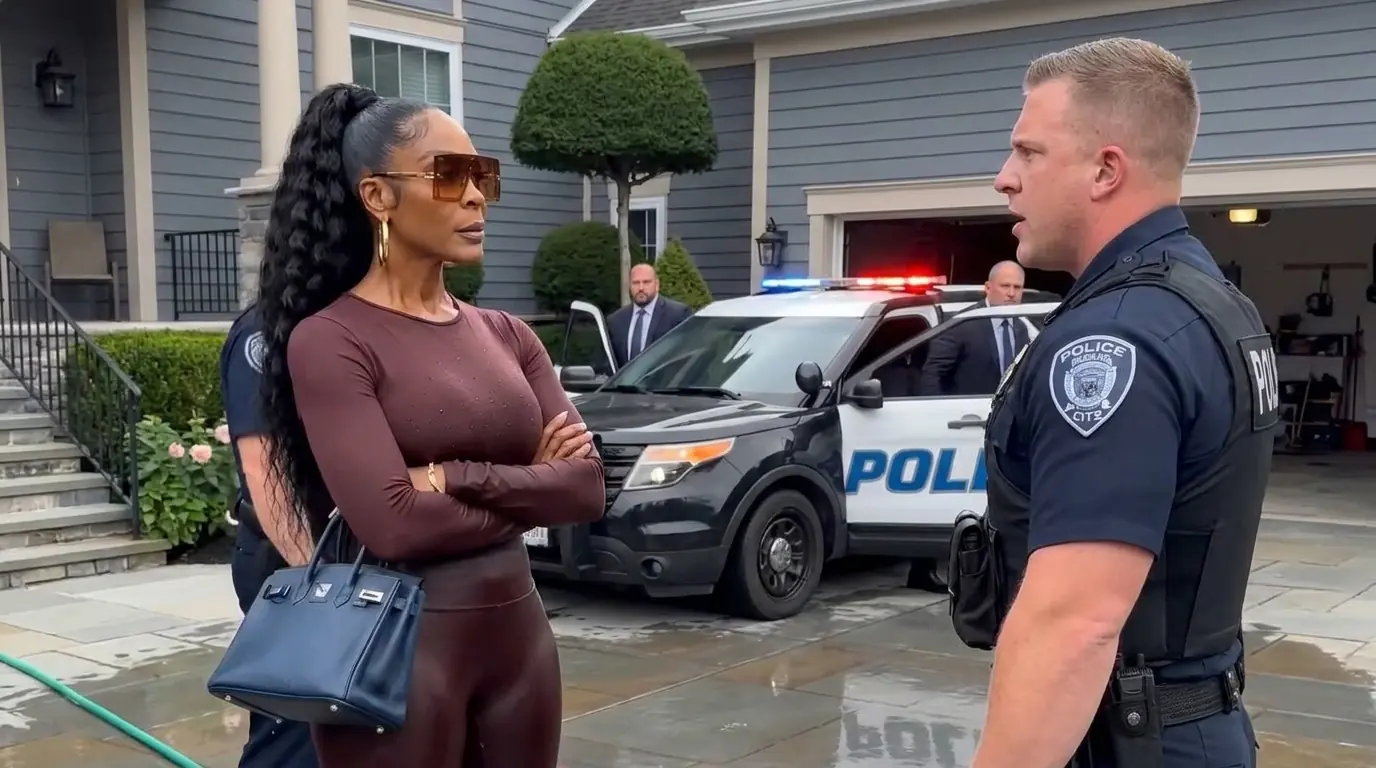
Dr. Camille Avery had been watering the hydrangeas behind her new house for maybe twelve minutes when Officer Eric Danner walked through the side gate without knocking. She did not hear the patrol cruiser stop because the stone wall surrounding the backyard blocked most of the street noise, while the soft rush of water covered whatever remained. Camille stood near a row of blue hydrangeas in cream trousers, a rust-colored blouse, dark sunglasses, and loafers entirely unsuited for yard work. When she noticed the officer, she released the nozzle trigger and asked, “Can I help you?”
Danner did not answer the question. He was a white man in his mid-forties with a thick neck, close-cut blond hair, and the square posture of somebody accustomed to entering conversations with the assumption that everyone else would adjust around him. A second white officer named Colin Pierce entered several steps behind him and stopped near the gate. Danner looked from Camille to the three-story stone house behind her and asked, “Who are you?”
Camille studied him for a moment before giving her full name. Danner asked what she was doing on the property, and she answered that she lived there. He looked toward the French doors leading into the kitchen, where unopened moving boxes were visible behind the glass. “This house is supposed to be vacant,” he said.
“It stopped being vacant Thursday,” Camille answered. She had purchased the house six weeks earlier and moved in three days ago, though half of her office was still trapped inside cardboard boxes and her dining room table had not yet arrived. The garden was the only part of the property that already felt settled because it required no furniture and no decisions about where photographs belonged. Danner did not appear interested in any of that.
He asked whether Camille had identification. She told him her wallet was inside the kitchen. When she took one step toward the rear doors, Danner held out his hand and ordered her to stay where she was. Camille stopped immediately and said, “You just asked where my identification is.”
“I asked a question,” Danner replied. Camille nodded. “And I answered it.”
Officer Pierce looked toward the moving boxes inside the house and then toward the electronic keypad mounted beside the garden gate. He seemed to be thinking through the details instead of simply listening to Danner’s tone. “Maybe we should run the property owner,” Pierce said. Danner did not even turn toward him.
“In a minute,” he said. Then he looked at Camille and asked how she entered the backyard. Camille pointed toward the keypad and said she used the gate code.
Danner asked how she knew the code. Camille almost smiled because the question had crossed from cautious to absurd so quietly that he seemed not to notice. “I programmed it Friday morning,” she said. Pierce looked down for half a second, perhaps to hide a reaction.
Danner’s expression only hardened. “You’re saying you own the whole property?” Camille looked at the house, pool, detached garage, and gardens surrounding them before returning her gaze to him. “Yes.”
“Do you have proof?” he asked. Camille said the closing documents, insurance policy, property-tax records, and identification showing the address were all inside. Danner gave a short laugh. “Convenient.”
Camille took off her sunglasses. “Where exactly would you expect someone to keep real-estate documents?” Danner said she needed to stop answering questions with questions. She replied that he had an easy way to verify ownership without entering the house. “Property records are public, and I already gave you my legal name.”
Danner’s jaw tightened. “Stop telling me how to do my job.” Camille’s expression became completely still. She had spent twenty-five years working around municipal government, police organizations, civilian oversight boards, public budgets, misconduct investigations, and city leadership. She knew the difference between an officer gathering information and an officer becoming irritated because information arrived from the person he had already decided to distrust.
Pierce reached toward his radio. “I can check it.” Danner finally looked at him. “Not yet.”
Camille noticed the choice. Verification was available, simple, and directly connected to the original complaint, yet Danner preferred more confrontation first. She asked what exactly the caller had reported.
“A suspicious person entering a vacant residence,” he said. Camille looked around the backyard. “You found me watering flowers.”
“You were seen entering through the side gate.” “Because it is my side gate.”
“You keep saying that.” “Because it remains true.”
Danner pointed toward the green hose in her hand. “Put that down.” Camille glanced at it and asked why. “Because I said so.”
“It’s a garden hose.” “I know what it is.”
“Then what safety problem does it create?” Danner stepped closer. “Put it down.”
Camille considered whether arguing further was worth anything and decided it was not. She placed the nozzle carefully on the flagstone path and moved both hands away from it. Danner then pointed toward the open gate and ordered her to walk over there.
“No,” Camille said. Danner blinked. “Excuse me?”
“I’ll stand here while your partner verifies ownership.” Danner said she was being temporarily detained while they investigated why she was on the property. Camille corrected him quietly. “My property.”
“That has not been confirmed.” “Because you have repeatedly chosen not to confirm it.”
Danner’s face reddened. “You’ve got an answer for everything.” Camille folded her arms. “Facts have that effect.”
Pierce coughed into one fist and looked away. Danner noticed. “Something funny?”
“No, sir.” Pierce reached for his radio again. “But I really think we should run the address.”
Danner stared at him for a moment, then nodded sharply. “Fine.” Pierce stepped several yards away and contacted dispatch while Danner remained with Camille.
The older woman who lived across the street appeared outside the gate at almost the same moment. Camille recognized her as Judith Palmer, a retired real-estate broker in her late sixties who had introduced herself during move-in. Judith had watched furniture being carried into the house and asked Camille whether she was the designer handling the new owner’s interiors. Camille had smiled and told her she was the new owner herself.
Apparently that conversation had not survived the weekend. Camille looked toward Judith and asked, “Did you call the police?” Judith shifted uncomfortably. “I was concerned.”
“About what?” Camille asked. Judith said she saw someone entering the side gate of a house that had recently been empty.
“You saw me move in Thursday.” Judith looked toward the officers. “I saw movers.”
“You saw me.” Judith did not answer.
Camille continued, “You asked whether I was the interior designer.” Judith’s cheeks reddened. “I remember.”
“And what did I tell you?” Judith looked down. “That you owned the house.”
Danner raised one hand. “Stop questioning the caller.” Camille turned toward him. “Her call is why two armed officers are standing in my backyard.”
“You answer our questions.” Danner’s tone sharpened. “You don’t run the investigation.”