Daniel Reed had been photographing the ocean for less than four minutes when someone put a hand on his shoulder.
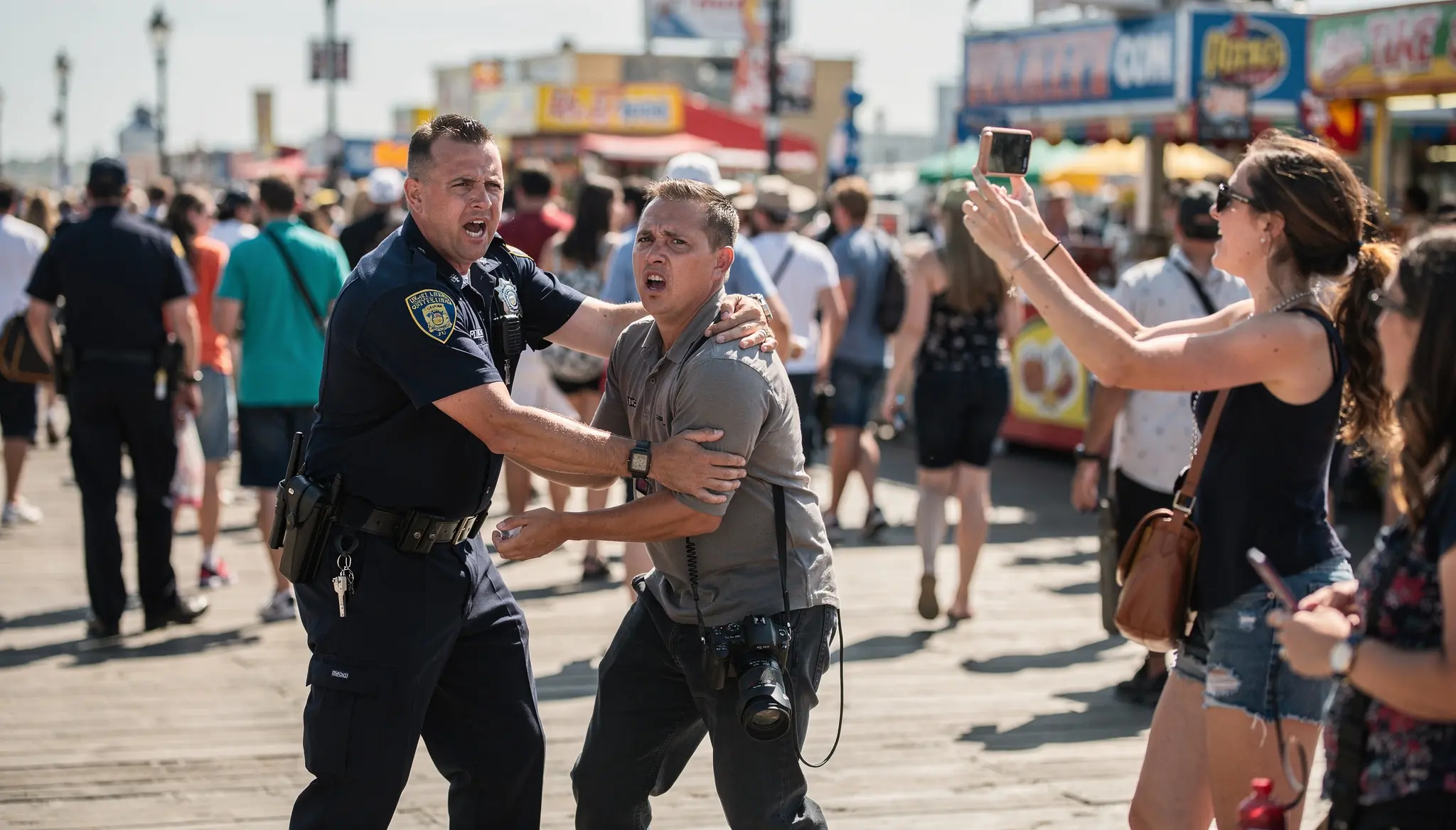
He lowered the camera immediately.
The sun was dropping behind the Pacific, turning the water copper and making every window along Harbor Point Boardwalk glow orange. Families crowded the wooden promenade with ice cream, beach towels, strollers, and paper trays of fried food. Music drifted from the old carousel building fifty yards behind him.
Daniel turned.
The man standing there wore a dark Lakehurst Police uniform.
Sergeant chevrons marked both sleeves.
His nameplate read KESSLER.
He was perhaps thirty-eight, broad across the shoulders, with closely cropped blond hair and a tattoo running from beneath one sleeve almost to his wrist.
“You need to stop taking pictures.”
Daniel stared at him.
“What?”
“You heard me.”
Daniel glanced toward the ocean.
Then toward the camera hanging from the black harness across his chest.
“I’m photographing the railing.”
Sergeant Ryan Kessler looked past him.
“Why?”
Daniel hesitated.
He should have prepared a simple answer.
He had prepared dozens.
None sounded normal when spoken aloud.
“I’m comparing it to older photographs.”
“What older photographs?”
Daniel looked toward the northern section of the boardwalk.
A hundred yards away, beyond a souvenir shop and a row of benches, the public promenade narrowed where an old maintenance access ramp descended toward the beach.
That was where Ava died.
Four years, two months, and nine days earlier.
Daniel looked back at Kessler.
“Personal photographs.”
The officer studied him.
“Boardwalk security called.”
“About me?”
“Yes.”
Daniel almost laughed.
He had been on the property less than fifteen minutes.
“What did they say?”
“A man with professional camera equipment was taking close photographs of the maintenance barriers.”
“That’s accurate.”
“You were also photographing people.”
“People are on the boardwalk.”
“That isn't an answer.”
Daniel tightened one hand around the camera grip.
“I’m not photographing specific people.”
Kessler looked toward the large telephoto lens.
“That thing says otherwise.”
Daniel had spent twenty-three years behind cameras.
He had photographed hurricanes, courthouse steps, championship games, school graduations, wildfires, weddings, protests, birds, architecture, and children running through sprinklers.
He knew what suspicion looked like.
He also knew when suspicion had already become conclusion.
“The lens is for compression.”
Kessler frowned.
“For what?”
“Perspective.”
Daniel pointed toward the rail.
“I’m matching an older focal length.”
The officer stared.
“You have ID?”
Daniel reached slowly toward his back pocket.
“Yes.”
He handed over his license.
Kessler read.
“Daniel Reed.”
“Yes.”
The officer looked up.
Something changed.
Not recognition exactly.
A delay.
Daniel saw it.
Kessler looked at the license again.
Then at Daniel.
“Daniel Reed.”
“Yes.”
The officer’s expression tightened.
“You're Ava Reed’s father.”
There it was.
Daniel felt the old pressure in his chest.
“Yes.”
Kessler looked toward the northern ramp.
Then at the camera.
“You should've said that.”
Daniel’s voice became colder.
“Why?”
Kessler handed the license back.
“Because now I understand what you're doing.”
“Do you?”
“You're documenting the old accident site.”
“Yes.”
“Why?”
“Because I want photographs.”
“For another lawsuit?”
Daniel stared.
The question came too quickly.
“That's not your concern.”
Kessler folded his arms.
“The city has already dealt with that case.”
Daniel felt heat rise behind his face.