Marin Holloway was 22 years old when she buried her father on the same hill where she'd buried her mother three years before. She had no money, no husband, no neighbors willing to help, and four acres of steep rocky ground that everyone in the Caro Valley agreed wasn't worth the trouble of walking across. The richest man in the valley, Gideon Mercer, had already offered to take it off her hands twice. She'd said no both times, though she couldn't have told you exactly why.
She was about to find out. The funeral was small. That was the honest word for it. Small and quiet in the way that felt less like peace and more like absence.
A handful of neighbors stood at the gravesite on the upper slope of the Holloway property, their boots sinking slightly into the soft earth near the fence line, their faces carrying that particular expression people wear when they don't know what to say and haven't bothered to think of anything. Pastor Dean said a few words. The wind took most of them. Marin stood at the head of the grave and did not cry.
She had cried already the night before, alone in the kitchen with the lamp turned low and her father's old coat folded across her lap, and she didn't have much left in her. What she had now was a dull, heavy weight behind her sternum that felt like it might be there for a while. Her father, Thomas Holloway, had been 54 years old. He'd spent the last six years coughing into rags and pretending he wasn't.
The land he'd worked, if you could call it working, was four acres of hillside above the valley floor, all slope and stone and thin soil that crumbled when you tried to dig more than 8 inches down. He tried corn twice. It had come up stunted both times. He tried keeping a small flock of chickens, but the foxes had found them before the second winter.
Mostly he'd done odd work for the lowland farms, hauled freight, fixed fences. He died with $11 in a tin box under the floorboard and about 60 wooden barrels stacked against the north side of the barn, which he'd collected over the years with some vague intention he'd never gotten around to explaining. After the last neighbor left, Marin walked back to the house, sat down at the kitchen table, and stared at the wall for a long time. The land was hers now, all four acres of it.
She could sell. That was the obvious thing. Gideon Mercer had made it plain enough, plain as a man can make something without actually saying it outright, that he wanted this parcel. He owned the 300 acres of bottomland below her, the richest soil in Caro Valley, black and deep and flat as a table.
He ran the grain operation, the strawberry rows, two of the dry goods suppliers, and had some arrangement with the Holt Mountain Hotel up the pass that none of the smaller farmers fully understood but suspected wasn't in their favor. When a man like that wanted your four acres of rock and slope, it was generally because he intended to either use it for something or prevent someone else from using it. Marin hadn't figured out which yet. She got up from the table and went outside.
The afternoon sun was coming in low from the west, throwing long shadows across the hillside, and the old barrels along the barnwall glowed reddish gold in it. There were 58 of them, she'd counted once. Oak staves held by rusting iron hoops. Most of them sound enough still, some with cracked staves or split rims.
They smelled like the inside of old wood, dry and faintly dark, like something that had been fermenting for a long time and had finally been allowed to rest. She sat on the bottom rail of the fence and looked at them for a while. She thought about her mother. Eleanor Holloway had died when Marin was 19, a fast and merciless fever that took her in 11 days.
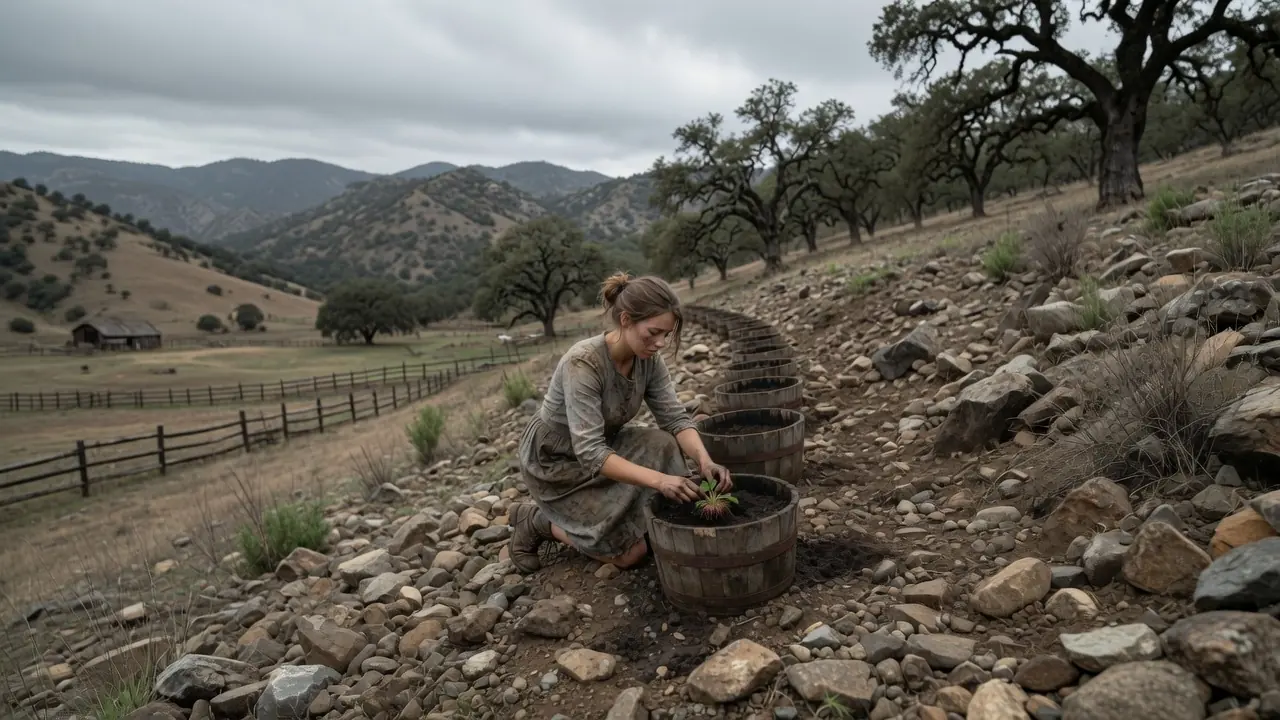
What Marin remembered most clearly about her mother more than her face, which she was beginning to lose in the way you lose things when you don't let yourself look at them too directly, was her hands. Large brown, capable hands, always in motion, always doing something. And a summer afternoon when Marin was maybe seven or eight, when Eleanor had taken an old zinc wash tub with a rusted hole in the bottom, plugged the hole with a cork and a rag, filled it with soil and compost, and planted strawberries in it on the south-facing slope near the house. They'd grown absurdly well, better than anything in the garden.
Marin remembered asking why. Because they're up off the ground, her mother had said the cold air rolls down at night and goes right under them. the Reigns doesn't sit on the roots. The berries hang clean. Marin had forgotten that until right now.
She looked at the barrels. She looked at the hillside. She was still sitting there when the light went completely. She didn't make the decision all at once.
It came in pieces the way most real decisions do. A thought here, a memory there, a slow accumulation of something that eventually got heavy enough to tip the scale. The first piece came three days after the funeral when Gideon Mercer rode up the hill. He came alone, which she supposed was meant to seem casual.
He was a large man, not fat, but solid, with a square jaw and gray coming into his dark hair at the temples. He dressed well for a farmer, pressed shirt, good boots, a hat that hadn't been rained on too many times. He had the kind of face that was accustomed to being agreed with. He dismounted at the gate and took off his hat and held it in front of him, which was either respect or performance.
She hadn't decided. "Miss Holloway," he said. "I'm sorry about your father." "Thank you," she said. "He was a hard worker." "She didn't say anything to that." Mercer looked out over the slope, doing the slow survey of a man calculating rather than admiring.
"I won't waste your time," he said. "You know, I've been interested in this property. The offer I made your father stands more than stands. I'm prepared to improve it given your circumstances.
My circumstances, she said, "You're alone up here. Winter's coming. This ground?" He paused, choosing his words with the care of a man who's learned that certain things sound better left implied. "It's not easy ground to work alone." "What's your number?" she said.
He told her. It was more than she'd expected. Not enough, but more than she'd expected. And the fact that it was more than she'd expected made her suspicious rather than grateful.
Men like Mercer didn't overpay for things unless they thought they were underpaying. I'll think about it, she said. Something moved behind his eyes. Not anger.
Not quite. More like recalculation. Of course, he said. He put his hat back on.
Don't think too long, Miss Holloway. Winter has a way of making decisions for people. He rode back down the hill. Marin stood at the gate until he was out of sight, then turned and looked at the barrels.
The second piece came from an unlikely place, Holt's Dry Goods, where she'd gone to arrange credit against the fall and winter. She didn't have enough cash to get through to spring without either selling the land or securing a line of credit she wasn't sure anyone would give her. She sat across from Everett Holt, no relation to the hotel, despite what newcomers always assumed, and listened to him explain with genuine discomfort that the store's credit arrangements were generally extended to established farming operations with projected yields. You don't have a crop, he said.
Not yet. And the land up there, he trailed off. Is mine, she said. Yes.
He looked at his hands. I'm sorry, Marin. It's not personal. She walked out of the store and stood on the boardwalk for a minute, watching the wagon traffic move through the main street of Caro Crossing.
Down at the far end of the street, she could see Mercer's grain warehouse, solid and whitewashed, taking up the better part of a block. She thought about what it meant that one man could own that much of a town without anyone seeming to notice. She went home. She took out a piece of paper and a pencil and sat at the kitchen table and tried to think what she had.
Four acres, hillside, thin soil, rock underneath, slope facing mostly south and southwest, 60-odd barrels, a barn that needed work but was standing, the remnants of a kitchen garden. $11. What she needed was income. Before winter became a real problem, before Mercer's patience ran out, before the $11 was gone, she wrote the word strawberries and then sat looking at it. She spent two weeks reading everything she could find about strawberries, which wasn't much.
The county almanac had two pages. A pamphlet from an agricultural bureau in the state capital, which she'd ordered by mail and which arrived bent and water stained, had a section on soil preparation, and another on pest management. Neither said anything about barrels. She thought about that afternoon with her mother in the wash tub, turned it over in her mind, tried to understand what she'd actually seen rather than what she'd remembered.
The berries had hung clean. The roots hadn't sat in standing water. The cold air at night, and on a hillside, the cold air always rolled downhill, pooling in the low spots, had passed right beneath them. She went out to the barrels and started examining them one by one.
Of the 58, 37 were sound enough to use. She'd need to knock out the bottom staves of each one, fit them over cut sections of fence post, and pack them with a mixture of soil and the composted kitchen scraps she'd been accumulating. She'd need to source strawberry crowns. That was the main expense, and it couldn't be avoided.
She wrote down numbers until the numbers started to make sense, barely. Then she went to see Dela Marsh. Dela Marsh was 61 years old and had been farming the same 12 acres on the eastern edge of the valley for 34 years. First with her husband and then alone after he died.
She grew table vegetables mostly, some corn, a small strawberry patch that she sold at the crossing market every July. She was the kind of person who had an opinion about everything and shared it whether you asked or not, which Marin had always found either comforting or exhausting depending on the day. Marin laid out what she was thinking. Dela listened without interrupting, which was either a good sign or a sign she was too skeptical to bother with questions.
Barrels, Dela said when Marin was finished. Yes, on that hillside. Right. Dela was quiet for a moment.
Your daddy ever try anything up there besides the corn? Chickens. And how'd that go? Foxes.
Dela made a sound that was not quite a laugh. She picked up her coffee cup and looked into it. Strawberry crowns are going to cost you. I know.
That's why I'm here. You want me to sell you crowns on credit? Against a share of the first year's harvest. Say 20%.
Dela looked at her. 20% of what? If this doesn't work, there's nothing. Then you've lost the crowns.
Marin said, same as if you'd eaten them yourself. Dela's mouth did something that might have been the beginning of a smile. That's a cold piece of arithmetic. It's honest.
Dela set down her cup. How many barrels did you say? 37 usable. Maybe 40 if I patch a few more staves.
You'll get a summer crop and a fall crop if you get them in by mid-April. That's what I need. 20%'s not enough, Dela said. 25.
22. 25, or you go buy them somewhere else at full price. Marin breathed out through her nose. Fine.
25. Dela nodded once, the way people nod when they've gotten what they wanted, but aren't going to make a show of it. And Marin, what? Don't tell anyone what you're doing until you have something to show.
People around here have a way of talking things to death before they ever get built. She started in March when the ground was still cold, but the worst of the mud had dried. She worked alone, which she'd expected, and which was fine because she didn't particularly want help from anyone who might talk. Knocking out the bottom staves of a barrel was harder than it sounded.
The wood had swollen and contracted through too many winters, and the iron hoops were corroded into the grain. She broke two mallets before she found the right angle. A sharp downward strike at the joint between the stave and the bottom ring, then work around the circumference. The first barrel took her most of an afternoon.
By the 10th, she had it down to 40 minutes. By the 20th, she could do it in 20. She cut the fence posts into two-foot sections and drove them into the hillside at intervals using a pattern she'd sketched out on paper and then revised three times before she felt like the spacing was right. Staggered rows to let the sun reach each barrel with enough clearance between them to walk through.
She set the barrels on the posts. They wobbled at first. She built small timber frames around the base of each post to stabilize them, working by feel as much as by geometry. The soil mixture took longer than she'd expected.
She had the kitchen compost, which was good, but not enough of it. She found that the thin hillside soil, for all its reputation for worthlessness, had a gritty, fast draining quality that was actually useful. Mixed right, it wouldn't compact around roots or hold standing water. She hauled gravel from the dry creek bed at the bottom of the property to layer in the bottom third of each barrel for drainage.
She found a pocket of dark loam near the old chicken enclosure that the animals had enriched over years with their manure and worked it in with the rest. She planted the crowns on the 12th of April, a cold morning with a low gray sky and the smell of rain somewhere to the west. She worked down the rows one by one, setting each crown just below the soil surface the way Dela had told her, firming the soil around each one with her fingers. Her hands went numb around midm morning, and she kept working.
By late afternoon, she had 71 barrels planted. She'd managed to repair a few more staves, after all. And she stood at the top of the hill and looked down the slope at them. All those dark circles in their timber frames, and felt something she couldn't quite name, not confidence.
She wasn't confident. There was too much she didn't know, too much that could go wrong. What she felt was more like commitment. the particular clarity of having done something you can't undo and finding to your own surprise that this steadies you rather than frightens you. She went inside and ate her supper and didn't think too much about what would happen if none of it worked.
And May came wet and cold, and Marin watched the barrels with an attention that was close to obsessive. She checked each plant every morning, looking for the pale green of first growth, the thin uncurling of new leaves. She watched for rot, for the gray white of fungal infection, for the yellowing that meant nitrogen problems. She'd read about all of these.
She'd never seen them on a plant she'd grown herself. The first leaves appeared in the second week of May, small and bright and vulnerable. She stood in the row and looked at them and felt something loosen slightly in her chest. The first person to comment on the barrels was a boy named Kobe Stettler, about 14, who came up the hill one afternoon on some errand for his father, and stopped at the fence line to stare.
"What are those?" he asked. "Strawberry barrels," Marin said. He looked at them for a long time. "Why aren't they in the ground?" "Because the ground here isn't any good," he thought about this.
"So, you just put dirt in barrels instead?" "That's about right. He looked at her like she'd said something interesting but possibly wrong. "Does it work?" "Ask me in July," she said. He went away.
She heard him laughing to himself about halfway down the hill. But the mockery, when it came in earnest, arrived through the usual channels, the grain store, the market stalls, the particular form of public conversation that Caro Crossing conducted over fence posts and across wagon beds. Marin heard about most of it secondhand through Dela, who relayed it with a dry neutrality that suggested she'd heard worse things said about worse ideas. Barrett Voss says you've lost your mind.
Dela told her one afternoon in early June. Barrett Voss can't keep his cornfield free of bindweed, Marin said. Pete Cullins calling you the barrel girl. People have been called worse.
Dela looked at her over the rim of her coffee cup. You're not bothered. I'm bothered, Marin said. I just don't see what being bothered is going to change.
What she didn't tell Dela, what she didn't tell anyone, was that the plants were coming along in a way that made her heart do something uncomfortable every time she walked the rows. They were dense and green and vigorous in a way she hadn't quite let herself expect. The south-facing slope caught sun from early morning to late afternoon, and the barrels held the warmth in the soil through the cooler nights. The drainage was exactly right.
She could see the difference in health between these plants and the small strawberry bed she'd kept in the kitchen garden below the house. These were darker, fuller, the leaves a deeper green that spoke of roots that had found what they needed. By mid June, the first berries were forming, small and hard and white green, but there she went inside and sat at the kitchen table and put her hands flat on the surface and breathed. The man from Holt Mountain Hotel arrived on a Tuesday in the 3rd week of June, which was not something Marin had expected.
His name was Frederick Lane, and he had the manner of a person accustomed to traveling in order to assess things. Calm, thorough, professionally pleasant. He wore a town coat that was slightly wrong for the valley, as if he'd bought it for somewhere else and never gotten around to replacing it. He'd heard about the barrels from somewhere.
He didn't say where, and Marin didn't press. He walked the rows with her, stopping to look at the berries at close range, occasionally crouching to examine the way the fruit hung from the plants out in the air, clean and dry, no contact with soil or mulch or the accumulated moisture of a flat field row. He picked one that was just coming ripe and held it up. No mud, he said.
That's the point. Marin said the berries from the valley operations come in with soil on them 40% of the time. We wash them, but it affects the flesh. These wouldn't need washing.
No. He set the berry on his palm and looked at it. What's your anticipated volume at full harvest? She told him.
She'd calculated it out several times. He nodded slowly as if checking her number against one he'd already formed. The hotel serves approximately 200 guests per night through July and August. We use fresh fruit at breakfast and in the dessert program.
The current supplier, he paused. Let's say the current arrangement has reliability issues. She knew who the current supplier was. Everyone in the valley knew.
I can guarantee consistent quality. She said, "I can't guarantee volume beyond what the plants will produce, which is what I told you. I won't promise something I can't deliver." Something shifted in Lane's face. Not surprise exactly, but a kind of attention. the look of a man who's been told several things over several days that turned out to be less than accurate and has now heard something different.
"That's an unusual approach for a sales conversation," he said. "I'm not selling you something that doesn't exist," Marin said. "I'm telling you what I have." He was quiet for a moment, looking out over the slope. The rows of barrels on their timber frames, the whole strange, jury-rigged, improbable operation spread across the hillside that everyone in the valley had agreed was worthless.
I'd like to discuss terms, he said. They talked for an hour at the kitchen table. Lane was careful and specific in the way that people are when they're spending someone else's money and have to be able to defend the decision later. He asked about consistency, about delivery schedule, about what happened if yield fell short.
Marin answered everything directly. When she didn't know the answer, she said so. The number he put on the table was almost double what the valley's berry growers were getting through standard market arrangements. The difference was the premium for quality, for the clean fruit, for the consistency, for the guarantee that what he ordered would arrive in the condition he'd specified.
She didn't say yes right away. even though she wanted to. She went through the terms carefully, pushed back on two clauses that seemed to leave her exposed if the hotel changed its dessert program, and got one of them revised. Then she said yes. After he left, she sat at the table for a long time. $11 and four acres of rock.
She thought about her father, who had tried and tried and gotten nowhere, not because he was foolish or lazy, but because he'd been trying to do what everyone else was doing. and what everyone else was doing on that hillside was the wrong thing. She thought about her mother's hands and the wash tub and the berries that had hung clean in the air while everything below them sat in mud. Land is not defined by what it is. Eleanor Holloway had told her once, though not in those words.
Her mother had not been a woman for aphorisms. She just pointed at the wash tub and said, "See, it grows where you make it grow." Marin got up and went outside. The evening was coming in warm and still, the kind of summer evening that felt like it might hold, like the warmth had soaked into the hillside deep enough to last through the night. The barrels stood in their rows, the plants green and heavy, the first red berries showing at the ends of the runners.
She walked the rows in the fading light. She checked each plant the way she'd been checking them every evening since May, looking for problems, looking for anything she'd missed. Everything was all right. For now, everything was all right.
She went in, ate supper, and slept better than she had in months. The first real harvest came in the last week of June, earlier than she'd projected, which meant the warmth had done what she hoped. She picked for three days straight, working from first light until the light failed, filling the shallow wooden trays she'd made over the winter from scrap lumber. The berries came off the plants clean and dry and heavy, a deep red all the way through that she hadn't quite expected.
She'd assumed the first year crop would be lighter, less developed. She loaded the trays into the wagon and drove up the pass road to Holt Mountain Hotel on a Friday morning, which was earlier in the week than Lane had specified, and she stopped at the kitchen entrance and asked for him. He came out and looked at the trays and didn't say anything for a moment. These are first season plants, she said.
I know, he said. He picked up a berry and turned it over. Clean on all sides, stem end and bottom both. No soil mark, no bruising, the flesh firm and uniformly red.
This is better than I expected. They're not all this size, she said. The sizing's variable. I told you that.
I remember. He looked up at her. The kitchen is going to want to see more. Can you increase volume for next week? within what the plants will give me.
I can't force them." He nodded. "The chef wants to speak with you." She had not expected that. The chef was a woman named Marguerite, small and precise, who came out of the kitchen with flour on her apron and held one of the berries up to the window light and then ate it without ceremony and stood still for a moment. "These are exceptional," she said in a tone that was neither warm nor cold but simply accurate.
"Thank you," Marin said. What variety? Everbearing. I can get you a second crop in September.
Marguerite looked at her. You can guarantee September delivery. Same as I guaranteed June. What the plants produce, I deliver.
I won't guarantee a number I can't hit. Marguerite looked at Lane. Something passed between them that Marann couldn't fully read. "We'll take everything you bring," Marguerite said.
Marin drove back down the pass road with empty trays and a signed receipt in her pocket. And when she hit the valley floor, she turned south on the main road past the long rows of Mercer's bottomland fields. The flat black soil, the tidy rows of conventional berry plants set in the ground in the usual way, the irrigation channels running between them. And she did not stop.
She turned up the hill road and went home. By the time she reached the property, she could see what she'd built from the approach. the timber frames along the slope, the barrels dark against the pale hillside, the whole strange architecture of it, improbable and stubborn and surprisingly beautiful in the afternoon light. She unhitched the horse and put away the wagon and went inside. Tomorrow she'd checked the second planting block for ripeness.
There were more berries coming. The everbearing variety was living up to its name, setting new fruit as fast as she could pick. She had calculations to run, delivery schedules to map, supply logistics to think through. She had work.
She sat down at the table with her ledger and her pencil and got to it. Outside, the evening came down easy over the hillside, and the barrels stood in their rows against the fading sky. All those dark circles holding the earth that held the plants that were against every expectation anyone in the valley had bothered to form, doing exactly what she'd needed them to do. The contract with Holt Mountain Hotel was not a secret Marin managed to keep for long.
She hadn't tried especially hard to keep it. She'd simply gone about her work without announcing anything, the way her father had taught her by example, if not by words. You didn't talk about what you were doing until you had something to show. Talking too early was how people got ahead of themselves, and getting ahead of yourself on a hillside with thin soil and a borrowed line of strawberry crowns was a fast way to end up with nothing but the embarrassment.
But Caro Valley was not a place where information moved slowly. By the second week of July, when she'd made three deliveries to the hotel and had a fourth scheduled, the story had gotten around. Not the full story. People rarely got the full story, but enough of it.
The barrel girl from up on the Holloway slope had somehow talked her way into a supply deal with the hotel up the pass, and she was getting premium prices for it. The reactions sorted themselves out more or less the way she'd expected. Dela Marsh came by on a Thursday afternoon, ostensibly to check on the crowns she'd supplied, and stood in the middle of the upper planting block, looking at the berries with an expression that was trying not to be impressed and not quite succeeding. She picked one, turned it over, set it back.
These are better than mine, she said. Different conditions, Marin said. Don't be modest. You know what you've got here.
Marin looked at the row. She did know the everbearing plants were on their second flush now. The first harvest taken clean and a new set of berries forming behind it. Smaller than the first wave, but still good, still firm.
Still the deep red that Marguerite the chef had held up to the window light. How's the credit arrangement sitting with you? Marin asked. Fine, Dela paused.
Better than fine. You going to be able to make the 25%. Yes. When?
End of August, after the second harvest settles, Dela nodded. She looked out over the slope, the barrels in their rows, the whole arrangement that she'd put 25% of her crown stock into without being entirely sure it wasn't a waste. You thought about what you're doing next year? She asked some.
You're going to need more barrels. I know. And more crowns. I know.
Dela looked at her sideways. You going to come to me for those or you going to let me wonder about it? Despite herself, Marin smiled. I'll come to you.
The other reactions were less warm. Oh. Pete Cullen, who farmed 40 acres of bottomland 2 mi south and had been calling her the barrel girl since May, upgraded his commentary in July to something Marin heard about through three different people before the week was out. The gist of it was that she'd gotten lucky with a city man who didn't know the valley. that the hotel deal wouldn't last past the first season when Lane figured out what real berry farming looked like, and that the whole barrel operation was one bad storm away from tipping over and rolling down the hill.
She heard this and didn't say anything about it to anyone, which was harder than it sounded. What made it harder was that Cullen wasn't entirely wrong about one thing. She was exposed. The barrels were stable in the frame she'd built, but a serious wind event could cause problems.
She'd been thinking about that since June when a late spring storm had come through and she'd spent half the night in the upper field with a lantern checking the structures by hand. Nothing had failed, but she'd felt for the first time the particular vulnerability of having built something unconventional. No one else had done this, which meant no one else had learned from the failures yet, and she was going to be the one to learn them. She spent two days in late July reinforcing the frames.
She added cross bracing between the posts, drove the uphill stakes deeper, tied the whole structure together with heavy wire in a way that made it look less like a farm and more like a piece of machinery. It was not elegant. It worked. She was on her knees in the second row driving a stake when she heard a horse on the lower track.
Mercer didn't come up to the planting this time. He stopped at the fence line, the same place had stopped, and waited. She finished driving the stake before she stood up, which was deliberate enough that she knew he'd register it. She walked down to the fence.
I hear you've got a deal with Lane, he said. No preamble. His hat was in his hands again, which she was starting to think was just a habit rather than any particular sign of respect. I do, she said.
He came to me first, Mercer said before he came up here. Did he tell you that? No. I offered him a better volume, more consistent supply than four acres of hillside can produce.
Then why is he buy-ing from me? Something in Mercer's expression shifted. Not quite displeasure, but the precursor to it. The slight compression around the eyes of a man who is used to being able to answer questions and has encountered one he can't.
The quality argument, he said, he's got some idea about the hotel's image. Premium sourcing, a city notion. The berries are better, Marin said. That's not a notion for now.
He looked past her at the barrels. She could see him assessing, not admiring, never admiring, but calculating. You know what your problem is going to be, Miss Holloway? She waited.
Scale, he said. Lane wants volume. Right now, you're a novelty to him. Come spring, when he's planning for a full season, he's going to want to guarantee you can't make off four acres.
He'll come back to me. Maybe, Marin said. Not maybe. His voice had shifted slightly, still polite, but with something underneath it now.
Something that had stopped pretending it wasn't there. I'm going to give you the same offer I gave your father. Same number, same terms. You take it now before winter, and you walk away with enough to start somewhere else.
I'm not walking away, she said. You're going to be 23 years old trying to run a one-woman operation on four acres of rock. That's not a farm, Miss Holloway. That's a very slow failure.
She looked at him for a moment. She thought about her father and about the $11 in the tin box, and about the way Thomas Holloway had tried and failed at things that were the wrong things to try on this land, and how the right thing had been here all along in the shape of 60 barrels against a barn wall. "You'll excuse me," she said. "I've got work." She turned and walked back up the slope without looking back.
The trouble with Mercer, she understood even then, was not that he was wrong about scale. He wasn't wrong. The hotel contract was real, and Lane was pleased, but the quantities she was producing from 71 barrels were still modest compared to what a full lowland operation could turn out. She knew that she'd been running the numbers.
What Mercer was wrong about was the assumption that her only path was to compete directly on his terms. Volume against volume, acre against acre. She'd been thinking differently. The hillside above the valley had other properties besides her own.
To the north, separated by a rusted fence line and a stretch of scrub oak, was the Dever place, 12 acres of slope that had been unoccupied for 2 years since Howard Dever had sold off his equipment and moved in with his daughter in town. Before that, the Rains property, 8 acres with a similar aspect. And further north along the ridge, two or three other parcels that the valley's conventional wisdom had written off as marginal or worthless. All of them had the same south-facing exposure that her operation had.
All of them had the rocky, thin soiled, fast draining ground that made conventional farming nearly impossible. All of them were available, or could be at prices that reflected their supposed worthlessness. She'd been making notes in the back of her ledger for two weeks, trying to think through what a larger arrangement might look like. Not her owning all of it.
She didn't have that kind of capital and wouldn't for years, but something more lateral. Other farmers working their own land using the same methods. She hadn't said anything to anyone about this yet. It was still too unformed, too speculative.
She needed the second harvest to come in first. She needed to know what the numbers actually looked like. The second harvest came in mid August, running over 5 days because she was picking more carefully now, grading the berries by size as she went. The larger fruit for the hotel's dessert program, the smaller ones for the breakfast service, the irregulars held back for a new arrangement she'd been developing with Culver's General Store in the crossing, who'd agreed to take them at a reduced rate for retail.
She was in the lower block on the third day of picking when she heard someone on the hill road, not a horse this time, but footsteps, and she looked up to see a young man coming up the track with his hat in his hand, which meant he wanted something. He was maybe 25, broad-shouldered, with calloused hands and the particular kind of sunburn that came from working outdoors without bothering about it. She'd seen him before at the crossing market. She thought he worked for one of the farms east of town, though she couldn't remember which one.
Miss Holloway, he said, stopping at the edge of the planting. That's me. My name's Frank Reigns. My grandfather owns the property north of yours.
She stopped picking. I know the rains place. Yes, ma'am. He looked at the barrels, the same slow look she'd seen on a dozen faces over the summer, starting as skepticism and moving somewhere else as the eye took in the actual plants, the actual fruit.
He's been talking to Mercer about selling. Mercer's been after him since spring. I know, she said, though she only mostly knew. She'd heard pieces of it.
He doesn't want to sell, Frank said. He doesn't want to leave, but he can't figure out how to make the land pay. He tried corn three years running and it just it doesn't work up here. You know what the soil's like?
I do. I told him what you were doing. He didn't believe me until I described it. And then he still wasn't sure. but he asked me to come up and ask if you'd he stopped started again.
He'd like to know if you'd be willing to come talk to him. Marin set her picking tray down on the frame of the nearest barrel. She looked at Frank Reigns, who was holding his hat and waiting with an expression that was careful and a little apprehensive, the face of someone who doesn't know if they're going to be sent away or not. She thought about Mercer's voice, a very slow failure. when she said yes.
She went to see Eli Reigns the following Sunday morning. He was 70 years old, weatherbeaten down to something essential, with the kind of stillness that came from having been knocked around enough times that you'd stopped wasting energy on things you couldn't control. He met her at the gate of the Reigns property and led her up the slope without much preamble, which she appreciated. The land was similar to hers, rocky, pitched, south-facing, with that particular pale grayish soil over a limestone shelf.
There were no barrels, no structures, just the open hillside with some scrub and dried grass from the failed corn attempts. "Frank says you're making money," Eli said. "I'm covering expenses and then some." Marin said, "The second harvest will put me ahead for the first time with barrels. With barrels?" He was quiet for a moment, looking out over his slope.
I'm 70 years old, he said. I don't have the money to set up what you set up. I don't know that I have the strength for it either. What do you have?
She asked. He looked at her slightly surprised by the directness of it. What materials do you have on the property? She said, "What tools?
What resources?" He thought about it. 40 or 50 old whiskey casks in the far barn. Some post lumber I never used. A cart horse and the cart.
That's enough to start, Marin said. With your help, he said. It wasn't quite a question. I'd show you the setup.
Walk you through the soil mix, the spacing, the drainage layer. The rest is just labor. And what do you want for that? Eli asked.
And his voice had gone careful. Not suspicious exactly, but the carefulness of a man who'd been approached with offers before, and had learned that offers generally had a cost attached. Nothing right now, she said. If you get a contract with the hotel or any other buyer, I'd like a right of first conversation about coordinating delivery schedules.
That's it. He looked at her for a long moment. Why? Because if there are two of us producing quality berries from this hillside, we can make better guarantees to buyers than I can alone.
More volume, same standard. That's worth more to both of us than keeping it separate. Eli was quiet again. Down the slope, Frank was moving around the far barn.
And from here she could see him hauling something out, one of the old whiskey casks, heavy and awkward, setting it against the wall in the afternoon sun. Frank believes in this, Eli said. Frank's the one who came to find me, Marin said. He did.
Something softened slightly around the old man's eyes. Not sentimentality, but something adjacent to it. His father would have liked you," he said in a tone that indicated this was not a casual thing to say. "She didn't know what to do with that, so she just nodded." "All right," Eli said.
"Come back Saturday and we'll start." She came back Saturday and the Saturday after that and the one after that. Frank turned out to be a fast learner and a good worker. He had the kind of practical intelligence that picked things up by doing them rather than by being told, which meant she showed him something once and then watched him figure out the refinements himself. The old whiskey casks were better than her father's oak barrels in some respects, slightly larger with thicker staves.
They built 42 setups on the Reigns slope over three weekends. Working from first light until the early afternoon heat made it miserable. Eli watched from the shade of the barn on the first day, occasionally offering observations that she initially ignored, and then, after testing two of them, started listening to more carefully. He knew this hillside in the way that came from 70 years of proximity, where the water moved, where the frost pockets were, which sections of slope got wind from the northnorthwest in late fall.
This was information she hadn't had. She incorporated it into the spacing on the Reigns side, adjusting the row orientation to shelter the more exposed frames. You should have asked him first, Frank told her one afternoon when Eli was out of earshot. I know, she said.
He knows things about this land that aren't in any almanac. I'm learning that. Frank hammered a cross brace into place, checked the angle, hammered it again. He told Mercer no again, by the way, last week.
Mercer came out personally. Marin looked up. What did Mercer say? He said the offer was still good, but it wouldn't stay good forever.
He said the berry market was going to consolidate and the hillside properties would be worthless in 2 years. Frank's voice was even relaying rather than editorializing. Granddad told him he'd think about it. But he's not going to take it.
No. Frank looked down the slope. But Mercer doesn't know that, and I think Granddad likes it that way. Marin thought about Mercer's face at her fence line, the calculation behind his eyes.
He was watching. She knew. He was watching her, watching the rains place, watching the hotel arrangement. He was building a picture of something.
She just wasn't certain yet what the picture was. We should move faster on the planting, she said. Get the Reigns side and crowns before the end of September if we can. That's tight, Frank said.
I know you have a problem with tight. He looked at her. No, he said I've got a problem with slow. She went back to her work.
September came in dry and bright. The kind of fall weather that felt like a gift you were slightly suspicious of. The second harvest settled out better than she'd projected. The volume was up, the quality held, and Marguerite had sent word through Lane that the hotel wanted to extend the arrangement through the following season.
The number she offered for the extended contract made Marin sit very still at the kitchen table for several minutes before she wrote anything down. She sent word back through Lane she needed two weeks to consider. What she was considering was this. Lane wanted more volume.
He'd been careful not to say so directly, but the extended contract terms implied it. The pricing structure rewarded scale. If she could combine her operation with the Reigns side and get them both producing at full capacity by next summer, she could meet the volume target. that he was working toward without sacrificing the quality standard. But to do that, she needed the crowns in the ground this fall.
And to get crowns in the ground this fall on both properties, she needed more capital than the second harvest had given her. She went back to Dela. You want me to extend more crowns on credit? Dela said.
250 crowns. I'll take the delivery in three lots over the next 4 weeks. Dela looked at her ledger, then at Marin, then at her ledger again. You're expanding onto the reigns place.
Yes. Does Mercer know? Not yet. Dela set her pencil down.
When he finds out, he's going to move. He was going to move eventually anyway, Marin said. It might as well be when I've got something he can't easily undo. Dela was quiet for a moment.
Outside, the late afternoon sun was coming through the window at a low angle. The kind that made everything in the room look older and more serious than it was. 20% Dela said on the additional crowns. You've earned the discount.
Thank you. Don't thank me. If this goes bad, I'm out five years of crown stock and you're out of hillside. I know.
Marin said it's not going to go bad. You don't know that. No, she admitted. But I know it's not going to go bad for the reasons everybody thinks it will.
Dela looked at her for a moment with an expression that was hard to read. Something between exasperation and respect. the two things sitting together in the particular way they do when someone says something that is probably reckless and also annoyingly probably correct. Get out of here, Dela said. I'll have the first lot ready Thursday.
Marin got out of there. She drove back up this hill road in the long evening light, the wagon empty, the arrangement made, the future three weeks closer than it had been that morning. The Reigns slope was dark against the sky to the north, and she could see, if she looked, the outlines of the frames Frank had built along the upper section. New structures on old ground, waiting.
She turned up the Holloway track and went home. The crowns went in the ground on the Reigns slope the first week of October, and Marin worked every day of it alongside Frank. The two of them moving through the rows with a rhythm that didn't require much talking. Eli watched from his chair on the porch of the farmhouse. occasionally calling down something about the wind angle or the frost pocket in the northwest corner.
And Marin had learned by now to stop what she was doing and listen when the old man spoke. The extended contract with Holt Mountain Hotel was signed on a Wednesday in mid-October with terms that ran through the following two full seasons. Lane had driven down from the pass himself to deliver the signed copy, which she took as a sign that he considered it significant enough to do in person. They sat at her kitchen table, and he went through the clauses one more time, and she caught one ambiguity in the delivery schedule terms that he agreed to clarify in language more favorable to her before the copy went to the hotel's accounts office.
She was getting better at that, at reading contracts, at knowing which language mattered and which was filler, at understanding where the real exposure was. She'd learned it the hard way by reading everything three times and asking questions she was occasionally embarrassed not to know the answers to and writing things down until she understood them. After Lane left, she sat at the table with the signed contract in front of her and thought about Mercer. He hadn't come back to the fence line since August.
That was more significant than his coming would have been. Men like Mercer didn't go quiet because they'd stopped caring. They went quiet because they were doing something. She found out what he was doing in November from an unlikely source.
The unlikely source was Barrett Voss, the man who told Dela in June that Marin had lost her mind. He appeared at her gate on a cold Tuesday morning with his hat pulled down against the wind and an expression that suggested he would rather be anywhere else. I heard something, he said without preamble. She waited.
Mercer's been buy-ing barrels. He said it the way people say things they find ridiculous but have verified enough to believe. Not here. He's been sourcing them from the cooperage over in Mil Haven.
60 70 of them. He had them hauled out to his east field last week. Marin kept her face even. His east field.
The bottomland section. Yeah. He's setting up what he's calling a trial plot. Talking about it at the grain store like he invented the idea himself.
Voss paused. I thought you should know. She looked at him. He was a large man, red-faced, with the permanently squinted eyes of someone who'd spent 40 years looking into wind and sun.
He'd mocked her all spring and part of the summer. She wasn't sure what he thought he was doing now. Why are you telling me? She asked.
He shifted his weight. Because it doesn't sit right, he said finally. He got the idea from you, and he's not the kind of man who gives credit. She didn't say anything to that.
Also, Voss said, and now his voice had gone flat with something she recognized as real anger. He approached me last week about selling my South Acreage, offered me half what it's worth, and talked about it like he was doing me a favor. I told him no. He got He stopped.
He has a way of talking to people like they're not quite as smart as him. I know, Marin said. Yeah. He looked out over her slope, the barrels standing empty now in their winter frames, waiting for spring.
You going to be all right? I don't know yet, she said, which was honest. He nodded once, put his hat back on, and went back down the hill. She spent the rest of November thinking about Mercer's East Field, which she'd passed a hundred times on the valley road, and knew as well as she knew her own land.
It was good bottomland, flat, black soiled, well irrigated, everything her hillside wasn't. Which meant that if Mercer set up barrel towers on that field, he would have in theory the one thing she didn't have, volume. He could run 100 barrels on a single flat acre without the physical challenge of working a slope. He could hire labor for it. he could produce at a scale she couldn't match.
What he couldn't replicate, what she kept coming back to, turning it over in her mind through the cold evenings was the elevation, the hillside drainage, the cold air rolling down through the frames at night and passing clean under the berries. The particular combination of fast draining rocky soil and south-facing aspect that she'd understood only gradually by watching and adjusting over a full season. Barrels on flat bottomland would grow strawberries. She was fairly certain of that, whether those strawberries would be what Marguerite had held up to the kitchen window and called exceptional, that she didn't know yet.
Mercer didn't know either, she suspected. He was guessing, the way people guess when they see a result and think they understand the method without understanding the conditions that made the method work. She wrote this all down in the back of her ledger and then closed it and went to bed and didn't sleep well. December was quiet in the way that agricultural winters are quiet.
Not peaceful exactly, but compressed, a season of preparation and worry dressed up as rest. She repaired the frames on the lower slope that had taken the most weather damage, replaced three barrel staves that had cracked in the October cold, and spent two long afternoons adjusting the bracing on the Reigns side based on what Eli had told her about the northwest wind. Frank came by most Saturdays. Ostensibly, he came to check on the Reigns structures, but he usually ended up staying for coffee and conversation that had gradually stopped being purely about the farming and had become something harder to categorize.
She was aware of this in the way you're aware of a change in light, not abrupt, just a slow shift in the quality of things. She didn't do anything about it, which was partly because she was busy and partly because she didn't trust herself to be sure what she wanted. life had not been giving her the leisure to think about what she wanted versus what she needed. What she knew about Frank Reigns after three months of working alongside him. He was patient in a way that didn't come from passivity.
He'd give you silence when you needed it and push back when he thought you were wrong. And the pushing back was never aggressive. It was just frank, which might have been a coincidence of naming or might not. He'd grown up on this hillside.
He understood the land the same way Eli did through accumulated proximity rather than study. And he had a quality she'd encountered rarely in people her age, which was that he didn't seem threatened by her competence. He just worked with it. She thought about her mother's hands and about the kind of person you wanted beside you on a hillside in the cold.
She thought about Mercer's barrels on the bottomland. She went back to her ledger. Mercer made his first move in February. She found out about it when Lane sent her a letter that arrived on a gray Thursday morning, brief and careful in the way that letters are when someone is trying to be honest without being unkind.
The hotel's ownership had been approached by Mercer directly, not through Lane, but above him at the corporate level through the hotel's parent company in the city. Mercer had proposed a supply contract at significantly higher volume than Marin could provide at prices slightly below what the hotel was currently paying her with a promotional arrangement that would name Mercer's operation as the hotel's exclusive Valley Source supplier. Lane wrote that he had opposed the arrangement and that his opposition was on record. He wrote that the hotel's management was as yet undecided.
He wrote that he thought she should know. She read the letter twice, folded it, put it in the ledger. Then she sat at the table and let herself be angry for about 10 minutes because the anger was real and trying to pretend otherwise was a waste of effort. She was angry at Mercer's particular method.
Not confronting her directly, not competing openly, but going around and above and underneath using connections she didn't have and money she didn't have, and the particular social leverage of a man who'd been doing business in this valley for 30 years and had everyone's ear. After 10 minutes, she got up and made coffee and started thinking. The hotel's management was undecided. That meant the door wasn't closed.
That meant, who was her advocate inside that building, still had room to work. What he needed from her, what she needed to give him, was something that made the decision easier. Not a promise of volume she couldn't back up. Something real.
She drove to the rains place that afternoon and found Eli and Frank in the barn doing winter maintenance on the cart. I need to talk to both of you, she said. They came out of the barn and stood in the pale February light, and she told them about the letter. Eli listened without expression.
Frank's jaw tightened twice, which was the most visible reaction he ever gave. What do you need? Eli said when she was finished. I need to know if you're in, she said.
Not part way fully. If I go back to Lane and tell him the reigns operation is part of a coordinated supply arrangement, combined volume, combined quality standard, my certification on both operations, I need to know that's true and that it stays true. Eli was quiet for a moment. He looked at his barn, at the hillside, at his hands.
You're talking about us being connected officially, he said. I'm talking about us being stronger together than separately. Mercer can outvol me alone. He can't outvolume both of us maintaining the hillside quality standard not on his bottomland fields.
You sure about that? Frank said. You sure his barrels won't produce the same quality? Not sure, she said.
But I think the elevation matters more than he knows. The hillside drainage, the cold air at night going through the frames. You can't replicate that by putting a barrel on flat ground. She paused.
I could be wrong, but the conditions here are what made last season work, and he doesn't have them. Frank looked at his grandfather. Eli looked at the hillside. "All right," Eli said.
"We're in." She wrote back to Lane that week. She was careful about the language, not defensive, not urgent, just factual and precise. She laid out what the combined Holloway-Reigns operation could produce at full capacity across two seasons. She included the quality documentation she'd kept since the first harvest, the grading records, the rejection rate, the delivery consistency numbers.
She included Marguerite's written assessment from the previous summer, which she'd asked for and received in September, and which said in the chef's characteristic tone that the berries were the finest she had sourced in 11 years of hotel kitchen management. She sent the letter and waited. The waiting was the hardest part. She'd never been good at waiting.
She was the kind of person who'd rather be doing the wrong thing than nothing at all, which she knew was a flaw and had not been able to correct. She repaired fence posts. She recalculated soil mix ratios. She drove up to the Reigns slope twice and walked the empty frames in the cold checking structure, checking the drainage she'd built under the barrel rows.
Mercer's move happened while she was waiting. It came from two directions at once, which told her it had been coordinated. The first direction was the supply side. Harlan Webb, who ran the valley's main agricultural supply operation, and from whom she'd been sourcing the grit and compost amendment she used in her barrel mix, sent her a letter in the first week of March explaining that he was no longer able to extend credit to her account and that existing balances would need to be settled before new orders could be placed.
The letter was apologetic in the careful way of a man who has been pressured and knows you know it and hopes you won't say so out loud. She had enough supplies on hand for the first spring planting barely. The second direction was the Dever place. She'd been in quiet discussions with Harland Dever, Howard's son, about leasing the 12 unoccupied acres north of the Rains property.
Nothing had been signed. They'd been talking. Arlland Dever came to her gate in the second week of March with an uncomfortable expression and told her that he'd accepted an offer from Mercer, "Not for the lease of the property, but for the sale of it outright at a number Dever said he couldn't walk away from." "He approached you directly," she said. Last week, Dever said, "I'm sorry, Marin.
It's he made it hard to say no." She looked at him. He was a decent man in a difficult situation and she didn't have the standing to be angry at him for taking money he needed. She knew what money you needed felt like. All right, she said.
I wanted to tell you myself, he said rather than have you hear it through the valley. I appreciate that, she said. And she did, though it didn't change anything. After he left, she stood at the gate and looked north at the Dever slope rising above the Reigns property.
Mercer had just acquired 12 acres of hillside, not bottomland, hillside with the same south-facing aspect as her operation and the Reigns property, which meant he wasn't just guessing anymore. He understood the elevation mattered. He'd figured it out, or someone had told him. She thought about who might have told him, and the list of people who knew enough to tell him wasn't long.
She went inside and sat at the table and looked at the wall for a while. Then she picked up her pencil and started writing down what she actually had versus what she'd been counting on having because the situation had changed and sitting in the feeling of it wasn't going to do anything useful. Lane's response came the third week of March, which was a long time to wait for a letter that said essentially not yet. The hotel's ownership was still in discussion.
Mercer had added to his proposal quality guarantees, promotional language, a financial arrangement that appeared to involve something beyond the supply contract, though the details were opaque. Lane was pushing back. He needed more time. She wrote back.
She understood she would hold the quality standard on both properties. She would be ready to supply on the contracted schedule regardless of what the ownership decided. She didn't write what she was actually thinking, which was that she was not sure how long she could hold without the web supply credit, and that if the hotel's management came down on Mercer's side, she would lose the premium pricing that made the operation viable, and that without that pricing, she didn't know what the next 6 months looked like. She folded the letter and went out to check the frames.
April came cold. The crowns she'd planted in October on the Reigns slope were showing first growth, the pale green of new leaves coming up out of the soil in the barrels, fragile and stubborn in the way that early growth always was. She checked them every morning and found herself more relieved each time they looked all right than she wanted to admit. She was in the upper rains block on a Tuesday afternoon in the second week of April, checking drainage under the frames when she heard horses on the valley road below.
More than one moving at a pace that wasn't casual. She straightened up and looked down the slope. Four riders, Mercer at the front, flanked by two men she recognized as his operation managers, and behind them someone she didn't recognize. a man in a town coat carrying a satchel, the particular look of someone legal about him. They turned up the Dever track.
She watched them ride up onto the property that had been the Dever place for three days now and was Mercer's. They disappeared over the ridge. She stood on the Reigns hillside with her hands at her sides and looked at the place where they'd gone and thought, "He's moving fast. Too fast, maybe.
Or exactly fast enough." She didn't know yet. She went back to checking the drainage. There was nothing else to do right now except the work in front of her. And not doing the work in front of her because she was worried about the work she couldn't control was the kind of thinking that lost farms.
She checked every barrel in the upper block. She found two with drainage problems. The grit layer had compacted over the winter and spent an hour correcting them. Her back achd by the time she finished.
She'd been sleeping less than she should, eating unevenly, working in the cold without paying attention to whether she was properly dressed for it. She walked back to her own property in the late afternoon, down through the connecting fence line she and Frank had opened up between the two properties in the fall and stood for a moment at the top of the Holloway slope, looking down at the barrels in their frames. 71 barrels on her side, 42 on the Reigns side, 113 units producing at combined capacity by July if the crowns came through as projected. Mercer had 12 acres of Dever Hillside above them, a cooperage full of barrels and connections that reached higher than she could follow.
She thought about her father's tin box, $11, and a lifetime of trying the wrong things. She thought about her mother's wash tub and the berries hanging clean in the air and the simple thing nobody had bothered to understand until she'd been desperate enough to try it. The light was going. She needed to eat something.
She needed to write to Lane again. She needed to figure out the supply situation with Web before April was over because the soil amendments for the second planning were going to be necessary by the end of the month. She needed most urgently to not make any decisions from fear. She went inside.
On the table the ledger sat open to the page of calculations she'd been running for a week. She sat down, picked up the pencil, and went back to work. Outside the dark came down over the valley, over Mercer's new acquisition and her own hillside and the Reigns slope to the north, over all of it equally and without preference, the way weather always came in this valley, without caring who'd built what or why, or how much was riding on whether it held. She worked until the lamp needed filling.
Then she filled it and kept working. The hail storm came on a Thursday in the second week of May, which was late enough in the season that the first berries were forming on the Holloway side. Small and hard still, not yet showing color, but there. Marin had been watching the sky since Tuesday, when the air had taken on that particular flat quality that meant weather was building somewhere west of the valley and working itself up to something.
She'd been wrong before about weather. Everyone who farmed was wrong about weather regularly. But she'd spent two days tightening the cross bracing on the most exposed frames, the ones along the upper ridge line where the northwest wind hit hardest, and she'd moved the loose materials from the barnyard into the barn itself. And she'd told Frank when he came by on Wednesday to do the same on the Reigns side.
"How bad?" he'd asked. "I don't know," she said. "Bad enough to prepare for. He'd gone back to the Reigns slope and spent the afternoon checking frames.
She knew because she could see him working from her upper field, a small figure moving along the rows in the late gray light. The storm hit at 3:00 in the morning. She woke to the sound of it on the roof. Not rain at first, but something harder.
The particular rattling percussion of hail on wood, irregular and violent. She got up and went to the window and couldn't see anything in the dark except the white streaks of it coming down in the light from the barn lantern she'd left burning. The sound was enormous. It went on for 20 minutes, and then, as abruptly as it had come, it stopped.
She dressed and went out. The hail had been the size of large marbles. She could see them lying on the ground, already beginning to melt in the warmer air that followed the storm. The kitchen garden below the house was destroyed. the corn starts she'd put in last week as a cover crop experiment were flat on the ground.
She walked up the slope with the lantern, moving fast, checking frames. The cross bracing had held. The frames were standing. Three barrels in the uppermost row had shifted on their posts.
She could see the angle was wrong, and she spent 20 minutes in the dark, correcting them by feel, her hands cold and clumsy, the ground wet and treacherous under her boots. One barrel had cracked at the rim, probably a flaw in the stave she hadn't caught. She pulled it off its post and set it aside. She went down every row.
By the time she reached the bottom of the lower block, the sky was beginning to lighten in the east with the first gray suggestion of morning, and what she could see clearly enough to assess was this. The crop was largely intact. The berries were small enough still that the hail had passed through the canopy without the weight to break stems. A few plants on the exposed upper row had taken damage, bruised leaves, one or two broken runners, but the core of the planting was standing.
She stood at the bottom of the slope with the lantern in her hand and let out a breath that seemed to have been in her chest since 3:00 in the morning. Then she looked down at the valley. The valley floor was a different situation. She could see it from the hill road when she drove down at first light to check on Dela.
The low fields had taken the storm flat across their full exposure. No slope to deflect it. No elevation to break the hail's velocity. The cornrows were flattened.
The berry plantings in the bottomland were worse. She could see from the road that the low-growing plants had been stripped, the fruit beaten off the runners, the stems bent and broken in the standing water that had accumulated in the field channels. She turned in at Dela's gate. Dela was already in her field.
She was standing in the middle of her strawberry rows in her barn coat and rubber boots, looking at the damage with the expression of someone who has passed the first shock and is now doing arithmetic. Marin pulled the wagon up and got down. "How bad?" she said. "The strawberries are finished," Dela said.
Her voice was flat and factual. The whole plot maybe 10% salvageable. The corn is She made a gesture that completed the sentence. "How are you?" The hillside held.
Marin said. Dela looked at her. Something moved across her face. Complicated more than one thing at once.
"Your frames?" Three shifted, one barrel cracked. The crop is mostly intact. Dela was quiet for a moment. She looked back at her ruined rows, the plants beaten down into the saturated soil, the berries that had been forming now lying in the mud.
34 years of farming, and she'd lost crops before. She had the particular stillness of someone who has learned how to absorb a bad thing without it breaking them, which was not the same as being unaffected. Well, she said, "I'm sorry, Dela. It's farming." She pulled her coat tighter.
Go check on Frank and Eli. the Reigns slope had fared similarly to hers, better than the valley floor, worse than she'd hoped. Frank met her at the fence line. He had a cut on his forearm from where a barrel rim had caught him when he'd gone out in the dark to check the frames, and he was holding it with his other hand in a way that indicated it was more than superficial. "You need to have that looked at," she said.
"It's fine, Frank. It needs washing and a wrap." He said, "I've had worse from a fence post. Tell me about your side." She told him. He told her about his six barrels shifted, two cracked beyond use, one frame that had partially collapsed in the lower section where he'd been meaning to reinforce the post and hadn't gotten to.
The crop damage was similar to hers. The upper exposed row had taken the worst of it. The lower blocks were largely standing. "Granddad wants to see you," Frank said.
"Eli was on the porch when they came up. He looked older than he had in the fall, which was what a bad winter and a bad spring did to men his age. and he was watching the valley below with an expression that was difficult to read. Mercer's bottomland fields are gone, he said when Marin came up the steps. I know, she said.
His new place on the diver slope. I couldn't see it from here in the dark. Could you see it from your upper field? She hadn't looked.
She'd been focused on her own frames. She looked now from the elevation of the Reigns porch north along the ridge to where the Dever property began. At this distance, she couldn't see fine detail, but she could see that the barrel structures Mercer had been putting up on the acquired hillside. She'd watched them going up over the past three weeks, visible from her upper slope on clear days, were not all standing.
Several of the frames were down. She could see the shapes wrong against the hillside. She said nothing for a moment. He built fast, Eli said.
Too fast. The framing was light. I could see it from here when they were putting it up. post spacing too wide. He hired men who didn't know what they were doing because he was in a hurry.
Or because he didn't think it mattered, Frank said. Same thing, Eli said. Marin looked at the distant hillside. She thought about the two days she'd spent reinforcing her frames before the storm, the cross bracing, the tightened wire, the afternoon Frank had spent doing the same on the Reigns side.
She thought about Eli telling her about the northwest wind in the fall and how she'd adjusted the frame orientation on the northern blocks accordingly. "He built fast because he was trying to have something to show the hotel by summer," she said. "And now he doesn't," Frank said. "Now he doesn't," she agreed.
The valley meeting was Voss's idea, which surprised her. He came up the hill 4 days after the storm when the immediate damage assessment had settled into the longer, slower work of figuring out what could be salvaged and what was gone. He looked tired. His corn had been badly damaged, and he'd spent three days in the fields trying to determine if late replanting was viable.
But he had the focused energy of a man who'd thought something through and come to a conclusion. "There needs to be a meeting," he said. all the affected growers, the hotel buyers, anyone with a stake in what comes next before Mercer gets to frame it his way. He'll be there, Marin said. Of course, he'll be there.
That's why the rest of us need to be there first. She looked at him. You're organizing this. I'm suggesting it.
You're going to do the talking. He said it without hedging, as if it were already obvious. Your operation survived. His didn't.
That's the whole argument, and you're the one who built it. I'm 23 years old and half the valley spent last spring calling me the barrel girl, she said. They did, Voss said. And now your crop is standing and theirs is in the mud.
People update their opinions when their livelihoods are on the line. He paused. Most people. She thought about what a room full of valley growers and hotel buyers and Gideon Mercer would look like and what she would need to say in it and whether she could say it in a way that landed. when she said, "Next Saturday, Caro Crossing at the grain hall.
I'll send word." He went back down the hill. She went inside and sat at the table and thought about what she actually had concretely to bring into that room. She spent the week between the storm and the meeting doing two things simultaneously, managing the post-storm recovery on both the Holloway and Reigns slopes and preparing what she intended to say. The first was physical and demanding.
Resetting frames, replacing the cracked barrels, assessing which plants needed to be pulled and which could recover. The second was the kind of work she was less practiced at. And it showed in the drafts she made and discarded. She wasn't trying to make a speech.
She'd watched enough men give speeches at Valley meetings to know that speeches were mostly performances, and performances were easy to dismiss. What she needed was something harder to argue with than words. She pulled her records. Every delivery to the hotel since July of the previous year, dates, volumes, quality grades, rejection rate.
The rejection rate was under 2%, which was the number she was most proud of and which meant the most in practical terms. Marguerite's kitchen got what it ordered in the condition specified when it was supposed to arrive. That was a record she could put on a table. She pulled Marguerite's written assessment.
She pulled the signed extended contract, which represented two more full seasons of premium pricing, the existence of which told its own story about what the hotel thought of her reliability. She made a simple chart of her barrel count versus yield per barrel over two harvests, which was the number that would answer the scale argument most directly. Then she made a second chart comparing her per barrel yield against the standard yield figures from the county agricultural bulletin for conventional lowland berry planting. The comparison was stark enough that she checked the math twice before she was comfortable with it.
She put all of this in a folder and then sat back and thought about what she was missing. What she was missing was the storm data. Not her data. She knew her own numbers, but comparative data.
What the valley floor had lost, what Mercer's bottomland operation had lost, what his Dever hillside frames had lost because they'd been built wrong. She went to see Dela. Dela, it turned out, had already been talking to three other growers about the storm damage. Not because she'd anticipated the meeting, but because Dela talked to everyone, which was one of her most consistent qualities.
She had rough numbers for six different operations scrolled in her own ledger with characteristic bluntness. Can I use these? Marin asked. What for?
Marin told her about the meeting. Dela looked at the ledger. She looked at Marin. You're going to walk into a room with Gideon Mercer and tell him his operation failed because he did it wrong.
I'm going to walk into a room with Gideon Mercer and let the numbers say it for me. He's not going to sit quietly. I know. Dela was quiet for a moment.
Then she tore the relevant pages from her ledger and handed them over. Don't say where you got these unless someone asks directly. All right. And Marin.
Dela's voice had shifted to something more careful. He has friends in that room. Men who owe him money. Men whose supply arrangements go through his warehouse.
Don't expect a clean fight. I don't expect anything to be clean, Marin said. And Saturday came gray and cold. A late spring day that hadn't decided yet whether it wanted to be winter still.
The grain hall in Caro Crossing was large enough for perhaps 60 people and held close to that number when Marin arrived, which meant Voss had done his work thoroughly. She recognized most of the faces. Growers, a few merchants, two men from Webb supply operation, Frederick Lane, and beside him, a woman she hadn't seen before, who had the manner of someone from the hotel's corporate office. Mercer was already there.
He was standing near the front with two of his managers, talking to a group of men from the Eastern Valley, and when Marin came in, he saw her, and his expression went carefully neutral. She found a place at the side of the room and set her folder on the table in front of her and waited. Voss opened it. He was not a natural speaker.
He was blunt and somewhat graceless, and he said exactly what he meant without decoration, which under the circumstances was the right approach. He laid out the situation plainly. The storm had hit the valley hard. Multiple operations had taken serious damage, and the question in front of the room was what came next for the valley's berry supply, particularly regarding the hotel contracts.
Mercer spoke before anyone had formally asked him to. He had the kind of social confidence that didn't wait for permission. He stood up and laid out his position in a voice that was measured and reasonable and full of things that were mostly true, arranged in an order that served his argument. His bottomland operation had been damaged.
He acknowledged that straightforwardly, which was smart. His Dever Hillside experiment had also taken losses, which he described as the expected setbacks of a first season trial that would be corrected in the rebuild. He had the capital to rebuild quickly. He had the supply chain, the labor, the established relationships.
He was positioned, he said, to be the valley's reliable large-scale supplier going into the summer season, which was what the hotel needed, and he was prepared to honor that with contractual guarantees. He did not mention Marin. The omission was so deliberate, it was almost louder than anything he'd said. Lane raised his hand from the back of the room.
"The hotel's current supplier weathered the storm without significant loss," he said. His voice was mild and precise. "That's relevant to the conversation." "A shift in the room, not dramatic. A few heads turning, a murmur, the slight reccalibration that happened when a fact entered a discussion that someone had been hoping to keep out of it." Mercer looked at Lane.
Miss Holloway's operation is four acres, he said. The hotel's volume requirements are currently being met. Lane said in combination with the Reigns property. Another shift.
Marin felt it rather than saw it. The room's attention moving, resettling. Voss said from the side, "Marin, show them the numbers." She stood up. She hadn't planned a speech, and she didn't give one.
She opened the folder and took out the first sheet, the delivery record, and set it on the table at the front of the room where people could see it. Two seasons of deliveries to Holt Mountain Hotel, she said. Dates, volumes, quality grades. The rejection rate is here, she pointed.
Under 2% for both seasons combined. She set down the second sheet. The yield comparison per barrel yield from my operation against the county average for conventional bottomland planting. This is from the agricultural bulletin which is public record.
The numbers aren't mine. She set down the third sheet. Dela's damage figures. Storm damage assessment from six valley operations including two conventional berry operations and Mercer's bottomland field.
These numbers came from the growers themselves. I didn't calculate them. She looked up. The room was quiet in a way that was different from before.
The particular quiet of people who are actually reading something rather than waiting for someone to finish talking. The hillside frames survived because of two things that work together. She said the elevation and the drainage. You can put barrels anywhere.
What you can't replicate is the combination of high ground and fast draining soil that changes how the plant grows. I learned that by accident. I learned it because I didn't have any good ground. I only had the hillside.
She paused. The Reigns property has the same conditions. The Dever slope, if the frames had been built properly, would have had similar conditions. The storm proved what a full season already suggested.
The method works, but only if you understand why it works. She sat down. Mercer said from the front. This is one season's data from a 4-acre operation run by.
He stopped. He didn't finish the sentence, but the room heard the shape of what he hadn't said. An older man near the back stood up. His name was August Crane, and he had been farming in Caro Valley for longer than almost anyone in the room.
He was in his late 60s, heavy set, with a reputation for saying what he thought in terms that left no ambiguity. I've bought berries at every market in this valley for 40 years, Crane said. I've seen what Holloway's operation produces, and I've seen what everything else in this valley produces. The quality isn't comparable.
That's not an opinion. That's 40 years of experience telling you what the numbers already said. He sat down. The silence that followed was a different kind of silence again.
Mercer said something about scale. One of his managers said something about reliability. The woman from the hotel's corporate office, who had not spoken yet, raised her hand with the deliberate patience of someone who has been waiting for the right moment. Her name was Gretchen Farrow and she introduced herself as the hotel group's regional procurement director.
She spoke for 4 minutes and what she said, stripped of its professional courtesy, was this. The hotel group was not interested in the cheapest supply. They were interested in the most consistent quality at a defensible price point because the hotel's brand was built on what it served. The current contract with the Holloway operation had been the strongest performance in their regional supplier portfolio.
The storm outcome had confirmed that the method and the conditions were genuinely differentiated, not merely a first season anomaly. The hotel group was prepared to discuss extending and expanding the existing arrangement on terms that would require broader production capacity than one property could provide. She looked at Marin when she said the last part. Marin looked back.
Mercer said with the particular edge that appeared in his voice when the ground had shifted under him, and he was still deciding whether to acknowledge it. Any expanded arrangement would naturally involve the largest and most established operation in the valley. Farrow looked at him with the polite blankness of someone who has dealt with men like him in rooms like this for 20 years. That determination will be based on the criteria I've described, she said. quality, consistency, and the demonstrated resilience of the production method.
She looked back at her notes. Voss, from the side of the room, made a sound that was not quite a laugh. The meeting didn't resolve everything. These things never did in one room on one afternoon.
Mercer left before the last discussion was finished, which told her something about how he'd read the outcome. His manager stayed and listened, which told her something else, that he wasn't done, but he'd shifted to a different kind of calculation. Lane found her on the boardwalk after. Farrow wants to meet with you Monday, he said.
Formally, bring whatever documentation you have on the Reigns operation capacity. All right. And Marin, he paused. She's going to ask about scalability, about whether you can grow this.
Have an honest answer ready, not an optimistic one. I know the difference, she said. I know you do. He looked out at the main street.
Crane's endorsement helped. People listened to him. I know, she said. She'd felt it in the room.
The moment Crane stood up, something had settled. 30 years of a man's reputation doing work that her two years of records alone might not have been enough to do. Frank was waiting with the wagon at the end of the street. When she came down the boardwalk steps, he looked at her face and didn't ask how it had gone.
Eli's going to want to hear everything," he said. "I know." She got up on the wagon. Frank climbed up beside her. The afternoon had gone colder, a thin wind coming down from the pass, and the main street of Caro Crossing was clearing out as people headed home before dark.
She thought about Monday, about Farrow and the documentation she'd need to pull together, about what honest scalability looked like when she laid it out against what the hotel was going to ask for. The wagon turned north on the valley road toward the hill. She looked up at the slope as they came around the bend where the Holloway property first came into sight from the road. the frames on the hillside, the barrels in their rows, all of it standing against the gray spring sky, while the valley floor below it was still showing the marks of the storm in every flattened row and waterlogged channel. She looked at it for a long time.
Frank said nothing. The horse moved steadily up the incline. The cold came down off the ridge in the way it always did at the end of the day, flowing downhill past the frames, past the barrels, past the plants that were still growing, still setting fruit, still doing the stubborn particular thing that she had asked them to do. She turned forward on the seat and looked at the road ahead, Monday.
She needed to be ready for Monday. The meeting with Gretchen Farrow lasted two hours and 40 minutes, which was longer than Lane had suggested it would be and shorter than Marin had feared. Farrow was thorough in the way of someone who made decisions that other people would later hold her accountable for, which meant she asked the same question in three different forms until she was satisfied that the answer was consistent. She asked about soil conditions, about the specific combination of elevation and drainage, about whether the method could be transferred to other hillside properties without losing the quality differential.
She asked about the Reigns operation readiness timeline. She asked about failure points, what could go wrong, and how Marin had accounted for it. Marin answered everything directly. Where she didn't know something, she said so.
And when she was uncertain about a projection, she said that too. And Farrow's expression each time she did this was the expression of someone ticking a box they'd expected might go unchecked. At the end of it, Farrow set her pen down and looked at the folder of documents on the table between them. The delivery records, the yield comparisons, the quality assessments, the extended contract, the storm damage figures laid next to the surviving harvest numbers.
What you're describing, Farrow said, is not a single farm operation. You're describing a production standard that requires specific conditions and a specific method. The question is whether you can hold that standard across multiple properties without it diluting. That's the right question, Marin said.
What's your answer? The conditions are replicable on the right ground. The method is teachable. What isn't transferable is the shortcut.
You can't build the frames wrong and expect the conditions to compensate. My concern with expanding isn't whether other hillside properties can produce the standard. It's whether the people working them will understand why the standard exists, not just how to meet it on paper. Farrow looked at her.
And how do you solve that? I stay involved, Marin said. Not as an owner of everyone's operation. As the person who trains the method and certifies the quality.
If a property goes into an arrangement with the hotel, it meets my standard or it doesn't carry the designation. You'd refuse to certify a property that wasn't meeting standard, even if it reduced your overall volume. Yes, that would cost you. It would cost me less than having the hotel receive one bad delivery and lose confidence in everything that comes from this hillside.
Farrow was quiet for a moment. She picked up her pen, made a note, set the pen down again. "We'll need a formal framework," she said. something contractual that defines the certification criteria, the quality floor, the remediation process if a property falls below standard. Can you draft that?
Marin thought about what drafting something like that would require. The legal language, the precision, the things she didn't know yet about how agreements like this were structured. I'll need help with the legal form, she said. I can tell you every specific that should be in it.
I can't guarantee I know how to write it in the language that holds up. Farrow nodded. We have people for that. I'll send you a template to work from.
What I need from you is the substance, the criteria, the process, the standards. She looked at Marin steadily. If this framework holds up to our review, we're prepared to offer a three-year supply agreement structured around a designated hillside cooperative, your operation, and any certified properties that meet the standard. Volume targets increase each year.
Pricing reflects the quality differential over conventional supply. She named a number for year 1. Marin kept her face level. I'll need to review the full terms, she said.
Of course. Farrow gathered her papers. One more thing, Miss Holloway. She paused with the manner of someone who'd been waiting to say something until the formal portion was finished.
The storm outcome was not an accident. You prepared for it. The other operations in the valley, including Mercer's, did not or could not. That's the kind of thing that looks like luck from the outside.
It isn't luck. I've been in procurement long enough to know the difference. Marin didn't say anything to that. She just nodded.
She drove back up the hill road with the afternoon sun coming in from the west and the valley spread below her, still showing the marks of the May storm in the lowland fields. The irregular patches of replanted ground, the sections of damaged crop that hadn't recovered and had been turned under. She thought about Farrow's question. What's your answer?
She hadn't had the answer fully formed until she said it out loud in that room, which was something she'd noticed about herself. She understood things more completely when she had to explain them to someone else. The thing in her head was always approximate, a shape without sharp edges. The thing she said aloud had to be precise enough for someone else to evaluate, and the effort of making it precise clarified it even to herself.
Three-year agreement, certified cooperative, a quality standard with her name attached to it. She thought about her father's 60 barrels against the barn wall and the $11 in the tin box, and she thought he would have laughed. And then he would have believed it. She told Eli and Frank that same evening.
They were in the Reigns kitchen, which had become a common enough gathering place that Marin no longer felt like a visitor in it. Eli made coffee without being asked, which was his version of welcome, and Frank sat across the table from her with his forearms resting on the surface and listened to the whole thing without interrupting. When she finished, Eli was quiet for a long time. three years, he said. Yes.
Certified cooperative. Your certification? My standard. The hotel enforces it through the contract.
If a property falls below grade, they stop buy-ing from that property until it's corrected. I'm the one who determines what corrected looks like. Eli looked into his coffee cup. That's a lot of responsibility to put on one person.
I know, she said. You're 23 years old. I know that, too. He looked up at her.
There was something in his face she hadn't seen before. Not doubt, not quite. More like the recognition of something real. the face you make when a thing stops being theoretical and becomes actual weight that someone is going to have to carry. I'm not saying you can't do it, he said.
I'm saying you should know what you're taking on. I do know, she said. I've been taking things on since I buried my father with $1 in the house. He was quiet again.
Frank said from across the table, "What do you need from us?" It was a simple question asked simply and it landed in the room with the particular weight of a thing said by someone who means exactly what they said and nothing beyond it. I need the rains operation to full capacity by July. She said I need your grandfather to let me bring two other hillside growers up here to see how we've built it before I try to certify anyone else. And I need both of you to tell me when I'm wrong about something because I'm going to be wrong about things and I need to know it before the hotel does.
Frank nodded once. Eli said, "The two growers. Who are you thinking?" Voss and a woman named Clara Sutton. She has 6 acres on the East Ridge that she's been trying to make work for four years.
The aspect is right. The soil is right. She doesn't have capital, but she's a good farmer and she's not too proud to learn something new. She come to the meeting at the grain hall?
Eli asked. She was there. She was the one in the back corner who didn't say anything but took notes the whole time. Eli looked at Frank.
Frank looked back. Something passed between them that she'd learned to recognize over months of working alongside them. The Reigns family version of agreement conducted in about a quarter of a second without words. "Bring them up," Eli said.
She went to see Voss first because Voss was closer and because she still felt faintly that she owed him the directness of going to him herself rather than sending word. He was in his barn when she arrived, working on a piece of irrigation equipment with the focused irritation of a man fighting with something that should be simple. He looked up when she came in. She told him what she was proposing.
He listened in the way he listened, completely still, no expression, which she'd learned meant he was actually paying attention rather than preparing a response. When she finished, he said, "You want me to rebuild my operation? Tear out the berry rows in the lowland and move up to the slope. The south slope of your property has the right conditions.
You've got a good aspect up there and you've never done anything with it because the lowland rows were already established. four years of established planting, he said, which got wiped out in 20 minutes. He was quiet. He set down the tool he'd been holding. You're asking me to start over, he said.
I'm 51 years old. You're also the man who told me to go into that meeting and make the argument. She said, "You didn't tell me to be cautious about it. You told me to go in and let the results speak." He looked at her for a moment with the particular expression of a man who has had his own words used against him and finds it both annoying and fair.
What's the timeline on the cooperative agreement? He said, "I need to have certified properties identified before the end of June. The hotel wants the framework in place before the summer season. That's tight.
I know." He turned the tool over in his hands. He looked at the barn wall, at the irrigation equipment, at something she couldn't see. I'd need help with the initial setup, he said. I can't afford to hire labor for it.
Frank Reigns knows the build as well as I do. He'll come help you. The Reigns boy, he's 25. He's a better builder than anyone I've worked with.
Voss set the tool down on the workbench. All right, he said. You get me the framework document when it's ready. I'll look at it.
That's all I'm asking. she said. "No," he said. And now there was something in his voice that had shifted. Not warm exactly, but something that had been held back and was now being said.
"You're asking me to trust that you know what you're doing well enough that it's worth betting my next 5 years on." He paused. "I've watched you work for 2 years. The answer's yes, but call it what it is." She held his gaze. "You're right," she said.
Thank you. He made a sound that was neither acceptance nor dismissal. Go see the Sutton woman, he said. And don't make me look bad.
But Clara Sutton was 43 years old and had the specific exhaustion of a farmer who has been trying to make marginal ground produce conventional results for too long. Her East Ridge property was beautiful in the way that difficult land sometimes was, steep and rocky and silver gray in the late afternoon light. and she met Marin at the gate with the weariness of someone who had been approached with ideas before and had learned to be careful about which ones she let herself believe in. Marin didn't give her a pitch. She took her up to the south-facing section of the property and walked it with her and asked her questions about what she already knew, where the frost pockets were, how the drainage ran, what the soil depth was at various points.
Clara answered carefully. The way you answer when you're realizing that someone is asking questions that suggest they already have answers and they're checking whether yours match. You know this land, Marin said. I've been trying to farm it for four years.
Clare said that's different from knowing it. You know it. The drainage here is better than my own property. You've got that limestone shelf running shallower and it sheds water faster.
You just haven't had a method that worked with those conditions instead of against them. Clara was quiet for a moment. She looked at her slope. I heard what you said at the grain hall, she said about the elevation and the drainage working together.
Yes, I thought about it for three days, Clara said. I kept thinking, I have that. My slope is steeper than Holloways. My drainage is faster.
If anything, my conditions are better than hers. She stopped. And then I thought, that's probably what everyone thinks about their own land. It's what everyone thinks, Marin agreed.
The difference is whether you're right. She looked out over the slope. You're right. Clara looked at her directly for the first time.
She had the kind of face that had learned to keep its reactions private. You could see the discipline in it, the long habit of not letting herself hope too readily. What does it cost, she said, to get into this arrangement? The certification costs nothing except meeting the standard.
The setup, barrels, frames, crowns. That's capital you have to find. I can help you source the materials at a group rate if the cooperative comes together. I can show you the build.
I can't fund it. I have some savings, Clara said. Slowly, as if the admission cost her something. Not a lot, enough to start small, maybe.
Start with 20 barrels, Marin said. You don't have to build the whole thing in one season. Start with 20. Prove the quality. get the certification then expand and the hotel takes the output at premium pricing same as my operation and the Reigns property.
Clara was quiet again. The wind came down off the ridge and moved through the scrub on the east side of the slope and somewhere below them a bird called once and then stopped. When do I need to decide? Clara said by end of June, Marin said.
But if you're going to do it this season, the sooner the better. The crowns need to go in. Clara looked at her slope for a long moment. Marin didn't push.
She'd learned over two years of trying to make things grow in difficult ground. That the moment you started pushing people toward a decision you'd already made for them, you lost something important, their actual judgment, their real buy-in, the part of a person that would carry the work through when it got hard and there was nobody around to encourage them. All right, Clara said finally. Show me the build.
The framework document came from Farrow's office in the first week of June. 40 pages of careful legal language with a template structure and margin notes indicating where Marin needed to fill in the specific criteria. She read it twice, made notes in the margins, and then drove to the county seat to sit for three hours with a lawyer named Pollard, who charged her more per hour than she made per delivery, but who explained with patient precision exactly what the language meant and which sections she needed to revise and what the consequences of the current phrasing would be if things went wrong. She revised three sections, sent the revisions back to Farrow's office, and received a modified draft within the week.
By the third week of June, the Caro Valley Hillside Cooperative had four founding members, Holloway, Reigns, Voss, and Sutton. The cooperative held the certification standard, managed the collective relationship with the hotel, and in a provision she'd fought for and eventually gotten, retained the right to expand membership to any hillside property that met the conditions in the quality floor without requiring the hotel's approval for each new member. That last provision had taken two back and forth exchanges with Farrow to resolve. Farrow had argued that the hotel needed oversight of who carried the quality designation.
Marin had argued that the oversight mechanism was the standard itself. If a property met it, it qualified and no additional gatekeeping was necessary. The standard was the gate. Farrow had accepted this.
Marin thought she'd wanted to accept it from the start and had been testing whether Marin would hold the line on it. The three-year agreement was signed on a Friday morning in late June in the grain hall in Caro Crossing with Farrow and Lane on one side of the table and Marin, Eli, Voss, and Clara on the other. Frank sat against the wall because there wasn't room at the table and said he was fine there when Marin tried to make room for him. Mercer was not present.
He had made one more approach to Lane directly in the week before the signing and Lane had relayed the conversation to Marin with his characteristic precision. Mercer had argued that the cooperative arrangement unfairly excluded established valley operations, that the quality differential claim was unproven at scale, that the whole structure was built on two seasons of data from a marginal property. Lane had listened and then told him that the hotel's procurement decisions were based on demonstrated performance and that the current supplier's demonstrated performance was the basis for the decision on the table. Mercer had said something after that which Lane declined to repeat verbatim at the table.
After the signatures, Farrow looked at the four of them and said, "We expect the cooperative to grow. The hotel group has properties in two other regions that have expressed interest in this sourcing model. If this arrangement performs over the next 18 months the way the initial contract performed, we'll want to discuss a broader arrangement. Nobody said anything for a moment.
Eli, sitting at the end of the table, made a sound that was quiet and brief. It might have been satisfaction. It might have been something more than that, the sound of a man who had been prepared to sell his land to Mercer 6 months ago and was now sitting at a table where the direction of things had turned in a way he hadn't expected. She looked at him.
He looked back at her and something passed between them that didn't need to be said. Outside, Voss was the first one on the boardwalk. He stood in the June morning with his hat in his hands and looked at the valley like he was seeing it from a slightly different angle than usual. Well, he said, "Well," Marin said.
51's not too old, he said, which was not what she'd expected him to say. He said it like he was confirming something he'd been arguing with himself about to start over. No, she said it's not. He put his hat on and walked to his wagon without further ceremony, which was exactly how Voss did everything.
The summer came in full and hot, the kind of heat that the hillside handled better than the valley floor. The elevation kept the nights cooler, and the cool nights kept the fruit firming properly instead of softening in the accumulated warmth. Marin picked through July and into August with Frank and Clara and Voss's daughter, who turned out to be a faster picker than anyone, and had a talent for grading that Clara had noticed first and told Marin about. The hotel was getting its deliveries.
Marguerite had sent word through Lane that the dessert program was receiving comments from guests. Specific voluntary comments of the kind that people don't make about food unless something has genuinely surprised them. Marin heard this and was glad and then went back to work because there was always more work. In August, two more hillside farmers came to her asking about certification.
One was from the north ridge, a man named Hector Peele, who'd been watching the Voss setup go in from his property line and had spent three weeks deciding whether to come down and ask. The other was a woman from outside the valley entirely. She'd heard about the cooperative through some connection to the hotel supply network and had driven two hours to find Marin and asked if her ridge property in the next county qualified. It didn't quite.
The elevation was right, but the soil conditions were different enough that Marin spent two afternoons on the property before she understood why and then told the woman honestly that the conditions might be workable, but she'd need to see a small trial planting succeed before she could certify it. The woman, whose name was Rosalie Kern, said she'd do the trial. Marin said she'd come back in the fall to assess it. She drove home from that second visit in the late afternoon down a road she'd never been on before, past land she'd never seen, and thought about what it meant that someone had come two hours to find her, not to find a berry operation, to find the person who knew how to make the right ground produce something worth finding.
It was a strange thing to be at 23. She didn't feel like the person those two hours of road implied. She felt like herself, tired, with a sore back from a week of heavy picking, with a list of things she'd meant to do today that she hadn't gotten to, with a complicated situation with Frank Reigns that she still hadn't resolved because she kept running out of day before she ran out of things that needed doing. She thought about that, about running out of day, her mother had died at 47, her father at 54.
Neither of them had wasted much time on waiting for the right moment for things because farming didn't give you right moments. It gave you weather windows and planting schedules and the narrow gap between when a thing was possible and when it wasn't. She thought about Frank sitting against the wall at the signing because there wasn't room at the table. She thought about the way he'd said, "What do you need from us?" Simple and direct.
No performance in it. Just the genuine question of a person who intended to be useful. She drove home. He was at the upper fence line when she turned in at the Holloway gate, which was not unusual.
He often came by in the evenings to check on the Reigns side structures from her upper field, where you had a better view of the northern blocks. He saw the wagon coming and waited. She pulled up and he came to the side of the wagon and looked at her. How was it?
He said, long, she said. The propertyy's interesting. The soil's different from ours, but I think it might work with adjustments. You think or you know?
I think, she said. I told her that. He nodded. She looked at him in the evening light.
She'd been putting off this conversation for 3 months for reasons that all seemed reasonable in isolation and collectively amounted to avoidance, which was not a quality she respected in herself. Frank," she said. "Yeah, I need to tell you something, and I need you to not make it complicated." He looked up at her with an expression that was steady and slightly amused and entirely patient. "All right, I don't know how to do this part," she said.
"The rest of it, the land, the method, the cooperative, I figured that out by working through it. This I don't know how to work through. I just know that I'm better at everything when you're around and that I look for you when something goes wrong and that the table at the signing felt wrong with you against the wall. He was quiet for a moment.
That wasn't complicated, he said. I haven't finished. Go ahead. I'm not easy to be around, she said.
I work too much and I don't explain myself enough and I've been known to be wrong about things and take too long to admit it. I'm telling you that first because it's true and because if you're going to decide something based on this conversation, you should decide it based on the accurate version. He looked at her for a long time. The evening was warm and still, the last light coming off the hillside in that particular reddish gold color she'd been watching for 2 years and never gotten tired of.
I know all of that, he said. I've been working alongside you for 8 months. I know you know. I'm saying it anyway.
Okay. He reached up and took her hand where it rested on the wagon side. Just that. Took her hand and held it.
"I've been waiting for you to stop being too busy to have this conversation," he said. "I wasn't going to push." "You don't move well when you're pushed." She looked at their hands. She thought about the wash tub in the garden and her mother's voice. "It grows where you make it grow." "No," she said.
"I don't." He didn't say anything else, and she didn't either. For a moment, the valley was going dark below them, the fields and the roads and the distant lights of Caro Crossing. All of it settling into the particular quiet of a summer evening when the heat breaks just slightly at the end of the day, and everything breathes. The cooperative had seven members by the following spring.
The Kern property in the next county had passed its trial and been certified in October. Two more hillside operations in Caro Valley had come in before winter. The hotel's regional office had sent a letter inquiring about the model for potential replication at two other properties. Mercer did not come back to her fence line.
She heard through the valley's usual channels, that he turned his attention to a grain consolidation on the southern end of the county, which was the kind of thing he was built for and the kind of market she had no interest in competing in. She didn't know if he'd made peace with what had happened or was simply waiting. She thought probably the latter, and she thought probably it didn't matter much either way. What mattered was the hillside in May, the frames along the slope, the new growth coming up in the barrels, the particular green that meant the winter had done its job, and the spring was doing its job, and the plants were doing what plants did when the conditions were right.
She stood at the top of the Holloway property one morning, the kind of morning that arrived with no warning in late May. All blue sky and cool air and light that made the hillside looked like it was worth something. Below her, the valley spread out in all its flatness. To the north, the Reigns slope with its frames in full production.
Past that, the beginning of the Voss acreage, where the new frames had gone in over the winter. Further north, barely visible, Clara Sutton's East Ridge, seven operations. More coming. A quality standard that had her name on it, which meant every good delivery and every bad one reflected on her directly, which was uncomfortable and correct.
She had chosen to put her name on it because anonymous standards drifted, and standards that drifted eventually became meaningless, and she had not built this to become meaningless. She thought about what her mother had said about the wash tub. the full version, not the version she'd been carrying, the memory she'd recovered piece by piece over two years of working the land her mother had worked before her. Eleanor Holloway had said, "It grows where you make it grow. But you have to be willing to look stupid first.
You have to be willing to carry the wash tub out in front of everybody and plant in it when everybody can see you and everybody thinks you've lost your mind. That's the part nobody wants to do. The rest is just farming." Marin had lost her mind in front of the whole valley. She'd carried the wash tub out in full view and planted in it anyway, and the valley had laughed, and the berries had grown, and the laughter had stopped, and the valley had changed.
Not because she'd been brilliant, not because she'd been fearless. She hadn't been fearless. She'd been frightened consistently and had worked anyway, which was different from courage, and probably more useful. She'd been willing to look like a fool on the correct hillside, doing the correct wrong thing at the moment when the correct wrong thing was exactly what the land needed.
The rest was just farming. She turned and walked back down the slope toward the barn, where Frank was already working on the frame repairs from the previous week's wind, the sound of his hammer coming clear and steady in the morning air. She had deliveries to prepare. She had a letter from Rosalie Kern to respond to.
She had a meeting with Farrow's office next week about the second-year terms and a list of items she intended to push on. She had work as always. She had work. Below her the valley lay in the May morning, and across the hillsides the barrel towers stood in their rows, all those dark circles against the pale stone, all that unlikely growing in the most unlikely ground.
Fruit hanging clean in the air above the valley that had once looked up at this hillside and seen nothing worth having. She went to work.