The motorcycle rolled into Noah Bennett’s repair shed just after sunset, coughing once before the engine finally went quiet.
Its back tire sagged low against the gravel, and the black frame was coated with pale dust from the long country road outside Maple Hollow. The woman standing beside it kept her helmet tucked beneath one arm, trying to look calm, but her eyes kept drifting toward the little farmhouse beyond the shed door.
Noah noticed that before he noticed anything else.
Her name, at least the one she gave him, was Serena Vale.
She wore a dark riding jacket, expensive boots, and the kind of confidence that looked practiced instead of natural. But there was something tense in the way she held herself, something watchful and tired, as if she had spent too many years expecting kindness to come with hidden hooks.
Noah did not ask too many questions.
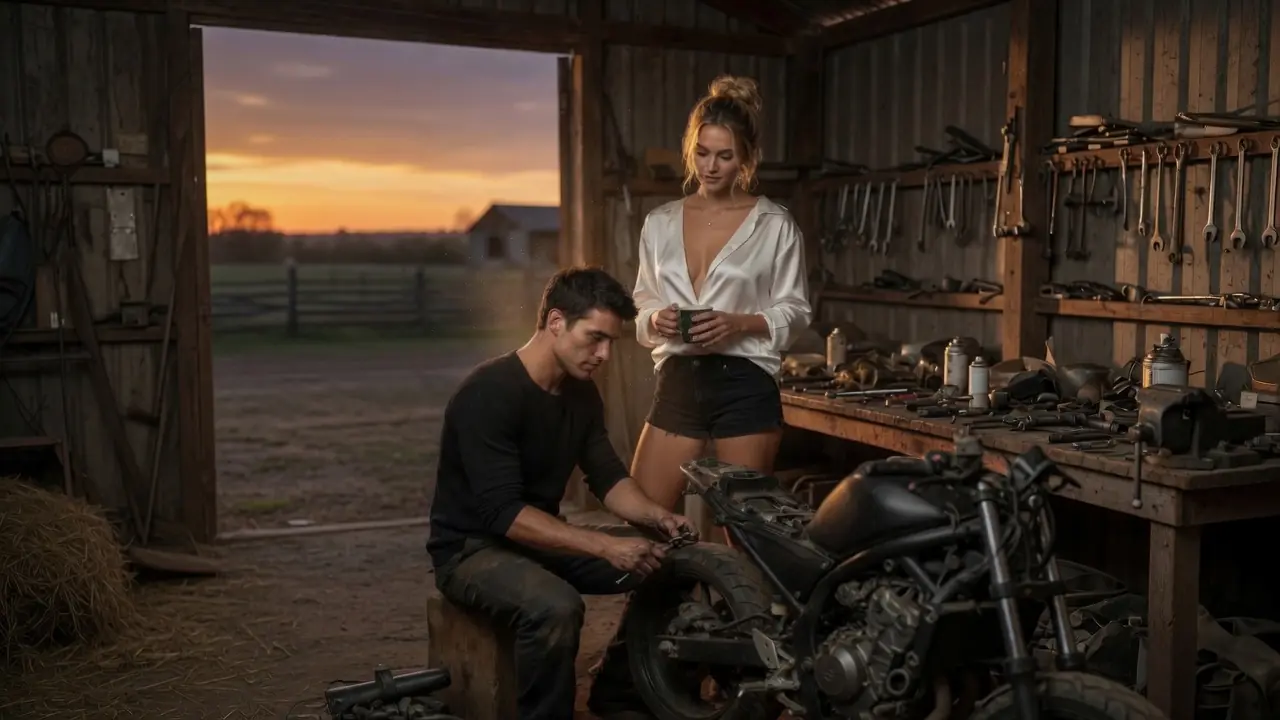
He simply switched on the overhead lights, pulled his old toolbox from beneath the workbench, and crouched beside the rear tire. The shed smelled of motor oil, dust, pinewood, and old rain trapped in the floorboards. It was not beautiful, not polished, not the sort of place Serena was used to entering.
But it was warm.
That surprised her.
Noah ran his thumb along the rim and found the damaged edge almost immediately.
“You caught something sharp a few miles back,” he said. “Maybe metal from the road. Tire’s done for tonight.”
Serena stepped closer, one gloved hand resting on the motorcycle’s seat.
“Can you fix it?”
“I can,” Noah said. “But not safe enough for you to ride before morning.”
Her mouth tightened.
Outside, evening settled over the farm in soft blue layers. The small house stood beyond the shed, its porch light glowing yellow against the darkening yard. Somewhere behind it, a little girl laughed, and a small dog barked as if the world had given him a job too important to abandon.
Serena turned toward the sound.
A girl with loose brown curls raced across the grass after the dog, her pink sneakers flashing in the dusk. She stopped when she saw Serena in the shed and lifted one hand in a shy wave.
Serena waved back before she could think better of it.
The gesture felt strangely fragile.
“That’s my daughter,” Noah said, still studying the wheel. “Ellie thinks every stranger is either lost, hungry, or in need of pancakes.”
Serena almost smiled.
“She sounds generous.”
“She gets that from her grandmother,” Noah said. “Not from me.”
The words were light, but Serena heard the weight underneath them.
Noah worked quietly. His sleeves were rolled to his elbows, and the scars across his hands showed years of fixing things other people had already given up on. He did not stare at Serena’s clothes, her watch, or the expensive motorcycle leaning under his roof.
That unsettled her more than suspicion would have.
People usually noticed the money first.
Even when they pretended not to.
“How much will this cost?” she asked.
Noah loosened the axle nut with a firm pull.
“Let me see what I’m dealing with first.”
“I can pay.”
“I didn’t say you couldn’t.”
She narrowed her eyes.
Most people either tried to impress her or take from her. Noah did neither. He only lowered his head again and kept working, his shoulders steady beneath the hanging light.
Serena leaned against the workbench and watched him remove the damaged tire.
He handled the bike carefully, respectfully, almost gently. Even broken, even belonging to a stranger, the machine was treated like something worth saving.
That thought bothered her.
“You always this careful with other people’s problems?” she asked.
Noah looked up.
“Problems don’t shrink because you ignore them,” he said.
Then he went back to work.
Serena looked away first.
The answer had touched something she preferred not to name.
For years, she had been ignoring her own problems behind locked elevators, private cars, attorneys, boardrooms, and hotel suites with views so high the city seemed unreal below her. She called it independence. She called it privacy. She called it control.
But control, she had learned, could become a cage if no one was ever allowed close enough to see the bars.
Noah slid a jack beneath the bike and lifted it slowly. The motorcycle shifted. Serena instinctively reached toward the handlebar.
Noah caught her wrist gently.
“Careful,” he said. “If that tips, it’ll pull you down with it.”
His touch was brief.
Respectful.
He let go immediately.
That startled her more than being grabbed would have.
Serena folded her arms, hiding the tremor that had moved through her hand.
“I’m not easy to pull down.”
Noah smiled faintly without looking impressed.
“I believe you. But strong people still get hurt when heavy things fall the wrong way.”
She turned toward the shelves of old parts, pretending to study them.
The shed suddenly felt too honest.
A few minutes later, Ellie appeared at the doorway with two glasses of lemonade balanced carefully in her small hands.
“Daddy, Nana said you forgot to drink again,” she announced.
Noah’s face softened at once.
The tired lines around his eyes eased, and for a moment he looked younger than he had while kneeling beside the motorcycle.
“Thank you, bug,” he said, taking one glass. “Did you bring one for Miss Serena?”
Ellie held out the second glass.
Serena accepted it carefully.
“You look like somebody famous,” Ellie said.
Noah closed his eyes.
“Ellie.”
Serena gave a small laugh.
“It’s all right. I’m just somebody with a broken motorcycle.”
Ellie considered that.
“Then Daddy can fix it. Daddy fixes everything.”
Noah’s smile faded so quickly Serena almost missed it.
But she did not miss it.
The words had landed on him like a debt.
He kissed Ellie’s forehead and told her to wash up before supper. The girl ran back toward the house, the dog following close behind.
Serena watched Noah lift the glass of lemonade but not drink.
“You don’t like being called a hero,” she said.
Noah turned back to the tire.
“Heroes don’t count quarters before buying school shoes.”
He said it plainly.
No bitterness.
No performance.
Just fact.
That made it hurt worse.
Serena wanted to ask more, but something stopped her. She knew what it felt like to have pain inspected by strangers. So she said nothing, and Noah seemed grateful for the mercy.
For a while, the shed held only small sounds.
The clink of tools.
The scrape of a wrench.
Crickets starting their evening song outside.
Dishes clattering faintly from the farmhouse kitchen.
Serena had spent most of her adult life surrounded by noise. Reporters calling her name. Investors arguing over numbers. Assistants filling her day with reminders. Men speaking softly while trying to calculate how much of her life they could turn into profit.
Here, nobody asked her to be impressive.
Nobody asked her to explain.
Nobody asked what her last name could buy.
Noah found a thin shard of metal buried near the rim and held it up between two fingers.
“This did it.”
Serena stepped closer.
The little piece of metal looked harmless.
Tiny.
Almost laughable.
“All that trouble from something so small,” she murmured.
Noah set it on the bench.
“That’s usually how trouble starts.”
The words stayed with her.
Her own trouble had started small too.
Not with the public betrayal.
Not with the headlines.
Not with the man who had smiled on magazine covers beside her and then tried to take control of her company through a marriage contract she had not known he was planning.
It had started with one compliment that sounded too polished.
One hand resting too long against her back.
One question about voting shares disguised as concern.
By the time Serena understood she had been loved as an asset instead of a woman, the damage had already spread through her life.
Noah handed her a flashlight.
“Hold this here for me?”
She blinked.
“You want me to help?”
“Unless you charge by the minute.”
Despite herself, she smiled.
She angled the light toward the chain while he worked beneath the frame. He gave simple instructions, and she followed them carefully. Lower. Higher. Hold steady. A little to the left.
The task was ordinary.
Practical.
Strangely intimate.
For the first time in years, Serena felt useful in a way that had nothing to do with signing checks or making decisions that affected thousands of employees.
“You listen well,” Noah said after a while.
She looked down at him.
People had called her brilliant, impossible, ruthless, elegant, cold, beautiful, dangerous, and visionary. They had called her everything except good at listening.
The compliment felt too personal.
“I’m usually the one people pretend to listen to,” she said before she could stop herself.
Noah paused.
He looked up, but did not rush to fill the silence.
His concern did not feel like pity.
That was new too.
“Sounds lonely,” he said.
Serena’s fingers tightened around the flashlight.
She wanted to deny it.
She did not.
“It can be.”
The kitchen door opened, and an older woman called that supper was ready.
Noah wiped his hands on a rag and lowered the bike carefully.
“I need one part from town,” he said. “Shop opens in the morning.”
Serena reached for her wallet.
Noah shook his head.
“Eat first.”
She froze.
“What?”
“A motorcycle can wait longer than a person should.”
She stared at him.
“You don’t even know me.”
Noah shut the toolbox.
“I know you’re stranded. That’s enough for tonight.”
Supper at the Bennett farmhouse was simple.
Chicken stew.
Cornbread.
Green beans from a garden behind the house.
The plates did not match, one chair had a repaired leg, and Ellie’s drawings covered the refrigerator in bright, crooked lines. Noah’s mother, June Bennett, placed a bowl in front of Serena as if feeding strangers from broken roads was simply part of running a household.
Serena thanked her politely, but her voice came out quieter than she intended.
At that table, nobody cared about market reports.
Nobody asked about press statements.
Nobody tried to impress her.
Ellie talked about school, spelling words, her dog Biscuit, and how she planned to be a veterinarian, artist, and pancake restaurant owner all at the same time.
Noah listened as if every word mattered.
He cut Ellie’s cornbread in half, wiped stew from her chin, and nodded seriously when she explained that Biscuit had “emotional problems” because he barked at the mail truck.
Serena watched them and felt something ache behind her ribs.
No camera.
No public image.
No careful family portrait prepared for a charity gala.
Just a tired father making sure his daughter knew she was worth listening to.
After supper, Noah returned to the shed.
Serena followed with two mugs of coffee June had pressed into her hands. The night had cooled, and the shed lights glowed warmly against the yard. Noah looked surprised when she handed him a mug.
“Thank you.”
“For the coffee?”
“For bringing it.”
They stood beside the motorcycle for a while, drinking in silence.
“You could have left me on the road,” Serena said.
Noah leaned against the workbench.
“I could have.”
“Why didn’t you?”
He looked through the open door toward the farmhouse window, where Ellie’s shadow moved behind the curtain.
“Because I hope somebody would stop for my daughter one day.”
Serena turned away quickly.
That answer did something to her.
It was not charm.
Not strategy.
Not a man trying to be noble in front of a woman he wanted something from.
It was love, stretched outward into the world.
The next morning, sunlight spilled across the shed floor.
Serena had tied her hair back and borrowed one of June’s faded work shirts over her riding clothes. The shirt hung loosely, making her look less like someone escaping a magazine cover and more like a person who had slept badly but woken lighter.
Noah noticed.
He did not comment.
He handed her the flashlight again, and this time she took it without hesitation.
He explained the axle, the brake caliper, the chain tension, and why the rim needed careful alignment after the tire change. Serena listened closely, asking questions that made him smile despite himself.
She liked the way he looked when he taught something he knew well.
The tiredness did not vanish, exactly.
But it stepped back.
By noon, the motorcycle was repaired.
Noah rolled it out, tested the brake, listened to the engine, and nodded.
“She’ll ride.”
Serena should have felt relieved.
Instead, something in her tightened.
A fixed bike meant freedom.
It also meant leaving.
Noah turned off the engine.
“You’ll be safe if you take the main road.”
“How much do I owe you?” she asked.
Payment was easier than gratitude.
Noah named a price so low she almost laughed.
“That barely covers the part.”
“You helped.”
“That is not how business works.”
“Probably why I don’t run a big one.”
The sentence was harmless.
Serena felt it anyway.
She forced a smile.
“You’d be terrible at business.”
“Maybe,” Noah said. “But I sleep fine most nights.”
She wondered what that was like.
To sleep without wondering who had smiled falsely at you that day.
To live without lawyers reviewing every relationship before it could touch you.
To be poor and burdened and exhausted, yet somehow not hollow in the way her penthouse sometimes made her feel.
On the porch, Ellie sat drawing with colored pencils.
The picture showed a woman on a motorcycle with a crown over her head.
Serena sat beside her.
“Why does she have a crown?”
Ellie kept coloring.
“Because she’s a secret queen.”
Serena’s heart gave one hard kick.
“Maybe she’s pretending.”
“Maybe,” Ellie said. “Or maybe she wants people to like her without the crown.”
Serena looked toward the shed, where Noah was putting away tools.
Children, she thought, could be terrifying.
They saw through doors adults had spent years reinforcing.
That evening, she stood beside the repaired motorcycle with one hand resting on the seat.
The sun was lowering over the fields, turning the road beyond the farm into a ribbon of gold. She should have left before dark. She knew that.
Still, she did not move.
Noah stepped beside her, leaving careful space.
“You can make it to the highway before sunset if you go soon.”
“That’s what I should do.”
He heard the word should.
“But?”
Serena closed her eyes.
When she opened them, the practiced strength in her face had softened.
“But I’m tired of going back to people who only know what I can give them.”
Noah did not answer quickly.
That was one thing she had begun to trust about him.
He did not rush into other people’s pain with tools that did not fit.
“Then maybe don’t go back the same way you came,” he said.
She almost told him everything.
Her real name.
Her company.
The foundation.
The fortune.
The headlines.
The ex-fiancé who had loved her money with such convincing tenderness that she had nearly mistaken it for devotion.
The words rose.
Fear caught them.
If Noah knew who she really was, would his kindness bend?
Would June look at her differently?
Would Ellie’s “secret queen” become something real enough to change the way the child smiled at her?
So Serena asked about him instead.
Noah resisted at first, then spoke in pieces.
The repair shop in town had cut his hours.
The mortgage letter was waiting in his dresser drawer.
Ellie’s school fees were overdue.
June needed medication she kept saying could wait.
He did not ask for help.
Not once.
That made it harder to listen.
Serena could have fixed half his problems before sunrise. She could have paid the mortgage, opened a college account for Ellie, bought the shop that had reduced his hours, and made sure June never had to choose between medicine and groceries again.
But money used too quickly can bruise a person’s dignity.
And Noah’s dignity was not loud, but it stood between them like something sacred.
“You carry all that and still stopped for me,” she said.
Noah looked embarrassed.
“Your tire didn’t know I had bills.”
She laughed softly.
Then cried before she could stop herself.
Noah saw the tears and went still.
He did not reach for her.
Did not ask her what was wrong.
Did not make her pain into a problem he needed to solve.
He only stood beside her quietly, letting her gather herself without shame.
By morning, Serena was gone.
The motorcycle was no longer in the shed, and a folded note rested on the workbench beside the metal shard that had ruined her tire.
Noah found it while coffee brewed in the kitchen.
His fingers slowed as he read.
Thank you for repairing the bike.
Thank you for feeding a stranger.
Thank you for proving kindness can exist without a bill attached.
There was money beneath the note.
Not too much.
Just enough to cover the repair honestly.
Noah smiled faintly because she had understood.
Then he saw a second envelope.
Ellie’s name was written across the front.
Inside was a simple card with a butterfly on it.
For school supplies, pancakes, and future adventures.
Noah frowned at the corner of the envelope.
A small foundation logo was printed there.
The Larkspur Children’s Trust.
He did not know what that meant yet.
He would.
Three weeks later, a letter arrived confirming that Ellie had received an education scholarship through a rural children’s fund. It covered school fees, supplies, books, and future tuition support.
Noah read the letter three times at the kitchen table.
June covered her mouth.
Ellie asked if grown-ups cried when good things happened.
Noah wiped his eyes and told her yes.
Sometimes they did.
He tried to trace the foundation.
Every phone call ended politely.
Privacy protected.
No public donor.
No further information available.
But at the bottom of the letter, one sentence told him enough.
Thank you for stopping when you could have ridden past.
That sentence belonged to Serena.
Months passed.
Then her face appeared on television.
Noah stood frozen in the living room while a news anchor spoke over a polished image of the same woman who had held a flashlight in his shed.
Celeste Armand, billionaire philanthropist and founder of Armand Global Holdings, returns to public life after months away from the spotlight.
Ellie pointed at the screen.
“Daddy! That’s the motorcycle lady!”
June turned slowly toward Noah.
Noah did not answer.
He stared at the woman on television.
The suit was expensive.
The hair perfect.
The face guarded again for the cameras.
But he could still see the woman who had stood in his shed, frightened by kindness and trying not to cry over a cup of coffee.
He expected to feel fooled.
Instead, what came was gentler.
More complicated.
Serena had hidden her name.
But not her heart.
The money had been the disguise.
Not the woman.
A year later, the summer fair filled the town square of Maple Hollow with music, fried food, handmade signs, and children running sticky-fingered between booths.
Noah was helping a farmer fix a stubborn tractor engine near the edge of the lot. His sleeves were rolled up, and grease darkened his hands. Ellie danced nearby with a paper fan while June sat beneath a shade tent, laughing at the dog trying to steal popcorn.
Then a familiar motorcycle rumble moved through the fairground.
Noah’s hand stopped on the wrench.
The black motorcycle rolled slowly between the booths.
Serena stopped near the old oak by the courthouse, removed her helmet, and looked across the crowd.
Their eyes met.
For a moment, neither moved.
The fair noise seemed to fall away.
Ellie ran first.
“Motorcycle lady!”
Serena dropped to one knee just in time for the child to throw herself into her arms. She hugged Ellie tightly, closing her eyes as if the embrace had brought her somewhere she had been trying to find for years.
Noah walked over slowly, wiping his hands on a rag.
His heart beat harder with every step.
Serena stood, still holding Ellie’s hand.
This time, she did not look like a billionaire pretending not to be known.
She looked like a woman asking to be seen anyway.
“Bike trouble again?” Noah asked.
His voice came out rougher than he intended.
Serena smiled, and her eyes shone.
“No. The bike is fine.” She glanced at it, then back at him. “I came because the bike got fixed, but I didn’t.”
Noah did not speak.
Serena took a breath.
“My name is Celeste Armand,” she said. “But the woman who stayed in your shed, ate at your table, and held that flashlight was not a lie.”
Noah looked at her for a long moment.
“I know.”
Her lips parted slightly.
“You do?”
“The television helped.”
She laughed, but it trembled.
“I should have told you.”
“Probably.”
“I was afraid.”
“I figured.”
She looked down, ashamed.
He waited.
“I was afraid that if you knew what I had, you would stop being who you were,” she said.
Noah’s face softened.
“And I suppose I was afraid that if I knew what you had, I might stop being who I was too.”
That honesty quieted both of them.
Ellie squeezed Serena’s hand.
“Are you still a secret queen?”
Serena looked down at her and smiled through tears.
“Not so secret anymore.”
“Good,” Ellie said. “Secrets make people tired.”
Noah laughed softly.
Serena looked at him.
“You repaired my motorcycle,” she said. “But you also repaired something I thought had rusted shut.”
Noah shook his head.
“I didn’t repair you.”
“No?”
“No.” He stepped closer. “I just reminded you that broken things still deserve care.”
Serena’s eyes filled.
Around them, the fair kept moving.
Music played.
Children shouted.
Someone called out about fresh pies.
Nobody understood that a quiet miracle was unfolding beside an old tractor and a black motorcycle.
Noah reached out slowly, giving her every chance to refuse.
Serena placed her hand in his.
This time, she did not pull away.
And neither did he.