The morning the mules arrived, every man in Carver's Mill had an opinion about it. Not because opinions were scarce in Carver's Mill, which was a small town in the hill country of Eastern Tennessee, where the population was modest and the opinions were not. But because this particular morning gave them something they hadn't had in a while, which was something genuinely new to have opinions about. 20 mules.
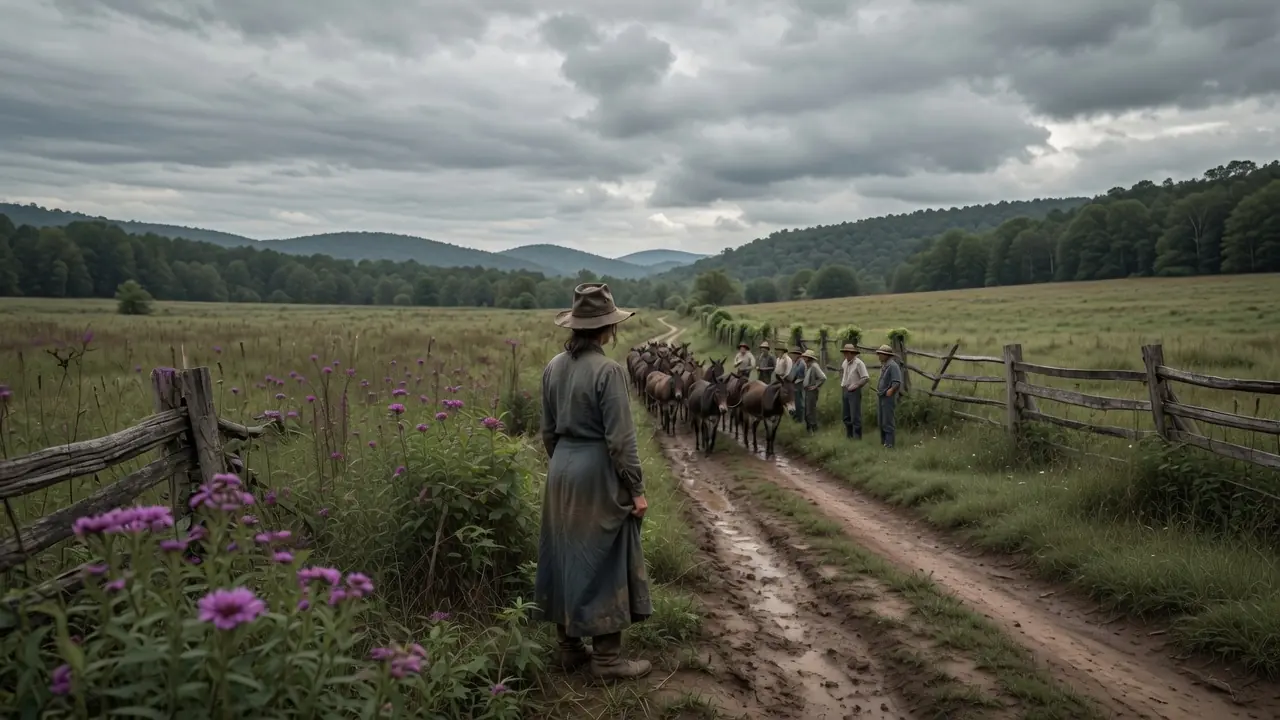
Coming down the Draper Road in a line behind a wagon, driven by a boy named Ferris, who worked for the Hendrick family, and who had the expression of someone who has been given an errand he doesn't entirely understand and has decided not to think too hard about it. The mules were various. Some were young, some were not. Some were the color of creek mud after rain, and some were darker, almost black in the early light.
They moved with the particular unhurried quality of animals that have been somewhere and are going somewhere else and are not especially troubled by either transition. They turned off Draper Road onto the smaller road that ran toward the Calla Birch property, and the men standing outside the feed store watched them go. Ned Prater said, "20 mules." Roy Sims said, "Counted them myself."
Ned looked at the road after the last mule had turned the corner. "The Kendrick boy's taking them to Calla Birch's place." Roy said, "That's what I heard." Ned was quiet for a moment.
Then he said what several people were thinking, but he was the one who said it first. "What in the world does Cal Birch want with 20 mules?" The answer to that question was something Cal Birch had been thinking about for three years. But she wasn't in town that morning.
She was at the bottom of her west field, standing at the edge of the place she had been thinking about for three years, looking at it the way she always looked at it, which was with the particular attention of someone who was waiting for the right moment and is not yet sure it has arrived. The mules came down her road at half past seven. She heard them before she saw them and she walked up from the field to meet them. Ferris Hendrick pulled the wagon to a stop and looked at her.
He said, "20, like you asked." "My daddy says he hopes you know what you're doing." Calla Birch looked at the mules. She walked the line of them slowly, looking at each one, the way her father had taught her to look at animals, starting with the eyes and working down.
She said, "Tell your daddy I appreciate his concern." Ferris handed her the lead rope and drove back to town. Calla Birch was 39 years old and had been farming the Birch property alone for six years, since her husband Walter had died of a fever in the spring of 1908 and left her the land, the equipment, the debt at the Carver's Mill Savings and Loan, and a set of opinions about what she could and couldn't manage that she had been quietly disproving ever since. The Birch property was 83 acres in the hill country east of town, where the land did what hill country land does, which is refused to be flat about anything.
The upper fields were good ground, rocky in places but workable, and Calla had been working them with a consistency that the farm records showed clearly, if anyone had been looking at them, which nobody had because nobody looked at a widow woman's farm records in Carver's Mill in 1911 unless they were the bank. And the bank looked at them with the specific attention of an institution that is waiting for a reason to be concerned. Calla kept the bank from finding a reason. She was methodical and careful, and she understood the land the way people understand something they have grown up on and then lost and then come back to, which is with a gratitude that sharpens the attention.
But there was the West Field. The West Field was not a field. That was the problem. It was 112 acres of bottom land that ran from the base of the upper property down along the creek and it had not been farmed in anyone's recent memory because it could not be farmed by the means available.
The land itself was extraordinary. Dark creek bottom soil that had been accumulating depth and richness for longer than the Birch family had owned it. Calla's father, Amos Birch, had pressed his hand into that soil when she was 12 years old and held it up to show her the color. He had said, "This is what good ground looks like.
This is what 100 years of leaves and water looks like when it settles." She had said, "Why don't we plant it?" He had looked at the terrain around them. The shallow places where the water table came close to the surface and made the ground soft enough to take a boot to the ankle.
The old root masses of fallen trees that had been there so long they had become part of the soil structure. The creek bends where the land folded in on itself in ways that made straight lines impossible. The grade changes that happened every 20 yards. Nothing dramatic.
Just enough to make every piece of equipment that approached the edge of the field either sink or slide or both. He had said, "Someday someone will figure out how." He had died without figuring it out. His father had died without figuring it out.
The 112 acres of the richest soil on the Birch property had been sitting at the bottom of the west slope for three generations. Too good to ignore and too difficult to use. Calla had been thinking about it since Walter died. She had been thinking about it in the specific way of a woman who has identified a problem and is waiting for the solution to become clear enough to act on.
They had worked with it. She had stood on the road watching the Hendrick mules work and something had connected in her mind quietly, the way the most important connections happen, without announcement. The west field needed something that didn't fight the ground. Something that felt the ground before it committed its weight to it.
Something patient enough to work the land the way the land required, rather than the way the equipment preferred. She had driven home and walked the west field again. This time looking for something specific. She found it on the third walk in November when the leaves were down and the light came through at an angle that revealed things the summer growth had hidden.
The old trail was barely visible. You had to know what you were looking for, which Calla did because her father had mentioned it once years ago in passing. The way people mention things they consider minor that turn out not to be. He had said, "Used to be a way through the bottom, old-timer told me, before the creek shifted.
Don't know exactly where it ran." The old-timer he'd mentioned had been dead for 30 years by the time Calla was walking the field in November light, looking for a line in the ground that might be the ghost of something that had been. She found it by the texture of the soil. Along the bottom of the west field, running at an angle that didn't correspond to the creek or the property lines or anything obvious, there was a strip of ground where the surface was different.
Not dramatically. You wouldn't see it in summer with the growth up. But in November, with the ground clear and the light coming in low from the southwest, the strip was visible as a slightly higher, slightly firmer line running through the soft bottom soil. Old cart track, packed by years of use, then abandoned when the creek shifted and the bottom became impassable, then covered by decades of growth.
But the packed subsoil was still there, compressed by whatever had passed over it long ago, firmer than the surrounding ground by enough to hold weight that the surrounding ground would not. Calla had stood on that line in November and pressed her boot into the ground beside it. Her boot sank two inches. She stepped onto the line itself.
Her boot held. She had walked the line for its full length, 200 yards through the bottom, and she had understood what she was looking at. A way in. Not easy.
Not obvious. Not accessible to anything heavy or wide or mechanical. But a way in, firm enough underfoot to carry something careful. Something like a mule.
The Hendrick family had been trying to sell or give away 20 mules since October. The Hendricks ran the largest farm operation in the county, which meant they had converted to tractor power in 1909 with the enthusiasm of people who have been waiting for something and have finally gotten it. The mules had been sold off gradually, but 20 remained. The ones that other buyers hadn't wanted for various reasons.
Too old, too young, too set in their ways, too uncertain in disposition. Tom Hendrick had told Calla in September that he was going to sell them for whatever the rendering operation in Knoxville would pay, which was not much because he couldn't afford to keep feeding animals that weren't working. Calla had said, "What will you take for all 20?" Tom had looked at her.
"You want 20 mules?" She had named a price. It was low and they both knew it. Tom Hendrick had taken it without negotiating because the alternative was the rendering operation and he was not a man who liked that alternative.
The news had reached Carver's Mill by the following morning. The opinions had been forming since. Ned Prater's opinion found its fullest expression at the feed store on the Thursday after the mules arrived. He said to the general company, "20 mules on the Birch place.
Woman already carrying a note at the bank and she goes and buys 20 mules nobody else wanted." Roy Sims said, "What she going to do with them?" Ned said, "That's what I'd like to know." A man named Clyde Foss, who farmed 200 acres north of town with two new tractors and considered himself modern in the specific way of someone who has recently purchased something expensive and needs to justify it, said, "Mules are finished.
Every serious operation in this county has moved to mechanized power. You're not going to get competitive yield pulling a plow with a mule in 1911." Ned said, "Calla Birch isn't running a competitive operation. She's running what she can keep."
Clyde said, "Which is my point." The conversation moved on, as conversations at feed stores do, to other topics that were less interesting, but more comfortable. But the mules on the Birch Place remained available as a subject whenever the conversation needed one. And in Carver's Mill, in the autumn of 1911, it needed one fairly often.
Calla spent the first two weeks learning the mules, not using them. Learning them. There was a difference, and the difference was something her father had tried to explain when she was young, and that she had understood better as she got older. He had said, "An animal you know is twice the animal you don't.
You learn them first. You use them after." The 20 mules were not a uniform group. They were 20 individuals who had been grouped together by the circumstance of being unwanted, which was not the same as being similar.
There was an older Jenny, maybe 15 years, dark bay, who stood quietly while the younger ones moved around her and watched everything with the calm attention of an animal that has seen most of what the world is going to show her and is no longer surprised by it. Calla thought of her as Still, because stillness was what she radiated. Still became the reference point. Where Still stood, the others eventually stood.
What Still accepted, the others came to accept. She was not aggressive about her authority. She simply had it, the way some creatures have it, through some combination of age and temperament that the others recognized and deferred to. There was a young mule, barely two, who Calla thought of as Rush, because he moved before he thought and then corrected, which was a pattern she recognized and was not worried about because it was youth and not character.
Rush would settle. There were three that were difficult, not dangerous, but stubborn in the way that mules are stubborn when they have been handled inconsistently by people who didn't understand that stubbornness in a mule is usually a response to something that didn't make sense to them. Calla worked with these three separately, slowly, finding the specific thing that each one needed to make sense of what she was asking. She did not rush any of it.
The neighbors who drove past the Birch place on their way to town saw her in the field with the mules every day, moving through them, working with individual animals, using the old harness equipment she had pulled from the barn and repaired over the course of two weeks. The collar fittings replaced, the traces oiled, the hames checked and adjusted. Ned Prater drove past on a Thursday and saw her working the old forecart with four mules hitched to it in the upper field, making passes across ground that was already broken, not because the ground needed working, but because the mules needed to learn the equipment and the equipment needed to learn the mules, and neither of those things happened without practice. He slowed his horse.
He watched for a while. He drove on. The old forecart had been in the barn since Walter's father had put it there, which was long enough that no one had thought of it as equipment. It was a relic, a thing from before, the kind of object that accumulates in old barns the way old barns accumulate everything that has become too invested in to discard and too outdated to use.
Calla had found it in November, the same week she had walked the old trail in the bottom field, and the finding of the two things in the same week had felt like the way solutions present themselves when you have been patient long enough, not all at once, but in pieces that arrive close enough together that you can see how they fit. The forecart was sound. The wood was dry and hard. The way old hardwood gets when it has been kept out of weather and moisture long enough.
The metal fittings had surface rust that came off with oil and a rag. The tongue needed replacing, which she did with a piece of ash from the wood lot that Walter had cut before he died and that had been drying in the barn long enough to be exactly right for the purpose. She spent a week on the forecart. She spent another week on the harness.
She was thorough because thoroughness was what the work required and because the opposite of thoroughness in draft animal work is the kind of accident that ends the work entirely. When she was done, the old equipment looked like what it was, old, worn, carried the marks of its history, but it worked. She knew it worked because she had tested every connection and every fitting and every piece of leather and every metal ring and none of them had failed the test. She hitched Still to the forecart on a Tuesday morning and drove her around the upper field for 2 hours.
Still pulled with the steady, unhurried power of an animal that knows exactly what is being asked and has no objection to it. The forecart tracked true. The fittings held. Calla stopped in the middle of the upper field and stood for a moment with her hand on Still's neck.
She said to no one, "All right." She went into the bottom for the first time in early March, not with all 20 mules, with four, Still leading, the other three chosen for their steadiness. Animals that had been working with Calla for two months now and had developed the particular trust that comes from a handler who is consistent and patient and does not ask more than what has been established. She did not take the forecart.
Not yet. She went in on foot, leading the four mules, testing the old trail before she put weight on it beyond herself. The trail held. She walked it twice, up and back, with the mules behind her, feeling the ground through her boots, watching how the mules place their feet, which was the important thing.
A mule feeling uncertain ground will tell you. They will slow. They will shift their weight back. They will not proceed with confidence onto ground that their feet are telling them is not trustworthy.
These four mules proceeded. Not fast. Not without attention. They felt each step the way careful animals feel uncertain ground, with the slight hesitation of a foot placed and tested before the weight follows.
But they proceeded. The old trail ran through the bottom for its full 200 yards, from the edge of the upper property down to the wider area near the creek, where the ground flattened out into the 112 acres that Calla had been looking at for three years. She stood at the end of the trail with four mules behind her and looked at the bottom land. The early March light was thin and gray, and it fell across the field without drama, showing the land as it was, which was wet in the low places, covered in the dead growth of last season's weeds and volunteer brush, marked by the stumps of old trees and the hummocks of root masses that had been growing undisturbed for decades.
It was also the richest soil she had ever stood on. She could smell it. The particular mineral sweetness of creek bottom soil that has been building itself for a long time without interruption. The smell of depth.
She pressed her boot into the ground beside the trail. It sank, but not all the way. four inches maybe 5 before it found something more solid underneath. She looked at the low places where the water was standing. Not much water, not flood water.
The kind of standing water that comes from a water table too close to the surface. The kind that doesn't drain the way it should because something is directing it wrong. She had been thinking about the water since November. Her father had mentioned once that the bottom field had drained differently when he was young.
That there had been a system of some kind. Old tile or cut channels that someone had put in before the creek shifted. That when it stopped working the bottom stopped draining. She had not found the record of it.
She had looked in the barn. In the box of old papers that held the Birch property history going back to the original deed. And she had not found a map or a plan or any documentation of whatever drainage system had existed. But she had found something else.
In the back of the old farm journal that had belonged to her grandfather. In the section at the end where the pages were mostly blank. There were three lines in handwriting she didn't recognize. Written in pencil that had faded to barely visible.
Tile runs from Big Rock to Creek Bend. Sets 12 feet. North Branch 8 feet. Both blocked at junction 1887.
She had read those lines so many times she had them in her memory. Blocked at junction 1887. The creek had shifted in 1889. Two years after whatever had blocked the drainage junction.
The field had gone wet. The creek shift had finished what the blockage started. And then there was no reason to fix the drainage because the field was inaccessible anyway. And no reason to make it accessible because the drainage was broken anyway.
The two problems had existed together for 22 years. Each one making the other worse. Each one making the other seem more permanent than it was. Calla had been thinking about the junction since she found those three lines.
She needed to find it. Finding a drainage junction that someone had noted as blocked in 1887 required two things. The first was the big rock, which the journal had used as a starting reference. There was only one rock in the bottom field large enough to be called the big rock without qualification.
A limestone outcrop near the northwest corner that was visible even in summer above the growth. Maybe four feet high and 8 feet across. The kind of geological feature that gets used as a landmark because it has no alternative. The second was understanding what blocked tile drainage looked like from the surface.
Which was not obvious, but was findable if you knew what you were looking for. Which Calla had spent the winter reading about in the agricultural extension bulletins that the county office sent out to farms on their mailing list. The bulletins had a section on field drainage that she had read four times and then requested additional materials on. Which had arrived in January and which she had read with the specific attention of someone who is reading for a purpose.
The surface signs of failed tile drainage were standing water in specific patterns rather than general flooding. Areas where the soil stayed wet long after surrounding areas had dried. Depressions that collected water and held it. And sometimes if the tile had collapsed rather than simply blocked slight surface subsidence along the line of the old system.
She had been looking for these signs every time she walked the bottom since November. She had found a pattern. The standing water in the bottom field was not random. It followed a line, roughly, that ran from the northwest to the southeast.
And it was heaviest at a point about 60 yards from the big rock. And then again at a point near the creek bend. Between those two points, the ground was wetter than it should have been given the general topography. The water was finding those places because it had nowhere else to go.
The junction was between those two points. She thought it was. She needed the mules to get close enough to find out. The work of the spring was slow, and she did not rush it.
She brought the mules into the bottom field in stages, extending their range week by week, working the edges before the center, clearing the lightest brush with hand tools, and the mules pulling power before she tried the heavier work. The old trail held. Every time she brought the mules down it, she added a little weight, a little load, a little more demand on the footing. And every time the trail held.
The packed subsoil that the old use had compressed into the ground was still there, decades later, still firmer than the surrounding land, still reliable in the way that things are reliable when they have been made correctly in the first place. She widened the trail by a foot at a time, using the mules to drag cut brush to the edges and build up the soft shoulders with the material, which compressed under the mule hooves and added stability. It was not fast work. It was not the kind of work that looked dramatic from the road.
Ned Prater drove past on a Tuesday in April and saw nothing unusual because the bottom field was not visible from the road, and Calla was in it, not visible, either, working with four mules in the early morning before the day got hot. What Ned saw was an empty upper field and a farm that looked quiet. What was actually happening was that Calla had gotten the forecart into the bottom for the first time that Tuesday. Coming down the widened trail with Still and three others pulling and the empty cart behind, testing the trail under load before she put anything in the cart that mattered.
The trail held under the cart. She stood in the bottom field with the forecart and four mules and the creek sounds around her and the smell of the deep soil and she felt the particular feeling of a thing that has been prepared for arriving. She found the junction on a Wednesday in the second week of May. She found it the way she had expected to find it by digging at the point where the surface evidence converged.
The wettest ground the lowest micro-depression the place where her calculations from the journal note and the surface observation aligned. She went down four feet before she found the tile. Old clay tile the kind that had been made locally before the factories started producing it uniformly, irregular in diameter fitted together in sections that had held for decades and then shifted when the ground moved one section dropping relative to the next and creating a dam that caught sediment and roots and eventually stopped the flow entirely. The junction was where two lines of tile met.
The north branch as the journal had called it came in from the upper northwest. The main line ran southeast toward the creek bend. At the junction, one section of the main line had dropped three inches relative to the line of the rest and the space it had created had filled with clay sediment over 22 years until the flow was entirely blocked. She looked at it for a long time.
The fix was not simple but it was clear. She needed to lift the drop section, reestablish the grade, clear the accumulated sediment from both lines back to the point where the flow was unobstructed, and pack the surrounding soil firmly enough that the junction would not shift again. She could not do it alone. The weight of the tile sections and the volume of the excavation required more than one person.
She went to town and asked for help. She asked Dolph Sayers, who was 71 years old and had been a tile man before. tile laying became unfashionable, and who still had his tools and his knowledge and, as it turned out, an interest in seeing a problem he had never been given the chance to solve. Dolph came out on a Thursday morning with his tile hooks and his grade level and his 40 years of understanding how water moved underground. And he stood at the edge of Calla's excavation and looked at what she had uncovered and said, "Well, there it is."
He looked at her. "How'd you find it?" She showed him the three lines in the journal. He read them.
He looked at the excavation. He looked at the bottom field around them, at the standing water in the low places, at the mules standing patiently near the forecart at the edge of the work area. He said, "You brought mules in here." She said, "I needed something that could get here."
He looked at Still, who was looking back at him with the calm attention of an animal with no particular agenda. Dolph said, "Smart." He said it the way old men say things that cost them nothing to say because they have been around long enough to have no investment in being right about everything. They worked for three days.
Dolph directed the excavation and the tile work. Calla did the labor with the help of two men she hired from town. And the mules moved the excavated material and brought in the materials needed for the repair. Clean gravel for the junction packing.
New tile sections for the two that had cracked beyond use. Tools and equipment that would not otherwise have reached the work site. On the third day, Dolph opened the flow at the creek end. And they stood at the junction and watched the water begin to move.
It moved slowly at first. The system had been blocked for 22 years and it took time for the accumulated static water to find its direction and commit to it. But it moved. By evening, it was running clear.
The field dried in stages through May and June. Not all at once. The ground that had been wet for 22 years did not give up its water in a week. But the pattern changed.
The standing water that had been permanent retreated. The micro-depressions that had held water dried out to soil. The low places that had been soft enough to take a boot to the ankle firmed up as the water table dropped to where it belonged. Calla watched it the way she had been watching the bottom field for three years.
With the attention of someone waiting for something they have been working toward. In the third week of June, she walked the bottom field from one end to the other and pressed her boot into the ground every 20 yards and counted how deep it went. The deepest it went was two inches. In most places it held at the surface.
She knelt and picked up a handful of soil and held it in her palm. It was the color her father had shown her when she was 12 years old. The color of a hundred years of leaves and water settling into depth. She put it down.
She went to the barn and looked at what equipment she had that could work the bottom field with mule power. The forecart for hauling. The old walking plow that had been in the barn since before Walter. The kind of plow that one or two mules could pull through prepared ground.
A drag harrow that needed new tines, but was structurally sound. She had what she needed. She started breaking ground on the 1st of July. Breaking a field that has not been broken before is different from working a field that has been farmed.
The soil has its own structure built over years without disturbance. And the first breaking is a negotiation between what the soil has made of itself and what you intend to make of it. Calla worked slowly, which was the right speed. She used Still and Rush together on the walking plow, which was the combination that had come to work best for the slower, heavier work.
Still set the pace and Rush had settled over the course of the spring into the animal she had seen in him when she bought him, steady and willing once the inconsistency of his early handling had been replaced by the consistency of hers. The bottom soil turned rich and dark. The plow moved through it with a resistance that was not difficulty, but depth. The resistance of ground that has been building itself and has substance.
She worked the field in sections, breaking an acre, then leaving it, then breaking the next, moving through the 112 acres over the course of six weeks, not hurrying, letting each section settle between passes, working with the land's rhythm rather than against it. The men who came to see it later, in August when the work was evident, stood at the edge of the bottom field and looked at the turned ground and did not say much, which was its own kind of commentary. Ned Prater came on a Thursday. He tied his horse at the upper fence and walked down the slope to where Calla was working the drag harrow with four mules, finishing a section she had broken the previous week.
He watched for a while without speaking. She brought the mules around at the end of a pass and stopped near him to check a fitting. He said, "That's deep soil." She said, "Yes."
He said, "How far does it go?" She gestured across the field. "All of it. All 112 acres."
He was quiet for a moment, looking at the turned ground. "How'd you get the mules in here?" She told him about the old trail. He looked at where the trail entered the bottom from the upper field, the widened path that was now worn smooth with regular use.
He said, "Old cart track." She said, "Somebody used this bottom before the creek shifted. There was a way in. The ground remembered it."
Ned was quiet. He said, "What are you going to plant?" She said, "Corn first, then see what it does." He nodded slowly.
"Creek bottom corn." She said, "Yes." He said, "My grandfather used to talk about bottom field corn. Said it was the best corn he ever raised before the ground went bad."
She looked at him. "When did it go bad?" He thought about it. "1880 sometime.
He always said the drainage failed and they couldn't fix it." He looked at the field. "Is that what happened here?" She said, "Something like it.
The tile blocked at the junction in 1887. The creek shifted two years later. Nobody could get in to fix the drainage and there was no point fixing the drainage if nobody could get in." He said, "And you figured out how to get in."
She said, "The mules figured it out. I just watched them." Ned Prater looked at Still, standing near the end of the last pass with her ears forward, looking at the conversation with the alert patience of an animal waiting to see if work is resuming. He said, "20 mules."
Calla said, "Eighteen working. Two that are retired and living well." He made a sound that was not quite a laugh, but was in that direction. Then he said, "I owe you an apology."
She said, "For what?" He said, "For what I said in September about you not knowing what you were doing." She looked at him. "I didn't hear what you said in September."
He said, "No, but you knew people were saying it." She looked at the field at the dark turned soil stretching out across 112 acres that had been waiting for someone to find the way in and fix the thing that was broken. She said, "I wasn't doing it to prove anything to anyone here." He said, "I know.
That's why it worked." The corn went in the second week of August. It was late for corn, too late for the highest yield, but not too late for a first season crop on ground that had never been farmed, which was how Calla thought of it. Not what it would produce at its peak, but what it would tell her about what it was.
The stalks that came up in September were the color of good health, deep green and consistent in a way that the upper field corn, on ground that had been farmed repeatedly, was not. Creek bottom soil does not give back what it has spent on previous crops because it has not spent it. It gives what it has accumulated, which is different from what worked land gives. The corn came in at the end of October.
Calla walked the rows before the harvest with the same attention she had walked the field in November three years ago and in November 2 years ago and every time she had come down to look at what the field might become. What it had become was what she had thought it would become. Not a miracle. Not something that couldn't be explained or that required special circumstance.
Just a field that had been given what it needed to be what it was, which was the richest ground on the Birch property. Producing at the rate that ground like this produces when it is properly drained and properly worked and properly tended. Dolph Sayers came to see the corn in October. He walked the rows with his hands clasped behind his back in the way of an old man who has given up hurrying through things he wants to see clearly.
He stopped at the center of the field and looked at the stalks around him. He said, "Your grandfather found this ground." Calla said, "My great-grandfather." "He put in the drainage tile."
Dolph said, "And it ran for what? 30 years before it blocked?" She said, "Best we can figure." He was quiet, looking at the corn.
Then he said, "30 years of drainage, 22 years blocked. 50 years of leaves and water going into this soil with nobody taking anything out." He pressed his boot into the ground and felt it hold. "That's what you're standing on."
She said, "I know." He said, "You built a good trail getting in here." She said, "My father told me the ground was rich. I just had to find the way to it."
He nodded. He looked at the mules. Several of them were visible at the upper edge of the field near the trail entrance. Still among them, standing with the unhurried patience that was her characteristic quality.
He said, "People thought you were foolish." She said, "People thought the mules were foolish. He said, "Same thing." She said, "Not quite.
The mules weren't foolish and neither was I. People just couldn't see what we were for." Dolph looked at her, then at the field, then at the mules. He said, "I can see it now."
The following spring, she planted the bottom field in full, not corn. She rotated. Corn had told her what the ground could do. Now, she wanted to know what else it would do.
She put in clover on the northwest section and let it fix nitrogen through the summer. She put in vegetables on the south acre nearest the creek, which had the most consistent moisture and the deepest color of any soil on the property. She put corn again in the central sections, this time in full and on time, planted in April when it should be planted. The summer of 1913 was dry, not catastrophically dry, but dry enough that every farm in the county felt it.
The upper fields at the Birch property suffered. The soil there was good, but it was surface soil, holding its moisture in the top layer, and a dry summer pulled that moisture out faster than the rain was replacing it. The bottom field did not suffer. The bottom field, properly drained, with its water table at the right depth, with its century of accumulated organic matter holding moisture through drought, the way deep soil holds it, which is from below rather than from above, produced through the dry summer as if the dry summer were happening elsewhere.
Calla's corn on the bottom field topped out at yields that the county agricultural report, which she dutifully recorded in the farm journal she had taken over from Walter, noted as exceptional for the region in a drought year. The county agricultural agent came to see it in September. He walked the field with her and asked questions that she answered from the farm records, the drainage map she had made, the notes she had kept since the first day she brought the mules into the bottom, the records of what had been planted where and when and what had come up and at what rate. He said, "You should present this at the county fair."
She said, "I don't need to present it." He said, "Other farms could benefit from knowing what you did here." She looked at the field, at the bottom land stretching out to the creek bend, at the mules working a section of late season cover crop near the far edge, at the old trail entrance worn smooth with two years of regular use. She said, "What I did was fix what was broken and find the way in.
Both of those things were already here. I just had to see them." He said, "Most people didn't." She said, "Most people weren't looking."
In the autumn of 1913, the Birch property was a different farm from the Birch property of the autumn of 1910. Not because anything had been added that wasn't already there, the land was the same land, the soil was the soil that had been there for a hundred years and more, the creek was the same creek, the hill slope was the same slope. What had changed was use. What had changed was access.
What had changed was the understanding of what the land contained and the means to reach it. The bottom field had produced its second full season. The farm records showed numbers that Calla compared carefully to the upper field records and to the county averages and to the records that went back to her grandfather's time in the pages of the old farm journal. The bottom field produced at twice the rate of the upper fields on the same inputs.
Not because it was magical, because it was deep, and because it had been rested for 22 years while the drainage was broken, and in that resting had become what deep soil becomes when nobody asks it to give anything for a long time, which is more capable of giving than it was before. The 20 mules were working animals now in the full sense of the phrase. They knew the trail. They knew the bottom field.
They knew the equipment and the handler and the work that was asked of them, which they performed with the steady efficiency of animals that have been well kept and well used, which are the same thing in the end. Still was 16. She worked three days a week and rested the rest, which was Calla's decision based on Still's age and Still's status as the animal without whom the rest would not have found their footing in the uncertain ground of the beginning. You did not work a 16-year-old mule 6 days a week.
You recognized what she had given, and you gave her what she needed. Rush was four. He had become what Calla had seen in him when she called him Rush and watched him move before he thought, which was a strong, reliable, fast-learning animal who had taken the steadiness of the work and made it his own. He pulled more than any other mule on the farm.
He did it without drama. Ned Prater stopped at the edge of the bottom field on a November afternoon in 1913, three years after the morning he had watched the mules go past the feed store and said, "What in the world does Calla Birch want with 20 mules?" He stopped his wagon at the upper fence and looked down at the bottom, at the harvested field visible in the November light. The soil turned after the last crop, dark and rich and resting for the winter.
He sat in his wagon for a while. Calla came up from the lower barn and saw him there. She said, "Ned." He said, "Calla."
He looked at the field. Second full season. She said, "Yes." He said, "I heard the numbers."
She said, "The numbers are in the record." He was quiet for a moment. "That's the richest ground in the county, isn't it?" She said, "Might be."
He said, "Was always there." She said, "Always was." He said, "Just needed somebody to find the way in." She said, "Just needed the right way to get there."
He looked at the mules in the near pasture, visible over the fence, Still among them, standing in the late afternoon light, with her ears forward and her characteristic air of calm attention. He said, "20 mules." Calla said, "20 mules." He shook his head slowly, not in disbelief, but in the specific way of a man who was thinking about the distance between what he had assumed and what turned out to be true, and finding that distance larger than he'd like.
He said, "You knew what you were doing." She said, "I knew what I was looking for. The mules knew how to get there. Between us, we figured out the rest."
He gathered his reins. He looked at the field one more time. He said, "Your father would have liked to see this." Calla looked at the bottom field, at the dark soil resting under the November sky, at the land that had been waiting longer than either of them had been alive for someone to find the old trail and fix the broken drainage and let it be what it had always been capable of being.
She said, "He told me what it was. He just didn't live to see it opened." Ned nodded. He drove on.
Calla stood at the fence and looked at the field until the light was gone. Then she went in and wrote in the farm journal the way she wrote every evening what the day had been and what the land had done and what she observed and what she intended. The entry was short as most of her entries were. She wrote Bottom Field, year two.
Soil dark after turning. Water table correct. Mules settled for winter. Still sound.
She closed the journal. She put it on the shelf beside the old journal the one with the three lines in faded pencil at the back. Tile runs from Big Rock to Creek Bend. Sets 12 feet.
North Branch, 8 feet. Both blocked at junction 1887. Someone had written those lines 26 years ago knowing about a problem they could not fix leaving the note for whoever came after them. She had come after them.
The trail was open. The field was producing. The note had been answered.