The thirty-eighth floor of Meridian Freight International looked beautiful from the outside, but inside, it felt like a place where people had forgotten how to breathe.
Glass walls reflected expensive furniture, silver company plaques, and a skyline that made the city look calm from far above. But beneath that polished surface, the employees moved like prisoners who had learned which floorboards creaked. Nobody laughed too loudly. Nobody stood too long at the coffee machine. Nobody spoke unless they were sure the wrong person was not listening.
That wrong person was Preston Vale.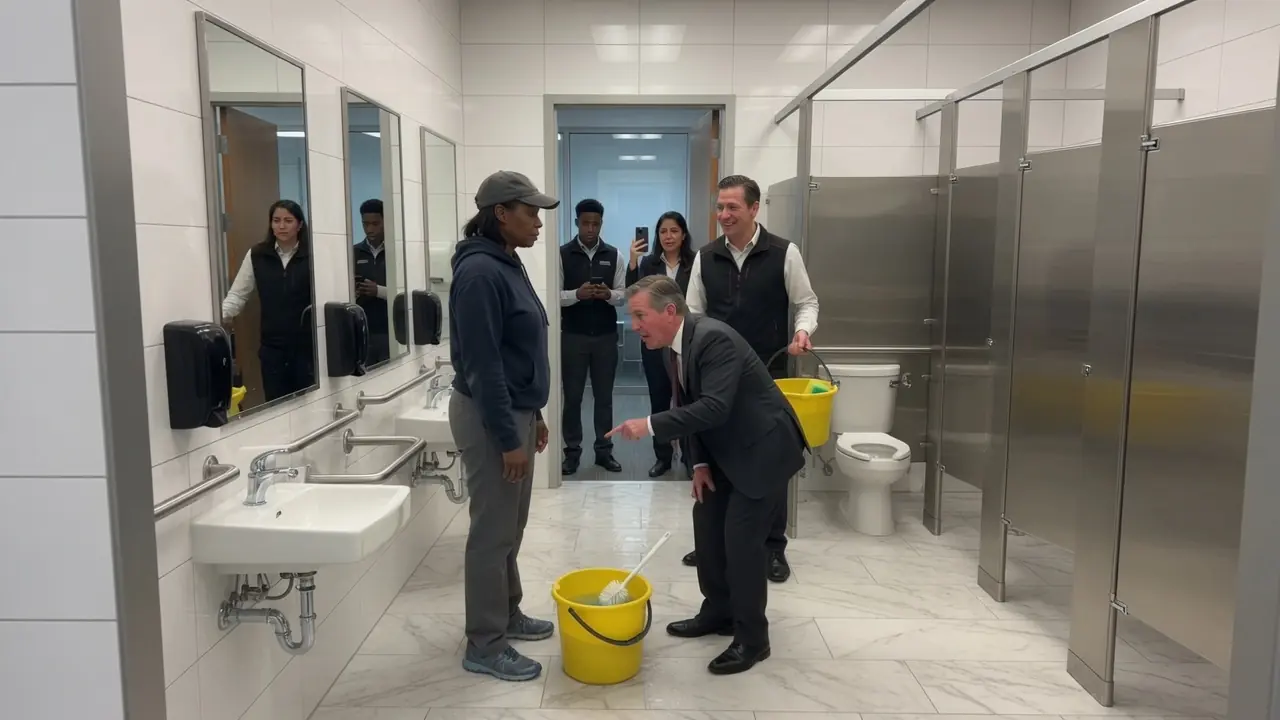
Preston was the senior regional director of Meridian’s East Division, a man who measured human value by job title, suit fabric, and how quickly people lowered their eyes when he entered a room. He wore dark Italian shoes, a sharp charcoal suit, and a wine-red tie that seemed to announce his temper before he did. On paper, his division was productive. On paper, his numbers were excellent.
But numbers can hide fear better than people can.
For months, quiet complaints had reached the executive office downtown. Anonymous reports described public humiliation, unpaid overtime pressure, retaliation, threats, and workers breaking down in stairwells after being screamed at in front of their teams. Every report ended the same way: Please do not use my name.
That last sentence told Cassandra Monroe more than any spreadsheet ever could.
Cassandra was the founder and CEO of Meridian Freight International. She had built the company from a rented warehouse, one box truck, and a line of credit nobody expected her to repay. Twenty-two years later, Meridian moved cargo across three continents, employed thousands of people, and appeared on magazine covers whenever business reporters wanted a story about grit, discipline, and modern leadership.
But Cassandra knew a company could grow so large that the truth stopped reaching the top floor.
So on a cold Monday morning, she did not arrive in a black car. She did not wear a tailored suit. She did not bring an assistant, a legal team, or a photographer. She stepped out of the service elevator wearing gray work pants, a faded navy hoodie, plain sneakers, and a baseball cap pulled low over her eyes.
To anyone watching, she looked like a temporary cleaner sent by an outside agency.
That was exactly what she needed them to see.
The service corridor smelled faintly of floor polish and burnt coffee. Cassandra pushed a yellow cleaning cart past stacked boxes, loose cables, and an overflowing trash bin someone had clearly decided was beneath them. Her eyes moved slowly, taking everything in. She saw the cracked emergency exit sign, the blocked fire door, the puddle near the executive restroom, and the absence of any warning cone.
She also saw the people.
A young clerk named Daniel kept typing with one hand while pressing the other against his stomach like he was trying to hold himself together. A payroll assistant named Marcy wiped her eyes every time the office printer covered the sound. An older warehouse coordinator stood near the copier with his shoulders rounded, staring at the floor as if waiting for punishment.
Then Preston Vale turned the corner.
The entire office changed shape around him.
Daniel straightened. Marcy stopped moving. Two supervisors who had been whispering near the conference room immediately separated and pretended to read documents. Preston did not need to say anything for the room to tense. That was how deeply he had trained fear into the walls.
Beside him walked Nolan Price, his operations assistant and loyal shadow. Nolan was smaller, younger, and always eager to prove he could be as cruel as the man he served. He carried a tablet under one arm and wore a vest with red trim that matched Preston’s tie, like a uniform for borrowed authority.
Preston stopped when he saw Cassandra by the restroom door.
His face twisted with immediate disgust.
“You,” he snapped. “You’re late.”
Cassandra turned slowly. “Good morning.”
“Don’t good-morning me.” Preston looked her up and down, from the old hoodie to the plain sneakers. “The agency said someone would be here by seven-thirty. It is almost eight-thirty, and that bathroom is still a disaster.”
Cassandra glanced toward the puddle spreading across the marble near the restroom entrance. “There appears to be a leak. Someone should put down a safety sign before—”
His voice cracked through the office like a whip.
Several employees looked down immediately. Cassandra saw that too. People did not react like this to one bad morning. They reacted like this to a pattern.
“I am not from the agency,” Cassandra said calmly.
Preston laughed once, sharp and ugly. “Of course you are. Look at you.”
Cassandra’s eyes lifted to his. “You should be careful with assumptions.”
That should have been his warning.
Preston missed it entirely.
Instead, he stepped closer until he was inside her personal space. “Listen to me, sweetheart. I don’t know what kind of attitude they allow wherever you came from, but on my floor, cleaners clean. They do not talk back. They do not analyze leaks. They do not stand around pretending to be important.”
The words landed in the silent office.
Marcy’s hand covered her mouth.
Daniel stopped typing.
Cassandra did not move.
Nolan smirked beside Preston, enjoying the show because men with borrowed power often become drunk on someone else’s cruelty. He picked up a plastic bucket from the cleaning cart and shoved it toward Cassandra’s feet. Blue water sloshed over the side and splashed onto her sneakers.
“Come on,” Nolan said. “Director Vale doesn’t like repeating himself.”
Cassandra looked at the bucket, then back at Preston. “You are making a mistake.”
Preston’s eyes narrowed. “No. The mistake was letting people like you think you can walk into a corporate office and act equal to the people who run it.”
That sentence pulled something cold through the room.
Not because it was surprising.
Because too many people had heard some version of it before.
Cassandra’s voice stayed even. “I need you to understand what you are doing before you continue.”
Preston leaned in. “What I’m doing is giving you one chance to keep whatever miserable temporary job you have.”
Then he grabbed her sleeve.
The movement was quick, violent, and stupid.
His fingers twisted into the fabric of her hoodie, jerking her forward hard enough that the cleaning cart bumped the wall. Someone gasped. Nolan stepped aside to block the view from the hallway, but he was not quick enough. Daniel’s hand had already moved toward his phone.
Preston dragged Cassandra toward the executive restroom.
“Since you want to stand around talking,” he growled, “you can start with the toilets.”
Cassandra stumbled once on the wet marble but caught herself. Her cap dipped lower over her face. She did not fight him, not because she could not, but because the truth needed witnesses. A private insult could be denied. A public assault could not.
Inside the restroom, white tiles reflected the harsh overhead lights.
The air smelled of chemical cleaner and damp paper towels. One sink was running because the handle had broken. Water had spilled under the counter and seeped toward the door. Preston shoved Cassandra inside like he was throwing away something dirty.
Nolan followed with the bucket.
He slammed it onto the floor so hard that blue water splashed across Cassandra’s pants. Yellow sponges floated inside. A stiff white scrub brush lay across the rim.
Preston pointed toward the last stall. “That one.”
Cassandra stood still. “You want me to scrub a toilet.”
“I want you on your knees,” Preston said. “And I want that bowl shining by the time I come back.”
The cruelty in his voice had nothing to do with cleanliness.
It was about making someone small.
Cassandra slowly turned toward him. “Say that again.”
Preston smiled because he mistook her calm for weakness. “Get on your knees and scrub.”
Nolan chuckled behind him.
From the restroom doorway, Daniel and Marcy stood frozen. Daniel held his phone low, recording. Marcy’s eyes were wet, but her hand was steady around her own phone. For once, fear had not stopped them. It had turned into evidence.
Preston saw the phones and snapped, “Put those away before I fire both of you.”
Neither moved.
That was the first crack in his kingdom.
Cassandra bent down, picked up the yellow sponge, and held it for a moment. Her fingers tightened around it, not in shame, but in control. Then she looked up at Preston from beneath the brim of her cap.
“You have eight minutes left,” she said.
Preston blinked. “What?”
“Eight minutes of power,” Cassandra replied. “Use them wisely.”
Nolan laughed again, but it came out thinner this time.
Preston’s face reddened. He snatched the scrub brush from the bucket and slapped it against the toilet tank beside her, the sound echoing off the tile. “You think this is funny? I can have you blacklisted from every agency in this city.”
Cassandra stood.
Slowly.
The sponge dropped from her hand into the bucket with a soft splash.
Preston grabbed her arm again, but this time she looked directly at his fingers until he released her without understanding why. There are moments when a predator senses danger but cannot yet name it. Preston felt that for half a second.
Then his ego buried the warning.
“Clean it,” he said. “Or I’ll drag you out of this building myself.”
Cassandra reached up and removed her cap.
Pinned underneath it, almost invisible against the dark fabric, was a tiny camera.
She looked straight into it.
“Begin live review,” she said.
The office outside changed within seconds.
Every monitor on the thirty-eighth floor went black.
Spreadsheets vanished. Email windows disappeared. The company dashboard froze, flickered, and returned as a full-screen video feed from the executive restroom entrance. Preston’s face filled every display, twisted with anger as he grabbed Cassandra’s sleeve and dragged her across the floor.
The audio was clear.
Every threat.
Every insult.
Every order.
Every employee on the floor saw it at once.
Daniel lowered his phone slowly, no longer needing it. Marcy stepped away from her desk, her face pale, her mouth open. The warehouse coordinator near the copier straightened for the first time all morning. People emerged from cubicles, conference rooms, and side offices, drawn by the sound of Preston’s own voice condemning him from every screen.
Preston stormed out of the restroom just as the video replayed the moment he ordered Cassandra onto her knees.
His face drained of color.
“Nolan,” he shouted. “Kill the feed.”
Nolan rushed to a terminal and began stabbing at keys. Nothing happened. He tried another screen. Then another. Each one showed the same footage, now looping with a timestamp, floor location, and incident classification.
A blue banner appeared across every monitor.
Workplace assault detected. Executive integrity protocol activated.
Preston froze.
The elevator chimed.
Once.
Twice.
Three times.
The doors opened to reveal six corporate security officers in navy uniforms, followed by Meridian’s chief legal officer, the head of human resources, and two members of the board audit committee. Behind them came Cassandra Monroe.
Not in the hoodie.
Not in the cap.
Not with the cleaning cart.
She wore a tailored deep-blue suit, white blouse, and the same calm expression she had carried when Preston thought she was powerless. Her hair was pulled back neatly now, her company ID clipped to her lapel in plain view. The entire floor seemed to inhale at once.
Preston took one step backward.
“No,” he whispered.
Cassandra walked toward him slowly. “Yes.”
Nolan’s mouth opened and closed without sound.
Cassandra stopped in the middle of the office, beneath the largest monitor, where Preston’s own recorded face still screamed orders behind her. “For six months, employees in this division have reported intimidation, retaliation, wage pressure, safety violations, and abuse. I came here today to see whether those reports were exaggerated.”
She looked at Preston.
“They were not.”
Preston tried to smile. It was a broken, twitching thing. “Ms. Monroe, this is a misunderstanding. She— I mean, you were not identified. There was no badge. I thought—”
“You thought I was someone you were allowed to mistreat.”
The words silenced him.
Cassandra turned toward Daniel and Marcy. “Did he speak to employees this way regularly?”
For a moment, old fear fought new truth.
Then Daniel lifted his chin. “Yes.”
Marcy stepped forward. “Every day.”
One by one, others joined.
“He threatened my job when I asked about overtime.”
“He made me work through lunch and changed the timesheet.”
“He called me useless in front of a client.”
“He told us reporting him would be career suicide.”
The voices came slowly at first, then faster, like water breaking through a dam that had been cracking for years. Preston looked around the room, stunned that the people he had trained into silence still had voices. Nolan backed toward the conference room, trying to disappear behind a glass wall.
Security blocked him.
The chief legal officer, Evelyn Hart, stepped forward with a folder in her hand. “Preston Vale, effective immediately, your employment with Meridian Freight International is terminated for cause. You are denied severance, your access has been revoked, your company accounts have been frozen, and the evidence of physical assault will be referred to law enforcement.”
Preston’s lips trembled. “You can’t do this. I built this division.”
Cassandra’s eyes did not soften. “You poisoned it.”
Evelyn turned to Nolan. “Nolan Price, your employment is also terminated for cause due to participation in harassment, intimidation, falsification of staff reports, and obstruction.”
Nolan’s knees nearly gave out. “I was following orders.”
Cassandra looked at him. “That excuse has protected cowards for too long.”
The badge readers on the doors beeped.
Preston reached for his access card and swiped it at the executive hallway entrance. A red light flashed. Denied. He swiped again, harder. Denied. He looked at the small piece of plastic in his hand as if it had betrayed him.
The whole office watched.
It was not loud.
It was worse than loud.
It was final.
Preston suddenly lunged toward Cassandra, not fast enough to reach her, but desperate enough to reveal exactly who he was when cornered. Two security officers caught him by the arms before he crossed three steps. They turned him around, locked his wrists behind his back, and held him still while he shouted about lawsuits, board connections, and how everyone would regret this.
Nobody looked afraid anymore.
That may have frightened him most.
Nolan tried to slip toward the stairwell, but Daniel stepped into his path. Daniel did not touch him. He did not need to. A security guard caught Nolan by the back of his vest and turned him around.
“Walk,” the guard said.
Preston and Nolan were escorted across the marble floor they had used as a stage for humiliation. They passed the restroom where the bucket still sat near the door, yellow sponge floating in blue water. They passed the desks of employees they had belittled. They passed the screens still showing the truth in high definition.
For years, Preston had made people walk that floor with lowered heads.
Now he crossed it with every eye on him.
At the elevator, he twisted back toward Cassandra. “You ruined me.”
Cassandra did not blink. “No, Preston. I documented you.”
The doors closed on him.
For a few seconds, nobody moved.
Then Marcy started crying.
Not the quiet crying she had done at her desk when she thought no one noticed. This was different. This was the kind of crying that comes when a person’s body realizes the danger has finally left the room. Daniel put one hand on her shoulder, then quickly removed it, unsure if comfort was allowed in a place that had punished softness for so long.
Cassandra saw that too.
She turned to the staff. “The North Division will close for the rest of the day. Everyone will be paid. HR will remain available for private statements, and no retaliation of any kind will be tolerated. If your hours were altered, your pay will be corrected. If you were threatened, we will investigate. If you stayed silent because you were scared, you are not in trouble.”
That last sentence broke something open.
A woman near the back covered her face.
An older man sat down like his legs had stopped trusting him.
Daniel looked at the floor, then at Cassandra. “We thought nobody would believe us.”
Cassandra’s expression changed for the first time. Not dramatically. Just enough to show the wound beneath the authority. “That is why I came myself.”
By noon, the video had reached every Meridian office in the country.
Not because Cassandra leaked it to humiliate anyone, but because the emergency protocol had automatically preserved and distributed the footage to the board, legal, HR, and internal compliance channels. People talked. Someone screenshotted the incident banner. Someone else shared the memo announcing Preston’s termination.
By three o’clock, the business press had heard enough to start calling.
By five, Meridian released a statement.
It did not use soft language.
It did not call the assault an “unfortunate interaction.” It did not say “workplace disagreement” or “leadership misstep.” It said a senior director had physically and verbally abused a person he believed to be a temporary service worker, and that Meridian had terminated him for cause while initiating a full review of workplace culture across the company.
Preston tried to fight back.
He called three reporters, two board contacts, and a lawyer who had once played golf with him. He claimed Cassandra had entrapped him. He said the whole thing was staged. He said he had been under pressure, misunderstood, provoked by an unidentified trespasser.
Then Daniel and Marcy released their statements.
Then twelve more employees came forward.
Then payroll records showed altered hours.
Then security logs showed maintenance requests Preston had blocked because he did not want “low-level distractions” affecting executive workflow.
Then an email surfaced from Nolan, instructing supervisors to “keep weak employees afraid enough to perform.”
By the end of the week, Preston Vale was not defending his career.
He was defending himself against assault charges, labor violations, and a civil complaint from employees who had spent years swallowing fear because they needed health insurance more than dignity.
Three months later, the thirty-eighth floor looked different.
Not because the walls had changed, though some had. Not because the furniture had changed, though Preston’s oversized executive desk had been removed and replaced by shared meeting space. It looked different because people no longer moved like they were waiting to be hit by words.
The restroom leak had been fixed.
The blocked fire door had been cleared.
The break room had real chairs now, not broken ones nobody had time to replace. A safety board hung near the service elevator with instructions printed in plain language. Beneath it was a new company rule, framed in blue.
No title is worth more than a person.
Cassandra returned to the floor without disguise on the first day of the new leadership program.
Daniel had been promoted to compliance coordinator. Marcy now led payroll review, and she had become known across the division for catching every missing hour down to the minute. The warehouse coordinator who used to stare at the copier now ran safety operations with the calm authority of a man finally trusted to know his own job.
The new regional director, Amara Wells, met Cassandra near the elevator.
Amara was steady, direct, and allergic to office theater. She had started her career loading trucks on the night shift and had no patience for leaders who thought fear was a strategy. On her first day, she had removed the reserved parking signs from the executive spots and replaced them with visitor parking for clients and field workers.
Preston would have called that weakness.
The floor called it oxygen.
Cassandra walked past the executive restroom and stopped when she saw something on the wall beside it. Someone had framed the old yellow sponge.
Not as a joke.
Not as decoration.
Underneath it, a small brass plate read:
The day silence ended.
Cassandra stood there for a long moment.
Daniel approached quietly. “We can take it down if you don’t like it.”
She shook her head. “No. Leave it.”
He nodded.
Cassandra looked through the glass walls at the employees working, talking, asking questions without flinching. The company had not become perfect overnight. No company does. Culture is not changed by one dramatic firing, one viral moment, or one powerful speech.
But sometimes a door opens because one person refuses to stay on their knees.
That afternoon, Cassandra held a meeting with the entire division.
No stage.
No spotlight.
No speechwriters.
She stood in the center of the office where Preston used to pace and looked at the people he had tried to shrink.
“I built Meridian to move freight,” she said. “But somewhere along the way, I forgot that companies do not move anything. People do. People move the cargo, answer the calls, fix the numbers, clean the floors, repair the leaks, calm the clients, and keep the promises executives like to take credit for.”
The room was silent, but not from fear.
From attention.
“I cannot undo what happened here,” Cassandra continued. “But I can make sure this floor never again rewards cruelty and calls it leadership. From now on, every manager in this company will be judged not only by what their team produces, but by what their team survives to produce it.”
Marcy wiped one tear from her cheek.
Daniel smiled down at his notebook.
Amara crossed her arms and nodded once.
Cassandra looked toward the framed sponge by the restroom door. “Preston Vale thought power meant forcing someone beneath him. He was wrong. Power is what you do when nobody can stop you. Character is what decides whether people need protection from you.”
A few employees clapped.
Then more.
Then the whole floor.
Cassandra did not smile widely. She was not celebrating. She was remembering. The wet tile. The hand on her sleeve. The sponge in her palm. The faces in the doorway of two frightened employees who had finally chosen to record the truth.
When she left that evening, she did not take the private elevator.
She walked out through the service corridor.
The same corridor she had entered through in a hoodie and cap, pushing a cleaning cart past people who thought she was invisible. Only now, employees looked up when she passed. Not with fear. Not with performance.
With recognition.
Outside, the city had turned gold under the setting sun.
Cassandra stepped onto the sidewalk, where cars rushed past and office workers hurried toward trains, restaurants, apartments, and lives that did not fit inside corporate reports. For a moment, she stood still and looked back at the tower of glass and steel.
It still looked powerful from the outside.
But now, at least on the thirty-eighth floor, power had been taught a lesson it would not forget.
Never mistake someone’s uniform for their worth.
Never mistake silence for weakness.
And never hand a woman a sponge if you have no idea whose company you are standing in.