The wind in Mercy Bend, Kansas, had a way of finding every crack in a building and every crack in a person.
It carried dust through the streets, under doors, into water buckets, between the pages of hymnals, and along the hems of women’s skirts. It had blown across that prairie long before Nora Whitcomb arrived, and it would keep blowing long after the town forgot the sound of her wagon wheels.
She came in late October of 1885, sitting beside a freighter who had agreed to carry her the last thirty miles for two dollars and a silver sewing thimble.
She had no trunk.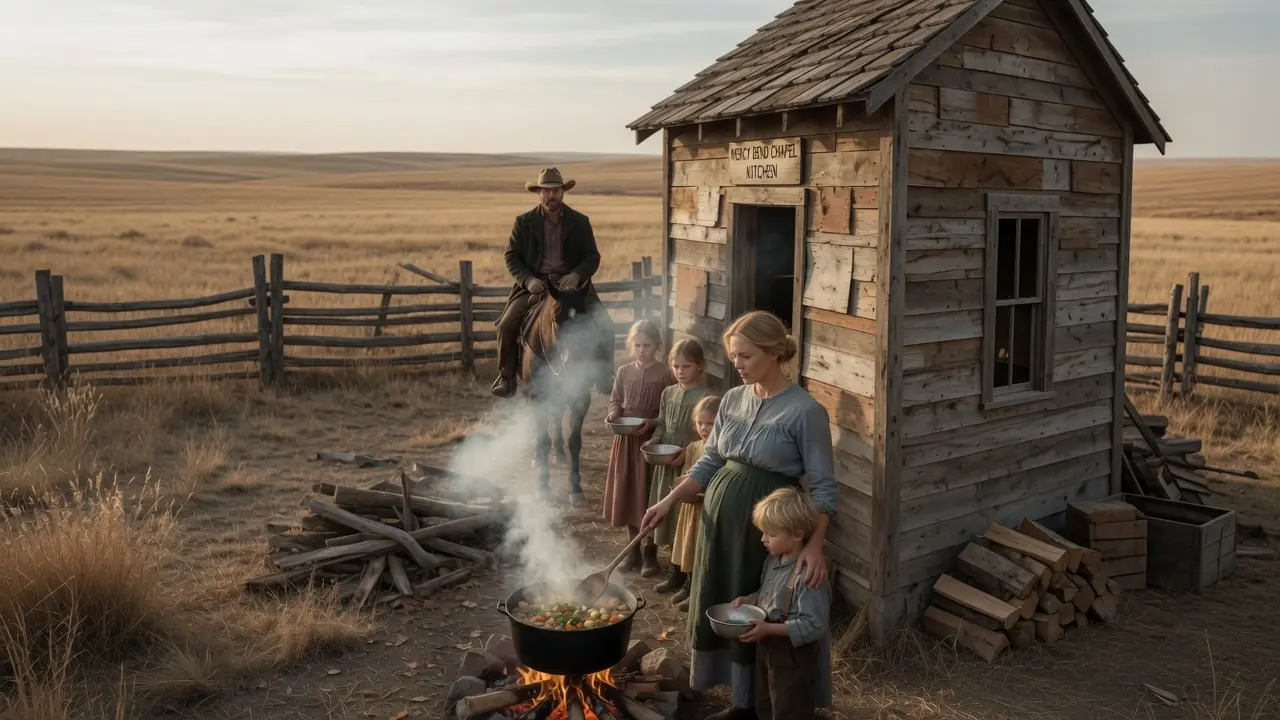
No husband.
No home waiting.
Only a worn carpetbag, a cast-iron skillet wrapped in cloth, and one hand resting protectively over the child growing beneath her heart.
Her husband, Daniel Whitcomb, lay buried somewhere west of the Cedar Fork Trail, under a cottonwood tree with no proper marker. He had died helping another family pull their wagon out of a flooded wash, swept under when the bank gave way. Nora still remembered his hand slipping from hers, the river taking him before she could even scream his name properly.
After that, people were kind in the careful way they are kind when they do not want responsibility.
They gave condolences.
They gave advice.
They gave looks.
But no one gave her a place to stay for long.
Her late husband’s cousin had promised shelter in Mercy Bend, then sent word through the minister that his wife “was not comfortable receiving a pregnant widow of uncertain means.” The phrase was polite enough to be read aloud, but ugly enough to leave Nora standing in the street with nowhere to go.
That was how she found the chapel.
It stood at the far end of town, white once but now weather-gray, its steeple leaning slightly toward the prairie like it was tired of pointing at heaven. A hand-painted sign beside the front steps read Mercy Bend Chapel and Children’s Home.
The word home looked hopeful.
The building did not.
A shutter hung loose near the side window. The front steps sagged in the middle. Behind the chapel, a patched-on kitchen leaned under a roof made from boards that did not quite match. From somewhere inside came the sound of children.
Not happy children exactly.
Hungry children trying to sound brave.
Reverend Amos Bell opened the door before Nora knocked twice. He was a thin man in his fifties, with kind eyes, ink on his cuffs, and the defeated posture of someone who had been praying for help while expecting none.
“Mrs. Whitcomb?”
“Yes.”
He looked past her, as if still hoping to see a wagon full of supplies behind her.
There was none.
Then his gaze fell to her belly, and pity crossed his face before he could hide it.
Nora lifted her chin.
“You said in your telegram that you needed someone who could cook, mend, and help with the children.”
“I did,” Reverend Bell said softly. “And I meant it.”
“Then I’m here.”
The children were gathered in the back room around a long table made from mismatched planks. There were eleven of them, from a solemn fifteen-year-old girl to a round-eyed boy barely four. Their clothes were clean but patched. Their hair had been combed by someone in a hurry. Their faces held the thin sharpness of children who had learned not to ask for seconds.
The oldest girl stood when Nora entered.
“I’m Jane,” she said. “I help with the little ones.”
Her tone was polite, but guarded.
Nora knew that tone.
Children abandoned by adults often grew manners like armor.
One by one, they gave their names.
Jane, fifteen, who watched everything.
Miles, thirteen, all elbows and restless energy.
Clara, eleven, who held a sewing needle tucked into her sleeve.
The twins, Eli and Ezra, nine, impossible to tell apart until one smiled and the other did not.
Peter, eight, who carried a slingshot he claimed was only for scaring crows.
Mabel, seven, who collected buttons.
Ruthie, six, who whispered every answer.
Jonas, five, who wanted to know if Nora had ever seen a buffalo.
Little Samuel, four, who had been left at the chapel door as a baby and still slept with a rag doll made from an old flour sack.
And finally, Grace, a tiny girl with black curls and serious gray eyes, who did not say her name until Jane gently touched her shoulder.
“Grace,” the child whispered.
Nora looked around the room.
At the children.
At the nearly empty pantry shelves.
At the stove that leaned on one back leg.
At the pot on the fire, where beans boiled in water so thin it could hardly be called broth.
Then she set her carpetbag down.
“What is for supper?”
Reverend Bell gave a helpless little smile.
“Beans.”
“With what?”
“More beans, if the Lord provides.”
A few children laughed softly, more out of loyalty than humor.
Nora rolled up her sleeves.
“Well, let’s see what He has already provided and what we can make of it.”
The pantry offered very little.
A sack of cornmeal.
A heel of salt pork, mostly fat.
Three onions gone soft at the edges.
Dried beans.
A jar of sorghum.
A handful of shriveled apples someone had donated before they turned completely bad.
To another woman, it might have looked like proof of despair.
To Nora, it looked like a challenge.
She had learned cooking from her mother in a house where there was never enough of anything except work. She knew how to stretch broth, sweeten hardship, coax flavor from scraps, and make children believe a full bowl meant they were safe for at least one evening.
“Clara,” she said, “can you slice those onions thin?”
The girl blinked.
“I can try.”
“Trying is how most things begin.”
“Miles, I need kindling. Small pieces, dry if you can find them.”
“Yes, ma’am.”
“Jane, show me where you keep bowls. Twins, wash your hands. Peter, if that slingshot shoots anything indoors, I will feed it to the stove.”
Peter’s eyes widened.
Then he grinned.
For the first time, the room moved with purpose.
Nora browned the salt pork fat in the skillet until the kitchen smelled almost rich. She fried the onions slowly, letting them turn sweet and golden before stirring them into the beans. She chopped the apples and simmered them with sorghum into a warm sauce. She mixed cornmeal with hot water and a little grease, then fried small cakes crisp around the edges.
By the time supper was served, the beans were still beans.
But they tasted like someone had cared.
That was different.
Eli, or maybe Ezra, took the first bite and stopped moving.
“It tastes like Sunday,” he said.
Jane shot him a look.
“What does that mean?”
He shrugged.
“Like something special.”
Nora turned away quickly to hide the tears burning behind her eyes.
She had not been called special in a long time.
After supper, the children helped clean without being asked, though most of them watched Nora while they worked. Not suspicious exactly, but careful. Waiting to see if she would vanish like other adults had.
When the dishes were done, Samuel climbed onto the bench beside her and touched the cloth bundle near her bag.
“What’s that?”
“My skillet.”
“Just a pan?”
Nora smiled.
“Not just. My husband bought it the week we married. Said a good skillet could make a home out of almost anywhere.”
Samuel thought about that.
“Can it make this one?”
Nora looked around the broken room.
At the children pretending not to listen.
At the reverend with his tired eyes.
At the wind rattling the windowpanes.
Then she placed a hand over her belly.
“We can try.”
The next morning, she began.
Not with grand declarations.
With breakfast.
Corn mush sweetened with the last of the apple sauce. Hot water poured over mint leaves Jane knew how to find near the creek. Biscuits made flatter than Nora liked, but warm enough to make the younger children hum with pleasure.
Then came chores.
Real chores, not punishments.
Jane managed the laundry with Nora’s help. Clara mended torn socks and learned how to turn a shirt collar. Miles and Peter hauled water. The twins split kindling badly at first, then better. Mabel counted beans. Ruthie helped Samuel wash his face and acted very proud of the responsibility.
Within a week, the chapel smelled different.
Less like damp wood and old fear.
More like coffee grounds, soap, smoke, and bread.
Nora sang while she cooked, old hymns and trail songs and lullabies her mother had sung before grief made her voice too tired. The children grew quiet whenever she sang, not because she was gifted, but because a woman’s song in a kitchen meant something many of them barely remembered.
By the end of the second week, the children had begun calling her Mrs. Nora.
By the third, Samuel forgot and called her Mama Nora.
The room froze.
Jane looked horrified.
Reverend Bell stopped with a spoon halfway to his mouth.
Samuel’s face crumpled as if he expected scolding.
Nora crossed the kitchen slowly, bent as much as her belly allowed, and touched his cheek.
“That name is a serious thing,” she said gently.
“I’m sorry,” he whispered.
“I didn’t say it was wrong.”
He looked up.
Her throat tightened.
“You may call me that if it helps your heart.”
After that, the younger ones began using it too.
Jane resisted the longest.
But Nora saw the way the girl hovered near her at dusk, needing closeness but refusing to ask for it.
Mercy Bend noticed the change before it admitted the reason.
Children who had once walked through town with heads down began standing taller. Their clothes, still patched, were neater. Their faces filled out a little. They laughed more. They carried baskets to the general store and spoke with manners that made Mrs. Hattie Pike behind the counter shake her head in grudging admiration.
“Widow’s got them organized,” she told anyone who would listen.
Not everyone approved.
Some women whispered that a pregnant widow should not be running a household of orphans. Some men wondered why Reverend Bell allowed it. Some said charity was one thing, but dependence was another.
Nora heard enough to understand.
She kept cooking.
The first time Silas Greer saw her, she was carrying a pot of stew across the chapel yard in a wind strong enough to steal breath.
Silas owned the largest ranch within forty miles of Mercy Bend. Greerland spread over thousands of acres of prairie, creek bottom, grazing land, and cottonwood stands. His cattle bore the double-G brand, and his name could quiet arguments at the bank before he even entered the room.
He was thirty-eight, tall, broad-shouldered, with dark hair, a trimmed beard, and pale eyes that made people feel measured. His parents had died during the winter fever eight years earlier, within a week of each other. After that, Silas dismissed half the household staff, stopped attending church, and turned his ranch into something profitable and silent.
People called him hard.
They were not wrong.
But hard things are often shaped by weather no one sees.
Silas had come to the chapel with a lame foal.
That was the excuse, anyway.
The foal’s mother had rejected it, and Silas told Reverend Bell it was no use to him if it died. He said the children might learn responsibility trying to keep it alive.
Nora saw through that lie before he finished speaking.
No man carried a useless animal that carefully.
The foal lay in clean straw while the children gathered around, wide-eyed and whispering. Its breathing was shallow. Its legs looked too thin for hope.
Nora knelt beside it.
Silas frowned.
“You know horses?”
“I grew up with three mules, two milk cows, and one mare mean enough to bite the devil.”
A surprised sound came from his throat.
Not quite a laugh.
She ran her hands along the foal’s neck and ribs.
“It’s weak from hunger more than illness.”
“Mother won’t take it.”
“Then we start without her.”
She asked Jane for warm milk, Clara for clean cloth, and Miles to heat water. The children moved quickly, thrilled to be entrusted with saving something. Nora dipped the cloth in milk and placed it against the foal’s mouth. At first, nothing happened.
Then the animal sucked once.
A cheer rose from the children.
Silas stood behind them, silent.
Nora glanced up and caught his face before he could hide it.
There was grief there.
And hunger.
Not for food.
For the sight of a room full of people trying together.
“Will it live?” Grace whispered.
Nora smiled.
“I think it wants to.”
Silas looked at her then, really looked.
“Wanting isn’t always enough.”
“No,” Nora said, still stroking the foal’s neck. “But it’s a beginning.”
Something flickered in his eyes.
When he turned to leave, Nora followed him outside.
“Mr. Greer.”
He stopped beside his horse.
“Thank you for bringing the foal.”
“It was nothing.”
“No,” she said. “It was not.”
He looked uncomfortable under gratitude.
Nora had already learned that proud people often disliked being seen in the act of kindness. It ruined the story they told about themselves.
“You could stay for supper,” she said.
Silas looked at the chapel, then at the children peering through the window.
“I don’t take meals where I don’t belong.”
Nora’s answer came before she thought better of it.
“Most of us here are learning to belong after the fact.”
He looked at her for a long moment.
Then touched the brim of his hat.
“Another time, Mrs. Whitcomb.”
He rode away.
But two days later, a wagon arrived.
It carried oats, flour, beans, two sacks of potatoes, a coil of rope, and enough lumber to repair the chapel steps. Silas claimed it was excess from the ranch stores.
Nora looked at the fresh-cut lumber, the clean sacks, the carefully wrapped jar of coffee beans hidden beneath a folded cloth.
“Excess seems very well organized at Greerland,” she said.
Silas gave her a dry look.
“You object to organized excess?”
“I object to poor lying.”
His mouth twitched.
“Then I’ll practice.”
He returned again.
And again.
Sometimes with supplies.
Sometimes with repairs that suddenly needed doing.
Sometimes with no excuse at all, which the children liked best because it meant he stayed for stew.
Nora watched him change in small ways.
He spoke to Miles like a young man instead of a burden. He taught Peter how to sharpen a knife safely. He let the twins help him mend fence and pretended not to enjoy their constant arguing. He brought Ruthie a slate pencil after noticing hers had worn down to a nub.
For Samuel, he carved a little wooden horse.
The child held it to his chest as if it had breath.
“Mine?”
Silas cleared his throat.
“If you want it.”
Samuel looked at Nora.
She nodded.
Then he threw both arms around Silas’s leg.
The entire kitchen went silent.
Silas stood like a fence post struck by lightning.
Then, very carefully, he placed one hand on the boy’s head.
That night, after the children slept, Nora found Silas on the front steps staring out at the prairie.
“You’re good with them,” she said.
“I’m not.”
“You are.”
He shook his head.
“I’m useful with them. That’s different.”
“Sometimes usefulness is how love sneaks in when pride locks the front door.”
He turned toward her.
The wind moved loose strands of hair across her face, and for a moment he looked at her as if she were something both dangerous and necessary.
“You talk like a preacher.”
“I cook better than one.”
That earned a real laugh.
Small.
Rusty.
But real.
The affection between them grew slowly, not like a lightning strike but like fire taking hold in damp wood. Hard to start. Impossible to ignore once warm.
Nora found herself wearing her blue calico dress more often when he was expected.
Silas began washing before visits even if he claimed dust was honest.
Jane noticed everything.
“He likes you,” she said one afternoon while helping knead dough.
“He likes the children.”
“He looks at the children kindly. He looks at you like he’s afraid you’ll disappear.”
Nora pressed her palms into the dough.
“That is a serious accusation from a girl with flour on her nose.”
Jane wiped her nose and missed the flour completely.
“I’m just saying.”
Nora was frightened by how much she hoped Jane was right.
Hope, after loss, felt almost improper.
As if loving Daniel truly meant never letting her heart lift again.
But at night, when she sat by the kitchen fire feeling her baby turn inside her, she wondered whether grief and love might share the same room without dishonoring each other.
Then the legal notice came.
It arrived with a county clerk in a stiff collar, who looked eager to finish his errand and leave before the chapel roof gave him tetanus. Reverend Bell was out visiting a sick farmer’s wife, so Nora signed for the envelope herself.
The seal belonged to an attorney in the county seat.
She opened it at the kitchen table.
The words blurred at first.
Property deed.
Reversion.
Owner of record.
Silas Greer.
Nora read it twice.
Then a third time.
The chapel.
The kitchen.
The barn.
The yard where the children played.
The garden she had coaxed from stubborn soil.
All of it stood on land legally owned by Silas Greer.
She sat very still.
Jane stood across from her, face pale.
“Mama Nora?”
Before Nora could answer, hooves sounded outside.
Silas had come early, a bundle of window cloth and a box of nails tied behind his saddle. He dismounted with the easy grace that always made the younger children stop and stare.
Then he saw Nora’s face.
His expression changed.
“Nora?”
“A clerk came,” she said.
Silas went still.
That was answer enough.
“You own this place.”
He closed his eyes briefly.
“Yes.”
The word was quiet.
It hurt worse than a denial would have.
Nora stood slowly, one hand on her belly.
“You let me believe we were simply receiving charity from a neighbor.”
“You were.”
“No,” she said. “We were living under your permission.”
His face tightened.
“I never meant it that way.”
“But it was that way.”
He took one step toward her.
She stepped back.
The movement struck him visibly.
“I inherited the land after my parents died,” he said. “My father had promised this parcel to the church, but the papers were never properly recorded. Reverend Bell knew. I told him I would never interfere.”
“And you did not think I should know?”
“I should have told you.”
“Yes.”
“I was afraid if I did, you would look at every kindness as obligation.”
“And now I look at every kindness and wonder where truth ended.”
Silas flinched.
The children had gathered near the kitchen doorway, silent and frightened.
Nora lowered her voice.
“I have trusted you with these children. With my future. With feelings I was not sure I would ever have again.”
His eyes lifted.
“I love you.”
The words came out rough, unpolished, almost unwilling.
Nora’s throat tightened.
“Love without honesty is another kind of hunger, Silas.”
He looked as if she had struck him.
Maybe she had.
She wanted to take it back.
She wanted him to cross the room and make everything simple with those steady hands of his.
But nothing was simple when eleven children slept under a roof that belonged to a man who had kept that fact hidden.
“I need you to stay away for a while,” she said.
The children cried after he left.
Samuel cried hardest.
Nora did not cry until after midnight, when the house was quiet and the wind pushed cold through the windows Silas had come to mend.
Three weeks passed.
Winter came hard.
Supplies ran low. Donations slowed. Gossip grew teeth.
Mrs. Hattie Pike from the general store visited one morning with two church ladies and a mouth full of concern.
“Mrs. Whitcomb,” she said, looking around the kitchen as if counting faults, “several families have begun to wonder whether this arrangement is wise.”
Nora kept her hands folded.
“What arrangement?”
“A pregnant widow caring for so many children alone.”
“I am not alone. Reverend Bell—”
“Is a good man, but not a father. And soon you will have your own infant to consider.”
The words were wrapped in concern, but Nora heard the blade beneath.
“There is a children’s institution opening in Stonevale,” Mrs. Pike continued. “Proper beds. Proper oversight. Married matrons.”
Jane stood in the doorway with white lips.
Nora’s voice went cold.
“These children are not being sent away.”
“That may not be entirely your decision.”
After they left, Nora found Jane crying behind the pantry.
“They’ll split us up.”
“No,” Nora said, pulling the girl close.
“They can.”
“They will have to come through me first.”
Jane clung to her like the child she still was.
That night, little Samuel developed a fever.
For two days, Nora barely slept. She cooled him with damp cloths, brewed willow bark tea, whispered prayers, and ignored the ache in her back that warned she was doing too much. The children helped quietly, terrified of losing the smallest among them.
Samuel’s fever broke at dawn on the third day.
Nora stepped outside into the freezing air and finally let herself shake.
She needed help.
Not for herself.
For them.
So she sent Miles to Greerland with a note.
The children need your help. Please come.
Silas arrived before noon, his horse lathered, his coat streaked with snow. He came to the door looking like a man who had ridden through more than weather.
“Nora,” he said. “The children?”
“Safe for now.”
Relief crossed his face so plainly that anger in her chest lost some of its strength.
She brought him into the parlor and told him everything.
Mrs. Pike.
Stonevale.
The threat of removal.
The fever.
The dwindling stores.
Silas listened without interrupting. With every word, his jaw tightened. When she finished, he reached into his coat and withdrew a folded document.
“I should have brought this sooner.”
Nora stared at it.
“What is it?”
“The deed transfer.”
Her hands went cold.
Silas placed it on the table.
“I began the process the day after you sent me away. The chapel land will belong to the church outright. No reversion. No claim from me. No man’s permission required.”
Nora could not speak.
“I never wanted power over you,” he said quietly. “But not wanting it did not change the fact that I had it. You were right.”
Tears burned behind her eyes.
“I don’t know how to trust you again.”
“I know.”
“That paper fixes the land, not my heart.”
“I know that too.”
He looked toward the kitchen where the children whispered.
“But let me stand between them and anyone who thinks gossip is reason enough to break a family.”
Before she could answer, a carriage stopped outside.
Mrs. Pike had returned, this time with a county official and two members of the church auxiliary.
The official introduced himself as Mr. Alden Cross and said there had been complaints about the suitability of the children’s home.
He spoke politely.
That almost made it worse.
Silas stood beside Nora while Mr. Cross listed concerns: moral structure, winter provisions, an unmarried pregnant woman, uncertain property ownership.
Silas handed him the deed papers.
“The property concern is resolved.”
Mr. Cross read them carefully.
Mrs. Pike’s mouth tightened.
“That does not resolve Mrs. Whitcomb’s condition.”
A small voice came from the kitchen doorway.
“She’s going to marry Mr. Greer,” Samuel announced.
Nora froze.
Silas did too.
The room went silent.
Samuel clutched his wooden horse.
“He loves us. And Mama Nora loves him, even when she’s mad.”
Jane covered her mouth.
Mrs. Pike looked triumphant and scandalized at once.
“Is this true?”
Nora looked at Silas.
His eyes held no command.
Only hope.
And fear.
And a quiet willingness to be refused in public if that was what her dignity required.
Silas said nothing.
He left the choice to her.
That mattered.
More than any speech.
Nora lifted her chin.
“Yes,” she said. “It is true.”
The word seemed to settle the room.
Mr. Cross closed his satchel a few minutes later, satisfied that the children would remain under stable care. Mrs. Pike left with stiff shoulders and a face that promised future disapproval, but she had lost this battle.
When the door closed behind them, the children erupted.
Samuel shouted.
The twins jumped.
Grace began crying because everyone else was happy and she did not know what else to do.
Nora turned to Silas.
“You let me choose.”
“I will always let you choose.”
Her anger did not vanish.
That would make the story too neat.
But something inside her loosened.
Before she could answer, pain gripped her low and sharp.
She grabbed the back of a chair.
Silas stepped forward.
“Nora?”
Another pain came, stronger.
Her water broke across the floorboards.
“The baby,” she whispered. “Now.”
The house moved like a storm.
Jane took charge of the younger children. Clara boiled water. Miles rode for the midwife. Silas carried Nora to her room with such care that she almost wept before the pain truly began.
The labor was fast.
Too fast.
The midwife, Mrs. Elspeth Crane, arrived with snow on her shawl and worry in her eyes. For hours, Nora drifted between pain and prayer, gripping Silas’s hand while he spoke to her in a voice that did not shake, even when his face showed fear.
“Stay with me,” he whispered.
“I’m trying.”
“You’re stronger than the whole prairie.”
“Then why does the prairie hurt less?”
A laugh broke through his fear.
Near midnight, the baby cried.
A girl.
Small, red-faced, furious, alive.
Mrs. Crane placed her on Nora’s chest, and the room became holy in the ordinary way birth makes it holy.
Silas stood beside the bed, tears in his eyes.
“She’s beautiful.”
Nora looked down at her daughter.
Then up at the man who had made mistakes, told truths late, and still come when called.
“Would you hold her?”
Silas took the baby like she was made of glass and starlight.
The little girl opened her tiny fist and caught his finger.
He broke completely.
“Hello,” he whispered. “Welcome home.”
Nora watched him and knew something with a calm certainty that surprised her.
Trust would take time.
Forgiveness would take work.
Marriage would not erase hurt.
But this man would love her child.
This man would love all the children.
And he would spend his life proving that power could be laid down, not used.
“What should we call her?” he asked.
Nora smiled through exhaustion.
“Hope.”
Silas looked at her.
“Yes,” he said softly. “That seems right.”
They were married two weeks later in the chapel, with eleven children in clean clothes, one sleeping infant wrapped in a blue quilt, and a congregation that had finally learned to keep its opinions quieter than its prayers.
Nora wore her blue calico dress.
Silas wore his father’s black coat and his mother’s wedding ring on a ribbon in his pocket until Reverend Bell asked for it.
When he slid the ring onto Nora’s finger, his hand trembled.
She let him tremble.
That was another kind of honesty.
Spring came early in 1886.
By then, the old chapel had changed.
Silas added rooms to the back. The barn roof no longer leaked. The pantry shelves held flour, beans, apples, preserves, coffee, and sugar for special days. A schoolroom took shape near the garden, with desks built by Miles and Silas and a slate board donated by Reverend Bell’s cousin.
The foal lived.
Grace named him Button for reasons no one understood.
Samuel still carried the wooden horse everywhere, though now he claimed Button might get jealous.
Nora stood on the porch one golden morning with baby Hope sleeping against her shoulder and watched the children scatter across the yard.
Jane taught Ruthie her letters.
Clara mended a shirt in the shade.
Miles helped Silas repair a wagon wheel.
The twins argued over chicken feed.
Mabel lined buttons along the porch rail by color.
It was noisy.
Messy.
Imperfect.
It was home.
Silas came to stand beside her.
He had lost the sharp solitude he carried when she first met him. Not all of it. Some loneliness never leaves entirely. But it no longer ruled him.
“County approved the school district,” he said.
Nora turned.
“They did?”
He nodded.
“Teacher starts in autumn. Children from neighboring farms can come too.”
She looked toward the yard, overwhelmed.
“A school.”
“A proper one.”
She laughed softly.
“When I arrived here, I thought I was only looking for shelter.”
Silas slipped an arm around her shoulders.
“And found a kingdom.”
“A loud kingdom.”
“The best kind.”
She leaned into him carefully, the baby warm between them.
“Do you ever think about that first foal?”
“Button? Every day. Mostly because Samuel keeps trying to feed him biscuits.”
“No,” she said, smiling. “I mean, if you had not brought him here…”
Silas looked out over the prairie.
“I would have found some other excuse.”
Nora glanced at him.
“You think so?”
“I know so.”
“Why?”
He looked at her then, pale eyes warmed by something that still humbled her.
“Because I was already looking for a reason to come back to life. I just didn’t know it yet.”
Nora’s eyes filled.
Hope stirred against her shoulder, gave one small sigh, and settled again.
Around them, the prairie wind moved through new grass, softer now than it had been that autumn day when Nora arrived with nothing but grief, a skillet, and a child unborn.
She had fed orphans with scraps.
She had turned hunger into supper, a chapel into a home, and loneliness into family.
And the richest rancher in Mercy Bend had learned that wealth did not mean owning land, cattle, or barns full of grain.
Wealth was this.
A baby sleeping against his wife’s heart.
Children laughing in a yard that once held only dust.
A table long enough for everyone.
A woman brave enough to love again.
Silas kissed the top of Nora’s head.
“Thank you,” he said.
“For what?”
“For making room for me.”
Nora looked at the children, the garden, the chapel, the land that no longer belonged to one man but to the family they had built.
Then she smiled.
“That’s what love does,” she said. “It makes room.”
And across the Kansas prairie, under a sky washed clean by spring light, the house behind the old chapel rang with the sounds of children, cattle, dishes, laughter, and life continuing.
Not the life Nora had planned.
Something harder.
Stranger.
Bigger.
Better.
A life built from leftovers, second chances, and the stubborn belief that even in the harshest country, kindness could take root and grow.