By the time Ruth Albbright reached Dust Hollow, Kansas, she had learned that grief made ordinary things heavy.
A carpetbag could become heavy. A wooden wagon step could become heavy. Even the small leather purse containing her last few dollars felt as though it carried every mile she had traveled since burying her husband.
Her own body felt heaviest of all.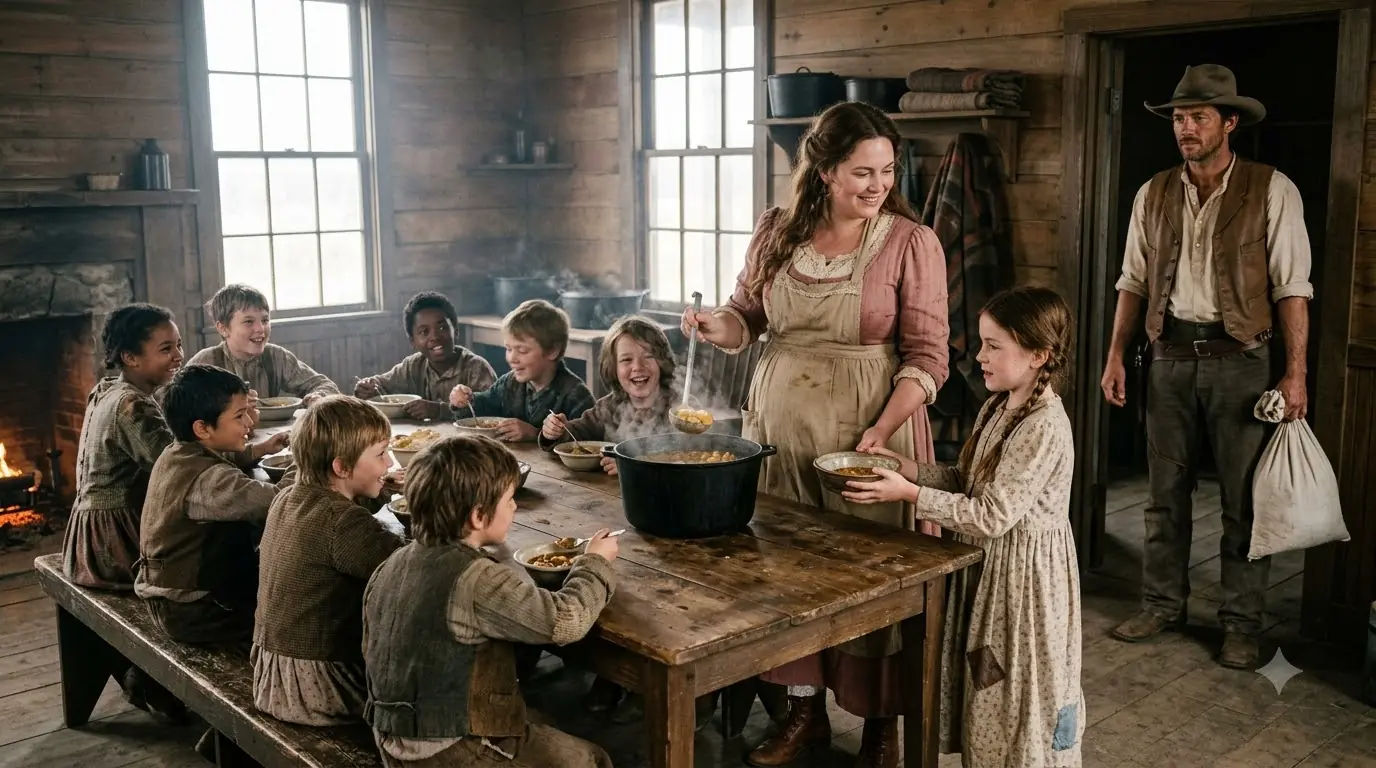
Ruth was thirty years old and nearly eight months pregnant. Her ankles were swollen from travel, her back ached, and every few hours the child inside her shifted hard enough to remind her that whatever happened next, she would soon be responsible for one more life.
The wagon stopped in front of what had once been Grace Chapel.
The building leaned slightly toward the prairie as though years of Kansas wind had finally convinced it to surrender. White paint had peeled from the siding. Two shutters hung crooked. A wooden cross remained above the entrance, though one arm had split and been repaired with iron wire.
Ruth looked toward the driver.
“This is it?”
The driver, an elderly farmer named Mr. Talbot, nodded.
“Only place in Dust Hollow Reverend Morrison said might take you.”
Ruth stared at the chapel.
She had imagined something different.
Not better exactly.
She had stopped making the mistake of expecting better.
Still, she had imagined perhaps a boardinghouse, a widow willing to rent a room, or a church family that needed help in exchange for shelter.
Not an abandoned-looking chapel with children watching through the windows.
One small face disappeared as soon as Ruth noticed.
Then another.
Mr. Talbot climbed down and placed Ruth’s two bags beside the road.
“You sure you’ll be all right?”
“No.”
He blinked.
Ruth smiled tiredly.
“But I suppose I’ll find out.”
That answer seemed to satisfy him more than false confidence would have.
He tipped his hat and drove away.
Ruth stood alone.
For several seconds she listened to the wagon wheels fade into the distance.
Then the chapel door opened.
A thin man in his late fifties stepped outside.
He wore a black coat polished shiny at the elbows and spectacles held together near one hinge with thread.
“Mrs. Albbright?”
“Yes.”
“I’m Reverend Morrison.”
He came down quickly.
“You shouldn’t be lifting those.”
Ruth looked toward her bags.
“I lifted them from St. Louis.”
“That doesn’t make it sensible here.”
Before she could argue, he took both.
His face tightened under the weight.
Ruth smiled.
“Still feeling sensible?”
He laughed.
It was a tired laugh.
But kind.
“Come inside.”
The first thing Ruth noticed inside Grace Chapel was the smell.
Boiled potatoes.
Woodsmoke.
Damp wool.
Children.
Twelve of them.
A long table filled the old sanctuary where pews had once stood. Mattresses lined one wall. An iron stove occupied the corner. A faded curtain divided a small sleeping area near what had once been the altar.
The children stared.
Ruth stared back.
A little girl with brown braids sat closest.
Perhaps eight years old.
Freckles.
Patched floral dress.
She held a spoon but no bowl.
Reverend Morrison said:
“Children, this is Mrs. Ruth Albbright.”
Nobody answered.
Ruth looked around.
“Are they always this friendly?”
A small boy whispered:
“We’re not supposed to bother guests.”
Ruth turned toward him.
“Good.”
“Because I’m tired.”
A few children smiled.
The little girl with braids said:
“Are you staying?”
Ruth looked toward Reverend Morrison.
He looked uncomfortable.
“As long as she needs.”
Ruth understood.
Which meant:
As long as she could be useful.
Or until there was no food.
Or until the county shut the place down.
“Then yes,” Ruth said.
The girl smiled.
“My name’s Lucy.”
“Hello, Lucy.”
Lucy looked at Ruth’s stomach.
“Is there a baby in there?”
Several children immediately leaned forward.
Ruth placed one hand over the curve beneath her dress.
“So I’ve been told.”
“How’d it get there?”
Reverend Morrison coughed violently.
Ruth fought a smile.
“That is a conversation for another day.”
Lucy considered.
“All right.”
Then:
“Is it hungry too?”
That question broke something in Ruth.
Not visibly.
She had become skilled at keeping grief inside.
But she looked toward the empty bowl in front of Lucy.
Then toward the others.
“How much food do you have?”
Reverend Morrison hesitated.
That was answer enough.
The pantry contained six potatoes, half a sack of flour, dried beans, one onion, two carrots, a little bacon grease, and enough salt to make desperation taste acceptable.
Ruth stood staring.
“This feeds twelve children?”
“Thirteen now,” Reverend Morrison said carefully.
Ruth looked toward him.
He raised both hands.
“I’m counting you.”
“Fourteen.”
He frowned.
Ruth touched her stomach.
“Oh.”
“Yes.”
Reverend Morrison sighed.
“I have asked every ranch in the county for donations.”
“And?”
“Some give.”
“Some can’t.”
“Some think the orphanage encourages dependence.”
Ruth looked toward the dining room.
“They’re children.”
“I know.”
“What happened to their families?”
“Different things.”
“Disease.”
“Accidents.”
“Two were abandoned.”
“One father was imprisoned.”
“Some mothers died in childbirth.”
Ruth’s hand moved unconsciously to her belly.
Reverend Morrison noticed.
“I’m sorry.”
“So am I.”
She looked back at the pantry.
“What do you normally cook?”
“Beans.”
“Potatoes.”
“Sometimes cornmeal.”
Ruth rolled up her sleeves.
“Then tonight we make soup.”
He blinked.
“With what?”
“With everything.”
She began.
Potatoes diced smaller so they seemed more numerous. Carrots grated. Onion browned in bacon grease. Beans mashed partly into the broth to thicken it. Flour turned into rough dumplings with water and salt.
By dusk, the iron pot smelled better than anything the chapel had served in weeks.
Children gathered around the table.
Ruth ladled carefully.
Small portions first.
Then second helpings if anything remained.
Lucy held out her bowl.
“This smells rich.”
“It isn’t.”
“But we can pretend.”
Lucy grinned.
Ruth filled her bowl.
The little girl took one bite and closed her eyes.
“Oh.”
“What?”
“It tastes like somebody lives here.”
Ruth stopped.
Reverend Morrison looked away.
Ruth swallowed.
Then filled another bowl.
That night she slept behind the curtain near the altar.
The baby moved.
Outside, wind rattled the chapel siding.
A child coughed.
Another whimpered in sleep.
Ruth lay awake listening.
She had arrived needing a place to stay.
Before sunrise, twelve children had already begun turning it into a reason to remain.
Ruth established order within three days.
Not because anyone appointed her.
Because chaos annoyed her.
She created washing days.
Baking days.
Repair evenings.
Older children carried water.
Younger ones collected kindling.
Everyone learned that blankets could be patched before holes became impossible.
Reverend Morrison protested when she climbed onto a chair to repair curtains.
“You are expecting a child.”
“I noticed.”
“You should rest.”
“I rested on a train for eleven hours.”
“That hardly counts.”
“Then I’ll rest after winter.”
Winter.
That word changed his expression.
It was September.
Kansas winter was not far away.
The chapel roof leaked above the storage room.
The barn behind it sagged.
Only seven proper coats existed for twelve children.
Wood supply might last six weeks.
Ruth looked around one evening.
“We need more.”
Reverend Morrison nodded.
“We always need more.”
“No.”
“I mean we need a plan.”
He looked toward her.
“You have one?”
“Not yet.”
“Then how do you know?”
“Because waiting for generosity isn’t a plan.”
That sentence would later become one of Reverend Morrison’s favorite things Ruth ever said.
At the time, he merely sighed.
“You sound like my late wife.”
“Was she sensible?”
“Terrifying.”
“Good.”
Eli Thatcher first entered Grace Chapel carrying a calf.
Not a sack of flour.
Not money.
A calf.
The children heard commotion outside and ran toward the door.
Ruth followed more slowly.
Her pregnancy made sudden movement increasingly inconvenient.
When she stepped onto the porch, she saw a tall man beside a wagon.
Dark brown hair beneath a weathered hat.
Strong shoulders.
Gray-blue eyes.
Expensive boots covered deliberately in dust.
He held a small brown-and-white calf wrapped partly in a blanket.
Lucy gasped.
“Baby cow!”
The man looked toward her.
“Technically.”
“What happened?”
“Mother rejected him.”
“Why?”
“Sometimes animals make poor decisions.”
Ruth looked at the man.
“So do men.”
His eyes moved toward her.
For a second neither spoke.
Reverend Morrison came outside.
“Eli.”
There was history in the greeting.
Not friendship exactly.
Familiarity.
The man nodded.
“Reverend.”
Then looked toward Ruth again.
“This is Mrs. Albbright?”
Ruth raised an eyebrow.
“You’ve heard about me?”
“Dust Hollow is small.”
“That sounds dangerous.”
“It is.”
Reverend Morrison introduced them.
Eli Thatcher.
Owner of Thatcher Ranch.
The name meant nothing to Ruth.
The children reacted differently.
One boy whispered:
“He owns the red barns.”
Another said:
“He’s rich.”
Eli heard.
His expression tightened slightly.
“I own barns.”
“Rich is arguable.”
Reverend Morrison snorted.
“Only if you argue badly.”
Ruth almost smiled.
Eli carried the calf inside the barn.
The children followed.
He explained how to mix warm milk and feed slowly.
Ruth knelt beside the animal.
Eli immediately said:
“You shouldn’t be down there.”
She looked up.
“Do all men in Kansas begin conversations by telling pregnant women what they shouldn’t do?”
He froze.
Several children giggled.
Eli rubbed the back of his neck.
“No.”
“Good.”
Ruth adjusted herself carefully and coaxed the calf to drink.
Eli watched.
Longer than necessary.
She noticed.
“Something wrong?”
“No.”
“You’re staring.”
“I’m watching the calf.”
“The calf is lower.”
That made the children laugh openly.
Even Eli smiled.
Ruth looked away before he saw hers.
He returned the next day.
With oats.