Blood had dried beneath Clara Whitmore’s fingernails before she drove the next nail.
She noticed it.
She simply did not care enough to stop.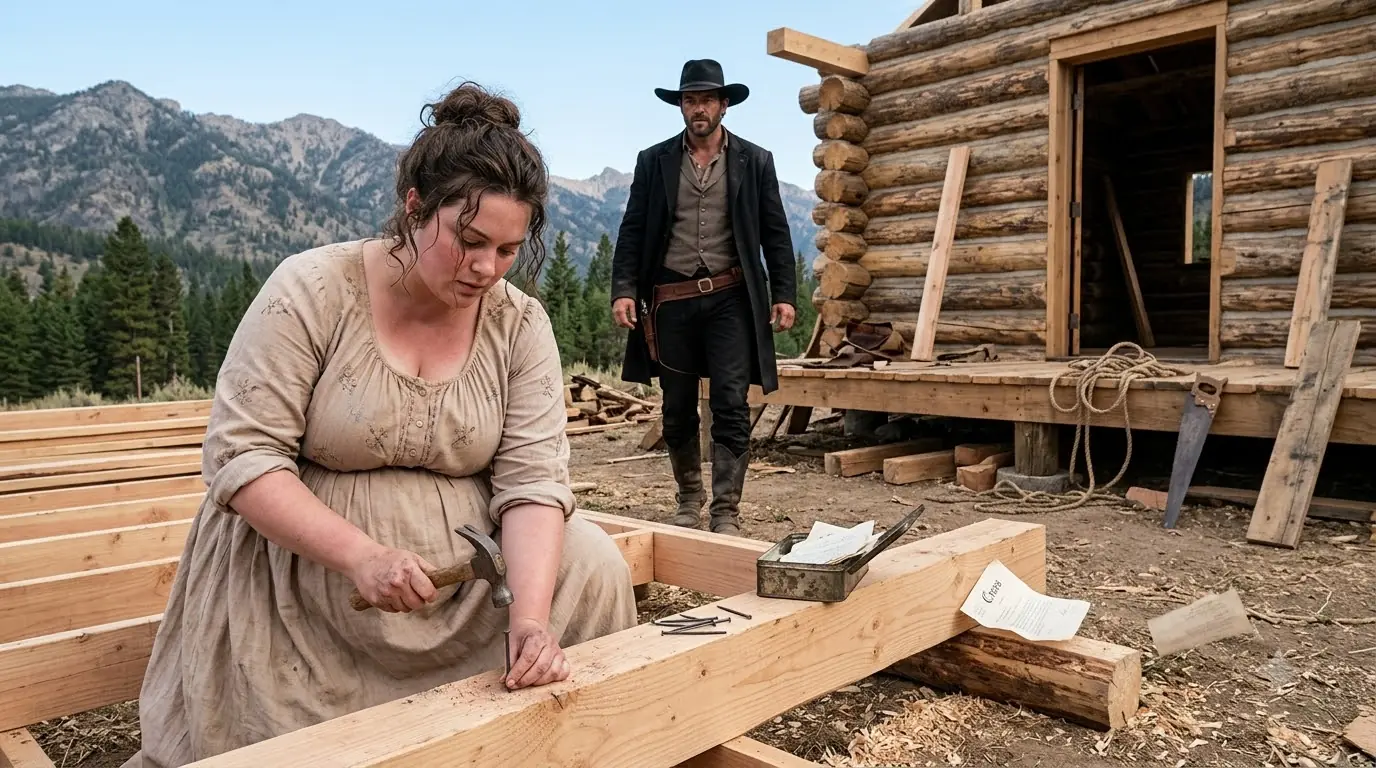
The nail sat slightly crooked against the pine joist. Clara steadied it between two swollen fingers, lifted the hammer, and struck.
Once.
Twice.
On the third blow it went straight.
“Better.”
She shifted her weight carefully and reached for another.
The child inside her moved.
Not violently.
A long rolling pressure beneath the heavy curve of her stomach, as though the little girl were turning over in protest at her mother’s position.
Clara put the hammer down.
“All right.”
She rubbed one hand slowly across her belly.
“I heard you.”
Another movement.
Clara smiled.
“You complain like your grandmother.”
The unfinished cabin offered no response except the creak of timber in the mountain wind.
Late afternoon sunlight poured through walls that were still more opening than structure. Half the roof had been covered. The rest remained an exposed skeleton of fresh-cut rafters pointing toward a clean Montana sky.
Forty acres stretched around her.
Pines.
Rock.
Dry grass.
A narrow creek.
High country that most people considered inconvenient.
Clara considered that its greatest advantage.
Inconvenient land attracted fewer men who believed they knew what ought to be done with it.
She had been at the homestead eleven weeks.
During that time the people of Harland Creek had developed a fascination with predicting her failure.
The dry-goods clerk gave her until October.
The butcher predicted the first hard freeze.
Mrs. Avery at the boardinghouse told anyone willing to listen that childbirth would “teach Clara what stubbornness costs.”
Three ranch hands had watched her unloading lumber and offered to purchase the claim from her before she “made the baby pay for pride.”
Clara rejected every offer.
The offers became jokes.
The jokes became predictions.
The predictions became certainty.
Nobody asked why a thirty-one-year-old woman seven months pregnant preferred an unfinished cabin in the mountains to a comfortable house in town.
They preferred simpler explanations.
She was foolish.
Abandoned.
Too proud.
Probably difficult.
Edward Whitmore would have liked that last one.
Difficult.
It had been his favorite word.
Clara picked up another nail.
Before Edward, she had been Clara Vale.
She sometimes missed the name.
Not because there had been anything grand about being a Vale, but because the girl who carried it had not yet learned to question every thought before speaking.
Edward taught her that skill.
He never struck her.
That fact had kept Clara confused for years.
Cruel men, according to the stories women told one another, shouted.
They drank.
They slammed doors.
They came home smelling of perfume that did not belong to their wives.
Edward did none of those things.
He spoke quietly.
He smiled when correcting her.
He explained.
Always explained.
When Clara made household decisions, Edward explained why she had chosen badly.
When she suggested they save money differently, he explained why she did not understand finance.
When she wanted a bank account in her own name, he patiently explained that married women did not need competing interests.
When she laughed loudly at dinner once, he said nothing until they were alone.
Then he touched her hand and said:
“You don't realize how people look at you when you do that.”
She had stopped laughing loudly.
When Clara suggested using the bookkeeping skills her mother had taught her to earn money for local merchants, Edward smiled.
“My love, you struggle enough managing this household.”
Their house had three rooms.
Clara kept every bill accurate to the penny.
But after hearing the sentence enough times, she began wondering whether he might be right.
Then she became pregnant.
For perhaps two weeks, Edward changed.
He brought her oranges.
Asked whether she was tired.
Put one hand against her belly when there was nothing yet to feel.
Clara allowed hope to become reckless.
Then Edward accepted a business position in Denver.
He told her over supper.
“You'll stay with my sister in Butte.”
Clara looked up.
“For how long?”
“Until the child arrives.”
“I’m your wife.”
“Yes.”
“I would go with you.”
Edward cut his meat.
“The arrangement would be inconvenient.”
Clara watched him.
“For whom?”
His knife stopped.
“Don't begin.”
“Begin what?”
“This.”
He gestured vaguely toward her.
Questions.
Disagreement.
Existence.
Clara felt something inside her settle.
“What happens after the baby is born?”
Edward resumed eating.
“We decide what arrangement makes sense.”
“For the three of us?”
He looked at her then.
“With you.”
That was the moment.
No screaming.
No broken glass.
Only a fork resting beside a white plate and her husband explaining that whether she remained part of her own family would be determined later.
Clara lay awake until two.
At three, she packed.
At four, she opened the tin box her mother had left her.
At five, she took half the money from the household cash drawer.
Exactly half.
Edward could never say she stole from him.
She left an accounting sheet.
He probably hated that most.
By sunrise Clara was gone.
Inside the tin box were letters from her mother, old receipts, two tax documents, a small photograph, a map, and a folded deed Clara had never completely understood.
One name appeared repeatedly.
Cross.
Her mother had never explained it.
Clara remembered asking once when she was sixteen.
Her mother had taken the paper from her hands.
“Old business.”
“Whose?”
“Mine.”
Then she had put it away.
After her mother’s death, Clara kept the box because it was one of the few things Edward considered too unimportant to control.
He had looked through the papers once.
She remembered his sudden interest.
“What is this?”
“A deed.”
“To Montana land?”
“I think so.”
“Worth anything?”
“My mother said no.”
Edward spent twenty minutes studying it anyway.
Later he told Clara it was probably invalid.
She believed him.
That had been five years earlier.
After leaving him, she stopped believing things merely because Edward said them.
The legal description led her to the mountains outside Harland Creek.
Not directly.
It took a surveyor.
A patient clerk.
Two days comparing old maps.
The original document described more land than the forty acres Clara ultimately claimed, but sections had changed hands, boundaries had been altered, and no one at the county office could tell her exactly what remained valid.
Clara did not have money for a long legal fight.
She found forty acres adjacent to the old description that remained available.
She claimed them.
Then she began building.
The first corner was six inches wrong.
She tore it out.
Her first wall bowed.
She dismantled half of it.
She dropped a beam across her boot and sat in the dirt crying without sound for four minutes before standing again.
Harland Creek watched.
The town waited for failure.
Clara gave them construction instead.
By September, the cabin had walls.
Half a roof.
A floor taking shape.
And a ridge beam twelve feet above the ground that every man who stopped by had informed her she could not raise alone.
She raised it with two homemade gin poles and enough profanity that the child inside her would probably be born already knowing several useful words.
The week after the ridge beam went up, Nathaniel Cross rode onto her property.
Clara heard the horse.
She reached for the rifle.
The rider emerged between tall pines.
He was the kind of man distance could not make ordinary.
Tall.
Broad.
Dark hat.
Long black coat dulled with dust.
His horse alone cost more than everything Clara owned.
The saddle was custom leather.
The rifle at his leg well maintained.
Clara stood beside the cabin.
The man reined in twenty yards away.
His eyes went first to her face.
Then her rifle.
Then the enormous curve beneath her beige work dress.
Then the cabin.
Finally the ridge beam.
“You put that up?”
Clara tightened her grip on the rifle.
“No.”
His eyebrow rose.
“The archangels came Tuesday.”
For one second he simply stared.
Then laughed.
A real laugh.
No cruelty.
No disbelief hidden inside it.
Clara disliked how immediately she liked the sound.
He removed his hat.
“Nathaniel Cross.”
The surname landed.
Clara’s grip shifted.
Everyone knew Nathaniel Cross.
Twelve thousand acres north of Harland Creek.
One of the largest cattle operations in that region.
Timber rights.
Freight contracts.
A controlling interest in the Harland Creek mill.
Wealth inherited partly from his father and expanded considerably by Nathaniel himself.
Thirty-eight.
Widower according to one rumor.
Never married according to another.
Too difficult to marry according to several women who seemed offended by the fact.
Clara glanced toward the cabin.
The tin box was inside.
Nathaniel noticed the movement but said nothing.