The Duke called her "a pretty face and an empty head" in front of half of London—and directly behind her. She did not turn around. She raised her card, and when the auctioneer's hammer came down, it was not his name he called. What happened next took the Duke an entire season to understand, required a public apology, and very nearly cost him everything else.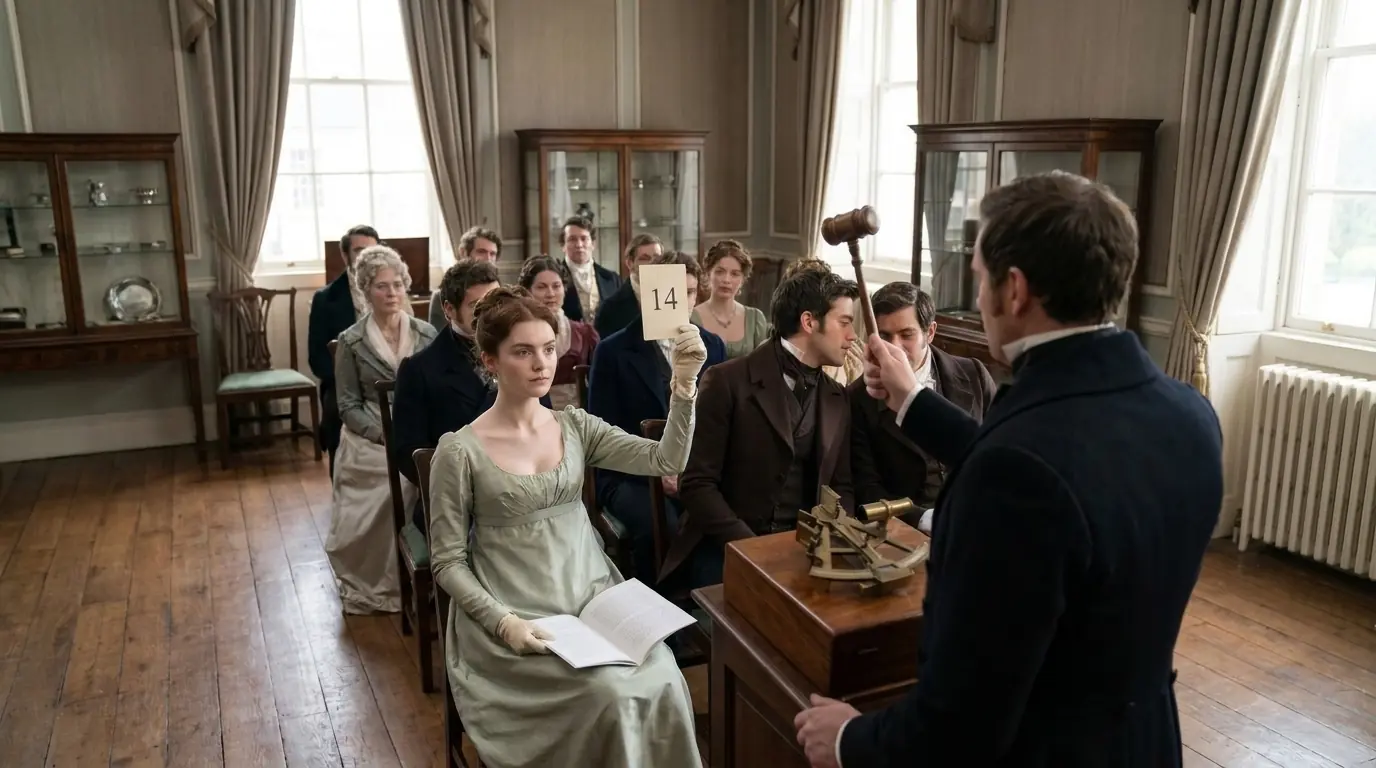
The sale at Callaway's began at 10:00 on a Tuesday in April, and by then the room smelled of beeswax, damp wool, and ambition. Sophia Delvane arrived with her aunt. This was not unusual. Lady Frant brought Sophia to a great many places, concerts, exhibitions, the occasional lecture at the Royal Institution when the subject was sufficiently uncontroversial, and Sophia came without argument, which Lady Frant took as evidence of an agreeable temperament, and Sophia took as evidence of an agreeable destination. Callaway's was a destination she had been angling toward for 6 weeks.
The estate of Sir Rowan Pell, navigator, cartographer, fellow of the Royal Society, dead since February, had passed to a nephew who cared nothing for maps and everything for the income maps might generate at auction. The catalog had been printed. Sophia had obtained a copy the afternoon it was available. She had read it twice before dinner and once more after, and on the third reading she had stopped at lot 47 and set the catalog down very carefully on her writing table, as a person does when they do not wish to crumple the page. Lot 47, a brass sextant of exceptional craftsmanship, engraved with the initials RP and a meridian line, believed to have accompanied Sir Rowan Pell on his 1804 expedition to the northern latitudes.
Provenance confirmed. Her sextant, the one in the walnut case on the shelf in her sitting room, the one her father had purchased from Pell's own hand in 1806 and left to her at his death, was engraved with the same meridian line, different initials, the same maker's mark on the underside of the arc. She had looked it up. She had looked everything up. She had spent two weeks looking things up, which was the sort of activity that Sophia Delvane was not generally assumed to engage in.
She took a seat near the aisle in the third row, set her reticule on her lap, and opened her catalog to lot 47. Lady Frant sat beside her, and surveyed the room with the expression of a woman who had attended enough auctions to find them mildly theatrical and entirely enjoyable. She was 61, wore purple without apology, and had been Sophia's father's sister before she became Sophia's primary social guardian, a role she discharged with considerable competence and very little sentimentality. "Lord Chatham is here," she said, not looking at Sophia.
"Third row on the left. He has the catalog open to the silver." "I didn't come for the silver. I know what you came for. I'm telling you what Lord Chatham came for in case it becomes relevant." Lady Frant paused.
There is also a man standing near the back whom I do not recognize, which in this room is unusual. Sophia did not look up. What does he look like? Tall, brown coat, the expression of someone who finds the proceedings beneath him, but has not yet decided to leave. Half the room looks like that.
Not quite like this. Lady Frant tilted her head a fraction. He has the catalog, but he is not reading it. He is reading the room. Sophia looked up.
Then he was, as described, tall. The brown coat was well cut without being fashionable. The coat of a man who spent money on quality, and nothing on trend. He stood with his back partially to the wall near the rear left column, arms not quite crossed, catalog held loose in one hand. He was looking at the lots displayed along the side wall.
He was looking specifically at lot 47. Sophia looked back down at her own catalog. "Do you know him?" she asked. "I know of him," Lady Frant said, which was a distinction she made precisely.
Crispin Hawk, the Duke of Mero. He has been abroad for 4 years, the Adriatic, I believe, and before that somewhere further east. He returned in January, and has been largely invisible since, which society finds either mysterious or rude, depending on whom you ask. “Which do you find it?” “Sensible,” Lady Frant said.
January is no time to reappear. The auctioneer called the room to order. Sophia straightened in her chair and set her catalog flat across her knees. Lot 47 was late in the first half. She had 12 lots to wait through, and she intended to spend them paying attention to nothing that would cost her composure.
The Duke of Mero took a seat directly behind her. She knew this because she heard him settle and because Lady Frant's eyes moved briefly to the row behind and returned without expression, which was its own information. Sophia did not turn around. The lots moved at a reasonable pace. A set of charts went to a shipping merchant for twice the estimate.
A chronometer drew three bidders into a contest that resolved eventually in favor of a young man in a striped waistcoat who looked surprised to have won. A collection of correspondence—letters between Pell and a colleague at the Admiralty—went unsold, the estimate too high for what the room could verify. Sophia watched all of it with the mild pleasant attention she had spent years perfecting. It looked like polite interest. It was, in fact, a cataloging of exactly who wanted what and how much they wanted it.
She had £340 authorized from her own quarterly allowance, which she controlled entirely under the terms of her father's will. She had not mentioned the auction to her mother, who would have asked why, or to her fiancé, Sir William Breck, who would have offered to attend and bid on her behalf, which was kind of him and entirely beside the point. Lot 47 was called. The auctioneer described it in adequate terms, exceptional craftsmanship, confirmed provenance, a significant piece of navigational history, and opened at £30. Sophia raised her card.
Two other bidders entered immediately. The man in the striped waistcoat apparently emboldened by his chronometer and someone toward the front whose card Sophia couldn't see. They climbed to 50 without difficulty. The front bidder dropped at 55. The waste coat followed at 62.
Sophia held at 65. A pause. The auctioneer looked around the room. 70, said a voice behind her. Low, unhurried, the voice of a man who had not needed to raise it. Sophia raised her card. 75.
Another pause, this one shorter. 80. She turned her card over in her lap once, a habit so small that only Lady Frant would have noticed. Then she raised it. 90. The pause that followed was longer, long enough that the auctioneer drew breath to close. 100, said the voice. Sophia did not turn around.
She did not consult her catalog or adjust her posture or do any of the things that people did when they were recalculating. She had known since lot 4 that she might need to go higher, and she had decided since lot 6 that she would. 120, she said. Silence. The auctioneer waited the requisite count. 120 going once, going twice. Nothing.
Sold. Lady Frant made no visible expression. Sophia uncurled her fingers from the bidding card and set it neatly on top of her catalog. From the row directly behind her, she heard, conversationally and at no particular volume, the remark of a man who had not considered whether she was listening. “Pretty face. Clearly came with someone else's money and someone else's idea,” the voice said to whoever sat beside him.
A murmur of amusement from the same direction. Sophia looked straight ahead at the auctioneer, who was already moving to lot 48. Lady Frant's hand settled briefly over Sophia's wrist. Not a pat, just a placement, firm and steady, and then withdrawn. “Well,” Lady Frant said very quietly, “now we know.” Sophia collected lot 47 at the payments table with the same pleasantness she had maintained throughout.
The clerk was efficient. The case was wrapped in cloth. She signed where required and thanked the clerk by name, because she had made it her business to learn the clerk's name before she arrived. She was crossing toward the door when the Duke of Mero stepped into her path. Not deliberately or not entirely.
"Miss," he glanced at her then at the cloth wrapped parcel under her arm. "Delvane," she said pleasantly. Sophia Delvane. A pause that lasted exactly long enough to be noticeable.
You had a figure in mind. I had the piece in mind, she said. The figure followed from that. He looked at the parcel again. You know what it is?
I know what it is, she agreed. Do you? The question landed without emphasis, without edge. It was on the surface entirely civil. The Duke of Mero looked at her for a moment with an expression she did not bother to interpret.
“Ursant,” he said. “Pell's.” “One of two,” Sophia said. The maker produced a matched pair for the 1804 expedition.
“Different owners by 1806. The other one is at home on my shelf.” A beat. “You came to complete the set,” he said. “Yes.”
He had nothing to say to that. Sophia waited pleasantly in case anything occurred to him. Nothing did. Good day, your grace, she said, and moved past him through the door. Lady Frant fell into step beside her on the pavement and they walked half a block in silence before her aunt spoke.
"He heard himself," Lady Frant said. "Most people don't," said Sophia. "No, but he did." A pause. "Whether he does anything about it is another question entirely." Sophia shifted the parcel under her arm.
The brass inside was cool through the cloth, and heavier than she'd expected, and exactly what she had come for. "It doesn't matter," she said. Lady Frant said nothing, which was its own kind of commentary. Sir William Breck called that afternoon as he did on Tuesdays.
He was 53, silver at the temples, and possessed of a steadiness that Sophia's mother found deeply reassuring, and Sophia found deeply comfortable, which she had decided was near enough to the same thing. He brought her a small book, an account of a recent expedition to the Baltic, because he knew she liked that sort of thing, and he accepted the tea that was offered, and he asked after her morning with genuine interest. "I attended the Pell auction," she said. "Ah," he set his cup down.
"Did you find what you were looking for?" "I did." “Good.” He meant it. That was one of the true things about Sir William: he meant what he said, and what he said was consistently decent. “Was it very expensive?”
“More than I intended.” He smiled. “Worth it?” Sophia looked at the walnut case already sitting beside its twin on the shelf across the room where she had placed it the moment she arrived home before she'd even taken off her gloves. The two instruments sat side by side, the engraving on each catching the afternoon light at slightly different angles.
"Yes," she said. Sir William followed her gaze to the shelf. He looked at the two cases for a moment, then back at her, and something in his expression shifted, not unhappily, but with the quiet attention of a man doing arithmetic that had nothing to do with money. He didn't say anything.
He returned to his tea. The Duke of Mero did not go directly home from Callaway's. He walked, which he did when he was thinking, and he had been doing a great deal of walking since January. London in 1818 was not the London he had left in 1814, or it was exactly the same London, and he was not the same person, and he had not yet determined which of those was the problem. He had gone to the auction on impulse.
He went to most things on impulse at present, having not yet reconstructed the infrastructure of routine that four years abroad had dismantled. Someone at his club had mentioned the Pell estate. He had known Pell slightly years ago, and he had a vague regard for the man's work, and he had thought perhaps a piece of it would look well at Mero. Mero was a house that needed filling. He had been avoiding that fact since January, and the auction had seemed like a sideways approach to it.
He had not expected to be outbid. He had certainly not expected to be outbid by a girl of 22 with a quiet voice and a cloth wrapped parcel and the precise unhurried manner of someone who had known what they were doing since before they arrived. One of two. The other is at home on my shelf. He had made a remark.
The remark had been, he was honest enough, walking to complete the thought, unkind and wrong, and she had been sitting directly in front of him. The probability that she had heard it was not a probability. It was a certainty. He turned toward Piccadilly. The remark—specifically, “Pretty face. Clearly came with someone else's money and someone else's idea”—had been said to Foresight, who sat beside him, who had laughed, and whose laughter Crispin had neither encouraged nor stopped.
He thought about her expression when she'd said one of two. No triumph in it, no performance, just the plain transmission of a fact she had known, and he hadn't. He had been wrong about her before he had spoken to her, which was a variety of wrong he particularly disliked, having been on the receiving end of it himself. He did not go to his club. He went home, poured himself a glass of wine, and stood in front of the empty space above the library mantle, where he had vaguely imagined the sextant might sit.
It was going to continue being empty. That seemed about right. The Aldermast Ball was the first significant gathering of the season held 3 weeks after the Pell auction in a house on Grosvenor Square with excellent floors and indifferent paintings. Half of London attended, the other half sent their excuses and read about it the following morning. Sophia wore pale green, which her mother considered too quiet, and Lady Frant considered correct.
She arrived with Sir William, which was expected, and was greeted by Mrs. Aldermast, which was obligatory, and found Lady Frant within 4 minutes of entering the ballroom, which was strategic. "He's here," Lady Frant said without preamble. "Who?" Lady Frant gave her the look that comment deserved. Sophia accepted a glass from a passing tray.
“Where?” “Speaking to Lord Foresight near the east wall. He arrived twenty minutes ago. He has danced with no one and shown no indication of intending to. That is his affair.”
It becomes everyone's affair when Foresight is involved. Lady Frant's voice was dry as chalk. Foresight was sitting beside Mero at Callaway's. Sophia had assumed as much. She had not asked.
“It does not signify.” “It has already signified,” Lady Frant said. “I heard it twice on my way across the room: the Delvane girl outbid Mero at auction and spent a fortune on some nautical nonsense.”
Lady Frant continued, “That is the charitable version. The less charitable version is that you were showing off, that someone put you up to it, and that you could not possibly have known what you were bidding on.” She paused. The last one came from Mrs. Foresight, which tells you where it originated. Sophia looked across the room. The Duke of Mero was indeed near the east wall.
He was not at this moment speaking to Foresight. He was listening to Foresight, which was different. His expression had the quality of a man who had agreed to attend a musical performance and arrived to find it longer than described. As she watched, he glanced across the room and found her. She looked away first, but not quickly.
There was a difference between looking away and retreating, and she had learned it young. “He made a mistake,” she said. “He knows it. That is the end of the matter.” “My dear girl,” Lady Frant said with great fondness, “that is never the end of the matter.”
That is the beginning of one. Sir William appeared at her elbow with characteristic timing. He looked across the room toward where she had been looking and then at her with an equanimity that was entirely genuine. “If Mero were to ask you to dance,” he said pleasantly, “I should not object.”
“He looks like a man in need of an errand.” “You are very gracious,” she said. “I am very observant.” He offered his arm for the first set. “Shall we?”
She took it. They went onto the floor, and Sir William danced with his usual competence. During a turn, he said, “You seem preoccupied.” “I am attending to the steps.” “You never have to attend to the steps.” He said it without reproach. “Is something the matter?” “Nothing of consequence.” He nodded, accepting this with the ease of a man who had learned not to press.
The set ended, so William returned her to Lady Frant, mentioned a friend he'd spotted near the card room, and went, leaving a vacancy beside her that was, Sophia thought, not entirely accidental. “Miss Delvane.” She turned. The Duke of Mero was apparently in the habit of appearing without announcement. He was also, she noted, not carrying a drink, not looking at anyone else in the room, and addressing her with the focused directness of a man who had decided to do something and was doing it before he changed his mind. “Your Grace,” she said. “I owe you an apology.”
Whatever she had expected, it was not that. She had expected to be ignored or to be spoken to with the careful social pleasantness that passed for acknowledgement among people who preferred to pretend that awkward moments had not occurred. She had not expected this. Lady Frant beside her became extremely occupied with her fan. “Do you?” Sophia said.
“I made a remark at Callaway's,” he said. He said it evenly, not as confession, more as a statement of established fact. “It was wrong in every particular, and you were sitting directly in front of me.” “Directly in front of you,” she repeated. “I should not have said it in any case.”
“That I said it where you could hear it is a separate and compounding error.” He held her gaze. “I am sorry.” “That is better,” she said. He looked at her with the attention of someone recalibrating. “I would like,” he said, “if you are not engaged for the next set, to dance.” Behind her fan, Lady Frant made no expression whatsoever.
Sophia could feel this. “I am not engaged,” Sophia said. “Though I should tell you, Your Grace, that dancing with me will not repair your estimate in anyone's eyes.” It will only make you appear to be correcting a mistake. “I am correcting a mistake publicly. Is there a version of it you would prefer?” She considered him. He was still doing that thing, looking at her as though recalibrating, as though the instrument in his hand was giving him readings he hadn't prepared for. “No,” she said. “This version will do.” She took his offered arm and they went onto the floor.
He danced better than she expected, which she noted and filed without comment. He was also quiet during the first figure, which meant she was quiet during the first figure, and the silence between them was not uncomfortable so much as watchful. “The sextant,” he said during a pause in the pattern. “The matched pair.”
How did you know?" "My father purchased one from Pell directly in 1806. Pell mentioned in the letter of provenance that a second had been made." "I read the letter," she paused. "I've read it several times. And when the catalog appeared, I read the lot description and looked up the maker's mark, which confirmed the match. Another pause in the figure.
They turned, came back together. “Where did you learn to read a maker's mark?” he asked. “From books, mostly, and from asking questions of people who knew the answers.” She glanced at him. “I found that if you look decorative enough while asking, people answer very thoroughly.”
He was quiet for a moment. “That is a damning thing to say.” “It is an accurate thing to say about everyone in this room.” “About most of them,” she said. “Not all.” The music shifted.
They went through the next sequence without speaking. When they came back to the slower passage, he said, “What did you do with it—the second sextant?” “I put it beside the first on the shelf in my sitting room.” “Do they look right together?” She thought about the afternoon light on the two cases, the maker's marks at slightly different angles, the same meridian line on each.
"Yes," she said. "They look exactly right." He nodded as though this answered something beyond what she'd been asked. The dance ended. He returned her to Lady Frant.
He bowed correctly. She curtsied correctly. He left without lingering, which was, she thought, also correct. Lady Frant waited until he was 5 paces away. “Well—” “Don't,” said Sophia.
“I have not said anything.” “You were about to say something approximately the length of a sermon.” “I was going to say he apologized and meant it, which puts him above seventy percent of this room, and then I was going to say nothing further.” Lady Frant closed her fan. But since you're in a mood to be contrary, I'll add only this, Sir William saw.
Sophia looked across the room. Sir William was standing with his friend near the card room entrance, a glass in hand, looking in her general direction with an expression that was thoughtful rather than troubled. When he caught her eye, he raised his glass slightly. She lifted her chin slightly in return. "He's a good man," Sophia said.
"He is," Lady Frant agreed. "That's what makes it complicated." 3 weeks later, Sophia attended a lecture at the Royal Institution on the subject of celestial navigation, and the Duke of Mero was there. This was not an ambush. He was there first in a seat toward the back, apparently by habit.
She arrived with Lady Frant and took seats to the left, nearer the front. She did not acknowledge him. He did not acknowledge her. The lecture was given by a dry-voiced man with excellent credentials and a tendency to lose his place in his own notes which Sophia found endearing. She took her own notes as she always did in the small leather notebook she brought to any occasion involving information she wanted to keep.
The celestial hour circles were discussed, the correction for refraction, the method of reducing an observation to local apparent time. These were things she knew in outline and wanted to know more precisely. And the lecturer, despite his notes, was precise. At the interval, she was standing near the window reviewing what she'd written when someone stopped beside her. “You are taking notes,” said the Duke of Mero.
“I am.” He looked at the notebook. "May I ask what on?" She showed him the page without comment. The notation was dense and exact. Correction formula in the margin, a small diagram of the lunar distance method.
He looked at it for longer than was polite. “This is better than mine.” “I doubt that.” “I have not taken any.” He paused.
“I do not generally need to write things down.” “Nor do I, usually, but I do not want to get this wrong.” She closed the notebook. “Mero is near the coast, is it not? Do you use instruments?”
“I used to, on the Adriatic.” He said the words flatly, as if deciding how much to add. Not recently. She let him decide. He looked at the window, then back.
“Why celestial navigation?” he asked. “Because that is what the sextants were built for.” She paused. “I wanted to understand what I have.” He was quiet for a moment.
“Most people do not.” “Most people,” she said, “buy things for their mantelpiece.” Something moved across his expression, brief controlled. Quiet. The interval bell rang.
They returned to their respective seats without further exchange, and for the second half of the lecture, Sophia was aware of him at the back of the room in the same way that she was sometimes aware of an open window, not looking at it, but conscious of the movement of air. She mentioned none of this to Sir William, because there was nothing to mention. She mentioned none of it to her mother, who was deep in the organizational pleasure of the season, and would not have understood why a navigation lecture was preferable to a morning call. She mentioned a degree of it to Lady Frant, who listened without interruption. He comes to things, Lady Frant said afterward.
I've begun to notice. He has returned to society after 4 years. It's natural he should attend things. He attended a navigation lecture. He has an interest in navigation.
He has an interest, Lady Frant said, in something. Sophia opened her book. You are engaged, Lady Frant said more gently. I'm aware. Sir William is a good man.
Yes. Sophia turned a page she hadn't read. I know what Sir William is. Lady Frant left it there. She was good at leaving things, which was one of her more underrated gifts.
The instrument on the shelf had not changed, but Sophia found herself looking at it differently. She had looked at it for years as her father's acquisition, then as a curious and beautiful object, then as one of a pair waiting for its counterpart. Now she looked at the two of them together. The matched meridian lines, the maker's mark appearing twice, and thought about the lecture's formula for correcting an observation. You had to account for where you stood.
The instrument was precise, but precision required a fixed point of reference. Without knowing exactly where you were, the reading meant nothing. She closed the case and went to dress for dinner. The Foresight dinner was unavoidable. Sophia had avoided it in her mind for a week and then accepted the invitation because her mother accepted first and because refusing would have produced more comment than attending.
She arrived in a carriage with her mother and spent the journey hearing about the seating arrangements which her mother had obtained from Mrs. Foresight's housekeeper through channels Sophia had long since stopped questioning. She was seated, as it turned out, between a pleasant baronet who talked about his estate and the Duke of Mero, who talked about very little until the soup was removed. Foresight, at the head of the table, had the eyes of a man who had arranged this deliberately, and was pleased with himself about it. Sophia filed this information and said nothing because the baronet on her left was asking about Sir William, and she answered that with the ease of long practice. The Duke spoke when the baronet turned to his other neighbor.
“I did not know you would be here.” “Nor did I.” She considered her plate. Though I suspect Mr. Foresight knew both. A pause.
Yes. “Does being managed trouble you?” “Less than it might, given the current alternative.” She glanced at him. “What is the alternative?”
“Sitting next to Foresight himself and listening to him describe his investment in a Northumberland mine.” He picked up his wine. "By comparison, this is quite pleasant." Sophia looked back at her plate to conceal the thing that nearly happened to her expression. "High praise," she said. "I'm still working on the fine gradations." The fish course arrived.
The baronet on her left resumed. For 20 minutes, the table was loud enough that conversation with the Duke was technically impossible, and Sophia used the time to eat and watch the room, and think about nothing in particular. “The sextant,” he said during a lull. “Does it work?” She looked at him.
“Mine—the original, the one your father bought. I have never tried to use it,” she said after a pause. “I know the theory now. I have been reading.” “You could try it.” “I would need a horizon.” “Mero has one.”
He said it without inflection, as if he had not just said something that would travel from this table to every morning room in London if Foresight overheard it. The coast, clear sighteline to the east. Sophia held very still in the way that she had learned to hold still when something unexpected required her to think quickly. That would be, she said with precision, an unusual excursion. Most interesting ones are.
She looked at him. He was looking at his wine, which was either studied nonchalance or the genuine variety, and she had not yet collected enough evidence to determine which. "I'll bear it in mind," she said. He nodded.
The baronet returned. The moment passed into the general traffic of the evening, and Sophia carried it home with her in the same careful way she had carried lot 47 from Callaway's. It was Mrs. Foresight who ensured the evening had a lasting shape. Sophia heard it secondhand from Lady Frant, who had heard it firsthand from the wife of the baronet, who had been standing 3 feet away, Mrs. Foresight, in the drawing room after dinner, speculating to two friends about the seating arrangement and the conversation she'd observed. “Of course Mero would find her pretty.”
They all do. Whether he finds her worth speaking to twice is another matter. A girl in her position must be careful not to mistake attention for interest. Lady Frant delivered this with her usual precision and then waited. She's not wrong technically, Sophia said.
She's right for the wrong reasons, which is worse. It doesn't matter. He was being polite at dinner. He mentioned Mero's coast. Lady Frant said in passing.
Men don't mention their coastlines in passing. Sophia looked at her hands. I'm engaged to Sir William. You are? Lady Frant agreed.
I think about that, too. Outside the window, May had settled into something that was almost warm. Sophia thought about the formula for reducing an observation. You needed a fixed point, and then you needed the horizon, and the distance between what you measured and what was true depended entirely on knowing precisely where you stood. She didn't say this to Lady Frant.
It was too close to something she hadn't admitted to herself. In the second week of June, the Royal Institution held a small exhibition of instruments and charts from several notable expeditions, among them three pieces from the Pell estate that had not gone to auction. Sophia had read the notice in the morning, and decided before noon that she would attend. She had a question about Pell's notation system that had been nagging at her since the lecture, and she hoped one of the curators might answer it. She had not, for once, anticipated the Duke of Mero.
He was already there when she arrived, standing before a case containing one of Pell's charts, the Northern Latitude Survey, 1804, the same expedition, with the focused stillness of someone actually looking rather than performing looking. He had a small notebook of his own, and had apparently been writing in it because there was a pencil in his hand, and the notebook was open. She nearly turned around. She did not turn around because there was no sensible reason to, and because she had come specifically to see the Pell charts, and because turning around would have meant something she was not prepared to mean. She walked to the next case along, and looked at the chronometer from the 1809 Greenland expedition, and thought about nothing.
Miss Delvane, he had moved without her noticing, which was irritating. I didn't know you would be here. I'm beginning to find that a reliable introduction, she said. A corner of his mouth moved. I mean it.
I know. She looked back at the chronometer. The Pell charts are to your left. I've seen them. He stayed beside her.
“There is a notation in the northern margin I cannot interpret. Something about a correction he made in the field. His shorthand.” “His shorthand,” she said. “He used a modified version of the nautical almanac notation from the 1790s. There is a key in his published account of the expedition.”
Silence. How do you know that? He asked. I read his published account of the expedition. More silence.
She glanced at him. He was looking at her with the expression she had now seen several times. The recalibration, but deeper this time, as though the instrument had run out of range, and he was recalculating the scale. I owe you a second apology, he said. The first one covered the remark.
The first one covered the words. This one is for the reason behind them. He held her gaze steadily. I assumed before you'd spoken a word. Sophia was quiet for a moment.
Around them, the exhibition carried on. Other visitors, low voices, the institution's clockwork ticking somewhere in the background. Most people do, she said finally. I know it's not an excuse. No, she turned back to the chronometer case.
Is that what you came to say? No, he said. I came to see the charts. “What I came to say—” A pause. “I am less certain about.” She waited.
This was another thing she had learned. When someone was deciding whether to say a thing, the worst response was to fill the space. I find, he said slowly, as though choosing each word with some care, that I look for you in rooms when I arrive somewhere. He stopped. I thought you should know that.
The clockwork ticked. Two visitors moved past them toward the Pell case talking about something unrelated. Sophia looked at the chronometer. It was a beautiful instrument, a Kendall copy, she thought, in the K2 pattern, the kind that had gone with Cook. It measured time to within a second a day on the open sea, precise enough to find yourself on the face of the earth within a few miles.
I'm engaged to Sir William Breck, she said. I know he's a good man. I believe you. She turned to look at him. His expression had settled into something she had not seen before.
Not the recalibration, not the careful social composure, but something underneath both of those. Something that had been decided and said and was now simply sitting there waiting to be a fact. That was a very honest thing to say, she said quietly. “I am working on it.” A beat. “Honesty, it turns out, is a practice.”
She almost said something. Several things, in fact, arranged themselves in her mind with the brisk efficiency of a woman who knew how to think under pressure. She said none of them. "I need to speak to the curator," she said about the notation.
"Of course." She walked to the far end of the room. Her heart was doing something she was not prepared to examine, and the back of her neck was warm, and she stood in front of a case of transit instruments for 30 seconds before she remembered what she had come here to find out. The curator was helpful. The notation was explained.
She wrote it down. When she turned to leave, the Duke of Mero was standing before the Pell chart with his notebook, his pencil moving. He did not look up. She left the exhibition. On the pavement outside, the afternoon was bright and slightly cold, and she stood in it for a moment with her notebook in her hand.
Then she walked home. She told Lady Frant that evening. Not all of it. She told it without inflection, and without the part about her heart, which was private, and not yet something she was prepared to speak aloud. She told the fact of it, what he had said, what she had replied.
Lady Frant listened from her chair by the fire, hands in her lap, expression unreadable. “And?” she said when Sophia finished. “And nothing.” I told him I was engaged to Sir William, which I am. Oh, which you are?
Lady Frant agreed. Do you intend to remain so? “That is not—” Sophia stopped. The question isn't about him. No, the question has never been about him.
Lady Frant looked at the fire. The question is what you want, which you have been avoiding with some skill for the better part of the season. I am 22 and this is my first season, and I have done everything correctly. You have, Lady Frant said without irony. So had your mother at your age and her mother before that.
The fire snapped outside a carriage passed. I'm fond of Sir William, Sophia said. I know. He's kind to me. I know that, too.
Sophia looked at her hands. The small leather notebook was still in her lap. She had not put it away since she came home. He said he looks for me in rooms. Yes, said Lady Frant.
I've seen him do it. Sophia looked up. He's not subtle about it, Lady Frant said. He is about most things, I suspect, but not about that. The fire settled.
Sophia closed her fingers around the notebook. I need to think, she said. Yes, her aunt said. You do. Sir William called the following afternoon.
He brought this time no book, just himself correctly dressed with his usual equanimity. The tea was poured. Her mother lingered for precisely the appropriate length of time, and then found reason to be elsewhere, which was a skill Sophia's mother had always possessed and deployed with reliable accuracy. Sophia looked at him across the tea table. "You've been thinking," Sir William said.
"I'm often thinking about something specific." He set his cup down. “I have noticed it since the Foresight dinner.” “I think—” She was quiet. Miss Delvane, he said gently.
Sophia, you may say it. The kindness of this was almost harder than anything else would have been. She looked at the window, then back at him. I don't think, she said carefully, that I am as settled as I ought to be if I were truly settled. She paused.
I don't believe that is your fault. No, he said, I don't believe it is either. You deserve. I know what I deserve. He said it without sharpness.
I also know what you deserve, which is someone who is not merely fond of you. The word landed precisely. She had used it to Lady Frant. I'm fond of Sir William. He had evidently in his quiet and attentive way understood exactly what that word meant coming from her.
I'm sorry, she said. Don't be. He picked up his cup and drank his tea. “I suspected it at the Aldermast Ball, when I watched you dance with Mero.” Not because of what I saw in him, because of what I saw in you.
She looked at him. You were paying attention, he said simply. You pay attention to a great many things. I have admired that about you since we met, but that evening was different. He paused.
I don't believe you've been paying that particular kind of attention to me. She had nothing to say to this. It was true, and he knew it was true, and denying it would have been an insult to them both. "What will you do?" she asked instead.
“Return to Suffolk, I expect. There are things that want managing.” He set his cup down with finality. “I will not be unkind about this. I hope you know that.”
“I know that, and I hope—” He stopped and reconsidered. “I hope he is worth the trouble. Mero seems a complicated sort of person.” “He is,” she said. “So are you,” Sir William said.
That may be the point. He stood, took his leave correctly, and was gone. Sophia sat at the tea table for a long time afterward in the still room, listening to the house around her. From across the room on the shelf, the two sextant cases sat side by side in the afternoon light. The matched meridian lines invisible from here, but present all the same.
She knew where they were. She didn't need to see them. She did not go anywhere for 3 days. She read. She walked in the small garden at the back of the house.
She answered correspondence with her usual care and said nothing to her mother, who had not yet been told about Sir William, and would need to be told soon, and who would not take it quietly. On the fourth day, Lady Frant appeared at the door of her sitting room with her coat still on, and the expression of a woman who had come directly from somewhere. “Mero is leaving,” she said, “for the coast. His man told someone, and someone told me.” Sophia looked up from her book.
When? She said. The end of the week. Why? The estate.
Apparently, there are things that want his attention. Lady Frant paused. I don't know whether he knows about Sir William. Sophia was quiet. He said something honest to you.
Lady Frant said, "In the exhibition, you said nothing in return. I told him about my engagement. You told him a fact. That isn't the same thing." Lady Frant looked at her steadily.
He is leaving. You may let him or you may not. But if you let him leave without saying the honest thing, you will have done to him what everyone has always done to you. Sophia closed her book. Assumed, she said.
They assumed. Lady Frant agreed. Outside the street was quiet. The afternoon was going. On the shelf behind her, the two brass instruments sat in their cases, the meridian line on each, waiting for someone who knew how to use them properly, who understood that the reading was useless without knowing exactly where you stood.
She stood up and reached for her coat. I'll come with you, said Lady Frant, who had not taken hers off. She told her mother about Sir William first. This was the correct order. Lady Frant agreed, and Lady Frant's agreement on questions of correct order was worth more than most people's certainty on matters of substance.
Her mother took it in the drawing room, standing, which was how she received news she had not prepared for. There was a silence of perhaps 10 seconds. Then Sophia, what have you done? I have ended an engagement that was not right for either of us. Sir William is a good man.
I know. He said the same of himself in different words and he was not wrong. Sophia sat, which was deliberate. Her mother standing while she sat reversed the usual pressure of these conversations. He is not unhappy about it. “Mother, he was, I think, relieved.”
Men do not show relief at being refused. Sir William is not performing. He never has been. Her mother sat then not because she was persuaded but because standing had stopped working. She looked at her hands, then at Sophia with the expression of a woman doing rapid and unhappy arithmetic.
“Is there someone else?” she said, not as a question. I don't know yet, Sophia said. That is the truth. Her mother said several more things.
Sophia heard them. She answered what could be answered and let the rest settle like sediment. By the end of the hour, her mother was not pleased, but was at least finished, and had accepted the cup of tea that a well-timed housemaid appeared with, which meant she had accepted temporarily that the situation existed. That evening Sophia wrote a letter to Sir William, not a long one. He would not have wanted a long one.
She thanked him for his decency, not the word decency, which was too clinical, but the thing itself in her own language, and she said she hoped Suffolk would be everything it ought to be, and she meant it. She sealed it, gave it to the footman, and went to bed. She lay awake for 2 hours thinking about the coast. She would not leave for Mero secretly. This was Lady Frant's contribution to the planning, delivered the following morning in the sitting room with the directness of a woman who had already thought the matter through.
You will not travel alone, Lady Frant said. I will come with you. We will call on Mero as part of a journey to Mrs. Alderton in Kent. She owes me a visit and will not question the timing. Mero is a reasonable stop on the route.
We will stay one night, two at the outside, and I will be present throughout. If an engagement results, the visit is explained. If it does not, the visit is a courtesy call and nothing more. Sophia looked at her. You've planned this already.
I planned it the moment you reached for your coat yesterday. Lady Frant sat down. I have been 22. I know what reaching for a coat means. “And if it does not go as I intend—” Sophia stopped.
If it does not go as I intend, then we continue to Kent, and I enjoy Mrs. Alderton's cook, who is excellent. Lady Frant picked up her tea. But I don't think that will be the case. They left two mornings later in Lady Frant's carriage with a maid and a coachman and every appearance of a respectable journey. Lady Frant brought a novel.
Sophia brought her leather notebook and in its walnut case packed carefully in her bag the sextant. She was not entirely certain why she had brought it. It felt necessary which was reason enough. Mero stood on a headland above the sea. It was not what she had imagined, which had been something grander and more forbidding.
It was large without being imposing. Gray stone that had weathered into something almost warm. Windows that faced east across the water, a drive that curved through open ground rather than closing through trees. The effect was of a house that had always been here and had stopped feeling the need to announce itself. The sea was visible from the gate.
The sighteline to the east was, as he had said, clear. They arrived in the early afternoon. The housekeeper received them with the composed efficiency of a woman whose household was well-run and who had been given apparently sufficient notice. A note had been sent ahead, Lady Frant's doing, framed as a courtesy call from an acquaintance passing through the county. They were shown to a sitting room.
Tea was brought. Lady Frant settled into an armchair with her novel, and the particular expression of a woman who intended to be invisible while remaining entirely present. Sophia sat and looked at the sea through the window. She heard him before she saw him, footsteps in the hall, not hurried, and then a pause outside the door that lasted perhaps 3 seconds before it opened. He was in working clothes.
He had clearly been on the shore for real and not decoratively. There was wind in everything, and his boots were not drawing room boots. He looked at Sophia, then at Lady Frant, then back at Sophia with an expression she had not seen before, because she had never surprised him before. “Miss Delvane,” he said, and then, “Lady Frant.” “Your Grace.” Lady Frant turned a page without looking up.
Do go on. I am reading. He came into the room properly. He did not sit. Neither did Sophia.
“Sir William?” he said, not quite a question. Something had reached him then. He ended it, in effect, though he was kind enough to let me say the words. She paused. He saw what I was not saying.
“He was more perceptive than I deserved.” Crispin said nothing. He was watching her the way he watched things he wanted to understand. “You said,” she said, “at the Royal Institution, that you look for me in rooms.” “Yes.” “I look for you,” she said.
I have for some time. I didn't say so then because I was engaged and because saying it felt like more than I'd established the right to say. She held his gaze. I'm saying it now. From the armchair, Lady Frant's page turned again with the timing of a woman who had perfected the art of being elsewhere while remaining in the room.
He crossed to her in three steps, and she had one moment of absolute stillness before his hands came up to her face, and he kissed her with the focused, unhurried certainty of a man who had made a decision, and was finished deliberating. She kissed him back with equal certainty, and rather more feeling than she had known was waiting. When they stopped, not long and not long enough, he kept his hands where they were and looked at her from approximately four inches away. "You brought something," he said.
His eyes moved to her bag, which sat on the chair beside the window. The walnut case was visible at the top. “The sextant,” she said. “My father's. I thought—” She stopped. “I do not know what I thought, only that you should see it here.” He released her gently and lifted the case from her bag. He opened it. He looked at the instrument the way she had looked at it the first time her father showed it to her with the attention that meant a thing was being understood rather than admired. "Come and show me the shore," she said.
He looked up. Something in his face had changed, not the recalibration. Something that had finished recalibrating and arrived. "Yes," he said.
“All right,” Lady Frant said from the armchair. “Take the maid.” They stood at the sea's edge in the afternoon with the east horizon clear and level before them. And Sophia showed him the meridian line on the arc, running her finger along the engraving, and he showed her how to read the vernier scale properly, which she had been doing slightly wrong from the book. The maid stood at a diplomatic distance on the shingle, examining the middle distance with professional commitment.
The light was good, the horizon was good. Sophia made her first real observation imperfectly, and he corrected the angle without touching her hands, talking her through it in the even voice he used when he was thinking rather than performing. She got it. The reading, such as it was, was close. "Well," he said.
"Don't," she said. "I was going to say, well done." She looked up at him. The wind off the sea was doing something to both of them equally, which she found she liked. “Was it?” she said. “For a first attempt?”
He took the instrument and made the same observation in a third of the time with a calm efficiency that was frankly irritating. “You have had four years of practice.” He looked at the reading then at the horizon. “I missed this.” “The coast?” A pause.
I didn't know what else I'd missed until January. “When you came back?” “When I came back.” He glanced at her. I was at a disadvantage for some time in terms of knowing what I was looking at.
You were looking at me, she said, and deciding I wasn't worth looking at. “Yes.” No flinching. “I was wrong. Comprehensively.” “Comprehensively,” he agreed.
The corner of his mouth moved. “Are you going to be like this?” “I have not decided yet. Probably.” He looked at the horizon again.
Good, he said. He proposed the following morning in the library before Lady Frant had come down to breakfast. He was standing, she was sitting. He asked in plain words without preamble which suited them both. “Yes,” she said.
“Obviously.” He sat down across from her. “Obviously. You looked for me in rooms. I came to your coast with my aunt, a maid, and a letter of introduction addressed to a woman in Kent.” She looked at him over the table.
“I think we had already settled it.” “I wanted to say the words.” “So did I.” She held his gaze. I'm glad you went first.
“Are you always going to outbid me?” “At auctions,” she said. “Everywhere else, we can negotiate.” He looked at her with the expression that had stopped being recalibration some time ago, and had become, she thought, simply the way he looked at her. Open, settled, as though the instrument had found its fixed point, and the reading had come clear. When Lady Frant came down 20 minutes later, she looked at the two of them at the library table, the open sextant case between them, and said, "Good, I'll write to Mrs. Alderton." They stayed at Mero for 2 days, which was correct, with Lady Frant present, and the engagement settled, and the days had the quality of things that would shortly become ordinary, and had not yet had the chance to do so.
He showed her the estate, not the formal tour, the actual version, the parts that wanted attention and the parts he valued, and the difference between the two, which he explained without vanity, and with the unsentimental precision of a man who understood what he had inherited. She asked questions, he answered them, she asked better questions, he answered those more carefully. "Are you assessing it," he said on the second morning, walking the east edge of the grounds above the shore. "I'm learning it," she said.
There's a difference. What is the difference? Assessing is deciding whether something has value. Learning is understanding what value it already has. She looked out at the water.
I already know Mero has value. I'm finding out what kind. He was quiet for a moment. “And what needs attention,” she said. The east wing is in excellent repair.
“The library needs a system.” She glanced at him. “And the sightline to the sea is exactly as described.” He looked at her for a long moment. “I have never,” he said, “been so thoroughly surveyed in my own grounds.”
You should be flattered. “I am,” he said. “Extremely.” They returned to London on the third morning. Lady Frant triumphant and Sophia composed. The engagement was announced within the week, which was the correct thing to do, and which Sophia's mother received with an expression that moved rapidly through shock, calculation, and gratification before settling on the last.
Her duke, her mother said for the second time in a fortnight, but with entirely different inflection. The same one as before, Sophia said. Mero, that is a very old title. 1642, Sophia said. And the estate solvent. The east wing was renovated in 1811.
There's a library, she paused. And a very clear sight line to the sea. Her mother sat down. A sighteline to the sea, she repeated in the tone of someone who had given up following and was simply registering what arrived. I'll explain the rest later, Sophia said.
There's quite a bit of it. Society received the engagement with a mixture of calculation, congratulation, and commentary that it offered every significant event. The calculation concerned the Delvane fortune meeting the Mero title. The congratulation was distributed in proportion to how well people knew either party. The commentary was divided between those who considered it an excellent match and those who considered it mildly irregular.
Something about the auction, something about Callaway's, something about Foresight's dinner. Mrs. Foresight said, "Well, I suppose one never knows." Which was the closest she was likely to come to revising her position. Lord Foresight said to Crispin at the club, "I see the Delvane girl landed you." And Crispin, whose four years abroad had not made him more patient with Foresight's particular variety of wit, said, "If that's how you saw it, you weren't watching carefully." And left the room. Lady Frant, when told this, said, "Good." They were engaged for 2 months, which was shorter than her mother wanted and longer than either of them preferred, and they spent it in the way of people who have found their fixed point, and are now working out the mechanics.
He came to call in the proper manner, and was received in the drawing room, and the conversations they had in drawing rooms with her mother present were civil and pleasant, and approximately 15% of what they would actually have said to each other. The other 85% happened in letters. He sent her books, not at random precisely, a treatise on Hadley's quadrant, an account of a Pacific navigation she hadn't found, a slim volume of star tables with a note inside that said only, “For the vernier scale.” She sent him back a correction to one of his expedition accounts marginal notes in her own handwriting, which he returned with the correction annotated and three further questions. They argued in letters about navigation, about history, about a review he had read in a quarterly journal that Sophia considered badly argued.
She told him so at length. He disagreed also at length and was wrong and eventually said so. Lady Frant read none of these letters and was fully aware of all of them. At a concert in July, they sat beside each other and listened to Haydn performed by musicians of varying ability and said very little except at the interval. “The second violin is consistently sharp,” he said.
It's distracting. Only if you're listening to the wrong things. She looked at him. What should I be listening to? The first violin, he said, which is exceptional and making the whole thing work regardless.
A pause. There's a lesson in it somewhere. Tell me when you find it, she said. He found it in a letter 3 days later. She wrote back that his metaphor was over wrought.
He said it wasn't. She conceded the point in a postscript that he kept, though she didn't know this until much later. The wedding was in August in the church near Mero, which was not where her mother had wished. Her mother had wished it in London, in a church appropriate to the occasion, but which was where Sophia wanted it, and she said so, which was becoming a habit. The day was clear.
The east horizon was visible from the churchyard. Lady Frant wore purple. Her mother wore blue and kept herself composed by the sustained effort of a very determined woman. Sir William, who had been invited and had come, stood near the back with a quiet expression, and left promptly after, which was the correct thing to do, and which he noticed, and for which she was glad. When the ceremony was finished and they stood in the August light outside the church, Crispin said to her very quietly in the moment before everyone else arrived around them, "There's your horizon." She looked east.
The sea was a line of dark blue at the edge of the world. "There it is," she said. He took her hand and they turned toward the people coming out of the church, and that was that. The first year of marriage to Crispin Hawk taught Sophia several things she had not anticipated.
He was, in private, funnier than she had been prepared for, not the dry wit he deployed in company, something drier than that, quieter, with an even delivery that ambushed her periodically in the middle of ordinary conversations. She was not, she privately admitted, accustomed to being ambushed, and she found she liked it. He also had opinions about breakfast, which surprised her. She had expected a man who'd spent 4 years abroad to have shed most domestic opinions. He had not.
He had in fact acquired several. The butter must be salted. The bread must be yesterday's. The tea must be poured by him, which he did each morning with the focused efficiency of someone who had been making his own tea in inconvenient circumstances for long enough to develop exacting standards. You're very particular, she said one morning in October.
About important things, he said pouring. Breakfast is important. Breakfast is the most important. He handed her the cup. You should know this about me.
I'm learning it now. Better now than never. She looked at him over the rim. When I outbid you at Callaway's, she said, you sat directly behind me for the better part of an hour. What did you think?
He considered this with the seriousness he gave most questions. That you were very still. Still? The kind of stillness that's a decision, not an absence. You didn't fidget.
You didn't look around. You knew what you were there for. He set his own cup down. I noticed you before the bidding started. Then I said a stupid thing.
Her very stupid thing. Correct. She was quiet for a moment. You should know, she said, that I heard you immediately. I know.
And that I outbid you partly because I was always going to, and partly because I was angry. I know that, too, she looked at him. And you aren't bothered by it. I deserved it, he said simply. And you got the better outcome.
Both things are true. He picked up his cup. Also, it's how we met in the sense that matters. I'm not interested in it being otherwise. She thought about this for the rest of the morning and concluded that he was right, which was a thing she was finding she could admit about him without difficulty.
He was right at a reasonable rate, not always, not even usually, but often enough to be worth consulting. By November, she had reorganized the library. This had not been deliberate. She had been looking for the third volume of a nautical history and found that the shelves had no system she could identify, which she mentioned to Crispin, who said, "There isn't one. I know where things are." "You know where things are?" she repeated.
"Yes, that's not a system. It works. It works for one person." He looked at her over his book. There was only one person.
A pause. The fire settled. "There are two now," she said. He set his book down and stood up.
“Show me what you would do,” he said. She showed him. They spent the afternoon on the library floor with piles of books around them, and argued about chronological versus thematic, and the argument became something else halfway through, and the books remained where they were until the following morning. The library was reorganized the following week by a combination of her system and his knowledge of where things were, which produced a result better than either approach alone. He did not say this.
She did not say it either. They both knew. In January, Sophia found she was expecting a child. She told Crispin on a Tuesday morning before breakfast in the sitting room while he was reading his correspondence. She was matter-of-fact about it because she was matter-of-fact about most things when she was thinking carefully, which she had been.
He put his correspondence down. He looked at her for a long moment, and whatever was on his face was not for the benefit of anyone else in the world. "Are you well?" he said. "Very," she said.
I'm told it's early yet to be certain, but yes, very well. He crossed the room and sat beside her on the settee, which was not his usual chair, and took her hand in both of his. He did not say anything. She leaned her head against his shoulder, and they sat there in the January morning while the fire burned and the sea made its noise beyond the east windows. After a while, he said, “A son or daughter?” “One or the other, I expect.” “Yes.” A pause. “I would like—” He stopped. “I do not mind which.” “Nor do I.” “I want—” Another stop. “I know,” she said. “I want that, too.”
They sat a while longer. Outside the east light was the winter variety, thin and clear and very honest. Her mother came to Mero for 2 weeks in February. Sophia managed this by giving her mother something useful to do, which in this case was planning a dinner for 16 that would have occupied three people and thoroughly occupied her mother. Lady Frant came separately and overlapped by 4 days which made everything bearable.
“You look well,” Lady Frant said the morning after she arrived. “I am well.” “He has been—” “Yes.” “Good.” Lady Frant looked at the two sextant cases on the shelf.
They had come with Sophia from the London house at Crispin's suggestion. They should be here on the coast where they were made for. And they sat now on the library shelf where the gap in the reorganized system had been left deliberately for them. “They suit the room.” “They suit the shelf specifically,” Sophia said. “Crispin measured it.”
Lady Frant looked at her. “Before I arrived?” Sophia said, “He measured the shelf and moved things to make room.” He didn't mention it. She paused. I noticed anyway.
Of course you did. Lady Frant sat down. Are you happy? The question was direct and deserved a direct answer. Sophia considered it with the seriousness it warranted.
I am, she said genuinely, not quietly and not in spite of anything. She looked at the window. It's not what I expected happiness to feel like. What did you expect? Something calmer.
Yes, said Lady Frant. It usually is with the wrong person, she picked up her tea. With the right one, it tends to be more inhabited. Sophia thought about the library floor and the books in piles and the argument about chronological versus thematic, about the letters during the engagement, the annotations and counter annotations, about the morning tea and the salted butter, and the way he looked at her when she said something he hadn't expected, which still happened regularly, and which she suspected was a permanent feature. Inhabited, she said.
Yes, that's it. The child was born in late August, a year after the wedding, almost to the week. A daughter. She arrived at four in the morning with excellent timing and no patience for the proceedings and was placed in Sophia's arms by a midwife who had delivered half the county and was not given to sentiment. Sophia looked at her for a long time in the particular silence that has no equivalent. Crispin was permitted in at four.
He stood beside the bed and looked at his daughter with the same expression he had worn at the Royal Institution when he said, "I look for you in rooms." the expression of someone who had said the honest thing and was now simply living with it. He said nothing for nearly a minute. Then he said, “She has your expression.” “She is four hours old.”
“I know what I am looking at.” He reached out and touched the back of his daughter's hand very gently with one finger. The hand was impossibly small. His finger was not steady. “Have you decided?”
They had debated names for 3 months. She had a list. He had objections to most of the list which she had found both irritating and telling. "Clara," she said.
“For my father, Charles.” He was quiet. "Yes," he said. "That's right." She watched him look at Clara, who was asleep with the authority of someone who had decided the world could wait.
His expression had settled into something that had no guard on it whatsoever. "You're not what I expected either," she said quietly. He looked up. “Nor are you.” The corner of his mouth moved.
“You were supposed to be decorative and biddable.” “I was told you were going to fill an ancestral estate and leave.” “I came back,” he said. “You came back,” she agreed. He sat in the chair beside the bed, which had been placed there by the midwife for precisely this purpose, and looked at his wife and his daughter in the half-light of an August morning, with the sea somewhere beyond the east windows, and he stayed.
Three years later, the library at Mero had been expanded by one low shelf. This was Crispin's doing. The shelf was at approximately knee height and ran along the wall below the window, and it contained books that were shorter and thicker than those above, with pictures in them, and boards instead of cloth. It had been added the week before Clara's second birthday, and had been restocked three times since. Clara, at three, had her mother's stillness and her father's opinions about breakfast.
She had also developed over the course of several mornings an interest in the shelf higher up, specifically in the two walnut cases that sat where Crispin had measured space for them. She had asked about them twice. The first time Sophia had explained that they were instruments and Clara had said instruments with great satisfaction and moved on. The second time Clara had asked to see inside and had been lifted up and had looked at the brass with the focused attention of someone recording information. On a Tuesday in November, she asked a third time.
Sophia was writing at the library desk. Crispin was reading. Clara came in from the hall with her decisive three-year-old gait and stopped before the shelf and pointed. “The instruments,” she said. “Yes,” said Sophia without looking up.
“What are they for?” Sophia put her pen down. She looked across the room at Crispin, who had lowered his book and was watching with the quiet attention he gave things he knew were worth watching. She stood, lifted Clara, and opened the nearer case. “This one,” she said, “was your grandfather's.”
“He bought it from the man who used it, who had been to the very north of the world, where the sea freezes.” She ran Clara's finger gently along the meridian line. “And this one?” Clara asked. Sophia lifted her toward the second case, the one from Callaway's. “This one was supposed to go with the first. They were always meant to be together.”
Clara considered this. “Were they lost?” “Separated,” Sophia said. “For a while. But they are together now.” "They are?" Clara looked at them both with her father's assessing expression on her three-year-old face.
"Good," she said with finality, and wriggled to be put down, and went back to the low shelf to find a book about horses. Crispin had set his book down entirely. He was looking at Sophia with an expression that had no performance in it. "Pretty face," he said very quietly, "and empty head." “Your Grace,” said Sophia. “You have never said anything more wrong in your life.”
“No,” he agreed. “I had not the faintest idea what I was looking at.” “And now?” He picked his book back up, which was not an answer except that it was, and she went back to her desk and her letter, and outside the east windows the November sea was gray and honest, and going on forever, and from the low shelf came the sound of Clara turning pages with the focused attention of someone who intended eventually to understand everything.