The Gulfstream G700 rested beneath a pale New Jersey morning at Teterboro Airport, its silver-white fuselage reflecting hangars, fuel trucks, and black SUVs moving across the private aviation ramp. Inside, the cabin had been designed to erase every reminder that travel could be uncomfortable: cream leather, walnut cabinets, brushed metal, thick carpeting, chilled champagne, and crystal glasses that cost more than some commercial tickets. The aircraft was the pride of Meridian Crown Aviation, used by hedge-fund founders, celebrities, international executives, and families wealthy enough to treat private transcontinental travel as routine. That morning, however, the most important passenger aboard looked like someone the crew had no particular reason to impress.
Her name was Camille Rowan. She was forty-six, Black, composed, and dressed in a dark forest-green cashmere travel set with small gold earrings, flat leather shoes, and no obvious designer logos. Her hair was pulled into a low bun, and the only luggage she carried into the cabin was an old brown leather backpack whose corners had softened after years of use.
A cabin attendant checked the manifest and smiled professionally. “Forward left, Ms. Rowan.” Camille thanked her, placed the backpack beside the cream leather seat, and opened a thick biography she had been reading in the terminal. Nothing about her behavior suggested that fourteen days earlier, a holding company she controlled had completed the purchase of Meridian Crown Aviation.
The acquisition had taken nearly seven months. Lawyers argued over aircraft leases, maintenance reserves, debt, insurance obligations, hangar contracts, crew agreements, and international operating permits. Everyone in senior leadership knew the company had changed hands, but the formal ownership briefing had only begun moving through flight operations that week.
Camille wanted something different from the acquisition than the previous owners did. Meridian Crown had beautiful aircraft, experienced crews, strong corporate accounts, and a recognizable reputation among wealthy clients. What concerned her were the employee files and passenger complaints she found buried behind the financial reports.
Former employees described a culture divided by status. Frequent high-spending clients received extraordinary service, while unfamiliar travelers sometimes had to prove they belonged. Complaints mentioned passengers being judged by their clothes, accents, luggage, occupations, and whether a crew member believed they looked wealthy enough to be sitting inside a multimillion-dollar aircraft.
Each complaint had been explained away. One captain said a passenger misunderstood safety instructions, another manager blamed a scheduling problem, and a customer-service director described several cases as “expectation mismatches.” Camille had spent too many years buying companies to trust convenient phrases.
She asked for three years of complaints. Then crew evaluations, passenger notes, refund requests, account tiers, captain feedback, and internal communications around high-value customers. A pattern appeared quietly.
Certain passengers were treated less like customers and more like royalty. Employees used phrases such as protect the relationship, priority preservation, and high-sensitivity account when discussing people who spent enormous amounts each year. No policy officially said another passenger should surrender dignity to keep those clients happy.
The practical culture sometimes said otherwise.
Camille decided not to issue a memo. Memos changed behavior the moment employees knew leadership was looking. She wanted to know what happened when nobody believed leadership was anywhere near the room.
She called the internal plan Project Clear Sky. Only four people knew it existed: Camille, the incoming chief operating officer, the head of human resources, and an outside corporate investigator. Everyone else simply saw a normal booking from New York to Los Angeles under Camille’s own name.
No alias was necessary. She did not expect anyone below the executive level to recognize it.
The flagship Gulfstream was chosen deliberately. If Meridian Crown’s highest-rated crew on its most prestigious aircraft displayed the same behavior described in the complaints, nobody could dismiss the problem as a weak location or inexperienced team. Camille booked one ordinary seat, carried an ordinary bag, and refused executive transport to the aircraft.
For the first fifteen minutes, nothing happened. The cabin attendant was polite, the galley was organized, and the pilots performed their preparation without incident. Camille almost began wondering whether the complaints reflected an outdated culture.
Then Evelyn Harrington boarded.
She was sixty-three, silver-haired, elegantly dressed in an ivory skirt suit, pearl strands, cream pumps, and a structured handbag Camille recognized as a limited European design. Her husband, Charles, followed while discussing a merger on his phone. The couple had flown with Meridian Crown dozens of times.
Evelyn stopped halfway down the aisle. Her eyes moved directly to Camille. Then they moved to Camille’s seat.
“That’s mine.” The cabin attendant checked the manifest.
“Mrs. Harrington, your seat is directly across the aisle today.” Evelyn smiled without warmth. “No, I always sit there.”
The attendant checked again. “Ms. Rowan is assigned to that seat.” Evelyn lowered her voice.
“I’ve flown this aircraft more times than I can count. Your company knows I prefer the forward-left position because the lighting is better and the vibration is lower.” The attendant looked uncomfortable.
Camille continued reading. Evelyn glanced toward her again. “Then move her.”
The cabin attendant hesitated. That hesitation interested Camille more than Evelyn’s demand. The employee knew the manifest clearly assigned the seat to Camille, yet she behaved as though telling a high-value client no required permission from somebody above her.
“There are several other forward seats available,” the attendant offered. Evelyn’s mouth tightened.
“I don’t want another seat.” Camille looked up from the page.
“If lighting is the concern, I’m happy to adjust the shade.” Evelyn stared at her.
“I wasn’t speaking to you.” Camille nodded once.
“All right.” She reopened the book.
That somehow made Evelyn angrier. “Excuse me?”
The attendant stepped closer. “Mrs. Harrington, I can offer you the seat immediately across from Ms. Rowan.” Evelyn crossed her arms.
“I want the seat I always use.” Her husband lowered his phone and finally noticed the conversation. “What happened?”
“She’s refusing to move.” Camille raised one eyebrow.
“I haven’t actually been asked by anyone with authority to move.” The cabin attendant looked away because the statement was technically correct.
Evelyn’s expression sharpened. “You’re being unnecessarily difficult.” Camille closed the book halfway.
“I’m sitting in the seat listed beside my name.” Evelyn turned to the cabin attendant. “Get the captain.”
That should have been the point where policy ended the dispute. There was no safety issue, no weight-and-balance problem, no medical need, and no operational reason to change anybody’s seat. A captain had nothing meaningful to resolve beyond asking the Harringtons to follow the manifest.
Instead, the attendant walked toward the cockpit.
Camille made a mental note. Cabin employee understands policy but lacks confidence to enforce it against major account. Then she returned to her biography.
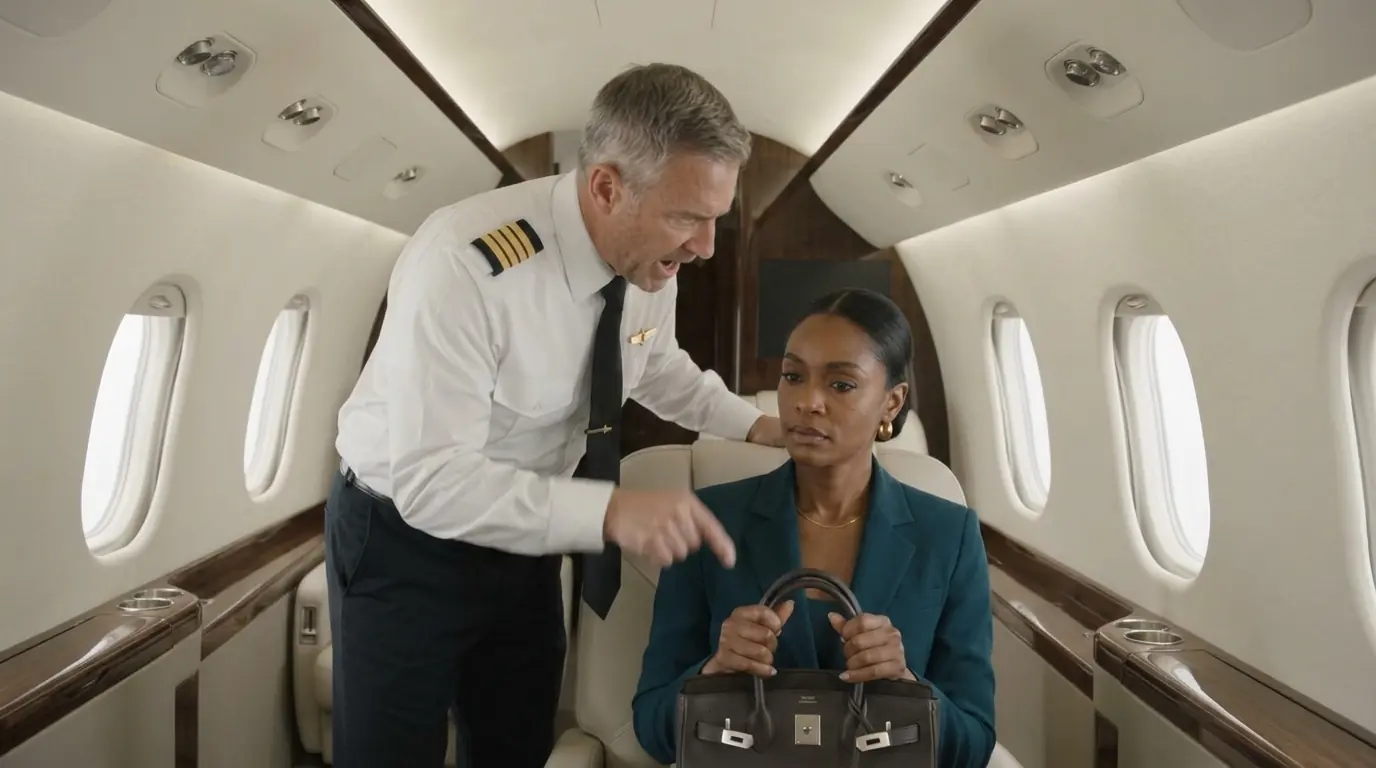
Less than two minutes later, Captain Douglas Pierce stepped into the cabin. He was fifty-eight, tall, silver-haired, and wore the crisp white shirt, black tie, and four gold stripes of a senior private-aviation captain. His technical record was excellent.
Pierce had twenty-seven years of professional flying, thousands of hours on Gulfstreams, and no serious safety event. Executives praised his composure, wealthy clients requested him by name, and schedulers considered him one of Meridian Crown’s strongest captains. Yet three customer complaints in eighteen months had mentioned the same unsettling feeling.
He made me feel as though I had to prove I belonged on the airplane.
Camille had highlighted that line herself. Pierce walked directly toward her without first asking the attendant for the manifest. He glanced at Evelyn, then at Camille.
“Ma’am, I need you to relocate.” Camille inserted a bookmark.
“For what reason?” Pierce’s jaw tightened slightly.
“Mrs. Harrington has a long-standing seating preference.” Camille looked across the aisle.
“A preference isn’t an assignment.” Pierce gave the tight smile of someone who expected cooperation once rank entered the conversation.
“I’m asking you to help us avoid an unnecessary issue before departure.” Camille looked around the cabin. “There wasn’t an issue until she demanded a seat already assigned to somebody else.”
Evelyn stepped closer. “See? This is the attitude.” Camille looked at her.
“I’m still sitting quietly.” Pierce cut in.
“That’s enough.” His voice was firmer now.
Camille studied him carefully. He had decided the fastest path to peace was moving the passenger he believed possessed less influence. That decision had almost nothing to do with aircraft operations.
“Take your belongings and move farther back.” Camille answered, “No.”
The word was soft. Pierce’s expression changed immediately.
“Excuse me?” Camille looked at him.
“I said no.” Evelyn gave a short disbelieving laugh.
Pierce stepped closer. “While we’re operating this flight, I am responsible for this aircraft.” Camille nodded.
“Of course.” Pierce continued, “And I’m directing you to change seats.”
“For a safety reason?” “No.”
“Operational reason?” His irritation deepened.
“I don’t need to debate every crew decision with a passenger.” Camille watched him.
“Then we’re clear that this is not safety.” Pierce put the flight folder down hard on an empty seat.
“This is my aircraft while I’m in command.” That sentence interested Camille.
“Your aircraft?” Pierce looked directly at her. “Operationally, yes.”
Camille’s expression remained neutral. “Interesting.”
Pierce pointed toward the rear cabin. “Stand up and move before I remove you from the flight.” The conversation had become loud enough that all six passengers were watching now.
Camille slowly closed her book. “Your aircraft?”
“Yes.” Pierce looked impatient.
Camille reached toward the zipper of her backpack. “Then you probably should have read the purchase briefing.”
Pierce stared. “What are you talking about?”
“You should know who signed off on the company that owns it.” He laughed.
“I don’t care who you think you know.” Then he slapped one palm against the top of the empty seat.
“One more smart remark and you’re off this airplane.” Camille reached into the backpack and removed her phone.
“Perfect.” Pierce smiled sarcastically.
“You calling someone?” “No.”
Camille unlocked the screen. “You are.”
Pierce frowned.
“Call operations.” He looked almost amused.
“Gladly.” Camille continued.
“Tell them the woman you’re threatening to remove controls the company that owns this jet.” Silence filled the cabin.
Evelyn stared. The cabin attendant froze near the galley.
Pierce blinked once. Then he smiled.
Not because he believed her. Because he believed the claim finally proved she was unreasonable.
“You own this aircraft?” “Yes.”
“This G700?” “Indirectly, yes.”
“You expect me to believe that?” Camille answered, “No.”
She held up the phone. “I expect you to verify it.”
Pierce crossed his arms. “Show me proof.” Camille tilted her head.
“You aren’t entitled to inspect my corporate ownership documents because you decided another passenger wanted my seat.” Pierce looked irritated.
“You just claimed ownership.” Camille nodded.
“And you just threatened to remove your employer from an aircraft operated by her company.” Evelyn laughed nervously.