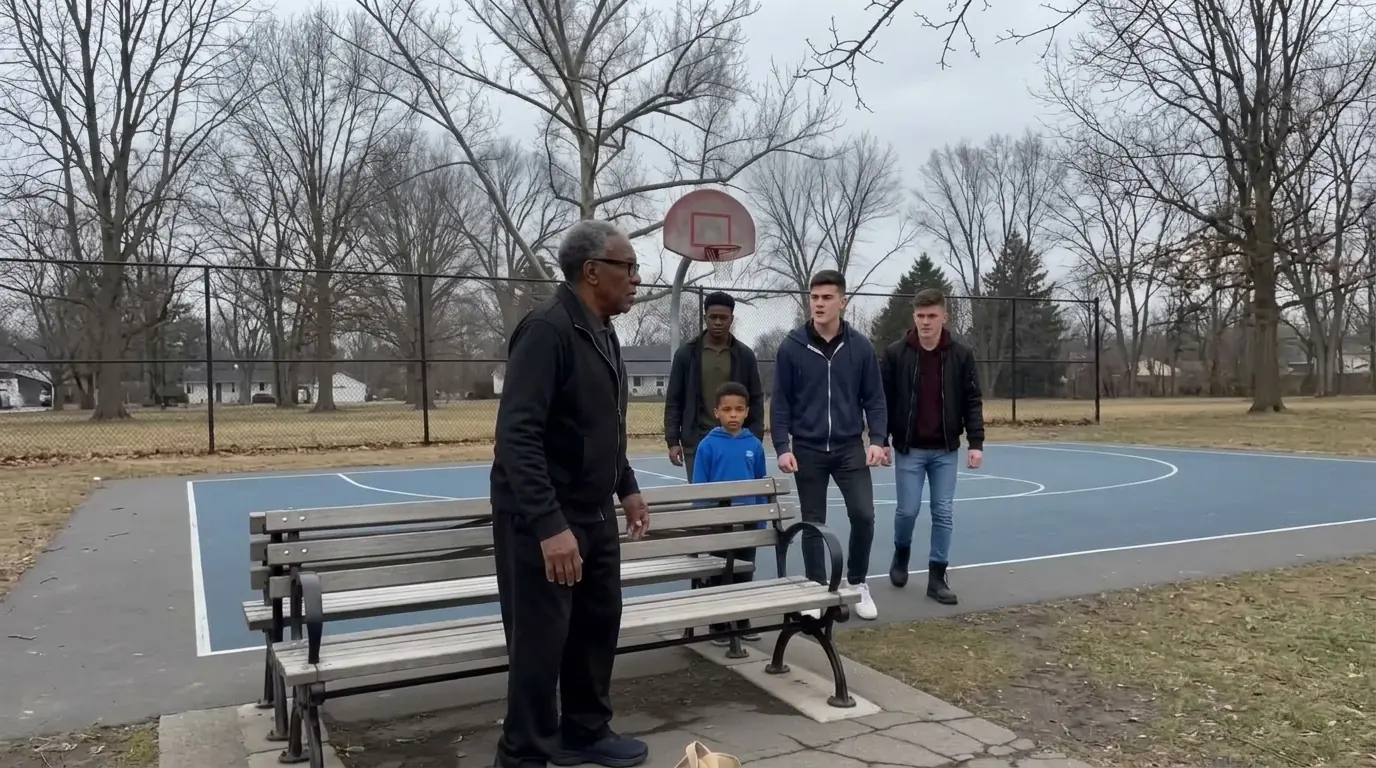
“Get off the bench, old man.”
Amos Reed looked up through dark prescription glasses at the young man standing in front of him. At seventy-four, Amos no longer moved quickly unless there was a reason, and right now he saw no reason to hurry. “There’s plenty of room, young man,” he said. “Sit if you want.”
Tanner Whitmore did not sit. He leaned closer until Amos could smell the mint gum on his breath, then grabbed a fistful of the old man’s faded gray sweatshirt. Behind him, three friends already had their phones raised.
“Don’t call me young man.” Tanner grinned toward the camera. “You think because you’re old you get to talk down to people?”
Amos looked at the hand gripping his shirt. “I’d rather you let go.” Tanner laughed.
Then he knocked Amos’s glasses from his face.
They hit the pavement beneath the bench. One lens cracked at the edge.
Without the glasses, the difference between Amos’s eyes became obvious. His left eye was still sharp and dark, but the right had been blind for nearly forty years, clouded by damage no surgery had ever repaired. Tanner stared for half a second before smiling wider.
“So that one really doesn’t work?” His friends laughed. Amos bent slowly to retrieve the glasses.
“Leave it alone.” Tanner nudged them away with his shoe.
The young men surrounded him. Amos straightened with the stiffness of a man whose knees reminded him every morning that he was no longer twenty-eight. He looked directly at Tanner with his one good eye.
“You sure you want to keep doing this?” Amos asked.
Tanner had no idea why that question made one of the older men shooting basketball nearby stop dribbling. He had no idea that the thin old man standing beneath the oak tree once fought under another name. He had no idea that forty-six years earlier, men who weighed more and feared less than Tanner had learned to pay attention when Amos Reed became quiet.
To the neighborhood, Amos was simply Mr. Reed from Mercer Street. He had lived in the same narrow brick house for forty-two years, through factory closures, rising rents, new coffee shops, renovated townhouses, and developers sending letters asking whether he had considered selling. Amos threw those letters away.
His wife, Lillian, had planted roses beside the porch in 1992. She died eight years ago after thirty-nine years of marriage, but the roses still came back every spring. Amos sometimes told himself that was why he stayed.
Most mornings, he woke before six. He swept the front walk, watered Lillian’s roses, brewed coffee strong enough to offend most doctors, and walked four blocks to Madison Park with an old canvas duffel over one shoulder. Inside were hand wraps, a jump rope, two battered pairs of gloves, a towel, and a small tin of petroleum jelly.
The children began coming three summers earlier. At first there were only two, both neighborhood boys who saw Amos shadowboxing beneath the oak tree and asked whether he knew what he was doing. Amos told them enough to get them to stop swinging with their chins in the air.
More kids followed.
There was fifteen-year-old Jamal, who came angry and left tired enough not to get into trouble before lunch. There was nine-year-old Sofia, whose footwork became so fast that Amos began calling her Sparrow. Then there was eleven-year-old Elijah Brooks.
Elijah was the reason Amos never skipped a morning.
The boy was small for his age, thin through the shoulders, and carried a stutter that could turn a simple sentence into a fight against his own mouth. His father had been in prison since Elijah was five, and his mother had disappeared from his life not long afterward. His grandmother, Denise Brooks, worked long shifts at St. Anne’s Hospital and had no money for summer programs.
The first week, Elijah only watched. He stood behind the drinking fountain and followed Amos’s hands with his eyes. On the eighth morning, Amos held out a pair of gloves.
“You want to try?” Elijah shook his head so quickly that Amos almost smiled. “That’s fine.”
He set the gloves on the bench. “They’ll be here tomorrow.”
Two weeks later, Elijah walked over and held out both hands. They trembled slightly. Amos pretended not to notice.
He wrapped them carefully.
“Two around the wrist.” Amos pulled the cloth snug. “Three over the knuckles, then between the fingers.”
It was the same method Samuel Booker had taught him fifty years earlier in a basement boxing gym in Philadelphia. Booker believed technique should become so familiar that fear could not erase it. Amos had never forgotten.
“Now plant your feet.” Elijah copied him.
“Left foot forward.” Amos adjusted the boy gently with the toe of his shoe. “Right foot back, knees loose, weight balanced.”
Elijah lifted his hands.
“Protect what matters,” Amos said.
The boy smiled.
That became their phrase.
Elijah learned the jab first. Amos made him throw it hundreds of times before adding the right hand.
“Straight out, straight back.” Amos tapped the boy’s glove. “Don’t admire your work.”
When Elijah became frustrated, the stutter worsened. Some mornings he ripped the gloves off and dropped them.
Amos never scolded him. He picked them up, put them on the bench, and said, “They’ll be here tomorrow.”
Elijah always returned.
Amos understood that boxing was only the visible lesson. Beneath it, he was teaching the boy that his body could remain steady when his mind felt trapped. The missing father, the stutter, the cheap sneakers, the neighborhood assumptions—none of those things decided what kind of man he would become.
Then Tanner Whitmore discovered Madison Park.
Tanner was twenty-three and had grown up without ever needing to learn the difference between access and entitlement. His father, Councilman Richard Whitmore, had served three terms, chaired the city’s public-safety committee, and maintained the kind of relationships that made police captains answer calls after midnight. Tanner understood those relationships before he understood taxes.
He also had nearly three hundred thousand followers online. His videos were called pranks, although most of them involved finding somebody unlikely to fight back and embarrassing them in public. Homeless men, delivery workers, elderly people waiting for buses, teenagers working fast-food counters.
The cruelty was always wrapped in laughter.
The first morning Tanner saw Amos and Elijah, he stopped halfway across the basketball court. Amos was correcting Elijah’s guard beneath the oak tree while two other children worked a jump rope nearby. Tanner looked at his friend holding the phone.
“Look at this.” He grinned. “Grandpa Fight Club.”
They walked over.
Tanner kicked Amos’s canvas bag. Gloves, tape, and wraps spilled onto the cracked pavement.
“What’s this supposed to be?” he asked. “A retirement-home boxing gym?”
His friends laughed.
Amos placed one hand on Elijah’s shoulder. “Pick up the gloves.”
Tanner stepped between them. “I’m talking to you.”
Amos looked at him. “I heard you.”
“You got a permit to run this?” Tanner asked. “Public park doesn’t mean you get to set up your little business here.”
“No business.” Amos crouched to collect the wraps. “Nobody pays me.”
Tanner turned toward the phone. “Even worse. Free training from a half-blind grandpa.”
Elijah’s shoulders tightened.
Amos zipped the duffel. “Come on.”
They left.
Tanner’s laughter followed them to the gate.
Amos returned at seven the next morning. So did Elijah.
Tanner arrived twenty minutes later with the same friends.
This time, he carried a large bottle of water.
He waited until Amos bent to correct Elijah’s stance. Then Tanner unscrewed the cap and poured the entire bottle over the old man’s head.
Water ran down Amos’s gray hair, beneath the collar of his sweatshirt, and across his glasses. The young men roared with laughter. One shouted, “He needed a shower anyway.”
Amos stood still.
Elijah froze.
Tanner leaned toward the phone. “Morning baptism at Madison Park.”
Amos removed his glasses, wiped them on the inside of his shirt, and put them back on. Then he looked toward Elijah.
“Show me your pivot.” Elijah stared at him.
“Mr. Reed—”
“Pivot.”
The boy moved his back foot.
“Again.”
Elijah did it.
His hands shook, but his feet were correct.
Tanner waited for anger. When none came, he eventually grew bored and left.
The video reached eighteen thousand likes before dinner.
The comments told Tanner exactly what he wanted to hear.
Do it again.
Make him snap.
Old dude thinks he’s tough.
Tanner returned Thursday.
This time, he opened Amos’s duffel and pulled out an old pair of brown leather boxing gloves. The stitching had faded, the leather was cracked, and the laces looked as though they might break if pulled too hard.
They were Amos’s.
Not training gloves.
His.
He had worn them in the late seventies, before safety regulations made lace-up competition gloves obsolete. Lillian used to clean the leather and keep them near the framed photograph from his championship night.
“Look at these things.” Tanner held one toward the camera. “Civil War boxing gloves.”
Amos’s expression changed.
“Put them back.”
Tanner heard something different in his voice but mistook restraint for weakness. He tossed one glove to his friend.
They played catch.
“Give them back,” Amos said again.
Tanner held the remaining glove over a trash can. “Come get it.”
Amos did not move.
Tanner dropped it inside.
Then the other.
“There.” He smiled. “Now they’re where they belong.”
Amos said nothing.
He sent Elijah home early.
At nearly ten that night, Amos walked back to the park carrying a flashlight. He pulled both gloves from beneath paper cups and food wrappers, carried them home, and spent an hour cleaning the leather on his porch.
His hands stayed steady.
His breathing did not.
The following Monday, Elijah arrived before Amos. He stood beside the bench rather than sitting.
Someone had spray-painted two words across the wood in white.
BLIND LOSER
Beneath it, smaller:
GO HOME
Elijah tried to speak. The first word caught.
“M-M-Mr. Reed…”
Amos looked at the paint.
Three months of progress disappeared from Elijah’s speech in seconds.
Amos set down the duffel. Then he sat directly on the painted bench.
“Today we work the right cross.”
Elijah stared. “What about that?”
Amos tapped his chest. “Does it change what’s in here?”
Elijah shook his head.
“Then let whoever painted it waste their paint.”
They trained.
But the park changed around them.
Parents began pulling their children from the group. Not because they blamed Amos, but because they did not want their children becoming targets of Tanner’s videos.
Jamal stopped coming first. Sofia disappeared two days later.
Within a week, Elijah was the only child left.
Denise Brooks could not move her grandson to another program. She worked from six in the morning until late afternoon, and private boxing gyms cost more than she could afford. So she continued dropping Elijah near the park on her way to work.
The neighborhood watched.
Mrs. Alice Turner from across the street saw almost every incident from her apartment window. Twice she picked up the phone to report Tanner. Twice she stopped before dialing.
Her daughter asked why.
Alice answered honestly. “Because everybody knows who his father is.”
Two complaints about Tanner eventually reached the precinct anyway. One was filed by a jogger. Another came from a father whose child had witnessed the harassment.
Neither moved forward.
One disappeared from the digital system altogether.
Tanner knew.
That knowledge changed the way he entered the park.
He stopped behaving like somebody testing boundaries. He behaved like someone convinced no boundary applied to him.
Amos noticed.
At night, something else began changing.
For thirty years, an old heavy bag had hung from a ceiling beam inside Amos’s garage. He installed it when he was still young enough to believe one day he might fight again.
He never did.
After Lillian died, the garage became mostly storage. The bag remained.
One evening, Amos stood in front of it.
He removed his glasses.
Wrapped his hands.
Then threw a jab.
The leather moved six inches.
His left eye tracked it.
Another jab.
Right cross.
Hook.
The bag swung harder.
Amos caught it with both palms.
He had not hit anything with intent in decades. Yet the rhythm returned before his mind could decide whether it should.
Jab.
Cross.
Left hook to the body.
Step.
Uppercut.
His knees complained.
His lungs burned.
His hands remembered everything.
For the next two weeks, Amos trained after dark. Nobody knew.
His dead right eye saw nothing. His left still measured distance beautifully.
His feet were slower.
His timing was not.