The first time Eli Carter saw the motorcycle, he thought it looked dead.
Not broken.
Dead.
There was a difference.
Broken machines usually looked temporary. A loose chain hung crooked. A tire sagged. A wire dangled where it should have been attached. You could look at them and imagine the shape they would return to once someone gave them enough patience.
The old Harley looked like it had stopped waiting.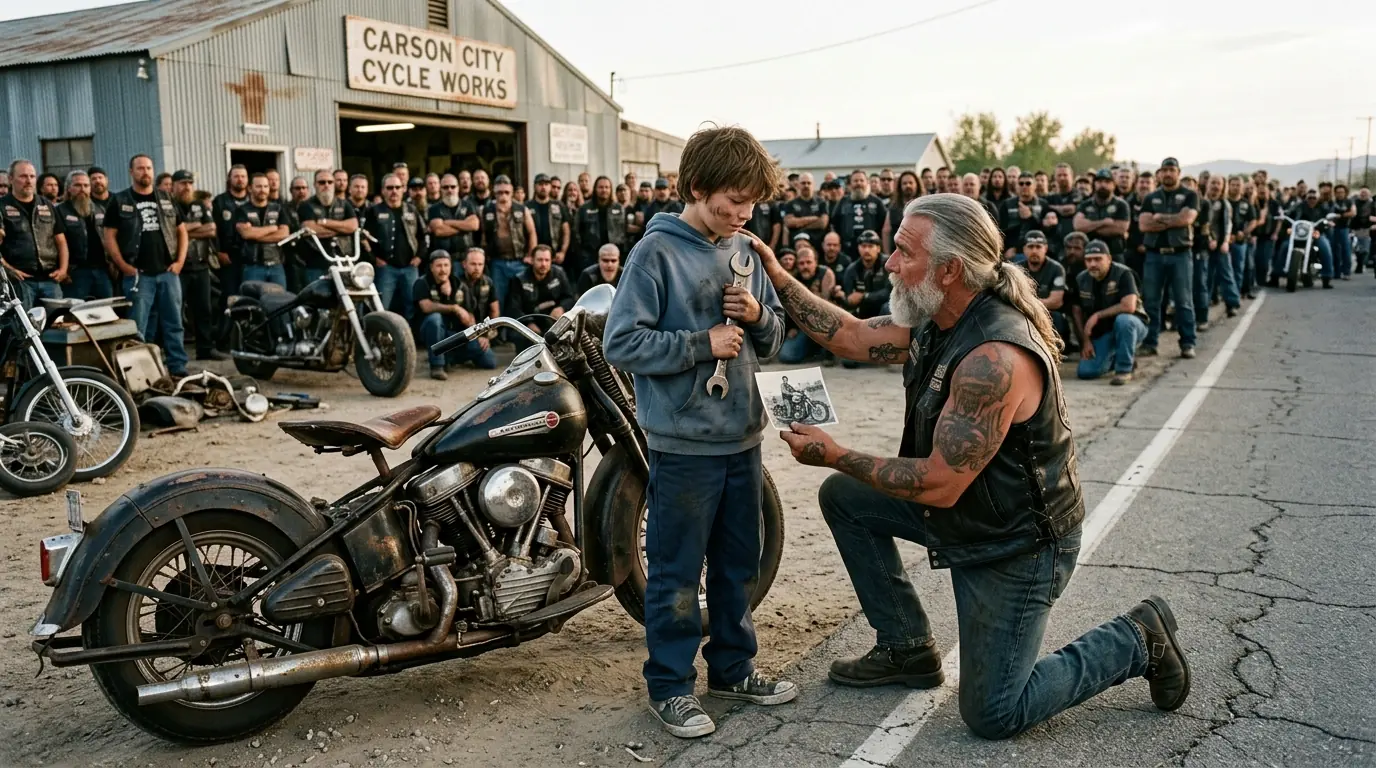
It sat near the darkest corner of Maddox’s Auto Repair outside Carson City, Nevada, covered by a stained canvas tarp so thick with dust that Eli could see the outline of the handlebars without lifting it.
He should not have been inside the building.
He knew that.
He should not even have been behind it.
But twelve-year-old boys who had spent six nights sleeping wherever adults would not notice them stopped worrying about ordinary rules fairly quickly.
Hunger changed priorities.
So did cold.
Eli had arrived behind the garage shortly after midnight with a backpack, twelve dollars and fourteen cents, one clean T-shirt, a toothbrush, and a photograph of his father folded inside an old plastic sandwich bag.
He had been walking for most of the afternoon.
Then riding buses until the money became too precious.
Then walking again.
Maddox’s Auto Repair looked abandoned after dark.
The front sign was old.
White paint cracked.
Large black letters:
MADDOX’S AUTO REPAIR
CARSON CITY, NV
Behind the building sat scrap wheels, old engines, crates, three motorcycles beneath tarps, and a rusted pickup with no doors.
To Eli, it looked safer than a bus station.
He found an empty wooden shipping crate beneath an awning.
He crawled behind it.
Pulled his faded-blue hoodie tight.
Used his backpack as a pillow.
And slept.
At 6:03 the next morning, he woke to motorcycles.
Not one.
Many.
Eli opened his eyes.
The ground vibrated faintly.
Engines approached from the road.
He lifted his head just enough to see around the crate.
Seven motorcycles rolled into the gravel yard.
Large men climbed off.
Leather vests.
Gray beards.
Bandanas.
Boots.
Tattoos.
Eli flattened himself immediately.
His father had taught him not to judge people by clothing.
But his father had also taught him that being cautious was free.
A massive older man climbed off the first motorcycle.
Long gray hair slicked back.
A beard that reached nearly to his chest.
Tattooed arms.
Black sleeveless leather vest.
Dark jeans.
Heavy boots.
He walked toward the garage door.
The others followed.
Someone called:
“Morning, Ray.”
The gray-bearded man grunted.
“Nothing good happens before coffee.”
A shorter biker laughed.
“That your philosophy?”
“It is now.”
They disappeared inside.
The garage opened twenty minutes later.
Eli remained hidden.
He watched.
Listened.
Learned.
The gray-bearded man was Ray Callahan.
People called him Ironhand.
Eli could understand why.
Ray had hands that looked capable of tightening engine bolts without tools.
But he did not behave the way Eli expected.
He shouted sometimes.
Mostly at machines.
Never at customers.
A woman arrived in an old Honda that was making a high squealing noise.
Ray listened for ten seconds.
“Belt.”
She asked:
“How much?”
He looked beneath the hood.
“Twenty bucks for the belt.”
“What about labor?”
“You bring me banana bread every Christmas.”
“That does not pay rent.”
“It pays better than your husband's cooking.”
She laughed.
Ray replaced the belt.
Charged her only for the part.
Later, a young man brought in a motorcycle with a damaged clutch cable.
Ray showed him how to replace it instead of charging full labor.
“Learn it once.”
he said.
“Then you don't need me next time.”
By noon, Eli's fear had changed into curiosity.
By two, hunger was stronger than both.
A biker carrying a paper bag walked outside.
He sat on an overturned bucket.
Opened it.
Burger.
Fries.
Eli smelled them.
His stomach hurt.
The biker ate half the fries, then returned inside because someone called him.
The bag remained.
Eli waited.
Thirty seconds.
One minute.
Two.
Then crawled toward it.
He grabbed three fries.
Not all.
Just three.
He had learned that taking everything made theft obvious.
He ate them behind the crate.
Best food he had tasted in days.
Then came a voice.
“You planning on paying for those?”
Eli froze.
The biker stood six feet away.
Not Ray.
Another man.
Mid-forties.
Dark beard.
Bandana.
Eli's hands shook.
“I only took three.”
The man stared.
“That supposed to make it better?”
Eli looked down.
“I’m sorry.”
The man looked at the boy's filthy hoodie.
Then the backpack.
Then his face.
“How long you been back here?”
Eli said nothing.
The biker sighed.
“Kid.”
“Yesterday.”
“You run away?”
“No.”
“You live nearby?”
“No.”
“That sounds like yes.”
Eli stepped backward.
The biker raised both hands.
“Easy.”
“I’m not grabbing you.”
Eli looked toward the road.
The man saw.
“Don't run.”
Eli ran.
He vaulted over a low fence behind the garage.
Cut through an empty lot.
Did not stop until the building disappeared.
He spent the afternoon hiding beneath an overpass.
At sunset, hunger returned.
So did cold.
And despite everything, so did the garage.
Eli went back after midnight.
Nobody was there.
He slept beneath the awning again.
The second morning he stayed farther away.
The bikers apparently assumed he was gone.
Nobody searched behind the crate.
At least not where he could see.
Around noon, the same biker who had caught him left a paper bag on the overturned bucket.
Then walked inside.
Eli stared.
The bag remained.
Twenty minutes.
Thirty.
Finally he approached.
Inside:
Burger.
Fries.
Bottle of water.
And a note written on a receipt.
THREE FRIES LIMIT REMOVED.
Eli stared.
Then smiled despite himself.
He ate half.
Saved the rest.
That night, while searching for a better place to sleep, he found a damaged vent panel at the rear of the garage.
It opened into a storage room.
Eli knew entering was wrong.
He also knew the temperature would fall below forty.
He squeezed through.
Inside smelled like oil, rubber and metal.
He slept beneath a workbench.
That was when he found the old Harley.
The tarp sat almost directly across from him.
At first he ignored it.
By the second night, curiosity won.
Eli lifted one corner.
Dust drifted.
He coughed.
Then pulled the tarp higher.
A fuel tank emerged.
Faded.
Scarred.
Old lettering nearly invisible beneath oxidation.
Then the engine.
Panhead.
Eli knew immediately.
His father had kept motorcycle magazines stacked beside their couch.
Not glossy modern ones.
Old repair manuals.
Swap-meet catalogs.
Photocopied service pages.
Eli remembered sitting on the garage floor while his father explained engine designs.
Knucklehead.
Panhead.
Shovelhead.
Evolution.
He pointed to pictures as though teaching anatomy.
“Engines are like people.”
his father once said.
“They complain before they quit.”
Eli had been nine.
“People quit too.”
His father paused.
“Sometimes.”
“Do they complain first?”
“Usually.”
“What if nobody listens?”
His father looked toward him.
“Then that's the real problem.”
Eli ran his fingers above the old Harley without touching it.
1948 or 1949.
He could tell from details.
At least he thought he could.