I did not move.
Rain was still dripping from the shoulders of my jacket, my old Marine cap was folded in one hand, and a cheap blue folder was tucked against my chest like it contained the last important thing I owned.
In a way, it did.
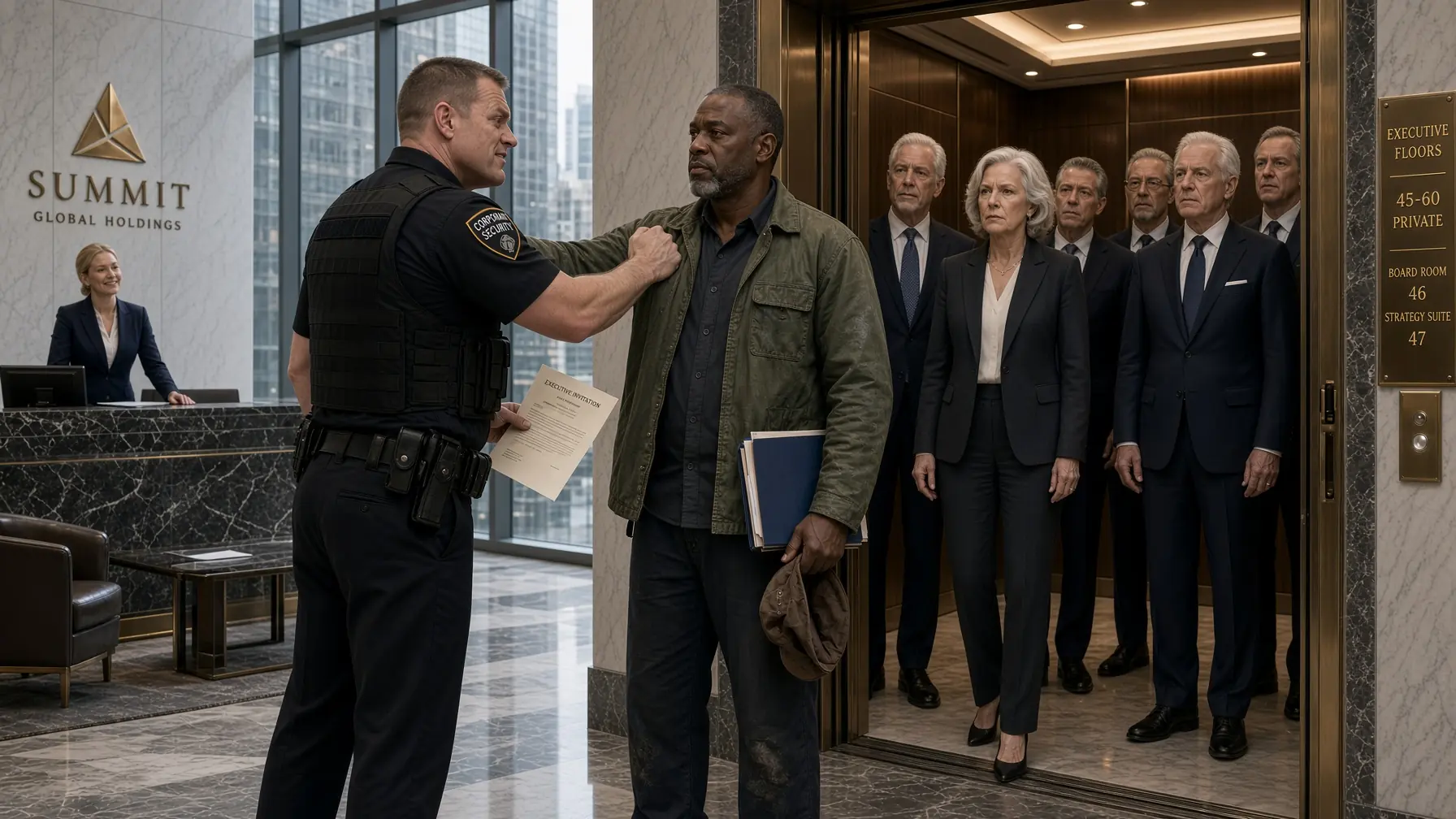
The security guard blocking the private elevator was named Carl Mercer. His badge said SECURITY SUPERVISOR, though the way he stood in front of me made it seem as if the title meant something much larger.
“I told you already,” he said. “This elevator is for senior leadership only.”
“Then I’m in the right place.”
Carl laughed.
Not loudly.
Just enough for the receptionist to hear.
“You delivering something?”
“No.”
“Maintenance entrance is around back.”
“I’m not here for maintenance.”
His eyes dropped to my boots.
They were old Red Wings, darkened by rain and worn white around the toes. I had polished them the night before, but twenty minutes walking from the train station through Manhattan rain had undone most of that effort.
Carl looked at my jacket next.
Then at the Marine cap.
Then back at my face.
The calculation happening behind his eyes was not difficult to understand.
Fifty-eight-year-old Black man.
Work boots.
Cheap folder.
No expensive coat.
No company badge.
Wrong elevator.
Problem solved.
The receptionist said, “Sir, you need an appointment.”
“I have one.”
“With whom?”
“Mrs. Whitaker.”
That finally got Carl’s attention.
He smiled again.
“Sure you do.”
I opened the blue folder.
Inside was a cream-colored letter on heavy paper bearing the gold seal of Whitaker Industrial Group.
The signature at the bottom belonged to Eleanor Whitaker, chairwoman of the board.
Mr. Miller,
Please come to Whitaker Tower at 9:00 a.m. on Monday. Use the executive elevator. Do not provide the enclosed materials to anyone except me, outside counsel, or the independent directors.
Carl took the letter before I finished unfolding it.
I reached out.
“Give that back.”
He stepped away.
“This looks fake.”
“It isn’t.”
“You people think putting something in a fancy envelope makes it official?”
The receptionist glanced at him.
I felt something hot move through my chest.
Not fear.
Not exactly anger either.
Something older.
I had spent twenty-two years in the Marine Corps learning that the easiest man to control was the one who believed anger made him stronger.
So I lowered my voice.
“Give me my letter.”
Carl leaned closer.
“Or what?”
That was when the elevator chimed.
The polished brass doors slid apart.
Six people stood inside.
Nobody spoke at first.
Eleanor Whitaker was in front.
Silver hair cut neatly at her jaw. Dark green suit. Pearls. Seventy-one years old and still carrying the kind of posture people mistook for arrogance until they realized it was discipline.
Beside her stood chief executive Daniel Price, general counsel Margaret Sloan, two independent directors, the chief financial officer, and a tall man I later learned was Jonathan Reese from outside counsel.
Every one of them looked at me.
Then, almost at once, they stood straighter.
Carl noticed.
So did I.
Eleanor stepped forward.
“Andre Miller?”
“Yes, ma’am.”
Her eyes moved from my wet jacket to the letter in Carl’s hand.
Then to my face.
“Why is Mr. Miller being held in the lobby?”
Carl’s confidence collapsed faster than I expected.
“He didn’t have a badge.”
Eleanor said nothing.
“He was trying to access the executive elevator.”
“He was instructed to use it.”
Carl looked at the letter.
“He was being aggressive.”
I spoke before anyone else could.
“I asked him to return my letter.”
Eleanor looked at Carl.
“Did you take it from him?”
Carl hesitated.
“He handed it—”
“No.”
I shook my head.
“He took it out of my hand.”
The tall lawyer, Reese, looked toward one of the ceiling cameras.
I noticed that.
Eleanor did too.
“Return it.”
Carl held the paper toward me.
For the first time, his hand was not quite steady.
I took it.
Eleanor looked at the folder beneath my arm.
“Do you have the original certificate?”
“Yes.”
“The correspondence?”
“Yes.”
“And the recording?”
I touched the old flip phone in my jacket pocket.
“I kept everything.”
Something passed across her face.
Pain, maybe.
Or relief.
Carl looked between us.
“What is this about?”
Eleanor never turned toward him.
“It concerns my father.”
Then she looked at me.
“And what this company did to the man who helped save it.”
The elevator remained open.
I stepped inside.
Before the doors closed, I looked back at Carl.
He already had his radio in his hand.
I did not know then whether he was calling a supervisor, trying to protect himself, or warning someone upstairs.
I only knew one thing.
Thirty-seven years after I first walked through the loading dock of Whitaker Industrial Systems carrying a toolbox and a lunch my mother had packed, I was finally going to hear the company explain why a piece of paper bearing my name had disappeared.
The boardroom occupied the forty-fourth floor.
I had seen photographs of it in annual reports.
Long walnut table.
Floor-to-ceiling windows.
Manhattan spread beneath the glass.
On television, rooms like that always looked powerful.
In person, the first thing I noticed was how quiet the carpet made everything.
Eleanor motioned toward a chair beside her.
“Please sit.”
I remained standing.
My jacket was wet.
“I’ll ruin the chair.”
For one second nobody understood what I meant.
Then Margaret Sloan almost smiled.
“We can replace the chair.”
I took off the jacket and folded it over the back instead.
My Marine cap went on top.
The blue folder stayed in my hands.
Daniel Price sat across from me.
He was forty-six, maybe forty-seven, dark hair, expensive navy suit, the kind of CEO who appeared comfortable being photographed from any angle.
But he did not look comfortable now.
“Mr. Miller,” he began, “first, I want to apologize for what happened downstairs.”
I raised one hand.
“We can handle downstairs later.”
That surprised him.
“Right now I want to understand why I’m here.”
Eleanor looked toward Reese.
He opened a binder.
“Because six weeks ago, Mrs. Whitaker found documents in her father’s estate archive that should have been reviewed decades ago.”
“My father died twenty-three years ago.”
“I know.”
“Your husband ran this company after that.”
Eleanor’s eyes lowered.
“Yes.”
Her husband, Charles Whitaker, had been CEO from 2001 until 2017.
He died two years later.
I had met Charles maybe four times in my life.
I remembered all four.
Not because he was important.
Because he had always looked through me as though he was already searching for the person standing behind me.
Eleanor folded her hands.
“My father’s personal files were stored in two places after his death. Most corporate documents went to company counsel. Several sealed boxes remained in a private archive at our family property in Connecticut.”
“Why open them now?”
“We’re preparing to transfer the archive to a university.”
I nodded.
“And you found my name.”
“We found more than your name.”
Reese turned the binder toward me.
The first page contained a photograph.
I was twenty-six.
Much thinner.
High-top work boots.
Blue Whitaker maintenance coveralls.
Standing beside Walter Whitaker, Eleanor’s father and founder of the company.
I had forgotten the picture existed.
Walter had one arm around my shoulder.
I remembered the day immediately.
April 4, 1994.
Whitaker Industrial Systems was not a giant company then.
Two hundred and eighty employees.
One manufacturing plant in Newark.
Another leased assembly building in Pennsylvania.
We made power-conversion units, ruggedized electrical equipment, and specialized industrial control systems.
The company had good engineers.
Good machinists.
Bad cash flow.
I had joined after four years in the Marines because my first enlistment had ended and my mother was sick.
I expected to stay a year.
Instead I stayed seven.
Walter Whitaker knew almost everybody in the Newark plant by name.
Not because he was a saint.
He was demanding, impatient, and capable of shouting so loudly from the production floor that people two buildings away heard him.
But he walked the floor.
That mattered.
In late 1993, Whitaker nearly lost the contract that kept the company alive.
A new generation of mobile power units had begun failing during heat and vibration testing. Engineers traced the problem repeatedly to connector assemblies and cooling, but replacements kept failing under field conditions.
I was not an engineer.
I was a maintenance technician.
But Marines had taught me something engineering school had not taught several very smart people in that plant.
Equipment rarely failed in the neat way drawings imagined it would.
I had spent nights watching technicians replace components that tested perfectly on a bench.