The sun hung heavy and gold over the Kansas prairie. It was the sweltering July of 1888. The heat pressed down like a physical weight on every living thing, cruel and relentless. Dust danced in the stagnant air like tiny spirits of the forgotten.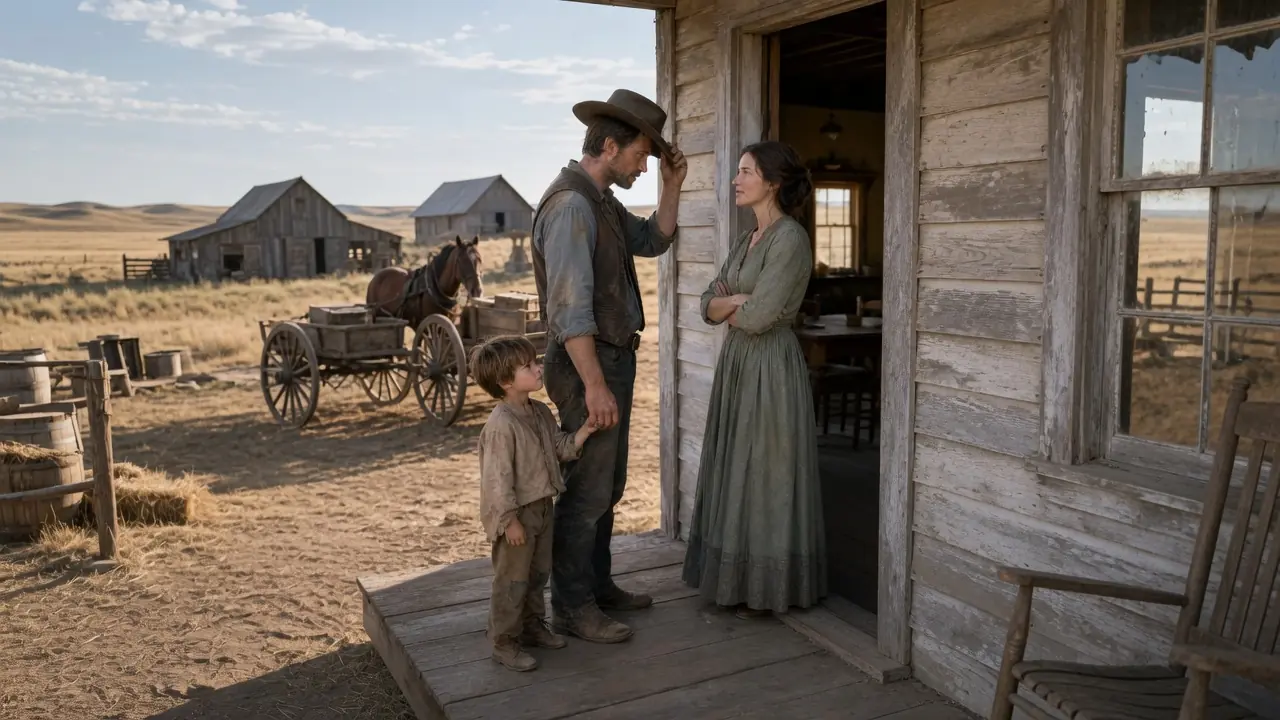
The sky was a bleached blue bowl turned upside down. No clouds offered the mercy of a shadow. The horizon shimmered with a deceptive liquid light. The dust coated the lungs and gritted between the teeth.
This was the year of the great drought when the earth across the American West cracked open like a parched throat. Farmers were walking away from their dreams. The banks were moving in like vultures. Caleb Vance pulled the reins of his weary horses.
His hands were cracked and stained by the road. The animals were nothing but skin and bone held together by sheer will. Their ribs counted the miles they had traveled from Missouri. Their heads hung low toward the scorched earth.
Their breath was a ragged, shallow sound in the silence. The wagon groaned under the weight of a life reduced to wooden crates. Every bump in the road was a protest from the aging wood. The wheels screamed for grease that did not exist.
Inside that wagon was the wreckage of a man's pride. His five-year-old son, Toby, sat huddled against his father's dusty thigh. The boy's face was smudged with the red earth of the frontier. His eyes were dull and heavy with exhaustion.
He did not complain about the thirst or the heat. He had forgotten what it felt like to be comfortable. He had forgotten the taste of cool water from a deep well. Caleb looked at the small weathered homestead ahead.
It sat like a lonely island in a sea of dead yellow grass. It was a sturdy house built of cedar and hope. The wood had bleached white under the relentless sun. It looked like bone left out to dry in the desert.
The porch was wide and shaded from the brutal afternoon heat. It looked like a sanctuary in a desert of tall grass. Standing there was a woman in a dress the color of spring sage. The fabric was faded but clean.
Hannah Montgomery did not move as the wagon approached. She stood like a statue carved from the very land she inhabited. She watched with eyes that had seen too much solitude. They were gray eyes like the sky before a winter storm.
Her arms were crossed tightly over her chest. It was a posture of defense born from years of widowhood. The silence between the house and the road was thick. It was a wall that Caleb had to break.
Only the sound of the cicadas broke the stillness. Their buzzing was a high, vibrating scream in the heat. Caleb tipped his sweat-stained hat with a trembling hand. "Good afternoon, ma'am," he said.
His voice was raspy from the road and the lack of water. It sounded like gravel grinding against rusted metal. It was the voice of a man who had forgotten how to speak to people. Hannah did not offer a smile or a greeting.
She did not move from her spot in the shade. She looked at the horses first. Their hides were caked in dry salt and grime. Their ribs showed through their hides like the holes of wrecked ships.
She looked at the wagon next. It was a humble collection of failures. It was filled with a rusted plow and a single rocking chair. There was a cracked mirror wrapped in a tattered quilt.
It was the inventory of a man who had lost everything but his dignity. Then her gaze softened as it landed on Toby. The boy looked up at her with eyes that were far too large for his face. They were blue eyes filled with a hollow kind of hunger.
It was a hunger for more than just bread. "We've come a long way from the Missouri border," Caleb explained. He wiped the sweat from his brow with a tattered sleeve. The movement was slow and painful.
"The drought took our well," he continued. "The corn died in the rows before it could silk. The bank took the rest of what was left. They didn't leave us enough for a bag of seed."
Hannah remained silent for a long moment. Her eyes scanned the horizon where the heat shimmered. The great drought of 1888 was a monster that devoured men's souls. It followed the brutal schoolhouse blizzard of January that same year.
The cattle were dying in the dried up creek beds. The crows were the only things getting fat. Caleb cleared his throat, feeling the weight of his own desperation. It was a heavy, suffocating thing.
"I'm not looking for a handout, ma'am," he said firmly. He sat a little straighter in the high seat. His voice regained a sliver of the strength he once had. "I just need a place to rest my horses for the night. They can't go another mile without collapsing. And my boy," he added softly.
He looked down at Toby's small, limp hand. He looked toward the large shadow-filled barn near the house. The red paint was peeling in long curling strips, but the roof looked tight, and the structure was sound. "Could we sleep in your barn?" he asked.
"I'll work for our stay," he promised. "I am a strong man when I have a meal in me. I can fix your fences or mend your roof. I am handy with a hammer and a saw. I can handle a team or clear a field."
Hannah stepped to the edge of the porch. The heat shimmered off the wooden boards like a fever. She looked at Caleb's calloused hands. They were stained with the oil of machinery and the dirt of the earth.
They were the hands of a man who knew the value of labor. She looked at his tired, honest face. There was no deceit in the lines around his eyes. There was only the exhaustion of a long defeat.
Then she looked at Toby again. The boy was clutching his father's sleeve with a tiny, dirty hand. His shirt was thin and missing three buttons. His collar was frayed and gray with dust.
Hannah felt a sharp, familiar ache in her chest. It was a pain she thought she had buried deep in the garden. She remembered her own husband, Silas. He had been a man of iron and laughter.
He had died of the flux two years prior. He had died in the middle of a harvest he couldn't finish. She remembered the way the house felt after he was gone. The silence had been louder than any storm.
The empty rooms had grown larger every day. "The barn is full of hay and spiders, Mr. Vance," she said. Her voice was soft, like the rustle of dry leaves in autumn. It was a voice that hadn't practiced kindness in a long time.
Caleb nodded, prepared to accept the humble shelter. "That would be a luxury," he replied. "It is better than the dirt we've slept on for a week. It is better than the open sky and the wolves."
Hannah shook her head slowly. "I wasn't finished," she said. Her voice gained a strange sudden strength. She walked down the porch steps.
Her green dress brushed against the dry grass with a shushing sound. The grass was so dry it sounded like paper. She stopped just a few feet from the wagon. She smelled of lavender and hard-scrubbed cedar.
"Your horses can have the barn and the grain," she stated. "I have enough oats left for a few days. The well is deep and still has sweet water. But a boy that age shouldn't be sleeping on a dirt floor. Not while I have a roof and a bed. Not while I have a spare room gathering dust."
Caleb began to thank her, but she raised a hand. The gesture was sharp and final. She looked directly into Toby's wide, curious eyes. "You asked to sleep in my barn," she whispered to Caleb.
"But maybe your son needs a mother more than he needs a stable." The words hung in the hot air like a sudden cool breeze. Caleb felt the breath leave his lungs. He didn't know how to respond to such a raw offer of grace.
It was a kindness he hadn't seen in many months. It was a miracle delivered in a sage green dress. "Ma'am, I couldn't possibly impose," Caleb started. His pride was a stubborn thing, even in the face of salvation.
"The house is large, Mr. Vance," Hannah interrupted. "And the stove is already hot for supper. I have more salt pork than one woman can eat. I do not like to eat alone. The clock ticks too loud when there is no talking. Bring the boy inside. There is a wash basin and a bed with clean linens. There is soap that smells of lemon."
Caleb climbed down from the wagon. His boots hit the ground with a heavy hollow thud. His legs were shaking from the long hours of travel. He reached up and lifted Toby into his arms.
He felt the boy's lightness, and it scared him. It was the lightness of a child who hadn't eaten a full meal in weeks. It was the weight of a bird with broken wings. They walked toward the house together.
They left the dust of the road behind them. The interior of the house was dim and cool. The thick walls kept the Kansas heat at bay. It smelled of dried lavender and old pine.
It smelled of wax and a life well-ordered. It was a world of order and peace. Caleb had forgotten that such places still existed. He felt too big and too dirty for the space.
Hannah pointed to a small room off the kitchen. "Put him there," she commanded gently. The room was small, but perfect. The walls were painted a pale, soft cream.
It had a window that looked out toward the orchard. The trees were dying, but they still stood tall. Hannah immediately began moving about the kitchen. She moved with a practiced, efficient grace.
She tied a clean white apron over her dress. She sliced thick pieces of salt pork. The meat was pink and marbled with fat. She dropped them into a heavy iron skillet.
The sizzle was a melody of survival. The smell of cooking fat filled the air. Caleb watched her from the doorway. He was afraid to step too far onto the clean rugs.
He felt like a ghost haunting a living home. His presence felt heavy and intrusive in this clean space. He noticed a quilt frame in the corner of the parlor. It held a half-finished pattern of interlocking stars.
The colors were deep blues and warm burgundies. The stitching was small and perfect. It reminded him of the quilts his own mother used to make. He remembered the smell of the woods in Ohio.
He remembered a time before the world turned to dust. Toby sat at the wooden kitchen table. The wood was scrubbed white from years of soap. His small feet dangled far above the floor.
He watched Hannah bake biscuits with wide-eyed wonder. She moved the flour with a rhythmic ease. Her hands were white with the dust of the grain. "Is she an angel, Papa?"
Toby whispered loudly. The question echoed in the quiet kitchen. Hannah paused, her hands covered in white flour. A small sad smile touched her lips.
It was a beautiful, fleeting thing. It was the first time she had smiled in a long time. "No, little one," she said. "I am just a woman who hates to see a good table go to waste. I am just a woman with an empty house. Now wash your hands," she said, pointing to a basin of clear, cool water.
Supper was a quiet affair. The sun was setting, casting long orange fingers across the floor. The only sounds were the clinking of forks on ceramic plates. The clock on the mantle ticked with a steady, rhythmic beat.
Caleb ate with a hunger that embarrassed him. He tried to maintain his dignity. He tried to use his napkin and eat slowly, but the food was too good to resist. The biscuits were light and tasted of real butter.
The salt pork was savory and rich. There were green beans preserved in glass jars from last year's garden. Toby fell asleep before he could finish his second biscuit. His chin was stained with gravy.
His head leaned against the back of the wooden chair. His mouth was slightly open in a peaceful slumber. Hannah stood up and moved toward the boy. She did not hesitate or look to Caleb for permission.
She gently scooped him into her arms. She carried him to the small bed and tucked him in. She pulled the sheet up to his chin. Caleb stood in the doorway watching the scene.
He felt a strange tightening sensation in his chest. She brushed a lock of hair from Toby's forehead. The gesture was so natural and so maternal. It brought a lump to Caleb's throat that he couldn't swallow.
It was a vision of a life he thought was gone forever. He turned away, unable to watch the beauty of it. It hurt to see what he had lost when his own wife died. The memory of the funeral was a sharp knife.
He walked out onto the porch to stare at the stars. The Kansas sky was vast and indifferent. It was a velvet curtain dotted with cold diamonds. The stars didn't care about the struggles of men.
They didn't care about the empty wells or the hungry children. A few minutes later, the screen door creaked on its hinges. The sound was a familiar, homely squeak. Hannah came out and stood beside him.
She leaned her elbows on the railing. She looked out into the darkness of the prairie. "He's a good boy," she said. "He is all I have left," Caleb replied.
His voice was thick with unspoken emotion. "He is my heart walking around outside my body. He looks like his mother," he added. "She had that same stubborn chin. She died when the fever hit the valley last spring. It took her in three days. I tried to save the farm for him. I worked until my fingers split and my back groaned, but the sky stayed blue for too long. The rain just forgot us. The clouds just passed us by like we weren't there."
Hannah leaned against the railing and looked at the moon. The moon was a pale, disinterested sliver. "The weather doesn't care about our plans," she said. "It follows its own cruel logic. It rains on the wicked and stays dry for the just. I lost my Silas to the same indifference. The flux doesn't care about a man's character. It doesn't care if he is the best farmer in the county. We worked this land for ten years. We built every inch of this house with our bare hands. And now I'm just holding on by my fingernails. The bank is a wolf at the door."
They stood in silence for a long time. Two souls adrift in the middle of a vast continent. The crickets sang in the dry grass. The wind whispered of fire and distance.
The next morning, the heat returned with a vengeance. It was a physical blow the moment the sun rose. Caleb was up before the sun reached the horizon. He could not be an idle guest.
His muscles ached to be useful. He found a broken hinge on the garden gate. He fixed it with a few careful strokes of his hammer. The sound of metal on metal was a good sound.
He chopped enough wood to last Hannah a month. The axe bit deep into the cedar logs. The pile grew high and neat against the side of the house. He hauled water from the deep well.
He filled every bucket and trough on the property. His shirt was soaking with sweat within an hour. The water was cool and clear, reflecting the morning sky. By noon, Caleb had repaired the porch, cleared the ditches, and chopped enough wood to last a month.
Hannah watched him from the kitchen window, feeling the empty house come alive again with the sound of his hammer. She was sitting at her sewing machine. The machine whirred with a steady mechanical heart. She was working on a patch for Toby's worn out trousers.
She used a piece of sturdy denim. It came from an old pair of Silas's overalls. It was strong fabric that had seen a thousand days of work. As she pulled the needle through the cloth, she felt a change.
The house didn't feel so cavernous anymore. The empty rooms felt smaller and warmer. The sound of Caleb's hammer filled the empty spaces. It was the sound of life returning to a tomb.
She heard Toby laughing in the yard. The boy was chasing a stray kitten near the barn. The kitten was a scrap of orange fur and hunger. It was a sound that had been missing for far too long.
Children's laughter is the best medicine for a lonely house. During lunch, Caleb noticed something on the mantle. It was a silver locket in a small velvet box. The silver was tarnished and dull from neglect.
The velvet was worn thin at the edges. "That's a beautiful piece," he remarked. Hannah looked at it, her expression hardening. She looked away quickly as if the sight pained her.
"It's all I have left of my mother," she said. "She brought it over from Ireland in a cedar chest. I was going to sell it next week. I was going to take it to the jeweler in Topeka. I need the money to pay the land taxes. The county doesn't care about the drought."
Caleb felt a sharp pang of guilt in his gut. It was a bitter taste in the back of his throat. He was a guest in a house that was also on the brink. He was eating food that she might need to sell.
He realized that Hannah wasn't just being kind. She was struggling just as hard as he was. She was fighting a war on her own doorstep. The drought was a slow poison for everyone.
It killed the land and then it killed the spirit. The local papers were full of stories of failure. They were lists of auctions and foreclosures. Families were abandoning their land every day.
They were leaving their dreams in the dust. The Santa Fe Railroad was packed with defeated people. They were heading east, back to where there was water. They were heading back to the green hills of Ohio and Kentucky.
But Hannah was still standing. She was a tree with deep roots. Her back was straight and her spirit was fierce. She was not a woman who broke easily.
That afternoon, a cloud of dust appeared on the horizon. It was a tall, swirling pillar of brown earth. It moved slowly along the dirt road. A rider approached the homestead on a black horse.
The horse was well-fed and glossy. Its coat shone like polished onyx. It was Mr. Blackwood, the local land agent. He was a man who smelled of expensive tobacco and misery.
He wore a suit that was too clean for the prairie. He didn't dismount as he pulled up to the porch. He sat high in his saddle, looking down on them. He looked at the farm like it was already his property.
"Good day, Mrs. Montgomery," Blackwood said. His voice was oily and far too smooth. It was the voice of a man who sold secrets. "I trust you have the payment for the northern parcel. The bank is becoming quite impatient."
Hannah stepped out onto the porch. She wiped her hands on her apron. Her jaw was set in a firm line. "The deadline isn't for another two weeks, Mr. Blackwood. I know my calendar as well as you do."
The man chuckled, a cold and dry sound. It reminded Caleb of a rattlesnake's warning. It was a sound without any humor in it. "I see you found some help," he said.
He looked at Caleb with visible disdain. He eyed Caleb's dusty clothes and worn boots. "I didn't know you were taking in drifters now, Hannah. I didn't know the Montgomery place was a boarding house. It's a bit scandalous for a widow, don't you think? People in town are starting to talk."
Caleb stepped forward before he could stop himself. He felt the heat of anger rising in his neck. His fists were clenched tightly at his sides. "The lady is providing shelter to a man and his son," Caleb said.
His voice was low and dangerous. It was the voice of a man with nothing left to lose. "There is nothing scandalous about Christian charity. There is nothing wrong with helping the weary."
Blackwood sneered and pulled on his reins. The black horse stepped back, snorting and tossing its head. "Charity won't pay the bank, Mr. Vance. Grace won't satisfy a mortgage. I'll be back in two weeks, on the stroke of noon. Make sure the money is ready in full. No excuses and no delays, or the Montgomery name will be gone from this county. The house will be sold to the highest bidder."
As he rode away, the silence on the porch was heavy. The dust from his horse settled on the steps. Hannah leaned against the doorframe. Her face was pale and her eyes were tired.
She looked suddenly older, more fragile. Caleb looked at her and saw the cracks in her armor. He saw the fear she tried to hide from the world. "How much is the payment?" he asked quietly.
He already knew the answer would be hard. "Fifty dollars," she whispered. "In this drought, it might as well be a million. I have only ten dollars saved in the jar."
Caleb looked at his horses grazing in the pasture. They were his last remaining assets. They were resting and gaining their strength. They were looking better after a night of oats and water.
They were his only means of moving forward. They were the ticket to a new life in the West. They were the engines of his future. But he looked at the house behind him.
He looked at the cool shade of the porch. He looked at Toby playing with a wooden toy inside. The boy was safe and fed for the first time in months. He knew what he had to do.
The decision was made in a single heartbeat. It was the only choice an honorable man could make. The next morning, Caleb didn't start on the chores. He didn't pick up the hammer or the axe.
He saddled his strongest mare, a bay with a white star. He rode into town without saying a word. He didn't look back at the house as he left. Hannah didn't ask where he was going.
She watched him go from the kitchen window. She spent the day in the parlor. Her fingers flew as she worked on her quilt. She was making a wedding ring pattern.
The circles were overlapping and complex. It was an ironic choice given her circumstances. The needle flashed in the sunlight like a tiny sword. She thought about the long road Caleb had traveled.
She thought about the boy's laughter in her yard. By sundown, Caleb returned on foot. He was walking slowly, his boots kicking up dust. His shadow was long and thin on the road.
He was carrying a heavy leather pouch. His saddle was slung over his shoulder. The weight of it made him stoop. His best horse was gone.
The mare that had carried him across three states was sold. The mare that had stayed by him when his wife died was gone. He walked up to the porch where Hannah was waiting. She was standing in the shadows, her face unreadable.
He placed the leather pouch on the small table. It made a solid, heavy thud. The sound of coins hitting wood was final. "There's sixty dollars in there," he said.
His voice was flat and devoid of regret. "The liveryman gave me a fair price for the mare. He knew she was a good worker and had heart. He knew she could pull a plow for years."
Hannah stared at the bag with wide eyes. She didn't reach for it. Then she looked at Caleb. She saw the dust on his boots and the sweat on his shirt.
"You sold your horse?" she gasped. "The one you called Pearl. How will you leave now? How will you reach the mountains?"
Caleb looked out over the darkened prairie. The wind was starting to pick up. It was a dry, restless wind. "I'm not leaving, Hannah," he said.
The words were steady and sure. "Not if you'll have us here. Not if there is work to be done. I've spent my life running from the dust. I've spent my life chasing a horizon that stays far away. I'd like to stay and fight it with you. I'd like to see if we can make this land green again."
Tears welled in Hannah's eyes. They were the first tears she had shed in two years. They spilled down her weathered cheeks. They left tracks in the fine dust on her face.
She reached out and took his hand. His skin was rough and scarred from years of toil. It was the hand of a man who understood hardship, but his grip was steady and warm. "I can't take this, Caleb," she sobbed.
"This is your whole life in a bag. It is too much for a stranger to give." "You have to," he replied firmly. "You have to take it for Toby, for this house that smells like home, for the future we might have if we stay."
That night, the house felt like a fortress. The walls seemed thicker and the roof more secure. The shadows were no longer lonely, but the controversy in town was only just beginning. A small town has many eyes and many tongues.
Word spread quickly through the small community. It traveled from the livery to the general store. They said the widow Montgomery had a man living with her. They said she had forgotten her husband too soon.
In 1888, the social codes were strict. They were as rigid as the iron rails of the train. The women at the general store whispered behind their fans. They looked away when Hannah's name was mentioned.
They shared rumors like they were trading recipes. The men at the saloon made crude jokes over their whiskey. They laughed about Caleb's work on the farm. They wondered what Silas would think of the stranger.
On Sunday, Hannah insisted they go to church. "We have nothing to be ashamed of," she told Caleb. "We have committed no sin but kindness." They dressed in their best clothes.
The clothes were clean, but they were still humble and patched. Hannah wore her green dress and the silver locket. She had polished the silver until it shone like a mirror. It hung around her neck like a badge of honor.
Toby sat between them in the wagon. He looked proud in his mended trousers. He had a clean face and combed hair. As they walked into the small church, the singing stopped.
The hymn Amazing Grace died in the air. The silence was sudden and cold. It was a physical wall of rejection. The congregation turned as one to stare.
Their eyes were judgmental and sharp. They were eyes that looked for splinters in others' hearts. The preacher was a stern man named Brother Miller. He had a voice like a heavy hammer hitting an anvil.
He cleared his throat but said nothing. He didn't offer a word of welcome or a nod. He didn't acknowledge the woman who had tithed for a decade. They sat in the very back pew.
The wood was hard and cold. They felt the weight of a hundred stares on their backs. The sermon was about the fires of judgment. It was about the slippery slope of moral decay.
It felt like every word was aimed at them. It felt like the preacher was throwing stones from the pulpit. After the service, no one came to greet them. The social circle closed tightly against them.
The families gathered in small groups, turning their backs. Even Hannah's oldest friend, Mrs. Gable, turned away. She had shared bread and sorrow with Hannah for years. She looked at a spot on the wall rather than at Hannah.
It was a silent, stinging rejection. It hurt more than the heat of the sun. It was the coldness of people who called themselves neighbors. As they walked back to the wagon, Blackwood was there.
He was leaning against the gate with a smirk on his face. He enjoyed the spectacle of their isolation. "A bold move, Hannah," he said loudly. He wanted the whole congregation to hear him.
"Bringing your paramour into the house of the Lord shows a lack of respect for the departed." Caleb stepped in front of Hannah. He stood tall, shielding her from the man's gaze. His eyes were blazing with a cold fire.
"This woman saved my son's life," Caleb shouted. His voice echoed off the church walls. It was a voice that demanded to be heard. "While the rest of you were busy counting your pennies, while you were busy closing your doors, you were busy counting other people's sins. If your God is offended by kindness, I want no part of him. If your heaven is only for the perfect, then I'll take the road."
He helped Hannah into the wagon. His touch was gentle and protective. They drove away from the church without looking back. The dust kicked up in high clouds behind them.
The ride home was long and silent. The prairie stretched out wide and unforgiving. Toby reached out and touched Hannah's hand. He sensed the sadness in the air.
"Are they mad at us, Mama Hannah?" he asked. Hannah's heart skipped a beat at the name. "Mama Hannah." It was the most beautiful thing she had ever heard.
She pulled him close to her side. She held him until the shaking in her hands stopped. "They're just afraid, Toby," she said softly. "People fear what they don't understand. They fear a love that doesn't follow their rules. They fear the strength of people who survive."
That evening, a storm finally began to brew. It gathered on the northern horizon. The clouds were dark and swollen with power, but it wasn't the rain they had prayed for. The air grew still and unnervingly hot.
The sky turned a sickly shade of green. Then it turned a deep, bruised yellow. The wind began to howl with a mournful sound. It was the sound of a thousand ghosts.
It carried the scent of dry grass and ozone. "It's a prairie fire," Caleb shouted. He was standing on the porch, pointing to the north. The drought had turned the territory into a tinderbox.
Every blade of grass was a match waiting to be struck. A stray spark from the train had ignited the world. The orange glow on the horizon grew brighter. It was a wall of flame moving across the earth.
It was a line of destruction miles wide. "We have to firebreak the house," Caleb yelled. He knew they didn't have much time. He grabbed the plow and hitched the remaining horse.
The horse was nervous, its eyes rolling in its head. Hannah didn't panic. She jumped into action. She was a woman of the plains.
She had lived through prairie fires before. She began soaking blankets in the well water. She pumped the handle until her arms burned. She dragged the heavy wet blankets to the roof.
Her strength was fueled by pure desperation. Caleb fought the plow through the hard earth. The ground was baked like a brick. The blades screamed as it tore through the soil.
The horse cried out in terror. The smell of smoke was getting stronger. He was trying to create a ring of bare dirt, a circle of safety around the barn and the house. The smoke began to fill their lungs.
It was thick and black and suffocating. It stung the eyes and burned the throat. Toby was huddled in the middle of the yard. He was crying and calling for his father.
Hannah ran to him and scooped him up. She ran through the thickening haze. She pulled him toward the root cellar. "Stay here, Toby," she commanded.
"Don't come out until I call your name. No matter what you hear, stay in the dark." She ran back to the well. Her hands were raw and aching from the rope.
The water was their only hope. Caleb was struggling with the horse. The animal was panicked by the scent of fire. The flames were visible now.
They were a wall of red racing across the grass. They were 50 feet high in some places. It was a terrifying, beautiful monster. It moved faster than a man could run.
It made a sound like a thousand freight trains. The heat became a physical wall. It singed the hair on Caleb's arms. Caleb managed to complete the circle.
The plow blade was hot from the friction. He let the horse go and it ran for the woods. He ran to the roof to help Hannah. They stood together against the heat.
They were two small figures against the apocalypse. They threw wet blankets over the cedar shingles and used buckets of water to quench the sparks. Embers fell like burning snow. One landed on Hannah's sleeve.
Caleb slapped it out with his bare hand. He barely noticed the sting in the moment. They worked in a blur of smoke for hours. Their lungs were screaming for air.
The fire roared past them like a freight train. It hit the firebreak and hesitated for a second. The flames split in two, going around the house. The heat was so intense, the window panes cracked.
The fire licked at the edges of the property. It charred the fence posts into black sticks, but the house and the barn stood firm. They were an island in a sea of black soot. The fire moved on, hungry for more fuel.
Word traveled fast across the county. People learned not only that the Montgomery place had survived, but that Caleb had ridden out during the worst of the fire to help a neighboring family save their barn and livestock before returning to fight for Hannah's home. As the fire moved south, the wind died down. The roar faded into a crackling hiss.
Caleb and Hannah collapsed on the porch. They were covered in grease, sweat, and ash. Their faces were masks of gray and black. Their clothes were singed and ruined.
Their eyes were red and watering from the smoke. They looked at each other in the dim light of the dying fire. They looked at the miracle of their survival. Despite the horror, they began to laugh.
It was a low, ragged sound at first. Then it grew into the laugh of survivors. It was the sound of people who had cheated death. They had held the line against the devil.
Toby peeked his head out of the root cellar. His face was streaked with tears and dirt. "Is it over?" he asked tentatively. Caleb stood up and walked to the cellar.
His legs felt like lead. He scooped the boy into his arms. "It's over, son," he whispered. "We're safe. We're all safe."
But Toby pulled free and ran straight to Hannah. She was still sitting on the porch steps, her face streaked with soot and tears. The boy threw his arms around her neck and held on with all his small strength, his body shaking. "I thought you were gone," he sobbed into her shoulder.
"I thought the fire took you like it took everything else. I don't want another mother to die. Please don't leave me, too." Hannah wrapped her arms around him and rocked him gently, her own tears falling into his hair.
Caleb stood a few feet away, watching the two people he loved most in the world cling to each other in the ashes. Something inside his chest broke open and began to heal. At the same time, the fire had done something unexpected. It had cleared the land of the dead, choking brush.
It had prepared the ground for something new. The cycle of the prairie was brutal, but necessary. Two days later, the clouds finally broke. The sky didn't just turn gray, it turned black.
The sky opened up with a thunderous roar. It was the sound of a million drums. The rain didn't just fall, it poured in sheets. It washed the ash into the thirsty soil.
It turned the black earth into a rich, dark mud. It was a rebirth for the Kansas prairie. The smell of wet earth was the sweetest perfume. The black earth began to show green almost overnight.
The seeds that had been dormant for years began to wake up. In the weeks that followed, the town changed. The news of the fire had traveled fast. They had seen the firebreak Caleb had built.
They had seen the blackened land and the one house standing. They realized the truth of what had happened. Without Caleb's strength, Hannah would be homeless. The drifter had saved a piece of their community.
He had done what no neighbor had offered to do. He had fought for a woman who wasn't even his kin. One by one, the people began to stop by. They came with baskets of food and words of apology.
Mrs. Gable brought a peach cobbler, still warm from the oven. She stood on the porch with tears in her eyes. "We were wrong about you, Hannah," she whispered. "Fear made us small and cruel. And we were wrong about Mr. Vance."
A few days later, Brother Miller rode up to the house. He dismounted slowly, hat in his hands. "Mrs. Montgomery. Mr. Vance," he said, his voice low.
"I came to thank you for what you did during the fire and to ask your forgiveness. I preached judgment when the Lord would have had me preach mercy. I was wrong about both of you." He shook Caleb's hand firmly, then turned to Hannah.
"This house has always been a place of kindness. I see that now." Caleb was busy rebuilding the fences. He used the charred wood as a foundation.
His hands were never idle for a moment. He was building a life with every nail he drove. He was weaving himself into the land. Hannah continued her quilt in the evenings.
She sat by the lamp as the crickets sang, but the pattern had changed significantly. She was no longer making wedding rings. She was making a pattern of her own design. It was a pattern born from the fire.
She called it the shelter. It featured a small house in a circle of trees. The trees were protective and strong. The colors were the green of new grass and the gray of rain.
One evening, the sun set over the green hills. The air was sweet with the smell of wet clover. The drought was finally becoming a memory. Caleb approached the porch after a long day.
He was carrying a small wooden box. He had carved it himself from a piece of cedar. The wood was polished and smooth. He handed it to Hannah without a word.
Inside was the silver locket. The silver was bright and polished. He had managed to buy it back from the jeweler. He had worked extra shifts at the town livery at night.
He had traded his labor for her memory. "I couldn't let you lose it," he said. "It belongs with you around your neck. It belongs to the history of this house."
Hannah touched the cool metal. She felt the weight of his sacrifice. Her heart was overflowing with a new kind of warmth. "Caleb, you've given us so much," she said.
"You've given us a chance to start again." "I've given nothing," he replied. "I've only paid back a debt of grace. You gave me a reason to stop running. You gave Toby a mother again. You gave us a place where the wind no longer hurts."
He took a deep breath of the prairie air. The air was cool and full of life. "I don't have a ring," he admitted. "I don't have a farm of my own yet. I am just a man with a hammer and a son. But if you'll have me, I'll stay. I will make sure you're never alone again. I will build you a kingdom out of this dirt."
Hannah didn't hesitate for a second. She stepped into his arms. She rested her head on his sturdy chest. She could hear his heart beating, strong and steady.
"I said it that first day, Caleb," she whispered. "This house has been silent for too long. I want to hear Toby's laughter every day. I want to hear your boots on the porch."
They were married under the big cottonwood tree. The leaves rustled like silk in the breeze. The creek was running high and clear nearby. Brother Miller performed the ceremony.
His voice was filled with newfound respect. He didn't speak of judgment this time. Toby stood beside them as the ring bearer. He held a bouquet of bright wildflowers.
The entire town was there to witness it. Their judgments had been replaced by celebration. The feast lasted until the stars came out. There was music and dancing on the new grass.
As the sun dipped below the horizon, they stood together. The three of them stood on their wide porch. They looked out over the land that had tested them. The hills were green and the water was deep.
It was still a hard life. It was filled with uncertainty and toil. The weather would turn again as it always does, but they were no longer strangers. They were no longer sleeping in a barn.
They were a family forged in the fire. They were nourished by the late summer rain. The American West was built on such stories. It was built on quiet heroism and grit.
It was built by men like Caleb who didn't give up. It was sustained by the hearts of women like Hannah. Sometimes the greatest miracle isn't gold. It isn't a railroad or a vast fortune.
It's simply a door that opens. It opens when the rest of the world is cold. It's a voice that offers a place to belong. You don't have to sleep in the barn tonight.
You are home now.