The Wabash Lantern Grill had sat on the corner of Third and Market in Logansport, Indiana, since before the war, and in the spring of 1985 it still had the same neon lantern over the door, with one pane of its glass gone dark so that it looked, from across the street at night, like a lantern somebody had been carrying for a very long time and was too tired to set down.
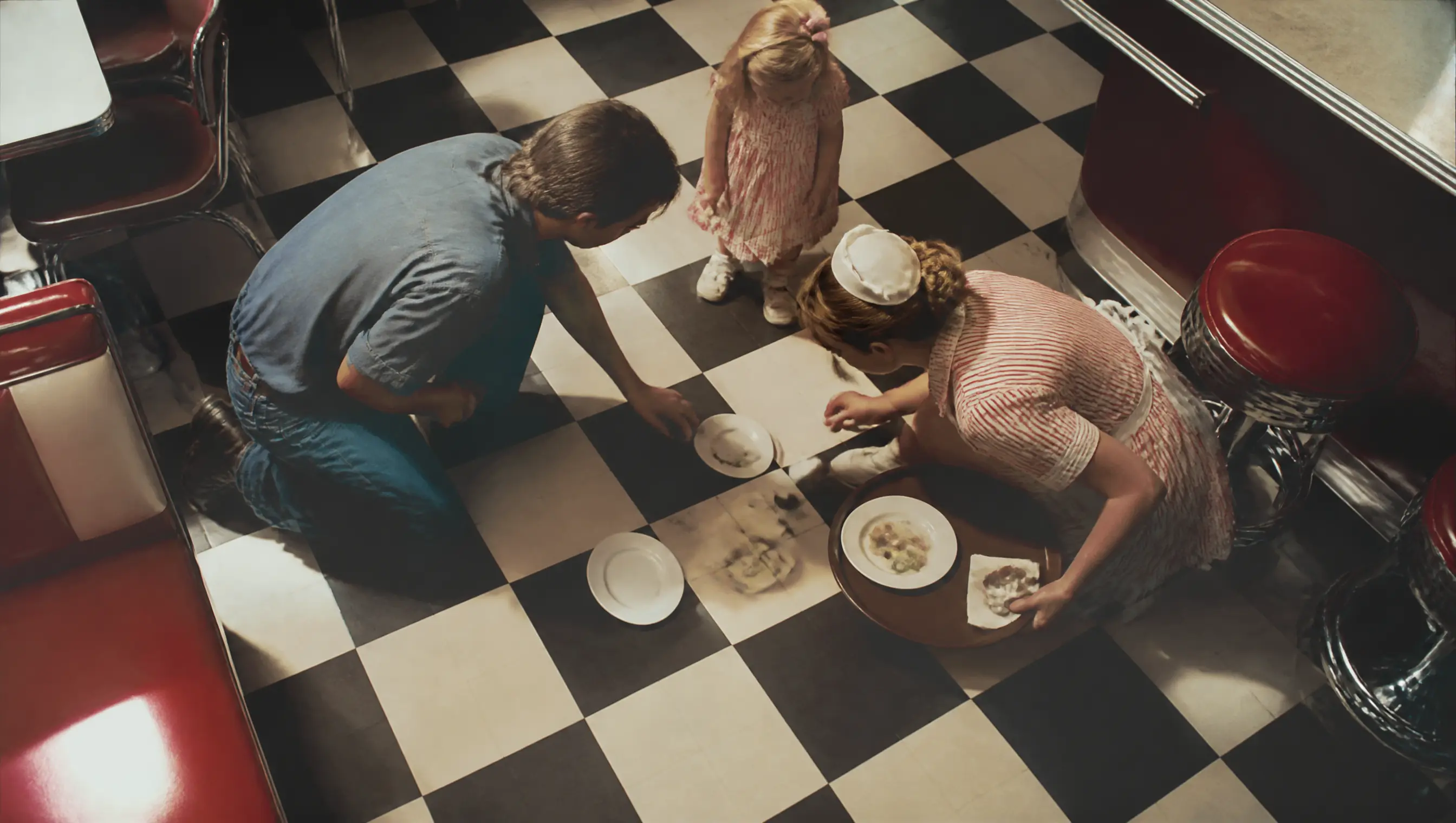
Cass Ruska had worked there for six years. She knew the place the way you know the inside of your own mouth. She knew that the third stool from the register wobbled and that old Mr. Fenstermaker would sit on it anyway, every morning, because he said it kept him awake. She knew the coffee urn ran hot on the left spigot and lukewarm on the right. She knew that the floor tile by the kitchen pass-through was cracked in the shape of Florida, and that if you set your heel on the panhandle at the wrong angle with a full tray, you would feel it.
She knew which side of the room to stand on, too, though she would not have told anybody why.
It was a Thursday in late April, half past five, and the supper rush in Logansport was not a rush so much as a slow tide. The men from the Cable Mill came in first with their caps folded in their back pockets, and then the women from the courthouse, and then the families, the ones with small children who had to be fed before seven or there would be weeping. The jukebox was playing Huey Lewis because one of the Burkhalter boys had put in a quarter, and the cook, a broad, silent man named Al Dorrance who had been flipping burgers at the Lantern since Eisenhower, was singing along under his breath in a voice nobody but Cass had ever heard, because nobody but Cass stood close enough to the pass-through to hear it.
She was carrying four plates and two coffees on the big oval tray. Two open-faced roast beef, a patty melt, a chef salad with the dressing on the side, and the coffees, one black and one with so much cream it was practically a milkshake. She had the tray on her right shoulder, the way her mother had taught her when she was fifteen and working the counter at the Greyhound depot in Peru, Indiana: weight over the bone, not the muscle, and let your hips do the steering.
Behind her, the new busboy came through the swinging door with a full gray tub of dishes.
His name was Kenny Vogt and he was sixteen and he had been told, his first day, to say "Behind you" whenever he came up on somebody carrying a tray. He said it. He said it clearly, he would insist later, almost crying, and Al Dorrance would back him up, and Cass would tell them both that she believed him, because she did.
He said it on her left side.
She stepped back to let a little boy in a Cubs cap go by, and her shoulder met the corner of the gray tub, and the tray went up and over in a slow, almost thoughtful arc, the way things do when you are watching them leave you. The roast beef went first. The chef salad came apart in the air like a firework. The cream coffee hit the floor and sent a pale fan across the black-and-white tile, right across the state of Florida, and the cup did not break but rolled, which was somehow worse, rolling and rolling under the booths in a loud, patient circle until it hit somebody's shoe and stopped.
The whole room went quiet. Huey Lewis did not. Huey Lewis went right on.
Cass stood in the middle of it with her hands still up where the tray had been. Gravy on her shoes. A piece of iceberg lettuce on the front of her apron, stuck there like a corsage.
"Oh," she said. "Well."
And then she was on her knees, because that is what you do. You do not stand there. You do not let them look at you. You get down and you start picking up, plate by plate, and you smile, and you say "No harm, no harm" to the table that has just lost its supper, and you do not let anyone see your hands shaking.
Her hands were shaking.