The Gulfstream came in too fast over Denver Centennial. Gear half locked. Hydraulic warning screaming through the tower frequency. $6 million of aircraft. Two pilots 90 seconds to impact.
On the tarmac below, a 38-year-old refueling tech and oil stained coveralls, set his clipboard down, walked into the old maintenance shack, and lifted an emergency handset no one else had thought to use. He spoke four short, level sentences. The jet landed safely. The hangar went absolutely silent and the woman on the observation deck who had closed a folder on him 6 months earlier turned slowly to look at him. The town of Highlands Ranch sat 30 minutes south of downtown Denver, a stretch of stucco subdivisions and brown grassy yards where most fathers wore polo shirts to work.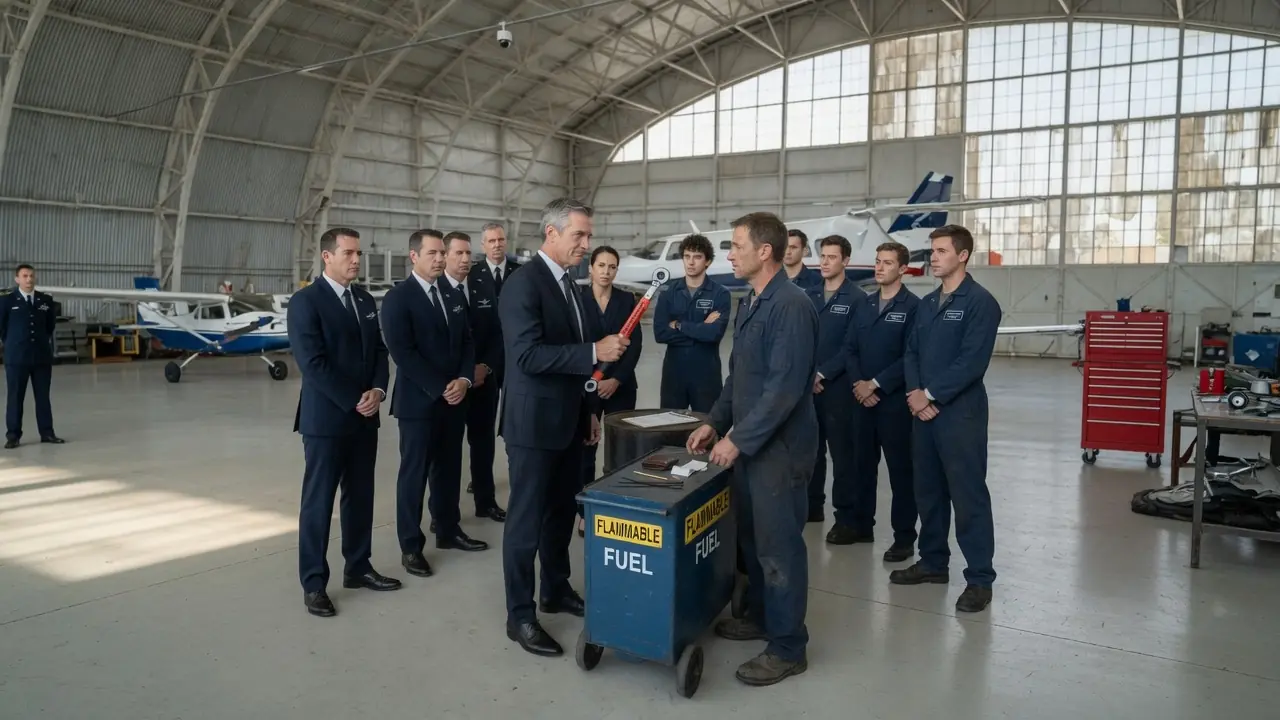
Declan Ror wore navy coveralls and steel-toe boots and most mornings he was up before the sun. His house was small, two bedrooms, a kitchen that still smelled faintly of his late wife's lavender soap, even 3 years after the bottle had run dry. He moved through it quietly. He had learned to live quietly. The coffee maker hissed.
The hallway nightlight flickered. In the back bedroom, a small boy slept curled around a model airplane the size of a paperback book. Sawyer Ror was 8 years old. He had his mother's hair sandy and stubborn and his father's habit of going very still when he was thinking. Declan sat on the edge of the bed for a long moment before he touched his son's shoulder.
The boy opened his eyes the way Declan had taught him to wake up. Calm. No panic. The way pilots are taught. "Time for school, buddy."
"Five more minutes." "You said that yesterday." "Yesterday was Tuesday." Declan almost smiled. He carried the boy to the kitchen and set him on the counter while he poured cereal.
They ate together without speaking, which was their way. Sawyer drew an airplane on a napkin with a crayon and slid it across the table. Declan studied it the way another man might study a tax return. "You forgot the backup wing," he said. "Planes don't have backup wings.
Good planes do." The boy thought about that for a long time and then nodded and ate his cereal. By 6:45, Declan was on the road in a Ford F-150 that had crossed 200,000 mi and refused to die. Sawyer rode in the back, his backpack on the seat beside him, his small face turned toward the window. In the bed of the truck, under a folded tarp, sat a locked cedar box Declan had not opened in seven years.
Inside, wrapped in soft cloth, was a naval aviator badge, a folded flight suit patch, and a photograph he did not need to look at to see. He dropped Sawyer at Cherry Hills Elementary at 7:20. The boy stopped at the curb and turned back. Mrs. Holloway said, "I have to draw what my dad does for show and tell."
Declan paused with his hand on the steering wheel. "Draw whatever you want. I want to draw the real thing, then draw it." Sawyer nodded once and ran inside. By 7:40, Declan was at Denver Centennial Airport.
Signing into the ground crew log under the fluorescent lights of Hangar B. He fueled three small jets before 9, he checked tire pressure on a Cessna Citation. He helped a mechanic named Pete drag a tool cart out of the rain. None of the men who passed him called him by his first name. They called him Ror, or hey, or sometimes nothing at all.
He preferred nothing at all. In the afternoon, while he ate a turkey sandwich on the back of his truck, the executive jet of Vance Aerodynamics taxied past. He watched it move without expression. He had been watching it for 6 months, 20 miles north in a glass tower on 17th Street in downtown Denver. Adrienne Vance was running her ninth meeting of the morning.
She was 34 years old. Blonde hair pulled back tight enough to look severe, and she had inherited Vance Aerodynamics from her father. two years and three weeks ago. She did not let anyone forget either number. The boardroom around her held 12 men, most of them older than her by at least a decade, all of them watching her hands. The Pentagon flight demonstration is in 10 days, she said.
Vance 7 is integrated. The Gulfstream is prepped. Lockheed will have two observers on the deck. The contract is $400 million over 6 years. We do not have room for a single error.
A man halfway down the table cleared his throat. And if the demo slips, it does not slip. The silence that followed was the kind her father used to leave in rooms on purpose. She had inherited that too. To her right at Marshall Crane, her chief operating officer, 45 and silver at the temples, the only executive who had stayed on after her father died.
He had been at the company for 17 years. He had been at her father's funeral when she could not stop crying. He had handed her a folder the next morning that said in his careful handwriting, "Everything will be fine." She believed him then. She mostly believed him still.
When they stepped out onto the tarmac, she walked past the line of ground crew without looking at any of them. She did not see Declan Ror set down his clipboard and turn his face away. She did not know she had ever seen him before. But 6 months earlier, in a small office on the third floor of the Vance building, she had sat across from a man with calloused hands and a Navy folder labeled with his name. She had asked him about the seven-year gap in his employment history.
He had looked at her steadily and said, "I can't't talk about it." Classified? "Yes, for who? I can't talk about that either." She had closed the folder. ""Then I'm sorry, Mr.
Ror. We can't bring you on."" He had nodded once without expression and stood and walked out. She had not thought about him again. That afternoon at the hangar, Marshall pointed out the demo bird, the new diagnostic console, the upgraded fly-by-wire racks. He made her laugh twice.
He reminded her of her father in the careful way he tucked his pen back into his pocket. She did not notice the man in navy coveralls, watching her cross the floor. But Declan noticed her. He noticed the way she walked beside Marshall Crane. He noticed how she trusted him and something in his jaw said in a way that would have been familiar to the men he had once flown with.
In a life she did not know existed. 3 days before the demonstration, Marshall Crane led a delegation through hangar B. The group was small but heavy with weight. Two men from Lockheed in identical gray suits. a woman from the defense department with a badge clipped to her belt, a photographer from the company's public relations firm who had been told to capture operational confidence. Adrienne walked at the front, half a step ahead of Marshall, the way she had learned to walk in rooms full of men.
They moved past the avionics bench, past the fuel coordination office, past the row of ground crew lockers. Marshall was speaking smoothly about quality control protocols when his eyes settled on a tool cart parked beside Declan Ror's station. He stopped walking. The delegation stopped with him. On the top tray of the cart, resting in plain view, sat a torque wrench.
It was not an ordinary torque wrench. The grip was wrapped in red tape with a small white serial sticker. Anyone who worked avionics knew what that meant. Restricted issue internal systems only. not authorized for the refueling line. Marshall picked it up between two fingers as though it were diseased.
"Whose station is this?" The hanger went quiet in the slow way hangars go quiet. The way sound bleeds out one corner at a time. Declan was standing near the fuel cart 15 ft away. A clipboard in his hand, a pencil tucked behind his ear.
He set the clipboard down on a steel drum. Ror, step over here, please. Declan walked over. He did not rush. He did not hesitate.
He stopped at a respectful distance and waited. Marshall held the wrench up so the delegation could see it. "Do you know what this is?" "I do." "Do you know what it costs?"
"I do." "Do you know what happens to a man who steals from this company?" After a beat, Declan said, "I do." The woman from the defense department shifted her weight. The Lockheed men looked at their shoes.
Adrienne, standing two paces behind Marshall, did not move. Her mouth had pressed into a thin pale line. "Empty your pockets," Marshall said. Declan did slowly, methodically. Front pockets first, back pockets, the small chest pocket of his coveralls, a wallet, a folded receipt, two zip ties, a stub of a pencil, nothing else.
Marshall did not stop. "Lift the cuffs." Declan lifted the cuffs of his coveralls, then the cuffs of his sleeves. The hangar watched a young technician named Yousef Park watching from the avionics bench, opened his mouth to speak, and was met with a look from Marshall that closed it again. When there was nothing left to search, Marshall held the wrench higher. ""Then how did this end up on your cart?"" Declan looked at him for a long second.
When he spoke, his voice was even and unhurried, the way pilots speak on a radio. That wrench was placed there at 7:00 in the morning. I arrived at 7:15. The hangar B ceiling camera has a timestamp on every motion event. You're welcome to pull it.
Marshall did not pull it. He set the wrench down without another word and turned the delegation toward the fly-by-wire racks. Adrienne walked past Declan and did not look at him. She felt his presence the way a person feels weather changing in their bones. She kept walking behind her.
Declan picked up his clipboard, slid the pencil from behind his ear, and went back to work. That night, the hanger emptied out by 8. Yousef Park stayed. He was 26, 2 years out of Colorado School of Mines, and he had been hired by Vance Aerodynamics, straight into the avionics software team. He liked the work.
He did not like what he was looking at on the screen in front of him. He had been combing through the Vance 7 firmware in preparation for the demonstration, running checksums on the hydraulic management module when something snagged his eye. Line 742, the error handling function for hydraulic pressure loss. The logic had been altered. Where the original code routed a sustained pressure drop to the backup actuator within 1 second, the new version waited for 3 seconds of continuous degradation before failing over.
It also stripped out the manual override flag. It was a small change. It was the wrong change. He stared at it for a long time. There was no author tag.
No commit signature. The repository should have required both. A shadow fell across the desk. "Line 742." Yousef jerked his head up.
Declan Ror was standing behind him, a coffee in one hand, his coveralls smelling faintly of jet fuel. He was looking at the screen. The way a man looks at something he has seen before. You Yousef swallowed. "You can read this."
"I'm guessing." "You're not guessing." Declan did not answer that. He pointed at the screen with the tip of his pencil. The 3-second delay isn't a tuning choice.
It's a deliberate window. If the system holds for 3 seconds without failing over, it locks the actuator in the degraded position. The pilot doesn't get a backup. He gets a frozen control surface. Yousef felt the back of his neck go cold.
"Who would write that?" "Someone who didn't want it to look like sabotage." Declan straightened, took a sip of his coffee, and walked away. He did not look back. Yousef sat alone at the bench for a long time before he saved the file, and closed the laptop with a hand that was not quite steady.
Across town, in the back bedroom of a small house in Highlands Ranch, Sawyer Ror was finishing a drawing. He had used three colors. Gray for the airplane, blue for the sky, brown for the man standing beside it. The airplane had no backup wing. He had thought about it for two days and decided his teacher was wrong.
Some planes did not get a backup. Some planes got a person instead. He had drawn the person carefully with sandy hair like his and steady shoulders like his father's. When Declan came home, Sawyer showed him the picture without saying anything. Declan looked at it for a long moment.
Then he sat down on the floor next to his son, his back against the bed frame, and pulled the boy against his side. ""This is a good picture, buddy." "It's you." "I know. You're the backup."" Declan did not answer. He kissed the top of his son's head and closed his eyes.
That same night, in her office on 17th Street, Adrienne Vance opened her laptop. She did not know why. She told herself she was reviewing demo logistics. She typed Declan Ror's name into the internal personnel system. The interview record came up.
She read it again. 6 months of distance had not changed it. She typed his name into the federal contractor database. Access restricted. Classified.
She typed his name into a public academic search. A single paper from 2014 rose to the top. Distributed architecture for fault tolerant fly-by-wire systems. Three authors. The lead author was listed only as Dor.
She closed the laptop. She did not sleep. The morning of the demonstration arrived clear and cold. The observation deck at Denver Centennial filled in slowly. Three executives from Lockheed and dark coats.
Two observers from the Pentagon, one in uniform, one in a charcoal suit, the chief acquisitions officer for the defense department's transport division, a thin man named Halberg, who had not smiled in two decades. Adrienne stood at the rail in a dark wool blazer, hands clasped behind her back, her chin held the way her father used to hold his. Marshall stood beside her, calm hands in his pockets, watching the runway with the patient air of a man who had already won. At 9:17 in the morning, the Gulfstream G650 rolled out of hangar A, gleaming white in the early sun. The Vance technicians on the tarmac stepped back.
The two pilots, both veterans of the Vance flight test program, completed their checks over the open channel. The control tower cleared takeoff. The jet lifted off cleanly. For the first 8 minutes, the demonstration went exactly as rehearsed. The pilots ran a sequence of standard maneuvers, climbing turns, holding patterns, controlled descents.
While the Vance 7 system streamed clean data to the screens on the observation deck, Hellberg nodded once. The Lockheed men exchanged a glance that on those men counted as enthusiasm. Adrienne let herself breathe. At minute nine, an amber light blinked on the diagnostic panel. The technician at the console paused.
Hydraulic pressure variance port side minor. Marshall did not turn. Hold the call. Normal range. At minute 10, the amber light went red.
A second alarm joined it. The lead pilot's voice came through the speaker tight at the edges. Vance ground. We are showing degraded control authority on the port elevator. Backup is not responding.
Repeat, backup is not responding. The observation deck went still. The control tower frequency cut in. Vance ground, requesting permission to initiate emergency protocol. Marshall raised one hand.
Calm. Standby. We need to confirm the failure mode before we override. Adrienne turned her head a quarter inch. Confirm what failure mode, Marshall?
It could be a sensor fault. If we trigger emergency procedure on a false read, we void the demo. The plane is degraded. Adrien, standby. She did not look at him.
She looked at the screen. The Gulfstream's nose had begun to drop. The pilots were fighting it. She could hear it in their breathing. At minute 11, the jet entered its turn back toward the field and lost 200 ft in a single second.
Hellberg stood up from his chair without sound. The uniformed Pentagon observer reached for his phone. On the tarmac, 400 yd below the observation deck. Declan Ror heard the change in the engine pitch before he heard the alarms. He set the fuel hose down on the cradle with the slow care of a man who was already moving in his head.
He walked. He did not run. He crossed the open apron toward an old gray maintenance shack at the corner of the taxiway, the one nobody used because the equipment inside was 20 years out of date. He had checked the lock on the door every Friday for 6 months without knowing exactly why. He knew now inside he flipped a breaker on a dust-covered panel.
A handset glowed pale green. The frequency it was tuned to had been a closed military test channel in the early 2000s. Repurposed when the airfield was civilianized in 2009 and forgotten by everyone who did not know it had been left active. Declan had not forgotten. Declan had been the engineer who had asked in a different lifetime that it be left active.
On the observation deck, Adrienne turned to Marshall. "Override now, Adrienne." "Now, Marshall." He did not move. She looked at his face for the first time in a long time and saw something she had never seen there.
Below her, the Gulfstream was 3 minutes from impact. Declan lifted the handset. His voice, when it came through the cockpit speakers, was not loud. It was even low, shaped by the practiced calm of a man who had once talked other men through worse than this. Gulfstream.
This is ground. Disengage autothrottle. Reset breaker C4 below the copilot's left knee. Now in the cockpit, two pilots looked at each other for half a second. The copilot reached under his seat, fingers searching the panel by feel.
A click, a small green light. The first alarm tone died. Outside on the observation deck, Adrienne went very still. The voice on the loop was not on the primary channel. It was on something else.
She did not know what frequency it was, but she knew the cadence of the words, and she knew with a small cold drop in her stomach that the procedure being called was a Vance internal bypass that fewer than five people in the company knew existed. Declan's voice came again. Bypass mode, alpha 2. Switch panel on the ceiling. Red cover left of the standby compass.
Flip it up. The pilot reached up. The red cover snapped. The switch clicked into place. Pressure will return in 12 seconds.
Don't pull the yoke. Let her settle. The copilot exhaled audibly into the open channel. The pilot kept his hands light. The Gulfstream's nose, which had been steadily dropping, leveled, hesitated, and lifted half a degree.
The amber lights on the deck console winked out. One at a time. Flaps 15, not 30. Air speed 140. Bring her in.
That was the fourth sentence. The pilot brought her in. The Gulfstream touched down 20 seconds later, rolled to the end of the runway, and stopped. The tower frequency crackled with the controller's voice, audibly shaken, confirming the safe landing. On the observation deck, nobody spoke.
The PR photographer had stopped lifting his camera some time ago. Hellberg sat down again, very slowly. Adrienne turned to Marshall. Her voice was quiet enough that only the people closest to her could hear it. Who was that on the auxiliary channel?
Marshall's mouth moved before his eyes did. I don't know. It must be an unauthorized technician. We'll find him. We'll dismiss him immediately.
She looked at him for a beat longer than was comfortable. She turned and walked toward the stairs below on the tarmac. Declan had already returned the handset to its cradle. He had closed the breaker panel. He had stepped back outside and was walking unhurried back toward his fuel cart as though nothing had happened.
Two of the younger ground crew stared at him as he passed. One of them said his name. He did not answer. Adrienne reached the bottom of the stairs and crossed the apron in a straight line. Her heels made hard, sharp sounds on the asphalt.
The wind from the runway pulled at her hair. She did not slow. She stopped 6 ft from him. Marshall arrived behind her a moment later with two airport security officers in tow. He needs to be removed.
He violated communication protocol. He could be charged. Marshall Adrienne, listen to me. Stand there. He stopped.
She did not turn around. She kept her eyes on Declan. The wind moved between them. The Gulfstream 400 yd behind him ticked as its engines cooled. She asked the question quietly.
The only question that mattered, ""Where'd you learn that?"" Declan looked at her for what felt like a long time. The corner of his mouth did something that was not a smile. "A long time ago." She held his gaze. "Bypass mode Alpha 2.
Three people in this company know about that. My father wrote it." "I know. I helped him debug it in 2015." the wind kept moving. Marshall behind her made a sound that was almost a word.
She did not turn around. Adrienne brought him to a small room at the back of the executive hangar and shut the door. It was a briefing room with a long table and a whiteboard that still had old maintenance equations on it from a decade ago. She did not sit. He did not sit.
She crossed her arms because she did not know what else to do with them. "I need a name," she said. "Not the one on your badge. The real one." Declan Ror.
That's the name on a paper from 2014. D. Ror, Distributed Architecture for fault tolerant fly-by-wire systems. The other two authors are dead and classified. "Were you Navy?"
"I was a test-pilot engineer first, a pilot second. Both." And then he was quiet for a beat. DARPA joint program. Vance was one of the industry partners.
I worked with your father for 3 years. We finished Alpha 2 in his garage in Cherry Creek in October of 2015. He made spaghetti. It was bad. Adrienne did not laugh.
Her throat had gone tight in a way she did not understand. "Why are you on my tarmac, Mr. Ror?" He looked at the whiteboard. The old equations.
He took a long breath. My wife was a test pilot. Her name was Naomi. She flew for the joint program out of Edwards. In 2018, she ran a high-altitude flight envelope test on an early version of Vance 7.
She came back and filed a report. She said the failover logic in the hydraulic module had been changed. She said it was unsafe. She filed it on a Monday. He paused.
She died on Thursday. Same module, same airframe. The official report said pilot error. The room held very still. I didn't believe the report.
He said I left the program. I spent four years trying to get someone to listen to me. I couldn't. The case was sealed. The aircraft was scrapped.
The records were classified. So, I came here to do what? To wait for what? For whoever altered that code to do it again. She felt her hand close around the back of the chair beside her.
She did not remember reaching for it. "You think it's somebody at Vance?" "I know it is." You know, he did not answer that. A soft knock at the door.
Yousef Park, white-faced, a small black drive pinched between his thumb and forefinger. He looked at Adrienne, then at Declan, then back at Adrienne. I pulled the commit history, he said. Line 7:42. The edit was made 3 weeks ago at 2:14 in the morning from internal terminal 7.
I cross-referenced badge swipes. One person entered the building at 1:52. One person left at 2:33. Same person. I have the log.
Adrienne held out her hand. Yousef placed the drive in it. "Thank you, Yousef." He nodded and left, and the door clicked shut behind him. She looked at the drive in her palm for a long second.
Then at Declan. "Marshall?", "Yes, tell me you weren't certain until just now. He did not answer that either." That evening, in a small kitchen in Highlands Ranch, an 8-year-old boy sat at the table drawing. He drew his father standing beside an airplane the way he had drawn it before, but this time behind his father, he drew a woman.
He did not know her face well enough to draw it clearly, so he left it soft and unfinished. Sketched with the side of the pencil, his grandmother washing dishes at the sink, looked over his shoulder, and asked who the lady was. Sawyer thought about it. "I don't know yet," he said. "But dad's not standing alone anymore."
His grandmother put a hand on his hair and did not say anything. She had been Naomi's mother. She had not heard her grandson speak about not standing alone in three quiet, careful, painful years. The emergency board meeting convened at 8 the next morning in the executive conference room on the 42nd floor of the Vance Tower. Lockheed sent a vice president and a lawyer.
The Pentagon sent Halberg and a uniformed colonel from the acquisition's office. The Vance board filled the rest of the table. 11 members in dark suits, every one of them visibly rattled. The press had not been told the full story yet. They had been told there had been an instrumentation anomaly and that the demonstration would be rescheduled.
Nobody at the table believed it. Adrienne sat at the head of the table. Marshall sat to her right, his folder open, his pen uncapped, his face composed. He had spent the night preparing. He had drafted a clean narrative.
A sensor manufacturer in Phoenix would be named as the responsible vendor. A parts replacement protocol would be announced. A public statement would be issued thanking the flight crew for their professionalism. By Friday, the story would be over. He began to speak.
Adrienne let him finish. When he was done, the room waited. She set her hands flat on the table. "Thank you, Marshall. Before we accept that explanation, I'd like to bring someone into the room."
The door opened. Declan walked in. He was still in coveralls. He had not changed. Marshall's pen stopped moving.
"This is unacceptable," Marshall said, half rising. This man is a ground crew technician. He has no clearance to be in this meeting. He is the person who illegally accessed the auxiliary channel yesterday. He should be in a hearing room, not at this table.
"Sit down, Marshall." He sat down. Declan did not look at him. He set a laptop on the table, plugged in the drive Yousef had given him, and brought up the code on the large screen at the end of the room. Line 742 of the Vance 7 hydraulic module appeared in white text on a black field.
Beside it, a second window showed the original version from before the alteration. He spoke without raising his voice. The change to this function is not a sensor fault. It is a deliberate modification of the failover logic. It was committed 3 weeks ago at 2:14 in the morning from an internal terminal inside this building.
The badge swipe logs confirm one person entered the building before the commit and one person left after it. The same person Halberg's face had gone the color of paper. Declan continued, "The modification ensures that under sustained hydraulic pressure loss, the system does not transfer authority to the backup actuator. It locks the control surface in its degraded state. That is what happened yesterday.
That is also what happened to the aircraft my wife was flying in February of 2018. A long silence opened in the room. Declan looked up from the laptop for the first time. He looked directly at Marshall Crane. His voice did not change.
That wasn't a fault. That was a signature. And whoever wrote it knew exactly where to hide it because they learned from the same man I did. The room did not move. The colonel from the Pentagon set his pen down on his pad and did not pick it up again.
The Lockheed lawyer slowly closed her notebook. Halberg's hand had come up to cover his mouth. Marshall Crane laughed. It was a thin sound. It did not reach his eyes.
This is absurd. A refueling tech with a flash drive and a grudge. Adrien, please. Whatever he is selling you, do not buy it. He has motive.
His wife died in a military aircraft. He has spent years looking for someone to blame. He has finally picked us. The badge logs are easily falsified. The code can be edited from any terminal.
Marshall Adrienne this is "I said sit down." He had not stood up but he sat down further. He did not raise her voice. You have been with this company for 17 years. You were with my father the week he died.
I owe you the dignity of one question. In front of these witnesses. "Where were you on the night of October 23 between 1:52 and 2:33 in the morning?" He opened his mouth. He closed it.
In the silence that followed, the colonel from the Pentagon picked up his phone. By that afternoon, the colonel's phone call had become a sealed federal investigation. Two agents from the FBI's Denver field office, working in cooperation with the Defense Criminal Investigative Service, arrived at the Vance Tower at 4:15 in the afternoon. They went directly to the secure server room on the 38th floor and copied the relevant logs under a warrant signed by a federal magistrate 90 minutes earlier. By 6:00 in the evening, they had what they needed.
By 8, they had more than they needed. The badge logs were not the only thing that had been recorded. Marshall Crane's workstation had a hardware-level access record that he had not known about. Installed by a security audit firm 2 years earlier on the recommendation of the chief technology officer. It was buried in the system.
It was unedited. It showed not only the commit on line 742, but a long trail of other activities reaching back across four years. Encrypted communications with a defense brokerage firm registered overseas. Wire transfers routed through three intermediary accounts. a folder deeply nested in the company's classified archive that contained the unredacted internal flight test reports from the joint Navy Vance program in 2018, including the report Naomi Ror had filed 2 days before her death. The report Marshall had personally accessed 72 hours before she was killed.
Adrienne sat alone in her office that night with the printed log in front of her. The desk lamp was the only light. She read the entries three times. She had grown up in this building. She had played on the floor of her father's office while he and Marshall Crane laughed at something on a whiteboard.
She had thrown rice at Marshall's daughter's wedding. She had cried on Marshall's shoulder at her father's funeral. She read the entries a fourth time. She did not cry. She picked up her phone and asked her assistant to call Declan Ror.
He came up at 9:40 in the evening. She had cleared the office. She had opened a bottle of bourbon she did not drink. She poured him a glass. She poured herself a glass.
Neither of them touched them. he said a photograph on her desk. 2016. A hanger in Palmdale, California. Three people standing in front of a chalkboard covered in equations. Her father in the center grinning.
A young woman to his left with sandy hair and a flight suit laughing at something. Declan on the right, younger, his hair a little longer, his eyes the same. Adrienne looked at the photograph for a long time. He was her instructor, Declan said quietly. Naomi flew with him for 2 years.
He's the reason she trusted Vance. He's the reason I did. And Marshall. Marshall was already there. He was already selling pieces of the program by then.
We didn't know. Your father didn't know. He died still not knowing. Her hand came up to her mouth and stayed there. Why did you take a job on my tarmac, Mr.
Ror? Because nobody guards their back from a man holding a fuel hose. She looked up at him. And because my son needed me close to home in a job I could leave at 5:00 with a normal life he could remember when he is older, I made a choice. I took the slow road.
I waited. The next morning at 7, FBI agents arrived at the Vance Tower with a warrant for Marshall Crane's arrest. They walked him out of his office without handcuffs as a courtesy because the company's attorneys had negotiated it that way. He did not resist. His face was the color of old paper.
He had not slept. In the hallway near the elevators, Declan was standing in a quiet corner talking to Yousef Park about something unrelated. Marshall stopped when he saw him. The agents waited. "Who are you?"
Declan looked at him without anger. "I'm her husband." Marshall stared at him. Then he stepped into the elevator. The doors closed.
He did not look back. Two weeks passed. The Pentagon contract was paused, then renegotiated, then signed under new terms. Vance Aerodynamics agreed to a permanent independent audit of all flight-critical software with the auditor selected jointly by the company and the defense department. The provision had been written by a consultant whose name did not appear in the public filings.
Adrienne had insisted on that. She had also insisted on a redesigned failover protocol that returned the manual override flag to the hydraulic module. The colonel from the Pentagon had read the new specification and said very quietly, ""This is good work. This is the work we should have had in 2018."" The press wrote about a brilliant anonymous engineer who had saved the company. They never learned his name.
Adrienne offered him a position as chief systems architect, a corner office, a salary that would have ended his money worries forever. Declan thanked her and turned it down. "I don't want an office," he said. "I want time with my son, then advise me." 2 days a week, your terms, your hours.
He thought about it for a long moment. He said, "Yes." On a Saturday in early November, Adrienne Vance drove out to a small house in Highlands Ranch she had never seen before. She did not wear work clothes. She did not bring her assistant.
She brought a box of art supplies that the man at the store had said were good for an 8-year-old who liked to draw airplanes. Sawyer Ror opened the door. He stood looking up at her for a long second. Then he turned and ran into the back of the house and came back with a sketchbook. He flipped it open to a page near the front.
He held it up. It was the drawing he had made on a quiet evening a week earlier. His father standing beside an airplane. A woman behind him, sketched soft and unfinished, her face left blank. He looked at Adrienne.
"You look like her." She did not know what to say to that. Declan came to the kitchen doorway, a dish towel in one hand. He looked at his son. He looked at her.
He did not say anything either. They ate sandwiches on the back porch as the sun went down. Sawyer asked her if she could fly. She told him she could not. He told her his father could teach her.
He told her his father had taught his mother. He said it the way a child says facts about the world. Without pain, just true. In a corner of the living room on a small shelf, there was a framed photograph. a woman with sandy hair laughing, a flight helmet under one arm. Adrienne saw it through the window.
She looked at Declan. Declan looked back. Neither of them spoke. Late in the afternoon, the three of them walked out to a small public viewing area near the south fence of Denver Centennial Airport. A Gulfstream was running its evening departure check on the far runway.
The light was gold. The wind smelled like cold metal and pine. Sawyer took his father's hand. Declan let him. Adrienne stood half a step behind them, close enough to belong, far enough to give them room.
She did not move forward. She did not move away. Neither of them had been looking for this. Neither of them had chosen any of this. But the man who had been underestimated for 7 years was no longer standing alone. And the woman who had once closed a folder on him was the one who had finally opened it back up. The Gulfstream lifted into the orange light. The three of them watched it