The red-and-blue lights appeared in my rearview mirror before I had even reached forty miles an hour.
I glanced at the speedometer.
Thirty-five.
Exactly thirty-five in a thirty-five-mile-per-hour zone.
The road into Willow Grove, Alabama, was narrow and sun-baked, bordered by pine trees, low brick houses, and drainage ditches browned by late-August heat. Nothing about the afternoon suggested trouble. The sky was painfully blue. A church sign advertised Wednesday-night supper. A boy was pushing a lawn mower across a yard three houses ahead.
Beside me, my wife barely moved.
Sloan looked at the patrol car in the passenger-side mirror.
“Did you miss a stop sign?”
“No.”
“Speed?”
“Thirty-five.”
“Headlight?”
“Daytime.”
The siren gave one short, impatient squawk.
I eased the Range Rover onto the gravel shoulder, lowered the windows slightly, put the transmission into park, and placed both hands high on the steering wheel.
My name is Knox Thorne.
At the time, I was fifty years old and served as a Special Agent in Charge with the FBI. My wife, Sloan Thorne, was a senior career prosecutor in the Department of Justice’s Civil Rights Division.
Neither fact mattered yet.
That would become important later.
We were not in Willow Grove on an operation.
We were not conducting a secret test.
We were not looking for corrupt police officers.
We were on our way to visit Sloan’s aunt outside Montgomery before spending the weekend with friends near Lake Martin.
The Range Rover belonged to us.
The registration was current.
My driver’s license was valid.
And the department-issued SIG Sauer secured beneath my seat was there because I was a federal law-enforcement officer authorized to carry it.
Nothing about that afternoon was supposed to become a federal matter.
Then Officer Holt Whitaker stepped out of his cruiser.
He was perhaps forty-three, thick through the shoulders, with sunglasses hiding his eyes and one hand resting near his holster before he had even reached my rear door.
He stopped beside the driver’s window.
“License and registration.”
“Good afternoon, officer.”
I kept both hands visible.
“May I ask why you stopped me?”
His mouth tightened.
“Obstructed view.”
He pointed through the windshield.
A small air freshener hung beneath the rearview mirror.
I looked at it.
Then at him.
“What exactly is obstructed?”
“Don’t start.”
“I’m asking the reason for the stop.”
“I gave you the reason.”
Sloan leaned slightly toward the center console but kept her hands where Whitaker could see them.
“Officer, are you saying the air freshener materially obstructed the driver’s view?”
Whitaker looked at her for the first time.
That changed the atmosphere.
He had not expected a question from the passenger.
“Ma’am, this doesn’t concern you.”
“I’m sitting in the vehicle.”
“Then sit quietly.”
Sloan looked at me.
I knew that look.
It meant she had already begun memorizing.
I handed Whitaker my driver’s license and registration.
He studied the license.
Then me.
Then the car.
“Whose vehicle?”
“Mine.”
He looked at the registration again.
The names matched.
Still he did not step away.
“Where you coming from?”
“Atlanta.”
“Where you headed?”
“Montgomery.”
“What for?”
“Personal travel.”
His lips moved slightly.
Not a smile.
Something more suspicious.
“Step out.”
I remained still.
“Am I being cited for the air freshener?”
“I said step out.”
“Is there another reason you need me outside the vehicle?”
Whitaker took his hand off his holster.
Only to point at me.
“Sir, I am giving you a lawful order. If you make me repeat myself, this is going to go differently.”
Sloan said, “Knox.”
Not because she believed Whitaker was right.
Because she knew escalation had begun.
I opened the door slowly.
“My hands are visible.”
Whitaker stepped backward.
“Turn around.”
I looked at him.
“For what?”
“Turn around and put your hands on the hood.”
“Are you conducting a pat-down?”
“You always ask this many questions?”
“When somebody asks me to put my hands on my own vehicle, yes.”
His jaw tightened.
“Hands on the hood.”
I complied.
The metal was hot enough that I could feel it through my palms.
Whitaker began patting me down.
Not a careful Terry frisk based on an articulated concern that I was armed and dangerous.
He went directly for pockets.
Wallet.
Keys.
Phone.
He removed all three.
Then his hand moved toward my waistband.
“Any weapons?”
“Yes.”
For the first time, his body changed.
“Where?”
“There is a secured firearm inside the vehicle.”
He stepped backward quickly.
“You got a gun in there?”
“Yes.”
“Where?”
I looked over my shoulder.
“I’m not consenting to a search.”
That sentence infuriated him.
“You think I asked for permission?”
“I’m telling you clearly that I do not consent.”
Sloan spoke from the passenger seat.
“Officer Whitaker, our identities are verified. If you believe you have probable cause to search this vehicle, please state the basis.”
Whitaker turned toward her.
“Get out.”
She did not move immediately.
“What is the basis?”
“Out!”
His hand went to his pistol.
Sloan slowly unbuckled.
“All right.”
She stepped out with her hands visible.
Whitaker pointed toward the shoulder.
“Stand over there.”
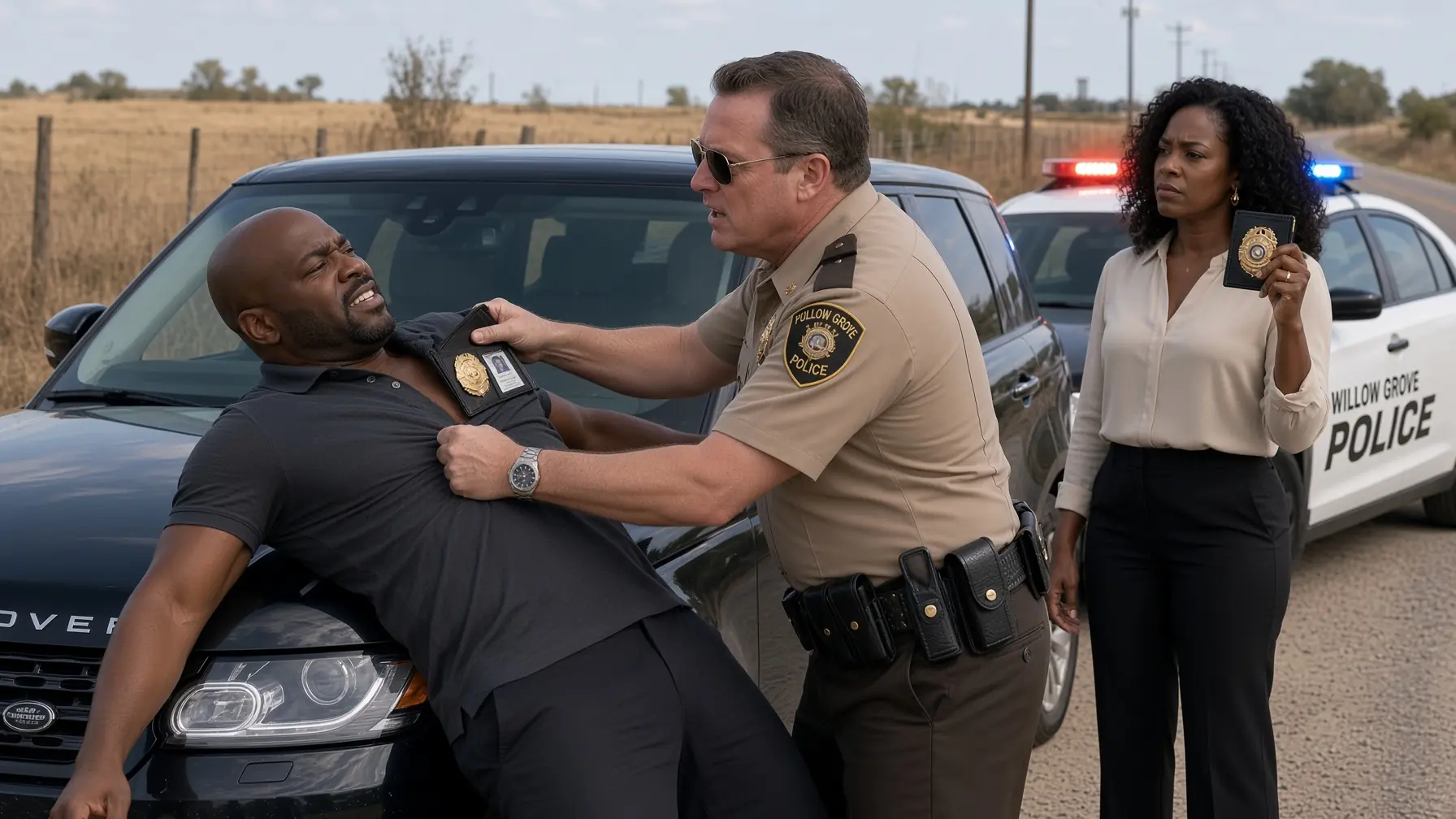
Then, without asking anything further, he opened my driver’s door.
I straightened.
“Officer, I do not consent to that search.”
He shoved me forward.
My chest struck the side of the hood.
“Stay where I put you.”
“You do not have consent.”
“Shut up.”
His upper body disappeared into the vehicle.
He opened the center console.
Glove compartment.
Door pocket.
Then reached beneath the seat.
My stomach tightened.
I already knew what he would find.
Within seconds he came up holding the SIG Sauer.
His eyes widened.
Not with fear.
With triumph.
“Gun!”
He shouted the word like he had discovered an explosive device.
He keyed his shoulder radio.
“Unit Twelve, armed subject! Send me another car.”
I turned my head.
“That weapon is lawfully possessed.”
“Don’t move!”
“It is department-issued.”
“Sure it is.”
“It has a serial number. You can verify it.”
Whitaker grabbed my wrist.
Then the other.
I felt one arm pulled too high behind my back.
“Officer—”
He slammed me harder against the hood.
My cheek hit metal.
Heat burned against the side of my face.
Sloan took one instinctive step toward us.
“Take your hands off him!”
Whitaker drew his sidearm.
“Back up!”
She stopped immediately.
Her hands rose.
“I am not approaching you.”
“Get on your knees.”
“No.”
His gun moved toward her.
“Get on your knees!”
Sloan’s voice became colder.
“I am standing still with my hands visible. There is no reason to put me on the ground.”
Whitaker stared at her.
“You people really don’t know when to stop.”
Something inside me went still.
I knew Sloan heard it too.
She did not ask what he meant.
Not yet.
Two police cruisers arrived within ninety seconds.
Doors opened.
Three officers approached.
Two had weapons drawn.
Whitaker shouted before any of them asked a question.
“Loaded firearm under the seat. Driver tried to conceal it.”
I lifted my head.
“I told him about the weapon before he searched.”
Whitaker forced my face back down.
“Quit talking.”
One of the arriving officers was younger, maybe thirty.
His name plate read DANIELS.
He looked at Sloan.
“Ma’am, are you armed?”
“Yes.”
Whitaker spun toward her.
“What?”
Sloan answered Daniels, not Whitaker.
“There is a lawfully carried firearm in my handbag.”
Whitaker laughed once.
“Jesus Christ. Both of them.”
Sloan’s face did not change.
Officer Daniels asked, “Where is the bag?”
“Front passenger floor.”
“Do you consent to me retrieving the weapon?”
“No.”
Daniels paused.
That pause mattered.
He looked toward Whitaker.
“Do we have PC?”
Whitaker snapped, “I already found one gun.”
“That doesn’t answer me.”
Whitaker’s expression changed.
“He was evasive.”
Daniels looked toward me.
I was face-down against the hood with both arms behind me.
“What’d he do before the stop?”
“Obstructed windshield.”
Daniels glanced through the Range Rover.
At the tiny air freshener.
Then back at Whitaker.
“You searched for that?”
Whitaker’s jaw flexed.
“I had officer-safety concerns.”
I said, “He searched after I expressly refused consent.”
Whitaker twisted my wrist.
Pain shot up my arm.
“Last warning.”
That was when the third arriving officer spoke.
“Enough.”
He was older.
Sergeant’s stripes.
Name plate: MARCUS BELL.
Bell moved closer.
“Holt, cuff him if you believe he’s under arrest. Otherwise stop bending his arm.”