The wind came down off the ridge first, then the rain, and by the time the wagon rolled into Briar Hollow, the road had turned to a river of black mud that sucked at the wheels with every turn. Marguerite Vance sat with her spine straight and her gloved hands folded over a carpet bag that held everything she owned, watching lantern light bleed yellow through the dusk from windows she did not yet know. She had been three weeks on the trail from Ohio, and the cold had settled so deep into her bones that she had stopped noticing it the way a person stops noticing an old ache. The driver, a leathery man named Purdy who chewed tobacco and rarely spoke, finally broke the silence as they crested the last hill before the Echo Ridge spread.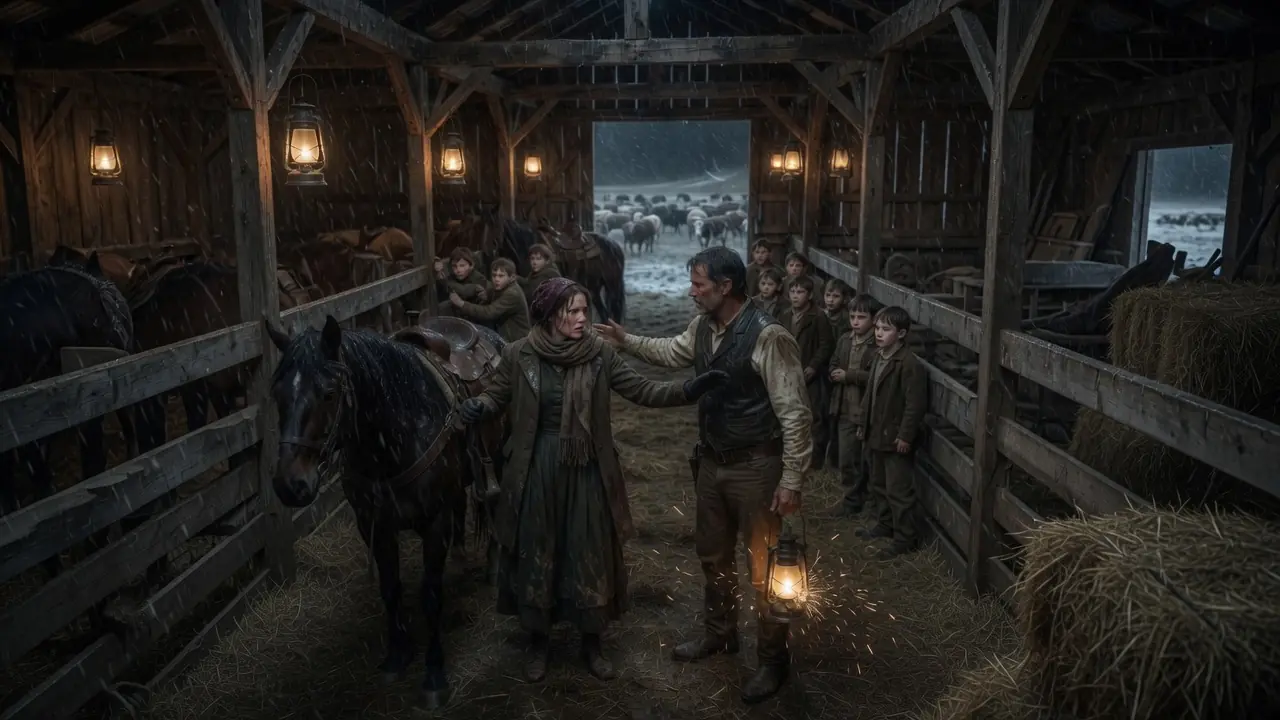
“Last chance to turn back, ma’am,” he said, not unkindly. “The Ashworth boys have run off two housekeepers and a schoolteacher this year alone. Folks in town say that ranch eats women whole.” “I am not afraid of boys,” Marguerite said, though her voice came out thinner than she intended. Purdy only grunted and snapped the reins.
The ranch house rose out of the storm like something carved from the mountain itself, long and low, smoke twisting sideways from the chimney before the wind tore it apart. Even before the wagon stopped, she could hear them: boys, plural, a chorus of shouting that did not sound like play so much as war. A dog barked, something crashed, and a boy’s voice, cracking with the particular fury of adolescence, shouted that it was not his turn to feed the hogs and never would be again as long as he lived. She climbed down before Purdy could offer his hand, her boots sinking into the mud, and stood looking up at the porch where a man had just appeared in the doorway with a lantern raised against the dark.
He was tall in the way that made doorframes look smaller, with shoulders that had clearly spent a lifetime hauling fence posts and hay bales, and a face weathered into permanent watchfulness. His eyes found her and held there, unreadable, the way a man might study weather he did not trust. “You’re the one from the agency,” he said, and it was not a question. “Marguerite Vance,” she replied, without extending her hand, sensing somehow that he would not take it.
“I was told there was a position.” “There was—still might be, depending.” He stepped back from the door, and the lamplight caught the gray threading early through his dark hair and the small crease between his brows that looked permanent. “Name’s Caleb Ashworth. You’ll want to come in before you catch your death.”
The youngest, perhaps five, peered out from behind his father’s leg with wide eyes and a thumb hovering near his mouth before he caught himself and dropped it, embarrassed. “Boys,” Caleb said, “this is Mrs. Vance.” “She won’t last,” Tobias said flatly, then turned and walked out of the room. Marguerite looked at the milk spreading toward her boots and at the five remaining boys watching her with the weariness of creatures who had learned that adults who arrived with suitcases tended to leave with them not long after.
She set her carpet bag down on the one dry patch of floor she could find. “Well,” she said, “someone had better find me a rag before this reaches the hearth.” It was not affection that moved Eli, age fourteen, to fetch one; it was, she would later understand, simple curiosity. She had not yelled, had not wept, and had not looked at his father with the silent appeal for help that the others had worn down to nothing.
She knelt right there in her traveling dress and mopped the milk herself, and the boys watched her do it the way they might watch the weather change. The first weeks tested her in ways the agency in Cheyenne had not prepared her for. Someone put a garter snake in the flour bin. Someone, she suspected the twins, who shared a single unreadable look between them like a private language, greased the porch steps so that she went down hard on her hip, though she said nothing of the bruise to anyone.
Sawyer, twelve, refused to speak to her at all for the better part of a month, communicating only through pointed silences and the occasional slammed door. She did not punish and did not plead; she simply kept rising before dawn to start the stove, kept mending the boys’ shirts with neat, even stitches long after they had gone to bed, and kept setting six places at the table even on nights when only five boys appeared to eat. Caleb watched all of it from a careful distance, the way a man watches a fence line he expects to fail. He had buried his wife four winters earlier after a fever took her in the space of nine terrible days.
In the time since, he had built a particular kind of armor, not unkind, never unkind, but guarded in the manner of a door that had been slammed shut once too hard to ever swing freely again. He spoke to Marguerite only of practical matters. The wood needed splitting, the well water had turned brackish after the last rain, and Wyatt’s boots were nearly through at the soles. “You don’t have to manage them alone,” he told her one evening, the only time in those first weeks he lingered in the kitchen after supper instead of retreating to the barn.
“Tobias is hard. He took his mother’s passing harder than the rest. I don’t expect you to fix that.” “I don’t intend to fix him,” Marguerite said, not looking up from the shirt in her lap. “I intend to outlast him.”
Something that might have been the beginning of a smile crossed Caleb’s face before he caught it and went still again, as though smiling were a debt he was not sure he could afford to pay. It was Wyatt who came to her first, in the quiet way the youngest often do. He took to following her through her chores, small and solemn, handing her clothespins at the wash line and naming the chickens after generals he had heard about from Tobias. One evening, after a nightmare sent him stumbling from his bed, it was Marguerite’s door he knocked on rather than his father’s.
She sat with him by lamplight until his breathing evened, humming something low and wordless that she remembered her own mother humming decades and a continent away. The twins came around through mischief turned into mutual conspiracy. She caught them trying to teach a barn cat to fetch and, instead of scolding them, knelt down and showed them how she had once trained a dog back home. Before long, the three of them were laughing in the hayloft while the cat sat utterly unmoved by all their efforts.
Sawyer’s silence broke the day she noticed, without him saying a word, that he had been quietly teaching himself to read from an old almanac because he was ashamed to ask. She began leaving easier books on his pillow without comment, never once mentioning what she knew. Eli warmed steadily, helping her haul water and teaching her the names of the mountains visible from the eastern pasture. Only Tobias remained a held breath, watching her with his arms crossed and his jaw set, waiting, she understood, for the moment she would prove herself just like the others: temporary, removable, gone.
Autumn deepened into the kind of cold that turned breath to fog and frosted the windows by morning. Caleb grew quieter as the season changed, with the particular silence of a man counting his herd against the coming winter and finding the numbers tight. Marguerite learned to read the weather in his shoulders before he said a word about it. She began stretching the stores further than they were meant to go without being asked and without making it a matter of conversation.
Fewer eggs cracked into the morning batter, broth was made to last two meals instead of one, and somehow the boys never went hungry while Caleb never had to say the words that would have cost him something to speak aloud. The storm came in November, faster than the sky had promised. It started as rain and turned to ice within an hour, and by the time Caleb realized the cattle in the north pasture had not been moved to shelter, the temperature had dropped hard enough to kill a man caught outside in shirtsleeves. Tobias and Eli were already saddling horses before he had finished pulling on his coat.
“I’m coming,” Marguerite said, already wrapping a scarf twice around her throat. “You’ll freeze,” Caleb said. “So will you, standing here arguing about it.” He looked at her for one long moment in the lamplight of the barn, rain hammering the roof above them, and something in his face shifted.
It was not surrender exactly, but a kind of recognition, as though he were seeing the shape of her for the first time and finding it sturdier than he had allowed himself to believe. “Stay close to me,” he said, and it was not a command so much as something gentler than that. They drove the herd through sheeting ice for nearly three hours, Marguerite’s hands gone numb on the reins and her skirts frozen stiff against her legs, while she shouted directions to the boys over the wind the way she imagined a captain might shout to a crew in a storm at sea. When the last steer was finally pushed into the shelter of the lower barn and the gate dropped shut behind it, she found herself standing in the sudden quiet beside Caleb, both of them soaked through and shaking with cold and something that was not only cold.
“You didn’t have to do that,” he said quietly. “Neither did you,” she answered. “And yet.” He huffed something that was almost a laugh, rare and rough, and for a moment, in the lantern light with ice melting from his lashes, he looked younger than she had ever seen him.
He was no longer the careful, guarded rancher who measured every word, but simply a man grateful not to be standing alone in the cold. It was Tobias who found them there. He had hung back from the others, ostensibly checking the gate latch, and now stood in the barn doorway watching his father look at Marguerite the way he had not looked at anyone in four years. Something in the boy’s face cracked open, not anger this time, but a grief so old it had calcified into something else entirely, something almost like relief.
“She stayed,” he said to no one in particular, the words barely audible over the wind. “She actually stayed.” Marguerite turned toward him. “I told you I would outlast you,” she said gently.
Tobias studied her for a long moment, rain dripping from his hat brim, and then, for the first time since she had arrived, he nodded. It was not in defeat, but in something that looked very much like welcome. By the time the storm broke, just before dawn, the sky had cleared to a hard, clean blue, and frost lay sparkling over the whole white world like something newly made. Marguerite stood on the porch wrapped in a quilt, watching her breath curl into the cold morning air, when Caleb came to stand beside her, close enough that their shoulders nearly touched.
“The boys,” he said slowly. “They’ve taken to you, all six of them, finally.” “And you?” she asked before she could stop herself. He was quiet long enough that she thought she had overstepped, but when she glanced at him, his eyes were steady on hers, with none of the old guardedness left in them.
“I think,” he said, “I stopped fighting it somewhere around the time you climbed into that ice storm after my cattle without being asked.” He reached over, hesitant, and took her cold hand in his rough, warm one. “I’m not an easy man to love, Marguerite. I’ve got six sons and a mountain of grief, and a ranch that will work you to the bone.”
“I never asked for easy,” she said. Inside, she could hear the boys stirring: Wyatt’s small voice asking where she had gone, the twins arguing good-naturedly over breakfast chores, Sawyer’s quiet laugh, Eli’s steady footsteps on the stairs, and even Tobias’s voice rising among them now, lighter than she had ever heard it. Caleb looked toward the sound of his sons, then back at her, and something settled in his face like a long winter finally giving way to spring. “Stay,” he said simply.
“Not as the housekeeper. Stay as family.” The sun broke fully over Echo Ridge then, gold spilling across the frosted pasture and catching in the ice-laden branches of the cottonwoods until the whole ranch seemed to shimmer like something out of a dream half remembered. Marguerite Vance stood on that porch with her hand in his, six boys’ voices rising warm behind the door, and understood that she had not simply found a position, nor even a family, but a home earned slowly through silence, patience, and one impossible storm. It was the way the truest things on the frontier always were.